A presentation on
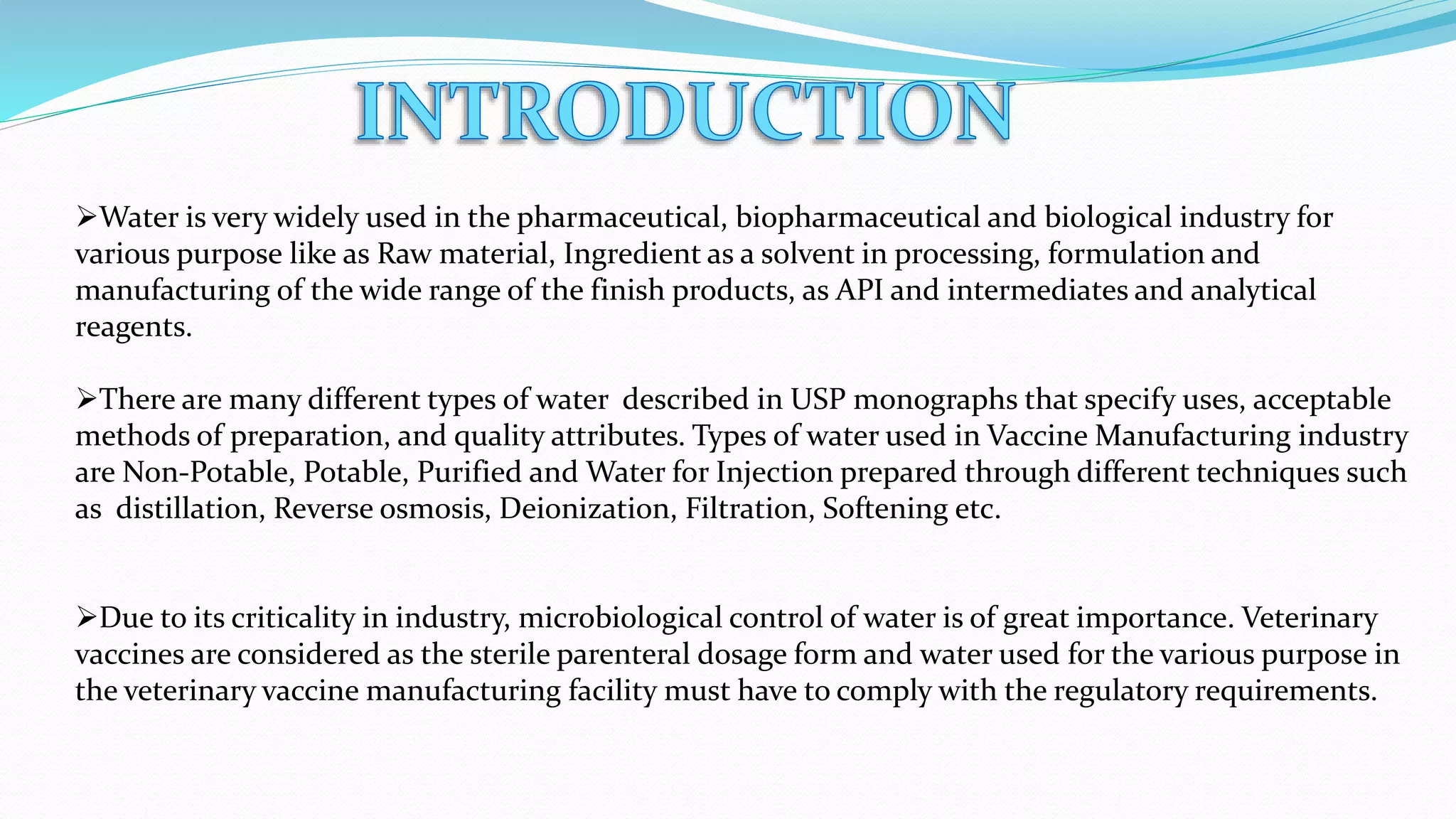
MICROBIAL ANALYSIS OF WATER SYSTEM AND ENDOTOXIN
ESTIMATION FOR VETERINARY VACCINE MANUFACTURING FACILITY
Internal Guided By:
Ms. ROSHANI K CHAUDHARY
Assistant Professor
Department of Biotechnology
MUIS
External Guided By:
Mr. HARDIK MISTRTY
Assistant Manager
Quality Assurance
Hester Biosciences Ltd.
Presented By
Asha P Patel
M.Sc Microbiology
16064511028
 To study importance of different grades of water in veterinary vaccine
manufacturing industry.
 To study uses and preparation techniques of different grades of water
used in industry.
 To enumerate the number of bacteria present in water samples by
different methods.
Water is very widely used in the pharmaceutical, biopharmaceutical and biological industry for
various purpose like as Raw material, Ingredient as a solvent in processing, formulation and
manufacturing of the wide range of the finish products, as API and intermediates and analytical
reagents.
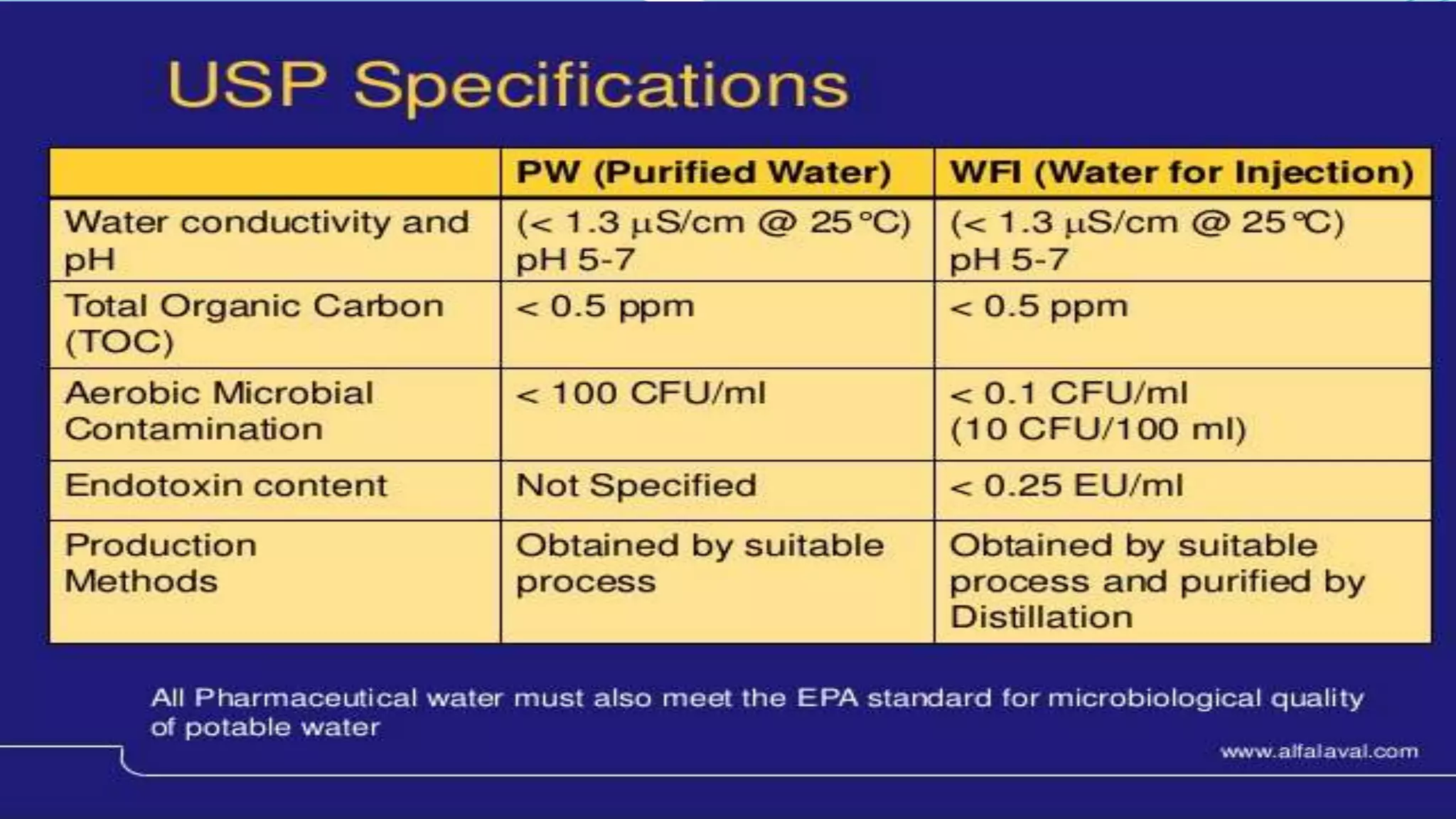
There are many different types of water described in USP monographs that specify uses, acceptable
methods of preparation, and quality attributes. Types of water used in Vaccine Manufacturing industry
are Non-Potable, Potable, Purified and Water for Injection prepared through different techniques such
as distillation, Reverse osmosis, Deionization, Filtration, Softening etc.
Due to its criticality in industry, microbiological control of water is of great importance. Veterinary
vaccines are considered as the sterile parenteral dosage form and water used for the various purpose in
the veterinary vaccine manufacturing facility must have to comply with the regulatory requirements.
Importance and Uses of Water in Pharmaceutical Industry
Different Grades of Water used in Vaccine Manufacturing Industry
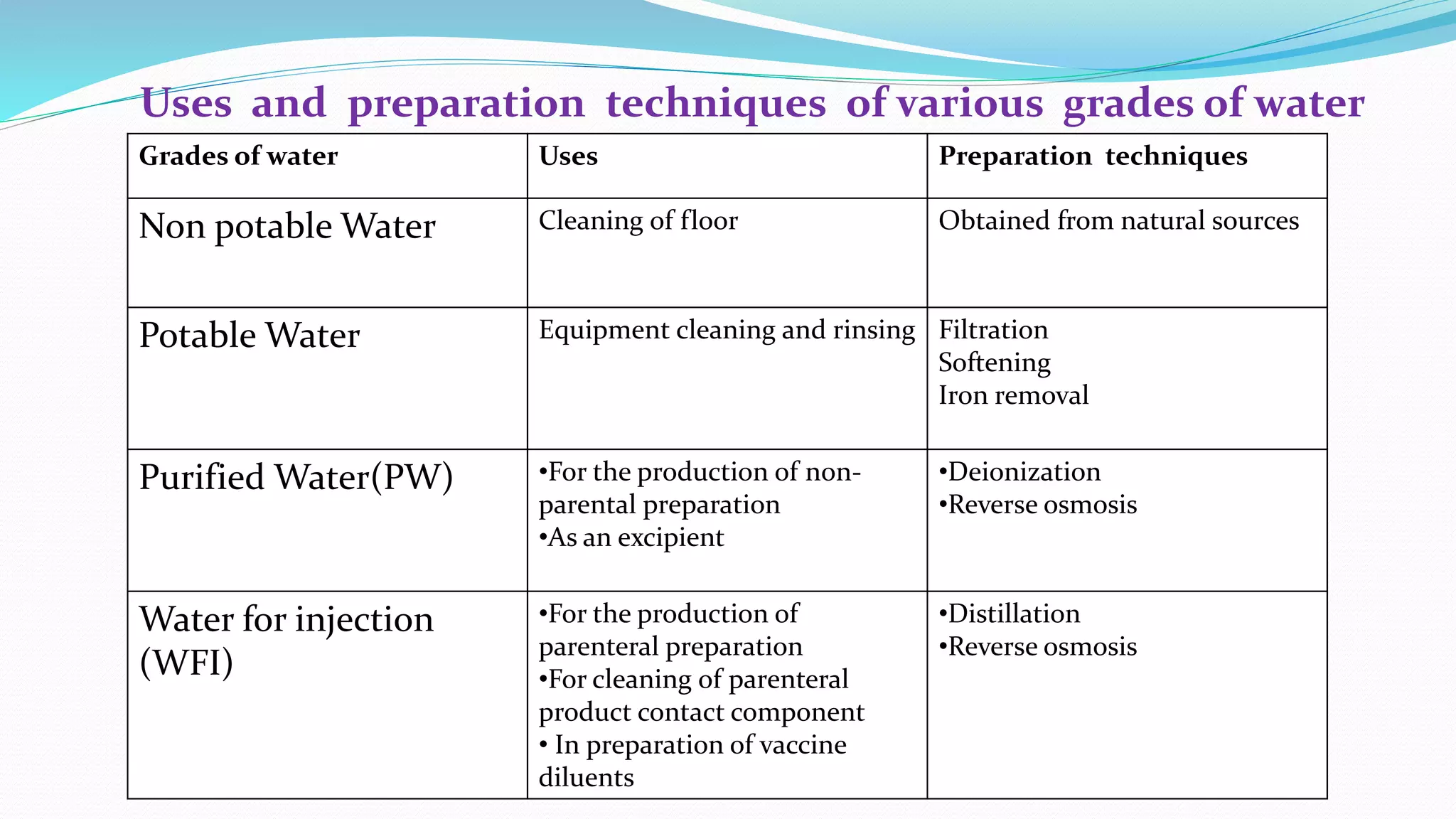
Uses and Preparation Techniques of various grades of Water
Microbiological Control of Water
Grades of water Uses Preparation techniques
Non potable Water Cleaning of floor Obtained from natural sources
Potable Water Equipment cleaning and rinsing Filtration
Softening
Iron removal
Purified Water(PW) •For the production of non-
parental preparation
•As an excipient
•Deionization
•Reverse osmosis
Water for injection
(WFI)
•For the production of
parenteral preparation
•For cleaning of parenteral
product contact component
• In preparation of vaccine
diluents
•Distillation
•Reverse osmosis
Uses and preparation techniques of various grades of water
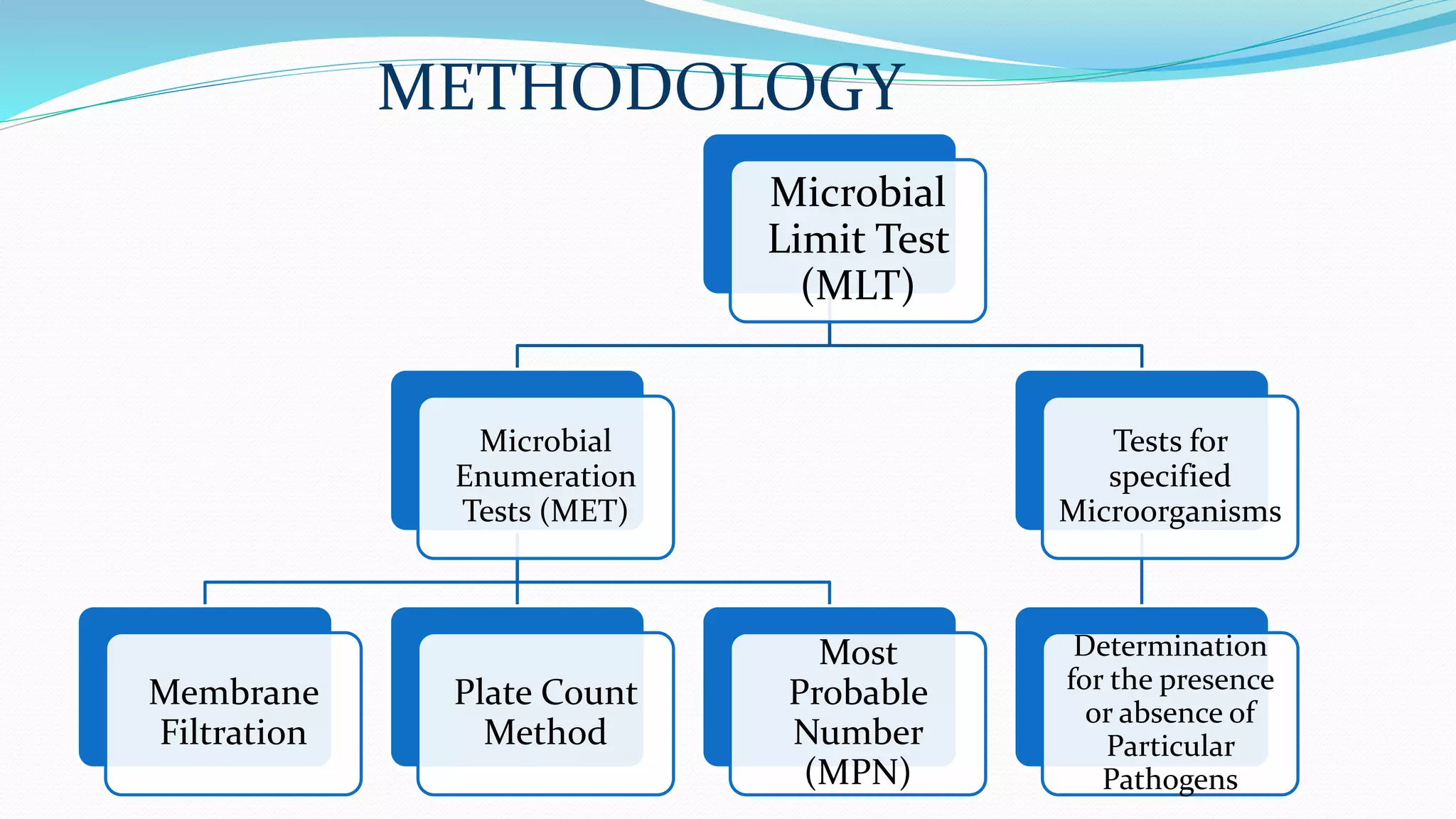
Microbial
Limit Test
(MLT)
Microbial
Enumeration
Tests (MET)
Membrane
Filtration
Plate Count
Method
Most
Probable
Number
(MPN)
Tests for
specified
Microorganisms
Determination
for the presence
or absence of
Particular
Pathogens
METHODOLOGY
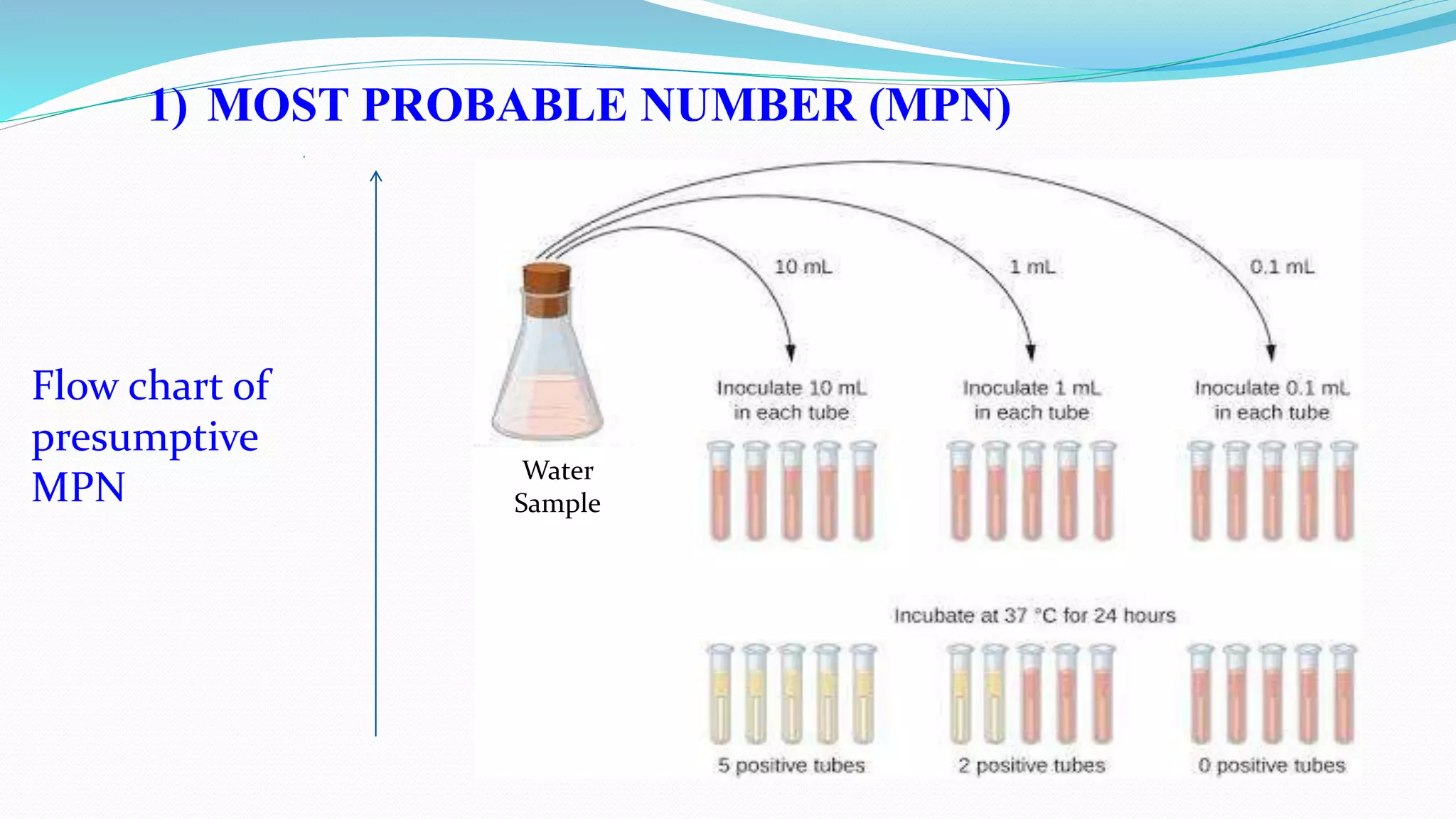
Flow chart of
presumptive
MPN
1) MOST PROBABLE NUMBER (MPN)
Water
Sample
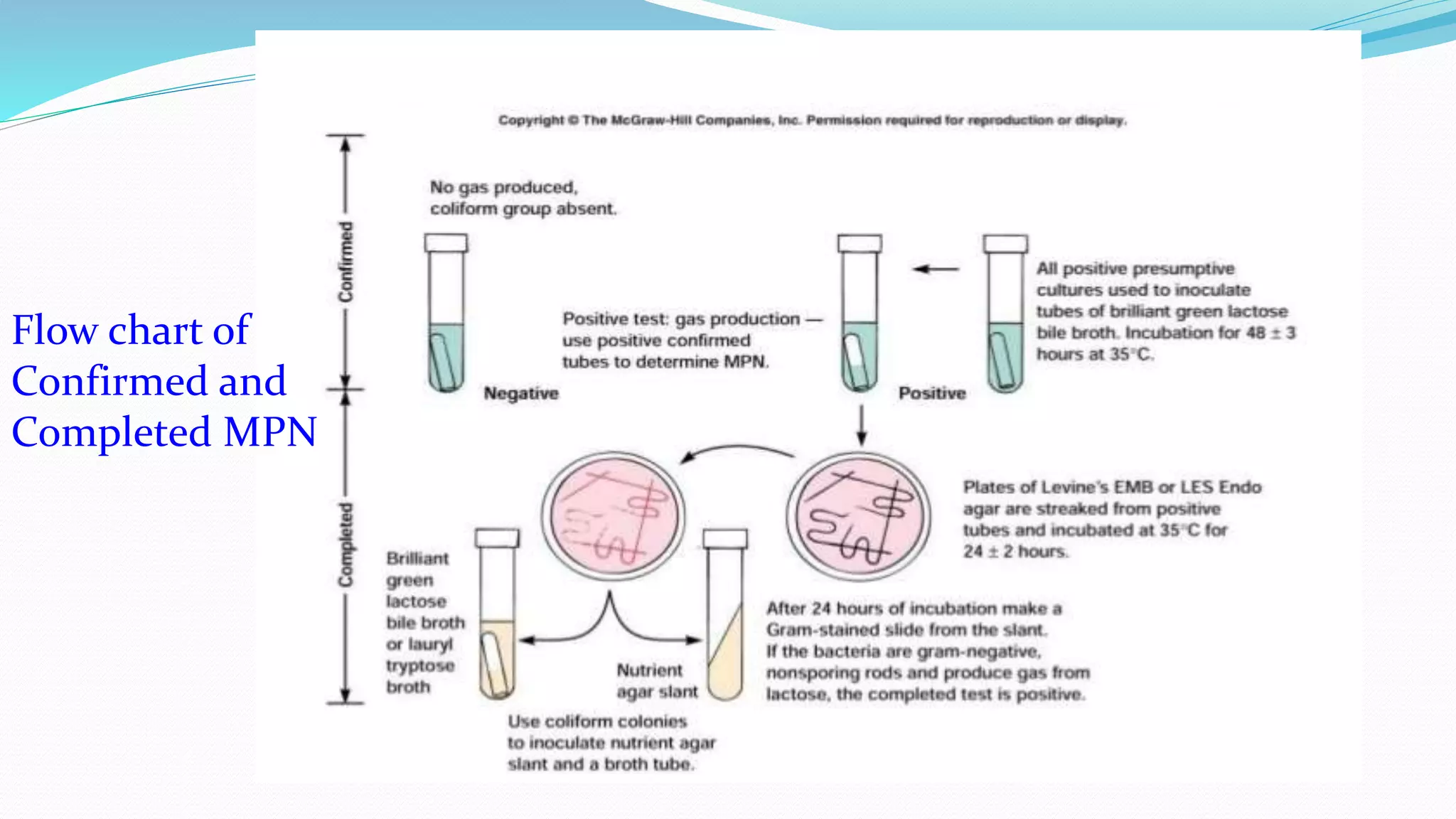
Flow chart of
Confirmed and
Completed MPN
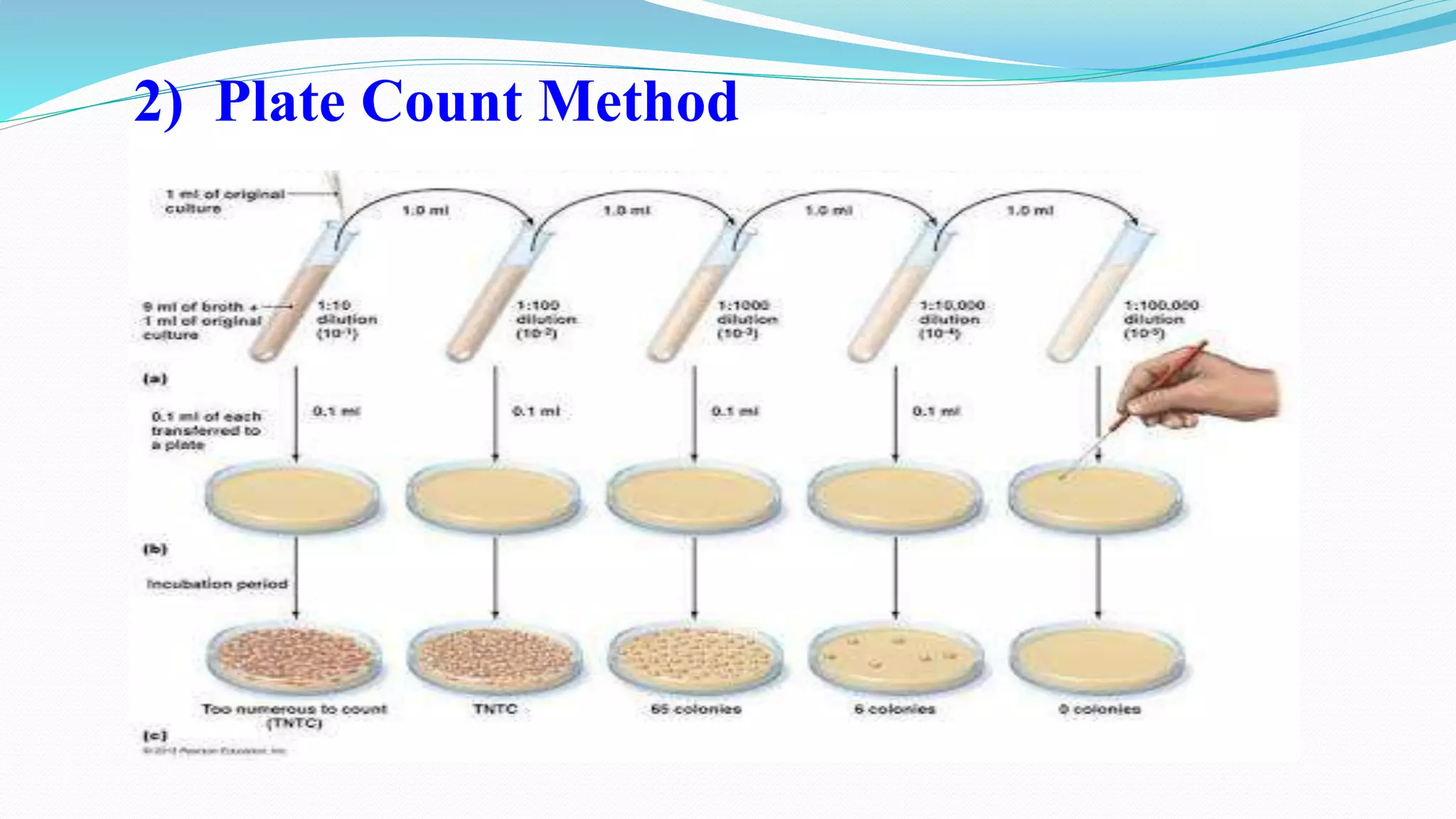
2) Plate Count Method
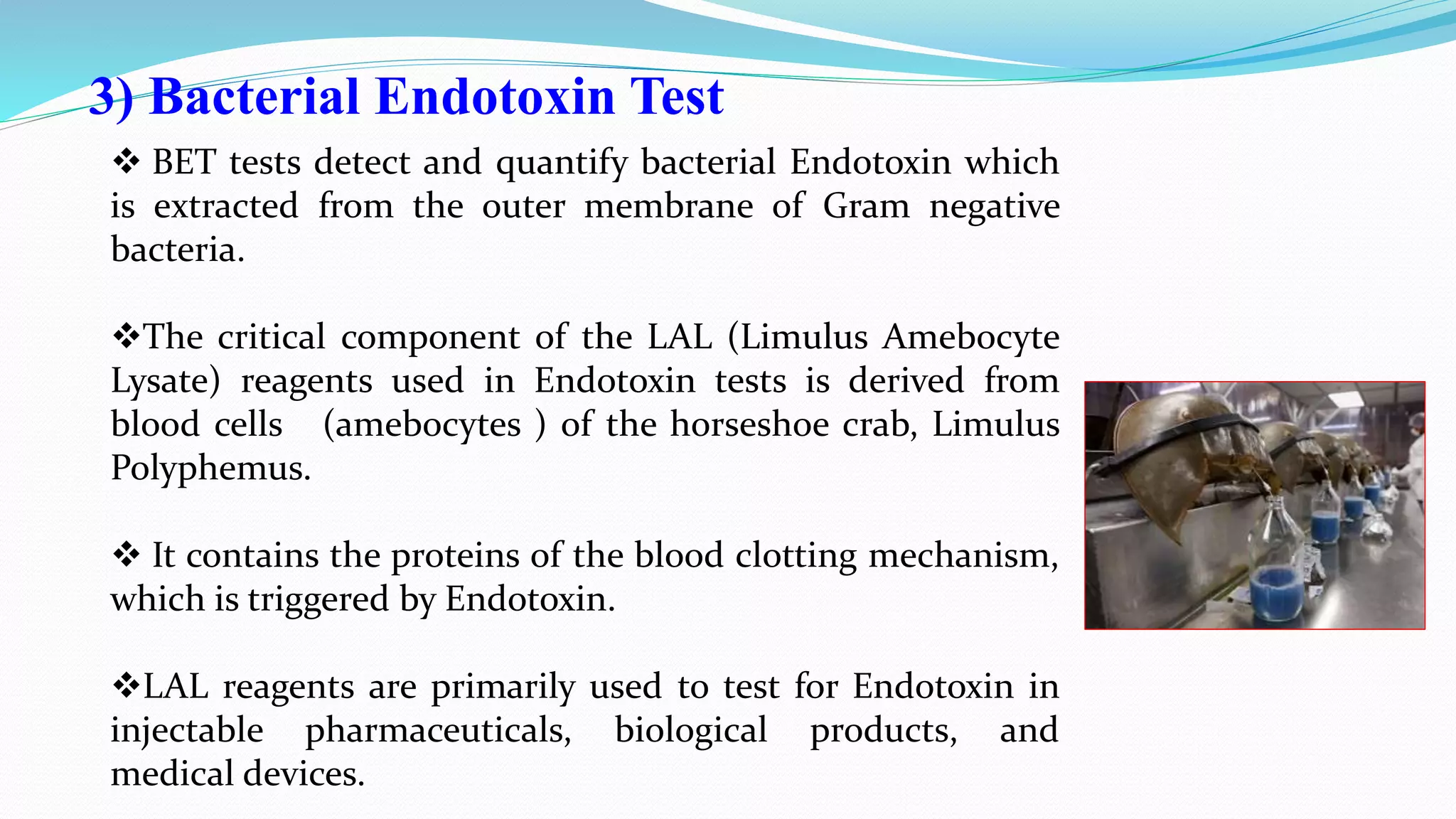
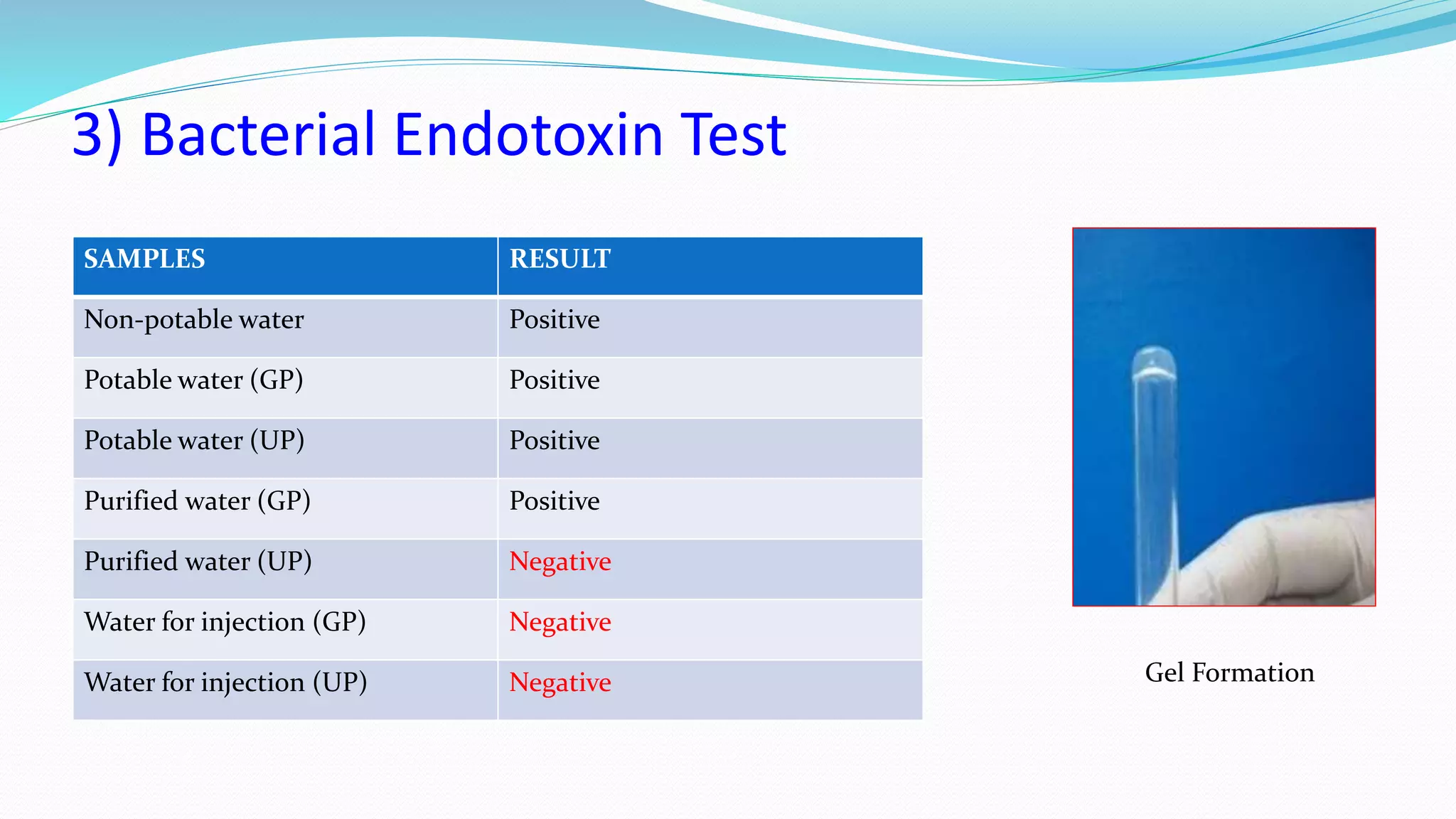
3) Bacterial Endotoxin Test
 BET tests detect and quantify bacterial Endotoxin which
is extracted from the outer membrane of Gram negative
bacteria.
The critical component of the LAL (Limulus Amebocyte
Lysate) reagents used in Endotoxin tests is derived from
blood cells (amebocytes ) of the horseshoe crab, Limulus
Polyphemus.
 It contains the proteins of the blood clotting mechanism,
which is triggered by Endotoxin.
LAL reagents are primarily used to test for Endotoxin in
injectable pharmaceuticals, biological products, and
medical devices.
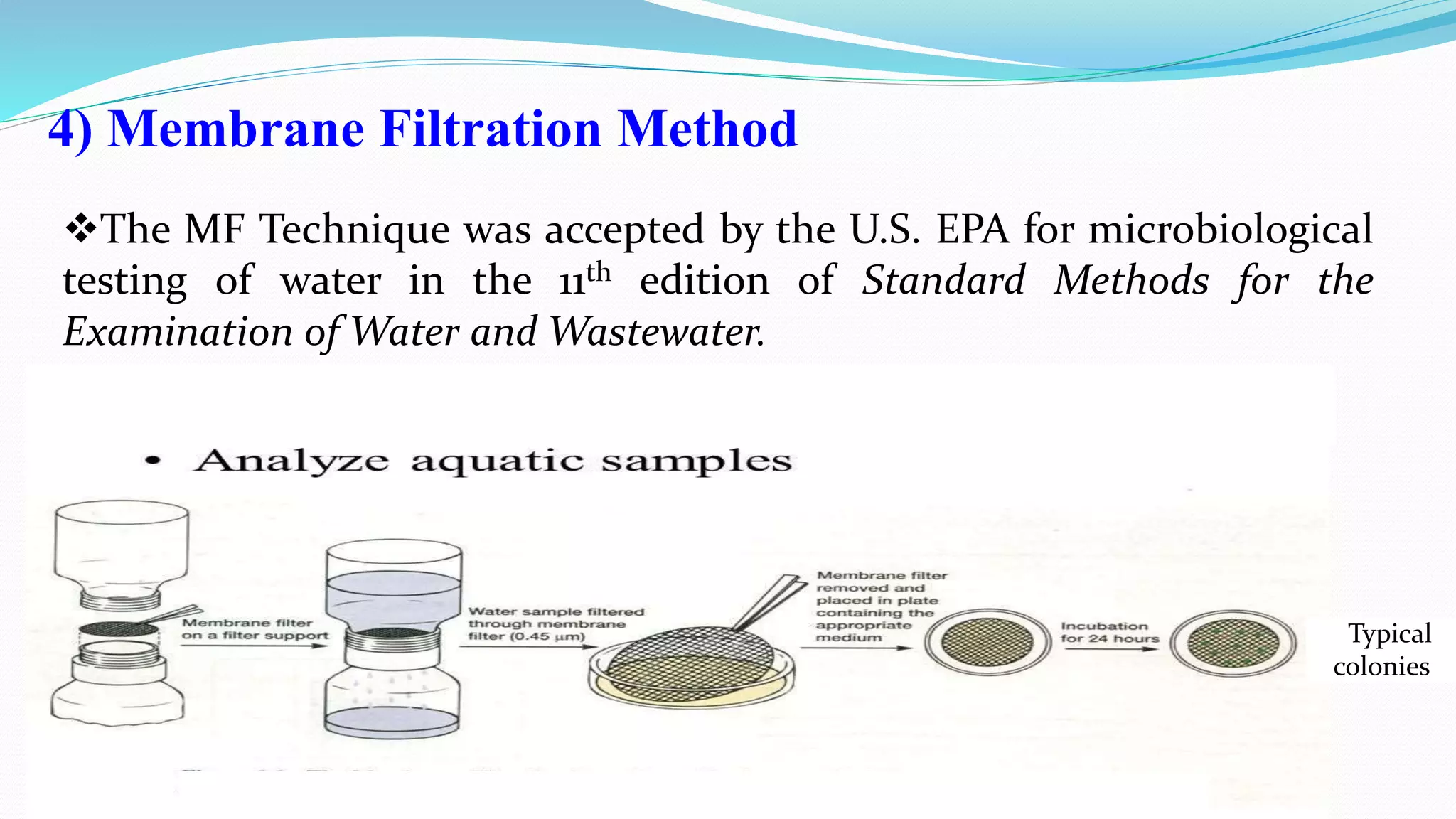
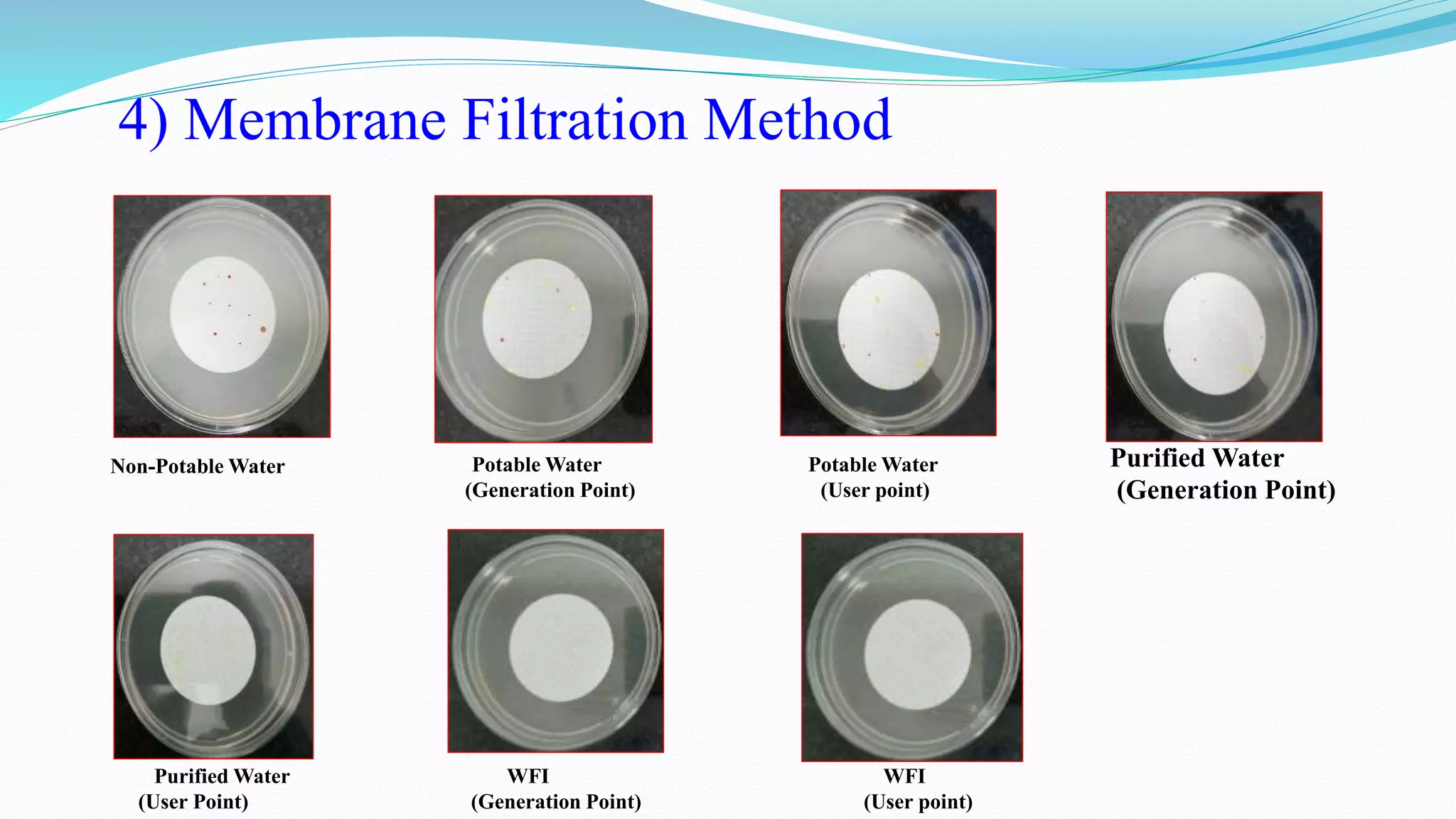
4) Membrane Filtration Method
The MF Technique was accepted by the U.S. EPA for microbiological
testing of water in the 11th edition of Standard Methods for the
Examination of Water and Wastewater.
TTypical
colonies
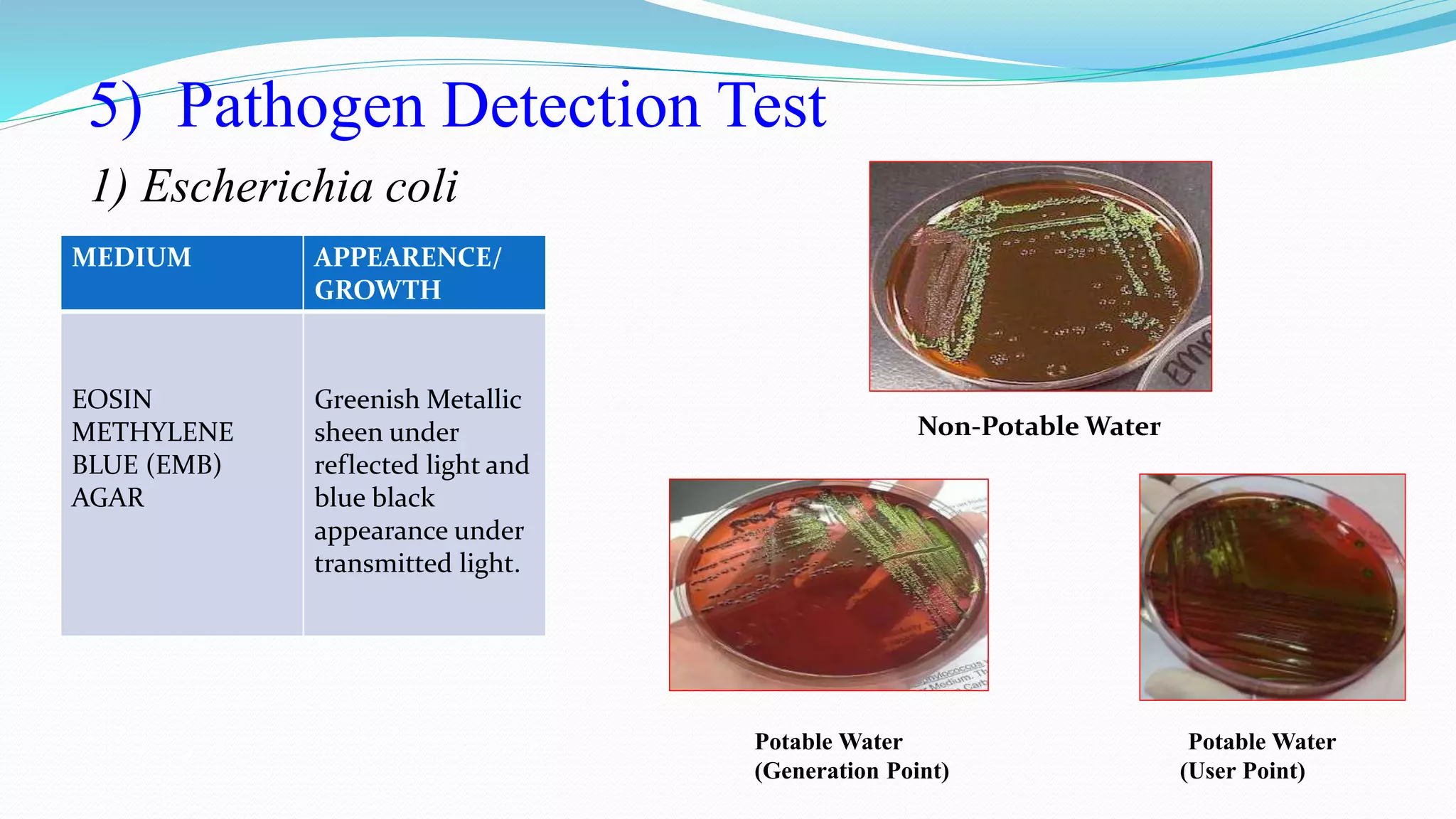
5) Pathogen Detection Test
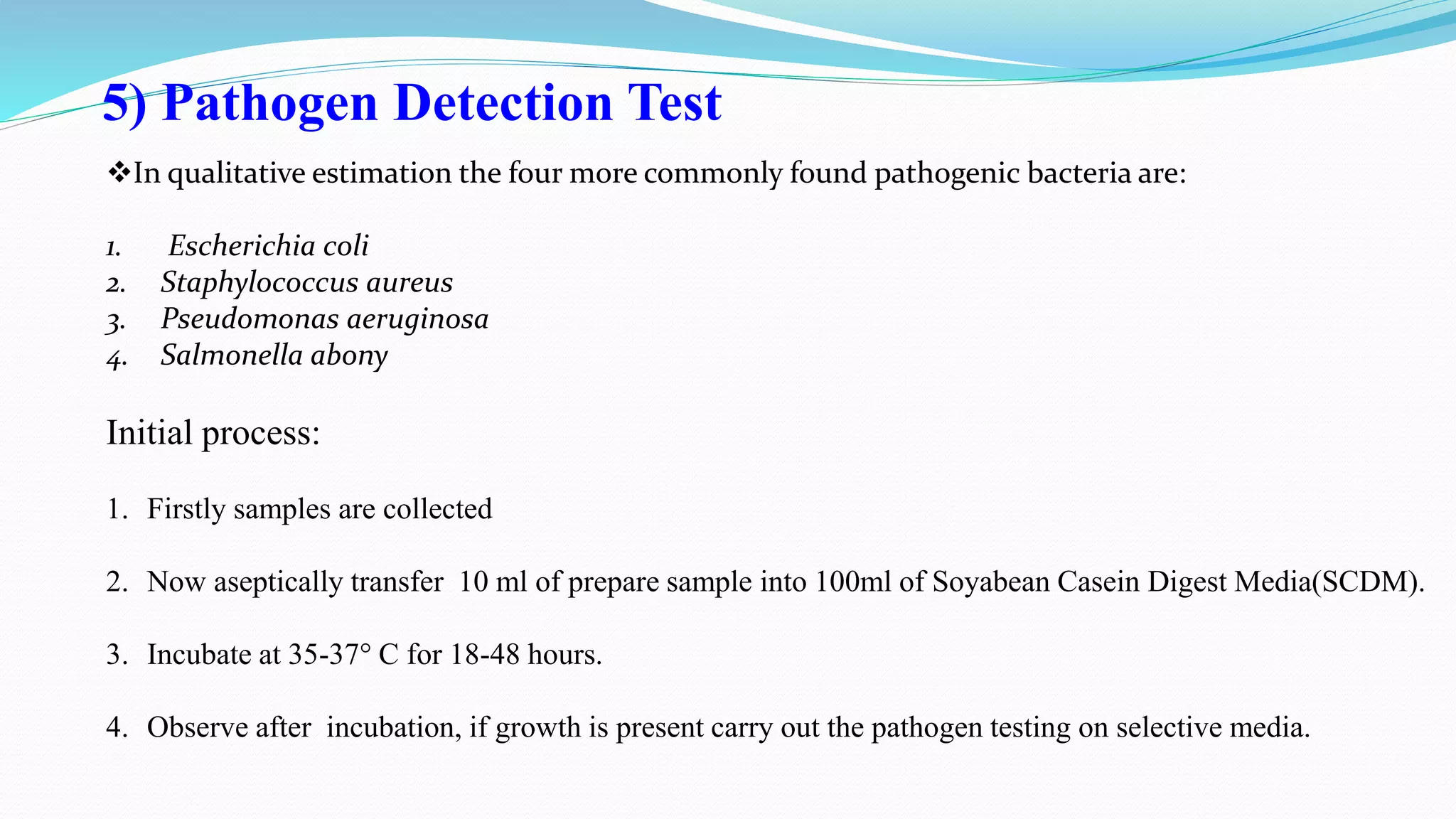
In qualitative estimation the four more commonly found pathogenic bacteria are:
1. Escherichia coli
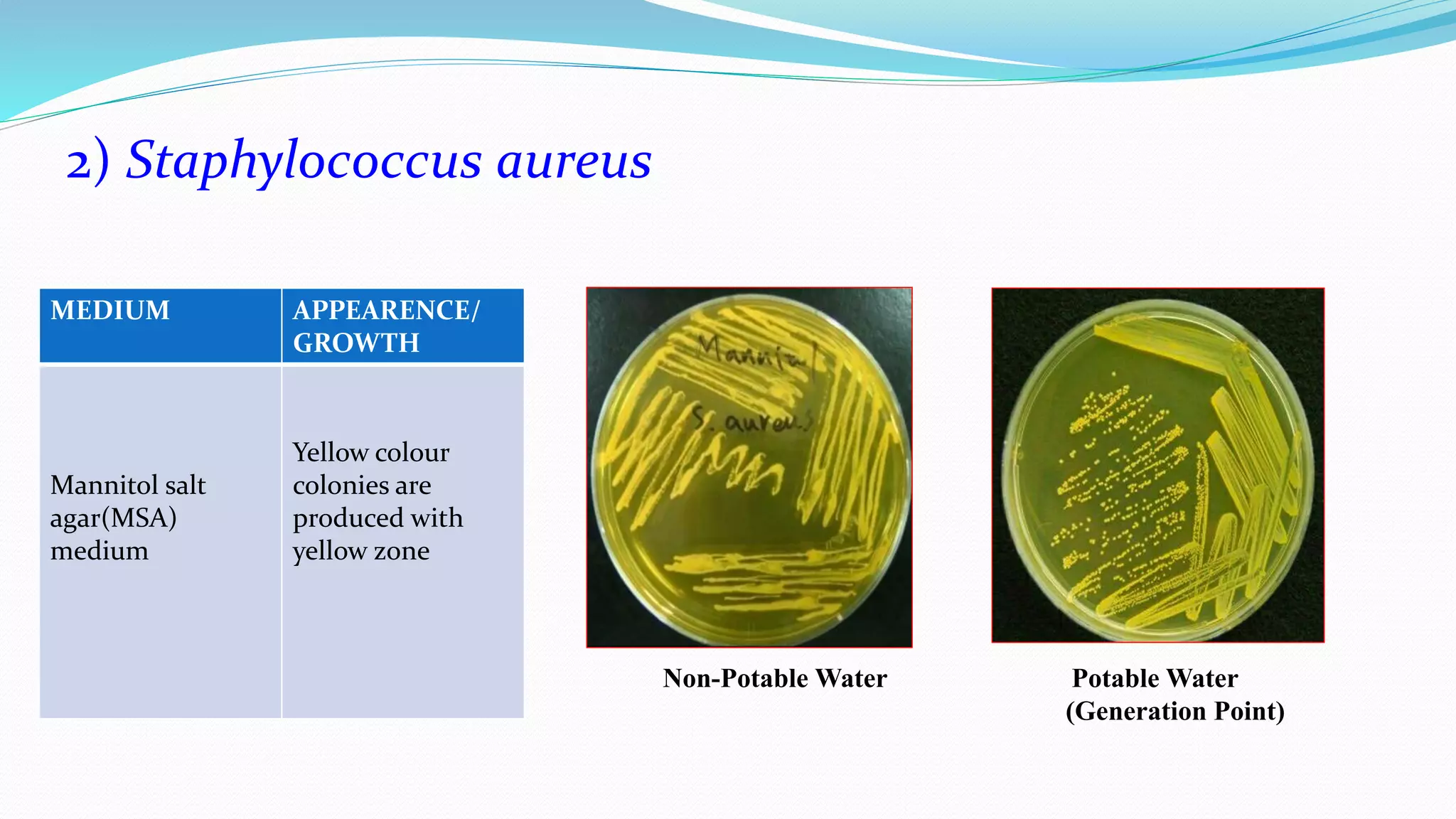
2. Staphylococcus aureus
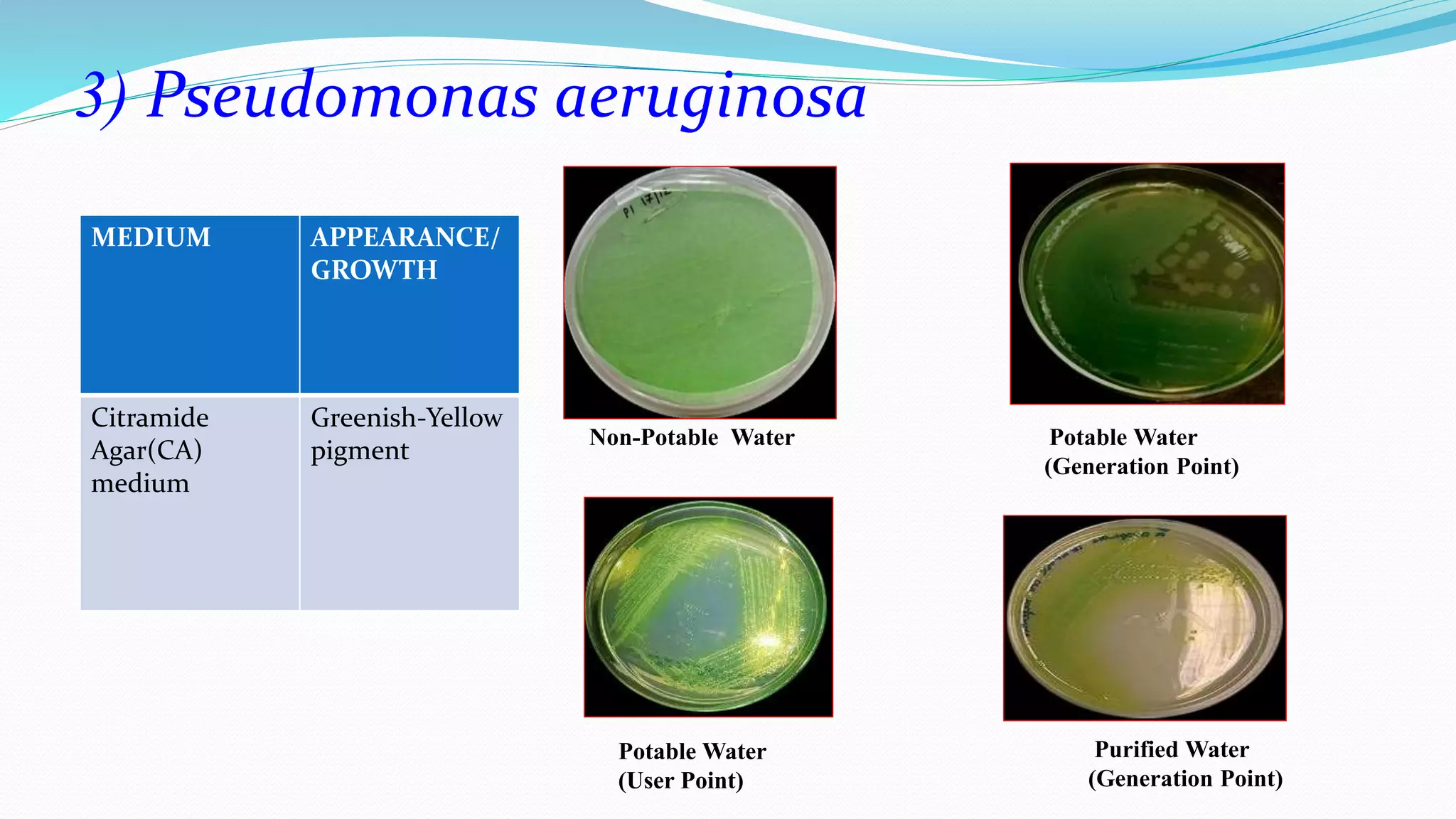
3. Pseudomonas aeruginosa
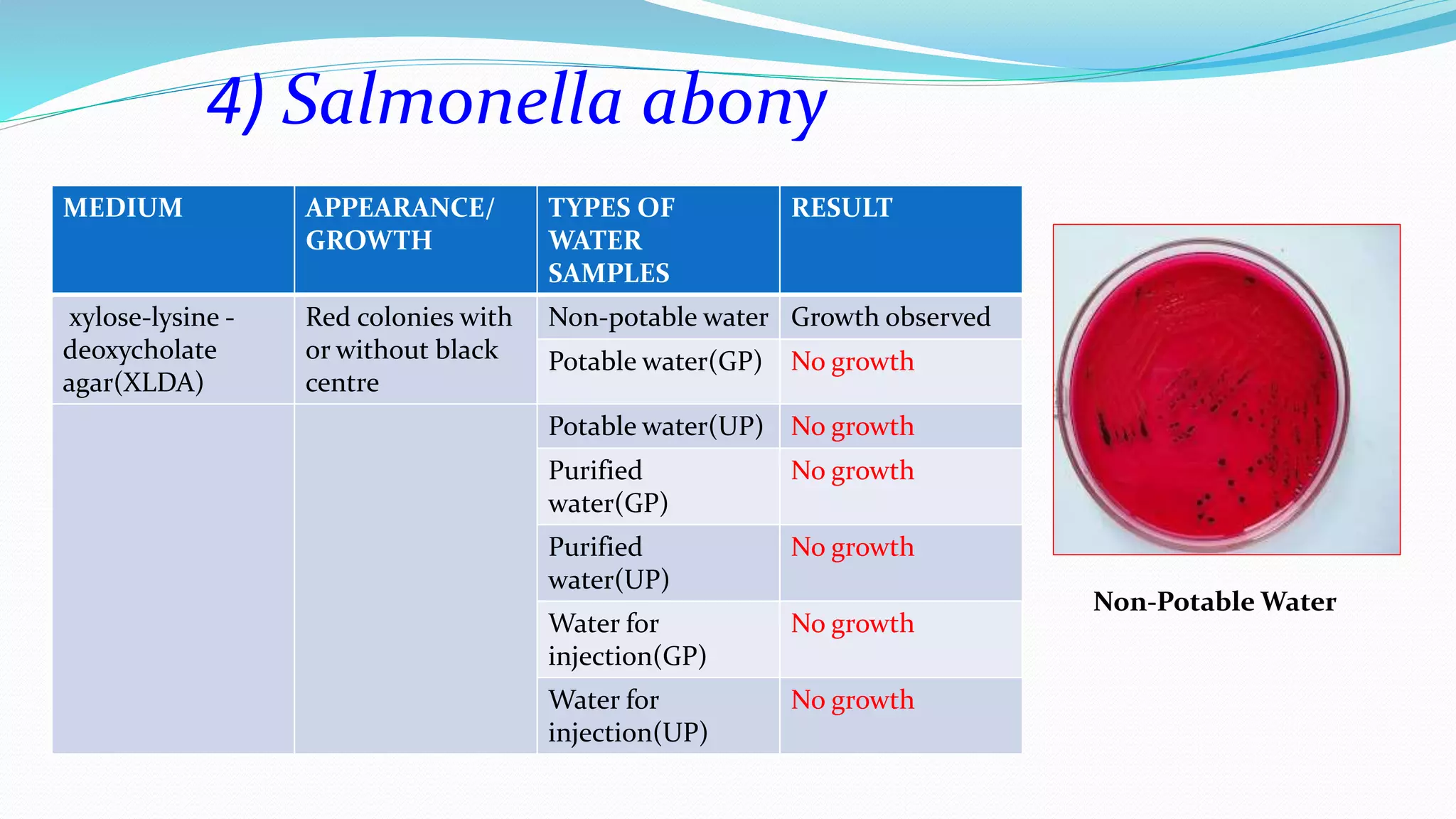
4. Salmonella abony
Initial process:
1. Firstly samples are collected
2. Now aseptically transfer 10 ml of prepare sample into 100ml of Soyabean Casein Digest Media(SCDM).
3. Incubate at 35-37° C for 18-48 hours.
4. Observe after incubation, if growth is present carry out the pathogen testing on selective media.
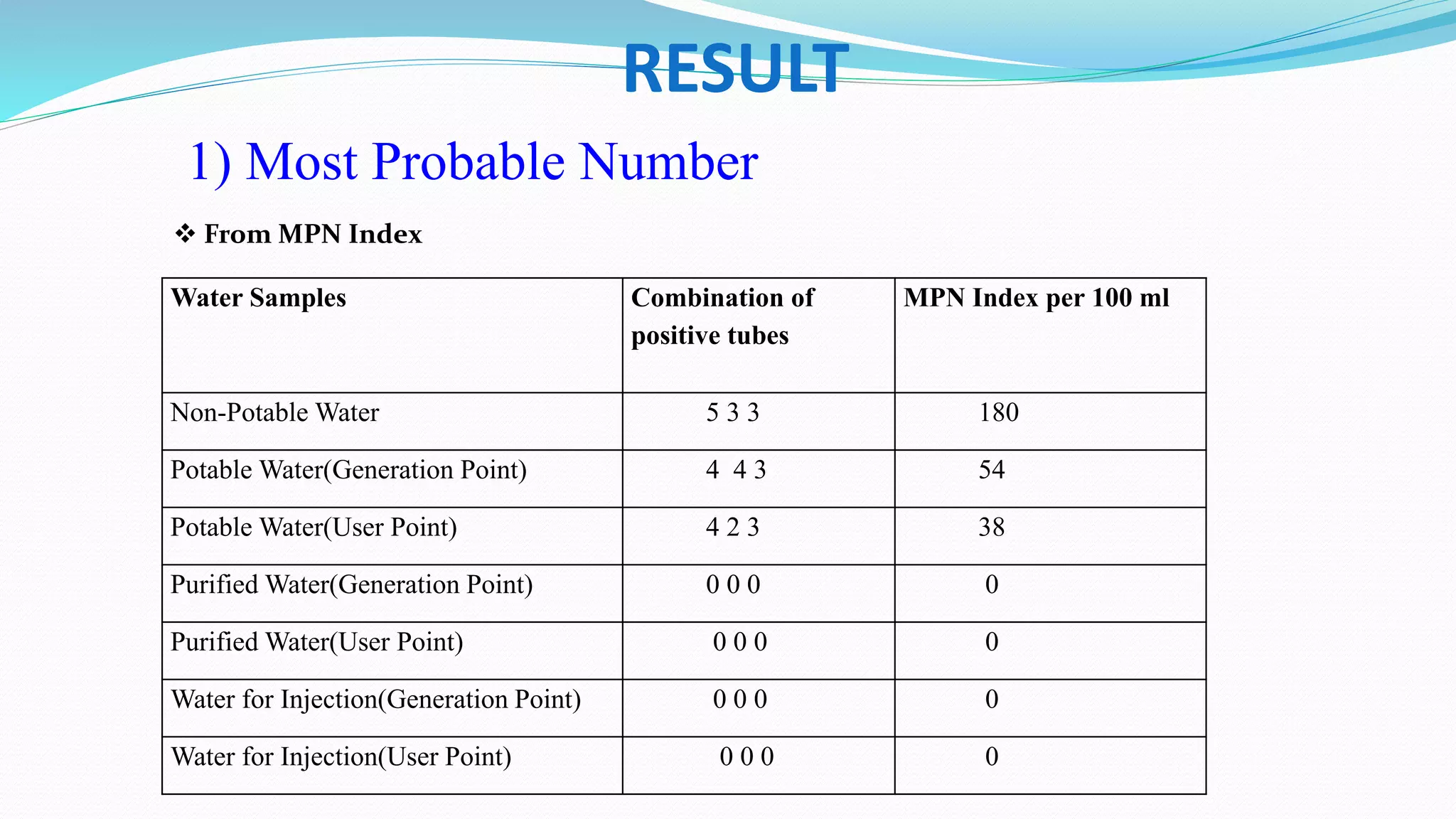
Water Samples Combination of
positive tubes
MPN Index per 100 ml
Non-Potable Water 5 3 3 180
Potable Water(Generation Point) 4 4 3 54
Potable Water(User Point) 4 2 3 38
Purified Water(Generation Point) 0 0 0 0
Purified Water(User Point) 0 0 0 0
Water for Injection(Generation Point) 0 0 0 0
Water for Injection(User Point) 0 0 0 0
 From MPN Index
1) Most Probable Number
RESULT
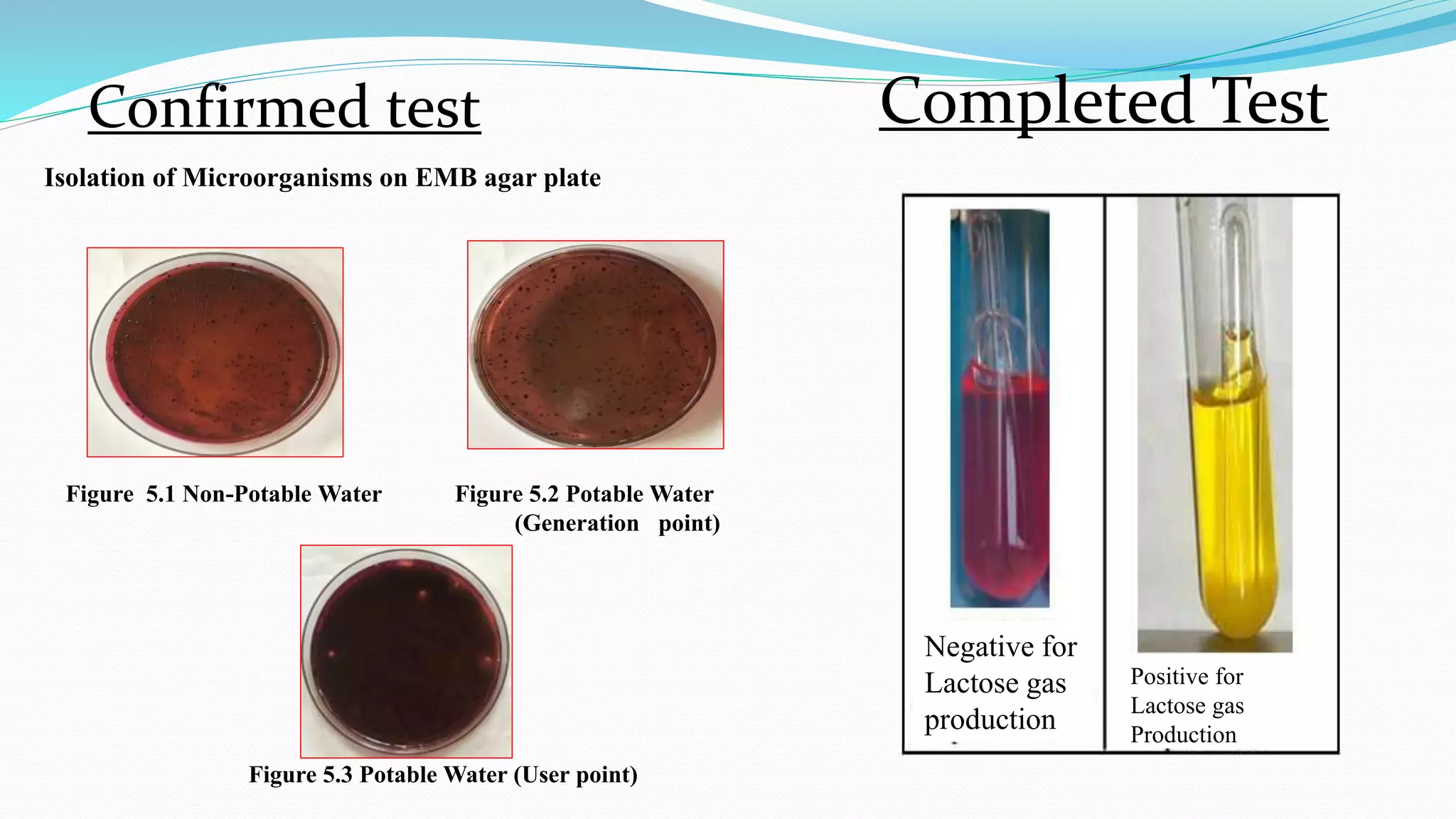
Confirmed test
Isolation of Microorganisms on EMB agar plate
Figure 5.1 Non-Potable Water Figure 5.2 Potable Water
(Generation point)
Figure 5.3 Potable Water (User point)
Completed Test
Negative for
Lactose gas
production
Positive for
Lactose gas
Production
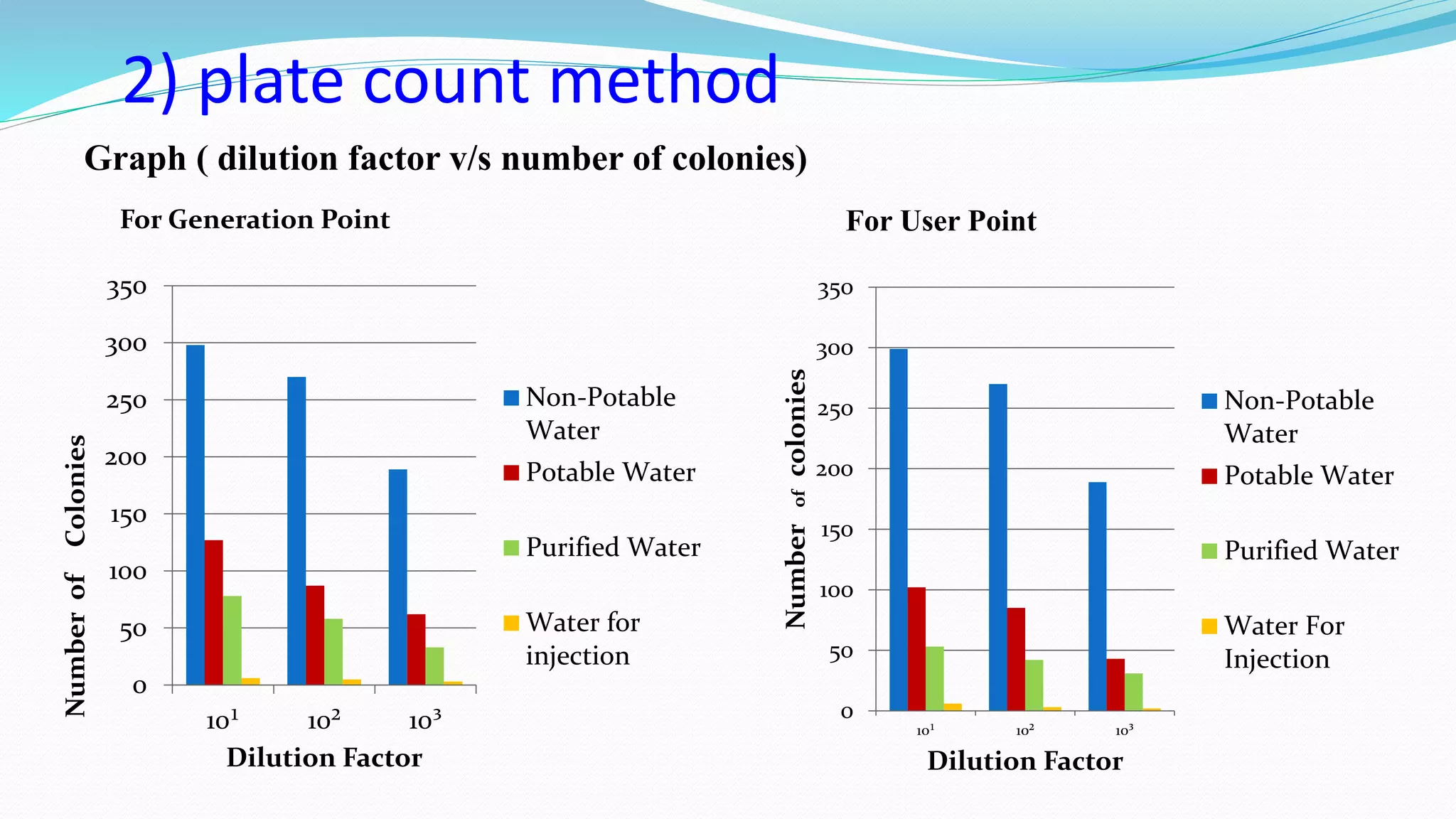
0
50
100
150
200
250
300
350
10¹ 10² 10³
NumberofColonies
Dilution Factor
Non-Potable
Water
Potable Water
Purified Water
Water for
injection
Graph ( dilution factor v/s number of colonies)
For Generation Point
0
50
100
150
200
250
300
350
10¹ 10² 10³
Numberofcolonies
Dilution Factor
Non-Potable
Water
Potable Water
Purified Water
Water For
Injection
For User Point
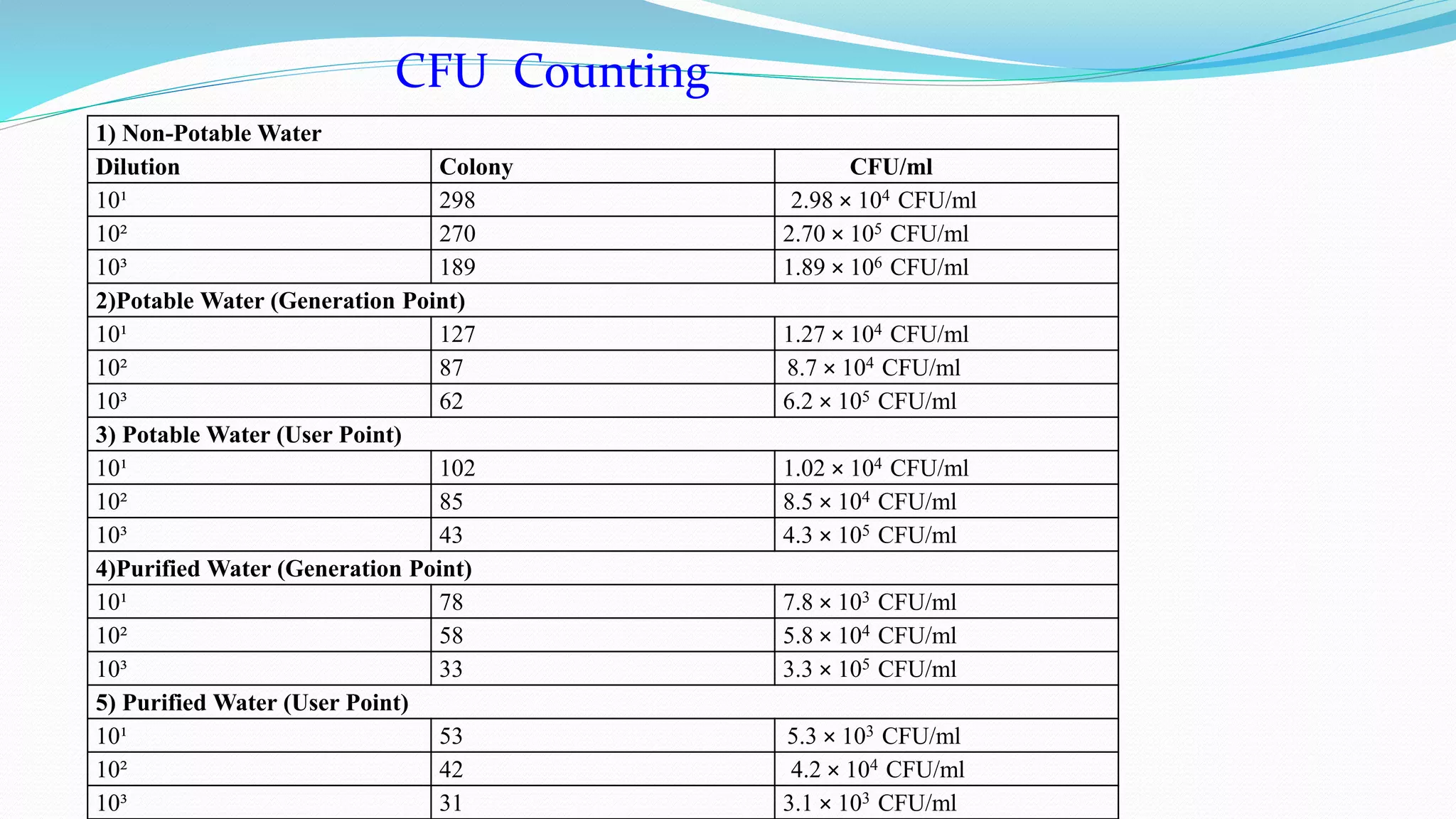
2) plate count method
1) Non-Potable Water
Dilution Colony CFU/ml
10¹ 298 2.98 × 10⁴ CFU/ml
10² 270 2.70 × 10⁵ CFU/ml
10³ 189 1.89 × 10⁶ CFU/ml
2)Potable Water (Generation Point)
10¹ 127 1.27 × 10⁴ CFU/ml
10² 87 8.7 × 10⁴ CFU/ml
10³ 62 6.2 × 10⁵ CFU/ml
3) Potable Water (User Point)
10¹ 102 1.02 × 10⁴ CFU/ml
10² 85 8.5 × 10⁴ CFU/ml
10³ 43 4.3 × 10⁵ CFU/ml
4)Purified Water (Generation Point)
10¹ 78 7.8 × 10³ CFU/ml
10² 58 5.8 × 10⁴ CFU/ml
10³ 33 3.3 × 10⁵ CFU/ml
5) Purified Water (User Point)
10¹ 53 5.3 × 10³ CFU/ml
10² 42 4.2 × 10⁴ CFU/ml
10³ 31 3.1 × 10³ CFU/ml
CFU Counting
3) Bacterial Endotoxin Test
SAMPLES RESULT
Non-potable water Positive
Potable water (GP) Positive
Potable water (UP) Positive
Purified water (GP) Positive
Purified water (UP) Negative
Water for injection (GP) Negative
Water for injection (UP) Negative Gel Formation
4) Membrane Filtration Method
Non-Potable Water Potable Water Potable Water
(Generation Point) (User point)
Purified Water WFI WFI
(User Point) (Generation Point) (User point)
Purified Water
(Generation Point)
5) Pathogen Detection Test
MEDIUM APPEARENCE/
GROWTH
EOSIN
METHYLENE
BLUE (EMB)
AGAR
Greenish Metallic
sheen under
reflected light and
blue black
appearance under
transmitted light.
1) Escherichia coli
Non-Potable Water
Potable Water Potable Water
(Generation Point) (User Point)
MEDIUM APPEARENCE/
GROWTH
Mannitol salt
agar(MSA)
medium
Yellow colour
colonies are
produced with
yellow zone
2) Staphylococcus aureus
Non-Potable Water Potable Water
(Generation Point)
MEDIUM APPEARANCE/
GROWTH
Citramide
Agar(CA)
medium
Greenish-Yellow
pigment
3) Pseudomonas aeruginosa
Non-Potable Water Potable Water
(Generation Point)
Potable Water
(User Point)
Purified Water
(Generation Point)
MEDIUM APPEARANCE/
GROWTH
TYPES OF
WATER
SAMPLES
RESULT
xylose-lysine -
deoxycholate
agar(XLDA)
Red colonies with
or without black
centre
Non-potable water Growth observed
Potable water(GP) No growth
Potable water(UP) No growth
Purified
water(GP)
No growth
Purified
water(UP)
No growth
Water for
injection(GP)
No growth
Water for
injection(UP)
No growth
4) Salmonella abony
Non-Potable Water
Conclusion
 In vaccine manufacturing industry, different grades of water are used for
different purposes. Testing of the Potable water, Purified water and Water for
injection used for the manfuacturing of the veterinary vaccines at the
different stage of the process done for the generation points as well as the user
points to be done using the MPN method, Plate count method and Filtration
method. So as far as the microorganisms are concerned based on the testing
and its respective results reveals that Potable water, Purified water and Water
for injection used for the manfuacturing of the veterinary vaccines comply
with the acceptance limit of the microbiology and states that the control for
the microorganism in water system is there .
REFERENCES
 Mehta G, Prabhu SM, Kantawala D. Industrial wastewater treatment-The Indian experience. J. Indian. Assoc. Environ.
Management. 22, 1995, 6-287.
 Gilbride, K. Molecular Methods for the Detection of Waterborne Pathogens. In Waterborne Pathogens, Detection
Methods and Applications; Bridle, H., Ed.; Elsevier B.V.: London, U K 2014, p. 387
 APHA Standard Methods For the Examination of Water and Wastewater, 21st ed., Washington DC: American Public
Health Association, American Water Works Association, and Water Environmental Federation, 2005.
 Jorgensen, J.H., Lee, J.C., Pahren, H.R.,. Rapid detection of bacterial endotoxins in drinking-water and renovated
wastewater. Applied and Environmental Microbiology 32,1976, 347-351.
 Traeger, H, Pharmaceuticals, The Presence of Bacteria, Endotoxins, and Biofilms in Pharmaceutical Water, Ultrapure
Water, March 2003, 98-102.
 Howe RHL, Nicoles RA. Waste treatment for veterinary and plant science research and production at Eli Lilly
Laboratories. Proceedings of the 14th Industrial waste conference, 1959, 25-30.
 Geldreich EE, Taylor RH, Blannon JC, Reasoner DJ. Bacterial colonization of point-of-use water treatment devices. J
Am Water Works Assoc 1985,77(2):72-80.
Microbial analysis of water system and endotoxin estimation

Microbial analysis of water system and endotoxin estimation

  • 1.
    A presentation on MICROBIALANALYSIS OF WATER SYSTEM AND ENDOTOXIN ESTIMATION FOR VETERINARY VACCINE MANUFACTURING FACILITY Internal Guided By: Ms. ROSHANI K CHAUDHARY Assistant Professor Department of Biotechnology MUIS External Guided By: Mr. HARDIK MISTRTY Assistant Manager Quality Assurance Hester Biosciences Ltd. Presented By Asha P Patel M.Sc Microbiology 16064511028
  • 2.
     To studyimportance of different grades of water in veterinary vaccine manufacturing industry.  To study uses and preparation techniques of different grades of water used in industry.  To enumerate the number of bacteria present in water samples by different methods.
  • 3.
    Water is verywidely used in the pharmaceutical, biopharmaceutical and biological industry for various purpose like as Raw material, Ingredient as a solvent in processing, formulation and manufacturing of the wide range of the finish products, as API and intermediates and analytical reagents. There are many different types of water described in USP monographs that specify uses, acceptable methods of preparation, and quality attributes. Types of water used in Vaccine Manufacturing industry are Non-Potable, Potable, Purified and Water for Injection prepared through different techniques such as distillation, Reverse osmosis, Deionization, Filtration, Softening etc. Due to its criticality in industry, microbiological control of water is of great importance. Veterinary vaccines are considered as the sterile parenteral dosage form and water used for the various purpose in the veterinary vaccine manufacturing facility must have to comply with the regulatory requirements.
  • 4.
    Importance and Usesof Water in Pharmaceutical Industry Different Grades of Water used in Vaccine Manufacturing Industry Uses and Preparation Techniques of various grades of Water Microbiological Control of Water
  • 6.
    Grades of waterUses Preparation techniques Non potable Water Cleaning of floor Obtained from natural sources Potable Water Equipment cleaning and rinsing Filtration Softening Iron removal Purified Water(PW) •For the production of non- parental preparation •As an excipient •Deionization •Reverse osmosis Water for injection (WFI) •For the production of parenteral preparation •For cleaning of parenteral product contact component • In preparation of vaccine diluents •Distillation •Reverse osmosis Uses and preparation techniques of various grades of water
  • 7.
    Microbial Limit Test (MLT) Microbial Enumeration Tests (MET) Membrane Filtration PlateCount Method Most Probable Number (MPN) Tests for specified Microorganisms Determination for the presence or absence of Particular Pathogens METHODOLOGY
  • 8.
    Flow chart of presumptive MPN 1)MOST PROBABLE NUMBER (MPN) Water Sample
  • 9.
    Flow chart of Confirmedand Completed MPN
  • 10.
  • 11.
    3) Bacterial EndotoxinTest  BET tests detect and quantify bacterial Endotoxin which is extracted from the outer membrane of Gram negative bacteria. The critical component of the LAL (Limulus Amebocyte Lysate) reagents used in Endotoxin tests is derived from blood cells (amebocytes ) of the horseshoe crab, Limulus Polyphemus.  It contains the proteins of the blood clotting mechanism, which is triggered by Endotoxin. LAL reagents are primarily used to test for Endotoxin in injectable pharmaceuticals, biological products, and medical devices.
  • 12.
    4) Membrane FiltrationMethod The MF Technique was accepted by the U.S. EPA for microbiological testing of water in the 11th edition of Standard Methods for the Examination of Water and Wastewater. TTypical colonies
  • 13.
    5) Pathogen DetectionTest In qualitative estimation the four more commonly found pathogenic bacteria are: 1. Escherichia coli 2. Staphylococcus aureus 3. Pseudomonas aeruginosa 4. Salmonella abony Initial process: 1. Firstly samples are collected 2. Now aseptically transfer 10 ml of prepare sample into 100ml of Soyabean Casein Digest Media(SCDM). 3. Incubate at 35-37° C for 18-48 hours. 4. Observe after incubation, if growth is present carry out the pathogen testing on selective media.
  • 14.
    Water Samples Combinationof positive tubes MPN Index per 100 ml Non-Potable Water 5 3 3 180 Potable Water(Generation Point) 4 4 3 54 Potable Water(User Point) 4 2 3 38 Purified Water(Generation Point) 0 0 0 0 Purified Water(User Point) 0 0 0 0 Water for Injection(Generation Point) 0 0 0 0 Water for Injection(User Point) 0 0 0 0  From MPN Index 1) Most Probable Number RESULT
  • 15.
    Confirmed test Isolation ofMicroorganisms on EMB agar plate Figure 5.1 Non-Potable Water Figure 5.2 Potable Water (Generation point) Figure 5.3 Potable Water (User point) Completed Test Negative for Lactose gas production Positive for Lactose gas Production
  • 16.
    0 50 100 150 200 250 300 350 10¹ 10² 10³ NumberofColonies DilutionFactor Non-Potable Water Potable Water Purified Water Water for injection Graph ( dilution factor v/s number of colonies) For Generation Point 0 50 100 150 200 250 300 350 10¹ 10² 10³ Numberofcolonies Dilution Factor Non-Potable Water Potable Water Purified Water Water For Injection For User Point 2) plate count method
  • 17.
    1) Non-Potable Water DilutionColony CFU/ml 10¹ 298 2.98 × 10⁴ CFU/ml 10² 270 2.70 × 10⁵ CFU/ml 10³ 189 1.89 × 10⁶ CFU/ml 2)Potable Water (Generation Point) 10¹ 127 1.27 × 10⁴ CFU/ml 10² 87 8.7 × 10⁴ CFU/ml 10³ 62 6.2 × 10⁵ CFU/ml 3) Potable Water (User Point) 10¹ 102 1.02 × 10⁴ CFU/ml 10² 85 8.5 × 10⁴ CFU/ml 10³ 43 4.3 × 10⁵ CFU/ml 4)Purified Water (Generation Point) 10¹ 78 7.8 × 10³ CFU/ml 10² 58 5.8 × 10⁴ CFU/ml 10³ 33 3.3 × 10⁵ CFU/ml 5) Purified Water (User Point) 10¹ 53 5.3 × 10³ CFU/ml 10² 42 4.2 × 10⁴ CFU/ml 10³ 31 3.1 × 10³ CFU/ml CFU Counting
  • 18.
    3) Bacterial EndotoxinTest SAMPLES RESULT Non-potable water Positive Potable water (GP) Positive Potable water (UP) Positive Purified water (GP) Positive Purified water (UP) Negative Water for injection (GP) Negative Water for injection (UP) Negative Gel Formation
  • 19.
    4) Membrane FiltrationMethod Non-Potable Water Potable Water Potable Water (Generation Point) (User point) Purified Water WFI WFI (User Point) (Generation Point) (User point) Purified Water (Generation Point)
  • 20.
    5) Pathogen DetectionTest MEDIUM APPEARENCE/ GROWTH EOSIN METHYLENE BLUE (EMB) AGAR Greenish Metallic sheen under reflected light and blue black appearance under transmitted light. 1) Escherichia coli Non-Potable Water Potable Water Potable Water (Generation Point) (User Point)
  • 21.
    MEDIUM APPEARENCE/ GROWTH Mannitol salt agar(MSA) medium Yellowcolour colonies are produced with yellow zone 2) Staphylococcus aureus Non-Potable Water Potable Water (Generation Point)
  • 22.
    MEDIUM APPEARANCE/ GROWTH Citramide Agar(CA) medium Greenish-Yellow pigment 3) Pseudomonasaeruginosa Non-Potable Water Potable Water (Generation Point) Potable Water (User Point) Purified Water (Generation Point)
  • 23.
    MEDIUM APPEARANCE/ GROWTH TYPES OF WATER SAMPLES RESULT xylose-lysine- deoxycholate agar(XLDA) Red colonies with or without black centre Non-potable water Growth observed Potable water(GP) No growth Potable water(UP) No growth Purified water(GP) No growth Purified water(UP) No growth Water for injection(GP) No growth Water for injection(UP) No growth 4) Salmonella abony Non-Potable Water
  • 24.
    Conclusion  In vaccinemanufacturing industry, different grades of water are used for different purposes. Testing of the Potable water, Purified water and Water for injection used for the manfuacturing of the veterinary vaccines at the different stage of the process done for the generation points as well as the user points to be done using the MPN method, Plate count method and Filtration method. So as far as the microorganisms are concerned based on the testing and its respective results reveals that Potable water, Purified water and Water for injection used for the manfuacturing of the veterinary vaccines comply with the acceptance limit of the microbiology and states that the control for the microorganism in water system is there .
  • 25.
    REFERENCES  Mehta G,Prabhu SM, Kantawala D. Industrial wastewater treatment-The Indian experience. J. Indian. Assoc. Environ. Management. 22, 1995, 6-287.  Gilbride, K. Molecular Methods for the Detection of Waterborne Pathogens. In Waterborne Pathogens, Detection Methods and Applications; Bridle, H., Ed.; Elsevier B.V.: London, U K 2014, p. 387  APHA Standard Methods For the Examination of Water and Wastewater, 21st ed., Washington DC: American Public Health Association, American Water Works Association, and Water Environmental Federation, 2005.  Jorgensen, J.H., Lee, J.C., Pahren, H.R.,. Rapid detection of bacterial endotoxins in drinking-water and renovated wastewater. Applied and Environmental Microbiology 32,1976, 347-351.  Traeger, H, Pharmaceuticals, The Presence of Bacteria, Endotoxins, and Biofilms in Pharmaceutical Water, Ultrapure Water, March 2003, 98-102.  Howe RHL, Nicoles RA. Waste treatment for veterinary and plant science research and production at Eli Lilly Laboratories. Proceedings of the 14th Industrial waste conference, 1959, 25-30.  Geldreich EE, Taylor RH, Blannon JC, Reasoner DJ. Bacterial colonization of point-of-use water treatment devices. J Am Water Works Assoc 1985,77(2):72-80.