Water Quality:
Wastewater
Microbiology
By: Anna Mae Cababaros
MS EST-1
Wastewater is teaming with microbes.
Many of which are necessary for the
degradation and stabilization of organic
matter and are beneficial. On the other
hand, wastewater may also contain
pathogenic or potentially pathogenic
microorganisms, which pose a threat to
public health.
Wastewater Constituents
Major classes:
– Suspended solids (TSS, VSS, etc.)
– Biodegradable organics (BOD, COD)
– Pathogens (bacteria, viruses, protozoa, etc.)
– Nutrients (N, P, etc.)
– Priority pollutants
– Organics that don’t biodegrade (refractory)
– Heavy metals (Cd, Zn, Pb, Hg, Cu)
– Ions (pH; contribute to TDS e.g. Ca2+, Na+, SO4-2)
– Temperature
– Toxicity
Concentration
Parameter Strong
(mg/L)
Medium
(mg/L)
Weak
(mg/L)
BOD5 400 220 110
COD 1000 500 250
Organic N 35 15 8
NH3-N 50 25 12
Total N 85 40 20
Total P 15 8 4
Total solids 1200 720 350
Suspended
Solids
350 220 100
ABLE 1. Typical Characteristics of Domestic Wastewater
From Metcalf and Eddy Inc. (1991).
 Many are human pathogens.
 Most occupy a role in the treatment
process.
They are:
– Bacteria – Viruses
– Archaea – Algae
– Fungi/yeast – Rotifers
– Protozoa
Biological Constituents
BacteriaBacteria VirusesViruses ProtozoaProtozoa HelminthesHelminthes
HUMANSHUMANS
Figure 1. Categories of organisms of public health
significance.
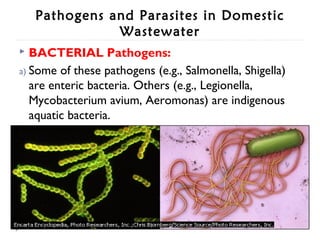
 BACTERIAL Pathogens:
a) Some of these pathogens (e.g., Salmonella, Shigella)
are enteric bacteria. Others (e.g., Legionella,
Mycobacterium avium, Aeromonas) are indigenous
aquatic bacteria.
Pathogens and Parasites in Domestic
Wastewater
Typhoid Fever
Salmonella typhi
– Diarrhea
– Transmitted by contaminated food, direct contact,
and drinking water
• Viruses - polio and hepatitis A
– Maintaining of 0.6 g/ml residual chlorine assuresμ
elimination
• Both diseases are transmitted from infected
individuals and in the developed world are associated
with the breakdown of water treatment practices.
Legionella pneumophila
 a waterborne pathogen transmitted via aerosols
 Found in water and soil but grows to high numbers
in warm waters (air conditioning cooling systems, hot
pools)
• An intracellular parasite of alveolar macrophage and
monocytes
 Pontiac fever - mild headaches, sore throat, fever,
that disappears after a few days
 Pneumonia that follows flu-like symptoms in the
elderly; 10% death
• Treated with erythromycin
 VIRAL pathogens:
b) Water and wastewater may become
contaminated by approximately 140 types of
enteric viruses. These viruses enter into the
human body orally, multiply in the
gastrointestinal tract, and are excreted in large
numbers in the feces of infected individuals.
 They are responsible for a broad spectrum
of diseases ranging from skin rash, fever,
respiratory infections, and conjunctivitis to
gastroenteritis and paralysis.
Viral Sources of Waterborne
Disease
• Hepatitis A: readily transmitted via water;
causes inflammation and necrosis of liver
• Norwalk-type viruses: cause acute
gastroenteritis
• Rotavirus: causes acute gastroenteritis,
especially in children
• Enteroviruses: many types can infect both the
intestines and the upper respiratory tract
• Reoviruses: infect the intestines and upper
respiratory tract (usually without disease
symptoms)
PROTOZOAN parasites:
c) These are released into aquatic environments as
cysts or oocysts, which are quite resistant to
environmental stress and to disinfection, and do
not multiply outside their hosts.
Giardiasis and
Cryptosporidiosis
• Giardia lamblia and Cryptosporidium parvum are
protozoans
• G. lamblia cyst ingested and trophozoite develop, attach
to intestine wall leading to diarrhea, foul smell,
stomach cramps
• Transmission through water. 97% of all surface water
carry cysts. Cysts are resistant to chlorine but
proper water treatment removes them during
flocculation and filtration
• Natural streams - transmission by wild animals
• Diagnosis: microscopic observation or antigen
presence; treated with drugs
. Person-to-Person Transmission
. Waterborne Transmission
. Foodborne Transmission
. Airborne Transmission
. Vector-Borne Transmission
. Fomites
Mode of
Transmission
Indicators and Detection
Indicator organisms indicate that fecal
pollution has occurred and microbial
pathogens might be present.
Total and fecal coliforms, and the enterococci
-fecal streptococci are the indicator
organisms currently used in the public
health arena.
Bacterial-Indicator organisms
• COLIFORM GROUP
–total coliforms
–fecal coliforms
–Escherichia coli
• STREPTOCOCCI
–fecal streptococci
(enterococci)
• SPORE FORMERS
–Clostridium perfringens
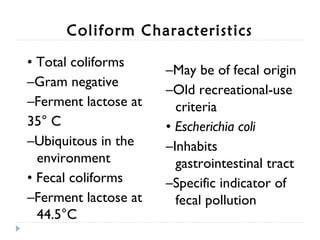
Coliform Characteristics
• Total coliforms
–Gram negative
–Ferment lactose at
35° C
–Ubiquitous in the
environment
• Fecal coliforms
–Ferment lactose at
44.5°C
–May be of fecal origin
–Old recreational-use
criteria
• Escherichia coli
–Inhabits
gastrointestinal tract
–Specific indicator of
fecal pollution
Other Fecal Indicators
• Fecal streptococci (enterococci)
–Gram-positive cocci
–Grows at 41 °C
• Clostridium perfringens
–Present in both human and animal wastes
–Produces a stress-resistant spore
–Indicates point sources, but poor indicator of
non-point pollution sources
–Possible surrogate for resistant bacteria
Chemical Indicators of Water Quality
I. Fecal Sterols- coprostanol, coprosterol,
cholesterol and coprostanone
(correlation with fecal contamination)
II. Free Chlorine Residuals- good indicator
for drinking water quality
III. Levels of Endotoxins
IV. Fluorescent Whitening Agents- included
in detergents and washing powders
Typical Water Quality Standards
• Drinking water
–No coliform
contamination
acceptable
• Public water supply
water
–2000 fecal coliforms
per 100 mL
• Recreational water
–200 fecal coliforms
per 100 mL
• Fish and wildlife
habitat
– 5000 fecal coliforms
per 100 mL
• Shellfish
–14 fecal coliforms per
100 mL
Wastewater Disinfection
 Disinfection is the destruction of microorganisms
capable of causing diseases. Disinfection is an essential
and final barrier against human exposure to disease-
causing pathogenic microorganisms, including viruses,
bacteria, and protozoan parasites.
 Chlorination was initiated at the beginning of the
twentieth century to provide an additional
safeguard against pathogenic microorganisms.
Factors Influencing Disinfection
 Types of Disinfectant
Used
 Type of
Microorganisms
present
 Disinfectant
Concentration and
contact Time
 Effect of pH
 Temperature
 Chemical and
Physical Interference
of Disinfection
Treatment methods based on chemical
and biological processes are called unit
processes.
Chemical unit processes include
disinfection, adsorption, or precipitation.
Biological unit processes involve
microbial activity, which is responsible for
organic matter degradation and removal
of nutrients (Metcalf and Eddy, 1991).
Wastewater Treatment
Objectives:
1. Reduction of the organic content of wastewater
(i.e., reduction of BOD).
2. Removal/reduction of trace organics that are
recalcitrant to biodegradation and may be toxic or
carcinogenic.
3. Removal/reduction of toxic metals.
4. Removal/reduction of nutrients (N, P) to reduce
pollution of receiving surface waters or
groundwater if the effluents are applied onto land.
5. Removal or inactivation of pathogenic
microorganisms and parasites.
1. Preliminary treatment. The objective of this operation is
to remove debris and coarse materials that may clog
equipment in the plant.
2. Primary treatment. Treatment is brought about by
physical processes (unit operations) such as screening and
sedimentation.
3. Secondary treatment. Biological (e.g., activated sludge,
trickling filter, oxidation ponds) and chemical (e.g.,
disinfection) unit processes are used to treat wastewater.
Nutrient removal also generally occurs during secondary
treatment of wastewater.
4. Tertiary or advanced treatment. Unit operations and
chemical unit processes are used to further remove BOD,
nutrients, pathogens, and parasites, and sometimes
toxic substances.
•Primary treatment - the
removal of large objects -
screening and sedimentation
• Resulting effluents have a
high BOD values
Many wastewater treatment technologies are
dependent on beneficial microorganisms for
remediation of wastewater so that it won't
detrimentally impact the environment.
One of the primary goals of biological treatment
is the removal of organic material from
wastewater so that excessive oxygen
consumption won't become a problem when
it is released to the environment.
Biological Wastewater Treatment
Another goal of biological treatment is
nitrification/denitrification.
Nitrification is an aerobic process in which
bacteria oxidize reduced forms of nitrogen.
Denitrification is an anaerobic process by
which oxidized forms of nitrogen are reduced
to gaseous forms, which can then escape into
the atmosphere.
This is important because the release of
nitrogen to the aquatic environment can also
cause eutrophication (algal overgrowth).
Overview of nitrification and
denitrification at the wastewater treatment plant.
• Anoxic digester:
Removal of high
molecular weight
material; industrial
wastewater
• Low production of
biomass; most C is
converted to CO2 and
CH4
Secondary Treatment- Anaerobic
• Organic carbon is converted
to CO2 and microbial biomass
• Trickling filter - a bed of rocks
(10-15 cm in diameter) at a 2
m depth. The thick biofilm that
forms on the rocks oxidizes
organic matter
• Activated sludge - 5 -10
hours
retention; flocs consisting of
bacteria (Zoogloea ramigera )
embedded in EPS
(slime) and eukaryotic
microbes
• The sludge may be digested
anaerobically or dried and
used as a fertilizer
Secondary Treatment- Aerobic
Tertiary Treatment- Removal of Inorganic
Nutrients
• Most treatment facilities carry out only
primary and secondary treatment
• Release of nitrate and phosphate -
eutrophication of receiving water bodies
• Physical chemical processes:
precipitation, filtration, chlorination
THE END…

Water quality

  • 1.
  • 2.
    Wastewater is teamingwith microbes. Many of which are necessary for the degradation and stabilization of organic matter and are beneficial. On the other hand, wastewater may also contain pathogenic or potentially pathogenic microorganisms, which pose a threat to public health.
  • 3.
    Wastewater Constituents Major classes: –Suspended solids (TSS, VSS, etc.) – Biodegradable organics (BOD, COD) – Pathogens (bacteria, viruses, protozoa, etc.) – Nutrients (N, P, etc.) – Priority pollutants – Organics that don’t biodegrade (refractory) – Heavy metals (Cd, Zn, Pb, Hg, Cu) – Ions (pH; contribute to TDS e.g. Ca2+, Na+, SO4-2) – Temperature – Toxicity
  • 4.
    Concentration Parameter Strong (mg/L) Medium (mg/L) Weak (mg/L) BOD5 400220 110 COD 1000 500 250 Organic N 35 15 8 NH3-N 50 25 12 Total N 85 40 20 Total P 15 8 4 Total solids 1200 720 350 Suspended Solids 350 220 100 ABLE 1. Typical Characteristics of Domestic Wastewater From Metcalf and Eddy Inc. (1991).
  • 5.
     Many arehuman pathogens.  Most occupy a role in the treatment process. They are: – Bacteria – Viruses – Archaea – Algae – Fungi/yeast – Rotifers – Protozoa Biological Constituents
  • 6.
    BacteriaBacteria VirusesViruses ProtozoaProtozoaHelminthesHelminthes HUMANSHUMANS Figure 1. Categories of organisms of public health significance.
  • 7.
     BACTERIAL Pathogens: a)Some of these pathogens (e.g., Salmonella, Shigella) are enteric bacteria. Others (e.g., Legionella, Mycobacterium avium, Aeromonas) are indigenous aquatic bacteria. Pathogens and Parasites in Domestic Wastewater
  • 8.
    Typhoid Fever Salmonella typhi –Diarrhea – Transmitted by contaminated food, direct contact, and drinking water • Viruses - polio and hepatitis A – Maintaining of 0.6 g/ml residual chlorine assuresμ elimination • Both diseases are transmitted from infected individuals and in the developed world are associated with the breakdown of water treatment practices.
  • 9.
    Legionella pneumophila  awaterborne pathogen transmitted via aerosols  Found in water and soil but grows to high numbers in warm waters (air conditioning cooling systems, hot pools) • An intracellular parasite of alveolar macrophage and monocytes  Pontiac fever - mild headaches, sore throat, fever, that disappears after a few days  Pneumonia that follows flu-like symptoms in the elderly; 10% death • Treated with erythromycin
  • 10.
     VIRAL pathogens: b)Water and wastewater may become contaminated by approximately 140 types of enteric viruses. These viruses enter into the human body orally, multiply in the gastrointestinal tract, and are excreted in large numbers in the feces of infected individuals.  They are responsible for a broad spectrum of diseases ranging from skin rash, fever, respiratory infections, and conjunctivitis to gastroenteritis and paralysis.
  • 11.
    Viral Sources ofWaterborne Disease • Hepatitis A: readily transmitted via water; causes inflammation and necrosis of liver • Norwalk-type viruses: cause acute gastroenteritis • Rotavirus: causes acute gastroenteritis, especially in children • Enteroviruses: many types can infect both the intestines and the upper respiratory tract • Reoviruses: infect the intestines and upper respiratory tract (usually without disease symptoms)
  • 12.
    PROTOZOAN parasites: c) Theseare released into aquatic environments as cysts or oocysts, which are quite resistant to environmental stress and to disinfection, and do not multiply outside their hosts.
  • 13.
    Giardiasis and Cryptosporidiosis • Giardialamblia and Cryptosporidium parvum are protozoans • G. lamblia cyst ingested and trophozoite develop, attach to intestine wall leading to diarrhea, foul smell, stomach cramps • Transmission through water. 97% of all surface water carry cysts. Cysts are resistant to chlorine but proper water treatment removes them during flocculation and filtration • Natural streams - transmission by wild animals • Diagnosis: microscopic observation or antigen presence; treated with drugs
  • 14.
    . Person-to-Person Transmission .Waterborne Transmission . Foodborne Transmission . Airborne Transmission . Vector-Borne Transmission . Fomites Mode of Transmission
  • 15.
    Indicators and Detection Indicatororganisms indicate that fecal pollution has occurred and microbial pathogens might be present. Total and fecal coliforms, and the enterococci -fecal streptococci are the indicator organisms currently used in the public health arena.
  • 16.
    Bacterial-Indicator organisms • COLIFORMGROUP –total coliforms –fecal coliforms –Escherichia coli • STREPTOCOCCI –fecal streptococci (enterococci) • SPORE FORMERS –Clostridium perfringens
  • 17.
    Coliform Characteristics • Totalcoliforms –Gram negative –Ferment lactose at 35° C –Ubiquitous in the environment • Fecal coliforms –Ferment lactose at 44.5°C –May be of fecal origin –Old recreational-use criteria • Escherichia coli –Inhabits gastrointestinal tract –Specific indicator of fecal pollution
  • 18.
    Other Fecal Indicators •Fecal streptococci (enterococci) –Gram-positive cocci –Grows at 41 °C • Clostridium perfringens –Present in both human and animal wastes –Produces a stress-resistant spore –Indicates point sources, but poor indicator of non-point pollution sources –Possible surrogate for resistant bacteria
  • 19.
    Chemical Indicators ofWater Quality I. Fecal Sterols- coprostanol, coprosterol, cholesterol and coprostanone (correlation with fecal contamination) II. Free Chlorine Residuals- good indicator for drinking water quality III. Levels of Endotoxins IV. Fluorescent Whitening Agents- included in detergents and washing powders
  • 20.
    Typical Water QualityStandards • Drinking water –No coliform contamination acceptable • Public water supply water –2000 fecal coliforms per 100 mL • Recreational water –200 fecal coliforms per 100 mL • Fish and wildlife habitat – 5000 fecal coliforms per 100 mL • Shellfish –14 fecal coliforms per 100 mL
  • 21.
    Wastewater Disinfection  Disinfectionis the destruction of microorganisms capable of causing diseases. Disinfection is an essential and final barrier against human exposure to disease- causing pathogenic microorganisms, including viruses, bacteria, and protozoan parasites.  Chlorination was initiated at the beginning of the twentieth century to provide an additional safeguard against pathogenic microorganisms.
  • 22.
    Factors Influencing Disinfection Types of Disinfectant Used  Type of Microorganisms present  Disinfectant Concentration and contact Time  Effect of pH  Temperature  Chemical and Physical Interference of Disinfection
  • 23.
    Treatment methods basedon chemical and biological processes are called unit processes. Chemical unit processes include disinfection, adsorption, or precipitation. Biological unit processes involve microbial activity, which is responsible for organic matter degradation and removal of nutrients (Metcalf and Eddy, 1991). Wastewater Treatment
  • 24.
    Objectives: 1. Reduction ofthe organic content of wastewater (i.e., reduction of BOD). 2. Removal/reduction of trace organics that are recalcitrant to biodegradation and may be toxic or carcinogenic. 3. Removal/reduction of toxic metals. 4. Removal/reduction of nutrients (N, P) to reduce pollution of receiving surface waters or groundwater if the effluents are applied onto land. 5. Removal or inactivation of pathogenic microorganisms and parasites.
  • 25.
    1. Preliminary treatment.The objective of this operation is to remove debris and coarse materials that may clog equipment in the plant. 2. Primary treatment. Treatment is brought about by physical processes (unit operations) such as screening and sedimentation. 3. Secondary treatment. Biological (e.g., activated sludge, trickling filter, oxidation ponds) and chemical (e.g., disinfection) unit processes are used to treat wastewater. Nutrient removal also generally occurs during secondary treatment of wastewater. 4. Tertiary or advanced treatment. Unit operations and chemical unit processes are used to further remove BOD, nutrients, pathogens, and parasites, and sometimes toxic substances.
  • 26.
    •Primary treatment -the removal of large objects - screening and sedimentation • Resulting effluents have a high BOD values
  • 27.
    Many wastewater treatmenttechnologies are dependent on beneficial microorganisms for remediation of wastewater so that it won't detrimentally impact the environment. One of the primary goals of biological treatment is the removal of organic material from wastewater so that excessive oxygen consumption won't become a problem when it is released to the environment. Biological Wastewater Treatment
  • 28.
    Another goal ofbiological treatment is nitrification/denitrification. Nitrification is an aerobic process in which bacteria oxidize reduced forms of nitrogen. Denitrification is an anaerobic process by which oxidized forms of nitrogen are reduced to gaseous forms, which can then escape into the atmosphere. This is important because the release of nitrogen to the aquatic environment can also cause eutrophication (algal overgrowth).
  • 29.
    Overview of nitrificationand denitrification at the wastewater treatment plant.
  • 30.
    • Anoxic digester: Removalof high molecular weight material; industrial wastewater • Low production of biomass; most C is converted to CO2 and CH4 Secondary Treatment- Anaerobic
  • 31.
    • Organic carbonis converted to CO2 and microbial biomass • Trickling filter - a bed of rocks (10-15 cm in diameter) at a 2 m depth. The thick biofilm that forms on the rocks oxidizes organic matter • Activated sludge - 5 -10 hours retention; flocs consisting of bacteria (Zoogloea ramigera ) embedded in EPS (slime) and eukaryotic microbes • The sludge may be digested anaerobically or dried and used as a fertilizer Secondary Treatment- Aerobic
  • 32.
    Tertiary Treatment- Removalof Inorganic Nutrients • Most treatment facilities carry out only primary and secondary treatment • Release of nitrate and phosphate - eutrophication of receiving water bodies • Physical chemical processes: precipitation, filtration, chlorination
  • 34.