1 2
3
3
Partial Use of stone dust in concrete as an
alternative of sand
ABSTRACT
.
Stone dust produced from stone crushing zones appears as a problem for effective disposal. Sand is a
widely used fine aggregate used in construction work. In this research, the main concern is to find an
substitute of sand. Substitution of normal sand by stone dust will serve both solid waste minimization
and waste recovery. The research focuses to determine the relative performance of concrete by using
stone dust. Water demand of crusher dust is high. A high dose of super plasticizer is required to
achieve the preferred workability. Crusher stone dusts satisfy the parameters of Indian Standard code
as fine aggregate. The concrete prepared using the dust successfully achieves the desired workability
and strength. Since high dose of plasticizer is required the cost of overall concrete increases by 5%-
8%. Proper quality control is required to use it at site.
Key words: Stone dust, concrete, compressive strength.
INTRODUCTION
Nowadays, natural resources are depleting at
a faster rate and on the other hand the industrial
wastes are accumulating in the environment. A better
approach to solve the both the problem is to use the
industrial waste as replacement of natural resources.
Concrete is the second most widely used material
around the globe next to water and the most widely
used material in construction industry due to its
various properties. The use of concrete has increased
exponentially and it has been estimated that around
25 billion tonnes of concrete is manufactured
globally. With increasing production of concrete the
raw materials required for it has also increased. In
earlier days there used to be plenty of natural
resources thus were used for the production of
concrete like coarse aggregate and fine
aggregate. But with increasing requirement the
depletion of natural resources increased more
rapidly, hence civil engineers started looking for
different alternatives to use in construction. Also,
conventional materials like natural soils, broken
rock pieces, sand are popularly used in the
construction of structures like roads,
embankments, reclamation of grounds etc.
Procurement of such materials in huge quantities
have been becoming very difficult and presence
of plastic fines in the soils causes surplus
deformations which proves to be costly for the
maintenance of structures. River sand is the most
commonly used fine aggregate in the production
of concrete poses the problem of acute shortage
many areas. Crusher stone dust can be an economic
alternative to the river sand. Crusher stone dust is
produced during crushing of stones into aggregates
of desired size say 10mm, 20mm etc. These dusts are
generally used in making blocks or land filling. It
has potential to be used as partial replacement of
natural river sand in concrete. Use of stone dust in
concrete not only improves the quality of concrete
but also conserve the natural river sand for future
generations. These resources of engineering
materials (sand, stone) are limited and day by day
the dependency on them must be minimized. So
some other materials should be introduced by
replacing sand and stone. Stone dust is one of such
alternative of sand that can fulfill the demand of fine
aggregate.
METHODOLOGY:
In order to establish the stone powder produced during
stone crushing as an substitute of normal sand a lots of
laboratory test are conducted and compared with the
same obtained result from the normal sand concrete.
COMPRESSIVE STRENGTH:
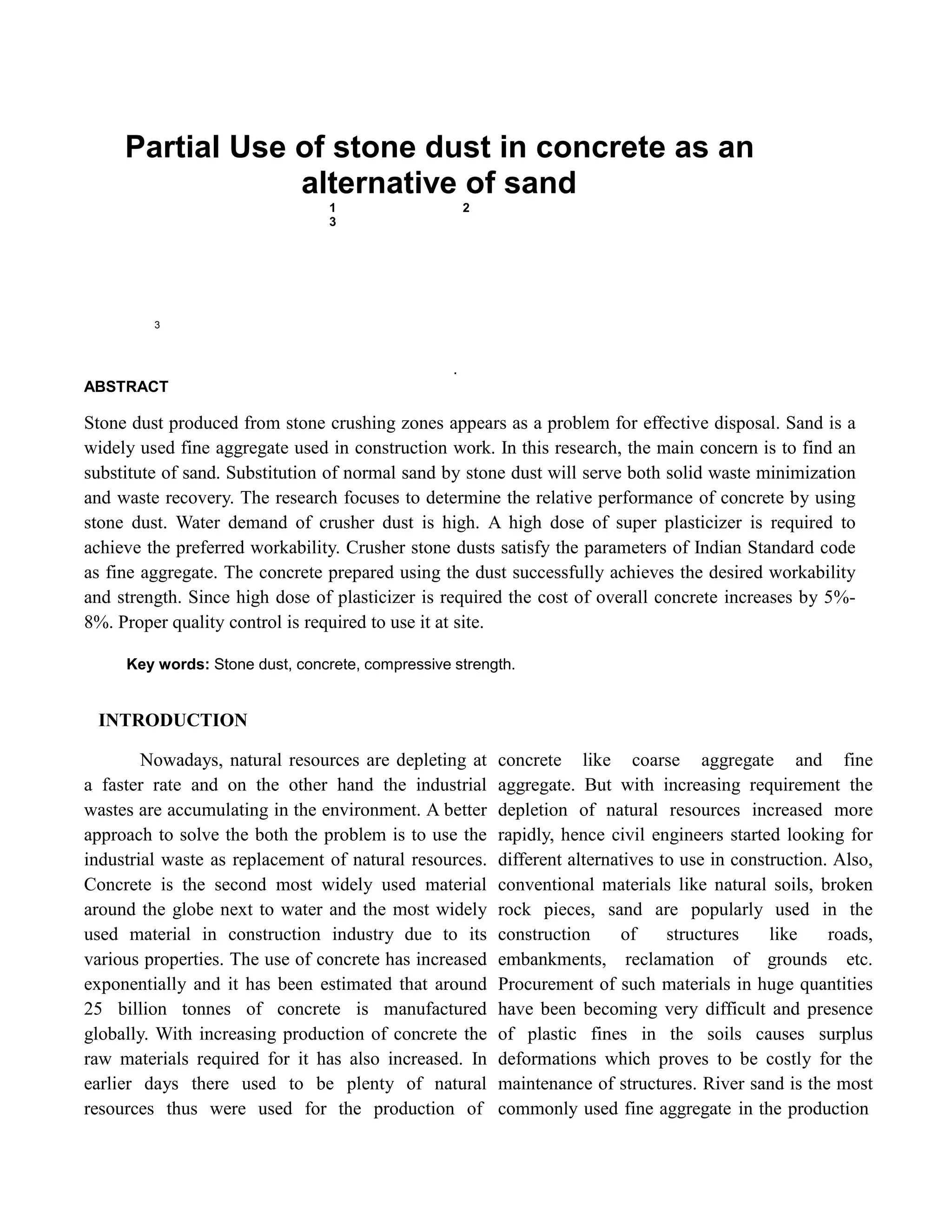
The compressive strength of concrete depends on the
water cement ratio lower be the water cement ratio
higher be the strength and vice-versa. The test is
performed on cubes which are casted using the concrete
and are cured in the curing tank. Cubes are test at 7
days and 28 days. Each time 3 cubes are tested and the
strength is represented as average of the three. So in
general 6 cubes are casted to test the compressive
strength of concrete.
In India the test is performed as per IS 516:1959
which defines the procedure for the complete test
includin sampling, casting, curing and testing. The
size of cubes is 150*150*150 mm. For casting of
the cubes iron moulds are used and compaction is
done. These casted cubes are then stored for curing
in curing tank after demoulding and is finally tested
using Compression Testing Machine (CTM) which
shows the load bearing capacity or failure load for
the cube.
Variation of compressive strength V/S
water cement ratio
WORKABILITY:
It is defined as the virtual ease with
which concrete can be mixed, transported,
moulded and compacted. The degree of
workability required depends on three factors.
These are the size of the section to be
concreted, the amount of reinforcement, and the
method of compaction to be used.
There are three ways to measure the
workability of a fresh concrete
(i). Slump Cone Test
(ii). Compaction Factor Test
(iii). Flow Table Test
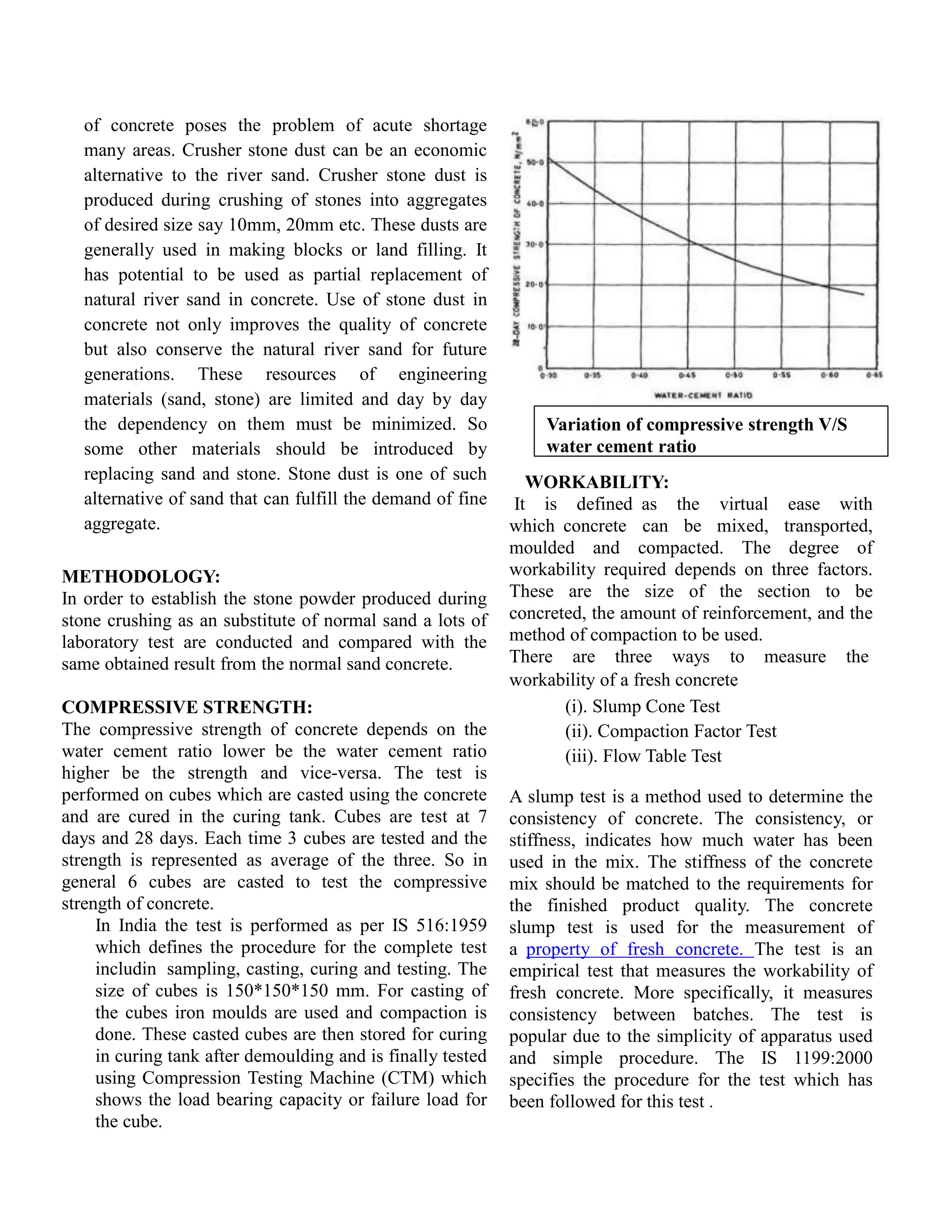
A slump test is a method used to determine the
consistency of concrete. The consistency, or
stiffness, indicates how much water has been
used in the mix. The stiffness of the concrete
mix should be matched to the requirements for
the finished product quality. The concrete
slump test is used for the measurement of
a property of fresh concrete. The test is an
empirical test that measures the workability of
fresh concrete. More specifically, it measures
consistency between batches. The test is
popular due to the simplicity of apparatus used
and simple procedure. The IS 1199:2000
specifies the procedure for the test which has
been followed for this test .
11 3
Slump,
mm
With this observation, there is need to adjust the
workability so that the required workability can be
achieved. There are different approach to improve
1.1.1.
the workability. The following approaches have
been tried to improve the workability and their
limitations are mentioned below
1. Increase water content of concrete
2. Partial replacement of sand
3. Use higher water cement ratio
4. Use of super plasticizers
1. Increase water content of concrete
Workability depends on water, with
increase in water content workability
increases
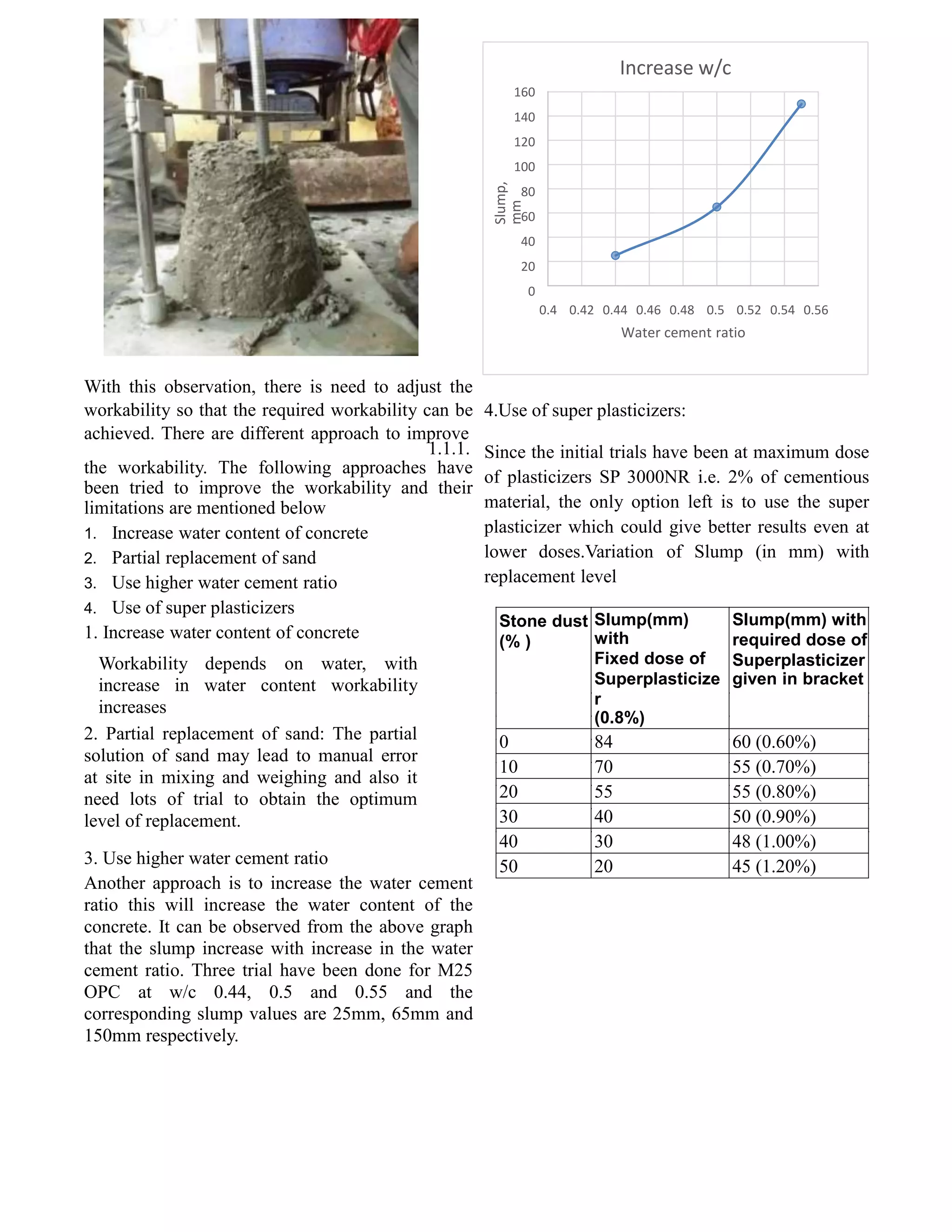
Increase w/c
160
140
120
100
80
60
40
20
0
0.4 0.42 0.44 0.46 0.48 0.5 0.52 0.54 0.56
Water cement ratio
4.Use of super plasticizers:
Since the initial trials have been at maximum dose
of plasticizers SP 3000NR i.e. 2% of cementious
material, the only option left is to use the super
plasticizer which could give better results even at
lower doses.Variation of Slump (in mm) with
replacement level
Stone dust
(% )
Slump(mm)
with
Fixed dose of
Superplasticize
r
(0.8%)
Slump(mm) with
required dose of
Superplasticizer
given in bracket
0 84 60 (0.60%)
10 70 55 (0.70%)
20 55 55 (0.80%)
30 40 50 (0.90%)
40 30 48 (1.00%)
50 20 45 (1.20%)
2. Partial replacement of sand: The partial
solution of sand may lead to manual error
at site in mixing and weighing and also it
need lots of trial to obtain the optimum
level of replacement.
3. Use higher water cement ratio
Another approach is to increase the water cement
ratio this will increase the water content of the
concrete. It can be observed from the above graph
that the slump increase with increase in the water
cement ratio. Three trial have been done for M25
OPC at w/c 0.44, 0.5 and 0.55 and the
corresponding slump values are 25mm, 65mm and
150mm respectively.
compressivestrengthofconcrete
cube(Mpa)
11
5
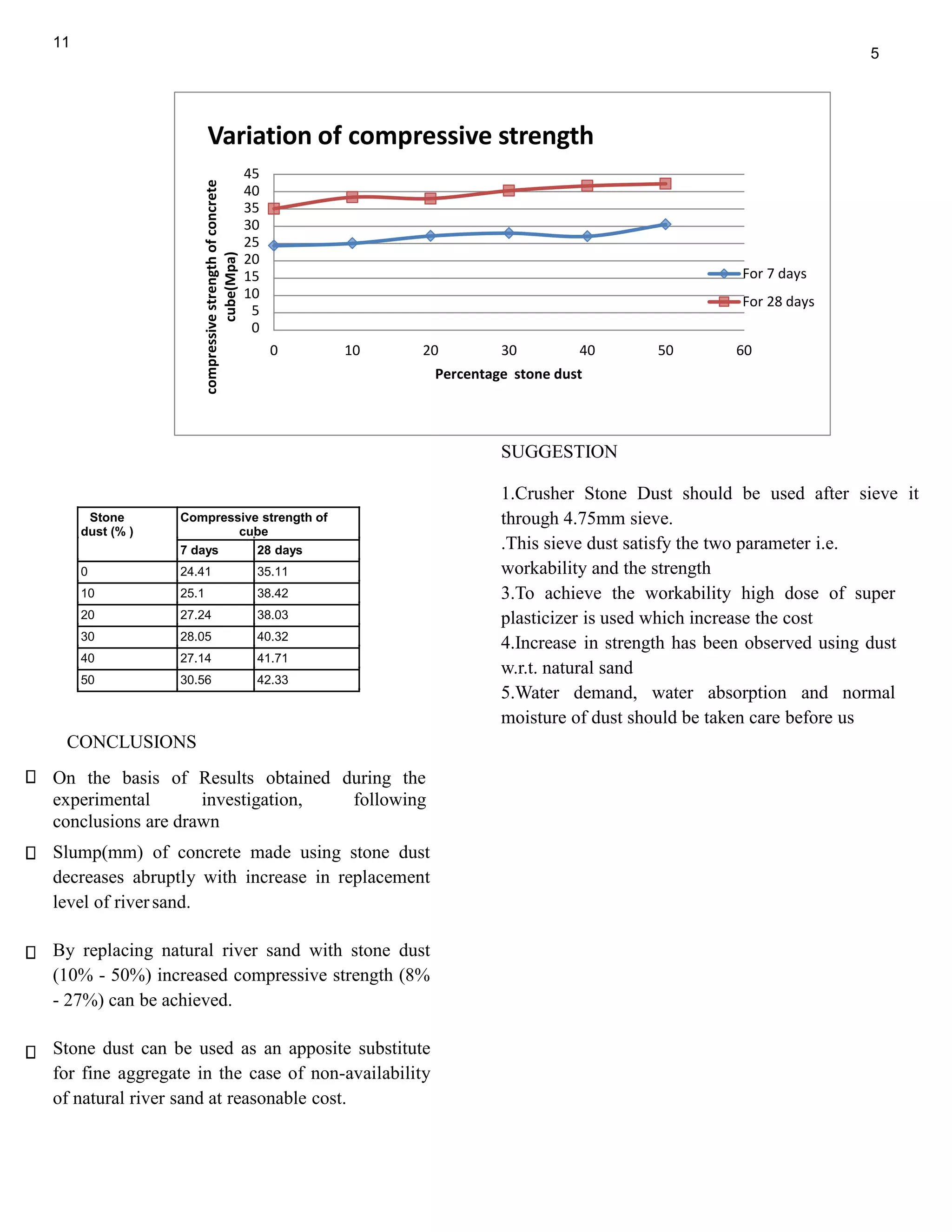
Variation of compressive strength
45
40
35
30
25
20
15
10
5
0
For 7 days
For 28 days
0 10 20 30 40 50 60
CONCLUSIONS
On the basis of Results obtained during the
experimental investigation, following
conclusions are drawn
Slump(mm) of concrete made using stone dust
decreases abruptly with increase in replacement
level of riversand.
By replacing natural river sand with stone dust
(10% - 50%) increased compressive strength (8%
- 27%) can be achieved.
Stone dust can be used as an apposite substitute
for fine aggregate in the case of non-availability
of natural river sand at reasonable cost.
Stone
dust (% )
Compressive strength of
cube
7 days 28 days
0 24.41 35.11
10 25.1 38.42
20 27.24 38.03
30 28.05 40.32
40 27.14 41.71
50 30.56 42.33
Percentage stone dust
SUGGESTION
1.Crusher Stone Dust should be used after sieve it
through 4.75mm sieve.
.This sieve dust satisfy the two parameter i.e.
workability and the strength
3.To achieve the workability high dose of super
plasticizer is used which increase the cost
4.Increase in strength has been observed using dust
w.r.t. natural sand
5.Water demand, water absorption and normal
moisture of dust should be taken care before us
REFERENCES
1. IS 456:2000code of practice for plain and
reinforced concrete.
2. IS 10262:2009
3. IS 383specifications for fine & coarse
aggregate from natural sources for concrete
4. IS 2386 methods of tests for aggregate for
concrete
5. IS 269:1989 – Specification for ordinary
Portland cement, 33 grade
6. IS 383:1970 – Specification for coarse and
fine aggregates from natural sources for
concrete
7. IS: 2250 – compressive strength test for
cement mortar cubes.
8. IS: 269 – specifications for 33 grade OPC.
9. IS: 8112 – specifications for 43 grade OPC.
10. IS: 12269 – specifications for 53 grade OPC.
11. IS 516:1959 Method of test for strength of
concrete
12. IS 650:1991 Specification for standard sand
for testing of cement
13. IS: 4031 – chemical analysis and tests on
cement.
14. IS: 456; 10262; SP 23 – codes for designing
concrete mixes.
15. IS: 9103 – specifications for concrete
admixtures.

Partial Use of stone dust in concrete as an alternative of sand

  • 1.
    1 2 3 3 Partial Useof stone dust in concrete as an alternative of sand ABSTRACT . Stone dust produced from stone crushing zones appears as a problem for effective disposal. Sand is a widely used fine aggregate used in construction work. In this research, the main concern is to find an substitute of sand. Substitution of normal sand by stone dust will serve both solid waste minimization and waste recovery. The research focuses to determine the relative performance of concrete by using stone dust. Water demand of crusher dust is high. A high dose of super plasticizer is required to achieve the preferred workability. Crusher stone dusts satisfy the parameters of Indian Standard code as fine aggregate. The concrete prepared using the dust successfully achieves the desired workability and strength. Since high dose of plasticizer is required the cost of overall concrete increases by 5%- 8%. Proper quality control is required to use it at site. Key words: Stone dust, concrete, compressive strength. INTRODUCTION Nowadays, natural resources are depleting at a faster rate and on the other hand the industrial wastes are accumulating in the environment. A better approach to solve the both the problem is to use the industrial waste as replacement of natural resources. Concrete is the second most widely used material around the globe next to water and the most widely used material in construction industry due to its various properties. The use of concrete has increased exponentially and it has been estimated that around 25 billion tonnes of concrete is manufactured globally. With increasing production of concrete the raw materials required for it has also increased. In earlier days there used to be plenty of natural resources thus were used for the production of concrete like coarse aggregate and fine aggregate. But with increasing requirement the depletion of natural resources increased more rapidly, hence civil engineers started looking for different alternatives to use in construction. Also, conventional materials like natural soils, broken rock pieces, sand are popularly used in the construction of structures like roads, embankments, reclamation of grounds etc. Procurement of such materials in huge quantities have been becoming very difficult and presence of plastic fines in the soils causes surplus deformations which proves to be costly for the maintenance of structures. River sand is the most commonly used fine aggregate in the production
  • 2.
    of concrete posesthe problem of acute shortage many areas. Crusher stone dust can be an economic alternative to the river sand. Crusher stone dust is produced during crushing of stones into aggregates of desired size say 10mm, 20mm etc. These dusts are generally used in making blocks or land filling. It has potential to be used as partial replacement of natural river sand in concrete. Use of stone dust in concrete not only improves the quality of concrete but also conserve the natural river sand for future generations. These resources of engineering materials (sand, stone) are limited and day by day the dependency on them must be minimized. So some other materials should be introduced by replacing sand and stone. Stone dust is one of such alternative of sand that can fulfill the demand of fine aggregate. METHODOLOGY: In order to establish the stone powder produced during stone crushing as an substitute of normal sand a lots of laboratory test are conducted and compared with the same obtained result from the normal sand concrete. COMPRESSIVE STRENGTH: The compressive strength of concrete depends on the water cement ratio lower be the water cement ratio higher be the strength and vice-versa. The test is performed on cubes which are casted using the concrete and are cured in the curing tank. Cubes are test at 7 days and 28 days. Each time 3 cubes are tested and the strength is represented as average of the three. So in general 6 cubes are casted to test the compressive strength of concrete. In India the test is performed as per IS 516:1959 which defines the procedure for the complete test includin sampling, casting, curing and testing. The size of cubes is 150*150*150 mm. For casting of the cubes iron moulds are used and compaction is done. These casted cubes are then stored for curing in curing tank after demoulding and is finally tested using Compression Testing Machine (CTM) which shows the load bearing capacity or failure load for the cube. Variation of compressive strength V/S water cement ratio WORKABILITY: It is defined as the virtual ease with which concrete can be mixed, transported, moulded and compacted. The degree of workability required depends on three factors. These are the size of the section to be concreted, the amount of reinforcement, and the method of compaction to be used. There are three ways to measure the workability of a fresh concrete (i). Slump Cone Test (ii). Compaction Factor Test (iii). Flow Table Test A slump test is a method used to determine the consistency of concrete. The consistency, or stiffness, indicates how much water has been used in the mix. The stiffness of the concrete mix should be matched to the requirements for the finished product quality. The concrete slump test is used for the measurement of a property of fresh concrete. The test is an empirical test that measures the workability of fresh concrete. More specifically, it measures consistency between batches. The test is popular due to the simplicity of apparatus used and simple procedure. The IS 1199:2000 specifies the procedure for the test which has been followed for this test .
  • 3.
  • 4.
    Slump, mm With this observation,there is need to adjust the workability so that the required workability can be achieved. There are different approach to improve 1.1.1. the workability. The following approaches have been tried to improve the workability and their limitations are mentioned below 1. Increase water content of concrete 2. Partial replacement of sand 3. Use higher water cement ratio 4. Use of super plasticizers 1. Increase water content of concrete Workability depends on water, with increase in water content workability increases Increase w/c 160 140 120 100 80 60 40 20 0 0.4 0.42 0.44 0.46 0.48 0.5 0.52 0.54 0.56 Water cement ratio 4.Use of super plasticizers: Since the initial trials have been at maximum dose of plasticizers SP 3000NR i.e. 2% of cementious material, the only option left is to use the super plasticizer which could give better results even at lower doses.Variation of Slump (in mm) with replacement level Stone dust (% ) Slump(mm) with Fixed dose of Superplasticize r (0.8%) Slump(mm) with required dose of Superplasticizer given in bracket 0 84 60 (0.60%) 10 70 55 (0.70%) 20 55 55 (0.80%) 30 40 50 (0.90%) 40 30 48 (1.00%) 50 20 45 (1.20%) 2. Partial replacement of sand: The partial solution of sand may lead to manual error at site in mixing and weighing and also it need lots of trial to obtain the optimum level of replacement. 3. Use higher water cement ratio Another approach is to increase the water cement ratio this will increase the water content of the concrete. It can be observed from the above graph that the slump increase with increase in the water cement ratio. Three trial have been done for M25 OPC at w/c 0.44, 0.5 and 0.55 and the corresponding slump values are 25mm, 65mm and 150mm respectively.
  • 5.
    compressivestrengthofconcrete cube(Mpa) 11 5 Variation of compressivestrength 45 40 35 30 25 20 15 10 5 0 For 7 days For 28 days 0 10 20 30 40 50 60 CONCLUSIONS On the basis of Results obtained during the experimental investigation, following conclusions are drawn Slump(mm) of concrete made using stone dust decreases abruptly with increase in replacement level of riversand. By replacing natural river sand with stone dust (10% - 50%) increased compressive strength (8% - 27%) can be achieved. Stone dust can be used as an apposite substitute for fine aggregate in the case of non-availability of natural river sand at reasonable cost. Stone dust (% ) Compressive strength of cube 7 days 28 days 0 24.41 35.11 10 25.1 38.42 20 27.24 38.03 30 28.05 40.32 40 27.14 41.71 50 30.56 42.33 Percentage stone dust SUGGESTION 1.Crusher Stone Dust should be used after sieve it through 4.75mm sieve. .This sieve dust satisfy the two parameter i.e. workability and the strength 3.To achieve the workability high dose of super plasticizer is used which increase the cost 4.Increase in strength has been observed using dust w.r.t. natural sand 5.Water demand, water absorption and normal moisture of dust should be taken care before us
  • 6.
    REFERENCES 1. IS 456:2000codeof practice for plain and reinforced concrete. 2. IS 10262:2009 3. IS 383specifications for fine & coarse aggregate from natural sources for concrete 4. IS 2386 methods of tests for aggregate for concrete 5. IS 269:1989 – Specification for ordinary Portland cement, 33 grade 6. IS 383:1970 – Specification for coarse and fine aggregates from natural sources for concrete 7. IS: 2250 – compressive strength test for cement mortar cubes. 8. IS: 269 – specifications for 33 grade OPC. 9. IS: 8112 – specifications for 43 grade OPC. 10. IS: 12269 – specifications for 53 grade OPC. 11. IS 516:1959 Method of test for strength of concrete 12. IS 650:1991 Specification for standard sand for testing of cement 13. IS: 4031 – chemical analysis and tests on cement. 14. IS: 456; 10262; SP 23 – codes for designing concrete mixes. 15. IS: 9103 – specifications for concrete admixtures.