In-Situ Concrete, Formwork
& Reinforcement - II
BE-1111 Building Design and Construction II
Level-1, Semester-2
Dr. Thilini Jayawickrama
Slump test
• Measure wetness or stiffness of concrete - workability
• Indirect measurement of consistency
Method
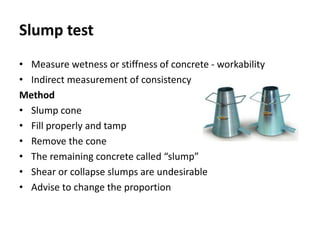
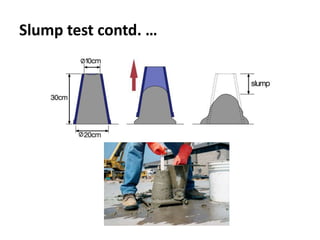
• Slump cone
• Fill properly and tamp
• Remove the cone
• The remaining concrete called “slump”
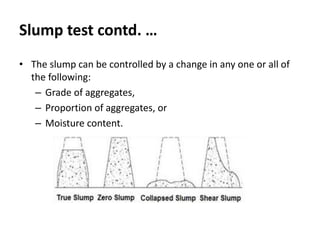
• Shear or collapse slumps are undesirable
• Advise to change the proportion
Slump test contd. …
Slump test contd. …
• The slump can be controlled by a change in any one or all of
the following:
– Grade of aggregates,
– Proportion of aggregates, or
– Moisture content.
Cube test
• Test for compressive strength
• Steel/cast iron molds in cubical shape
• Tamping rod
• Suitable identification number for each sample
• Soak in water for curing
• Test on a compression testing machine
• For 3, 7, 28 days
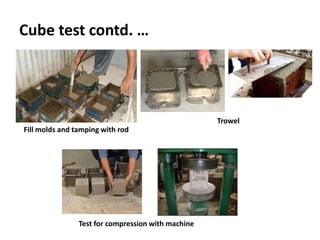
Cube test contd. …
Fill molds and tamping with rod
Trowel
Test for compression with machine
Classification of Concrete
By Strength
• Grade (N/mm2)
• In general at 28 days
By composition
• Normal weight concrete
• Lightweight concrete
Special types of concrete
• Hot weather concrete
• Self-compacted concrete
• Pumped concrete
Lightweight concrete
• Normal concrete has a considerable self-weight (density 2200-2600
kg/m3)
• Increase the size of building elements – uneconomical
• Reduce the self-weight and increase the efficiency
– Low-density concrete (non-structural purposes) (density 300-800
kg/m3)
– Structural lightweight concrete (density 1350-1900 kg/m3)
• The compressive strength is not as great as ordinary concrete
• Methods of production
– By replacing usual aggregate with lightweight aggregate
– By Introducing gas or air bubbles into the mortar
– By omitting the fine aggregate fraction - no-fines concrete
Lightweight concrete contd. …
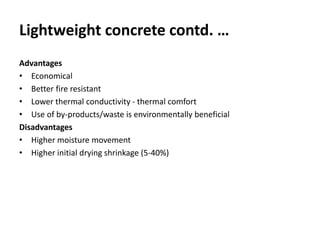
Advantages
• Economical
• Better fire resistant
• Lower thermal conductivity - thermal comfort
• Use of by-products/waste is environmentally beneficial
Disadvantages
• Higher moisture movement
• Higher initial drying shrinkage (5-40%)
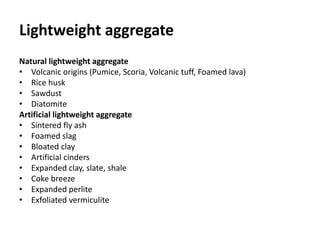
Lightweight aggregate
Natural lightweight aggregate
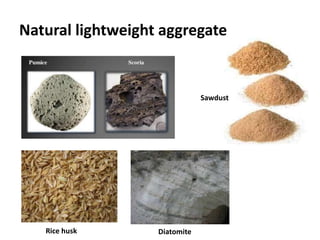
• Volcanic origins (Pumice, Scoria, Volcanic tuff, Foamed lava)
• Rice husk
• Sawdust
• Diatomite
Artificial lightweight aggregate
• Sintered fly ash
• Foamed slag
• Bloated clay
• Artificial cinders
• Expanded clay, slate, shale
• Coke breeze
• Expanded perlite
• Exfoliated vermiculite
Natural lightweight aggregate
Sawdust
Rice husk Diatomite
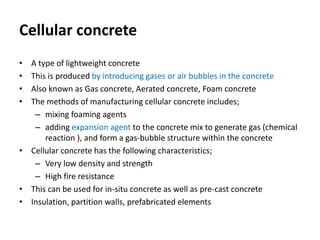
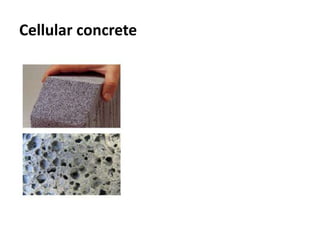
Cellular concrete
• A type of lightweight concrete
• This is produced by introducing gases or air bubbles in the concrete
• Also known as Gas concrete, Aerated concrete, Foam concrete
• The methods of manufacturing cellular concrete includes;
– mixing foaming agents
– adding expansion agent to the concrete mix to generate gas (chemical
reaction ), and form a gas-bubble structure within the concrete
• Cellular concrete has the following characteristics;
– Very low density and strength
– High fire resistance
• This can be used for in-situ concrete as well as pre-cast concrete
• Insulation, partition walls, prefabricated elements
Cellular concrete
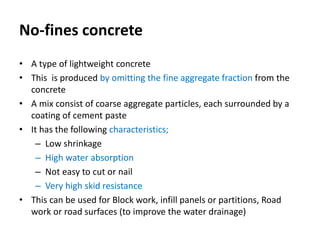
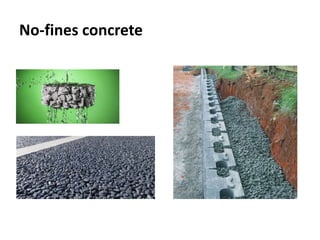
No-fines concrete
• A type of lightweight concrete
• This is produced by omitting the fine aggregate fraction from the
concrete
• A mix consist of coarse aggregate particles, each surrounded by a
coating of cement paste
• It has the following characteristics;
– Low shrinkage
– High water absorption
– Not easy to cut or nail
– Very high skid resistance
• This can be used for Block work, infill panels or partitions, Road
work or road surfaces (to improve the water drainage)
No-fines concrete
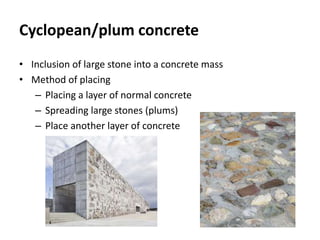
Cyclopean/plum concrete
• Inclusion of large stone into a concrete mass
• Method of placing
– Placing a layer of normal concrete
– Spreading large stones (plums)
– Place another layer of concrete
Hot weather concrete
• Recommended temperature for concrete mixing is 27+/- 20C
• Not possible to hold construction during hot weather
Problems with concrete in hot weather
Fresh concrete
• Quick settlement creates problems in pouring, compaction, and
finishing
Hardened concrete
• Likelihood of shrinkage cracks due to difference in temperature
between a concrete element and rest of the building or within the
same section
• Reduced durability, probability of corrosion of reinforcement bars
due to cracks
• Colour difference of the outer concrete surface due to different
hydration rates
Hot weather concrete contd. …
• Use cement types with slower rates of dehydration
• Use cold water
• Use low heat cement
• Storing aggregate in a shaded area
• Continuous spraying of water into aggregate
Self-compacted concrete
• This type of concrete is independent of workers’ performance
in compaction
• Self-compaction by means of self-weight of concrete
• Compact into every corner of formwork
Benefits
• Shorter construction period
• Assuring compaction in confined parts where vibrating
compaction is difficult
• Eliminate noise during compaction
Pumped concrete
• Pump a Ready- mixed concrete
• Pre-planning is required
– Pump volume
– Pressure capability
– Pipeline diameter
– Horizontal and vertical distance to be pumped
• Quality is important to ensure uniformity
• Precautions for hot/cold extreme weather conditions
• Workability of concrete affects pumping (Slumps 50 –
150mm)
Pumped concrete contd. …
Coarse aggregate
• Maximum size should be considered (limited to 1/3 of the
smallest inside diameter of the pipeline)
• Content to be reduced
Fine aggregate
• Together with cement and water, fine aggregate provides the
mortar (fluid) to convey coarse aggregate in suspension
Water
• Affects workability
Admixtures
• Those which are increasing workability will improve the ability
to pump
Concrete properties
Workability and Consistency
• Consistency is the fluidity or wetness indicating workability
• Fresh concrete should be easy to mix, transport, place,
compact and finish
• Workability is often considered to be a measure of the work
needed to compact the wet concrete.
• But it is also used to quantify the ease with which concrete
can be placed, although this depends on other properties
such as cohesiveness.
• The workability of the mix is determined by the slump test.
• It must retain free from segregation during these operations
Concrete properties contd. …
Segregation
• Segregation is the tendency for coarse aggregate to separate
from the sand-cement mortar
• This results in part of the batch having too little coarse
aggregate (likely to shrink more) and the remainder having
too much (poor resistance to abrasion)
• The method and equipment used to transport and handle the
concrete must not result in segregation of the concrete
materials
• When placing concrete, segregation can occur when mortar
tends to flow ahead of coarse materials
Concrete properties
Uniformity
• Degree of homogeneity or state of distribution within the
mix.
Testing uniformity
• Two samples are taken and concrete properties are
determined from each sample.
– First sample of concrete - when approximately 15% of the total
batch has been discharged
– Second sample of concrete - when approximately 85% of the
total batch has been discharged
• The properties of two samples are then compared to each
other and the property differences are determined.
Concrete properties contd. …
Bleeding
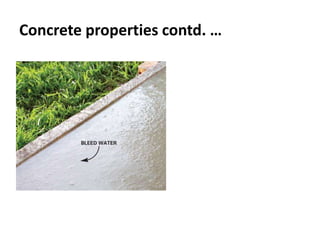
• Bleeding is the tendency of water to rise to the surface of
freshly placed concrete
• Develop a layer of water at the top or surface
• It is caused by the settlement of solid particles (cementing
materials and aggregate) and simultaneous upward migration
of water
• Inability of solid particles of the mixture to hold the water
amount as they settle down
• Bleeding is normal and it should not diminish the quality of
properly placed, finished, and cured concrete
Concrete properties contd. …
Bleeding contd. …
• Excessive bleeding increases the water-cement ratio near the
top surface
• Poor durability particularly if finishing operations take place
while bleed water is present
• Water rising to the top surface carries fine particles
• a weak top layer with poor durability
• not resistance to abrasion
• A water pocket or void can develop under a prematurely
finished concrete
Concrete properties contd. …
Types of Cement
Ordinary Portland Cement (OPC)
• The most common type due to suitability for many types of works
• It has medium type setting and hardening time
Rapid Hardening Portland Cement
• Sets faster than OPC
• This type is used for quick construction where speed is very critical
Sulphate Resisting Portland Cement
• It has better resistance to Sulphate attack than OPC
• This type is suitable for marine structures and foundations which built in
soils having high risk of Sulphate attack
Low Heat Portland Cement
• Suitable for mass concrete
• Fineness is higher than OPC and has lesser early strength
Types of Cement contd. …
High Alumina Cement
• It has very good resistivity for Sulphate but weak in acids
• The water requirement for hydration is higher (about twice) than in
OPC
Supersulphated Cement
• This is suitable for mass concrete work due to its low heat
generation during the hydration
• This type has resistance to chemicals
Portland Blast Furnace Cement
• This also generates less heat than OPC and has high resistivity to
Sulphate
White Cement
• Metal oxides, primarily iron and manganese
• This is expensive than OPC but not strong as OPC
Admixtures
• Admixtures may be used to modify the properties of the concrete to make
it better serve its intended use or for better economic reasons.
Retarding admixtures
• Slow down the hydration of cement, lengthening set time
• Suitable for hot weather conditions
• Most retarders also act as water reducers (frequently called water-
reducing retarders)
Accelerating admixtures
• Shorten set time of concrete
• Allowing cold-weather pour
• Facilitate early removal of formwork, early surface finishes, and
sometimes early load application
• Drying shrinkages of concrete can be increase – care must be taken while
selecting type and proportion of accelerators
Admixtures contd. …
Super plasticizers
• Also known as plasticizers
• Includes water-reducing admixtures
• These are “high range water reducers”
• Allow large water reduction
• Gives great flowability without substantially slowing set time or increasing
air entrainment
• They can maintain a specific consistency and workability at a greatly
reduced amount of water
Water reducing admixtures
• Require less water to make a concrete of equal slump, or increase the
slump of concrete at the same water content
• They can have the side effect of changing initial set time
• Mostly used in hot weather concrete placing and for pumping
Admixtures contd. …
Air-entraining admixtures
• Entrain small air bubbles in the concrete
• While some loss of strength typically accompanies increase air in
concrete, it generally can be overcome by reducing the water-
cement ratio via improved workability (due to air-entraining agent
itself) or by using other appropriate admixtures
Quality assurance
• Concrete with high quality and to the required international
standard and project specification
• Calibrate laboratory devices periodically
• Obtain samples correctly according to the standard
specifications
• Perform and review tests based on the quality system
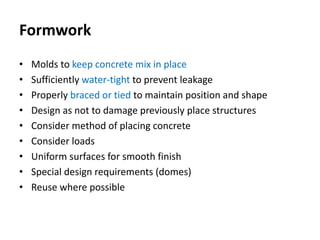
Formwork
• Molds to keep concrete mix in place
• Sufficiently water-tight to prevent leakage
• Properly braced or tied to maintain position and shape
• Design as not to damage previously place structures
• Consider method of placing concrete
• Consider loads
• Uniform surfaces for smooth finish
• Special design requirements (domes)
• Reuse where possible
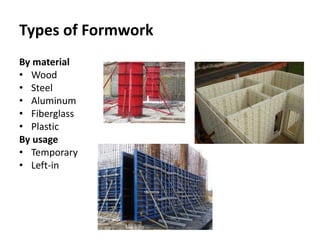
Types of Formwork
By material
• Wood
• Steel
• Aluminum
• Fiberglass
• Plastic
By usage
• Temporary
• Left-in
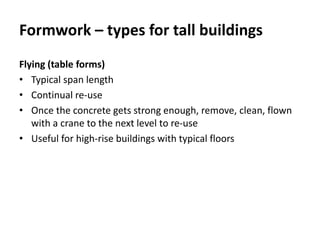
Formwork – types for tall buildings
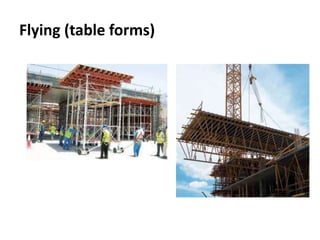
Flying (table forms)
• Typical span length
• Continual re-use
• Once the concrete gets strong enough, remove, clean, flown
with a crane to the next level to re-use
• Useful for high-rise buildings with typical floors
Flying (table forms)
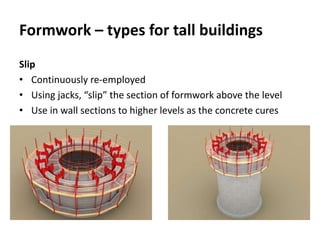
Formwork – types for tall buildings
Slip
• Continuously re-employed
• Using jacks, “slip” the section of formwork above the level
• Use in wall sections to higher levels as the concrete cures

2. Concrete.pptx

  • 1.
    In-Situ Concrete, Formwork &Reinforcement - II BE-1111 Building Design and Construction II Level-1, Semester-2 Dr. Thilini Jayawickrama
  • 2.
    Slump test • Measurewetness or stiffness of concrete - workability • Indirect measurement of consistency Method • Slump cone • Fill properly and tamp • Remove the cone • The remaining concrete called “slump” • Shear or collapse slumps are undesirable • Advise to change the proportion
  • 3.
  • 4.
    Slump test contd.… • The slump can be controlled by a change in any one or all of the following: – Grade of aggregates, – Proportion of aggregates, or – Moisture content.
  • 5.
    Cube test • Testfor compressive strength • Steel/cast iron molds in cubical shape • Tamping rod • Suitable identification number for each sample • Soak in water for curing • Test on a compression testing machine • For 3, 7, 28 days
  • 6.
    Cube test contd.… Fill molds and tamping with rod Trowel Test for compression with machine
  • 7.
    Classification of Concrete ByStrength • Grade (N/mm2) • In general at 28 days By composition • Normal weight concrete • Lightweight concrete Special types of concrete • Hot weather concrete • Self-compacted concrete • Pumped concrete
  • 8.
    Lightweight concrete • Normalconcrete has a considerable self-weight (density 2200-2600 kg/m3) • Increase the size of building elements – uneconomical • Reduce the self-weight and increase the efficiency – Low-density concrete (non-structural purposes) (density 300-800 kg/m3) – Structural lightweight concrete (density 1350-1900 kg/m3) • The compressive strength is not as great as ordinary concrete • Methods of production – By replacing usual aggregate with lightweight aggregate – By Introducing gas or air bubbles into the mortar – By omitting the fine aggregate fraction - no-fines concrete
  • 9.
    Lightweight concrete contd.… Advantages • Economical • Better fire resistant • Lower thermal conductivity - thermal comfort • Use of by-products/waste is environmentally beneficial Disadvantages • Higher moisture movement • Higher initial drying shrinkage (5-40%)
  • 10.
    Lightweight aggregate Natural lightweightaggregate • Volcanic origins (Pumice, Scoria, Volcanic tuff, Foamed lava) • Rice husk • Sawdust • Diatomite Artificial lightweight aggregate • Sintered fly ash • Foamed slag • Bloated clay • Artificial cinders • Expanded clay, slate, shale • Coke breeze • Expanded perlite • Exfoliated vermiculite
  • 11.
  • 12.
    Cellular concrete • Atype of lightweight concrete • This is produced by introducing gases or air bubbles in the concrete • Also known as Gas concrete, Aerated concrete, Foam concrete • The methods of manufacturing cellular concrete includes; – mixing foaming agents – adding expansion agent to the concrete mix to generate gas (chemical reaction ), and form a gas-bubble structure within the concrete • Cellular concrete has the following characteristics; – Very low density and strength – High fire resistance • This can be used for in-situ concrete as well as pre-cast concrete • Insulation, partition walls, prefabricated elements
  • 13.
  • 14.
    No-fines concrete • Atype of lightweight concrete • This is produced by omitting the fine aggregate fraction from the concrete • A mix consist of coarse aggregate particles, each surrounded by a coating of cement paste • It has the following characteristics; – Low shrinkage – High water absorption – Not easy to cut or nail – Very high skid resistance • This can be used for Block work, infill panels or partitions, Road work or road surfaces (to improve the water drainage)
  • 15.
  • 16.
    Cyclopean/plum concrete • Inclusionof large stone into a concrete mass • Method of placing – Placing a layer of normal concrete – Spreading large stones (plums) – Place another layer of concrete
  • 17.
    Hot weather concrete •Recommended temperature for concrete mixing is 27+/- 20C • Not possible to hold construction during hot weather Problems with concrete in hot weather Fresh concrete • Quick settlement creates problems in pouring, compaction, and finishing Hardened concrete • Likelihood of shrinkage cracks due to difference in temperature between a concrete element and rest of the building or within the same section • Reduced durability, probability of corrosion of reinforcement bars due to cracks • Colour difference of the outer concrete surface due to different hydration rates
  • 18.
    Hot weather concretecontd. … • Use cement types with slower rates of dehydration • Use cold water • Use low heat cement • Storing aggregate in a shaded area • Continuous spraying of water into aggregate
  • 19.
    Self-compacted concrete • Thistype of concrete is independent of workers’ performance in compaction • Self-compaction by means of self-weight of concrete • Compact into every corner of formwork Benefits • Shorter construction period • Assuring compaction in confined parts where vibrating compaction is difficult • Eliminate noise during compaction
  • 20.
    Pumped concrete • Pumpa Ready- mixed concrete • Pre-planning is required – Pump volume – Pressure capability – Pipeline diameter – Horizontal and vertical distance to be pumped • Quality is important to ensure uniformity • Precautions for hot/cold extreme weather conditions • Workability of concrete affects pumping (Slumps 50 – 150mm)
  • 21.
    Pumped concrete contd.… Coarse aggregate • Maximum size should be considered (limited to 1/3 of the smallest inside diameter of the pipeline) • Content to be reduced Fine aggregate • Together with cement and water, fine aggregate provides the mortar (fluid) to convey coarse aggregate in suspension Water • Affects workability Admixtures • Those which are increasing workability will improve the ability to pump
  • 22.
    Concrete properties Workability andConsistency • Consistency is the fluidity or wetness indicating workability • Fresh concrete should be easy to mix, transport, place, compact and finish • Workability is often considered to be a measure of the work needed to compact the wet concrete. • But it is also used to quantify the ease with which concrete can be placed, although this depends on other properties such as cohesiveness. • The workability of the mix is determined by the slump test. • It must retain free from segregation during these operations
  • 23.
    Concrete properties contd.… Segregation • Segregation is the tendency for coarse aggregate to separate from the sand-cement mortar • This results in part of the batch having too little coarse aggregate (likely to shrink more) and the remainder having too much (poor resistance to abrasion) • The method and equipment used to transport and handle the concrete must not result in segregation of the concrete materials • When placing concrete, segregation can occur when mortar tends to flow ahead of coarse materials
  • 24.
    Concrete properties Uniformity • Degreeof homogeneity or state of distribution within the mix. Testing uniformity • Two samples are taken and concrete properties are determined from each sample. – First sample of concrete - when approximately 15% of the total batch has been discharged – Second sample of concrete - when approximately 85% of the total batch has been discharged • The properties of two samples are then compared to each other and the property differences are determined.
  • 25.
    Concrete properties contd.… Bleeding • Bleeding is the tendency of water to rise to the surface of freshly placed concrete • Develop a layer of water at the top or surface • It is caused by the settlement of solid particles (cementing materials and aggregate) and simultaneous upward migration of water • Inability of solid particles of the mixture to hold the water amount as they settle down • Bleeding is normal and it should not diminish the quality of properly placed, finished, and cured concrete
  • 26.
    Concrete properties contd.… Bleeding contd. … • Excessive bleeding increases the water-cement ratio near the top surface • Poor durability particularly if finishing operations take place while bleed water is present • Water rising to the top surface carries fine particles • a weak top layer with poor durability • not resistance to abrasion • A water pocket or void can develop under a prematurely finished concrete
  • 27.
  • 28.
    Types of Cement OrdinaryPortland Cement (OPC) • The most common type due to suitability for many types of works • It has medium type setting and hardening time Rapid Hardening Portland Cement • Sets faster than OPC • This type is used for quick construction where speed is very critical Sulphate Resisting Portland Cement • It has better resistance to Sulphate attack than OPC • This type is suitable for marine structures and foundations which built in soils having high risk of Sulphate attack Low Heat Portland Cement • Suitable for mass concrete • Fineness is higher than OPC and has lesser early strength
  • 29.
    Types of Cementcontd. … High Alumina Cement • It has very good resistivity for Sulphate but weak in acids • The water requirement for hydration is higher (about twice) than in OPC Supersulphated Cement • This is suitable for mass concrete work due to its low heat generation during the hydration • This type has resistance to chemicals Portland Blast Furnace Cement • This also generates less heat than OPC and has high resistivity to Sulphate White Cement • Metal oxides, primarily iron and manganese • This is expensive than OPC but not strong as OPC
  • 30.
    Admixtures • Admixtures maybe used to modify the properties of the concrete to make it better serve its intended use or for better economic reasons. Retarding admixtures • Slow down the hydration of cement, lengthening set time • Suitable for hot weather conditions • Most retarders also act as water reducers (frequently called water- reducing retarders) Accelerating admixtures • Shorten set time of concrete • Allowing cold-weather pour • Facilitate early removal of formwork, early surface finishes, and sometimes early load application • Drying shrinkages of concrete can be increase – care must be taken while selecting type and proportion of accelerators
  • 31.
    Admixtures contd. … Superplasticizers • Also known as plasticizers • Includes water-reducing admixtures • These are “high range water reducers” • Allow large water reduction • Gives great flowability without substantially slowing set time or increasing air entrainment • They can maintain a specific consistency and workability at a greatly reduced amount of water Water reducing admixtures • Require less water to make a concrete of equal slump, or increase the slump of concrete at the same water content • They can have the side effect of changing initial set time • Mostly used in hot weather concrete placing and for pumping
  • 32.
    Admixtures contd. … Air-entrainingadmixtures • Entrain small air bubbles in the concrete • While some loss of strength typically accompanies increase air in concrete, it generally can be overcome by reducing the water- cement ratio via improved workability (due to air-entraining agent itself) or by using other appropriate admixtures
  • 33.
    Quality assurance • Concretewith high quality and to the required international standard and project specification • Calibrate laboratory devices periodically • Obtain samples correctly according to the standard specifications • Perform and review tests based on the quality system
  • 34.
    Formwork • Molds tokeep concrete mix in place • Sufficiently water-tight to prevent leakage • Properly braced or tied to maintain position and shape • Design as not to damage previously place structures • Consider method of placing concrete • Consider loads • Uniform surfaces for smooth finish • Special design requirements (domes) • Reuse where possible
  • 35.
    Types of Formwork Bymaterial • Wood • Steel • Aluminum • Fiberglass • Plastic By usage • Temporary • Left-in
  • 36.
    Formwork – typesfor tall buildings Flying (table forms) • Typical span length • Continual re-use • Once the concrete gets strong enough, remove, clean, flown with a crane to the next level to re-use • Useful for high-rise buildings with typical floors
  • 37.
  • 38.
    Formwork – typesfor tall buildings Slip • Continuously re-employed • Using jacks, “slip” the section of formwork above the level • Use in wall sections to higher levels as the concrete cures