



GENERAL
PRESENTATION
SUBMITTED BY:-
Neeraj Dhiman
GESTURE
RECOGNITION
TECHNOLOGY
CONTENT
 HISTORY
 INTRODUCTION
 USES
 INPUT DEVICES
 CORE COMPETENCY
 EXAMPLES
 NEW DEVELOPMENTS
 CONCLUSION
HISTORY
In the early 1960s, users could move a light-emitting pen to
control the Sketchpad computer-aided design system. Several
subsequent commercial systems also worked with light-emitting
pens. Research into camera-based computer vision for gesture
recognition began in earnest in the early 1990s at places such
as the Massachusetts Institute of Technology Media Lab,
Japan’s Advanced Telecommunications Re- search Institute
International, and the University of Zurich. Since then, a few
companies have sold gesture-recognition software. Until now,
though, the technology hasn’t had a significant commercial
impact.
INTRODUCTION
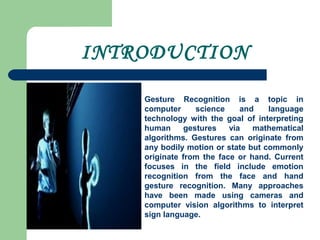
Gesture Recognition is a topic in
computer science and language
technology with the goal of interpreting
human gestures via mathematical
algorithms. Gestures can originate from
any bodily motion or state but commonly
originate from the face or hand. Current
focuses in the field include emotion
recognition from the face and hand
gesture recognition. Many approaches
have been made using cameras and
computer vision algorithms to interpret
sign language.
USES OF GESTURE
RECOGNITION
TECHNOLOGY
 Sign language recognition
 Directional indication through pointing
 Control through facial gestures
 Alternative computer interfaces
 Immersive game technology
 Virtual controllers
 Affective computing
INPUT DEVICES
 Depth-aware cameras.
 Stereo cameras.
 Controller-based gestures.
 Single camera
CORE COMPETENCY
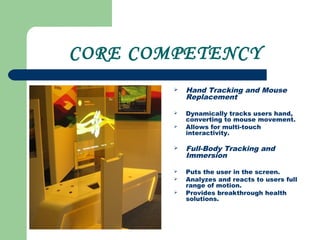
 Hand Tracking and Mouse
Replacement
 Dynamically tracks users hand,
converting to mouse movement.
 Allows for multi-touch
interactivity.
 Full-Body Tracking and
Immersion
 Puts the user in the screen.
 Analyzes and reacts to users full
range of motion.
 Provides breakthrough health
solutions.
SOME EXAMPLE
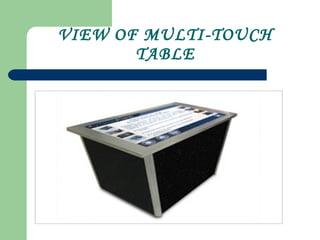
MULTI-TOUCH TABLE
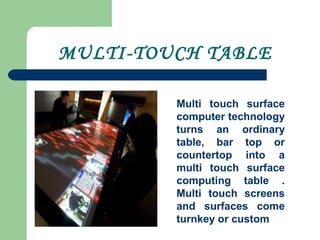
Multi touch surface
computer technology
turns an ordinary
table, bar top or
countertop into a
multi touch surface
computing table .
Multi touch screens
and surfaces come
turnkey or custom
VIEW OF MULTI-TOUCH
TABLE
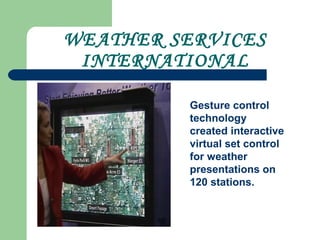
WEATHER SERVICES
INTERNATIONAL
Gesture control
technology
created interactive
virtual set control
for weather
presentations on
120 stations.
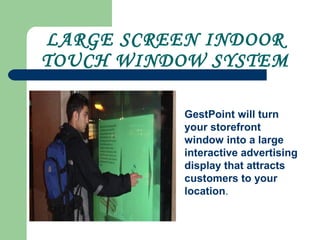
LARGE SCREEN INDOOR
TOUCH WINDOW SYSTEM
GestPoint will turn
your storefront
window into a large
interactive advertising
display that attracts
customers to your
location.
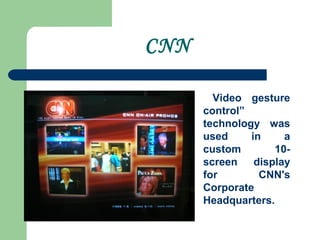
CNN
Video gesture
control”
technology was
used in a
custom 10-
screen display
for CNN's
Corporate
Headquarters.
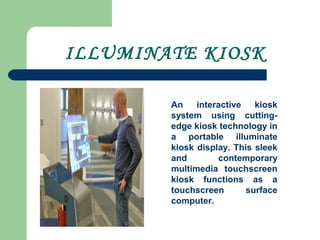
ILLUMINATE KIOSK
An interactive kiosk
system using cutting-
edge kiosk technology in
a portable illuminate
kiosk display. This sleek
and contemporary
multimedia touchscreen
kiosk functions as a
touchscreen surface
computer.
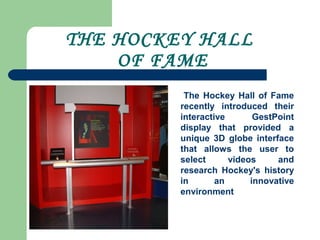
THE HOCKEY HALL
OF FAME
The Hockey Hall of Fame
recently introduced their
interactive GestPoint
display that provided a
unique 3D globe interface
that allows the user to
select videos and
research Hockey's history
in an innovative
environment
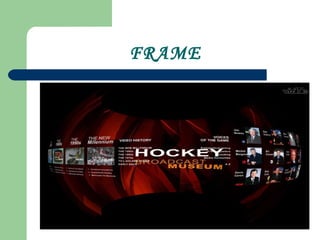
FRAME
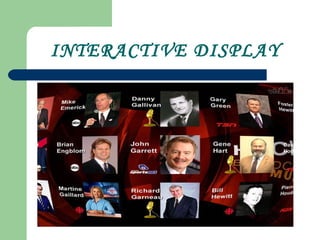
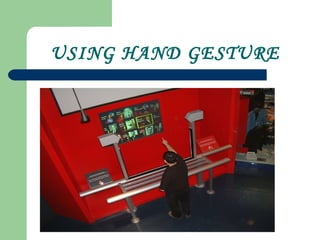
INTERACTIVE DISPLAY
USING HAND GESTURE
NEW DEVLOPMENTS
 Processing costs have decreased
considerably over time
 Combine image- and device-based
techniques
CONCLUSION
Now we observe that Gesture Recognitions
technology is suitable for any size of
organization. And it is fifty time faster then
other media for interaction with computer like
keyboard, trackball, joysticks, spring wheel,
mouse, digital pen.
THANK YOU

Gesture Recognation

  • 1.
  • 2.
  • 3.
    CONTENT  HISTORY  INTRODUCTION USES  INPUT DEVICES  CORE COMPETENCY  EXAMPLES  NEW DEVELOPMENTS  CONCLUSION
  • 4.
    HISTORY In the early1960s, users could move a light-emitting pen to control the Sketchpad computer-aided design system. Several subsequent commercial systems also worked with light-emitting pens. Research into camera-based computer vision for gesture recognition began in earnest in the early 1990s at places such as the Massachusetts Institute of Technology Media Lab, Japan’s Advanced Telecommunications Re- search Institute International, and the University of Zurich. Since then, a few companies have sold gesture-recognition software. Until now, though, the technology hasn’t had a significant commercial impact.
  • 5.
    INTRODUCTION Gesture Recognition isa topic in computer science and language technology with the goal of interpreting human gestures via mathematical algorithms. Gestures can originate from any bodily motion or state but commonly originate from the face or hand. Current focuses in the field include emotion recognition from the face and hand gesture recognition. Many approaches have been made using cameras and computer vision algorithms to interpret sign language.
  • 6.
    USES OF GESTURE RECOGNITION TECHNOLOGY Sign language recognition  Directional indication through pointing  Control through facial gestures  Alternative computer interfaces  Immersive game technology  Virtual controllers  Affective computing
  • 7.
    INPUT DEVICES  Depth-awarecameras.  Stereo cameras.  Controller-based gestures.  Single camera
  • 8.
    CORE COMPETENCY  HandTracking and Mouse Replacement  Dynamically tracks users hand, converting to mouse movement.  Allows for multi-touch interactivity.  Full-Body Tracking and Immersion  Puts the user in the screen.  Analyzes and reacts to users full range of motion.  Provides breakthrough health solutions.
  • 9.
  • 10.
    MULTI-TOUCH TABLE Multi touchsurface computer technology turns an ordinary table, bar top or countertop into a multi touch surface computing table . Multi touch screens and surfaces come turnkey or custom
  • 11.
  • 12.
    WEATHER SERVICES INTERNATIONAL Gesture control technology createdinteractive virtual set control for weather presentations on 120 stations.
  • 13.
    LARGE SCREEN INDOOR TOUCHWINDOW SYSTEM GestPoint will turn your storefront window into a large interactive advertising display that attracts customers to your location.
  • 14.
    CNN Video gesture control” technology was usedin a custom 10- screen display for CNN's Corporate Headquarters.
  • 15.
    ILLUMINATE KIOSK An interactivekiosk system using cutting- edge kiosk technology in a portable illuminate kiosk display. This sleek and contemporary multimedia touchscreen kiosk functions as a touchscreen surface computer.
  • 16.
    THE HOCKEY HALL OFFAME The Hockey Hall of Fame recently introduced their interactive GestPoint display that provided a unique 3D globe interface that allows the user to select videos and research Hockey's history in an innovative environment
  • 17.
  • 18.
  • 19.
  • 20.
    NEW DEVLOPMENTS  Processingcosts have decreased considerably over time  Combine image- and device-based techniques
  • 21.
    CONCLUSION Now we observethat Gesture Recognitions technology is suitable for any size of organization. And it is fifty time faster then other media for interaction with computer like keyboard, trackball, joysticks, spring wheel, mouse, digital pen.
  • 22.