Amna Nadeem
Mphill Chemistry
Session 2021-23
Submitted to:
Dr. ayub Rashid Ch.
Government college and university lahore
Paris Agreement 2015
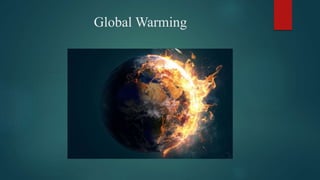
Global Warming
What is Paris Agreement?
 An agreement done by united nations framework convention on climate change
(UNFCCC).
 This agreement intends to reduce and mitigate
greenhouse gas emission.
 196 countries participated in this agreement.
 Nationally determined contributions (NDC’s) were taken before COP 21 in Paris.
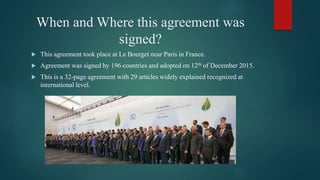
When and Where this agreement was
signed?
 This agreement took place at Le Bourget near Paris in France.
 Agreement was signed by 196 countries and adopted on 12th of December 2015.
 This is a 32-page agreement with 29 articles widely explained recognized at
international level.
Aims of Paris Agreement
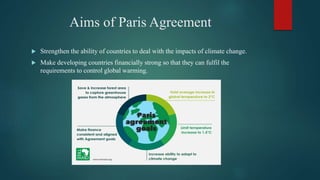
 To fight against global warming by maintaining global average temperature below
2◦ Celsius and must try to keep this below 1.5◦ Celsius.
At present the average temperature is more than 1.5◦ Celsius.
Aims of Paris Agreement
 Strengthen the ability of countries to deal with the impacts of climate change.
 Make developing countries financially strong so that they can fulfil the
requirements to control global warming.
Targets of Paris Agreement
 Agreement is about 20/20/20 targets
 Carbon dioxide emissions reductions by 20%
 Work on increasing the renewable energy market share by 20%
 Target to increase energy efficiency by 20%
Target to reduce Greenhouse gas
 Limit the amount of greenhouse gases emitted by human activities to the same
levels that trees, soil and ocean can bear naturally between 2050 to 2100.
Characteristics of Paris Agreement
 It mentions the need to review each country’s contribution to cutting emissions
after every five years.
 Developed countries will ensure to help developing countries by providing them
“Climate Finance”.
Characteristics of Paris Agreement
 Paris Agreement is a “bottom up” approach.
 This agreement is binding in some elements while at the same time this is non-
binding too.
Nationally Determined Contributions
(NDCs)
 Contributions from each country would be clear to achieve the overall global goal.
 Contributions need to be reported after every 5 years to UNFCCC.
 Contributions are not legally binding.
Criticism over Paris Agreement
 UNFCCC report had observed that all the pledges made by countries are
insufficient to meet the conservative goal of keeping temperature below 2◦
Celsius.
 There must be guidance to reduce emissions as this is a voluntary national caps
otherwise it would be difficult to achieve the goals.
Withdrawal of US from Paris Agreement
 On November 4, 2019 under Donald Trump’s tenure US announced to left the
agreement, and it was then out of the agreement on November 4, 2020.
Comeback of US In Paris Agreement
 Joe Biden came into force and he Re-Entered the Paris Agreement by knowing it’s
importance.
Article 28 and Rule to Exit the Paris
Agreement
 Article 28 allows countries to leave the agreement by following the specific rule.
 Countries can only leave the agreement after 3 years of enforcement of the
agreement.
 The withdrawal is not immediate. It will take a process of about 1 year.
Paris agreement 2015

Paris agreement 2015

  • 2.
    Amna Nadeem Mphill Chemistry Session2021-23 Submitted to: Dr. ayub Rashid Ch. Government college and university lahore
  • 3.
  • 4.
  • 5.
    What is ParisAgreement?  An agreement done by united nations framework convention on climate change (UNFCCC).  This agreement intends to reduce and mitigate greenhouse gas emission.  196 countries participated in this agreement.  Nationally determined contributions (NDC’s) were taken before COP 21 in Paris.
  • 6.
    When and Wherethis agreement was signed?  This agreement took place at Le Bourget near Paris in France.  Agreement was signed by 196 countries and adopted on 12th of December 2015.  This is a 32-page agreement with 29 articles widely explained recognized at international level.
  • 7.
    Aims of ParisAgreement  To fight against global warming by maintaining global average temperature below 2◦ Celsius and must try to keep this below 1.5◦ Celsius. At present the average temperature is more than 1.5◦ Celsius.
  • 8.
    Aims of ParisAgreement  Strengthen the ability of countries to deal with the impacts of climate change.  Make developing countries financially strong so that they can fulfil the requirements to control global warming.
  • 9.
    Targets of ParisAgreement  Agreement is about 20/20/20 targets  Carbon dioxide emissions reductions by 20%  Work on increasing the renewable energy market share by 20%  Target to increase energy efficiency by 20%
  • 10.
    Target to reduceGreenhouse gas  Limit the amount of greenhouse gases emitted by human activities to the same levels that trees, soil and ocean can bear naturally between 2050 to 2100.
  • 11.
    Characteristics of ParisAgreement  It mentions the need to review each country’s contribution to cutting emissions after every five years.  Developed countries will ensure to help developing countries by providing them “Climate Finance”.
  • 12.
    Characteristics of ParisAgreement  Paris Agreement is a “bottom up” approach.  This agreement is binding in some elements while at the same time this is non- binding too.
  • 13.
    Nationally Determined Contributions (NDCs) Contributions from each country would be clear to achieve the overall global goal.  Contributions need to be reported after every 5 years to UNFCCC.  Contributions are not legally binding.
  • 16.
    Criticism over ParisAgreement  UNFCCC report had observed that all the pledges made by countries are insufficient to meet the conservative goal of keeping temperature below 2◦ Celsius.  There must be guidance to reduce emissions as this is a voluntary national caps otherwise it would be difficult to achieve the goals.
  • 17.
    Withdrawal of USfrom Paris Agreement  On November 4, 2019 under Donald Trump’s tenure US announced to left the agreement, and it was then out of the agreement on November 4, 2020.
  • 18.
    Comeback of USIn Paris Agreement  Joe Biden came into force and he Re-Entered the Paris Agreement by knowing it’s importance.
  • 19.
    Article 28 andRule to Exit the Paris Agreement  Article 28 allows countries to leave the agreement by following the specific rule.  Countries can only leave the agreement after 3 years of enforcement of the agreement.  The withdrawal is not immediate. It will take a process of about 1 year.