Global Warming- gradual increase in the overall
temperature of the atmosphere due to higher
concentration of greenhouse gases;
Greenhouse gases- include carbon dioxide,
methane, nitrous oxide and ozone
Fossil Fuels Divestment- removal of investment
assets from companies engaged in the extraction
of fossil fuels
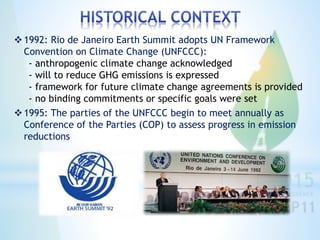
1992: Rio de Janeiro Earth Summit adopts UN Framework
Convention on Climate Change (UNFCCC):
- anthropogenic climate change acknowledged
- will to reduce GHG emissions is expressed
- framework for future climate change agreements is provided
- no binding commitments or specific goals were set
1995: The parties of the UNFCCC begin to meet annually as
Conference of the Parties (COP) to assess progress in emission
reductions
1997: Kyoto Protocol is adopted:
- establishes rolling commitment periods with the first
period 2006-2012
- sets binding emissions targets for 37 industrialized
countries + EU in the first period
- non-compliance is subject to penalties such as
banning from emissions trading schemes and higher targets
for the next period
2012: Doha Amendment:
- establishes the second commitment period 2013-2020
- ratified by only 59 countries and has not entered into
force
• COP21 stands for the 21st Conference
of the Parties
• 30 November -11 December in Paris,Le
Bourget
• Chaired by Laurent Fabius- French
Minister of Foreign Affairs
• 195 countries (all UN members)+ EU
• Result of the negotiations is the Paris
Agreement
• Goal is to keep global warming to less
than 2°C, optimally 1.5°C, compared
to pre-industrial levels
• Each country agrees to nationally
determined contributions(INDC)
• Reduction in GHG emissions will be
begin after 2020
• Zero emissions must be reached by
2050
• Countries are asked to review
contributions every 5 years, starting
2023
• $100 billion provided to developing
countries
• Agreement will be open for signing
on 22 April in New York
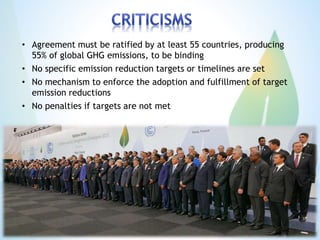
• Agreement must be ratified by at least 55 countries, producing
55% of global GHG emissions, to be binding
• No specific emission reduction targets or timelines are set
• No mechanism to enforce the adoption and fulfillment of target
emission reductions
• No penalties if targets are not met
The Paris Agreement
and our Policy Exercise
Focus on these questions in your meetings tomorrow
• Relate the scenario you are using (the year 2036) to the
2050 goals defined in the Paris Agreement.
• You will need to make estimates regarding the
required 5-year progress report in 2033
• This is one thing we will compare on Friday
• For the 2036 scenario you are examining, do you believe
it will be possible to achieve the 2050 goal of 0%
emissions? If not, how close can we come?
On Friday, we will look at these questions
• Are the policy recommendations derived from each
scenario helpful in achieving the 2050 goals?
• How might we amend these policies?
References
1. http://www3.epa.gov/climatechange/basics/
2. http://www.cop21.gouv.fr/en/
3. http://ec.europa.eu/clima/policies/international/nego
tiations/future/index_en.html
4. https://en.wikipedia.org/wiki/Paris_Agreement
5. http://adst.org/2015/12/negotiating-the-unfccc-the-
whole-world-was-against-us/
6. http://unfccc.int/kyoto_protocol/items/2830.php
7. http://unfccc.int/kyoto_protocol/doha_amendment/ite
ms/7362.php

Paideia second presentation vlad

  • 1.
    Global Warming- gradualincrease in the overall temperature of the atmosphere due to higher concentration of greenhouse gases; Greenhouse gases- include carbon dioxide, methane, nitrous oxide and ozone Fossil Fuels Divestment- removal of investment assets from companies engaged in the extraction of fossil fuels
  • 2.
    1992: Rio deJaneiro Earth Summit adopts UN Framework Convention on Climate Change (UNFCCC): - anthropogenic climate change acknowledged - will to reduce GHG emissions is expressed - framework for future climate change agreements is provided - no binding commitments or specific goals were set 1995: The parties of the UNFCCC begin to meet annually as Conference of the Parties (COP) to assess progress in emission reductions
  • 3.
    1997: Kyoto Protocolis adopted: - establishes rolling commitment periods with the first period 2006-2012 - sets binding emissions targets for 37 industrialized countries + EU in the first period - non-compliance is subject to penalties such as banning from emissions trading schemes and higher targets for the next period 2012: Doha Amendment: - establishes the second commitment period 2013-2020 - ratified by only 59 countries and has not entered into force
  • 4.
    • COP21 standsfor the 21st Conference of the Parties • 30 November -11 December in Paris,Le Bourget • Chaired by Laurent Fabius- French Minister of Foreign Affairs • 195 countries (all UN members)+ EU • Result of the negotiations is the Paris Agreement • Goal is to keep global warming to less than 2°C, optimally 1.5°C, compared to pre-industrial levels
  • 5.
    • Each countryagrees to nationally determined contributions(INDC) • Reduction in GHG emissions will be begin after 2020 • Zero emissions must be reached by 2050 • Countries are asked to review contributions every 5 years, starting 2023 • $100 billion provided to developing countries • Agreement will be open for signing on 22 April in New York
  • 6.
    • Agreement mustbe ratified by at least 55 countries, producing 55% of global GHG emissions, to be binding • No specific emission reduction targets or timelines are set • No mechanism to enforce the adoption and fulfillment of target emission reductions • No penalties if targets are not met
  • 7.
    The Paris Agreement andour Policy Exercise Focus on these questions in your meetings tomorrow • Relate the scenario you are using (the year 2036) to the 2050 goals defined in the Paris Agreement. • You will need to make estimates regarding the required 5-year progress report in 2033 • This is one thing we will compare on Friday • For the 2036 scenario you are examining, do you believe it will be possible to achieve the 2050 goal of 0% emissions? If not, how close can we come? On Friday, we will look at these questions • Are the policy recommendations derived from each scenario helpful in achieving the 2050 goals? • How might we amend these policies?
  • 8.
    References 1. http://www3.epa.gov/climatechange/basics/ 2. http://www.cop21.gouv.fr/en/ 3.http://ec.europa.eu/clima/policies/international/nego tiations/future/index_en.html 4. https://en.wikipedia.org/wiki/Paris_Agreement 5. http://adst.org/2015/12/negotiating-the-unfccc-the- whole-world-was-against-us/ 6. http://unfccc.int/kyoto_protocol/items/2830.php 7. http://unfccc.int/kyoto_protocol/doha_amendment/ite ms/7362.php