Inayat Baktoo
Harsh Gupta
Feb 2, 2017
or ACCORD de PARIS in french
The Paris Agreement
 Previous attempts had also
been made to establish a
treaty, specifically, the
Copenhagen Accord drafted
at COP15 in Copenhagen
which turned out to be a
failure.
Background
 The Paris Agreement is an
agreement within the United
Nations Framework
Convention on Climate
Change (UNFCCC) dealing
with greenhouse gases
emissions mitigation,
adaptation and finance
starting in the year 2020.
Intro
Introduction & Background
 As of December 2016, 194
UNFCCC members have
signed the treaty, 127 of
which have ratified it.
 The agreement went into
effect on 4 November 2016.
 The agreement was adopted
by consensus on 12
December 2015.
 It was opened for signature
on Earth Day i.e. 22 April the
following year at a ceremony
in New York.
Overview
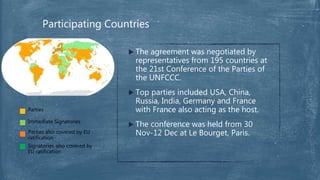
 The agreement was negotiated by
representatives from 195 countries at
the 21st Conference of the Parties of
the UNFCCC.
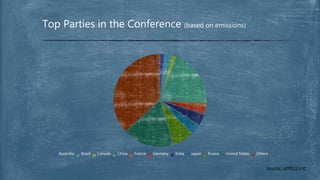
 Top parties included USA, China,
Russia, India, Germany and France
with France also acting as the host.
 The conference was held from 30
Nov-12 Dec at Le Bourget, Paris.
Participating Countries
Parties
Immediate Signatories
Parties also covered by EU
ratification
Signatories also covered by
EU ratification
Australia Brazil Canada China France Germany India Japan Russia United States Others
Top Parties in the Conference (based on emissions)
Source: unfccc.int
 Increasing the ability to adapt
to the adverse impacts of
climate change and foster
climate resilience and low
greenhouse gas emissions
development, in a manner that
does not threaten food
production.
 Making finance flows consistent
with a pathway towards low
greenhouse gas emissions and
climate-resilient development.
The aim of the convention is described in Article 2 labelled
"enhancing the implementation" of the UNFCCC through:
 Holding the increase in the
global average temperature to
well below 2 °C above pre-
industrial levels and to pursue
efforts to limit the temperature
increase to 1.5 °C above pre-
industrial levels, recognizing
that this would significantly
reduce the risks and impacts of
climate change.
Aim of the convention
Nationally Determined Contributions (NDCs)
 The contribution that each individual country should make in order to
achieve the worldwide goal ,determined by the countries individually,
are called NDCs.
 The contributions should be reported every five years and are to be
registered by the UNFCCC Secretariat.
 The 'contributions' themselves are not binding as a matter of
international law, as they lack the specificity, normative character, or
obligatory language necessary to create binding norms.
 Furthermore, there will be no mechanism to force a country to set a
target in their NDC by a specific date and no enforcement if a set
target in an NDC is not met.
 The global stocktake will kick off with a "facilitative dialogue" in
2018.
 At this convening, parties will evaluate how their NDCs stack up
to the nearer-term goal of peaking global emissions and the
long-term goal of achieving net zero emissions by the second
half of this century.
 The implementation of the agreement by all member countries
together will be evaluated every 5 years, with the first evaluation
in 2023.
 The outcome is to be used as input for new NDCs of member
states.
Global Stocktake
 Article 6 Para 6.2 and 6.3 of UNFCCC establish a framework to govern
the international transfer of mitigation outcomes (ITMOs).
 This provision requires the "linkage" of various carbon emissions
trading systems—because measured emissions reductions must avoid
"double counting", transferred mitigation outcomes must be recorded
as a gain of emission units for one party and a reduction of emission
units for the other.
 This system has been used in the hugely popular carboncoin.
Linkages and ITMOs
 As the agreement provides no consequences if countries do not meet
their commitments, consensus of this kind is fragile.
 The negotiators of the Agreement however stated that the NDCs and
the 2 °C reduction target were insufficient, instead, a 1.5 °C target is
required.
 It was noted that the estimated aggregate greenhouse gas emission
levels in 2025 and 2030 resulting from the intended nationally
determined contributions do not fall within least-cost 2 ̊C scenarios
but rather lead to a projected level of 55 gigatonnes in 2030, and
recognizing furthermore that much greater emission reduction efforts
will be required in order to hold the increase in the global average
temperature to below 2 ̊C by reducing emissions to 40 gigatonnes or
to 1.5 ̊C.
Drawbacks
 Institutional asset owners associations and think-tanks such as
the World Pensions Council (WPC) have observed that the
stated objectives of the Paris Agreement are implicitly
"predicated upon an assumption – that member states of the
United Nations will somehow drive down their carbon pollution
voluntarily and assiduously without any binding enforcement
mechanism to measure and control CO2 emissions at any level
from factory to state, and without any specific penalty gradation
or fiscal pressure (for example a carbon tax) to discourage bad
behaviour.
Aftermath
 http://unfccc.int/resource/docs/2015/cop21/eng/10.pdf#page=
30en.wikipedia.org
 http://edition.cnn.com/2015/12/12/world/global-climate-
change-conference-vote/
 https://ec.europa.eu/clima/policies/international/negotiations/p
aris_en
 https://en.wikipedia.org/wiki/Paris_Agreement
Sources
Questions & Discussion

Paris accords

  • 1.
    Inayat Baktoo Harsh Gupta Feb2, 2017 or ACCORD de PARIS in french The Paris Agreement
  • 2.
     Previous attemptshad also been made to establish a treaty, specifically, the Copenhagen Accord drafted at COP15 in Copenhagen which turned out to be a failure. Background  The Paris Agreement is an agreement within the United Nations Framework Convention on Climate Change (UNFCCC) dealing with greenhouse gases emissions mitigation, adaptation and finance starting in the year 2020. Intro Introduction & Background
  • 3.
     As ofDecember 2016, 194 UNFCCC members have signed the treaty, 127 of which have ratified it.  The agreement went into effect on 4 November 2016.  The agreement was adopted by consensus on 12 December 2015.  It was opened for signature on Earth Day i.e. 22 April the following year at a ceremony in New York. Overview
  • 4.
     The agreementwas negotiated by representatives from 195 countries at the 21st Conference of the Parties of the UNFCCC.  Top parties included USA, China, Russia, India, Germany and France with France also acting as the host.  The conference was held from 30 Nov-12 Dec at Le Bourget, Paris. Participating Countries Parties Immediate Signatories Parties also covered by EU ratification Signatories also covered by EU ratification
  • 5.
    Australia Brazil CanadaChina France Germany India Japan Russia United States Others Top Parties in the Conference (based on emissions) Source: unfccc.int
  • 6.
     Increasing theability to adapt to the adverse impacts of climate change and foster climate resilience and low greenhouse gas emissions development, in a manner that does not threaten food production.  Making finance flows consistent with a pathway towards low greenhouse gas emissions and climate-resilient development. The aim of the convention is described in Article 2 labelled "enhancing the implementation" of the UNFCCC through:  Holding the increase in the global average temperature to well below 2 °C above pre- industrial levels and to pursue efforts to limit the temperature increase to 1.5 °C above pre- industrial levels, recognizing that this would significantly reduce the risks and impacts of climate change. Aim of the convention
  • 7.
    Nationally Determined Contributions(NDCs)  The contribution that each individual country should make in order to achieve the worldwide goal ,determined by the countries individually, are called NDCs.  The contributions should be reported every five years and are to be registered by the UNFCCC Secretariat.  The 'contributions' themselves are not binding as a matter of international law, as they lack the specificity, normative character, or obligatory language necessary to create binding norms.  Furthermore, there will be no mechanism to force a country to set a target in their NDC by a specific date and no enforcement if a set target in an NDC is not met.
  • 8.
     The globalstocktake will kick off with a "facilitative dialogue" in 2018.  At this convening, parties will evaluate how their NDCs stack up to the nearer-term goal of peaking global emissions and the long-term goal of achieving net zero emissions by the second half of this century.  The implementation of the agreement by all member countries together will be evaluated every 5 years, with the first evaluation in 2023.  The outcome is to be used as input for new NDCs of member states. Global Stocktake
  • 9.
     Article 6Para 6.2 and 6.3 of UNFCCC establish a framework to govern the international transfer of mitigation outcomes (ITMOs).  This provision requires the "linkage" of various carbon emissions trading systems—because measured emissions reductions must avoid "double counting", transferred mitigation outcomes must be recorded as a gain of emission units for one party and a reduction of emission units for the other.  This system has been used in the hugely popular carboncoin. Linkages and ITMOs
  • 10.
     As theagreement provides no consequences if countries do not meet their commitments, consensus of this kind is fragile.  The negotiators of the Agreement however stated that the NDCs and the 2 °C reduction target were insufficient, instead, a 1.5 °C target is required.  It was noted that the estimated aggregate greenhouse gas emission levels in 2025 and 2030 resulting from the intended nationally determined contributions do not fall within least-cost 2 ̊C scenarios but rather lead to a projected level of 55 gigatonnes in 2030, and recognizing furthermore that much greater emission reduction efforts will be required in order to hold the increase in the global average temperature to below 2 ̊C by reducing emissions to 40 gigatonnes or to 1.5 ̊C. Drawbacks
  • 11.
     Institutional assetowners associations and think-tanks such as the World Pensions Council (WPC) have observed that the stated objectives of the Paris Agreement are implicitly "predicated upon an assumption – that member states of the United Nations will somehow drive down their carbon pollution voluntarily and assiduously without any binding enforcement mechanism to measure and control CO2 emissions at any level from factory to state, and without any specific penalty gradation or fiscal pressure (for example a carbon tax) to discourage bad behaviour. Aftermath
  • 12.
     http://unfccc.int/resource/docs/2015/cop21/eng/10.pdf#page= 30en.wikipedia.org  http://edition.cnn.com/2015/12/12/world/global-climate- change-conference-vote/ https://ec.europa.eu/clima/policies/international/negotiations/p aris_en  https://en.wikipedia.org/wiki/Paris_Agreement Sources
  • 13.