Paris Agreement and India’s Contribution
By Shyam Rathod
Environmental Governance
Climate Change Impacts
• As per WMO- 2015 was the warmest year(2300 people died in
India)- Avg temp in may-jun 39 Deg.
-Temp increased 1°C abv the pre- Industrial era.
-Its mainly due to El-Nino and warming caused by GHG
-Increase of Anthropogenic emissions Since IR.
• Five Pacific islands lost due to rising seas- Solomon Islands,
and Nuatambu Islands
Cont
• Acc to International Energy Agency(IEA), 2015
- Concentration of CO2 is 40% high than mid 1800s.
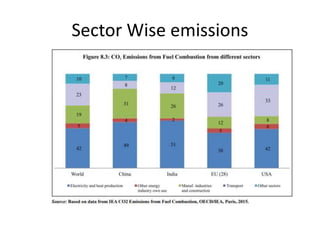
- Energy Sector – Largest contributor to GHG
- CO2 emissions from combustion of fuel have the
largest share.
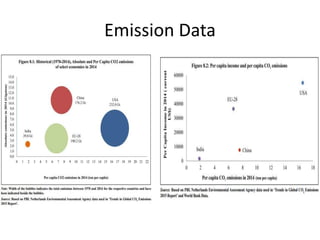
• As per Global emissions profile says- emissions
Unequal among different countries.
Emission Data
Sector Wise emissions
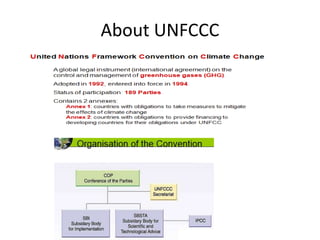
About UNFCCC
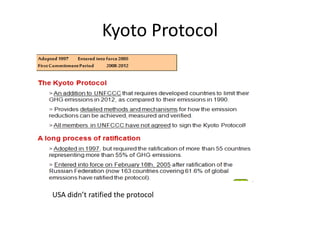
Kyoto Protocol
USA didn’t ratified the protocol
Paris Agreement-2015
• The 21st Conference of Parties under the UNFCCC- was in Paris Dec 2015
• Historical Climate Change Agreement
• Result of Intense Negotiations
• Post 2020 Actions on climate change
• Succeeded by Kyoto Protocol(KP)
• Unlike KP, it provides framework for all countries to take action against CC.
• Climate Justice and Sustainable Lifestyles
• 1st Time an Agreement brought all nations for common cause under
UNFCCC
Aim and Special Features
• Main Focus or Aim is to hold temp well below 2°C above
pre- industrial level and on driving efforts to limit it even
further to 1.5°C.
• Comprises 29 Articles and is supported by 139 decisions
of the COP.
• Identified as comprehensive and balanced agreement
• Bottom-up Approach followed( By asking individual
countries regd their contributions in reducing GHG)
• Others were Top-down Approach(KP) in which each
country got Target.
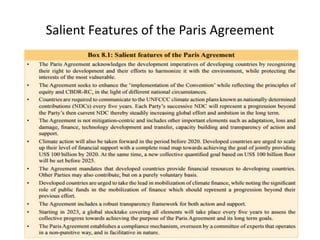
Salient Features of the Paris Agreement
Key Provisions of the Deal
1. CBDR-RC (combined but differentiated
responsibility and respective capability)-
2. NDCs-
Parties whose INDC have a time frame upto 2025-2030
are reqd to communicate or update these
contributions by 2020 and to do so every 5 years.
Support developing countries in achieving it.
3. Technology Development and Transfer
Technology mechanism(Tech executive comm, The
climate Tech Centre and Network)
Cont
4. Mitigation:
To achieve long term goal i.e below 2°C and sustainable dev,
eradicate poverty, control GHG and follow CBDR-RC
3 main elements- a. Peaking of GHG in developing
countries will take time
b. Calling developed countries to take action
c. To support developing countries in implementation
5. Global Stocktake
Cont
5. Finance- binding obligations on developed countries
Voluntary for developing countries in
contribution of fund
6. Transparency- Transparency mechanism of action
and support under the UNFCCC was differentiated
for Dev and Dev Countries:
a. Info provided by Developed counties- through
National Communications , Biennial Reports(BR)
subjected to International Assessment and
Review(IAR)
b. Developing countries- Natnl Comm and Biennial
Update Report(BUR) is subject to international
consultation and analysis(ICA)
Paris Deal Ratification
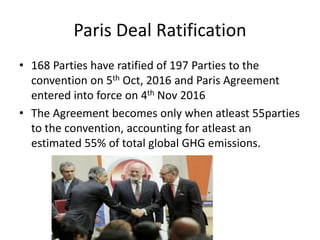
• 168 Parties have ratified of 197 Parties to the
convention on 5th Oct, 2016 and Paris Agreement
entered into force on 4th Nov 2016
• The Agreement becomes only when atleast 55parties
to the convention, accounting for atleast an
estimated 55% of total global GHG emissions.
India’s INDC
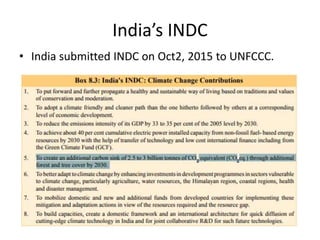
• India submitted INDC on Oct2, 2015 to UNFCCC.
Cont
• GCF- estd as operating entity of the financial mecahnism
of UNFCCC in 2011.
Funds from Developed to Developing
39 Govt pledged support of US$10.2 Bn, Highest cont-US
• Global Env Facility: estd as pilot prog for env protection.
Current project cycle is 2014-18, started in 1992.
As of Nov 2015 –directly invested in 3946 projects
US$14.5Bn.
India Got –US$5166mn
India’s Domestic Actions on Climate Change
1. National Action Plan on CC(NAPCC)-
The PM’s Council on CC(PMCCC) has directed missions
under the NAPCCC-to enhance mitigation,adaptation
and capacity building.
Setting up of new missions in existing eight
a. Considering CC impacts Health- a new mission on CC
is currently under formulation and National Expert
Group on CC and Health has constituted
b. Proposed waste to energy mission- emphasise to less
dependent on coal, oil and gas for power production
c. National Mission on Coastal Areas(NMCA)- will
prepare Integrated coastal resources and map
vulnerable areas. MoEFCC will manage
Cont
2. State Action Plans on CC- 28states and 5UTs submitted
SAPCCs.
32States and UTs have been endorsed by National
Steering Committee on CC at the MoEFCC.
3. National Adaptation Fund for Climate Change:
estd with a Budget of Rs 350Cr for the year 2015-
16,2016-17.
To meet the national and state adaptation measures
Till date NSCCC has approved 6Detailed Project Reports
amounting Rs. 117.98Cr for Punjab,H.P, O’sha,
Manipur,Kerala,T.N
Cont
4. Coal Cess and the National Clean Energy Fund:
India- one of few countries to have carbon tax in form
of cess on coal.
In 2010 Rs. 50/tonne on coal
In 2014 Rs. 100/tonne
In 2015-16 Rs. 200/tonne
All this cess amount was stored- NCEF fund was utilised
for various clean energy initiatives.
In 2015-16 Budget Rs. 4700Cr was allocated for NCEF
projects. NCEF supports Namami Gange(VGF)
Cont
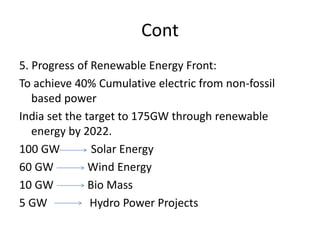
5. Progress of Renewable Energy Front:
To achieve 40% Cumulative electric from non-fossil
based power
India set the target to 175GW through renewable
energy by 2022.
100 GW Solar Energy
60 GW Wind Energy
10 GW Bio Mass
5 GW Hydro Power Projects
Reflections Done By India in 2Years
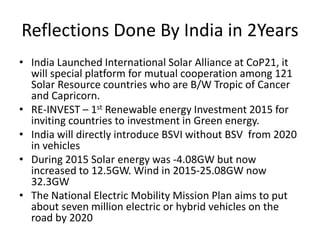
• India Launched International Solar Alliance at CoP21, it
will special platform for mutual cooperation among 121
Solar Resource countries who are B/W Tropic of Cancer
and Capricorn.
• RE-INVEST – 1st Renewable energy Investment 2015 for
inviting countries to investment in Green energy.
• India will directly introduce BSVI without BSV from 2020
in vehicles
• During 2015 Solar energy was -4.08GW but now
increased to 12.5GW. Wind in 2015-25.08GW now
32.3GW
• The National Electric Mobility Mission Plan aims to put
about seven million electric or hybrid vehicles on the
road by 2020
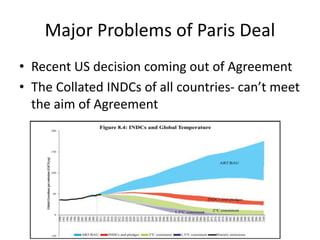
Major Problems of Paris Deal
• Recent US decision coming out of Agreement
• The Collated INDCs of all countries- can’t meet
the aim of Agreement
References
• Economic Survey 2015-16 Vol 2
• https://www.theguardian.com/environment/2016/m
ay/10/five-pacific-islands-lost-rising-seas-climate-
change
• http://time.com/3904590/india-heatwave-monsoon-
delayed-weather-climate-change/
• Paris Agreement Main Document
• International Solar Alliance Website

India and Paris Deal

  • 1.
    Paris Agreement andIndia’s Contribution By Shyam Rathod Environmental Governance
  • 2.
    Climate Change Impacts •As per WMO- 2015 was the warmest year(2300 people died in India)- Avg temp in may-jun 39 Deg. -Temp increased 1°C abv the pre- Industrial era. -Its mainly due to El-Nino and warming caused by GHG -Increase of Anthropogenic emissions Since IR. • Five Pacific islands lost due to rising seas- Solomon Islands, and Nuatambu Islands
  • 3.
    Cont • Acc toInternational Energy Agency(IEA), 2015 - Concentration of CO2 is 40% high than mid 1800s. - Energy Sector – Largest contributor to GHG - CO2 emissions from combustion of fuel have the largest share. • As per Global emissions profile says- emissions Unequal among different countries.
  • 4.
  • 5.
  • 6.
  • 7.
    Kyoto Protocol USA didn’tratified the protocol
  • 8.
    Paris Agreement-2015 • The21st Conference of Parties under the UNFCCC- was in Paris Dec 2015 • Historical Climate Change Agreement • Result of Intense Negotiations • Post 2020 Actions on climate change • Succeeded by Kyoto Protocol(KP) • Unlike KP, it provides framework for all countries to take action against CC. • Climate Justice and Sustainable Lifestyles • 1st Time an Agreement brought all nations for common cause under UNFCCC
  • 9.
    Aim and SpecialFeatures • Main Focus or Aim is to hold temp well below 2°C above pre- industrial level and on driving efforts to limit it even further to 1.5°C. • Comprises 29 Articles and is supported by 139 decisions of the COP. • Identified as comprehensive and balanced agreement • Bottom-up Approach followed( By asking individual countries regd their contributions in reducing GHG) • Others were Top-down Approach(KP) in which each country got Target.
  • 10.
    Salient Features ofthe Paris Agreement
  • 11.
    Key Provisions ofthe Deal 1. CBDR-RC (combined but differentiated responsibility and respective capability)- 2. NDCs- Parties whose INDC have a time frame upto 2025-2030 are reqd to communicate or update these contributions by 2020 and to do so every 5 years. Support developing countries in achieving it. 3. Technology Development and Transfer Technology mechanism(Tech executive comm, The climate Tech Centre and Network)
  • 12.
    Cont 4. Mitigation: To achievelong term goal i.e below 2°C and sustainable dev, eradicate poverty, control GHG and follow CBDR-RC 3 main elements- a. Peaking of GHG in developing countries will take time b. Calling developed countries to take action c. To support developing countries in implementation 5. Global Stocktake
  • 13.
    Cont 5. Finance- bindingobligations on developed countries Voluntary for developing countries in contribution of fund 6. Transparency- Transparency mechanism of action and support under the UNFCCC was differentiated for Dev and Dev Countries: a. Info provided by Developed counties- through National Communications , Biennial Reports(BR) subjected to International Assessment and Review(IAR) b. Developing countries- Natnl Comm and Biennial Update Report(BUR) is subject to international consultation and analysis(ICA)
  • 14.
    Paris Deal Ratification •168 Parties have ratified of 197 Parties to the convention on 5th Oct, 2016 and Paris Agreement entered into force on 4th Nov 2016 • The Agreement becomes only when atleast 55parties to the convention, accounting for atleast an estimated 55% of total global GHG emissions.
  • 15.
    India’s INDC • Indiasubmitted INDC on Oct2, 2015 to UNFCCC.
  • 16.
    Cont • GCF- estdas operating entity of the financial mecahnism of UNFCCC in 2011. Funds from Developed to Developing 39 Govt pledged support of US$10.2 Bn, Highest cont-US • Global Env Facility: estd as pilot prog for env protection. Current project cycle is 2014-18, started in 1992. As of Nov 2015 –directly invested in 3946 projects US$14.5Bn. India Got –US$5166mn
  • 17.
    India’s Domestic Actionson Climate Change 1. National Action Plan on CC(NAPCC)- The PM’s Council on CC(PMCCC) has directed missions under the NAPCCC-to enhance mitigation,adaptation and capacity building. Setting up of new missions in existing eight a. Considering CC impacts Health- a new mission on CC is currently under formulation and National Expert Group on CC and Health has constituted b. Proposed waste to energy mission- emphasise to less dependent on coal, oil and gas for power production c. National Mission on Coastal Areas(NMCA)- will prepare Integrated coastal resources and map vulnerable areas. MoEFCC will manage
  • 18.
    Cont 2. State ActionPlans on CC- 28states and 5UTs submitted SAPCCs. 32States and UTs have been endorsed by National Steering Committee on CC at the MoEFCC. 3. National Adaptation Fund for Climate Change: estd with a Budget of Rs 350Cr for the year 2015- 16,2016-17. To meet the national and state adaptation measures Till date NSCCC has approved 6Detailed Project Reports amounting Rs. 117.98Cr for Punjab,H.P, O’sha, Manipur,Kerala,T.N
  • 19.
    Cont 4. Coal Cessand the National Clean Energy Fund: India- one of few countries to have carbon tax in form of cess on coal. In 2010 Rs. 50/tonne on coal In 2014 Rs. 100/tonne In 2015-16 Rs. 200/tonne All this cess amount was stored- NCEF fund was utilised for various clean energy initiatives. In 2015-16 Budget Rs. 4700Cr was allocated for NCEF projects. NCEF supports Namami Gange(VGF)
  • 20.
    Cont 5. Progress ofRenewable Energy Front: To achieve 40% Cumulative electric from non-fossil based power India set the target to 175GW through renewable energy by 2022. 100 GW Solar Energy 60 GW Wind Energy 10 GW Bio Mass 5 GW Hydro Power Projects
  • 21.
    Reflections Done ByIndia in 2Years • India Launched International Solar Alliance at CoP21, it will special platform for mutual cooperation among 121 Solar Resource countries who are B/W Tropic of Cancer and Capricorn. • RE-INVEST – 1st Renewable energy Investment 2015 for inviting countries to investment in Green energy. • India will directly introduce BSVI without BSV from 2020 in vehicles • During 2015 Solar energy was -4.08GW but now increased to 12.5GW. Wind in 2015-25.08GW now 32.3GW • The National Electric Mobility Mission Plan aims to put about seven million electric or hybrid vehicles on the road by 2020
  • 22.
    Major Problems ofParis Deal • Recent US decision coming out of Agreement • The Collated INDCs of all countries- can’t meet the aim of Agreement
  • 23.
    References • Economic Survey2015-16 Vol 2 • https://www.theguardian.com/environment/2016/m ay/10/five-pacific-islands-lost-rising-seas-climate- change • http://time.com/3904590/india-heatwave-monsoon- delayed-weather-climate-change/ • Paris Agreement Main Document • International Solar Alliance Website