CONTEMPORARY ISSUES
LESSON 3
CLIMATE CHANGE AND ENVIRONMENTAL PROBLEMS
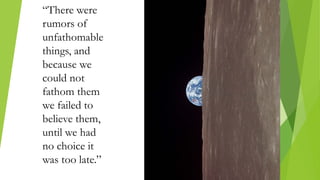
“There were
rumors of
unfathomable
things, and
because we
could not
fathom them
we failed to
believe them,
until we had
no choice it
was too late.”
What is Climate Change
Climate is the aggregated pattern of weather,
meaning averages, extremes, timing, spatial
distribution of…
• hot & cold
• cloudy & clear
• humid & dry
• drizzles & downpours
• snowfall, snowpack, & snowmelt
• blizzards, tornadoes, & typhoons
Climate change means altered patterns.
Global average temperature is just one measure of the
state of the global climate as expressed in these patterns.
Small temperature changes  big changes in the patterns.
(after Holdren NCES, 2008)
 CLIMATE CHANGE causes:
Change in the length and cycles of the rainy
season;
Change in the intensity and frequency of rainfalls;
And brings about:
Calamities such as:
Heat waves
Drought
Violent storms
Devastating floods
Destruction of the environment
Sickness and death due to calamities
CAUSES OF CLIMATE CHANGE
 CAUSED BY THE EFFECTS OF THE SUN
 SUNLIGHT CARRIES ENERGY THAT WARMS UP THE EARTH. A BIG PART OF IT IS
DIRECTLY REFLECTED BACK TO THE ATMOSPHERE AND TO SPACE.
 CAUSED BY THE EFFECTS OF HUMAN ACTIVITIES
 MANY HUMAN ACTIVITIES INCREASE CARBON DIOXIDE AND OTHER GREENHOUSE
GASES CONTRIBUTING TO THE RISE IN GLOBAL TEMPERATURE WHICH CAUSE
CLIMATE CHANGE.
 AS HUMAN POPULATION GROWS THE AMOUNT OF ACTIVITIES TO RESPOND TO THEIR
NEEDS INCREASES. THESE ACTIVITIES CAUSE THE WORSENING OF POLLUTION AND
THE INCREASE IN THE CONCENTRATION OF NATURAL AND SYNTHETIC GASES IN THE
ATMOSPHERE.
 THE INTENSIFICATION OF GLOBAL WARMING IS ESTIMATED TO HAVE STARTED
AROUND THE END OF THE 18TH CENTURY AT THE ONSET OF THE INDUSTRIAL
REVOLUTION.
THE GREENHOUSE GASES
 WATER VAPOR
 THIS IS THE MOST ABUNDANT GAS IN OUR ATMOSPHERE THAT CAUSES CLOUD FORMATION, PRECIPITATION, AND
CONTROLS THE INTENSIFIED HEAT IN THE ATMOSPHERE.
 INCREASED WATER VAPOR WARMER TEMPERATURE
 CARBON MONOXIDE (CO) AND CARBON DIOXIDE (CO2)
 COME FROM NATURAL PROCESS LIKE BREATHING AND VOLCANIC ERUPTIONS.
 ALSO FORMED DURING THE BURNING OF FOSSIL FUELS.
 HUMAN ACTIVITES LIKE CUTTING OF TREES, DEFORESTATION, FOREST FIRES, USE OF FOSSIL FUELS INCREASED THE
CONTRATION OF CARBON DIOXIDE IN OUR ATMOSPHERE.
 CHLOROFLUOROCARBON (CFC)
 USED AS REFRIGERANTS, AEROSOL PROPELLANTS
 DAMAGES THE OZONE LAYER OF THE EARTH
 METHANE
 FORMED FROM NATURAL PROCESSES SUCH AS ORGANIC MATERIALS LIKE GARBAGE, MANURE AND RICE STRAW
 NITROUS OXIDE
 FORMED FROM THE USE OF COMMERCIAL AND ORGANIC FERTILIZERS, BIOMASS BURNING, FOSSIL FUEL
COMBUSTION AND NITRIC ACID PRODUCTION
EFFECTS OF CLIMATE CHANGE
HUMAN ENVIRONMENT ECONOMY
• SUNBURN
• BLISTERS
• SKIN CANCER
• HEAT STROKE
• ALLERGY CAUSED BY
POLLUTION
• MOSQUITO BORNE
DISEASES
• RAT BORNE DISEASES
• RESPIRATORY SYSTEM
DISEASES
• ABDOMINAL DISEASES
• DEATH DUE TO CALAMITIES
• CHANGE IN WEATHER
SYSTEM
• DROUGHT
• FLOODS
• CORAL REEF DESTRUCTION
• SICKNESS AND DEATH OF
PLANTS AND ANIMALS
• SOIL EROSION
• INCREASE OF PESTS
• ALTERED LIFE CYCLE OF
PLANTS AND ANIMALS
• EXTINCTION OF
ENDANGERED SPECIES
• FOOD CHAIN IS ALTERED
• AGRICULTURAL
PRODUCTION SLOWS
DOWN
• BUSINESS AND LIVELIHOOD
OPPORTUNITIES DECLINE
• DEMAND FOR ENERGY
RISES
• RISING COST OFGOODS
AND SERVICES
• RISE IN CINCOME DOES
NOT MATCH THE RISE IN
COST OF GOODS AND
SERVICES RESULTING TO
FEWER CONSUMPTION
• IF CONSUMPTION IS LOW,
BUSINESS AS WELL AS THE
ECONOMY WILL COLLAPSE.
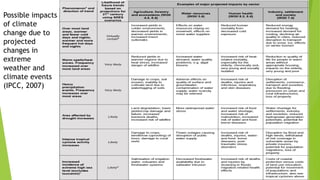
Possible impacts
of climate
change due to
projected
changes in
extreme
weather and
climate events
(IPCC, 2007)
POLICIES AND ROGRAMS ON CLIMATE CHANGE
POLICY/AGREEMENTS SALIENT FEATURES
R.A. 9729 as amended by
R.A. 10174 or The CLIMATE
CHANGE ACT OF 2009
• Aims to prevent and alleviate the harmful effects of climate change and to
ensure the safety of their area and its residents.
• Established the Climate Change Commission
• Paved the way for the National Climate Change Action Plan (NCCAP) and the
Local Climate Change Action Plan (LCCAP). The plans were outlined from 2011
to 2028 or a period of 18 years.
• The Action Plan included the following:
1. FOOD SECURITY
2. WATER SUFFICIENCY
3. ECOLOGICAL AND ENVIRONMENTAL STABILITY
4. HUMAN SECURITY
5. CLIMATE-SMART INDUSTRIES AND SERVICES
6. SUSTAINABLE ENERGY
7. KNOWLEDGE AND CAPACITY DEVELOPMENT
INTERGOVERNMENTAL
PANEL ON CLIMATE CHANGE
(IPCC)
• Established by the World Meteorological Organization (WMO) and the United
Nations Environment Programme (UNEP) in 1988
• The Intergovernmental Panel on Climate Change (IPCC) is dedicated to
providing the world with an objective, scientific view of climate change, its
natural, political and economic impacts and risks, and possible response
options.
POLICY/AGREEMENTS SALIENT FEATURES
INTERGOVERNMENTAL PANEL
ON CLIMATE CHANGE (IPCC)
• The IPCC was tasked with reviewing peer-reviewed scientific literature and
other relevant publications to provide information on the state of
knowledge about climate change
• The IPCC produces reports that contribute to the work of the United
Nations Framework Convention on Climate Change (UNFCCC), the main
international treaty on climate change.
• IPCC reports cover the "scientific, technical and socio-economic
information relevant to understanding the scientific basis of risk of human-
induced climate change, its potential impacts and options
for adaptation and mitigation.
• The IPCC provides an internationally accepted authority on climate
change, producing reports that have the agreement of leading climate
scientists and consensus from participating governments.
• The IPCC was awarded the 2007 Nobel Peace Prize which it shared with Al
Gore.
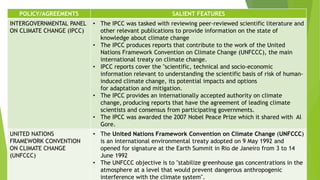
UNITED NATIONS
FRAMEWORK CONVENTION
ON CLIMATE CHANGE
(UNFCCC)
• The United Nations Framework Convention on Climate Change (UNFCCC)
is an international environmental treaty adopted on 9 May 1992 and
opened for signature at the Earth Summit in Rio de Janeiro from 3 to 14
June 1992
• The UNFCCC objective is to "stabilize greenhouse gas concentrations in the
atmosphere at a level that would prevent dangerous anthropogenic
interference with the climate system".
POLICY/AGREEMENTS SALIENT FEATURES
UNITED NATIONS
FRAMEWORK
CONVENTION ON CLIMATE
CHANGE (UNFCCC)
• The framework sets non-binding limits on greenhouse gas emissions for
individual countries and contains no enforcement mechanisms. Instead, the
framework outlines how specific international treaties (called "protocols" or
"Agreements") may be negotiated to specify further action towards the
objective of the UNFCCC
• One of the first tasks set by the UNFCCC was for signatory nations to
establish national greenhouse gas inventories of greenhouse gas (GHG)
emissions and removals.
• Major Treaties and Protocols:
1. KYOTO PROTOCOL - 2008-2012
2. DOHA AMENDMENT TO THE KYOTO PROTOCOL - 2013-2020
3. PARIS AGREEMENT
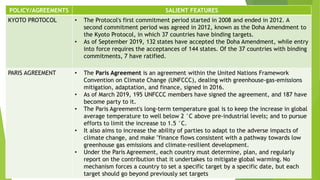
KYOTO PROTOCOL • The Kyoto Protocol is an international treaty which extends the 1992 United
Nations Framework Convention on Climate Change (UNFCCC) that commits
state parties to reduce greenhouse gas emissions, based on the scientific
consensus that:
• global warming is occurring and
• it is extremely likely that human-made CO2 emissions have predominantly
caused it.
• The Kyoto Protocol was adopted in Kyoto, Japan, on 11 December 1997 and
entered into force on 16 February 2005. There are currently 192 parties to the
Protocol.
POLICY/AGREEMENTS SALIENT FEATURES
KYOTO PROTOCOL • The Protocol's first commitment period started in 2008 and ended in 2012. A
second commitment period was agreed in 2012, known as the Doha Amendment to
the Kyoto Protocol, in which 37 countries have binding targets.
• As of September 2019, 132 states have accepted the Doha Amendment, while entry
into force requires the acceptances of 144 states. Of the 37 countries with binding
commitments, 7 have ratified.
PARIS AGREEMENT • The Paris Agreement is an agreement within the United Nations Framework
Convention on Climate Change (UNFCCC), dealing with greenhouse-gas-emissions
mitigation, adaptation, and finance, signed in 2016.
• As of March 2019, 195 UNFCCC members have signed the agreement, and 187 have
become party to it.
• The Paris Agreement's long-term temperature goal is to keep the increase in global
average temperature to well below 2 °C above pre-industrial levels; and to pursue
efforts to limit the increase to 1.5 °C.
• It also aims to increase the ability of parties to adapt to the adverse impacts of
climate change, and make "finance flows consistent with a pathway towards low
greenhouse gas emissions and climate-resilient development.
• Under the Paris Agreement, each country must determine, plan, and regularly
report on the contribution that it undertakes to mitigate global warming. No
mechanism forces a country to set a specific target by a specific date, but each
target should go beyond previously set targets
POLICY/AGREEMENTS SALIENT FEATURES
PARIS AGREEMENT • This strategy involved energy and climate policy including the so-called 20/20/20
targets, namely the reduction of carbon dioxide (CO2) emissions by 20%, the
increase of renewable energy's market share to 20%, and a 20% increase in energy
efficiency.
• The Paris deal is the world's first comprehensive climate agreement.
REFERENCES: • PHILIPPINE CLIMATE CHANGE ACT OF 2009 (REPUBLIC ACT NO . 9729)
http://unhabitat.org.ph/2009/07/27/philippine-climate-change-act-of-2009-
republic-act-no-
9729/#targetText=9729)%20aims%20to%20mainstream%20climate,development%20
and%20climate%20change%20initiatives.
• The Intergovernmental Panel on Climate Change
https://www.ipcc.ch/
• UNFCCC
https://unfccc.int/
WAYS TO HELP IN SOLVING THE PROBLEM
OF CLIMATE CHANGE
 PLANT TREES AND PLANTS
 REDUCE USE OF ENERGY
 USE OF ALTERNATIVE ENERGY (RENEWABLE)
 AVOID BURNING GARBAGE/WASTE
 KEEPING THE ENVIRONMENT CLEAN
 DO RECYCLING
 AVOID USING PLASTIC MATERIALS AND POISONOUS CHEMICALS
 ………
GRETHA THUNBERG
“CLIMATE WARRIOR”
 https://www.youtube.com/watch?v=JT73puKg8cc
 https://www.youtube.com/watch?time_continue=112&v=KAJsdgTPJpU

Contemporary issues climate change

  • 1.
    CONTEMPORARY ISSUES LESSON 3 CLIMATECHANGE AND ENVIRONMENTAL PROBLEMS
  • 2.
    “There were rumors of unfathomable things,and because we could not fathom them we failed to believe them, until we had no choice it was too late.”
  • 3.
    What is ClimateChange Climate is the aggregated pattern of weather, meaning averages, extremes, timing, spatial distribution of… • hot & cold • cloudy & clear • humid & dry • drizzles & downpours • snowfall, snowpack, & snowmelt • blizzards, tornadoes, & typhoons Climate change means altered patterns. Global average temperature is just one measure of the state of the global climate as expressed in these patterns. Small temperature changes  big changes in the patterns. (after Holdren NCES, 2008)
  • 4.
     CLIMATE CHANGEcauses: Change in the length and cycles of the rainy season; Change in the intensity and frequency of rainfalls; And brings about: Calamities such as: Heat waves Drought Violent storms Devastating floods Destruction of the environment Sickness and death due to calamities
  • 5.
    CAUSES OF CLIMATECHANGE  CAUSED BY THE EFFECTS OF THE SUN  SUNLIGHT CARRIES ENERGY THAT WARMS UP THE EARTH. A BIG PART OF IT IS DIRECTLY REFLECTED BACK TO THE ATMOSPHERE AND TO SPACE.  CAUSED BY THE EFFECTS OF HUMAN ACTIVITIES  MANY HUMAN ACTIVITIES INCREASE CARBON DIOXIDE AND OTHER GREENHOUSE GASES CONTRIBUTING TO THE RISE IN GLOBAL TEMPERATURE WHICH CAUSE CLIMATE CHANGE.  AS HUMAN POPULATION GROWS THE AMOUNT OF ACTIVITIES TO RESPOND TO THEIR NEEDS INCREASES. THESE ACTIVITIES CAUSE THE WORSENING OF POLLUTION AND THE INCREASE IN THE CONCENTRATION OF NATURAL AND SYNTHETIC GASES IN THE ATMOSPHERE.  THE INTENSIFICATION OF GLOBAL WARMING IS ESTIMATED TO HAVE STARTED AROUND THE END OF THE 18TH CENTURY AT THE ONSET OF THE INDUSTRIAL REVOLUTION.
  • 6.
    THE GREENHOUSE GASES WATER VAPOR  THIS IS THE MOST ABUNDANT GAS IN OUR ATMOSPHERE THAT CAUSES CLOUD FORMATION, PRECIPITATION, AND CONTROLS THE INTENSIFIED HEAT IN THE ATMOSPHERE.  INCREASED WATER VAPOR WARMER TEMPERATURE  CARBON MONOXIDE (CO) AND CARBON DIOXIDE (CO2)  COME FROM NATURAL PROCESS LIKE BREATHING AND VOLCANIC ERUPTIONS.  ALSO FORMED DURING THE BURNING OF FOSSIL FUELS.  HUMAN ACTIVITES LIKE CUTTING OF TREES, DEFORESTATION, FOREST FIRES, USE OF FOSSIL FUELS INCREASED THE CONTRATION OF CARBON DIOXIDE IN OUR ATMOSPHERE.  CHLOROFLUOROCARBON (CFC)  USED AS REFRIGERANTS, AEROSOL PROPELLANTS  DAMAGES THE OZONE LAYER OF THE EARTH  METHANE  FORMED FROM NATURAL PROCESSES SUCH AS ORGANIC MATERIALS LIKE GARBAGE, MANURE AND RICE STRAW  NITROUS OXIDE  FORMED FROM THE USE OF COMMERCIAL AND ORGANIC FERTILIZERS, BIOMASS BURNING, FOSSIL FUEL COMBUSTION AND NITRIC ACID PRODUCTION
  • 7.
    EFFECTS OF CLIMATECHANGE HUMAN ENVIRONMENT ECONOMY • SUNBURN • BLISTERS • SKIN CANCER • HEAT STROKE • ALLERGY CAUSED BY POLLUTION • MOSQUITO BORNE DISEASES • RAT BORNE DISEASES • RESPIRATORY SYSTEM DISEASES • ABDOMINAL DISEASES • DEATH DUE TO CALAMITIES • CHANGE IN WEATHER SYSTEM • DROUGHT • FLOODS • CORAL REEF DESTRUCTION • SICKNESS AND DEATH OF PLANTS AND ANIMALS • SOIL EROSION • INCREASE OF PESTS • ALTERED LIFE CYCLE OF PLANTS AND ANIMALS • EXTINCTION OF ENDANGERED SPECIES • FOOD CHAIN IS ALTERED • AGRICULTURAL PRODUCTION SLOWS DOWN • BUSINESS AND LIVELIHOOD OPPORTUNITIES DECLINE • DEMAND FOR ENERGY RISES • RISING COST OFGOODS AND SERVICES • RISE IN CINCOME DOES NOT MATCH THE RISE IN COST OF GOODS AND SERVICES RESULTING TO FEWER CONSUMPTION • IF CONSUMPTION IS LOW, BUSINESS AS WELL AS THE ECONOMY WILL COLLAPSE.
  • 8.
    Possible impacts of climate changedue to projected changes in extreme weather and climate events (IPCC, 2007)
  • 9.
    POLICIES AND ROGRAMSON CLIMATE CHANGE POLICY/AGREEMENTS SALIENT FEATURES R.A. 9729 as amended by R.A. 10174 or The CLIMATE CHANGE ACT OF 2009 • Aims to prevent and alleviate the harmful effects of climate change and to ensure the safety of their area and its residents. • Established the Climate Change Commission • Paved the way for the National Climate Change Action Plan (NCCAP) and the Local Climate Change Action Plan (LCCAP). The plans were outlined from 2011 to 2028 or a period of 18 years. • The Action Plan included the following: 1. FOOD SECURITY 2. WATER SUFFICIENCY 3. ECOLOGICAL AND ENVIRONMENTAL STABILITY 4. HUMAN SECURITY 5. CLIMATE-SMART INDUSTRIES AND SERVICES 6. SUSTAINABLE ENERGY 7. KNOWLEDGE AND CAPACITY DEVELOPMENT INTERGOVERNMENTAL PANEL ON CLIMATE CHANGE (IPCC) • Established by the World Meteorological Organization (WMO) and the United Nations Environment Programme (UNEP) in 1988 • The Intergovernmental Panel on Climate Change (IPCC) is dedicated to providing the world with an objective, scientific view of climate change, its natural, political and economic impacts and risks, and possible response options.
  • 10.
    POLICY/AGREEMENTS SALIENT FEATURES INTERGOVERNMENTALPANEL ON CLIMATE CHANGE (IPCC) • The IPCC was tasked with reviewing peer-reviewed scientific literature and other relevant publications to provide information on the state of knowledge about climate change • The IPCC produces reports that contribute to the work of the United Nations Framework Convention on Climate Change (UNFCCC), the main international treaty on climate change. • IPCC reports cover the "scientific, technical and socio-economic information relevant to understanding the scientific basis of risk of human- induced climate change, its potential impacts and options for adaptation and mitigation. • The IPCC provides an internationally accepted authority on climate change, producing reports that have the agreement of leading climate scientists and consensus from participating governments. • The IPCC was awarded the 2007 Nobel Peace Prize which it shared with Al Gore. UNITED NATIONS FRAMEWORK CONVENTION ON CLIMATE CHANGE (UNFCCC) • The United Nations Framework Convention on Climate Change (UNFCCC) is an international environmental treaty adopted on 9 May 1992 and opened for signature at the Earth Summit in Rio de Janeiro from 3 to 14 June 1992 • The UNFCCC objective is to "stabilize greenhouse gas concentrations in the atmosphere at a level that would prevent dangerous anthropogenic interference with the climate system".
  • 11.
    POLICY/AGREEMENTS SALIENT FEATURES UNITEDNATIONS FRAMEWORK CONVENTION ON CLIMATE CHANGE (UNFCCC) • The framework sets non-binding limits on greenhouse gas emissions for individual countries and contains no enforcement mechanisms. Instead, the framework outlines how specific international treaties (called "protocols" or "Agreements") may be negotiated to specify further action towards the objective of the UNFCCC • One of the first tasks set by the UNFCCC was for signatory nations to establish national greenhouse gas inventories of greenhouse gas (GHG) emissions and removals. • Major Treaties and Protocols: 1. KYOTO PROTOCOL - 2008-2012 2. DOHA AMENDMENT TO THE KYOTO PROTOCOL - 2013-2020 3. PARIS AGREEMENT KYOTO PROTOCOL • The Kyoto Protocol is an international treaty which extends the 1992 United Nations Framework Convention on Climate Change (UNFCCC) that commits state parties to reduce greenhouse gas emissions, based on the scientific consensus that: • global warming is occurring and • it is extremely likely that human-made CO2 emissions have predominantly caused it. • The Kyoto Protocol was adopted in Kyoto, Japan, on 11 December 1997 and entered into force on 16 February 2005. There are currently 192 parties to the Protocol.
  • 12.
    POLICY/AGREEMENTS SALIENT FEATURES KYOTOPROTOCOL • The Protocol's first commitment period started in 2008 and ended in 2012. A second commitment period was agreed in 2012, known as the Doha Amendment to the Kyoto Protocol, in which 37 countries have binding targets. • As of September 2019, 132 states have accepted the Doha Amendment, while entry into force requires the acceptances of 144 states. Of the 37 countries with binding commitments, 7 have ratified. PARIS AGREEMENT • The Paris Agreement is an agreement within the United Nations Framework Convention on Climate Change (UNFCCC), dealing with greenhouse-gas-emissions mitigation, adaptation, and finance, signed in 2016. • As of March 2019, 195 UNFCCC members have signed the agreement, and 187 have become party to it. • The Paris Agreement's long-term temperature goal is to keep the increase in global average temperature to well below 2 °C above pre-industrial levels; and to pursue efforts to limit the increase to 1.5 °C. • It also aims to increase the ability of parties to adapt to the adverse impacts of climate change, and make "finance flows consistent with a pathway towards low greenhouse gas emissions and climate-resilient development. • Under the Paris Agreement, each country must determine, plan, and regularly report on the contribution that it undertakes to mitigate global warming. No mechanism forces a country to set a specific target by a specific date, but each target should go beyond previously set targets
  • 13.
    POLICY/AGREEMENTS SALIENT FEATURES PARISAGREEMENT • This strategy involved energy and climate policy including the so-called 20/20/20 targets, namely the reduction of carbon dioxide (CO2) emissions by 20%, the increase of renewable energy's market share to 20%, and a 20% increase in energy efficiency. • The Paris deal is the world's first comprehensive climate agreement. REFERENCES: • PHILIPPINE CLIMATE CHANGE ACT OF 2009 (REPUBLIC ACT NO . 9729) http://unhabitat.org.ph/2009/07/27/philippine-climate-change-act-of-2009- republic-act-no- 9729/#targetText=9729)%20aims%20to%20mainstream%20climate,development%20 and%20climate%20change%20initiatives. • The Intergovernmental Panel on Climate Change https://www.ipcc.ch/ • UNFCCC https://unfccc.int/
  • 14.
    WAYS TO HELPIN SOLVING THE PROBLEM OF CLIMATE CHANGE  PLANT TREES AND PLANTS  REDUCE USE OF ENERGY  USE OF ALTERNATIVE ENERGY (RENEWABLE)  AVOID BURNING GARBAGE/WASTE  KEEPING THE ENVIRONMENT CLEAN  DO RECYCLING  AVOID USING PLASTIC MATERIALS AND POISONOUS CHEMICALS  ………
  • 15.
    GRETHA THUNBERG “CLIMATE WARRIOR” https://www.youtube.com/watch?v=JT73puKg8cc  https://www.youtube.com/watch?time_continue=112&v=KAJsdgTPJpU