Paris Agreement under the United Nations
Framework Convention on Climate Change
1
By Advocate HazoorAli Khan
hazoorjaankp@gmail.com
Background
2
Finally the world stands united against the central
environmental challengeof our time, committed to
cutting the carbon pollution that’s driving climate
change.
The Paris deal is theworld's first comprehensiveclimate
agreement.
Introduction
3
⚫In Paris on December 12, 2015, countries adopted an
international agreement to address climate change that
requires deeper emissions reduction commitments from all
countries—developed and developing.
⚫Countries responsible for 97 percent of global emissions
submitted their climate commitments prior to the
conference.
PARIS AGREEMENT: BUILDING UPON A
HISTORY OF INTERNATIONAL
AGREEMENTS
4
⚫The United Nations Framework Convention on
Climate Change (UNFCCC), formed in 1992 by 196
parties, set the ultimateobjective to “stabilize
greenhousegas concentrations in theatmosphereata
level that would prevent dangerous anthropogenic
interferencewith theclimatesystem.”
HISTORY OF INTERNATIONAL
AGREEMENTS
5
⚫ In 2009, the Copenhagen climate change conference
produced the Copenhagen Accord. This Accord was
expanded and formally adopted in 2010 as the Cancun
Agreementswheredozensof countries—committed to
reducing theiremissions by 2020.
HISTORY OF INTERNATIONAL
AGREEMENTS
6
Countries also agreed to a new set of mechanisms to
helpdeveloping countries reduceemissionsand adapt
toclimatechange, as well as a new system to track
countries’ progresson theircommitments.
In 2011, climate negotiations in Durban, South Africa set
theend of 2015 as thedeadline fora new international
agreement “applicable toall.” The Paris Agreement
has fulfilled this mandate to establish a post 2020
agreement.
Paris Agreement
7
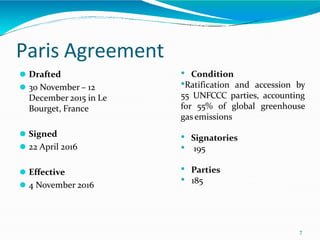
⚫ Drafted
⚫ 30 November – 12
December 2015 in Le
Bourget, France
⚫ Signed
⚫ 22 April 2016
⚫ Effective
⚫ 4 November 2016
• Condition
•Ratification and accession by
55 UNFCCC parties, accounting
for 55% of global greenhouse
gas emissions
• Signatories
• 195
• Parties
• 185
Aims
8
⚫Theaim of theagreement is todecrease global warming
described in its Article 2;
⚫(a) Holding the increase in the global average temperature
to well below 2°C above pre-industrial levels and to pursue
efforts to limit the temperature increase to 1.5°C above pre-
industrial levels, recognizing that this would significantly
reduce the risks and impactsof climate change;
⚫(b) Increasing theability toadapt to theadverse impactsof
climate change and foster climate resilience and low
greenhouse gas emissions development, in a manner that
does not threaten food production;
Nationally determined
contributions
9
⚫Contributions each individual country should make to
achieve theworldwide goal aredetermined byall countries
individuallyand are called nationally determined
contributions (NDCs).
⚫Article 3 requires them to be "ambitious", "represent a
progression over time" and set "with theview toachieving
the purposeof this Agreement". Thecontributions should
be reported every fiveyears.
⚫ Each furtherambition should be more ambitious than the
previousone, known as the principleof 'progression'.
⚫Not obligatory
⚫Mutual cooperation and sustainabledevelopment
Entry
10
⚫The Paris Agreementwasopen forsignature bystates
and regional economic integration organizations that
are parties to the UNFCCC (the Convention) from 22
April 2016 to 21 April 2017 at the UN Headquarters in
NewYork.
Withdrawal from Agreement
11
⚫Article 28 of the agreement enables parties to withdraw
from theagreementaftersending awithdrawal notification
to thedepositary, Withdrawal iseffectiveone yearafter the
depositary is notified.
⚫On August 4, 2017, the Trumpadministration delivered an
official notice to the United Nations that the U.S. intends
to withdraw from the Paris Agreement as soon as it is
legally eligible to do so.The formal notice of withdrawal
cannot be submitted until the agreement is in force for 3
years for the US, in 2019. In accordance with Article 28, as
theagreemententered into force in the United Stateson 4
November 2016, the earliest possible effective withdrawal
date for the United States is 4 November 2019.
Criticism
12
⚫A pair of studies in ”Nature” have said that, as of 2017,
none of the major industrialized nations were
implementing the policies they had envisioned and
have not met theirpledged emission reduction targets.
⚫Raised in temperature
⚫'noaction, justpromises
⚫Lack of binding enforcement mechanism ( whowill
compel the powerful state toabide by)
Future Contribution of some
countries
13
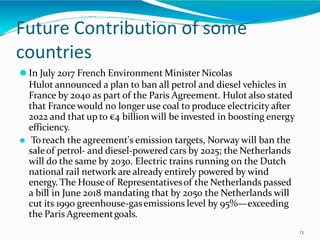
⚫ In July 2017 French Environment Minister Nicolas
Hulot announced a plan to ban all petrol and diesel vehicles in
France by 2040 as part of the Paris Agreement. Hulot also stated
that France would no longer use coal to produce electricity after
2022 and that up to €4 billion will be invested in boosting energy
efficiency.
⚫ Toreach the agreement's emission targets, Norway will ban the
saleof petrol- and diesel-powered cars by 2025; the Netherlands
will do the same by 2030. Electric trains running on the Dutch
national rail network are already entirely powered by wind
energy. The Houseof Representativesof the Netherlands passed
a bill in June 2018 mandating that by 2050 the Netherlands will
cut its 1990 greenhouse-gasemissions level by 95%—exceeding
the Paris Agreementgoals.
Conclusion
14
⚫While the Paris Agreement does not “solve” climate
change, it is a critical inflection point. It brings us
much closertoa saferclimate trajectoryand createsan
ambitious path forward for decades to come.
Countries have put forth an agreement that helps
strengthen national action by ensuring that the
current commitments are the floor—not the ceiling—
of ambition. The agreement will also help spurgreater
action by cities, states, provinces, companies, and
financial institutions. The Paris Agreement has
created a virtuous cycle of increased ambition over
time.
Thank you
15

406884048-Paris-Agreement.pptx

  • 1.
    Paris Agreement underthe United Nations Framework Convention on Climate Change 1 By Advocate HazoorAli Khan hazoorjaankp@gmail.com
  • 2.
    Background 2 Finally the worldstands united against the central environmental challengeof our time, committed to cutting the carbon pollution that’s driving climate change. The Paris deal is theworld's first comprehensiveclimate agreement.
  • 3.
    Introduction 3 ⚫In Paris onDecember 12, 2015, countries adopted an international agreement to address climate change that requires deeper emissions reduction commitments from all countries—developed and developing. ⚫Countries responsible for 97 percent of global emissions submitted their climate commitments prior to the conference.
  • 4.
    PARIS AGREEMENT: BUILDINGUPON A HISTORY OF INTERNATIONAL AGREEMENTS 4 ⚫The United Nations Framework Convention on Climate Change (UNFCCC), formed in 1992 by 196 parties, set the ultimateobjective to “stabilize greenhousegas concentrations in theatmosphereata level that would prevent dangerous anthropogenic interferencewith theclimatesystem.”
  • 5.
    HISTORY OF INTERNATIONAL AGREEMENTS 5 ⚫In 2009, the Copenhagen climate change conference produced the Copenhagen Accord. This Accord was expanded and formally adopted in 2010 as the Cancun Agreementswheredozensof countries—committed to reducing theiremissions by 2020.
  • 6.
    HISTORY OF INTERNATIONAL AGREEMENTS 6 Countriesalso agreed to a new set of mechanisms to helpdeveloping countries reduceemissionsand adapt toclimatechange, as well as a new system to track countries’ progresson theircommitments. In 2011, climate negotiations in Durban, South Africa set theend of 2015 as thedeadline fora new international agreement “applicable toall.” The Paris Agreement has fulfilled this mandate to establish a post 2020 agreement.
  • 7.
    Paris Agreement 7 ⚫ Drafted ⚫30 November – 12 December 2015 in Le Bourget, France ⚫ Signed ⚫ 22 April 2016 ⚫ Effective ⚫ 4 November 2016 • Condition •Ratification and accession by 55 UNFCCC parties, accounting for 55% of global greenhouse gas emissions • Signatories • 195 • Parties • 185
  • 8.
    Aims 8 ⚫Theaim of theagreementis todecrease global warming described in its Article 2; ⚫(a) Holding the increase in the global average temperature to well below 2°C above pre-industrial levels and to pursue efforts to limit the temperature increase to 1.5°C above pre- industrial levels, recognizing that this would significantly reduce the risks and impactsof climate change; ⚫(b) Increasing theability toadapt to theadverse impactsof climate change and foster climate resilience and low greenhouse gas emissions development, in a manner that does not threaten food production;
  • 9.
    Nationally determined contributions 9 ⚫Contributions eachindividual country should make to achieve theworldwide goal aredetermined byall countries individuallyand are called nationally determined contributions (NDCs). ⚫Article 3 requires them to be "ambitious", "represent a progression over time" and set "with theview toachieving the purposeof this Agreement". Thecontributions should be reported every fiveyears. ⚫ Each furtherambition should be more ambitious than the previousone, known as the principleof 'progression'. ⚫Not obligatory ⚫Mutual cooperation and sustainabledevelopment
  • 10.
    Entry 10 ⚫The Paris Agreementwasopenforsignature bystates and regional economic integration organizations that are parties to the UNFCCC (the Convention) from 22 April 2016 to 21 April 2017 at the UN Headquarters in NewYork.
  • 11.
    Withdrawal from Agreement 11 ⚫Article28 of the agreement enables parties to withdraw from theagreementaftersending awithdrawal notification to thedepositary, Withdrawal iseffectiveone yearafter the depositary is notified. ⚫On August 4, 2017, the Trumpadministration delivered an official notice to the United Nations that the U.S. intends to withdraw from the Paris Agreement as soon as it is legally eligible to do so.The formal notice of withdrawal cannot be submitted until the agreement is in force for 3 years for the US, in 2019. In accordance with Article 28, as theagreemententered into force in the United Stateson 4 November 2016, the earliest possible effective withdrawal date for the United States is 4 November 2019.
  • 12.
    Criticism 12 ⚫A pair ofstudies in ”Nature” have said that, as of 2017, none of the major industrialized nations were implementing the policies they had envisioned and have not met theirpledged emission reduction targets. ⚫Raised in temperature ⚫'noaction, justpromises ⚫Lack of binding enforcement mechanism ( whowill compel the powerful state toabide by)
  • 13.
    Future Contribution ofsome countries 13 ⚫ In July 2017 French Environment Minister Nicolas Hulot announced a plan to ban all petrol and diesel vehicles in France by 2040 as part of the Paris Agreement. Hulot also stated that France would no longer use coal to produce electricity after 2022 and that up to €4 billion will be invested in boosting energy efficiency. ⚫ Toreach the agreement's emission targets, Norway will ban the saleof petrol- and diesel-powered cars by 2025; the Netherlands will do the same by 2030. Electric trains running on the Dutch national rail network are already entirely powered by wind energy. The Houseof Representativesof the Netherlands passed a bill in June 2018 mandating that by 2050 the Netherlands will cut its 1990 greenhouse-gasemissions level by 95%—exceeding the Paris Agreementgoals.
  • 14.
    Conclusion 14 ⚫While the ParisAgreement does not “solve” climate change, it is a critical inflection point. It brings us much closertoa saferclimate trajectoryand createsan ambitious path forward for decades to come. Countries have put forth an agreement that helps strengthen national action by ensuring that the current commitments are the floor—not the ceiling— of ambition. The agreement will also help spurgreater action by cities, states, provinces, companies, and financial institutions. The Paris Agreement has created a virtuous cycle of increased ambition over time.
  • 15.