CRANIOVERTEBRAL
JUNCTION :
ANATOMY & RADIOLOGY
Presented By : Dr. SHAILESH JAIN
CRANIOVERTEBRAL JUNCTION
The craniovertebral (or craniocervical) junction(CVJ)
is a collective term that refers to the occiput (posterior
skull base), atlas, axis, and supporting ligaments.
It is a transition zone b/w a mobile cranium &
relatively rigid spinal column.
It encloses the soft tissue structures of the
cervicomedullary junction (medulla, spinal cord, and
lower cranial nerves).
EMBRYOLOGY &
DEVELOPMENT OF THE CVJ
Development of the cartilaginous cranium & the
adjacent structures begins during the early weeks of
intrauterine life.
2nd Gestational week : Mesoderm cells condense in
the midline to form notochordal process.
3rd Gestational week :
- notochordal process invaginates in b/w ecto &
endoderm to form notochord.
- dorsal ectoderm thickens to form neural groove
which folds, fuses, & becomes neural tube.
EMBRYOLOGY &
DEVELOPMENT OF THE CVJ
Between 3rd & 5th week :
- part of mesoderm which lies on either side of
notochord (Paraxial mesoderm) gives rise to somites
(Segmentation).
- total 42 somites form at 4th week.
- ventromedial portion of somite is k/a
sclerotome which forms the vertebral bodies.
- each sclerotome differentiates into a cranial,
loosely arranged portion and a caudal compact
portion by a fissure k/a “Fissure of von Ebner”
(Re-segmentation).
EMBRYOLOGY &
DEVELOPMENT OF THE CVJ
Mesenchymal cells of the fissure condense around
the notochord to form the intervertebral disc.
Notochord disappears at the vertebral bodies, but
persist as nucleus pulposus at disc.
The first four sclerotomes do not follow this course &
fuse to form the occipital bone & post.portion of FM.
This membraneous stage is f/b stages of
chondrification & ossification.
Out of 4 occipital sclerotomes the first 2 form
basiocciput, the III Jugular tubercles and the IV
(Proatlas) form parts of foramen magnum, atlas and
axis.
EMBRYOLOGY &
DEVELOPMENT OF THE CVJ
PROATLAS : divided into the hypocentrum, centrum
& the neural arches.
- hypocentrum forms the vestigial condylus
tertius or anterior tubercle of the clivus.
- centrum forms the apex of the dens, also
forms the apical ligament (AL) of dens (AL may
contain notochordal tissue,so k/a rudimentary IVdisc).
- ventral part of the neural arch forms the ant.
margin of FM, 2 occipital condyles & the alar &
cruciate ligaments.
- dorsal part forms paired rostral articular
facets, lateral masses of C1 & superior portion of the
post. arch of the atlas.
EMBRYOLOGY &
DEVELOPMENT OF THE CVJ
ATLAS : no vertebral body & no IV disc.
- major portion formed by first spinal sclerotome.
- trasitional vertebra as centrum of sclerotome is
separated to fuse with the axis body forming the
odontoid process.
- hypocentrum of 1st spinal sclerotome forms the
anterior arch of the atlas.
- neural arch of the first spinal sclerotome forms
the inferior portion of the posterior arch of atlas.
EMBRYOLOGY &
DEVELOPMENT OF THE CVJ
AXIS : develops from 2nd spinal sclerotome.
- hypocentrum of 2nd spinal sclerotome
disappears during embryogenesis.
- centrum forms the body of the axis vertebra &
neural arch develops into the facets & the posterior
arch of the axis.
- At birth odontoid base is separate from the
body of axis by a cartilage which persists until the
age of 8, later the center gets ossified.,or may remain
separate as Os- odontoidium.
- The apical segment is not ossified until 3 years
of age, at 12 years if fuses with odontoid to form
normal odontoid., failure leads to Os terminale.
OSSIFICATION CENTRES
OCCIPUT & BASIOCCIPUT :
2 occipital squamous portions – 2 centres
Basiocciput (clivus) - 1 centre
2 Jugular tubercles – 2 centres
2 Occipital condyles – 2 centres
ATLAS : ossifies from 3 centres
Each half of post. Arch with lateral mass –7 to 9 wk,
unites at 3 – 4 years.
Anterior arch – at 1 to 2 years centre appears,
unites with lateral mass at 6 – 8 years.
OSSIFICATION CENTRES
AXIS : ossifies from 5 primary & 2 secondary centres.
2 Neural arches – 2 centres appear at 7 – 8 wk
Body of axis – 1 centre appear at 4 – 5 months
Body of dens – 2 centres appear at 6 – 7 months
4 pieces (at birth) unite at 3 – 6 years
Tip of odontoid appears at 3 – 6 years, unites
with the body of odontoid at 12 years.
Odontoid & body of axis – only circumference of
intervening cartilage ossifies.
APPLICATIONS
Dysplasia of the occiptal segments may flatten the
clivus - platybasia.
When the basiocciput and rim of foramen magnum
are underdeveloped, the odontoid and arch of atlas
may invaginate- Basilar invagination.
The proatlas may develop into separate vertebrae -
Occipital vertebra, hypochondral bow of proatlas
may persist to gain attachment to the atlas, clivus or
even to the apical segment of the dens - responsible
for anterior cervicomedullary compression.
APPLICATIONS
If the posterior segment of the proatlas fails to fuse
with the atlas, a rare anomaly termed bipartite
articular facets occurs, may result in horizontal
instability of the OA joint.
Bicornuate dens : dens body may fail to fuse in
utero resulting in a V- shaped cleft found
radiographically at birth , rare in adults.
Failure of segmentation b/w the axis & the 3rd cervical
vertebra involves both the ant. & the post. Vertebral
segments, associated with other anomalies like
Klippel – Feil syndrome.
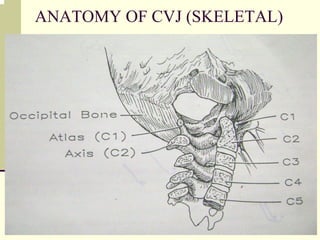
ANATOMY OF CVJ (SKELETAL)
ANATOMY OF CVJ (ARTICULAR)
Upper surfaces of C1 lateral masses are cup-like or
concave which fit into the ball & socket configuration,
united by articular capsules surr. the AO joint & by
the ant. & post. AO membranes.
4 synovial joints b/w atlas & axis –
2 median – front & back of dens (Pivot variety)
2 lateral – b/w opposing articular facets(Plane variety)
Each joint has its own capsule & synovial cavity.
ANATOMY OF CVJ(LIGAMENTOUS)
Principal stabilizing ligaments of C1 -
- Transverse atlantal ligament
- Alar ligaments
Secondary stabilizing ligaments of CVJ are more
elastic & weaker than the primary ligaments.
- Apical ligament
- Anterior & posterior A-O membranes
- Tectorial membrane
- Ligamentum flavum
- ALL & PLL
- Capsular ligaments
ANATOMY OF CVJ(LIGAMENTOUS)
ATLANTO-OCCIPITAL LIGAMENTS :
A) Anterior Atlanto-occipital Membrane ----
about 2 cm wide & consists of densely woven fibres
that radiate in a slightly lateral pattern.
Central fibres are thicker than the lateral portion.
Lateral fibres interconnect with the A-O capsules.
Ligament is continuous caudally with the anterior A-A
ligament & through it to the ALL of the spinal column.
It acts as a tension band that stretches during
extension, serving as a secondary stabilizer against
this motion.
ANATOMY OF CVJ(LIGAMENTOUS)
B) POSTERIOR ATLANTO-OCCIPITAL MEMBRANE :
A less strong ligament containing no significant
elastic tissue.
Ligament is loose b/w the bones & does not limit their
motion & is firmly attached anteriorly to the dura
mater.
Ligament invests itself on either side to form a canal
through which the vertebral artery, accompanying
veins, & the first cranial nerve pass.
C) LATERAL ATLANTO-OCCIPITAL LIGAMENTS :
- ascending lig which reinforce the A-O joint capsules.
ANATOMY OF CVJ(LIGAMENTOUS)
ATLANTOAXIAL LIGAMENTS :
Anterior A-A ligament,
Posterior A-A ligament
Transverse ligament of the atlas : thick, strong &
about 6mm in height.
- lig presents a fibrocartilagenous surface ventrally
allowing a free gliding motion to occur over the
posterior facet of the dens.
- posterior fibres of this ligament are arcuate, &
the more ventral fibres are circular in configuration.
ANATOMY OF CVJ(LIGAMENTOUS)
Caudal crus & Rostral crus (Fasciculi longitudinales)
fibres joined with transverse ligament on its dorsal
aspect to form Cruciate ligament of atlas.
The force required to rupture the transverse ligament
ranged from 12 to 180 kp (mean 84kp) under slow
loading & about 111 kp under rapid loading.
TAL effectively limits anterior translation and flexion
of the atlantoaxial joint.
An accessory band ventral to the ascending crus
attaching to the apex of the odontoid process is
termed Gerber’s ligament.
ANATOMY OF CVJ(LIGAMENTOUS)
AXIS – OCCIPITAL LIGAMENTS :
A) TECTORIAL MEMBRANE :
dorsal to the cruciate ligament, a strong band of
longitudinally oriented fibres attached to the dorsal
surface of the C3 vertebra, axis body ,& to the body
of dens.
It is the rostral extension of the PLL of the vertebral
column.
Essential for limiting flexion.
The accessory bands of the ligament passing to the
lateral capsule of the A-A joints -- Arnold’s ligament
ANATOMY OF CVJ(LIGAMENTOUS)
B) ALAR LIGAMENTS :
2 strong cords that attach to the dorsal lateral body
of the dens , about 8mm wide.
Fibres extend laterally & rostrally.
They are ventral & cranial to the transverse ligament.
Alar lig allow an anterior shift of C1 from 3 to 5 mm.
They limit the head – atlas rotatory movement on the
odontoid axis as well as strengthen the A-O capsule.
C) APICAL LIGAMENT : slender band of fibres about
2-5mm wide & 2-8mm long containing small amount
of collagen & elastic fibres.
No mechanical significance.
ANATOMY OF CVJ (MUSCLES)
Muscles have only a minor role related to
CVJ stabilization & do not limit the
movements of the joints.
Their principal function is one of initiating &
maintaining movement at the CVJ.
ANATOMY OF CVJ (NEURAL)
Neural structures related to CVJ are –
Caudal portion of brainstem (Medulla)
Cerebellum
Fourth ventricle
Rostral part of spinal cord
Lower cranial & upper cervical nerves
In cerebellum, only the tonsils, biventral lobules & the
lower part of the vermis (nodule, uvula & pyramid)
are related to CVJ.
Biventral lobule is located above the lateral part of
FM & the tonsils lie above the posterior edge.
ANATOMY OF CVJ (NEURAL)
CRANIAL NERVES :
Lower four cranial N. are closely related to CVJ.
9th & 10th cranial N arise from the medulla in the
groove b/w the inferior olivary nucleus & the inferior
cerebellar peduncle.
9th & 10th N are separated by a dural sheath which
separate these nerves as they penetrate the dura to
enter the jugular foramen.
The accessory N is the only cranial N that passes
through the FM.
ANATOMY OF CVJ (NEURAL)
Accessory N is composed of 2 parts.
The cranial part or the accessory portion (ramus
internus) is the smaller of the two & is accessory to
the vagus.
It arises from the medulla, is composed of multiple
rootlets & joins the vagus N.
The major portion (ramus externus) is the spinal
portion formed by a series of rootlets arising from the
lower medulla & upper spinal cord.
The rootlets may arise as low as the C7 root level.
ANATOMY OF CVJ (NEURAL)
Major trunk enters the skull via FM b/w dentate lig &
dorsal roots where it joins the cranial portion of the N
& leaves the skull through the jugular foramen.
Hypoglossal N : formed by the rootlets arising from
the medulla along the anterior margin of the olive &
pass behind the vertebral artery.
Its rootlets are collected in to two bundles which
perforate the dura mater separately, pass via the
hypoglossal canal & then unite.
ANATOMY OF CVJ (NEURAL)
SPINAL NERVE ROOTS :
The C1, C2, and C3 nerves, distal to the ganglion,
divide into dorsal and ventral rami.
The first cervical nerve located just below the
foramen magnum.
The C1 ventral root (SUBOCCIPITAL NERVE) is
composed of four to eight rootlets that joined and
coursed laterally and supplies the rectus capitis
lateralis.
ANATOMY OF CVJ (NEURAL)
Dorsal ramus is larger than the ventral ramus.
The dorsal rami divide into medial and lateral
branches that supply the skin and muscles of the
posterior region of the neck.
The dorsal ramus supplies rectus capitis posterior
major and minor, superior and inferior oblique, and
the semispinalis capitis.
The dorsal root of the first cervical nerve has
variations in its composition and its connections with
the accessory nerve.
ANATOMY OF CVJ (LYMPHATICS)
The lymphatic drainage of the O-A-A joints is
primarily into the retropharyngeal LN & then into the
deep cervical chain.
These LN’s also drain the nasopharynx & hence
retrograde infection may affect the synovial lining of
the CVJ complex with resultant neck stiffness &
instability.
ANATOMY OF CVJ (ARTERIAL)
The major arteries related to CVJ are vertebral,
posteroinferior cerebellar arteries (PICA), and the
meningeal branches of the vertebral, and external
and internal carotid arteries.
VERTEBRAL ARTERY arises from the upper
posterior part of the first segment of the subclavian
artery in the neck.
Each artery is divided into intradural and extradural
parts.
The extradural part is divided into three segments.
ANATOMY OF CVJ (ARTERIAL)
The terminal extradural segment of the vertebral
artery gives rise to the posterior meningeal and
posterior spinal arteries, branches to the deep
cervical musculature, and infrequently the PICA.
The intradural segment begins at the dural foramina
where it forms a funnel-shaped foramen around 4 to
6 mm length of the artery.
The first cervical nerve exits the spinal canal, and the
posterior spinal artery enters the spinal canal through
this dural foramen with the vertebral artery.
ANATOMY OF CVJ (ARTERIAL)
The intradural part of the artery is divided into lateral
and anterior medullary segments.
The branches arising from the vertebral artery in the
region of the FM are the posterior spinal, anterior
spinal, PICA, and anterior and posterior meningeal
arteries.
The PICA is the largest branch of the vertebral artery.
It usually originates within the dura mater, but it may
infrequently originate from the terminal extradural
part of the vertebral artery.
ANATOMY OF CVJ (ARTERIAL)
The tonsillomedullary PICA segment, which forms the
caudal loop related to the lower part of the tonsil, is
most intimately related to the foramen magnum.
The paired posterior spinal arteries usually arise
from the posteromedial surface of the vertebral
arteries, just outside the dura mater, but they may
also arise from the initial intradural part of the
vertebral arteries, or from the PICA.
The artery divides into an ascending branch to supply
the medulla & a descending branch to the superficial
part of the dorsal half of the cervical spinal cord.
ANATOMY OF CVJ (ARTERIAL)
The anterior spinal artery is formed by the union of
the paired anterior ventral spinal arteries, which
originate from the anterior medullary segment
(intradural segment) of the vertebral arteries.
ANATOMY OF CVJ (ARTERIAL)
MENINGEAL ARTERIES :
The dura mater around the FM is supplied by
the anterior and posterior meningeal
branches of the vertebral artery, and the
meningeal branches of the ascending
pharyngeal and occipital arteries.
ANATOMY OF CVJ (VENOUS)
The venous structures in the region of the FM are
divided into three groups:
- Extradural veins(extraspinal & intraspinal part)
- Intradural (neural) veins, &
- Dural venous sinuses( superior petrosal,
marginal & occipital )
The three groups anastomose through bridging and
emissary veins.
KINETIC ANATOMY OF CVJ
CVJ units are unique with respect to the rest of the
spine in that they do not bear weight through disks,
but rather through synovial joints lined with hyaline
cartilage, thus exhibit significantly more movement
than any other spinal level.
ROTATION : when movement occurs about an axis.
TRANSLATION : when movement occurs along an
axis.
The C1 lateral masses contain the occipital condyles
in a cup-like fashion, facilitating flexion and extension.
KINETIC ANATOMY OF CVJ
ATLANTO-OCCIPITAL JOINTS :
The C1 lateral masses contain the occipital condyles in
a cup-like fashion.
The condyles of these paired joints in saggital direction
are arcuate & thus due to this anatomy, motion about
the vertical axis is not possible.
Thus, this joint is biaxial having movements only
around the transverse & A-P axes.
2 types of movement permitted are forward or
backward bending (nodding of head / yes-yes movt.) &
a slight lateral tilting motion to either side.
These joints do not permit rotation.
KINETIC ANATOMY OF CVJ
ATLANTOAXIAL JOINTS :
Consists of 2 lateral zygapophyseal & 2 median
odontoid joints (pivot joint).
Rotation of atlas occurs around the odontoid process
like a wheel around an axle & its axis passes
centrally through the annulus osteofibrosis.
The superior facet of the axis is convex & the inferior
facet of the atlas is either horizontal or slightly convex
with horizontal orientation of the articulation.
Because of this, these facets slide forward &
backward on each other with rotation.
KINETIC ANATOMY OF CVJ
The A-A joints allow less flexion – extension motion
than rotation.
There is greater movement with extention (upto 10o)
than with flexion (upto 5o).
Flexion extension of the O-A joint exceeds that of the
A-A joint ( flexion 10o, extension 25o).
The ratio of extension to flexion is approx 2:1 & this
ratio maintains itself at both the O-A & A-A joints.
KINETIC ANATOMY OF CVJ
Total rotation of the entire cervical spine is upto 90o &
approx ½ occurs at the A-A joint.
Rotation with accompanying lateral flexion in the
cervical spine occurs below the axis due to oblique
orientation of the facets & their gliding motion with
rotation.
The organization of the ligamentous tissue limits the
range of motion of the CVJ.
With a certain degree of anteflexion, the tectorial
membrane, cruciform & Apical dens ligaments
become slack & do not check movement.
KINETIC ANATOMY OF CVJ
With further anteflexion, ant occipital margin shifts
forward & downward over the dens tip.
Caput of dens then acts as a fulcrum, resulting in
tightening of the tectorial membrane with consequent
checking of anteflexion (checking effect).
With retroflexion, the ant occiput & the caput of dens
move away from each other with resultant tightening
of tectorial membrane & limitation of RF.
The tightening of TM exerts counter pull on the outer
ligaments of lateral A-A joints which assists in
stabilization in this movement.
KINETIC ANATOMY OF CVJ
Alar ligaments exert their pull in a ventral-lateral
direction.
They limit rotation & lateral flexion only when both are
tight.
In neutral position of the head, both ligaments are
slack.
With maximum movement of the CVJ, either
beginning with rotation or lateral bending, the final
result is identical.
KINETIC ANATOMY OF CVJ
The anatomic structures that provide stability of the
O-A joint include –
cup shaped configuration of the joints, &
Ant & Post A-O membranes
Additional stability is provided by ligamentous
connections b/w occiput & axis that include the
tectorial membrane, alar, & apical ligaments.
KINETIC ANATOMY OF CVJ
Hyperrotation or rotatory subluxation of
C1–2 :
The atlantoaxial joint is the only joint of the neck that
relies entirely on ligamentous structures—it has no
buttressing bone-on-bone articulations— to limit axial
rotation.
Transection of the C1–2 capsular ligaments cause
small increases in motion, primarily in axial rotation.
Somewhat larger increases in axial rotation will occur
when the alar ligaments are transected.
So, hyperrotation injuries would be expected to be
associated with damage to both of these ligaments.
KINETIC ANATOMY OF CVJ
Depending on the severity of symptoms,
ligamentous injury that results in hyperrotation may
require surgical intervention for stabilization.
HYPERFLEXION :
Hyperflexion injuries at the craniocervical junction
commonly occur as occipitoatlantal dislocations and
TAL disruptions.
KINETIC ANATOMY OF CVJ
Occipitoatlantal dislocations occur when (primarily)
the apical, vertical cruciate, and alar ligaments and
(secondarily) the articular ligaments and posterior
column ligaments are disrupted, allowing the ball-
shaped occipital condyles to travel out of the cup-
shaped articulations of C1.
Occipitoatlantal dislocations are very unstable and
are typically treated by posterior occipitocervical
fusion.
KINETIC ANATOMY OF CVJ
TAL disruption occurs during hyperflexion because
the force of the TAL against the dens is the primary
force resisting anterior subluxation of C1 on C2.
If the TAL fails, severe instability will occur, with C1
moving anteriorly on C2 and the posterior arch of C1
pinching the spinal cord against the body of C2.
To treat TAL disruption, fusion of C1–2 is required
because it is currently infeasible to repair the TAL
surgically.
KINETIC ANATOMY OF CVJ
HYPEREXTENSION :
1) Hangman’s fracture :
2) Fracture of the posterior arch of C1 :
This type of injury can occur when the occiput or
spinous process of C2 collides with the posterior arch
of C1 during hyperextension.
Fracture of the posterior arch of C1 disrupts the
continuity of C1, which may not cause immediate
instability if there is no ligamentous damage, but could
lead to an increased tendency for cranial settling
because of easier spreading of lateral masses of C1.
KINETIC ANATOMY OF CVJ
3) Type III odontoid fractures : in which the fracture
occurs through a portion of the vertebral body, are
the most common fracture type for pure extension
force with no lateral component.
Odontoid fracture stability can be restored by direct
reapposition of the dens fragment to the body of C2
as long as the TAL is intact.
AXIAL COMPRESSION :
Jefferson’s fractures of C1 :
In this injury, a radial force on the ring of C1
fractures it in several places.
KINETIC ANATOMY OF CVJ
Jefferson’s fractures also can leave the
lateral masses free to move independently
from each other and from the anterior arch of
C1, disabling the important interaction of the
dens against the surrounding bony structures
in preventing anteroposterior and lateral
movement.
RADIOLOGY OF CVJ
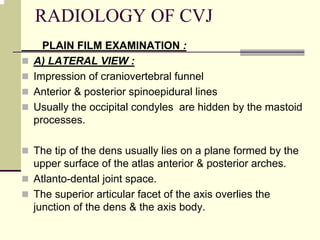
PLAIN FILM EXAMINATION :
A) LATERAL VIEW :
Impression of craniovertebral funnel
Anterior & posterior spinoepidural lines
Usually the occipital condyles are hidden by the mastoid
processes.
The tip of the dens usually lies on a plane formed by the
upper surface of the atlas anterior & posterior arches.
Atlanto-dental joint space.
The superior articular facet of the axis overlies the
junction of the dens & the axis body.
RADIOLOGY OF CVJ
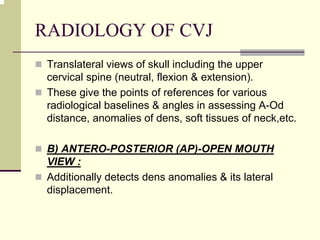
Translateral views of skull including the upper
cervical spine (neutral, flexion & extension).
These give the points of references for various
radiological baselines & angles in assessing A-Od
distance, anomalies of dens, soft tissues of neck,etc.
B) ANTERO-POSTERIOR (AP)-OPEN MOUTH
VIEW :
Additionally detects dens anomalies & its lateral
displacement.
RADIOLOGY OF CVJ
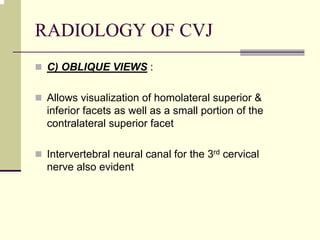
C) OBLIQUE VIEWS :
Allows visualization of homolateral superior &
inferior facets as well as a small portion of the
contralateral superior facet
Intervertebral neural canal for the 3rd cervical
nerve also evident
RADIOLOGY OF CVJ
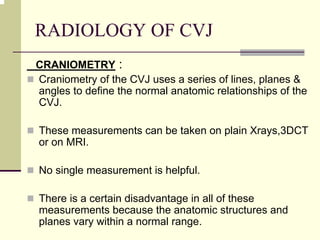
CRANIOMETRY :
Craniometry of the CVJ uses a series of lines, planes &
angles to define the normal anatomic relationships of the
CVJ.
These measurements can be taken on plain Xrays,3DCT
or on MRI.
No single measurement is helpful.
There is a certain disadvantage in all of these
measurements because the anatomic structures and
planes vary within a normal range.
RADIOLOGY OF CVJ
LATERAL PROJECTION OF SKULL X-RAY :
Palato – occipital (Chamberlain’s line)
Palato – suboccipital line (McGregor line)
Foramen magnum line (McRae line)
Height of the posterior cranial fossa (Klaus Index)
Wackenhein’s clival canal line
Bull’s angle (Atlanto-palatal angle)
Atlanto-temporo-mandibular index (Fischgold)
RADIOLOGY OF CVJ
FRONTAL PROJECTION OF SKULL X-RAY :
Bimastoid line (Fischgold & Metzer)
Bidigastric line (Fischgold & Metzer)
Condylar angle (Schmidt & Fischer)
FOR DIAGNOSIS OF PLATYBASIA :
Basal angle (Welcher)
Boogard’s angle
RADIOLOGY OF CVJ
Chamberlain Line :
The Chamberlain line extends between the posterior
pole of the hard palate and the opisthion (posterior
margin of the foramen magnum).
McGregor developed a modification of the
Chamberlain line when the opisthion could not be
identified on plain radiographs.
This McGregor line extends between the posterior
pole of the hard palate and the lowest point of the
occipital basi-squamous surface.
RADIOLOGY OF CVJ
The tip of the odontoid process commonly lies below
or just tangent to the Chamberlain line, and it may
normally project above this line for a distance of
several millimeters
The maximum distance that the odontoid process
may be seen above this line is variable, ranging from
1 mm ± 3.6 to 6.6 mm (1-5).
Not more than 1/3rd of the odontoid process should
extend above chamberlain’s line.
RADIOLOGY OF CVJ
The odontoid tip may be slightly higher if the
McGregor line is used.
The anterior arch of the atlas typically lies below
these lines.
Drawback of chamberlain’s line :
Posterior rim of FM shows great anatomic variability
& also it may be difficult to radiologically pinpoint
opisthion.
RADIOLOGY OF CVJ
Wackenheim Clivus Baseline (Basilar line):
The Wackenheim clivus baseline is constructed by
drawing a line along the clivus and extrapolating it
inferiorly into the upper cervical spinal canal.
This line should fall tangent to the posterior aspect of
the tip of the odontoid process.
This line intersects the dens when the skull is anterior
in position.
RADIOLOGY OF CVJ
The angle formed at the intersection of the
Wackenheim clivus baseline with a line constructed
along the posterior surface of the axis body and
odontoid process (craniovertebral or clivus-canal
angle) normally ranges from 150o in flexion to 180o in
extension.
Ventral spinal cord compression may occur when the
angle is less than 150o.
RADIOLOGY OF CVJ
Welcher Basal Angle :
The Welcher basal angle is formed at the intersection
of the nasion-tuberculum line and the tuberculum-
basion line.
It averages 132o & should always be less than 140o.
This angle is increased when the skull base is
abnormally flattened (Platybasia).
RADIOLOGY OF CVJ
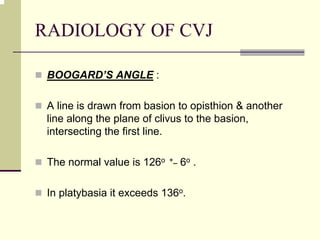
BOOGARD’S ANGLE :
A line is drawn from basion to opisthion & another
line along the plane of clivus to the basion,
intersecting the first line.
The normal value is 126o +_ 6o .
In platybasia it exceeds 136o.
RADIOLOGY OF CVJ
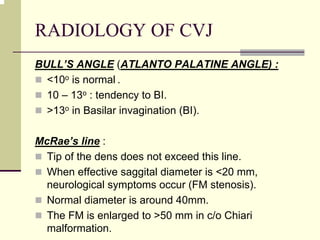
BULL’S ANGLE (ATLANTO PALATINE ANGLE) :
<10o is normal .
10 – 13o : tendency to BI.
>13o in Basilar invagination (BI).
McRae’s line :
Tip of the dens does not exceed this line.
When effective saggital diameter is <20 mm,
neurological symptoms occur (FM stenosis).
Normal diameter is around 40mm.
The FM is enlarged to >50 mm in c/o Chiari
malformation.
RADIOLOGY OF CVJ
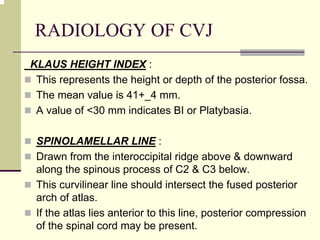
KLAUS HEIGHT INDEX :
This represents the height or depth of the posterior fossa.
The mean value is 41+_4 mm.
A value of <30 mm indicates BI or Platybasia.
SPINOLAMELLAR LINE :
Drawn from the interoccipital ridge above & downward
along the spinous process of C2 & C3 below.
This curvilinear line should intersect the fused posterior
arch of atlas.
If the atlas lies anterior to this line, posterior compression
of the spinal cord may be present.
RADIOLOGY OF CVJ
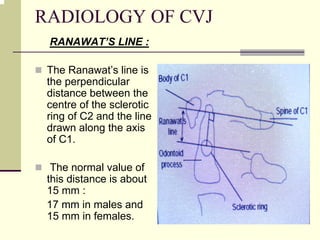
RANAWAT’S LINE :
The Ranawat’s line is
the perpendicular
distance between the
centre of the sclerotic
ring of C2 and the line
drawn along the axis
of C1.
The normal value of
this distance is about
15 mm :
17 mm in males and
15 mm in females.
RADIOLOGY OF CVJ
FISCHGOLD BIMASTOID LINE :
Normally passes through the A-O joint.
Apex of odontoid should lie about 2mm above this line
with a range b/w 3mm below & 10mm above.
FISCHGOLD BIDIGASTRIC LINE :
This line is situated 10mm above the bimastoid line.
Corresponds to McRae’s line on lateral view.
Odontoid tip normally should not project above this line.
RADIOLOGY OF CVJ
Atlantooccipitaljoint Axis Angle ( Condylar angle
of Schmidt & Fischer) :
This angle is formed by lines drawn parallel to A-O
joints, which typically intersect at the center of the
odontoid process when the condyles are symmetric.
The average angle is 125o with a range between
124o & 127o.
This angle becomes more obtuse in the presence of
occipital condylar hypoplasia.
RADIOLOGY OF CVJ
(NORMAL VARIANTS
& ANOMALIES)
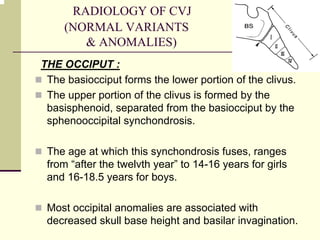
THE OCCIPUT :
The basiocciput forms the lower portion of the clivus.
The upper portion of the clivus is formed by the
basisphenoid, separated from the basiocciput by the
sphenooccipital synchondrosis.
The age at which this synchondrosis fuses, ranges
from “after the twelvth year” to 14-16 years for girls
and 16-18.5 years for boys.
Most occipital anomalies are associated with
decreased skull base height and basilar invagination.
RADIOLOGY OF CVJ
Condylus Tertius :
When the hypochordal bow of the fourth occipital
sclerotome (proatlas) persists or when the proatlas fails to
integrate, an ossifled remnant may be present at the distal
end of the clivus, called the condylus tertius or third
occipital condyle.
This third condyle may form a joint or pseudojoint with the
odontoid process or with the anterior arch of the atlas and
may lead to limitation in the range of motion of the CVJ.
There is an increased prevalence of os odontoideum
associated with this abnormality.
RADIOLOGY OF CVJ
Condylar Hypoplasia :
In condylar hypoplasia, the occipital condyles are
underdeveloped and have a flattened appearance,
leading to BI (violation of the Chamberlain line) and
widening of the atlantooccipital joint axis angle.
The lateral masses of the atlas may be fused to the
hypoplastic condyles, further accentuating the BI.
Condylar hypoplasia limits, or may even abolish,
movements at the A-O joint.
RADIOLOGY OF CVJ
Basiocciput Hypoplasia :
Hypoplasia of the basiocciput may be mild or severe,
depending on the number of occipital vertebrae affected.
It results in shortening of the clivus and violation of the
Chamberlain line and is virtually always associated with
basilar invagination.
The Wackenheim clivus baseline is usually normal,
although the clivus-canal angle is typically decreased and
there may be bow-string deformity of the cervicomedullary
junction.
RADIOLOGY OF CVJ
Atlantooccipital Assimilation / Occipitalization of Atlas :
The failure of segmentation between the skull and first
cervical vertebra results in assimilation of the atlas.
Incidence in a normal population – 0.08 to 3 %.
India – 40 to 50 % cases are associated among CVJ
anomalies.
The assimilation may be complete or partial.
It invariably results in basilar invagination.
Wackenheim clivus baseline may be normal, but the clivus-
canal angle may be decreased.
When incompletely assimilated, the atlas arches appear too
high on the lateral plain radiograph or, when completely
assimilated, are not visible at all .
RADIOLOGY OF CVJ
TOPOGRAPHIC FORMS (WACKENHEIM) :
Type I : Occipitalization (generally subtotal)
associated with BI.
Type II : Occipitalization (generally subtotal)
associated with BI & fusion of axis & 3rd cervical
vertebrae.
Type III : Total or subtotal occipitalization with BI &
maldevelopment of the transverse ligament.
Type III may be associated with various
malformations like C2-C3 fusion, hemivertebra, dens
aplasia, tertiary condyle, etc.
RADIOLOGY OF CVJ
The neurological symptoms are not caused by
occipitalization proper but rather by the fact that in the
absence of a free atlas, TL fails to develop which causes
posterior displacement of axis & compression of the
spinal cord.
Instability b/w atlas & axis is reducible in patients <15 yr’s
but after that irreducible state occurs.
Its combination with segmentation failure of 2nd & 3rd
cervical vertebrae results in gradual loosening of the
atlanto-dental joint with progressive atlanto-axial luxation
in children in about 50% of cases.
RADIOLOGY OF CVJ
ATLAS :
With the exception of the various atlantooccipital
assimilations, most atlas anomalies, when isolated,
produce no abnormal CVJ relationships and are not
associated with basilar invagination.
The vast majority of anomalies consist of various
arch clefts, aplasias, and hypoplasias.
Arch anomalies are frequently mistaken for fractures
in the evaluation of plain radiographs of patients with
a history of cervical spine trauma.
RADIOLOGY OF CVJ
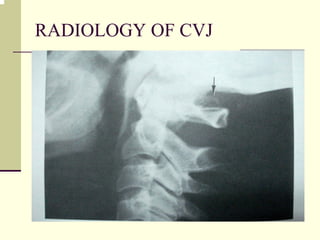
PONTICULUS POSTICUS / KIMMERLE’S
DEFORMITY :
It is a bony ridge projecting posteriorly from the
articular edge of the atlas superior articular facet.
The bony projection may be only a few mm long or
may elongate to unite with the adjacent neural arch of
the atlas to produce an “ARCUATE CANAL” through
which the vertebral artery passes.
This is due to ossification of a portion of the oblique
A-O ligament.
RADIOLOGY OF CVJ
RADIOLOGY OF CVJ
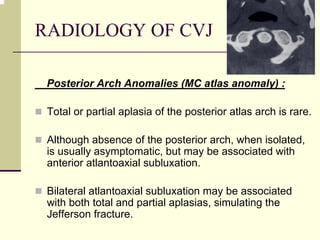
Posterior Arch Anomalies (MC atlas anomaly) :
Total or partial aplasia of the posterior atlas arch is rare.
Although absence of the posterior arch, when isolated,
is usually asymptomatic, but may be associated with
anterior atlantoaxial subluxation.
Bilateral atlantoaxial subluxation may be associated
with both total and partial aplasias, simulating the
Jefferson fracture.
RADIOLOGY OF CVJ
In contrast to the aplasias and hypoplasias, clefts of
the atlas arches are much more common.
Posterior rachischisis, most common, is observed in
4% of adults.
The majority of posterior atlas clefts (97%) are
midline, whereas lateral clefts, through the sulcus of
the vertebral artery, account for the remaining 3%.
Posterior arch rachischisis may be superimposed on
the odontoid process or the axis body on the open-
mouth odontoid view, simulating a fracture.
RADIOLOGY OF CVJ
Split Atlas :
In contrast to posterior arch rachischisis, anterior arch
rachischisis is quite rare (0. 1 %).
It is typically encountered in association with posterior
rachischisis - “split atlas”.
Normally, on a lateral radiograph, the anterior arch of the atlas
appears crescentic or half-moon-shaped, with dense cortical
bone surrounding the medullary cavity and a well-defined
predental space.
In anterior arch rachischisis, the anterior arch appears fat or
plump and rounded in configuration, appearing to ‘ ‘overlap’ ‘ the
odontoid process (making identification of the predental space
impossible); the arch may have unsharp, duplicated anterior
margins
RADIOLOGY OF CVJ
Atlanto-axial segmentation defect :
The lateral view shows horizontal orientation of one
of the lateral atlantoaxial joints.
The open-mouth view reveals hypertrophic change
of one lateral mass of the atlas and the base of the
odontoid.
Etiology - due to the incorporation of a somatic
segment into the atlas which normally forms part of
the lateral mass of the axis.
CONGENITAL ODONTOID
ANOMALIES OR DYSPLASIAS
Type I : Os odontoideum
Type II : Ossiculum terminale
Type III : Agenesis of odontoid base
Type IV : Agenesis of apical segment
Type V : Agenesis of odontoid
RADIOLOGY OF CVJ
Persistent Ossiculum Terminale :
Also called Bergman ossicle, results from failure of fusion of the
terminal ossicle to the remainder of the odontoid process.
The fusion typically is accomplished by 12 years of age.
Bergman ossicle may be confused with a type 1 odontoid fracture
(avulsion of the terminal ossicle), and absolute differentiation
between the two diagnoses may be difficult.
Whether traumatic or congenital in origin, this anomaly is stable
when isolated and of relatively little clinical significance.
The odontoid process is usually normal in height.
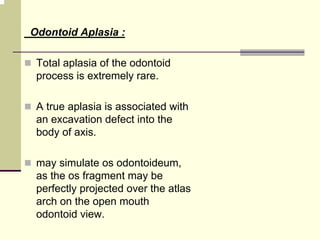
Odontoid Aplasia :
Total aplasia of the odontoid
process is extremely rare.
A true aplasia is associated with
an excavation defect into the
body of axis.
may simulate os odontoideum,
as the os fragment may be
perfectly projected over the atlas
arch on the open mouth
odontoid view.
OS ODONTOIDEUM
This term first introduced by Giacomini in 1886, refers to
an independent osseous structure lying cephalad to the
axis body in the location of the odontoid process.
The anterior arch of the atlas is rounded and hypertrophic
but the posterior arch is hypoplastic.
As the gap between the os odontoideum and the axis
body usually extends above the level of the superior
articular facet of the axis, cruciate ligament incompetence
and A-A instability are common.
OS ODONTOIDEUM
The margins of the axis body, the os, and anterior
arch are all well corticated.
Type 2 odontoid fracture is typically associated with a
flattened, sharp, uncorticated margin to the upper
axis body and a normal, halfmoon- shaped
appearance to the anterior atlas arch with a narrow
gap in b/w # segments.
Etiology – Embryologic, Traumatic &/or Vascular.
Types – Orthotopic & Dystopic.
Instability is more common with dystopic type.
OS ODONTOIDEUM
Reducible – on flexion, dorsal compression of the
cord occurs but on extension ventral compression
occurs secondary to increased angulation anteriorly.
Irreducible – due to displacement of TL ventral to
the ossicle.
Treatment :
Reducible – Occipito cervical PF in neutral position.
Irreducible – Transoral resection of the os, odontoid
remnant & surrounding granulation
tissue.
KLIPPEL FEIL SYNDROME
Described first by Klippel and Feil in 1912.
Etiology is unknown.
Due to failure of the normal segmentation of cervical
somites during the third and eighth weeks of gestation.
Classic triad of low posterior hair line, short neck and
limited neck ROM found in less than 50% of cases
The most consistent finding is limitation of neck motion.
Generally flexion and extension are better preserved
than side- bending and rotation.
KLIPPEL FEIL SYNDROME
TYPES :
Type 1: Cervical spine fusion in which elements of
many vertebrae are incorporated into a single block.
Type 2: Cervical spine fusion in which there is failure
of complete segmentation at only one or two cervical
levels and may include an occipito-atlantal fusion.
Type 3: Type 1 or type 2 fusion with co-existing
segmentation errors in the lower dorsal or lumbar
spine.
KLIPPEL FEIL SYNDROME
ASSOCIATED CONDITIONS:
Scoliosis- Up to 60% have >15 degrees curve.
Genito-urinary- up to 65%.Most common is absence of
kidney.
Sprengel's deformity- approx. 35%
Cardio-pulmonary- 5-15%, most commonly V.S.D.
Deafness- 30%, all types, MC mixed.
Sykinesis- Mirror motions have been described in up
to 20% of patients under the age of 5.
Cranio-cervical abnormalities (25%) - Includes C1-C2
hypermobility and instability, BI,Chiari I malformation,
diastematomyelia, & syringomyelia.
KLIPPEL FEIL SYNDROME
20% of patients may show facial asymmetry,
torticollis and neck webbing (pterygium colli).
Ptosis of the eye, Duane's eye contracture, lateral
rectus palsy, facial nerve palsy and cleft palate.
Upper extremity abnormalities, ie. syndactyly,
hypoplastic thumb, supernumary digits and
hypoplasia of the upper extremity.
KLIPPEL FEIL SYNDROME
SYMPTOMS:
Due to the hypermobility occurring at the open
segments, can lead to either frank instability or
osteoarthritis.
Mechanical symptoms due to joint irritation.
Neurologic symptoms due to root irritation or spinal
cord compression.
MANAGEMENT :
Usually conservative, rarely surgery required.
BASILAR INVAGINATION
Basilar invagination implies that the floor of the skull is
indented by the upper cervical spine, & hence the tip of
odontoid is more cephalad protruding into the FM.
There are two types of basilar invagination: primary
invagination, which is developmental and more
common, and secondary invagination, which is
acquired.
Primary invagination can be associated with
occipitoatlantal fusion, hypoplasia of the atlas, a bifid
posterior arch of the atlas, odontoid anomalies.
BASILAR INVAGINATION
In BI, all three parts of the occipital bone (basiocciput,
exoccipital & squamous occipital bone) are deformed.
Topographic types of BI :
Anterior BI : hypoplasia of the basilar process of the
occipital bone.
BI of the occipital condyles (Paramedian BI) –
Condylar hypoplasia
BI in the lateral condylar area.
Posterior BI : posterior margin of the FM is invaginated.
Unilateral BI.
Generalised BI
BASILAR INVAGINATION
BI is associated with high incidence of vertebral artery
anomalies.
Abnormal curvature of VA is due to the fact that they are
of normal length & course through a reduced bone space
(wide angle b/w 3rd & 4th part of VA).
SIGNS / SYMPTOMS : usually occur in 2nd or 3rd decade.
Short neck(78%),torticollis (68%)
s/s of associated ACM (cerebellar & vestibular
disturbances) & syringomyelia(25 to 35%).
BASILAR INVAGINATION
Motor & sensory disturbances (85%).
Lower cranial nerves involvement
Headache & pain in the nape of neck (greater occipital N)
s/s of raised ICP (HCP) due to posterior encroachment
which causes blockage of aqueduct of sylvius.
Compression of cerebellum & vestibular apparatus
leading to vertical or lateral nystagmus (65%) (not due to
direct pressure from post rim of FM but rather due to a
thickened band of dura).
Vertebral artery insufficiency s/s.
BASILAR IMPRESSION (SECONDARY
BASILAR INVAGINATION
Basilar impression refers to secondary or acquired
forms of BI & is due to softening of the bone & is
seen in conditions such as rickets,
hyperparathyroidism, osteogenesis imperfecta, Paget
disease, neurofibromatosis, skeletal dysplasias, and
RA & infection producing bone destruction with or
without ligamentous laxity.
May be associated with developmental cervical canal
stenosis & also fibrous bands & dural adhesions at
the dorsal cervicomedullary junction.
BASILAR IMPRESSION (SECONDARY
BASILAR INVAGINATION
Paget’s disease :
Usually symptomatic
after 40 years of age.
CT shows irregular
thick bones with a
“moth eaten”
appearance of the
calvaria.
BASILAR IMPRESSION (SECONDARY
BASILAR INVAGINATION
Achondroplasia :
Genetically dominant disorder characterized by
inhibition of endochondral bone formation.
The base of the skull is affected but the membraneous
convexity skull bone grows normally.
This differential bone growth results in large calvarium
on a small base.
The mortality is high in the 1st year of life due to
cervicomedullary dysfunction at the FM.
A small FM with hypertrophic bone & a posterior dural
shelf results in compression of neural structures.
CHIARI MALFORMATION
The Chiari malformations are a group of hindbrain
herniation syndromes initially described by Austrian
pathologist Hans Chiari in 1891.
Types of Chiari malformations :
Type I : Caudal descent of cerebellar tonsils in
cervical spine. Osseous anomalies of posterior skull
base and spine.
It presents in early adulthood rather than at birth.
Associated with syringomyelia in 50 to 70%.
CHIARI MALFORMATION
Type II : Caudal descent of cerebellar vermis and brain stem
into cervical spine.
Open spinal dysraphism
Hydrocephalus
Multiple neuroaxis anomalies
Type III : Craniocervical encephalocele containing portions
of cerebellum and brain stem.
Hydrocephalus
Type IV : (Controversial: not commonly accepted as a
Chiari malformation)
Aplasia/hypoplasia cerebellum
CHIARI I MALFORMATION
TREATMENT :
There is no role for prophylactic treatment in an
asymptomatic patient with an incidental CMI.
All symptomatic patients require surgical treatment.
In patients with CMI and hydrocephalus, the primary
treatment must be shunting the ventricular system.
The placement of a piece of muscle to plug the obex
(Gardner’s procedure) is no longer accepted. It either
confers no added benefit or actually worsens
outcome with an increased complication rate.
CHIARI I MALFORMATION
In presence of symptomatic ventral compression from
BI or retroflexion of the odontoid, the treatment is
ventral decompression.
In patients with a CMI,syrinx with scoliosis, the initial
treatment is posterior cervicomedullary
decompression.
There is a strong trend toward stabilization or
improvement of the curvature following
decompression which is especially true if the
curvature is less than 30 degrees.
CHIARI I MALFORMATION
OUTCOMES :
Patients presenting with pain (mainly headache and neck
pain) & weakness without associated atrophy –best
results.
cranial nerve dysfunction – moderate recovery
Sensory recovery poor.
The presence of central cord syndrome due to a syrinx-
indicative of poor recovery.
Three factors most prognostic of poor outcome are
atrophy, ataxia, and scoliosis.
Brain stem and cerebellar syndromes - good recovery
CRANIOVERTEBRAL JUNCTION
ANOMALIES IN DOWN SYNDROME
First described in 1965 by Tishler & Martel.
Characterized by increased ligamentous laxity and
abnormal joint and bony anatomy, which predispose
to instability.
Incidence of radiologic AA instability ranges from 7 to
40%, although < 1% of patients are symptomatic.
The incidence of bony anomalies involving the
occipital condyle, C1 ring, and odontoid is also
increased in Down syndrome.
CRANIOVERTEBRAL JUNCTION
ANOMALIES IN DOWN SYNDROME
TREATMENT OPTIONS :
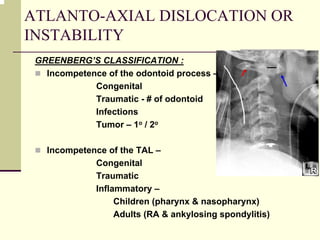
In asymptomatic atlantoaxial instability, posterior surgical
stabilization (occipitocervical or C1–2) is recommended if
os odontoideum is present, or if there is significant
instability (ADI >4.5 mm or SAC <14 mm) and the MRI
shows evidence of spinal cord injury (increased signal on
T2 images).
Even if the MRI is negative, surgery should be considered
on the basis of the degree of atlantoaxial instability.
Asymptomatic patients without significant instability should
be examined regularly.
ATLANTO-AXIAL DISLOCATION OR
INSTABILITY
GREENBERG’S CLASSIFICATION :
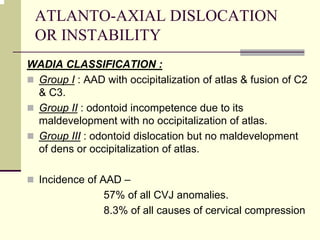
Incompetence of the odontoid process –
Congenital
Traumatic - # of odontoid
Infections
Tumor – 1o / 2o
Incompetence of the TAL –
Congenital
Traumatic
Inflammatory –
Children (pharynx & nasopharynx)
Adults (RA & ankylosing spondylitis)
ATLANTO-AXIAL DISLOCATION
OR INSTABILITY
WADIA CLASSIFICATION :
Group I : AAD with occipitalization of atlas & fusion of C2
& C3.
Group II : odontoid incompetence due to its
maldevelopment with no occipitalization of atlas.
Group III : odontoid dislocation but no maldevelopment
of dens or occipitalization of atlas.
Incidence of AAD –
57% of all CVJ anomalies.
8.3% of all causes of cervical compression
ATLANTO-AXIAL DISLOCATION OR
INSTABILITY
On the open mouth odontoid view, the
combined spread of the lateral masses of C1
on C2 should not exceed 6.9 mm. A number
greater than 6.9 mm would indicate rupture of
the transverse ligament.
An atlantoaxial distance greater than 4-5 mm,
as demonstrated by lateral radiographs, is
indicative of AAI.
ATLANTO-AXIAL DISLOCATION OR
INSTABILITY
Posterior atlantodental interval (PADI) measured
from the posterior border of the dens to the anterior
border of the posterior tubercle.
This index may be more important because it more
directly assesses the space available to the spinal
cord.
Normal range for the distance behind the dens is
19 – 32 mm in male & 19 – 30mm in females.
Below 19mm, neurological manifestations occur.
ATLANTO-AXIAL DISLOCATION
OR INSTABILITY
Rotatory displacement (Fielding and Hawkins
classification) :
Type I is simple rotatory displacement with an intact
transverse ligament.
Type II injuries involve anterior displacement of C1 on
C2 of 3-5 mm with one lateral mass serving as a pivot
point and a deficiency of the transverse ligament.
Type III injuries involve greater than 5 mm of anterior
displacement.
Type IV injuries involve the posterior displacement of
C1 on C2.
Both Type III and IV are highly unstable injuries.
ATLANTO-AXIAL DISLOCATION OR
INSTABILITY
Type I injuries (stable subluxations) – Collar.
Type II injuries may be potentially unstable.
Type III and IV rotatory displacements that are
unstable are treated surgically with a reduction and
C1-2 fusion.
The techniques of fusion vary from sublaminar wiring
techniques like Brooks or Gallie, Halifax clamp, or
transarticular screw of Magerl.
Non-traumatic conditions associated with
increase in the atlantoaxial distance :
Down syndrome
Due to laxity of the transverse ligament
Grisel syndrome
Atlantoaxial subluxation associated with
inflammation of adjacent soft tissues of the neck
Rheumatoid arthritis
From laxity of the ligaments and destruction of the
articular cartilage
Osteogenesis imperfecta
Neurofibromatosis
Morquio syndrome
Secondary to odontoid hypoplasia or aplasia
Other arthridities (Psoriasis,Lupus)
TUBERCULOUS AAD
<1% of all cases of spinal TB.
Local pain, restriction of neck movements & acute
tenderness of upper C-spine – Cardinal features.
Compression of CMJ could be due to granulation
tissue, cold abscess or bony instability & displacement.
Lower cranial Nerves paralysis +.
Waxing & waning picture due to acute compression of
ASA on flexion, which gets releived on extension.
Ligaments are extensively infiltrated by the disease
process & give way.
Hyperaemic decalcification occurs.
TUBERCULOUS AAD
Radiological findings in 3 stages –
Stage I : Retropharyngeal abscess with ligamentous
laxity +, bony architecture of C1-C2 preserved.
Stage II : Ligamentous disruption with AAD, minimal
bone destruction & retropharyngeal mass +
Stage III : marked destruction of bone, complete
obliteration of anterior arch of C1 & complete loss of
odontoid process, marked AAD & O-A instability.
TUBERCULOUS AAD
TREATMENT :
Bed rest, cervical traction, evacuation of retropharyngeal
abscess & prolonged external immobilization along with
ATT.
Surgery : Gross bony destruction with instability
Major neurological deficits
Unstable spine following conservative Tx
Surgery :
Posterior fusion
Anterior decompression with or without fusion
RHEUMATOID ARTHRITIS & CVJ
First described by Garrod in 1890.
20% of the patients with RA have AAD.
AAD is due to loss of tensile strength & stretching of
TL due to destructive inflammatory changes as well
as secondary degenerative changes in tissues from
vasculitis.
Similar changes occur in the median & lateral joints
which result in erosive changes in adjacent bone &
formation of granulation tissue in the synovial joints.
Odontoid process – osteoporosis, angulation / #.
RHEUMATOID ARTHRITIS & CVJ
Osteophyte formation (stabilizing effect) does not
occur secondary to deficient osteogenesis
(characteristic of RA).
BI occurs secondary to loss of bone in lateral mass of the
atlas with resultant rostral migration of axis vertebra.
The lateral mass of atlas may # with lateral displacement of
bone fragment.
Later on erosion of occipital condyles occur.
Excessive granulation tissue along with invaginated
odontoid produces ventral cervico medullary compression.
RHEUMATOID ARTHRITIS & CVJ
Occipital pain with radiation towards skull vertex
BI – 100%
AAD – 60%
Myelopathy – 75% in BI, 60% in AAD.
Neurogenic bladder – 30% cases of AAD.
Loss of position & vibration sensations in LL.
Brainstem dysfunction – 50% cases of BI.
Lower cranial N. involvement ( 12th, 10th, 9th & 5th)
BI causes caudal separation of the atlas anterior arch
from the clivus but the posterior arch is displaced
rostrally & ventrally – dorsal compression of CMJ.
RHEUMATOID ARTHRITIS & CVJ
A hook like appearance of the odontoid process
occurs 2o to the cruciate lig pannus eroding into the
odontoid process.
TREATMENT :
Reducible lesions – PF
Irreducible lesions – ventral resection of invaginated
odontoid process, surrounding granulation tissue &
fibrous shell.
Dorsal compression – posterior decompression.
Instability - occipitocervical fusion.
TRAUMATIC LESIONS OF CVJ
OCCIPITAL CONDYLE # :
1st described by Bell in 1817.
MC clinical features are LOC or cranial nerve
damage.
Classification (Anderson & Montesano) :
Type I : impacted – due to axial loading.
Type II : Basilar skull # - due to direct blow to skull.
Type III : Avulsion #.
Type I & II are stable injuries while type III is
potentially unstable.
TRAUMATIC LESIONS OF CVJ
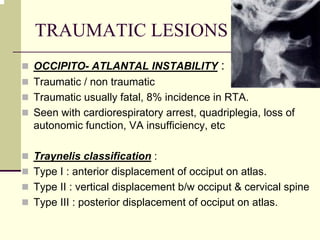
OCCIPITO- ATLANTAL INSTABILITY :
Traumatic / non traumatic
Traumatic usually fatal, 8% incidence in RTA.
Seen with cardiorespiratory arrest, quadriplegia, loss of
autonomic function, VA insufficiency, etc
Traynelis classification :
Type I : anterior displacement of occiput on atlas.
Type II : vertical displacement b/w occiput & cervical spine
Type III : posterior displacement of occiput on atlas.
TRAUMATIC LESIONS OF CVJ
# OF ATLAS :
Posterior arch # : 2/3rd of all #, occur at the junction
of posterior arch & lateral mass (hyperextension
injury).
Anterior arch # : rare
JeffersonJefferson’’s #s # : burst # of atlas, 1st described by
Geoffrey jefferson in 1920.
Axial loading – downward displacement of
condyles with separation of lateral mass of C1.
Classically 4 part # - 2 # each in ant & post arch.
neck pain & stiffness
Cervical collar / Halo immobilization
Non union – occiput to C2 fusion
TRAUMATIC LESIONS OF CVJ
HANGMAN’S # ( TRAUMATIC SPONDYLOLISTHESIS
OF AXIS ) :
“Judicial Hanging” - submental knots causes #
dislocation of neural arch of axis.
Today majority due to RTA.
B/l # passing downward through the neural arch of
axis with resultant anterior displacement of C2 on C3.
Two basic mechanisms :
Hyperextension & distraction
Hyperextension & compression
TRAUMATIC LESIONS OF CVJ
Type I : # are either non-displaced or have no
angulation & <3mm of displacement (stable injury
with uncommon neurological deficits).
Type II : # with significant angulation & translation of
anterior fragment.
Type III : # with severe angulation & displacement
along with concomitant U/L or B/L facet dislocation.
Neck pain but neurological deficits less.
Surgical Rx seldom required due to high chances of
spontaneous interbody fusion & # healing.
Most # managed by reduction & external
immobilization.
TRAUMATIC LESIONS OF CVJ
ODONTOID # :
Constitute about 7 – 14 % of cervical spine #.
Flexion is the MC mechanism of injury causing anterior
displacement of C1 on C2.
Anderson & D’Alonzo classification –
Type I : oblique avulsion # through the upper part of the
odontoid process at the point of alar ligament attachment.
Type II : # occur at the junction of the odontoid process & the
body of axis.
Type III : # extend down in to the body of axis.
ODONTOID #
Type I # are stable & heal well if immobilised in a
collar or brace.
Type III are usually stable #, skull traction f/b halo or
brace for 3 – 4 months results in fusion.
Type II # are prone to non union, with a failure rate of
30 - 60 % with conservative measures.
Indications for Sx – displacement >= 5mm, nonunion,
age >7 years / disruption of the TL.
Odontoid compression screws (acute type II #) / C1-2
arthrodesis (wiring / fusion, transarticular screws)
NEOPLASMS OF CVJ
Unusual
Metastatic malignancies, such as carcinoma of the
breast, lung, prostate, kidney and thyroid in adults;
and neuroblastoma, Ewing’s tumor, leukemia,
hepatoma and retinoblastoma in children, are most
common.
Primary malignancies involving the craniocervical
junction are rare(multiple myeloma).
Benign tumors are very rare.

Craniovetebraljunction

  • 1.
    CRANIOVERTEBRAL JUNCTION : ANATOMY &RADIOLOGY Presented By : Dr. SHAILESH JAIN
  • 2.
    CRANIOVERTEBRAL JUNCTION The craniovertebral(or craniocervical) junction(CVJ) is a collective term that refers to the occiput (posterior skull base), atlas, axis, and supporting ligaments. It is a transition zone b/w a mobile cranium & relatively rigid spinal column. It encloses the soft tissue structures of the cervicomedullary junction (medulla, spinal cord, and lower cranial nerves).
  • 3.
    EMBRYOLOGY & DEVELOPMENT OFTHE CVJ Development of the cartilaginous cranium & the adjacent structures begins during the early weeks of intrauterine life. 2nd Gestational week : Mesoderm cells condense in the midline to form notochordal process. 3rd Gestational week : - notochordal process invaginates in b/w ecto & endoderm to form notochord. - dorsal ectoderm thickens to form neural groove which folds, fuses, & becomes neural tube.
  • 4.
    EMBRYOLOGY & DEVELOPMENT OFTHE CVJ Between 3rd & 5th week : - part of mesoderm which lies on either side of notochord (Paraxial mesoderm) gives rise to somites (Segmentation). - total 42 somites form at 4th week. - ventromedial portion of somite is k/a sclerotome which forms the vertebral bodies. - each sclerotome differentiates into a cranial, loosely arranged portion and a caudal compact portion by a fissure k/a “Fissure of von Ebner” (Re-segmentation).
  • 5.
    EMBRYOLOGY & DEVELOPMENT OFTHE CVJ Mesenchymal cells of the fissure condense around the notochord to form the intervertebral disc. Notochord disappears at the vertebral bodies, but persist as nucleus pulposus at disc. The first four sclerotomes do not follow this course & fuse to form the occipital bone & post.portion of FM. This membraneous stage is f/b stages of chondrification & ossification. Out of 4 occipital sclerotomes the first 2 form basiocciput, the III Jugular tubercles and the IV (Proatlas) form parts of foramen magnum, atlas and axis.
  • 6.
    EMBRYOLOGY & DEVELOPMENT OFTHE CVJ PROATLAS : divided into the hypocentrum, centrum & the neural arches. - hypocentrum forms the vestigial condylus tertius or anterior tubercle of the clivus. - centrum forms the apex of the dens, also forms the apical ligament (AL) of dens (AL may contain notochordal tissue,so k/a rudimentary IVdisc). - ventral part of the neural arch forms the ant. margin of FM, 2 occipital condyles & the alar & cruciate ligaments. - dorsal part forms paired rostral articular facets, lateral masses of C1 & superior portion of the post. arch of the atlas.
  • 7.
    EMBRYOLOGY & DEVELOPMENT OFTHE CVJ ATLAS : no vertebral body & no IV disc. - major portion formed by first spinal sclerotome. - trasitional vertebra as centrum of sclerotome is separated to fuse with the axis body forming the odontoid process. - hypocentrum of 1st spinal sclerotome forms the anterior arch of the atlas. - neural arch of the first spinal sclerotome forms the inferior portion of the posterior arch of atlas.
  • 8.
    EMBRYOLOGY & DEVELOPMENT OFTHE CVJ AXIS : develops from 2nd spinal sclerotome. - hypocentrum of 2nd spinal sclerotome disappears during embryogenesis. - centrum forms the body of the axis vertebra & neural arch develops into the facets & the posterior arch of the axis. - At birth odontoid base is separate from the body of axis by a cartilage which persists until the age of 8, later the center gets ossified.,or may remain separate as Os- odontoidium. - The apical segment is not ossified until 3 years of age, at 12 years if fuses with odontoid to form normal odontoid., failure leads to Os terminale.
  • 9.
    OSSIFICATION CENTRES OCCIPUT &BASIOCCIPUT : 2 occipital squamous portions – 2 centres Basiocciput (clivus) - 1 centre 2 Jugular tubercles – 2 centres 2 Occipital condyles – 2 centres ATLAS : ossifies from 3 centres Each half of post. Arch with lateral mass –7 to 9 wk, unites at 3 – 4 years. Anterior arch – at 1 to 2 years centre appears, unites with lateral mass at 6 – 8 years.
  • 10.
    OSSIFICATION CENTRES AXIS :ossifies from 5 primary & 2 secondary centres. 2 Neural arches – 2 centres appear at 7 – 8 wk Body of axis – 1 centre appear at 4 – 5 months Body of dens – 2 centres appear at 6 – 7 months 4 pieces (at birth) unite at 3 – 6 years Tip of odontoid appears at 3 – 6 years, unites with the body of odontoid at 12 years. Odontoid & body of axis – only circumference of intervening cartilage ossifies.
  • 11.
    APPLICATIONS Dysplasia of theocciptal segments may flatten the clivus - platybasia. When the basiocciput and rim of foramen magnum are underdeveloped, the odontoid and arch of atlas may invaginate- Basilar invagination. The proatlas may develop into separate vertebrae - Occipital vertebra, hypochondral bow of proatlas may persist to gain attachment to the atlas, clivus or even to the apical segment of the dens - responsible for anterior cervicomedullary compression.
  • 12.
    APPLICATIONS If the posteriorsegment of the proatlas fails to fuse with the atlas, a rare anomaly termed bipartite articular facets occurs, may result in horizontal instability of the OA joint. Bicornuate dens : dens body may fail to fuse in utero resulting in a V- shaped cleft found radiographically at birth , rare in adults. Failure of segmentation b/w the axis & the 3rd cervical vertebra involves both the ant. & the post. Vertebral segments, associated with other anomalies like Klippel – Feil syndrome.
  • 13.
    ANATOMY OF CVJ(SKELETAL)
  • 14.
    ANATOMY OF CVJ(ARTICULAR) Upper surfaces of C1 lateral masses are cup-like or concave which fit into the ball & socket configuration, united by articular capsules surr. the AO joint & by the ant. & post. AO membranes. 4 synovial joints b/w atlas & axis – 2 median – front & back of dens (Pivot variety) 2 lateral – b/w opposing articular facets(Plane variety) Each joint has its own capsule & synovial cavity.
  • 15.
    ANATOMY OF CVJ(LIGAMENTOUS) Principalstabilizing ligaments of C1 - - Transverse atlantal ligament - Alar ligaments Secondary stabilizing ligaments of CVJ are more elastic & weaker than the primary ligaments. - Apical ligament - Anterior & posterior A-O membranes - Tectorial membrane - Ligamentum flavum - ALL & PLL - Capsular ligaments
  • 16.
    ANATOMY OF CVJ(LIGAMENTOUS) ATLANTO-OCCIPITALLIGAMENTS : A) Anterior Atlanto-occipital Membrane ---- about 2 cm wide & consists of densely woven fibres that radiate in a slightly lateral pattern. Central fibres are thicker than the lateral portion. Lateral fibres interconnect with the A-O capsules. Ligament is continuous caudally with the anterior A-A ligament & through it to the ALL of the spinal column. It acts as a tension band that stretches during extension, serving as a secondary stabilizer against this motion.
  • 17.
    ANATOMY OF CVJ(LIGAMENTOUS) B)POSTERIOR ATLANTO-OCCIPITAL MEMBRANE : A less strong ligament containing no significant elastic tissue. Ligament is loose b/w the bones & does not limit their motion & is firmly attached anteriorly to the dura mater. Ligament invests itself on either side to form a canal through which the vertebral artery, accompanying veins, & the first cranial nerve pass. C) LATERAL ATLANTO-OCCIPITAL LIGAMENTS : - ascending lig which reinforce the A-O joint capsules.
  • 18.
    ANATOMY OF CVJ(LIGAMENTOUS) ATLANTOAXIALLIGAMENTS : Anterior A-A ligament, Posterior A-A ligament Transverse ligament of the atlas : thick, strong & about 6mm in height. - lig presents a fibrocartilagenous surface ventrally allowing a free gliding motion to occur over the posterior facet of the dens. - posterior fibres of this ligament are arcuate, & the more ventral fibres are circular in configuration.
  • 19.
    ANATOMY OF CVJ(LIGAMENTOUS) Caudalcrus & Rostral crus (Fasciculi longitudinales) fibres joined with transverse ligament on its dorsal aspect to form Cruciate ligament of atlas. The force required to rupture the transverse ligament ranged from 12 to 180 kp (mean 84kp) under slow loading & about 111 kp under rapid loading. TAL effectively limits anterior translation and flexion of the atlantoaxial joint. An accessory band ventral to the ascending crus attaching to the apex of the odontoid process is termed Gerber’s ligament.
  • 20.
    ANATOMY OF CVJ(LIGAMENTOUS) AXIS– OCCIPITAL LIGAMENTS : A) TECTORIAL MEMBRANE : dorsal to the cruciate ligament, a strong band of longitudinally oriented fibres attached to the dorsal surface of the C3 vertebra, axis body ,& to the body of dens. It is the rostral extension of the PLL of the vertebral column. Essential for limiting flexion. The accessory bands of the ligament passing to the lateral capsule of the A-A joints -- Arnold’s ligament
  • 21.
    ANATOMY OF CVJ(LIGAMENTOUS) B)ALAR LIGAMENTS : 2 strong cords that attach to the dorsal lateral body of the dens , about 8mm wide. Fibres extend laterally & rostrally. They are ventral & cranial to the transverse ligament. Alar lig allow an anterior shift of C1 from 3 to 5 mm. They limit the head – atlas rotatory movement on the odontoid axis as well as strengthen the A-O capsule. C) APICAL LIGAMENT : slender band of fibres about 2-5mm wide & 2-8mm long containing small amount of collagen & elastic fibres. No mechanical significance.
  • 22.
    ANATOMY OF CVJ(MUSCLES) Muscles have only a minor role related to CVJ stabilization & do not limit the movements of the joints. Their principal function is one of initiating & maintaining movement at the CVJ.
  • 23.
    ANATOMY OF CVJ(NEURAL) Neural structures related to CVJ are – Caudal portion of brainstem (Medulla) Cerebellum Fourth ventricle Rostral part of spinal cord Lower cranial & upper cervical nerves In cerebellum, only the tonsils, biventral lobules & the lower part of the vermis (nodule, uvula & pyramid) are related to CVJ. Biventral lobule is located above the lateral part of FM & the tonsils lie above the posterior edge.
  • 24.
    ANATOMY OF CVJ(NEURAL) CRANIAL NERVES : Lower four cranial N. are closely related to CVJ. 9th & 10th cranial N arise from the medulla in the groove b/w the inferior olivary nucleus & the inferior cerebellar peduncle. 9th & 10th N are separated by a dural sheath which separate these nerves as they penetrate the dura to enter the jugular foramen. The accessory N is the only cranial N that passes through the FM.
  • 25.
    ANATOMY OF CVJ(NEURAL) Accessory N is composed of 2 parts. The cranial part or the accessory portion (ramus internus) is the smaller of the two & is accessory to the vagus. It arises from the medulla, is composed of multiple rootlets & joins the vagus N. The major portion (ramus externus) is the spinal portion formed by a series of rootlets arising from the lower medulla & upper spinal cord. The rootlets may arise as low as the C7 root level.
  • 26.
    ANATOMY OF CVJ(NEURAL) Major trunk enters the skull via FM b/w dentate lig & dorsal roots where it joins the cranial portion of the N & leaves the skull through the jugular foramen. Hypoglossal N : formed by the rootlets arising from the medulla along the anterior margin of the olive & pass behind the vertebral artery. Its rootlets are collected in to two bundles which perforate the dura mater separately, pass via the hypoglossal canal & then unite.
  • 27.
    ANATOMY OF CVJ(NEURAL) SPINAL NERVE ROOTS : The C1, C2, and C3 nerves, distal to the ganglion, divide into dorsal and ventral rami. The first cervical nerve located just below the foramen magnum. The C1 ventral root (SUBOCCIPITAL NERVE) is composed of four to eight rootlets that joined and coursed laterally and supplies the rectus capitis lateralis.
  • 28.
    ANATOMY OF CVJ(NEURAL) Dorsal ramus is larger than the ventral ramus. The dorsal rami divide into medial and lateral branches that supply the skin and muscles of the posterior region of the neck. The dorsal ramus supplies rectus capitis posterior major and minor, superior and inferior oblique, and the semispinalis capitis. The dorsal root of the first cervical nerve has variations in its composition and its connections with the accessory nerve.
  • 29.
    ANATOMY OF CVJ(LYMPHATICS) The lymphatic drainage of the O-A-A joints is primarily into the retropharyngeal LN & then into the deep cervical chain. These LN’s also drain the nasopharynx & hence retrograde infection may affect the synovial lining of the CVJ complex with resultant neck stiffness & instability.
  • 30.
    ANATOMY OF CVJ(ARTERIAL) The major arteries related to CVJ are vertebral, posteroinferior cerebellar arteries (PICA), and the meningeal branches of the vertebral, and external and internal carotid arteries. VERTEBRAL ARTERY arises from the upper posterior part of the first segment of the subclavian artery in the neck. Each artery is divided into intradural and extradural parts. The extradural part is divided into three segments.
  • 31.
    ANATOMY OF CVJ(ARTERIAL) The terminal extradural segment of the vertebral artery gives rise to the posterior meningeal and posterior spinal arteries, branches to the deep cervical musculature, and infrequently the PICA. The intradural segment begins at the dural foramina where it forms a funnel-shaped foramen around 4 to 6 mm length of the artery. The first cervical nerve exits the spinal canal, and the posterior spinal artery enters the spinal canal through this dural foramen with the vertebral artery.
  • 32.
    ANATOMY OF CVJ(ARTERIAL) The intradural part of the artery is divided into lateral and anterior medullary segments. The branches arising from the vertebral artery in the region of the FM are the posterior spinal, anterior spinal, PICA, and anterior and posterior meningeal arteries. The PICA is the largest branch of the vertebral artery. It usually originates within the dura mater, but it may infrequently originate from the terminal extradural part of the vertebral artery.
  • 33.
    ANATOMY OF CVJ(ARTERIAL) The tonsillomedullary PICA segment, which forms the caudal loop related to the lower part of the tonsil, is most intimately related to the foramen magnum. The paired posterior spinal arteries usually arise from the posteromedial surface of the vertebral arteries, just outside the dura mater, but they may also arise from the initial intradural part of the vertebral arteries, or from the PICA. The artery divides into an ascending branch to supply the medulla & a descending branch to the superficial part of the dorsal half of the cervical spinal cord.
  • 34.
    ANATOMY OF CVJ(ARTERIAL) The anterior spinal artery is formed by the union of the paired anterior ventral spinal arteries, which originate from the anterior medullary segment (intradural segment) of the vertebral arteries.
  • 35.
    ANATOMY OF CVJ(ARTERIAL) MENINGEAL ARTERIES : The dura mater around the FM is supplied by the anterior and posterior meningeal branches of the vertebral artery, and the meningeal branches of the ascending pharyngeal and occipital arteries.
  • 36.
    ANATOMY OF CVJ(VENOUS) The venous structures in the region of the FM are divided into three groups: - Extradural veins(extraspinal & intraspinal part) - Intradural (neural) veins, & - Dural venous sinuses( superior petrosal, marginal & occipital ) The three groups anastomose through bridging and emissary veins.
  • 37.
    KINETIC ANATOMY OFCVJ CVJ units are unique with respect to the rest of the spine in that they do not bear weight through disks, but rather through synovial joints lined with hyaline cartilage, thus exhibit significantly more movement than any other spinal level. ROTATION : when movement occurs about an axis. TRANSLATION : when movement occurs along an axis. The C1 lateral masses contain the occipital condyles in a cup-like fashion, facilitating flexion and extension.
  • 38.
    KINETIC ANATOMY OFCVJ ATLANTO-OCCIPITAL JOINTS : The C1 lateral masses contain the occipital condyles in a cup-like fashion. The condyles of these paired joints in saggital direction are arcuate & thus due to this anatomy, motion about the vertical axis is not possible. Thus, this joint is biaxial having movements only around the transverse & A-P axes. 2 types of movement permitted are forward or backward bending (nodding of head / yes-yes movt.) & a slight lateral tilting motion to either side. These joints do not permit rotation.
  • 39.
    KINETIC ANATOMY OFCVJ ATLANTOAXIAL JOINTS : Consists of 2 lateral zygapophyseal & 2 median odontoid joints (pivot joint). Rotation of atlas occurs around the odontoid process like a wheel around an axle & its axis passes centrally through the annulus osteofibrosis. The superior facet of the axis is convex & the inferior facet of the atlas is either horizontal or slightly convex with horizontal orientation of the articulation. Because of this, these facets slide forward & backward on each other with rotation.
  • 40.
    KINETIC ANATOMY OFCVJ The A-A joints allow less flexion – extension motion than rotation. There is greater movement with extention (upto 10o) than with flexion (upto 5o). Flexion extension of the O-A joint exceeds that of the A-A joint ( flexion 10o, extension 25o). The ratio of extension to flexion is approx 2:1 & this ratio maintains itself at both the O-A & A-A joints.
  • 41.
    KINETIC ANATOMY OFCVJ Total rotation of the entire cervical spine is upto 90o & approx ½ occurs at the A-A joint. Rotation with accompanying lateral flexion in the cervical spine occurs below the axis due to oblique orientation of the facets & their gliding motion with rotation. The organization of the ligamentous tissue limits the range of motion of the CVJ. With a certain degree of anteflexion, the tectorial membrane, cruciform & Apical dens ligaments become slack & do not check movement.
  • 42.
    KINETIC ANATOMY OFCVJ With further anteflexion, ant occipital margin shifts forward & downward over the dens tip. Caput of dens then acts as a fulcrum, resulting in tightening of the tectorial membrane with consequent checking of anteflexion (checking effect). With retroflexion, the ant occiput & the caput of dens move away from each other with resultant tightening of tectorial membrane & limitation of RF. The tightening of TM exerts counter pull on the outer ligaments of lateral A-A joints which assists in stabilization in this movement.
  • 43.
    KINETIC ANATOMY OFCVJ Alar ligaments exert their pull in a ventral-lateral direction. They limit rotation & lateral flexion only when both are tight. In neutral position of the head, both ligaments are slack. With maximum movement of the CVJ, either beginning with rotation or lateral bending, the final result is identical.
  • 44.
    KINETIC ANATOMY OFCVJ The anatomic structures that provide stability of the O-A joint include – cup shaped configuration of the joints, & Ant & Post A-O membranes Additional stability is provided by ligamentous connections b/w occiput & axis that include the tectorial membrane, alar, & apical ligaments.
  • 45.
    KINETIC ANATOMY OFCVJ Hyperrotation or rotatory subluxation of C1–2 : The atlantoaxial joint is the only joint of the neck that relies entirely on ligamentous structures—it has no buttressing bone-on-bone articulations— to limit axial rotation. Transection of the C1–2 capsular ligaments cause small increases in motion, primarily in axial rotation. Somewhat larger increases in axial rotation will occur when the alar ligaments are transected. So, hyperrotation injuries would be expected to be associated with damage to both of these ligaments.
  • 46.
    KINETIC ANATOMY OFCVJ Depending on the severity of symptoms, ligamentous injury that results in hyperrotation may require surgical intervention for stabilization. HYPERFLEXION : Hyperflexion injuries at the craniocervical junction commonly occur as occipitoatlantal dislocations and TAL disruptions.
  • 47.
    KINETIC ANATOMY OFCVJ Occipitoatlantal dislocations occur when (primarily) the apical, vertical cruciate, and alar ligaments and (secondarily) the articular ligaments and posterior column ligaments are disrupted, allowing the ball- shaped occipital condyles to travel out of the cup- shaped articulations of C1. Occipitoatlantal dislocations are very unstable and are typically treated by posterior occipitocervical fusion.
  • 48.
    KINETIC ANATOMY OFCVJ TAL disruption occurs during hyperflexion because the force of the TAL against the dens is the primary force resisting anterior subluxation of C1 on C2. If the TAL fails, severe instability will occur, with C1 moving anteriorly on C2 and the posterior arch of C1 pinching the spinal cord against the body of C2. To treat TAL disruption, fusion of C1–2 is required because it is currently infeasible to repair the TAL surgically.
  • 49.
    KINETIC ANATOMY OFCVJ HYPEREXTENSION : 1) Hangman’s fracture : 2) Fracture of the posterior arch of C1 : This type of injury can occur when the occiput or spinous process of C2 collides with the posterior arch of C1 during hyperextension. Fracture of the posterior arch of C1 disrupts the continuity of C1, which may not cause immediate instability if there is no ligamentous damage, but could lead to an increased tendency for cranial settling because of easier spreading of lateral masses of C1.
  • 50.
    KINETIC ANATOMY OFCVJ 3) Type III odontoid fractures : in which the fracture occurs through a portion of the vertebral body, are the most common fracture type for pure extension force with no lateral component. Odontoid fracture stability can be restored by direct reapposition of the dens fragment to the body of C2 as long as the TAL is intact. AXIAL COMPRESSION : Jefferson’s fractures of C1 : In this injury, a radial force on the ring of C1 fractures it in several places.
  • 51.
    KINETIC ANATOMY OFCVJ Jefferson’s fractures also can leave the lateral masses free to move independently from each other and from the anterior arch of C1, disabling the important interaction of the dens against the surrounding bony structures in preventing anteroposterior and lateral movement.
  • 52.
    RADIOLOGY OF CVJ PLAINFILM EXAMINATION : A) LATERAL VIEW : Impression of craniovertebral funnel Anterior & posterior spinoepidural lines Usually the occipital condyles are hidden by the mastoid processes. The tip of the dens usually lies on a plane formed by the upper surface of the atlas anterior & posterior arches. Atlanto-dental joint space. The superior articular facet of the axis overlies the junction of the dens & the axis body.
  • 53.
    RADIOLOGY OF CVJ Translateralviews of skull including the upper cervical spine (neutral, flexion & extension). These give the points of references for various radiological baselines & angles in assessing A-Od distance, anomalies of dens, soft tissues of neck,etc. B) ANTERO-POSTERIOR (AP)-OPEN MOUTH VIEW : Additionally detects dens anomalies & its lateral displacement.
  • 54.
    RADIOLOGY OF CVJ C)OBLIQUE VIEWS : Allows visualization of homolateral superior & inferior facets as well as a small portion of the contralateral superior facet Intervertebral neural canal for the 3rd cervical nerve also evident
  • 55.
    RADIOLOGY OF CVJ CRANIOMETRY: Craniometry of the CVJ uses a series of lines, planes & angles to define the normal anatomic relationships of the CVJ. These measurements can be taken on plain Xrays,3DCT or on MRI. No single measurement is helpful. There is a certain disadvantage in all of these measurements because the anatomic structures and planes vary within a normal range.
  • 56.
    RADIOLOGY OF CVJ LATERALPROJECTION OF SKULL X-RAY : Palato – occipital (Chamberlain’s line) Palato – suboccipital line (McGregor line) Foramen magnum line (McRae line) Height of the posterior cranial fossa (Klaus Index) Wackenhein’s clival canal line Bull’s angle (Atlanto-palatal angle) Atlanto-temporo-mandibular index (Fischgold)
  • 57.
    RADIOLOGY OF CVJ FRONTALPROJECTION OF SKULL X-RAY : Bimastoid line (Fischgold & Metzer) Bidigastric line (Fischgold & Metzer) Condylar angle (Schmidt & Fischer) FOR DIAGNOSIS OF PLATYBASIA : Basal angle (Welcher) Boogard’s angle
  • 58.
    RADIOLOGY OF CVJ ChamberlainLine : The Chamberlain line extends between the posterior pole of the hard palate and the opisthion (posterior margin of the foramen magnum). McGregor developed a modification of the Chamberlain line when the opisthion could not be identified on plain radiographs. This McGregor line extends between the posterior pole of the hard palate and the lowest point of the occipital basi-squamous surface.
  • 59.
    RADIOLOGY OF CVJ Thetip of the odontoid process commonly lies below or just tangent to the Chamberlain line, and it may normally project above this line for a distance of several millimeters The maximum distance that the odontoid process may be seen above this line is variable, ranging from 1 mm ± 3.6 to 6.6 mm (1-5). Not more than 1/3rd of the odontoid process should extend above chamberlain’s line.
  • 60.
    RADIOLOGY OF CVJ Theodontoid tip may be slightly higher if the McGregor line is used. The anterior arch of the atlas typically lies below these lines. Drawback of chamberlain’s line : Posterior rim of FM shows great anatomic variability & also it may be difficult to radiologically pinpoint opisthion.
  • 61.
    RADIOLOGY OF CVJ WackenheimClivus Baseline (Basilar line): The Wackenheim clivus baseline is constructed by drawing a line along the clivus and extrapolating it inferiorly into the upper cervical spinal canal. This line should fall tangent to the posterior aspect of the tip of the odontoid process. This line intersects the dens when the skull is anterior in position.
  • 62.
    RADIOLOGY OF CVJ Theangle formed at the intersection of the Wackenheim clivus baseline with a line constructed along the posterior surface of the axis body and odontoid process (craniovertebral or clivus-canal angle) normally ranges from 150o in flexion to 180o in extension. Ventral spinal cord compression may occur when the angle is less than 150o.
  • 63.
    RADIOLOGY OF CVJ WelcherBasal Angle : The Welcher basal angle is formed at the intersection of the nasion-tuberculum line and the tuberculum- basion line. It averages 132o & should always be less than 140o. This angle is increased when the skull base is abnormally flattened (Platybasia).
  • 64.
    RADIOLOGY OF CVJ BOOGARD’SANGLE : A line is drawn from basion to opisthion & another line along the plane of clivus to the basion, intersecting the first line. The normal value is 126o +_ 6o . In platybasia it exceeds 136o.
  • 65.
    RADIOLOGY OF CVJ BULL’SANGLE (ATLANTO PALATINE ANGLE) : <10o is normal . 10 – 13o : tendency to BI. >13o in Basilar invagination (BI). McRae’s line : Tip of the dens does not exceed this line. When effective saggital diameter is <20 mm, neurological symptoms occur (FM stenosis). Normal diameter is around 40mm. The FM is enlarged to >50 mm in c/o Chiari malformation.
  • 66.
    RADIOLOGY OF CVJ KLAUSHEIGHT INDEX : This represents the height or depth of the posterior fossa. The mean value is 41+_4 mm. A value of <30 mm indicates BI or Platybasia. SPINOLAMELLAR LINE : Drawn from the interoccipital ridge above & downward along the spinous process of C2 & C3 below. This curvilinear line should intersect the fused posterior arch of atlas. If the atlas lies anterior to this line, posterior compression of the spinal cord may be present.
  • 67.
    RADIOLOGY OF CVJ RANAWAT’SLINE : The Ranawat’s line is the perpendicular distance between the centre of the sclerotic ring of C2 and the line drawn along the axis of C1. The normal value of this distance is about 15 mm : 17 mm in males and 15 mm in females.
  • 68.
    RADIOLOGY OF CVJ FISCHGOLDBIMASTOID LINE : Normally passes through the A-O joint. Apex of odontoid should lie about 2mm above this line with a range b/w 3mm below & 10mm above. FISCHGOLD BIDIGASTRIC LINE : This line is situated 10mm above the bimastoid line. Corresponds to McRae’s line on lateral view. Odontoid tip normally should not project above this line.
  • 69.
    RADIOLOGY OF CVJ AtlantooccipitaljointAxis Angle ( Condylar angle of Schmidt & Fischer) : This angle is formed by lines drawn parallel to A-O joints, which typically intersect at the center of the odontoid process when the condyles are symmetric. The average angle is 125o with a range between 124o & 127o. This angle becomes more obtuse in the presence of occipital condylar hypoplasia.
  • 70.
    RADIOLOGY OF CVJ (NORMALVARIANTS & ANOMALIES) THE OCCIPUT : The basiocciput forms the lower portion of the clivus. The upper portion of the clivus is formed by the basisphenoid, separated from the basiocciput by the sphenooccipital synchondrosis. The age at which this synchondrosis fuses, ranges from “after the twelvth year” to 14-16 years for girls and 16-18.5 years for boys. Most occipital anomalies are associated with decreased skull base height and basilar invagination.
  • 71.
    RADIOLOGY OF CVJ CondylusTertius : When the hypochordal bow of the fourth occipital sclerotome (proatlas) persists or when the proatlas fails to integrate, an ossifled remnant may be present at the distal end of the clivus, called the condylus tertius or third occipital condyle. This third condyle may form a joint or pseudojoint with the odontoid process or with the anterior arch of the atlas and may lead to limitation in the range of motion of the CVJ. There is an increased prevalence of os odontoideum associated with this abnormality.
  • 72.
    RADIOLOGY OF CVJ CondylarHypoplasia : In condylar hypoplasia, the occipital condyles are underdeveloped and have a flattened appearance, leading to BI (violation of the Chamberlain line) and widening of the atlantooccipital joint axis angle. The lateral masses of the atlas may be fused to the hypoplastic condyles, further accentuating the BI. Condylar hypoplasia limits, or may even abolish, movements at the A-O joint.
  • 73.
    RADIOLOGY OF CVJ BasiocciputHypoplasia : Hypoplasia of the basiocciput may be mild or severe, depending on the number of occipital vertebrae affected. It results in shortening of the clivus and violation of the Chamberlain line and is virtually always associated with basilar invagination. The Wackenheim clivus baseline is usually normal, although the clivus-canal angle is typically decreased and there may be bow-string deformity of the cervicomedullary junction.
  • 74.
    RADIOLOGY OF CVJ AtlantooccipitalAssimilation / Occipitalization of Atlas : The failure of segmentation between the skull and first cervical vertebra results in assimilation of the atlas. Incidence in a normal population – 0.08 to 3 %. India – 40 to 50 % cases are associated among CVJ anomalies. The assimilation may be complete or partial. It invariably results in basilar invagination. Wackenheim clivus baseline may be normal, but the clivus- canal angle may be decreased. When incompletely assimilated, the atlas arches appear too high on the lateral plain radiograph or, when completely assimilated, are not visible at all .
  • 75.
    RADIOLOGY OF CVJ TOPOGRAPHICFORMS (WACKENHEIM) : Type I : Occipitalization (generally subtotal) associated with BI. Type II : Occipitalization (generally subtotal) associated with BI & fusion of axis & 3rd cervical vertebrae. Type III : Total or subtotal occipitalization with BI & maldevelopment of the transverse ligament. Type III may be associated with various malformations like C2-C3 fusion, hemivertebra, dens aplasia, tertiary condyle, etc.
  • 76.
    RADIOLOGY OF CVJ Theneurological symptoms are not caused by occipitalization proper but rather by the fact that in the absence of a free atlas, TL fails to develop which causes posterior displacement of axis & compression of the spinal cord. Instability b/w atlas & axis is reducible in patients <15 yr’s but after that irreducible state occurs. Its combination with segmentation failure of 2nd & 3rd cervical vertebrae results in gradual loosening of the atlanto-dental joint with progressive atlanto-axial luxation in children in about 50% of cases.
  • 77.
    RADIOLOGY OF CVJ ATLAS: With the exception of the various atlantooccipital assimilations, most atlas anomalies, when isolated, produce no abnormal CVJ relationships and are not associated with basilar invagination. The vast majority of anomalies consist of various arch clefts, aplasias, and hypoplasias. Arch anomalies are frequently mistaken for fractures in the evaluation of plain radiographs of patients with a history of cervical spine trauma.
  • 78.
    RADIOLOGY OF CVJ PONTICULUSPOSTICUS / KIMMERLE’S DEFORMITY : It is a bony ridge projecting posteriorly from the articular edge of the atlas superior articular facet. The bony projection may be only a few mm long or may elongate to unite with the adjacent neural arch of the atlas to produce an “ARCUATE CANAL” through which the vertebral artery passes. This is due to ossification of a portion of the oblique A-O ligament.
  • 79.
  • 80.
    RADIOLOGY OF CVJ PosteriorArch Anomalies (MC atlas anomaly) : Total or partial aplasia of the posterior atlas arch is rare. Although absence of the posterior arch, when isolated, is usually asymptomatic, but may be associated with anterior atlantoaxial subluxation. Bilateral atlantoaxial subluxation may be associated with both total and partial aplasias, simulating the Jefferson fracture.
  • 81.
    RADIOLOGY OF CVJ Incontrast to the aplasias and hypoplasias, clefts of the atlas arches are much more common. Posterior rachischisis, most common, is observed in 4% of adults. The majority of posterior atlas clefts (97%) are midline, whereas lateral clefts, through the sulcus of the vertebral artery, account for the remaining 3%. Posterior arch rachischisis may be superimposed on the odontoid process or the axis body on the open- mouth odontoid view, simulating a fracture.
  • 82.
    RADIOLOGY OF CVJ SplitAtlas : In contrast to posterior arch rachischisis, anterior arch rachischisis is quite rare (0. 1 %). It is typically encountered in association with posterior rachischisis - “split atlas”. Normally, on a lateral radiograph, the anterior arch of the atlas appears crescentic or half-moon-shaped, with dense cortical bone surrounding the medullary cavity and a well-defined predental space. In anterior arch rachischisis, the anterior arch appears fat or plump and rounded in configuration, appearing to ‘ ‘overlap’ ‘ the odontoid process (making identification of the predental space impossible); the arch may have unsharp, duplicated anterior margins
  • 83.
    RADIOLOGY OF CVJ Atlanto-axialsegmentation defect : The lateral view shows horizontal orientation of one of the lateral atlantoaxial joints. The open-mouth view reveals hypertrophic change of one lateral mass of the atlas and the base of the odontoid. Etiology - due to the incorporation of a somatic segment into the atlas which normally forms part of the lateral mass of the axis.
  • 84.
    CONGENITAL ODONTOID ANOMALIES ORDYSPLASIAS Type I : Os odontoideum Type II : Ossiculum terminale Type III : Agenesis of odontoid base Type IV : Agenesis of apical segment Type V : Agenesis of odontoid
  • 85.
    RADIOLOGY OF CVJ PersistentOssiculum Terminale : Also called Bergman ossicle, results from failure of fusion of the terminal ossicle to the remainder of the odontoid process. The fusion typically is accomplished by 12 years of age. Bergman ossicle may be confused with a type 1 odontoid fracture (avulsion of the terminal ossicle), and absolute differentiation between the two diagnoses may be difficult. Whether traumatic or congenital in origin, this anomaly is stable when isolated and of relatively little clinical significance. The odontoid process is usually normal in height.
  • 86.
    Odontoid Aplasia : Totalaplasia of the odontoid process is extremely rare. A true aplasia is associated with an excavation defect into the body of axis. may simulate os odontoideum, as the os fragment may be perfectly projected over the atlas arch on the open mouth odontoid view.
  • 87.
    OS ODONTOIDEUM This termfirst introduced by Giacomini in 1886, refers to an independent osseous structure lying cephalad to the axis body in the location of the odontoid process. The anterior arch of the atlas is rounded and hypertrophic but the posterior arch is hypoplastic. As the gap between the os odontoideum and the axis body usually extends above the level of the superior articular facet of the axis, cruciate ligament incompetence and A-A instability are common.
  • 88.
    OS ODONTOIDEUM The marginsof the axis body, the os, and anterior arch are all well corticated. Type 2 odontoid fracture is typically associated with a flattened, sharp, uncorticated margin to the upper axis body and a normal, halfmoon- shaped appearance to the anterior atlas arch with a narrow gap in b/w # segments. Etiology – Embryologic, Traumatic &/or Vascular. Types – Orthotopic & Dystopic. Instability is more common with dystopic type.
  • 89.
    OS ODONTOIDEUM Reducible –on flexion, dorsal compression of the cord occurs but on extension ventral compression occurs secondary to increased angulation anteriorly. Irreducible – due to displacement of TL ventral to the ossicle. Treatment : Reducible – Occipito cervical PF in neutral position. Irreducible – Transoral resection of the os, odontoid remnant & surrounding granulation tissue.
  • 90.
    KLIPPEL FEIL SYNDROME Describedfirst by Klippel and Feil in 1912. Etiology is unknown. Due to failure of the normal segmentation of cervical somites during the third and eighth weeks of gestation. Classic triad of low posterior hair line, short neck and limited neck ROM found in less than 50% of cases The most consistent finding is limitation of neck motion. Generally flexion and extension are better preserved than side- bending and rotation.
  • 91.
    KLIPPEL FEIL SYNDROME TYPES: Type 1: Cervical spine fusion in which elements of many vertebrae are incorporated into a single block. Type 2: Cervical spine fusion in which there is failure of complete segmentation at only one or two cervical levels and may include an occipito-atlantal fusion. Type 3: Type 1 or type 2 fusion with co-existing segmentation errors in the lower dorsal or lumbar spine.
  • 92.
    KLIPPEL FEIL SYNDROME ASSOCIATEDCONDITIONS: Scoliosis- Up to 60% have >15 degrees curve. Genito-urinary- up to 65%.Most common is absence of kidney. Sprengel's deformity- approx. 35% Cardio-pulmonary- 5-15%, most commonly V.S.D. Deafness- 30%, all types, MC mixed. Sykinesis- Mirror motions have been described in up to 20% of patients under the age of 5. Cranio-cervical abnormalities (25%) - Includes C1-C2 hypermobility and instability, BI,Chiari I malformation, diastematomyelia, & syringomyelia.
  • 93.
    KLIPPEL FEIL SYNDROME 20%of patients may show facial asymmetry, torticollis and neck webbing (pterygium colli). Ptosis of the eye, Duane's eye contracture, lateral rectus palsy, facial nerve palsy and cleft palate. Upper extremity abnormalities, ie. syndactyly, hypoplastic thumb, supernumary digits and hypoplasia of the upper extremity.
  • 94.
    KLIPPEL FEIL SYNDROME SYMPTOMS: Dueto the hypermobility occurring at the open segments, can lead to either frank instability or osteoarthritis. Mechanical symptoms due to joint irritation. Neurologic symptoms due to root irritation or spinal cord compression. MANAGEMENT : Usually conservative, rarely surgery required.
  • 95.
    BASILAR INVAGINATION Basilar invaginationimplies that the floor of the skull is indented by the upper cervical spine, & hence the tip of odontoid is more cephalad protruding into the FM. There are two types of basilar invagination: primary invagination, which is developmental and more common, and secondary invagination, which is acquired. Primary invagination can be associated with occipitoatlantal fusion, hypoplasia of the atlas, a bifid posterior arch of the atlas, odontoid anomalies.
  • 96.
    BASILAR INVAGINATION In BI,all three parts of the occipital bone (basiocciput, exoccipital & squamous occipital bone) are deformed. Topographic types of BI : Anterior BI : hypoplasia of the basilar process of the occipital bone. BI of the occipital condyles (Paramedian BI) – Condylar hypoplasia BI in the lateral condylar area. Posterior BI : posterior margin of the FM is invaginated. Unilateral BI. Generalised BI
  • 97.
    BASILAR INVAGINATION BI isassociated with high incidence of vertebral artery anomalies. Abnormal curvature of VA is due to the fact that they are of normal length & course through a reduced bone space (wide angle b/w 3rd & 4th part of VA). SIGNS / SYMPTOMS : usually occur in 2nd or 3rd decade. Short neck(78%),torticollis (68%) s/s of associated ACM (cerebellar & vestibular disturbances) & syringomyelia(25 to 35%).
  • 98.
    BASILAR INVAGINATION Motor &sensory disturbances (85%). Lower cranial nerves involvement Headache & pain in the nape of neck (greater occipital N) s/s of raised ICP (HCP) due to posterior encroachment which causes blockage of aqueduct of sylvius. Compression of cerebellum & vestibular apparatus leading to vertical or lateral nystagmus (65%) (not due to direct pressure from post rim of FM but rather due to a thickened band of dura). Vertebral artery insufficiency s/s.
  • 99.
    BASILAR IMPRESSION (SECONDARY BASILARINVAGINATION Basilar impression refers to secondary or acquired forms of BI & is due to softening of the bone & is seen in conditions such as rickets, hyperparathyroidism, osteogenesis imperfecta, Paget disease, neurofibromatosis, skeletal dysplasias, and RA & infection producing bone destruction with or without ligamentous laxity. May be associated with developmental cervical canal stenosis & also fibrous bands & dural adhesions at the dorsal cervicomedullary junction.
  • 100.
    BASILAR IMPRESSION (SECONDARY BASILARINVAGINATION Paget’s disease : Usually symptomatic after 40 years of age. CT shows irregular thick bones with a “moth eaten” appearance of the calvaria.
  • 101.
    BASILAR IMPRESSION (SECONDARY BASILARINVAGINATION Achondroplasia : Genetically dominant disorder characterized by inhibition of endochondral bone formation. The base of the skull is affected but the membraneous convexity skull bone grows normally. This differential bone growth results in large calvarium on a small base. The mortality is high in the 1st year of life due to cervicomedullary dysfunction at the FM. A small FM with hypertrophic bone & a posterior dural shelf results in compression of neural structures.
  • 102.
    CHIARI MALFORMATION The Chiarimalformations are a group of hindbrain herniation syndromes initially described by Austrian pathologist Hans Chiari in 1891. Types of Chiari malformations : Type I : Caudal descent of cerebellar tonsils in cervical spine. Osseous anomalies of posterior skull base and spine. It presents in early adulthood rather than at birth. Associated with syringomyelia in 50 to 70%.
  • 103.
    CHIARI MALFORMATION Type II: Caudal descent of cerebellar vermis and brain stem into cervical spine. Open spinal dysraphism Hydrocephalus Multiple neuroaxis anomalies Type III : Craniocervical encephalocele containing portions of cerebellum and brain stem. Hydrocephalus Type IV : (Controversial: not commonly accepted as a Chiari malformation) Aplasia/hypoplasia cerebellum
  • 104.
    CHIARI I MALFORMATION TREATMENT: There is no role for prophylactic treatment in an asymptomatic patient with an incidental CMI. All symptomatic patients require surgical treatment. In patients with CMI and hydrocephalus, the primary treatment must be shunting the ventricular system. The placement of a piece of muscle to plug the obex (Gardner’s procedure) is no longer accepted. It either confers no added benefit or actually worsens outcome with an increased complication rate.
  • 105.
    CHIARI I MALFORMATION Inpresence of symptomatic ventral compression from BI or retroflexion of the odontoid, the treatment is ventral decompression. In patients with a CMI,syrinx with scoliosis, the initial treatment is posterior cervicomedullary decompression. There is a strong trend toward stabilization or improvement of the curvature following decompression which is especially true if the curvature is less than 30 degrees.
  • 106.
    CHIARI I MALFORMATION OUTCOMES: Patients presenting with pain (mainly headache and neck pain) & weakness without associated atrophy –best results. cranial nerve dysfunction – moderate recovery Sensory recovery poor. The presence of central cord syndrome due to a syrinx- indicative of poor recovery. Three factors most prognostic of poor outcome are atrophy, ataxia, and scoliosis. Brain stem and cerebellar syndromes - good recovery
  • 107.
    CRANIOVERTEBRAL JUNCTION ANOMALIES INDOWN SYNDROME First described in 1965 by Tishler & Martel. Characterized by increased ligamentous laxity and abnormal joint and bony anatomy, which predispose to instability. Incidence of radiologic AA instability ranges from 7 to 40%, although < 1% of patients are symptomatic. The incidence of bony anomalies involving the occipital condyle, C1 ring, and odontoid is also increased in Down syndrome.
  • 108.
    CRANIOVERTEBRAL JUNCTION ANOMALIES INDOWN SYNDROME TREATMENT OPTIONS : In asymptomatic atlantoaxial instability, posterior surgical stabilization (occipitocervical or C1–2) is recommended if os odontoideum is present, or if there is significant instability (ADI >4.5 mm or SAC <14 mm) and the MRI shows evidence of spinal cord injury (increased signal on T2 images). Even if the MRI is negative, surgery should be considered on the basis of the degree of atlantoaxial instability. Asymptomatic patients without significant instability should be examined regularly.
  • 109.
    ATLANTO-AXIAL DISLOCATION OR INSTABILITY GREENBERG’SCLASSIFICATION : Incompetence of the odontoid process – Congenital Traumatic - # of odontoid Infections Tumor – 1o / 2o Incompetence of the TAL – Congenital Traumatic Inflammatory – Children (pharynx & nasopharynx) Adults (RA & ankylosing spondylitis)
  • 110.
    ATLANTO-AXIAL DISLOCATION OR INSTABILITY WADIACLASSIFICATION : Group I : AAD with occipitalization of atlas & fusion of C2 & C3. Group II : odontoid incompetence due to its maldevelopment with no occipitalization of atlas. Group III : odontoid dislocation but no maldevelopment of dens or occipitalization of atlas. Incidence of AAD – 57% of all CVJ anomalies. 8.3% of all causes of cervical compression
  • 111.
    ATLANTO-AXIAL DISLOCATION OR INSTABILITY Onthe open mouth odontoid view, the combined spread of the lateral masses of C1 on C2 should not exceed 6.9 mm. A number greater than 6.9 mm would indicate rupture of the transverse ligament. An atlantoaxial distance greater than 4-5 mm, as demonstrated by lateral radiographs, is indicative of AAI.
  • 112.
    ATLANTO-AXIAL DISLOCATION OR INSTABILITY Posterioratlantodental interval (PADI) measured from the posterior border of the dens to the anterior border of the posterior tubercle. This index may be more important because it more directly assesses the space available to the spinal cord. Normal range for the distance behind the dens is 19 – 32 mm in male & 19 – 30mm in females. Below 19mm, neurological manifestations occur.
  • 113.
    ATLANTO-AXIAL DISLOCATION OR INSTABILITY Rotatorydisplacement (Fielding and Hawkins classification) : Type I is simple rotatory displacement with an intact transverse ligament. Type II injuries involve anterior displacement of C1 on C2 of 3-5 mm with one lateral mass serving as a pivot point and a deficiency of the transverse ligament. Type III injuries involve greater than 5 mm of anterior displacement. Type IV injuries involve the posterior displacement of C1 on C2. Both Type III and IV are highly unstable injuries.
  • 114.
    ATLANTO-AXIAL DISLOCATION OR INSTABILITY TypeI injuries (stable subluxations) – Collar. Type II injuries may be potentially unstable. Type III and IV rotatory displacements that are unstable are treated surgically with a reduction and C1-2 fusion. The techniques of fusion vary from sublaminar wiring techniques like Brooks or Gallie, Halifax clamp, or transarticular screw of Magerl.
  • 115.
    Non-traumatic conditions associatedwith increase in the atlantoaxial distance : Down syndrome Due to laxity of the transverse ligament Grisel syndrome Atlantoaxial subluxation associated with inflammation of adjacent soft tissues of the neck Rheumatoid arthritis From laxity of the ligaments and destruction of the articular cartilage Osteogenesis imperfecta Neurofibromatosis Morquio syndrome Secondary to odontoid hypoplasia or aplasia Other arthridities (Psoriasis,Lupus)
  • 116.
    TUBERCULOUS AAD <1% ofall cases of spinal TB. Local pain, restriction of neck movements & acute tenderness of upper C-spine – Cardinal features. Compression of CMJ could be due to granulation tissue, cold abscess or bony instability & displacement. Lower cranial Nerves paralysis +. Waxing & waning picture due to acute compression of ASA on flexion, which gets releived on extension. Ligaments are extensively infiltrated by the disease process & give way. Hyperaemic decalcification occurs.
  • 117.
    TUBERCULOUS AAD Radiological findingsin 3 stages – Stage I : Retropharyngeal abscess with ligamentous laxity +, bony architecture of C1-C2 preserved. Stage II : Ligamentous disruption with AAD, minimal bone destruction & retropharyngeal mass + Stage III : marked destruction of bone, complete obliteration of anterior arch of C1 & complete loss of odontoid process, marked AAD & O-A instability.
  • 118.
    TUBERCULOUS AAD TREATMENT : Bedrest, cervical traction, evacuation of retropharyngeal abscess & prolonged external immobilization along with ATT. Surgery : Gross bony destruction with instability Major neurological deficits Unstable spine following conservative Tx Surgery : Posterior fusion Anterior decompression with or without fusion
  • 119.
    RHEUMATOID ARTHRITIS &CVJ First described by Garrod in 1890. 20% of the patients with RA have AAD. AAD is due to loss of tensile strength & stretching of TL due to destructive inflammatory changes as well as secondary degenerative changes in tissues from vasculitis. Similar changes occur in the median & lateral joints which result in erosive changes in adjacent bone & formation of granulation tissue in the synovial joints. Odontoid process – osteoporosis, angulation / #.
  • 120.
    RHEUMATOID ARTHRITIS &CVJ Osteophyte formation (stabilizing effect) does not occur secondary to deficient osteogenesis (characteristic of RA). BI occurs secondary to loss of bone in lateral mass of the atlas with resultant rostral migration of axis vertebra. The lateral mass of atlas may # with lateral displacement of bone fragment. Later on erosion of occipital condyles occur. Excessive granulation tissue along with invaginated odontoid produces ventral cervico medullary compression.
  • 121.
    RHEUMATOID ARTHRITIS &CVJ Occipital pain with radiation towards skull vertex BI – 100% AAD – 60% Myelopathy – 75% in BI, 60% in AAD. Neurogenic bladder – 30% cases of AAD. Loss of position & vibration sensations in LL. Brainstem dysfunction – 50% cases of BI. Lower cranial N. involvement ( 12th, 10th, 9th & 5th) BI causes caudal separation of the atlas anterior arch from the clivus but the posterior arch is displaced rostrally & ventrally – dorsal compression of CMJ.
  • 122.
    RHEUMATOID ARTHRITIS &CVJ A hook like appearance of the odontoid process occurs 2o to the cruciate lig pannus eroding into the odontoid process. TREATMENT : Reducible lesions – PF Irreducible lesions – ventral resection of invaginated odontoid process, surrounding granulation tissue & fibrous shell. Dorsal compression – posterior decompression. Instability - occipitocervical fusion.
  • 123.
    TRAUMATIC LESIONS OFCVJ OCCIPITAL CONDYLE # : 1st described by Bell in 1817. MC clinical features are LOC or cranial nerve damage. Classification (Anderson & Montesano) : Type I : impacted – due to axial loading. Type II : Basilar skull # - due to direct blow to skull. Type III : Avulsion #. Type I & II are stable injuries while type III is potentially unstable.
  • 124.
    TRAUMATIC LESIONS OFCVJ OCCIPITO- ATLANTAL INSTABILITY : Traumatic / non traumatic Traumatic usually fatal, 8% incidence in RTA. Seen with cardiorespiratory arrest, quadriplegia, loss of autonomic function, VA insufficiency, etc Traynelis classification : Type I : anterior displacement of occiput on atlas. Type II : vertical displacement b/w occiput & cervical spine Type III : posterior displacement of occiput on atlas.
  • 125.
    TRAUMATIC LESIONS OFCVJ # OF ATLAS : Posterior arch # : 2/3rd of all #, occur at the junction of posterior arch & lateral mass (hyperextension injury). Anterior arch # : rare JeffersonJefferson’’s #s # : burst # of atlas, 1st described by Geoffrey jefferson in 1920. Axial loading – downward displacement of condyles with separation of lateral mass of C1. Classically 4 part # - 2 # each in ant & post arch. neck pain & stiffness Cervical collar / Halo immobilization Non union – occiput to C2 fusion
  • 126.
    TRAUMATIC LESIONS OFCVJ HANGMAN’S # ( TRAUMATIC SPONDYLOLISTHESIS OF AXIS ) : “Judicial Hanging” - submental knots causes # dislocation of neural arch of axis. Today majority due to RTA. B/l # passing downward through the neural arch of axis with resultant anterior displacement of C2 on C3. Two basic mechanisms : Hyperextension & distraction Hyperextension & compression
  • 127.
    TRAUMATIC LESIONS OFCVJ Type I : # are either non-displaced or have no angulation & <3mm of displacement (stable injury with uncommon neurological deficits). Type II : # with significant angulation & translation of anterior fragment. Type III : # with severe angulation & displacement along with concomitant U/L or B/L facet dislocation. Neck pain but neurological deficits less. Surgical Rx seldom required due to high chances of spontaneous interbody fusion & # healing. Most # managed by reduction & external immobilization.
  • 128.
    TRAUMATIC LESIONS OFCVJ ODONTOID # : Constitute about 7 – 14 % of cervical spine #. Flexion is the MC mechanism of injury causing anterior displacement of C1 on C2. Anderson & D’Alonzo classification – Type I : oblique avulsion # through the upper part of the odontoid process at the point of alar ligament attachment. Type II : # occur at the junction of the odontoid process & the body of axis. Type III : # extend down in to the body of axis.
  • 129.
    ODONTOID # Type I# are stable & heal well if immobilised in a collar or brace. Type III are usually stable #, skull traction f/b halo or brace for 3 – 4 months results in fusion. Type II # are prone to non union, with a failure rate of 30 - 60 % with conservative measures. Indications for Sx – displacement >= 5mm, nonunion, age >7 years / disruption of the TL. Odontoid compression screws (acute type II #) / C1-2 arthrodesis (wiring / fusion, transarticular screws)
  • 130.
    NEOPLASMS OF CVJ Unusual Metastaticmalignancies, such as carcinoma of the breast, lung, prostate, kidney and thyroid in adults; and neuroblastoma, Ewing’s tumor, leukemia, hepatoma and retinoblastoma in children, are most common. Primary malignancies involving the craniocervical junction are rare(multiple myeloma). Benign tumors are very rare.