OrthomyxovirusParamyxovirusesEDWARD-BENGIE L. MAGSOMBOL, MDFPCP, FPCC, DASNCAssociate Professor, Department of MicrobiologyFatima College of Medicine
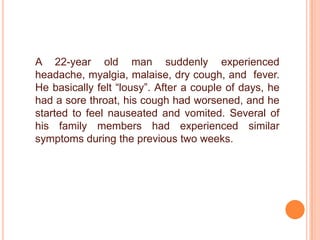
A 22-year old man suddenly experienced headache, myalgia, malaise, dry cough, and  fever. He basically felt “lousy”. After a couple of days, he had a sore throat, his cough had worsened, and he started to feel nauseated and vomited. Several of his family members had experienced similar symptoms during the previous two weeks.
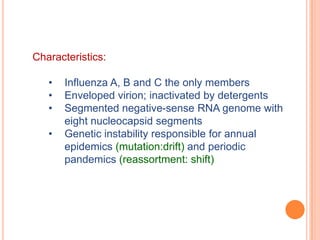
Characteristics:Influenza A, B and C the only members
Enveloped virion; inactivated by detergents
Segmented negative-sense RNA genome with eight nucleocapsid segments
Genetic instability responsible for annual epidemics (mutation:drift) and periodic pandemics (reassortment: shift)Structure & Replication:Envelope with two group-specific glycoproteins:Hemagglutinin (HA)Functions:Viral attachment protein – bind to sialic acid on epithelial cell surface receptorsPromotes fusion of the envelope to the cell membraneHemagglutinates human, chicken and guinea pig rbcElicits protective neutralizing antibody response
Structure & Replication:Envelope with two group-specific glycoproteins:Neuraminidase (NA)With enzyme activity
Cleaves the sialic acid on glycoproteins, including the cell receptor  prevents clumping & facilitates release of virus from infected cells
Target for two antiviral drugs: zanamivir (Relenza) and oseltamivir (Tamiflu)Structure & Replication:Type-specific proteins: used to differentiate among influenza A, B, and C virusesMatrix protein (M1)Viral structural protein
Interacts with nucleocapsid & envelope  promotes assemblyMembrane protein (M2)Forms membrane channel
Facilitates uncoating & HA production
Target for amantadineNucleocapsid proteins (NP)
Structure & Replication:Transcribes and replicates its genome in the target cell nucleus
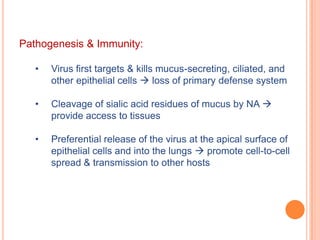
Assembles and buds from the plasma membranePathogenesis & Immunity:Virus first targets & kills mucus-secreting, ciliated, and other epithelial cells  loss of primary defense system
Cleavage of sialic acid residues of mucus by NA  provide access to tissues
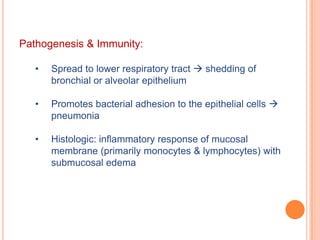
Preferential release of the virus at the apical surface of epithelial cells and into the lungs  promote cell-to-cell spread & transmission to other hostsPathogenesis & Immunity:Spread to lower respiratory tract  shedding of bronchial or alveolar epithelium
Promotes bacterial adhesion to the epithelial cells  pneumonia
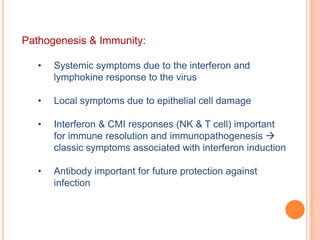
Histologic: inflammatory response of mucosal membrane (primarily monocytes & lymphocytes) with submucosaledemaPathogenesis & Immunity:Systemic symptoms due to the interferon and lymphokine response to the virus
Local symptoms due to epithelial cell damage
Interferon & CMI responses (NK & T cell) important for immune resolution and immunopathogenesis classic symptoms associated with interferon induction
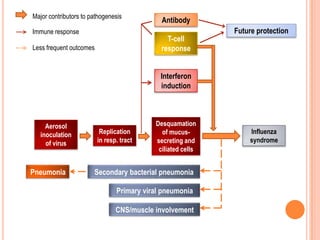
Antibody important for future protection against infection Major contributors to pathogenesisAntibody Future protectionImmune responseT-cell responseLess frequent outcomesInterferon inductionDesquamation of mucus-secreting and ciliated cellsAerosol inoculation of virusReplication in resp. tractInfluenza syndromePneumonia Secondary bacterial pneumoniaPrimary viral pneumoniaCNS/muscle involvement
Why is influenza difficult to control even when there is vaccination available?
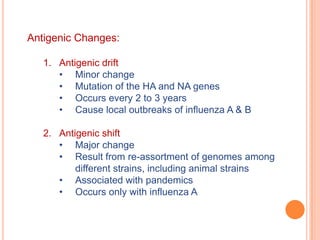
Antigenic Changes:Antigenic driftMinor change
Mutation of the HA and NA genes
Occurs every 2 to 3 years
Cause local outbreaks of influenza A & BAntigenic shiftMajor change
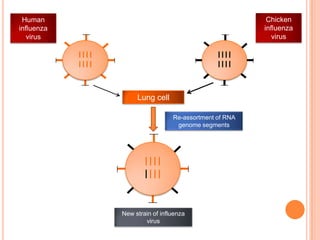
Result from re-assortment of genomes among different strains, including animal strains
Associated with pandemics
Occurs only with influenza AChicken influenza virusHuman influenza virusLung cellRe-assortment of RNA genome segmentsNew strain of influenza virus
How is the virus transmitted?
Virus is spread by inhalation of aerosol droplets expelled during talking, breathing, and coughing.
Virus likes cool, less humid atmosphere
Virus is extensively spread by school children. Who is at risk?
Seronegative people.Adults: classic “flu” syndromeChildren: asymptomatic to severe respiratory			tract infectionHigh-risk Groups:Elderly
Immunocompromised people
People with underlying cardiac or respiratory problems (including people with asthma and smokers)What are the clinical syndromes associated with the virus? What are the possible complications?
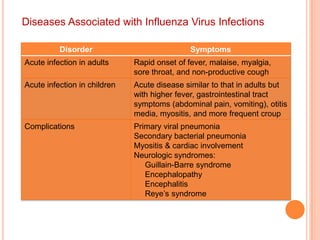
Diseases Associated with Influenza Virus Infections
How would the diagnosis of influenza be confirmed?
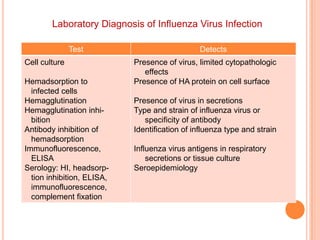
Laboratory Diagnosis of Influenza Virus Infection
Which antiviral drugs are effective for the treatment of influenza virus infection? What are the targets & mechanisms of action of these drugs?
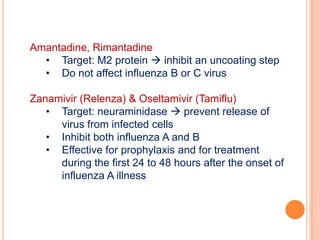
Amantadine, RimantadineTarget: M2 protein  inhibit an uncoating step
Do not affect influenza B or C virusZanamivir (Relenza) & Oseltamivir (Tamiflu)Target: neuraminidase  prevent release of virus from infected cells
Inhibit both influenza A and B
Effective for prophylaxis and for treatment during the first 24 to 48 hours after the onset of influenza A illnessWhat is the best way to control the virus?
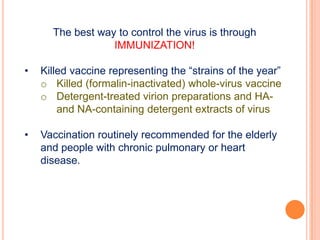
The best way to control the virus is through IMMUNIZATION!Killed vaccine representing the “strains of the year”
Killed (formalin-inactivated) whole-virus vaccine
Detergent-treated virion preparations and HA- and NA-containing detergent extracts of virus
Vaccination routinely recommended for the elderly and people with chronic pulmonary or heart disease.PARAMYXOVIRUSES
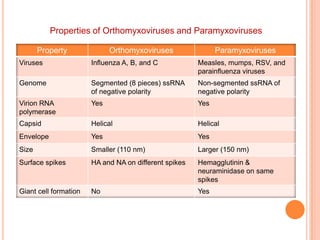
Properties of Orthomyxoviruses and Paramyxoviruses
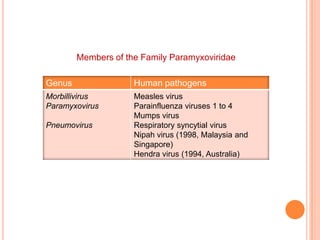
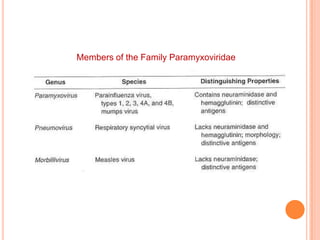
Members of the Family Paramyxoviridae
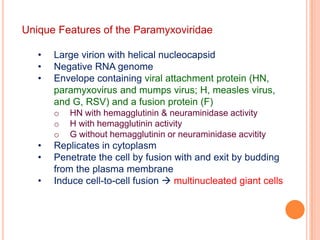
Unique Features of the ParamyxoviridaeLarge virion with helical nucleocapsid
Negative RNA genome
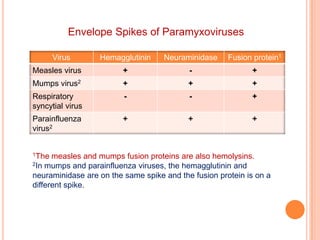
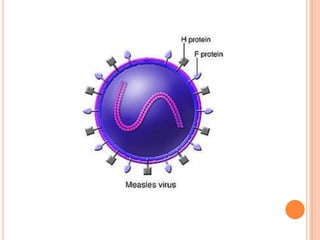
Envelope containing viral attachment protein (HN, paramyxovirus and mumps virus; H, measles virus, and G, RSV) and a fusion protein (F)
HN with hemagglutinin & neuraminidase activity
H with hemagglutinin activity
G without hemagglutinin or neuraminidase acvitity
Replicates in cytoplasm
Penetrate the cell by fusion with and exit by budding from the plasma membrane
Induce cell-to-cell fusion  multinucleated giant cellsEnvelope Spikes of Paramyxoviruses1The measles and mumps fusion proteins are also hemolysins.2In mumps and parainfluenza viruses, the hemagglutinin and neuraminidase are on the same spike and the fusion protein is on a different spike.
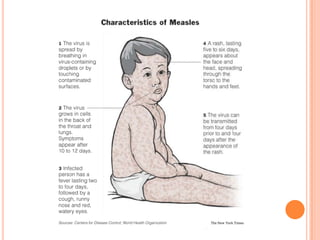
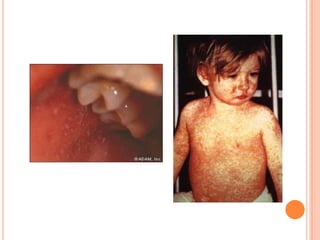
An 18-year old college freshman complained of a cough, runny nose, and conjunctivitis. The physician in the campus health center noticed small white lesions inside the patient’s mouth. The next day, a confluent red rash covered his face and neck.
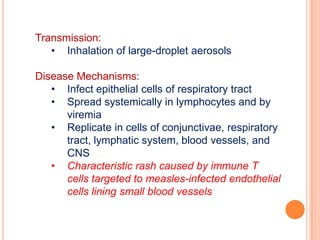
How is the disease transmitted?
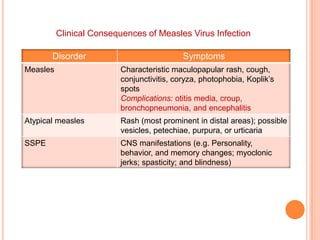
What clinical characteristics of this case were diagnostic for measles?

Otho myx