Nonverbal
Communication
“The World Beyond Words”
What is nonverbal communication?
 “Oral and nonoral messages
expressed by other than linguistic
means.”
 Messages transmitted by vocal
means that do not involve
language
 Sign language and written words
are not considered nonverbal
communication
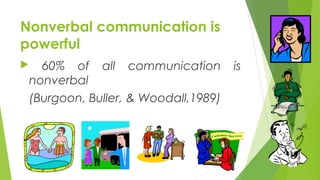
Nonverbal communication is
powerful
 60% of all communication is
nonverbal
(Burgoon, Buller, & Woodall,1989)
There are 7 types of nonverbal
behavior
 Proxemics
 Haptics
 Chronemics
 Kinesics
 Artifacts
 Vocalics or Paralanguage
 Environment
PROXEMICS (distance)
 Different cultures have different comfort levels
of distance
 As children grow older and become less
dependent on parents they require more
space
 Men tend to take up more space than
women
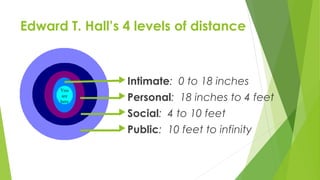
Edward T. Hall’s 4 levels of distance
Intimate: 0 to 18 inches
Personal: 18 inches to 4 feet
Social: 4 to 10 feet
Public: 10 feet to infinity
You
are
here
HAPTICS (touch)
Touch can express encouragement,
support, or happiness.
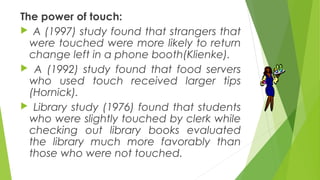
The power of touch:
 A (1997) study found that strangers that
were touched were more likely to return
change left in a phone booth(Klienke).
 A (1992) study found that food servers
who used touch received larger tips
(Hornick).
 Library study (1976) found that students
who were slightly touched by clerk while
checking out library books evaluated
the library much more favorably than
those who were not touched.
CHRONEMICS (time)
How is time used to communicate?
 What does it mean to you when
someone is always late?
 A study conducted by Burgoon (1989)
found that people who arrive 15 minutes
late are considered dynamic, but much
less competent, composed and
sociable than those that arrive on time.
KINESICS (behavior)
 Facial expressions
 Eye contact
 Body language
 Gestures
 Physical appearance
- The study of body movement and physical
expression
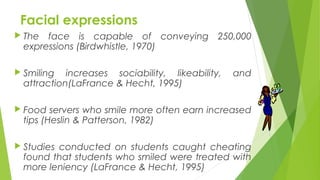
Facial expressions
 The face is capable of conveying 250,000
expressions (Birdwhistle, 1970)
 Smiling increases sociability, likeability, and
attraction(LaFrance & Hecht, 1995)
 Food servers who smile more often earn increased
tips (Heslin & Patterson, 1982)
 Studies conducted on students caught cheating
found that students who smiled were treated with
more leniency (LaFrance & Hecht, 1995)
 Facial expressions allow non-
speakers to contribute to ongoing
group discussions.
Eye contact
 People are more likely to comply when
more eye contact is used
 Eye contact conveys a sense of
sincerity
 Eye contact establishes a connection
between persons
 Lack of eye contact may be
perceived as rudeness, indifference,
nervousness, or dishonesty.
Body language
Mirroring – building rapport with others by
mimicking their nonverbal cues
People like those who are similar or equal to
them
“Mirroring” body language facilitates
compliance
Many self-help books suggest mirroring
techniques to get people to like them
Example: The book Unlimited Power by,
Anthony Robbins
Gestures
 Gestures can be seen as subtle or
not so subtle cues
 We use gestures to take the place
of words, or help us to increase
understanding of what is being said
Physical Appearance
 More attractive people are judged to be
happier, more intelligent, friendlier,
stronger, and kinder and are thought to
have better personalities, better jobs, and
greater marital competence (Knapp, 1992)
 Attractive people get more dates, higher
grades, higher tips, and lighter court
sentences than unattractive people (Dunn,
2000)
 Example:
In a 1980 study 73 defendants who had
been rated on physical attractiveness
went to trial. Results showed that the
more attractive defendants received
significantly lighter sentences (Stewart).
ARTIFACTS (Dress, Belongings, etc.)
 Material objects as an extension of oneself
 Clothing has the power to influence
 Change left in a phone booth was
returned to well dressed people 77% of the
time, poorly dressed people only 38% of
the time
 Several studies show that fancy suits,
uniforms and high-status clothing are
related to higher rates of compliance.
 The situation governs appropriate dress
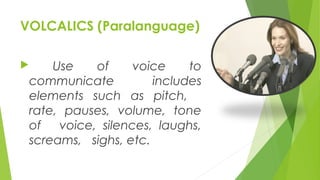
VOLCALICS (Paralanguage)
 Use of voice to
communicate includes
elements such as pitch,
rate, pauses, volume, tone
of voice, silences, laughs,
screams, sighs, etc.
 Studies have found that people who
talk louder, faster, and more fluently
are more persuasive
 Deep voices are often viewed as
more credible
 Powerless style of communication
(pauses, umhs, uhs, tag questions)
lowers perceptions of credibility
ENVIRONMENT
What we surround ourselves
with
Example: The way we
decorate our house tells
others a lot about us.
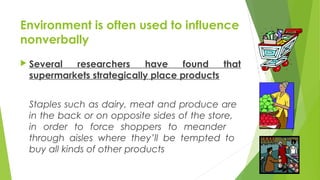
Environment is often used to influence
nonverbally
 Several researchers have found that
supermarkets strategically place products
Staples such as dairy, meat and produce are
in the back or on opposite sides of the store,
in order to force shoppers to meander
through aisles where they’ll be tempted to
buy all kinds of other products
Children’s products are usually placed on
lower shelves where they can easily be
viewed
Snack foods, which appeal to impulsive
buyers are usually placed near check-out
areas and at the end of isles where they
are more likely to be snatched up
(Field, 1996; Meyer, 1997: Tandingan, 2001)
Functions of Nonverbal
Communication
 Repeating
 Substituting
 Complementing
 Accenting
 Regulating
 Contradicting
 Deceiving
Repeating
The use of nonverbal behavior to say
what you are saying in words
Emblems- are the nonverbal behaviors
that we use to display what we mean
Example: head nods at the same time as
someone saying “yes”
Substituting
The use of nonverbal behaviors to say
things rather than words
We often answer questions others ask by
responding nonverbally rather than
verbally
Example: Nodding your head to answer a
question rather than saying “yes”
Complementing
The use of nonverbal behaviors to
strengthen what is being said with words.
Illustrators- nonverbal behaviors that
support what is being said verbally
Example: A friend says “I am so sorry” and
at the same time makes a sincerely sad
face
Accenting
The way we emphasize certain
words in order to clarify what we
mean.
Example: “NO!” or “No????”
Regulating
 Nonverbal behaviors that control the
flow of the conversation, and tell us
when it is our turn to talk, or when the
other person is finished talking.
Example: while telling a story to a friend,
one may pause to allow room for
comments
Contradicting
When people are saying one thing
yet their nonverbal behavior is
telling us something completely
different.
Example: A friend says, “I am so
sorry” while smiling
In conclusion
 A knowledge of the several factors
involved with nonverbal
communication, and an awareness
of its power will improve our ability
to communicate with others.

Nonverbal Communication

  • 1.
  • 2.
    What is nonverbalcommunication?  “Oral and nonoral messages expressed by other than linguistic means.”  Messages transmitted by vocal means that do not involve language  Sign language and written words are not considered nonverbal communication
  • 3.
    Nonverbal communication is powerful 60% of all communication is nonverbal (Burgoon, Buller, & Woodall,1989)
  • 4.
    There are 7types of nonverbal behavior  Proxemics  Haptics  Chronemics  Kinesics  Artifacts  Vocalics or Paralanguage  Environment
  • 5.
    PROXEMICS (distance)  Differentcultures have different comfort levels of distance  As children grow older and become less dependent on parents they require more space  Men tend to take up more space than women
  • 6.
    Edward T. Hall’s4 levels of distance Intimate: 0 to 18 inches Personal: 18 inches to 4 feet Social: 4 to 10 feet Public: 10 feet to infinity You are here
  • 7.
    HAPTICS (touch) Touch canexpress encouragement, support, or happiness.
  • 8.
    The power oftouch:  A (1997) study found that strangers that were touched were more likely to return change left in a phone booth(Klienke).  A (1992) study found that food servers who used touch received larger tips (Hornick).  Library study (1976) found that students who were slightly touched by clerk while checking out library books evaluated the library much more favorably than those who were not touched.
  • 9.
    CHRONEMICS (time) How istime used to communicate?  What does it mean to you when someone is always late?  A study conducted by Burgoon (1989) found that people who arrive 15 minutes late are considered dynamic, but much less competent, composed and sociable than those that arrive on time.
  • 10.
    KINESICS (behavior)  Facialexpressions  Eye contact  Body language  Gestures  Physical appearance - The study of body movement and physical expression
  • 11.
    Facial expressions  Theface is capable of conveying 250,000 expressions (Birdwhistle, 1970)  Smiling increases sociability, likeability, and attraction(LaFrance & Hecht, 1995)  Food servers who smile more often earn increased tips (Heslin & Patterson, 1982)  Studies conducted on students caught cheating found that students who smiled were treated with more leniency (LaFrance & Hecht, 1995)
  • 12.
     Facial expressionsallow non- speakers to contribute to ongoing group discussions.
  • 13.
    Eye contact  Peopleare more likely to comply when more eye contact is used  Eye contact conveys a sense of sincerity  Eye contact establishes a connection between persons  Lack of eye contact may be perceived as rudeness, indifference, nervousness, or dishonesty.
  • 14.
    Body language Mirroring –building rapport with others by mimicking their nonverbal cues People like those who are similar or equal to them “Mirroring” body language facilitates compliance Many self-help books suggest mirroring techniques to get people to like them Example: The book Unlimited Power by, Anthony Robbins
  • 15.
    Gestures  Gestures canbe seen as subtle or not so subtle cues  We use gestures to take the place of words, or help us to increase understanding of what is being said
  • 16.
    Physical Appearance  Moreattractive people are judged to be happier, more intelligent, friendlier, stronger, and kinder and are thought to have better personalities, better jobs, and greater marital competence (Knapp, 1992)  Attractive people get more dates, higher grades, higher tips, and lighter court sentences than unattractive people (Dunn, 2000)
  • 17.
     Example: In a1980 study 73 defendants who had been rated on physical attractiveness went to trial. Results showed that the more attractive defendants received significantly lighter sentences (Stewart).
  • 18.
    ARTIFACTS (Dress, Belongings,etc.)  Material objects as an extension of oneself  Clothing has the power to influence  Change left in a phone booth was returned to well dressed people 77% of the time, poorly dressed people only 38% of the time  Several studies show that fancy suits, uniforms and high-status clothing are related to higher rates of compliance.  The situation governs appropriate dress
  • 19.
    VOLCALICS (Paralanguage)  Useof voice to communicate includes elements such as pitch, rate, pauses, volume, tone of voice, silences, laughs, screams, sighs, etc.
  • 20.
     Studies havefound that people who talk louder, faster, and more fluently are more persuasive  Deep voices are often viewed as more credible  Powerless style of communication (pauses, umhs, uhs, tag questions) lowers perceptions of credibility
  • 21.
    ENVIRONMENT What we surroundourselves with Example: The way we decorate our house tells others a lot about us.
  • 22.
    Environment is oftenused to influence nonverbally  Several researchers have found that supermarkets strategically place products Staples such as dairy, meat and produce are in the back or on opposite sides of the store, in order to force shoppers to meander through aisles where they’ll be tempted to buy all kinds of other products
  • 23.
    Children’s products areusually placed on lower shelves where they can easily be viewed Snack foods, which appeal to impulsive buyers are usually placed near check-out areas and at the end of isles where they are more likely to be snatched up (Field, 1996; Meyer, 1997: Tandingan, 2001)
  • 24.
    Functions of Nonverbal Communication Repeating  Substituting  Complementing  Accenting  Regulating  Contradicting  Deceiving
  • 25.
    Repeating The use ofnonverbal behavior to say what you are saying in words Emblems- are the nonverbal behaviors that we use to display what we mean Example: head nods at the same time as someone saying “yes”
  • 26.
    Substituting The use ofnonverbal behaviors to say things rather than words We often answer questions others ask by responding nonverbally rather than verbally Example: Nodding your head to answer a question rather than saying “yes”
  • 27.
    Complementing The use ofnonverbal behaviors to strengthen what is being said with words. Illustrators- nonverbal behaviors that support what is being said verbally Example: A friend says “I am so sorry” and at the same time makes a sincerely sad face
  • 28.
    Accenting The way weemphasize certain words in order to clarify what we mean. Example: “NO!” or “No????”
  • 29.
    Regulating  Nonverbal behaviorsthat control the flow of the conversation, and tell us when it is our turn to talk, or when the other person is finished talking. Example: while telling a story to a friend, one may pause to allow room for comments
  • 30.
    Contradicting When people aresaying one thing yet their nonverbal behavior is telling us something completely different. Example: A friend says, “I am so sorry” while smiling
  • 31.
    In conclusion  Aknowledge of the several factors involved with nonverbal communication, and an awareness of its power will improve our ability to communicate with others.

Editor's Notes

  • #6 Example: When you go to the movies with someone of the opposite sex who usually gets the armrest?
  • #21 Credible – sincere, trustworthy, authority
  • #23 Meander - stroll