
BUSINESS COMMUNICATION
NON-VERBAL COMMUNICATION
INDUSTRY BEST PRACTICES
Trainer: BAM BLANCO RAMIRES
NON-VERBAL COMMUNICATION
The most basic form of communication is non-
verbal. The term non-verbal means “without
word”. Thus non-verbal communication is
communication without words.
Non-verbal communication means
communication that occurs without words.
DEFINITION
Acc to Raymond and John
“All communication that involves
neither written nor spoken words but occurs
without use of words are termed as non-
verbal communication .”
FUNCTIONS
• To provide information, either consciously or
unconsciously.
• To regulate the flow of conversation.
• To express emotion.
• To qualify, complement, contradict or expand
verbal messages.
• To control or influence others.
• To facilitate specific tasks.
Types of non-verbal communication
• KINESICS OR BODY LANGUAGE
• PROXEMICS OR SPACE LANGUAGE
• PARA LANGUAGE
KINESICS OR BODY LANGUAGE
Body language is a prominent and an important
medium of non-verbal communication. Body
language expresses internal feelings very
clearly. Body language is also known as
KINESICS. Kinesics is the study of body
movements and gestures.
TYPES OF BODY LANGUAGE
• POSTURES
• GESTURES
• FACIAL EXPRESSIONS
• EYE CONTACT
• BODILY CONTACT
• APPEARANCE
• SILENCE
FUNCTIONS OF BODY LANGUAGE
• They can provide information about feelings and
intentions.
• They can be used to regulate interactions.
• They can be used to express intimacy.
• They can be used to establish dominance or control.
• They can be used to facilitate goal attainment.
SIGNIFICANCE OF BODY LANGUAGE
• Reveals the working of Emotions.
• Reveals the Status.
• Replaces Verbal Communication.
• Sustain Verbal Conversation.
• Reveals a Person’s Attitudes and Traits.
• Reveals the Truth.
• Practical Application.
PROXEMICS
• The term ‘Proxemics’ was first used in the field
of communication by eminent researcher
Edward T. Hall. he derived the term Proxemics
from proximity. In the words of Barker and
Gaut, “The study of spatial factors between
the sender and receiver of the message is
called Proxemics.”
TYPES OF PROXEMICS
• SPACE LANGUAGE
• TIME LANGUAGE
• SURROUNDINGS
PARA LANGUAGE
The term para language is combination of two words-
”para”’ means like and “language” means mode of
communication. Thus, para language literally means
“like language”.
In the words of Prof. Barker and Gaut, “A language
alongside of language and includes vocal
characteristics such as pitch, range, resonance,
tempo and quality and various vocal sounds such as
grunts, groans and clearing the throat.”
BARRIERS TO COMMUNICATION
COMMON BARRIERS TO COMMUNICATION
1. SEMANTICS
Definition of words
Choice of words
COMMON BARRIERS TO COMMUNICATION
2. POOR CHOICE, USE OF CHANNELS
 When to use certain channel
Oral alone:
• Simple reprimand
• Settle simple dispute
Written alone:
• Don’t need immediate feedback
• Need record
COMMON BARRIERS TO COMMUNICATION
2. USE OF CHANNELS
Both channels:
• Commendation
• Serious reprimand
• Important policy change
Nonverbal
• Be aware of it.
COMMON BARRIERS TO COMMUNICATION
3. PHYSICAL DISTRACTIONS
4. NOISE, PHYSICAL,
PSYCHOLOGICAL
5. STATUS DIFFERENCE
6. EFFECTS OF EMOTIONS
COMMON BARRIERS TO COMMUNICATION
7. PERCEPTIONS
Stereotypes
Halo effects
Selective perception
• See and hear what we expect
• Ignore if conflicts with “what we know.”
Projection
COMMON BARRIERS TO COMMUNICATION
8. FILTERING, SCREENING
NEGATIVE INFORMTAION
9. EVALUATING THE SOURCE
10.ABSENCE OF FEEDBACK,
POOR FEEDBACK
COMMON BARRIERS TO COMMUNICATION
11. INFORMATION, DATA
OVERLOAD
12. POOR LISTENING
LISTEN TO RESPOND
LISTEN TO UNDERSTAND
TO OVERCOME BARRIERS:
Learn to use feedback well.
Be sensitive to receiver’s point of view.
Listen to UNDERSTAND!
Use direct, simple language, or at least use
language appropriate to the receiver.
Use proper channel(s). Learn to use channels
well.
Learn to use supportive communication, not
defensive communication.
LISTENING
What is Listening?
• listening (ILA, 1996): the process of receiving,
constructing meaning from, and responding to
spoken and/or nonverbal messages; to hear
something with thoughtful attention
• Effective communication is 2-way
– depends on speaking and listening
Listening vs. Hearing
• Hearing- physical process; natural; passive
• Listening- physical & mental process; active; learned
process; a skill
• Listening is hard!
You must choose to participate in the
process of listening.
Why Be A Good Listener?
Needs of the Customer…
• To be recognized and remembered
• To feel valued
• To feel appreciated
• To feel respected
• To feel understood
• To feel comfortable about a want or need
Listening is the most powerful form
of acknowledgment
…a way of saying, “You are
important.”
• Listening builds stronger
relationships
…creates a desire to cooperate
among people because they feel
accepted and acknowledged.
• Listening promotes being heard
…”Seek first to understand, then be
understood.”
• - Stephen Covey
Listening creates acceptance and
openness
…conveys the message that “I am
not judging you.”
Listening leads to learning
…openness encourages personal
growth and learning
Listening reduces stress and tension
…minimizes confusion and
misunderstanding, eliminating
related stress and tension
• Listening is CRITICAL in conflict
resolution
•
…much conflict comes from the
need to be heard. Successful
resolution depends on being a
non-anxious presence.
Barriers to Listening
• Equate With Hearing
• Uninteresting Topics
• Speaker’s Delivery
• External Distractions
• Mentally Preparing
Response
• Listening for Facts
• Personal Concerns
• Personal Bias
• Language/Culture
Differences
• Faking Attention
Bad Listening Habits
• Criticizing the subject or the speaker
• Getting over-stimulated
• Listening only for facts
• Not taking notes OR outlining everything
• Tolerating or creating distraction
• Letting emotional words block message
• Wasting time difference between speed of speech
and speed of thought
When Are You Listening?
• Non-Verbal Encouragers
• Verbal Encouragers
Active Listening
• … Allows you to make sure you hear the words
and understand the meaning behind the
words
• Goal: go beyond listening to understanding
Active Listening Requires…
• Definite Intent to Listen
• Focus on the Speaker
• Verbal and Non-Verbal Encouragers
• Feedback Loop to Insure Accuracy
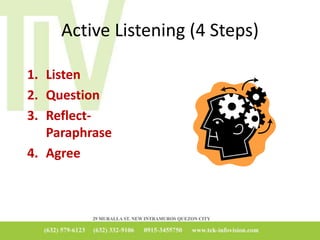
Active Listening (4 Steps)
1. Listen
2. Question
3. Reflect-
Paraphrase
4. Agree
Step 1: Listen
• To Feelings As Well As Words
– Words – Emotions -- Implications
• Focus on Speaker
– Don’t plan, speak, or get distracted
• What Is Speaker Talking About?
– Topic? Speaker? Listener? Others?
• Look At Speaker
• Use Verbal & Non-Verbal Encouragers
Step 2: Question
• 3 Purposes
– Demonstrates you are listening
– Gather information
– Clarification
• Open-ended
– Tell me more?
– How did you feel?
– Then what happened?
Step 3: Reflect-Paraphrase
• Reflect What Is Said (In your words)
• Reflect Feelings
• Reframe
– Capture the essence of the communication
– Remove negative framing
– Move toward problem solving
Step 4: Agree
• Get Speaker’s Consent to Your Reframing
• Speaker Has Been Heard and Knows It!
• Solution Is Near!
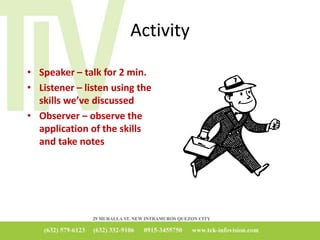
Activity
• Speaker – talk for 2 min.
• Listener – listen using the
skills we’ve discussed
• Observer – observe the
application of the skills
and take notes
INTERVIEW
INTERVIEW
• In the words of Stewart and Cash, “Interview
is a process of didactic communication with
pre-determined and serious purpose
designed to interchange behavior and
involving the asking and answering the
questions.”
ATTENDING INTERVIEW
In regard to people being interviewed for a
job, a national survey of employment
interviewers listed the following qualities in
order of their relative importance: (1)
appearance (2) manner of ideas, (3)
personality, (4) speech and voice, (5) manners
and (6) skills.
APPEARING FOR INTERVIEWS
• PLANNING AHEAD
• STUDY THE COMPANY
• PREPARE YOURSELF
a) Dress properly
b) Take all the Certificate
c) Be on Time
d) Appearing for the Interview
e) Walk Right In!
f) Being Interviewed
g) Do not overstay your Allotted Time
h) Reason for Leaving
i) On Leaving, Sincerely Thanks the Interviewer for His or Her Time
CONDUCTING INTERVIEW
• Decision about the Suitable Location
• Preparation for the Interview
• Commencing the Interview
1. Using questions for control
2. Listening by the Interviewers
3. Summarizing
4. Note-Taking
• Closing the Interview
• Making Judgments and Analyzing Results
49
More FREE training slides, tools and tips to come!
In-depth and customized in-house and public
seminars are also available. E-mail me at:
bam@tek-infovision.com

BUSINESS COMMUNICATION NON-VERBAL

  • 1.
    BUSINESS COMMUNICATION NON-VERBAL COMMUNICATION INDUSTRYBEST PRACTICES Trainer: BAM BLANCO RAMIRES
  • 2.
    NON-VERBAL COMMUNICATION The mostbasic form of communication is non- verbal. The term non-verbal means “without word”. Thus non-verbal communication is communication without words. Non-verbal communication means communication that occurs without words.
  • 3.
    DEFINITION Acc to Raymondand John “All communication that involves neither written nor spoken words but occurs without use of words are termed as non- verbal communication .”
  • 4.
    FUNCTIONS • To provideinformation, either consciously or unconsciously. • To regulate the flow of conversation. • To express emotion. • To qualify, complement, contradict or expand verbal messages. • To control or influence others. • To facilitate specific tasks.
  • 5.
    Types of non-verbalcommunication • KINESICS OR BODY LANGUAGE • PROXEMICS OR SPACE LANGUAGE • PARA LANGUAGE
  • 6.
    KINESICS OR BODYLANGUAGE Body language is a prominent and an important medium of non-verbal communication. Body language expresses internal feelings very clearly. Body language is also known as KINESICS. Kinesics is the study of body movements and gestures.
  • 7.
    TYPES OF BODYLANGUAGE • POSTURES • GESTURES • FACIAL EXPRESSIONS • EYE CONTACT • BODILY CONTACT • APPEARANCE • SILENCE
  • 8.
    FUNCTIONS OF BODYLANGUAGE • They can provide information about feelings and intentions. • They can be used to regulate interactions. • They can be used to express intimacy. • They can be used to establish dominance or control. • They can be used to facilitate goal attainment.
  • 9.
    SIGNIFICANCE OF BODYLANGUAGE • Reveals the working of Emotions. • Reveals the Status. • Replaces Verbal Communication. • Sustain Verbal Conversation. • Reveals a Person’s Attitudes and Traits. • Reveals the Truth. • Practical Application.
  • 10.
    PROXEMICS • The term‘Proxemics’ was first used in the field of communication by eminent researcher Edward T. Hall. he derived the term Proxemics from proximity. In the words of Barker and Gaut, “The study of spatial factors between the sender and receiver of the message is called Proxemics.”
  • 11.
    TYPES OF PROXEMICS •SPACE LANGUAGE • TIME LANGUAGE • SURROUNDINGS
  • 12.
    PARA LANGUAGE The termpara language is combination of two words- ”para”’ means like and “language” means mode of communication. Thus, para language literally means “like language”. In the words of Prof. Barker and Gaut, “A language alongside of language and includes vocal characteristics such as pitch, range, resonance, tempo and quality and various vocal sounds such as grunts, groans and clearing the throat.”
  • 13.
  • 14.
    COMMON BARRIERS TOCOMMUNICATION 1. SEMANTICS Definition of words Choice of words
  • 15.
    COMMON BARRIERS TOCOMMUNICATION 2. POOR CHOICE, USE OF CHANNELS  When to use certain channel Oral alone: • Simple reprimand • Settle simple dispute Written alone: • Don’t need immediate feedback • Need record
  • 16.
    COMMON BARRIERS TOCOMMUNICATION 2. USE OF CHANNELS Both channels: • Commendation • Serious reprimand • Important policy change Nonverbal • Be aware of it.
  • 17.
    COMMON BARRIERS TOCOMMUNICATION 3. PHYSICAL DISTRACTIONS 4. NOISE, PHYSICAL, PSYCHOLOGICAL 5. STATUS DIFFERENCE 6. EFFECTS OF EMOTIONS
  • 18.
    COMMON BARRIERS TOCOMMUNICATION 7. PERCEPTIONS Stereotypes Halo effects Selective perception • See and hear what we expect • Ignore if conflicts with “what we know.” Projection
  • 19.
    COMMON BARRIERS TOCOMMUNICATION 8. FILTERING, SCREENING NEGATIVE INFORMTAION 9. EVALUATING THE SOURCE 10.ABSENCE OF FEEDBACK, POOR FEEDBACK
  • 20.
    COMMON BARRIERS TOCOMMUNICATION 11. INFORMATION, DATA OVERLOAD 12. POOR LISTENING LISTEN TO RESPOND LISTEN TO UNDERSTAND
  • 21.
    TO OVERCOME BARRIERS: Learnto use feedback well. Be sensitive to receiver’s point of view. Listen to UNDERSTAND! Use direct, simple language, or at least use language appropriate to the receiver. Use proper channel(s). Learn to use channels well. Learn to use supportive communication, not defensive communication.
  • 22.
  • 23.
    What is Listening? •listening (ILA, 1996): the process of receiving, constructing meaning from, and responding to spoken and/or nonverbal messages; to hear something with thoughtful attention • Effective communication is 2-way – depends on speaking and listening
  • 24.
    Listening vs. Hearing •Hearing- physical process; natural; passive • Listening- physical & mental process; active; learned process; a skill • Listening is hard! You must choose to participate in the process of listening.
  • 25.
    Why Be AGood Listener? Needs of the Customer… • To be recognized and remembered • To feel valued • To feel appreciated • To feel respected • To feel understood • To feel comfortable about a want or need
  • 26.
    Listening is themost powerful form of acknowledgment …a way of saying, “You are important.”
  • 27.
    • Listening buildsstronger relationships …creates a desire to cooperate among people because they feel accepted and acknowledged.
  • 28.
    • Listening promotesbeing heard …”Seek first to understand, then be understood.” • - Stephen Covey
  • 29.
    Listening creates acceptanceand openness …conveys the message that “I am not judging you.”
  • 30.
    Listening leads tolearning …openness encourages personal growth and learning
  • 31.
    Listening reduces stressand tension …minimizes confusion and misunderstanding, eliminating related stress and tension
  • 32.
    • Listening isCRITICAL in conflict resolution • …much conflict comes from the need to be heard. Successful resolution depends on being a non-anxious presence.
  • 33.
    Barriers to Listening •Equate With Hearing • Uninteresting Topics • Speaker’s Delivery • External Distractions • Mentally Preparing Response • Listening for Facts • Personal Concerns • Personal Bias • Language/Culture Differences • Faking Attention
  • 34.
    Bad Listening Habits •Criticizing the subject or the speaker • Getting over-stimulated • Listening only for facts • Not taking notes OR outlining everything • Tolerating or creating distraction • Letting emotional words block message • Wasting time difference between speed of speech and speed of thought
  • 35.
    When Are YouListening? • Non-Verbal Encouragers • Verbal Encouragers
  • 36.
    Active Listening • …Allows you to make sure you hear the words and understand the meaning behind the words • Goal: go beyond listening to understanding
  • 37.
    Active Listening Requires… •Definite Intent to Listen • Focus on the Speaker • Verbal and Non-Verbal Encouragers • Feedback Loop to Insure Accuracy
  • 38.
    Active Listening (4Steps) 1. Listen 2. Question 3. Reflect- Paraphrase 4. Agree
  • 39.
    Step 1: Listen •To Feelings As Well As Words – Words – Emotions -- Implications • Focus on Speaker – Don’t plan, speak, or get distracted • What Is Speaker Talking About? – Topic? Speaker? Listener? Others? • Look At Speaker • Use Verbal & Non-Verbal Encouragers
  • 40.
    Step 2: Question •3 Purposes – Demonstrates you are listening – Gather information – Clarification • Open-ended – Tell me more? – How did you feel? – Then what happened?
  • 41.
    Step 3: Reflect-Paraphrase •Reflect What Is Said (In your words) • Reflect Feelings • Reframe – Capture the essence of the communication – Remove negative framing – Move toward problem solving
  • 42.
    Step 4: Agree •Get Speaker’s Consent to Your Reframing • Speaker Has Been Heard and Knows It! • Solution Is Near!
  • 43.
    Activity • Speaker –talk for 2 min. • Listener – listen using the skills we’ve discussed • Observer – observe the application of the skills and take notes
  • 44.
  • 45.
    INTERVIEW • In thewords of Stewart and Cash, “Interview is a process of didactic communication with pre-determined and serious purpose designed to interchange behavior and involving the asking and answering the questions.”
  • 46.
    ATTENDING INTERVIEW In regardto people being interviewed for a job, a national survey of employment interviewers listed the following qualities in order of their relative importance: (1) appearance (2) manner of ideas, (3) personality, (4) speech and voice, (5) manners and (6) skills.
  • 47.
    APPEARING FOR INTERVIEWS •PLANNING AHEAD • STUDY THE COMPANY • PREPARE YOURSELF a) Dress properly b) Take all the Certificate c) Be on Time d) Appearing for the Interview e) Walk Right In! f) Being Interviewed g) Do not overstay your Allotted Time h) Reason for Leaving i) On Leaving, Sincerely Thanks the Interviewer for His or Her Time
  • 48.
    CONDUCTING INTERVIEW • Decisionabout the Suitable Location • Preparation for the Interview • Commencing the Interview 1. Using questions for control 2. Listening by the Interviewers 3. Summarizing 4. Note-Taking • Closing the Interview • Making Judgments and Analyzing Results
  • 49.
    49 More FREE trainingslides, tools and tips to come! In-depth and customized in-house and public seminars are also available. E-mail me at: bam@tek-infovision.com