NONVERBAL COMMUNICATIONProxemics: Territoriality, Defense, and Reaction  Created by: A. Nelson
Proxemics is the study of the communicative aspects of space.
Territoriality is personal space we don't want others to invade. 	Lyman and Scott (1967) identify 3 types of territorial encroachments: InvasionViolationContamination
InvasionINVASION is more all-encompassing and permanent. It is an attempt to take over another's territory.
ViolationVIOLATION involves the unwarranted use of another's territory. This may be done with the eyes, the voice or other sounds, or with the body.
ContaminationCONTAMINATION is defiling another's territory, not by presence but what we leave behind. 
Defense	The 2 primary methods for territorial defense are: Prevention Reaction
DefensePREVENTION is a means of staking out our territory so others recognize it as ours and go elsewhere. A person's presence in a place can keep others from entering it.
DefenseObjects are also used as territorial markers to designate "your" spatial area.  Although one doesn't always own a particular territory, we nonetheless presume "ownership" by the sheer frequency with which we occupy a space or by the markers we use to communicate that the territory is "ours."
If the prevention of territorial violations does not work, how do people react?When people come close to use in face-to-face encounters, we are physiologically aroused; heart rate and skin responses increase.
ReactionOne response to invasion of our privacy is behavior that restores our privacy zone. This response accepts the invitation and cedes the territory. Another response is the well-known elevator phenomenon, in which people are crowded more closely than they like, so everyone looks up or down as if to say “I’m not trying to intrude into your space.” A third response is to challenge the invasion—to stand your ground and refuse to yield territory.
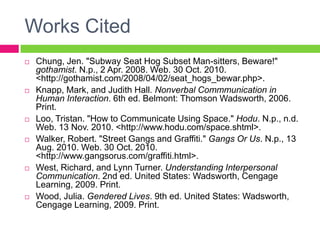
Works CitedChung, Jen. "Subway Seat Hog Subset Man-sitters, Beware!" gothamist. N.p., 2 Apr. 2008. Web. 30 Oct. 2010. <http://gothamist.com/2008/04/02/seat_hogs_bewar.php>. Knapp, Mark, and Judith Hall. Nonverbal Commmunication in Human Interaction. 6th ed. Belmont: Thomson Wadsworth, 2006. Print. Loo, Tristan. "How to Communicate Using Space." Hodu. N.p., n.d. Web. 13 Nov. 2010. <http://www.hodu.com/space.shtml>. Walker, Robert. "Street Gangs and Graffiti." Gangs Or Us. N.p., 13 Aug. 2010. Web. 30 Oct. 2010. <http://www.gangsorus.com/graffiti.html>. West, Richard, and Lynn Turner. Understanding Interpersonal Communication. 2nd ed. United States: Wadsworth, Cengage Learning, 2009. Print. Wood, Julia. Gendered Lives. 9th ed. United States: Wadsworth, Cengage Learning, 2009. Print.

Proxemics

  • 1.
  • 2.
    Proxemics is thestudy of the communicative aspects of space.
  • 3.
    Territoriality is personalspace we don't want others to invade. Lyman and Scott (1967) identify 3 types of territorial encroachments: InvasionViolationContamination
  • 4.
    InvasionINVASION is moreall-encompassing and permanent. It is an attempt to take over another's territory.
  • 5.
    ViolationVIOLATION involves theunwarranted use of another's territory. This may be done with the eyes, the voice or other sounds, or with the body.
  • 6.
    ContaminationCONTAMINATION is defilinganother's territory, not by presence but what we leave behind. 
  • 7.
    Defense The 2 primarymethods for territorial defense are: Prevention Reaction
  • 8.
    DefensePREVENTION is ameans of staking out our territory so others recognize it as ours and go elsewhere. A person's presence in a place can keep others from entering it.
  • 9.
    DefenseObjects are alsoused as territorial markers to designate "your" spatial area.  Although one doesn't always own a particular territory, we nonetheless presume "ownership" by the sheer frequency with which we occupy a space or by the markers we use to communicate that the territory is "ours."
  • 10.
    If the preventionof territorial violations does not work, how do people react?When people come close to use in face-to-face encounters, we are physiologically aroused; heart rate and skin responses increase.
  • 11.
    ReactionOne response toinvasion of our privacy is behavior that restores our privacy zone. This response accepts the invitation and cedes the territory. Another response is the well-known elevator phenomenon, in which people are crowded more closely than they like, so everyone looks up or down as if to say “I’m not trying to intrude into your space.” A third response is to challenge the invasion—to stand your ground and refuse to yield territory.
  • 12.
    Works CitedChung, Jen."Subway Seat Hog Subset Man-sitters, Beware!" gothamist. N.p., 2 Apr. 2008. Web. 30 Oct. 2010. <http://gothamist.com/2008/04/02/seat_hogs_bewar.php>. Knapp, Mark, and Judith Hall. Nonverbal Commmunication in Human Interaction. 6th ed. Belmont: Thomson Wadsworth, 2006. Print. Loo, Tristan. "How to Communicate Using Space." Hodu. N.p., n.d. Web. 13 Nov. 2010. <http://www.hodu.com/space.shtml>. Walker, Robert. "Street Gangs and Graffiti." Gangs Or Us. N.p., 13 Aug. 2010. Web. 30 Oct. 2010. <http://www.gangsorus.com/graffiti.html>. West, Richard, and Lynn Turner. Understanding Interpersonal Communication. 2nd ed. United States: Wadsworth, Cengage Learning, 2009. Print. Wood, Julia. Gendered Lives. 9th ed. United States: Wadsworth, Cengage Learning, 2009. Print.