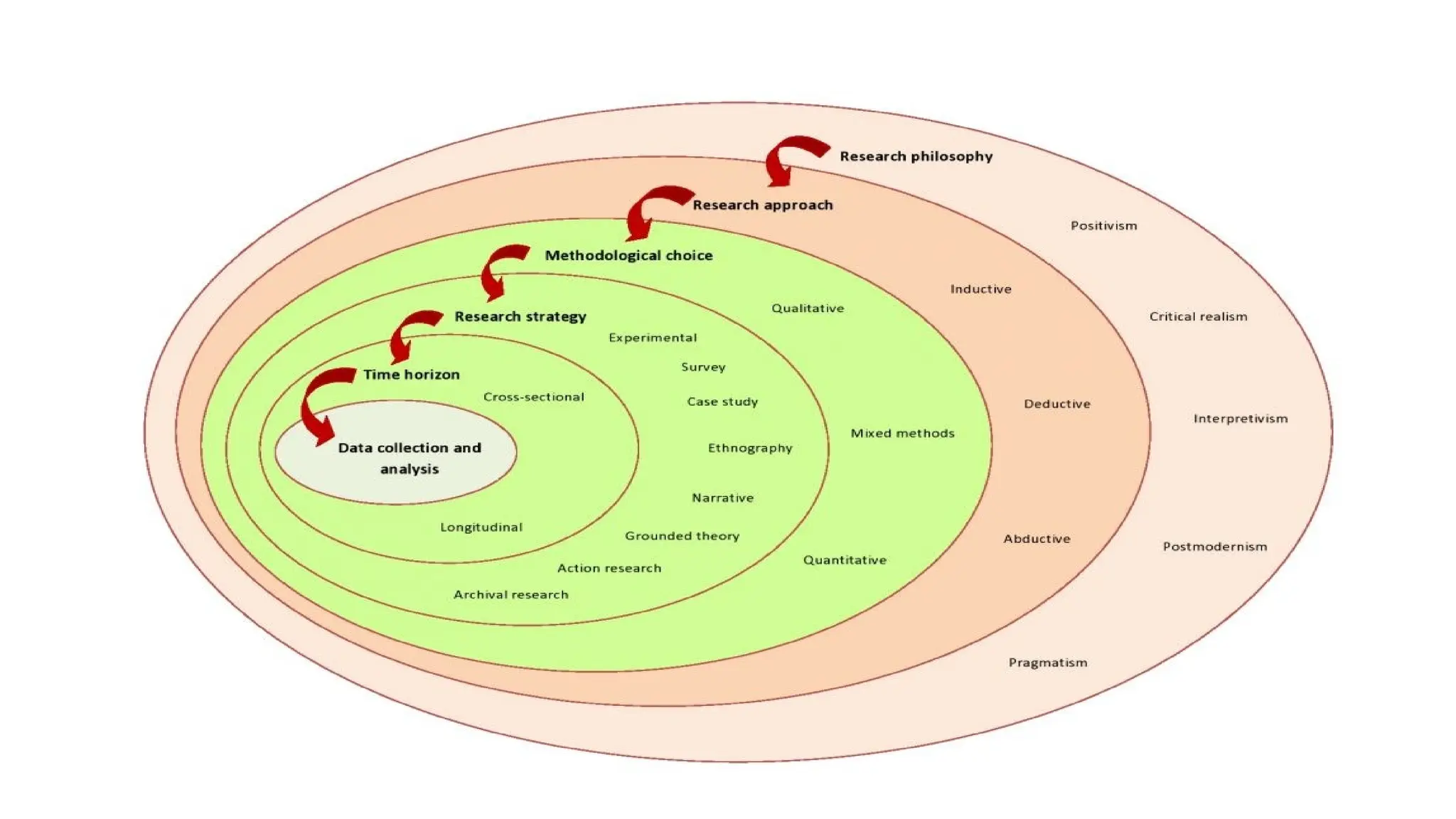
Research Philosophy
• Researchphilosophy deals with the source, nature and
development of knowledge. In simple terms, a research
philosophy is belief about the ways in which data about a
phenomenon should be collected, analyzed and used.
• Although the idea of knowledge creation may appear to be
profound, you are engaged in knowledge creation as part of
completing your dissertation. You will collect secondary and
primary data and engage in data analysis to answer the
research question and this answer marks the creation of new
knowledge.
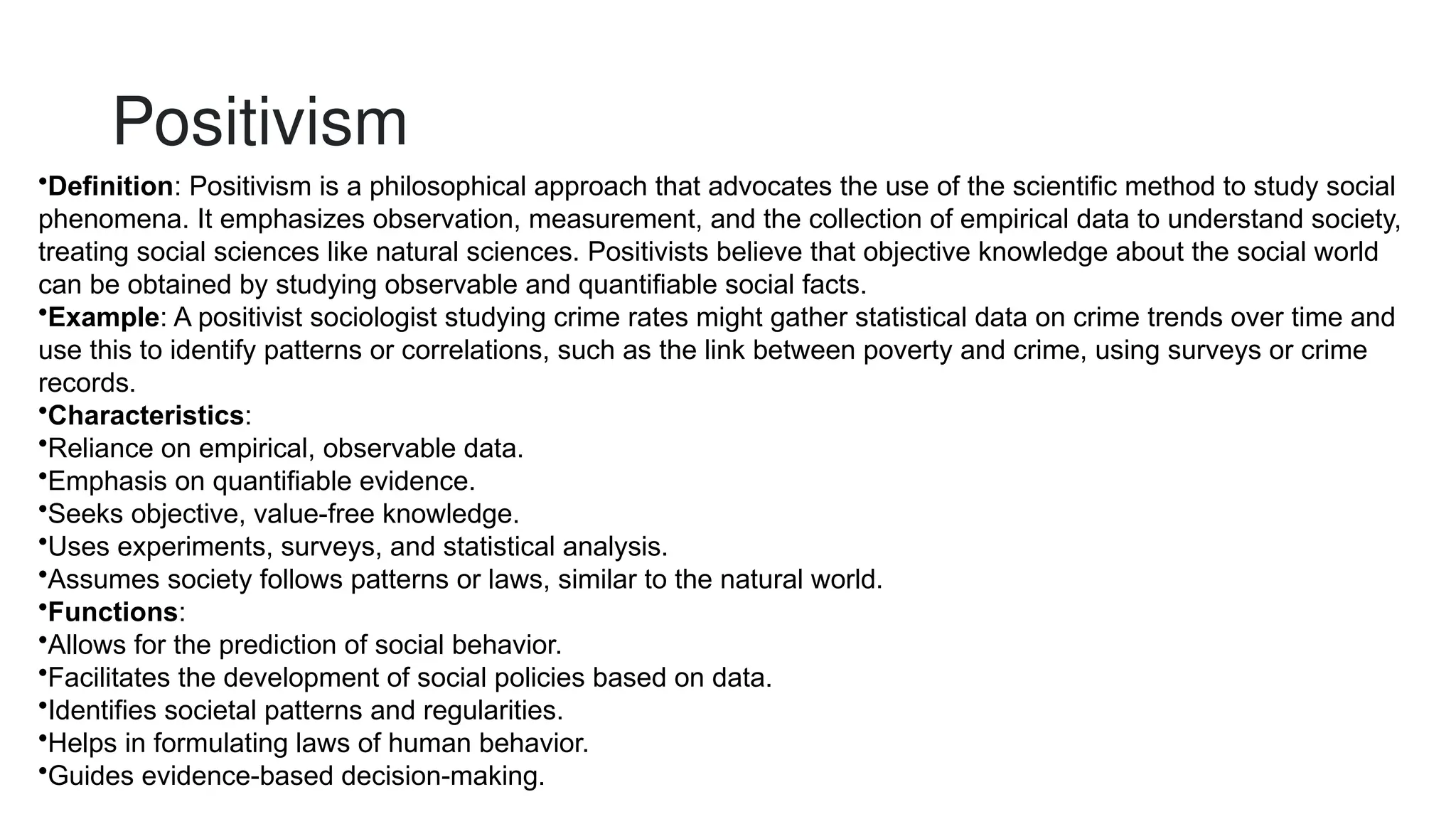
Positivism
•Definition: Positivism isa philosophical approach that advocates the use of the scientific method to study social
phenomena. It emphasizes observation, measurement, and the collection of empirical data to understand society,
treating social sciences like natural sciences. Positivists believe that objective knowledge about the social world
can be obtained by studying observable and quantifiable social facts.
•Example: A positivist sociologist studying crime rates might gather statistical data on crime trends over time and
use this to identify patterns or correlations, such as the link between poverty and crime, using surveys or crime
records.
•Characteristics:
•Reliance on empirical, observable data.
•Emphasis on quantifiable evidence.
•Seeks objective, value-free knowledge.
•Uses experiments, surveys, and statistical analysis.
•Assumes society follows patterns or laws, similar to the natural world.
•Functions:
•Allows for the prediction of social behavior.
•Facilitates the development of social policies based on data.
•Identifies societal patterns and regularities.
•Helps in formulating laws of human behavior.
•Guides evidence-based decision-making.
6.
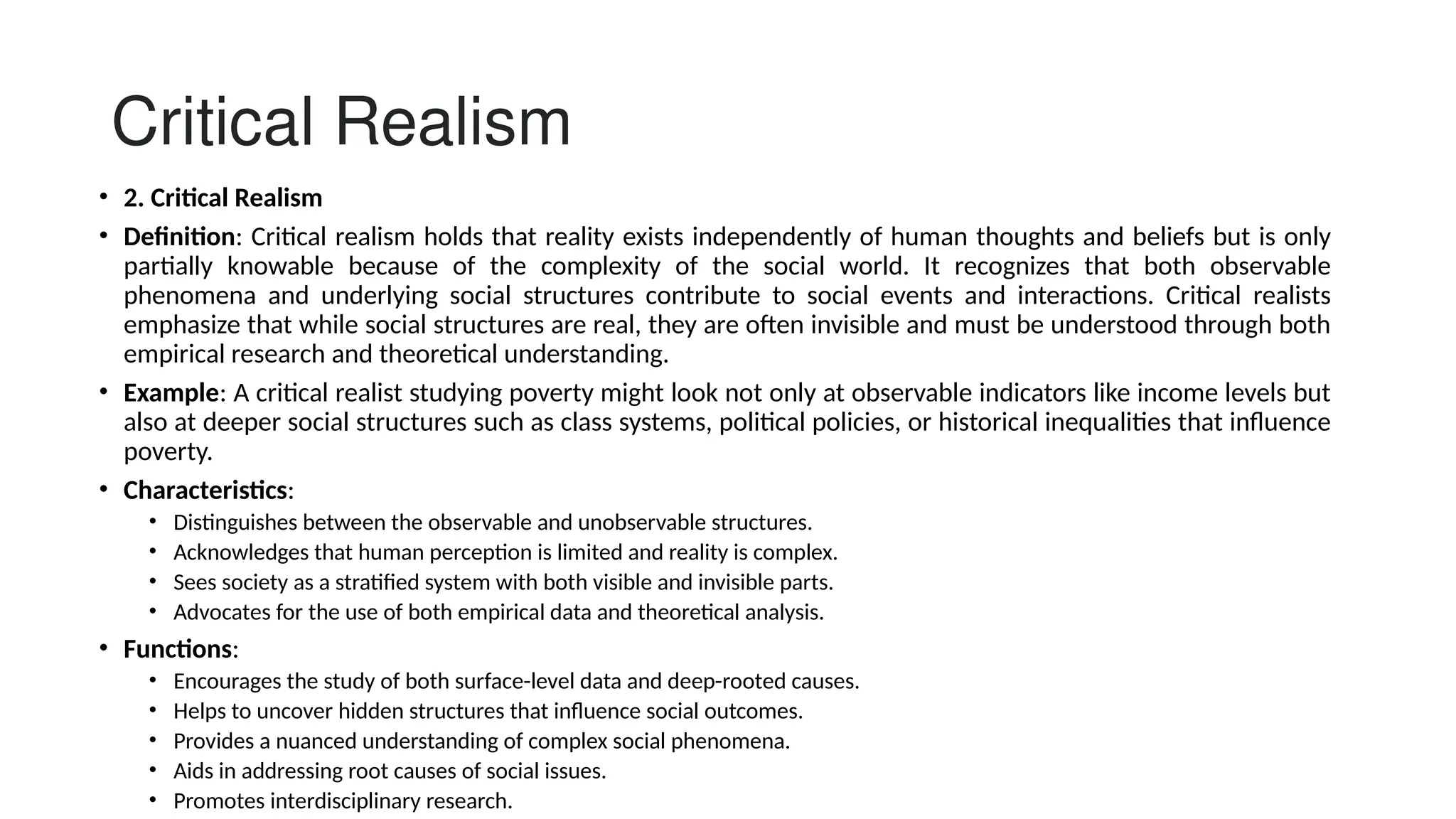
Critical Realism
• 2.Critical Realism
• Definition: Critical realism holds that reality exists independently of human thoughts and beliefs but is only
partially knowable because of the complexity of the social world. It recognizes that both observable
phenomena and underlying social structures contribute to social events and interactions. Critical realists
emphasize that while social structures are real, they are often invisible and must be understood through both
empirical research and theoretical understanding.
• Example: A critical realist studying poverty might look not only at observable indicators like income levels but
also at deeper social structures such as class systems, political policies, or historical inequalities that influence
poverty.
• Characteristics:
• Distinguishes between the observable and unobservable structures.
• Acknowledges that human perception is limited and reality is complex.
• Sees society as a stratified system with both visible and invisible parts.
• Advocates for the use of both empirical data and theoretical analysis.
• Functions:
• Encourages the study of both surface-level data and deep-rooted causes.
• Helps to uncover hidden structures that influence social outcomes.
• Provides a nuanced understanding of complex social phenomena.
• Aids in addressing root causes of social issues.
• Promotes interdisciplinary research.
7.
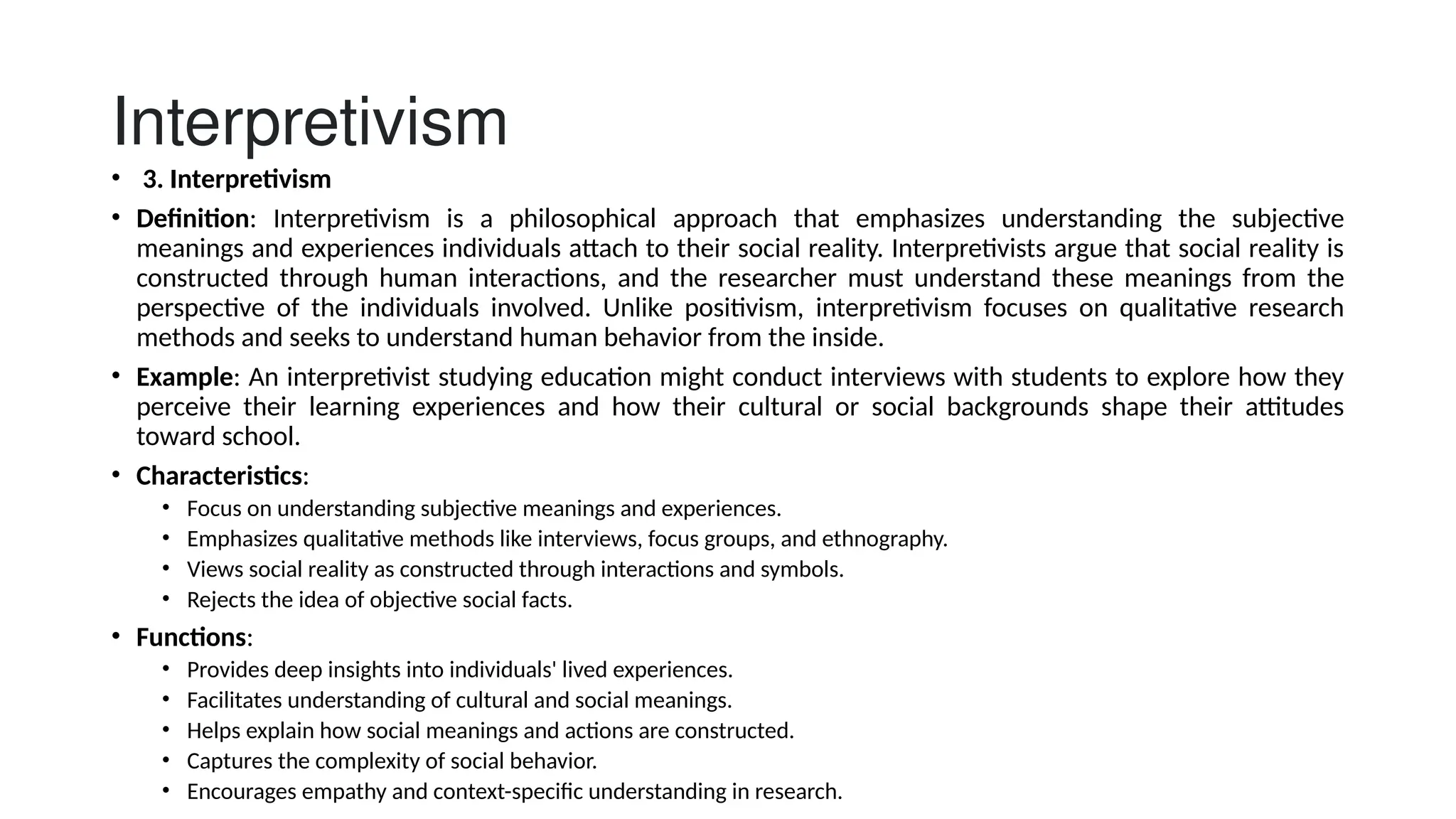
Interpretivism
• 3. Interpretivism
•Definition: Interpretivism is a philosophical approach that emphasizes understanding the subjective
meanings and experiences individuals attach to their social reality. Interpretivists argue that social reality is
constructed through human interactions, and the researcher must understand these meanings from the
perspective of the individuals involved. Unlike positivism, interpretivism focuses on qualitative research
methods and seeks to understand human behavior from the inside.
• Example: An interpretivist studying education might conduct interviews with students to explore how they
perceive their learning experiences and how their cultural or social backgrounds shape their attitudes
toward school.
• Characteristics:
• Focus on understanding subjective meanings and experiences.
• Emphasizes qualitative methods like interviews, focus groups, and ethnography.
• Views social reality as constructed through interactions and symbols.
• Rejects the idea of objective social facts.
• Functions:
• Provides deep insights into individuals' lived experiences.
• Facilitates understanding of cultural and social meanings.
• Helps explain how social meanings and actions are constructed.
• Captures the complexity of social behavior.
• Encourages empathy and context-specific understanding in research.
8.
Post Modernism
• 4.Postmodernism
• Definition: Postmodernism is a skeptical philosophical approach that questions grand narratives, universal truths,
and the idea of objective reality. Postmodernists argue that reality is fragmented, fluid, and socially constructed.
They critique traditional assumptions about society, knowledge, and power, emphasizing that truth is subjective and
influenced by power structures. Postmodernism challenges the idea of fixed identities or stable meanings and
focuses on the diversity of perspectives.
• Example: A postmodernist studying media might examine how different media outlets construct various narratives
around the same event, emphasizing the fragmented and subjective nature of truth in media representation.
• Characteristics:
• Rejects grand theories and universal truths.
• Emphasizes the fluid and fragmented nature of reality.
• Focuses on discourse, power relations, and deconstruction of ideas.
• Questions traditional authority and knowledge systems.
• Functions:
• Encourages diverse perspectives and pluralism in understanding society.
• Challenges dominant ideologies and structures of power.
• Promotes critical thinking about the construction of knowledge.
• Exposes the limitations of universal or fixed truths.
• Fosters creativity and innovation by questioning norms.
9.
Pragmatism
• Definition: Pragmatismis a philosophical approach that focuses on the practical application of ideas,
emphasizing that the truth of an idea is determined by its usefulness in solving problems. Pragmatists
argue that knowledge and concepts should be evaluated based on their practical outcomes and effects on
human experiences. They reject the idea of fixed truths, advocating for a flexible, problem-solving
approach to understanding the world.
• Example: A pragmatist studying social policy might focus on whether a policy achieves desired outcomes
in practice, rather than evaluating it based on ideological principles. For example, they may examine the
effectiveness of welfare programs based on how well they improve the lives of beneficiaries.
• Characteristics:
• Focuses on practical consequences and usefulness of ideas.
• Believes that knowledge is constantly evolving based on experiences.
• Emphasizes problem-solving and real-world applications.
• Rejects fixed truths or absolute beliefs.
• Functions:
• Encourages a focus on practical solutions to social issues.
• Promotes adaptability and flexibility in research and policy-making.
• Evaluates the effectiveness of ideas based on real-world outcomes.
• Stimulates interdisciplinary collaboration to solve complex problems.
• Enhances relevance and applicability of sociological research.
Inductive
Inductive reasoning involvesmoving from specific observations to broader generalizations or theories. It starts with
particular instances and builds up to general principles or conclusions based on patterns observed in the data.
Inductive reasoning does not guarantee certainty but provides probable conclusions based on evidence.
Example: If a researcher observes that in several cases, students who study more tend to perform better in exams,
they may conclude that there is a general relationship between study time and exam performance. The researcher
moves from specific data points to a general conclusion.
•Characteristics:
•Moves from specific to general.
•Generates theories from data.
•Based on observations or empirical evidence.
•Leads to probabilistic conclusions.
•Common in qualitative research.
•Strengths:
•Useful for generating new theories and hypotheses.
•Allows for flexibility and openness to new data.
•Good for exploring new or understudied phenomena.
•Limitations:
12.
Deductive
Deductive reasoning involvesstarting with a general theory or premise and working down to a specific conclusion. It’s
a top-down approach where conclusions are logically derived from premises that are assumed to be true. If the
premises are correct, the conclusion must also be true.
•Example: If the general theory is "All humans need oxygen to live," and the premise is "John is a human," then the
specific conclusion is "John needs oxygen to live." The reasoning starts with a broad truth and applies it to a specific
case.
•Characteristics:
•Moves from general to specific.
•Begins with a theory or hypothesis.
•Uses logic to derive conclusions.
•Results in certainty, if premises are true.
•Common in quantitative research and testing hypotheses.
•Strengths:
•Provides clear, logically sound conclusions.
•Useful for testing theories or hypotheses.
•High level of certainty in conclusions (if premises are valid).
•Limitations:
•
13.
Abductive
Abductive reasoning involvesstarting with incomplete or puzzling observations and then inferring the
most likely or plausible explanation. It’s often used when there is limited data, and the goal is to
develop a reasonable hypothesis based on the best available evidence. Abductive reasoning is
commonly used in exploratory research or problem-solving.
Example: If a doctor observes a patient with specific symptoms, they may infer that the most likely
cause is a particular illness, even though other explanations are possible. The doctor uses the available
evidence to propose the best explanation.
Characteristics:
• Moves from observation to the best possible explanation.
• Involves generating hypotheses based on incomplete data.
• Focuses on plausibility rather than certainty.
• Common in diagnostic fields (medicine, detective work).
Strengths:
• Useful in situations with limited or ambiguous data.
• Encourages creative and flexible thinking.
• Helps develop hypotheses that can be tested later.
Limitations:
• Conclusions are not always certain or definitive.
• May lead to incorrect assumptions if other factors are overlooked.
14.
Summary
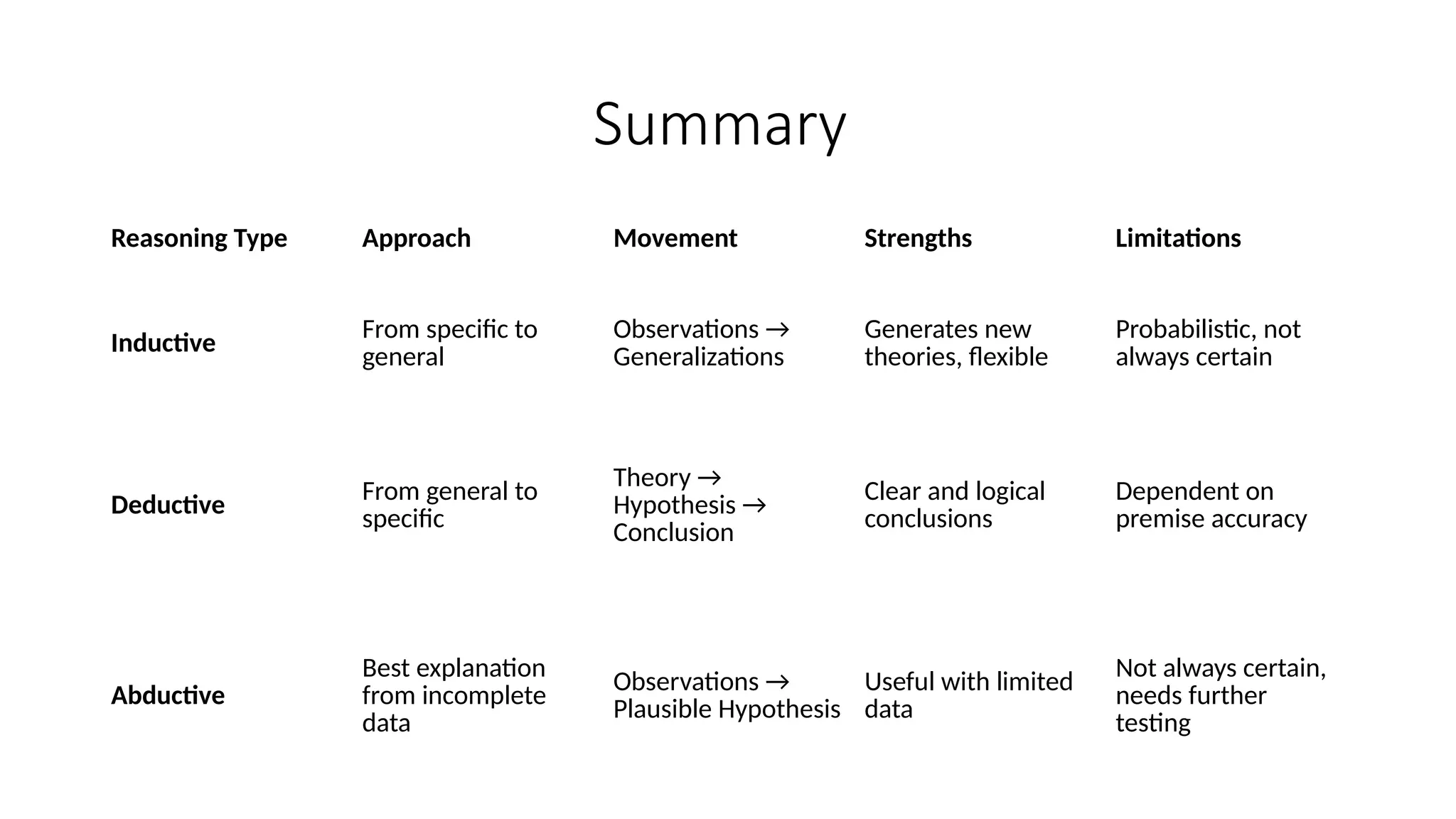
Reasoning Type ApproachMovement Strengths Limitations
Inductive
From specific to
general
Observations →
Generalizations
Generates new
theories, flexible
Probabilistic, not
always certain
Deductive
From general to
specific
Theory →
Hypothesis →
Conclusion
Clear and logical
conclusions
Dependent on
premise accuracy
Abductive
Best explanation
from incomplete
data
Observations →
Plausible Hypothesis
Useful with limited
data
Not always certain,
needs further
testing
Qualitative Method
• Qualitativeresearch is defined as a market research
method that focuses on obtaining data through open-ended and
conversational communication. This method is not only about
“what” people think but also “why” they think so. For example,
consider a convenience store looking to improve its support.
• Qualitative research involves collecting and analyzing non-
numerical data (e.g., text, video, or audio) to understand
concepts, opinions, or experiences. It can be used to gather in-
depth insights into a problem or generate new ideas
for research.
17.
Quantitative Method
• Quantitativemethods emphasize objective measurements and the
statistical, mathematical, or numerical analysis of data collected through
polls, questionnaires, and surveys, or by manipulating pre-existing
statistical data using computational techniques.
• Quantitative research is defined as a systematic investigation of
phenomena by gathering quantifiable data and performing statistical,
mathematical, or computational techniques. Quantitative research
collects information from existing and potential customers using
sampling methods and sending out online surveys, online polls,
questionnaires, etc., the results of which can be depicted in the form
of numerical. After careful understanding of these numbers to predict
the future of a product or service and make changes accordingly.
18.
Mixed Method
• MixedMethods Studies. The term “mixed methods” refers to an
emergent methodology of research that advances the
systematic integration, or “mixing,” of quantitative and
qualitative data within a single investigation or sustained
program of inquiry. ... Integrating the data during data collection,
analysis, or discussion.
Experimental
Experimental research isa study that strictly adheres to a
scientific research design. It includes a hypothesis, a variable
that can be manipulated by the researcher, and variables that
can be measured, calculated and compared.
21.
Survey
Survey Research isdefined as the process of conducting
research using surveys that researchers send to survey
respondents. The data collected from surveys is then statistically
analyzed to draw meaningful research conclusions.
Type of Survey Method:
• Online surveys
• Paper surveys
• Telephonic Surveys
• One-to-One interviews
• Random public opinion
22.
Case Study
A casestudy is a research approach that is used to generate an
in-depth, multi-faceted understanding of a complex issue in its
real-life context. It is an established research design that is used
extensively in a wide variety of disciplines, particularly in the
social sciences.
Case studies are in-depth investigations of a single person,
group, event or community. Typically, data are gathered from
a variety of sources and by using several different methods
(e.g. observations & interviews).
23.
Ethnography
Ethnography, simply stated,is the study of people in their own
environment through the use of methods such as participant
observation and face-to-face interviewing. ... Classic ethnographic
research involves a detailed description of the whole of a culture
outside of the country of origin of the researcher.
Ethnography is a type of qualitative research that gathers
observations, interviews and documentary data to produce
detailed and comprehensive accounts of different social
phenomena. ... It is also aimed at those interested in considering
the use of ethnographic methods in their own research work.
24.
Narrative
Narrative research isa term that subsumes a group of
approaches that in turn rely on the written or spoken words or
visual representation of individuals. These approaches typically
focus on the lives of individuals as told through their own stories.
Along with life history, narrative research includes such
approaches as life-story research, oral history, biography,
personal experience methods, and narrative inquiry.
25.
Grounded theory
Grounded theoryis a systematic methodology that has been
largely, but not exclusively, applied to qualitative research
conducted by social scientists. The methodology involves the
construction of hypotheses and theories through the collecting
and analysis of data.
26.
Action Research
Action researchis an interactive inquiry process that balances
problem-solving actions implemented in a collaborative context
with data-driven collaborative analysis or research to understand
underlying causes enabling future predictions about personal and
organizational change.
For example: Individual action research involves working
independently on a project, such as an elementary school
teacher conducting her own, in-class research project with her
students. ... School-wide action research generally focuses on
issues present throughout an entire school or across the district.
27.
Archival Research
Archival researchis research involving primary sources held in
an archives, a Special Collections library, or other
repository. Archival sources can be manuscripts, documents,
records (including electronic records), objects, sound and
audiovisual materials, or other materials.
Archival research is a method of collecting data from sources that
already exist. An example of archival research would be a
psychologist looking at mental institution records from the 1900s
to determine the prevalence of depressive symptoms in patients
at the time. ...
28.
Time Horizon
• CrossSectional Study
• Longitudinal Study
• Time Series Study
• Panel Study
29.
Variable
A variable isany property, a characteristic, a number, or a
quantity that increases or decreases over time or can take on
different values in different situations. When conducting
research, experiments often manipulate variables.
Qualitative Variable
Qualitative variablesare those that express a qualitative
attribute such as hair color, religion, race, gender, social
status, method of payment, and so on. The values of a
qualitative variable do not imply a meaningful numerical
ordering.
The value of the variable ‘religion’ (Muslim, Hindu, ..,etc.)
differs qualitatively; no ordering of religion is implied.
Qualitative variables are sometimes referred to
as categorical variables.
For example, the variable sex has two distinct categories:
‘male’ and ‘female.’ Since the values of this variable are
expressed in categories, we refer to this as a categorical
32.
Ordinal and NominalVariables
Ordinal variables are those which can be logically ordered or
ranked higher or lower than another but do not necessarily
establish a numeric difference between each category, such
as examination grades (A+, A, B+, etc., clothing size (Extra
large, large, medium, small).
Nominal variables are those who can neither be ranked nor
logically ordered, such as religion, sex, etc.
33.
Quantitative Variables
Quantitative variables,also called numeric variables, are those variables
that are measured in terms of numbers. A simple example of a quantitative
variable is a person’s age.
The age can take on different values because a person can be 20 years old, 35
years old, and so on. Likewise, family size is a quantitative variable, because a
family might be comprised of one, two, three members, and so on.
That is, each of these properties or characteristics referred to above varies or
differs from one individual to another. Note that these variables are
expressed in numbers, for which we call them quantitative or sometimes
numeric variables.
A quantitative variable is one for which the resulting observations are
numeric and thus possesses a natural ordering or ranking.
34.
Discrete and ContinuousVariables
A discrete variable, restricted to certain values, usually (but not necessarily)
consists of whole numbers, such as the family size, number of defective
items in a box. They are often the results of enumeration or counting.
A few more examples are;
• The number of accidents in the twelve months.
• The number of mobile cards sold in a store within seven days.
• The number of patients admitted to a hospital over a specified period.
• The number of new branches of a bank opened annually during 2001-
2007.
• The number of weekly visits made by health personnel in the last 12
months.
35.
continuous variable
A continuousvariable is one that may take on an infinite number of
intermediate values along a specified interval. Examples are:
• The sugar level in the human body
• Blood pressure reading
• Temperature
• Height or weight of the human body
• Rate of bank interest
• Internal rate of return (IRR)
• Earning ratio (ER)
• Current ratio (CR)
36.
Dependent and Independent
Variables
Inmany research settings, there are two specific classes of variables
that need to be distinguished from one another, independent
variable and dependent variable. Many research studies are aimed
at unrevealing and understanding the causes of underlying
phenomena or problems with the ultimate goal of establishing a
causal relationship between them. Look at the following statements:
• Low intake of food causes underweight.
• Smoking enhances the risk of lung cancer.
• Advertisement helps in sales promotion.
• The drug causes the improvement of a health problem.
37.
Independent Variable
The variablethat is used to describe or measure the factor that is
assumed to cause or at least to influence the problem or outcome is
called an independent variable.
Depending on the context, an independent variable is sometimes called
a predictor variable, regressor, controlled variable, manipulated
variable, explanatory variable, exposure variable (as used in reliability
theory), risk factor (as used in medical statistics), feature (as used in
machine learning and pattern recognition) or input variable.
The explanatory variable is preferred by some authors over the
independent variable when the quantities treated as independent
variables may not be statistically independent or independently
manipulable by the researcher.
38.
Dependent Variable
The variablethat is used to describe or measure the problem
or outcome under study is called a dependent variable.
In a causal relationship, the cause is the independent
variable, and the effect is the dependent variable. If we
hypothesize that smoking causes lung cancer, ‘smoking’ is the
independent variable and cancer the dependent variable.
A business researcher may find it useful to include the
dividend in determining the share prices. Here dividend is the
independent variable, while the share price is the dependent
variable
39.
Depending variable
Depending onthe context, a dependent variable is
sometimes called a response variable, regress and, predicted
variable, measured variable, explained variable, experimental
variable, responding variable, outcome variable, output
variable, or label.
An explained variable is preferred by some authors over the
dependent variable when the quantities treated as dependent
variables may not be statistically dependent.
If the dependent variable is referred to as an explained
variable, then the term predictor variable is preferred by
some authors for the independent variable.
40.
Background Variable
In almostevery study, we collect information such as age,
sex, educational attainment, socioeconomic status, marital
status, religion, place of birth, and the like. These variables
are referred to as background variables.
41.
Moderating Variable
In anystatement of relationships of variables, it is normally
hypothesized that in some way, the independent variable ’causes’
the dependent variable to occur. In simple relationships, all other
variables are extraneous and are ignored. In actual study
situations, such a simple one-to-one relationship needs to be
revised to take other variables into account to better explain the
relationship.
This emphasizes the need to consider a second independent
variable that is expected to have a significant contributory or
contingent effect on the originally stated dependent-independent
relationship. Such a variable is termed a moderating variable.
42.
Intervening Variable
Often anapparent relationship between two variables is
caused by a third variable.
For example, variables X and Y may be highly correlated, but
only because X causes the third variable, Z, which in turn
causes Y. In this case, Z is the intervening variable.
43.
1. Blind leadBlind
2. Inadequate Assistance
3. Unavailability of Supervisor
4. Selection of New Topic
5. Lack of Confidence to start
New study
6. Poor Library Management
7. Access to Journals
8. Insufficient Data
9. Appropriate Literature
10. Data collection difficulty
11. Misleading data on internet
12. Difficulty in selection of Tool
13. Inappropriate data analysis
techniques
14. High Cost of Publishing
15. Time and Money
Problems faced by Researcher in Pakistan
44.
Researcher faced problemwhich lead him/her to anxiety, example of few are
listed here:
Procedural Anxiety
Information overload Anxiety
Resource Anxiety
Library Anxiety
Competence Anxiety
Computer/technology/software Anxiety
Language Anxiety
Thematic Anxiety
Problems faced by Researcher Cont..
• Any difficultyin theoretical or practical situation
• Area of concern, a knowledge Gap
• A condition to be improved
• A difficulty to be eliminated
• A troubling question that exist in theory or practice
• Unclear idea about people, program or phenomenon
• Vogue insight about a situation, which need further investigation
What is a Research Problem
47.
1.There must bean individual or a group which has some difficulty or
the problem.
2.There must be some objective(s) to be attained at.
3.There must be alternative means (or the courses of action) for
obtaining the objective(s) one wishes to attain.
4.There must remain some doubt in the mind of a researcher with regard
to the selection of alternatives.
5.There must be some environment(s) to which the difficulty pertains.
Components of a Research Problem
48.
• Existing Theories
•Personal Experience
• Daily Problems
• Brain Storming
• Discussion with experts
• Previous Studies
• Literature
• Change
• Emerging Trends in various disciplines
Sources of a Research Problem
49.
Research resolves aroundthe Four P’s:
1. People
2. Problems
3. Programs
4. Phenomena
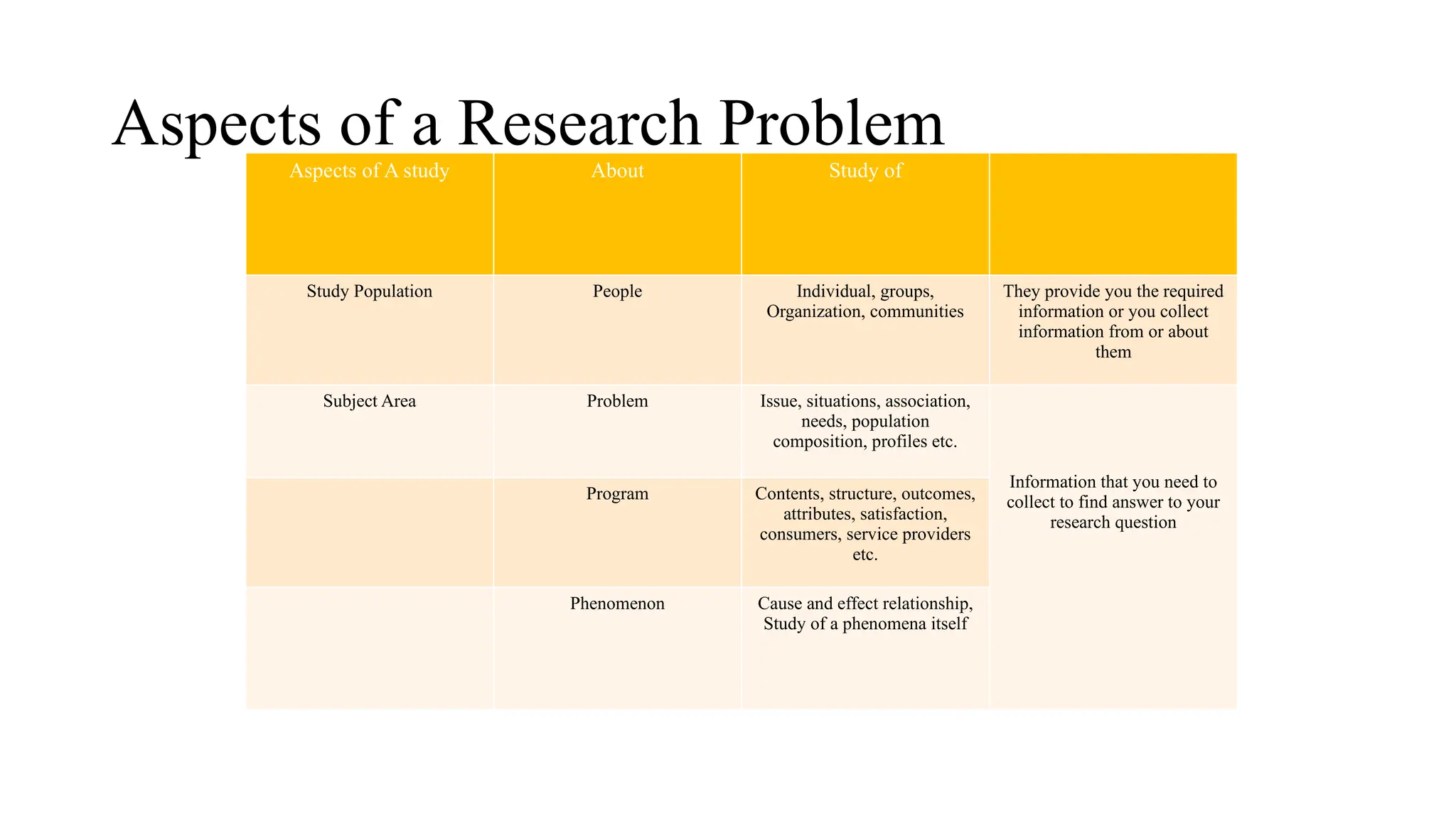
Aspects of Research Problem
5. The study Population
6. The Subject Area
Sources & Aspects of a Research Problem
50.
Aspects of Astudy About Study of
Study Population People Individual, groups,
Organization, communities
They provide you the required
information or you collect
information from or about
them
Subject Area Problem Issue, situations, association,
needs, population
composition, profiles etc.
Information that you need to
collect to find answer to your
research question
Program Contents, structure, outcomes,
attributes, satisfaction,
consumers, service providers
etc.
Phenomenon Cause and effect relationship,
Study of a phenomena itself
Aspects of a Research Problem
51.
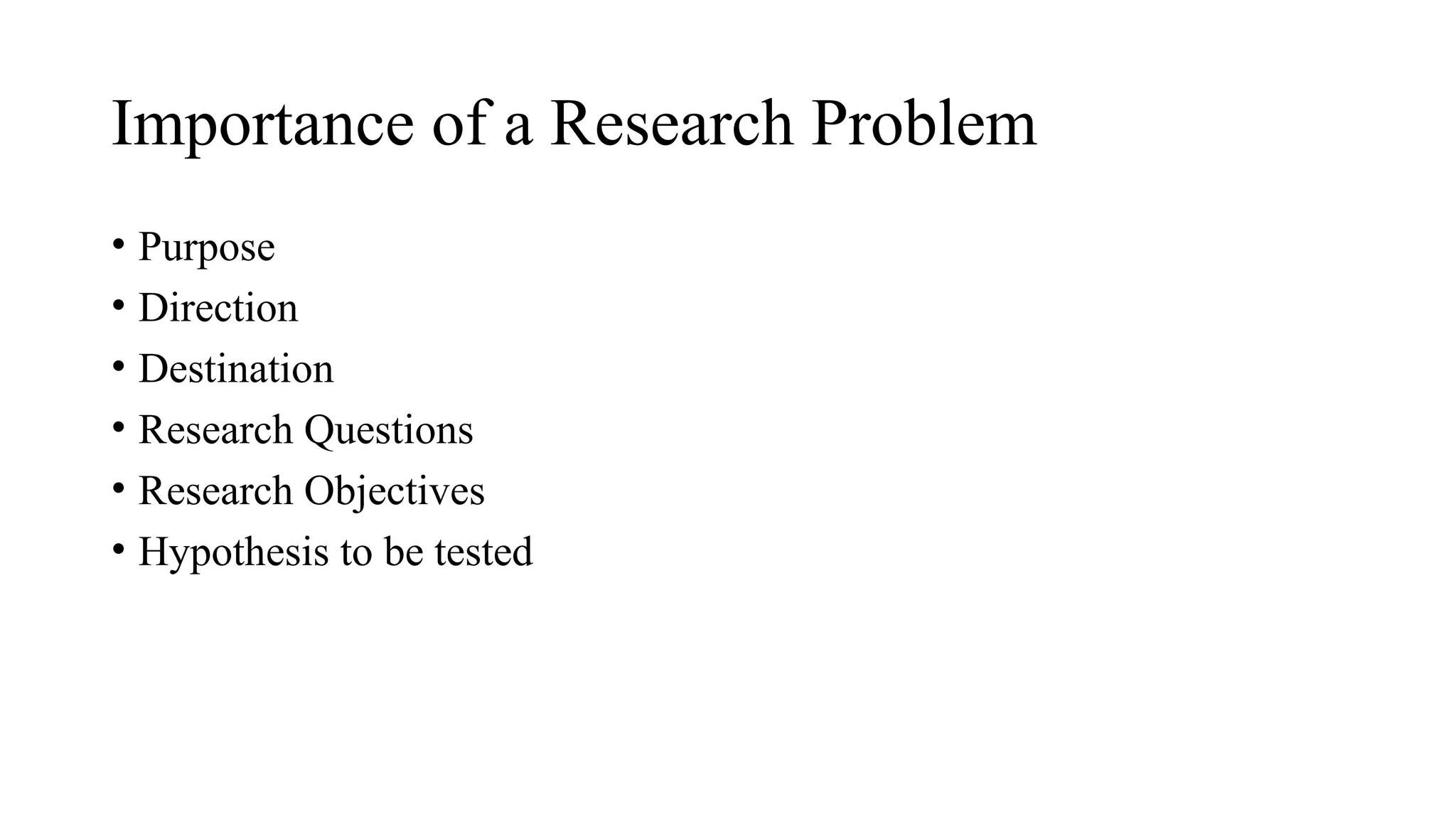
• Purpose
• Direction
•Destination
• Research Questions
• Research Objectives
• Hypothesis to be tested
Importance of a Research Problem
52.
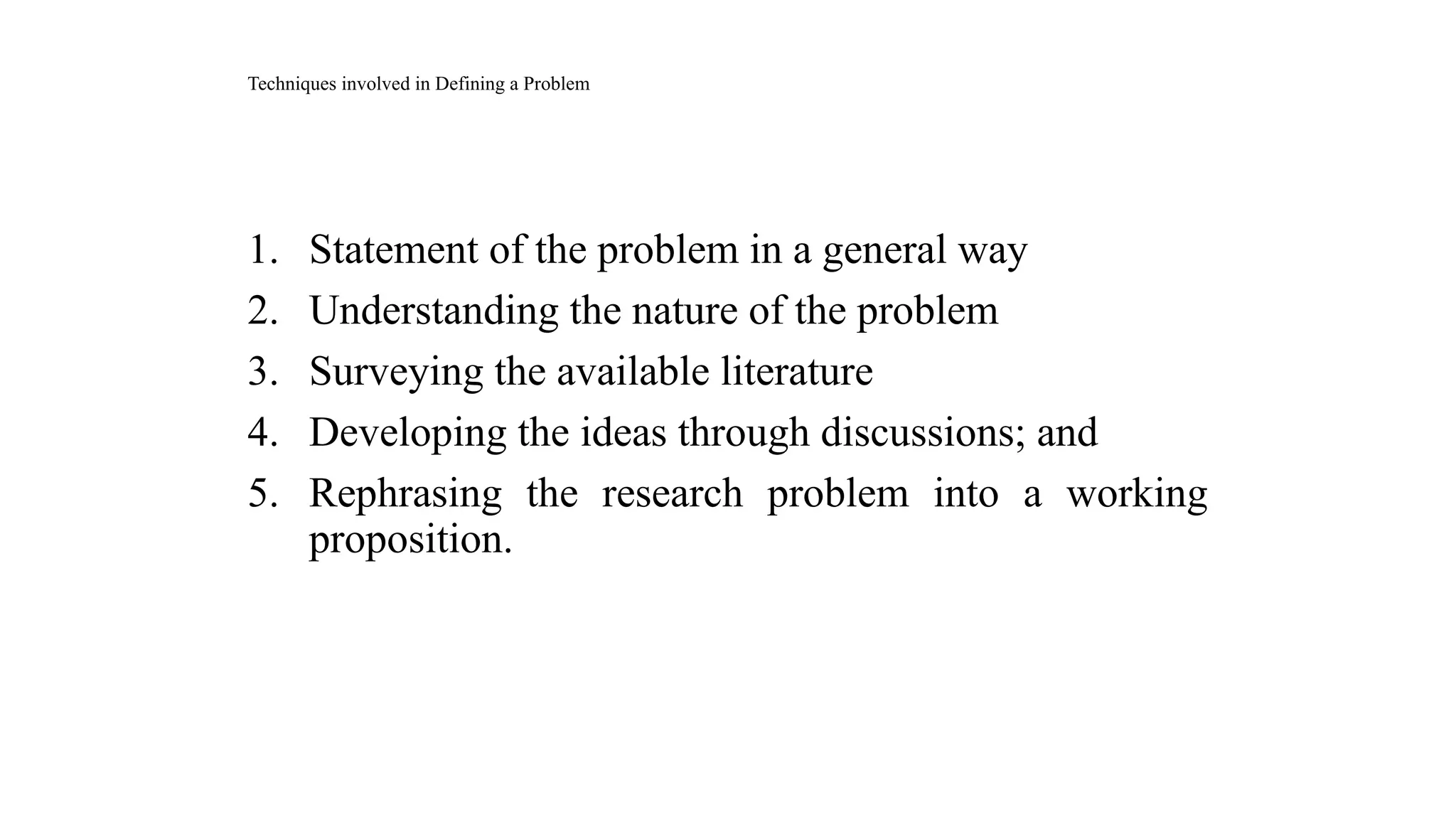
1. Statement ofthe problem in a general way
2. Understanding the nature of the problem
3. Surveying the available literature
4. Developing the ideas through discussions; and
5. Rephrasing the research problem into a working
proposition.
Techniques involved in Defining a Problem