 Who passed the exam?
11/16/2016
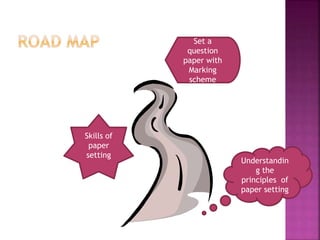
Skills of
paper
setting
Understandin
g the
principles of
paper setting
Set a
question
paper with
Marking
scheme
A
E
 Certifying
 Qualifying
 Selecting
 Eliminating
 Classifying
 Searching
 Based on a predetermined set of criteria.
 For instance,
 90% and up = A
 80% to 89.99% = B
 70% to 79.99% = C
 60% to 69.99% = D
 59.99% and below = F
 Pros:
 Sets minimum
performance
expectations.
 Demonstrate what
students can and
cannot do in relation
to important content-
area standards (e.g,
ILS).
 Cons:
 Some times it’s hard to
know just where to set
boundary conditions.
 Lack of comparison
data with other
students and/or
schools.
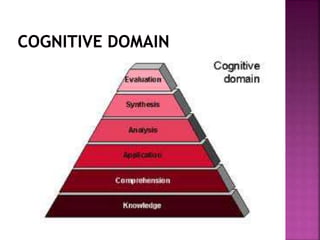
 Factual knowledge
 Procedural knowledge
 Conceptual knowledge
 Meta-cognitive knowledge
 Give an example of all the four types of
knowledge
 How do we test the validity and reliability of
a question paper?
 How do you test the Reliability and
consistency of a Question paper?
 Knowledge
 Understanding
 Application
 Skill
 Creativity
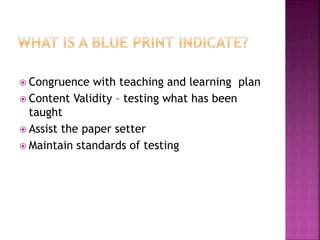
 Congruence with teaching and learning plan
 Content Validity – testing what has been
taught
 Assist the paper setter
 Maintain standards of testing
 define,
 list,
 recall,
 repeat,
 reproduce
 state
 narrate
classify,
describe,
discuss,
explain,
identify,
locate,
recognize,
report,
 select,
 translate,
paraphrase
choose,
demonstrate,
Illustrate
interpret,
write.
operate,
schedule,
sketch,
solve,
use,
 appraise,
 compare,
 contrast,
 Critically evaluate
 differentiate,
 discriminate
distinguish,
examine,
experiment,
question,
test
 appraise,
 argue,
 defend,
 judge,
 select,
 support,
 value,
 assemble,
 construct,
 create,
 design,
 develop,
 formulate,
 write.
 Each group will create 2 sample questions on
each of the competencies identified.
 Terms
 Facts
 Concepts
 Principles
 Processes
 Themes
 What is an ‘Valency’?
 Define the term “Entropy”
 What do you understand from the term
“Momentum”?
 Define the term “polymerisation”
 What is malnutrition?
 What is Gravitational Force?
 Why do we need to purify ores before
extraction of metals?
 How is sugar digested in the body?
 What is periodic law?
 In a triangle, the square on the
hypotenuse is equal to the sum of the
squares on the two adjacent sides. What
do you call this triangle?
 Why the water in a mud pot is cool?
 Why does a cycle tube often burst during
a summer?
 Why do we need to expose ourselves to
sunlight for sometime everyday?
 What is a sub-routine in a program?
 Why are able to cook the food faster in a
pressure cooker?
 Animal charcoal is used as a decolourizing
agent. Why?
 Hydrogen/Helium balloons are used for study
by weather departments. Why?
 The electropositive character of elements
decrease along a group in the periodic table.
Why?
 Suggest three factors that influence the
production of Ammonia in Haber’s process
 Describe how fermentation takes place
 How is the impure blood purified in the
body?
 Explain the role of messenger- RNA in
genetic processes
 How does an inverter function?
 Properties of elements are periodic functions of
their atomic numbers – why?
 What is Artificial Intelligence? How does it play a
significant role in modern computing?
 Pollution control needs social priority. Why?
 Why the plastic bags are banned in certain hill
stations?
 Create 2 questions under each category
 Examine the competencies in the
following questions:
 Name three conditions necessary for germination
of a seed
 Why air is necessary for germination of a seed?
 If seeds are sown very deep, they do not
germinate, why?
 If there is a heavy rainfall immediately after
sowing the seeds, what would be the effect on
the germination of seeds?
 Why do Sodium and Chlorine have a tendency
to form a chemical bond?
 Metallic sodium reacts vigourously with water
but not a Sodium ion. Why?
 Give an example of a highly electropositive
and a highly electronegative element which
results in the formation of an electrovalent
bond?
 Sodium chloride is an ionic compound but not
Barium Chloride. Explain
 List two chemical properties of Carbon di
oxide gas (lower ability –recall)
 Describe the details of the digestive
system of a man (medium ability –
cognitive outcome)
 Why the P – 1/v graph is linear? How
would the graph look if it is 1/ P Vs V?
( ability to interpret and explore- higher
difficulty)
 Prepare Oxygen gas in the laboratory and
collect two cylinders. Show two tests for
its chemical property
 ( psychomotor outcome- higher ability)
 Why Carbon monoxide is considered as a
poisonous gas?
 All alcoholic drinks are made of ethyl
alcohol and not methyl alcohol. Why?
 When water seeps through a wall towards a
switch in an electric point, the switch gives a
shock when touched?
 See the following questions:
 With the help of a diagram describe the internal
structure of a dicot system
 Draw a labeled diagram of longitudinal section of
the petunia flower
 In the given diagram of amoeba, label the parts
a, b, c and d
 (a+b)2 =……………..
 Vocabulary
 Syntax
 Directional or stimulus words
 Scoring objectivity
 Mechanics of writing
 Questions should be direct and simple
 The vocabulary should be communicative
 It should ensure correct communication
 It should not give an implied meaning
 The syntax should be correct
 The syntax should have the correct positioning of
the stimulus word
 The syntax should be simple and not be a
compounded sentence
 The syntax should not be long enough to trigger
multiple meanings
 Every word carries a different directional
stimulus.
 Need to understand the differences
between;
 Name, state, list, and enumerate
 Explain, discuss, clarify, and describe
 Why, what, when and how
 Comment, observe, differentiate and analyze
 Need to know the target clientele
 Need to know target objective
 Need to know the status of the question in
the blue print
 Need to know the difficulty level
 Need to know -Is the question a
differentiator or a neutralizer?
 The context of the question
 The knowledge level of the examinees
 The locus of the question in the blue print
 The nature of the topic
 The score allotted
 The possible value point(s)
 How do we set questions relating to HOTS?
 On 26th August Lok sabha cleared the Food security bill. Some of
the features of this bill are:
 The food bill will cover 2/3 of the Indian population.
 It includes 75% of rural and 50% of urban population.
 Each beneficiary will be entitled to get 5 kg of rice, wheat and
cereals for 5, 3 and 1 per kg.

 Solve the following:
 Write in decimal form.
 If the population of India is 1.26 billion, find the number of
people who will be covered under this food bill.
 If 70% of Indians live in rural areas, find the number of rural
people who will be covered under this food bill.
 Do you think the implementation of the Food Security bill will
improve the condition of malnourished children in India? Give a
reason.
 The land acquisition bill was passed by Lok Sabha on Aug 29 and the Rajya Sabha on
Sep 4.
 Some of the Key features of this bill are:
 The consent of 80 % of land owners concerned is needed to acquire land for private
projects and of 70 % landowners for public-private projects.
 The compensation has also been significantly increased under the new law. It
suggests compensation for the owners of the acquired land to be four times the
market value in case of rural areas and twice in case of urban areas.
 P
 Using the above information, solve the following: 1400m 1300

 Q
1500m
 A villager Ranjan was growing wheat in a piece of land, which was triangular in
shape as shown in the figure. A private company that wanted to set up a factory
acquired his land. The market value of the land was 450 per sq.m. Find the amount
he got from the company as compensation. Do you agree with the development
happening at the loss of agricultural land in India? Justify your answer.
 Krishna has a triangular plot. The
government decided to take over
this land to construct a Health
centre. The government said that it
would give him another piece of
plot in lieu of his plot. In the figure,
is Krishna’s plot and would be the
plot given by the government, in
such a way that side PQ II side AB
and PC = BC. Find out whether
Krishna would be compensated with
less area or more area or equal area
of land. Also, find the length of side
QC if length of AC = 850 m. Justify
your answers with proper reasons.
P
C B
Q
C B
Q
 Is it to ensure higher scoring objectivity?
 Is it to facilitate guessing competency?
 Is it to enable analytical thinking?
 Is it to identify the level of understanding?
 The four elements:
 Visibly incorrect
 Provocative
 Apparently correct
 Correct
Aluminum vessels are frequently used for
cooking; not copper vessels?
a. Copper is costly, while Aluminum is cheap
a. Aluminium is a good conductor, Copper is a poor conductor
b. Aluminum is easily available, but copper is not
c. Copper form poisonous hydroxy complexes, while Aluminium
doesn’t.
 Q.1 Mumbai can not have a large scale
production of wind energy because of
a) lack of technology
b) very high humidity (90% or more)
c) less wind velocity
d) lack of space .
Paper setting   principles and practices

Paper setting principles and practices

  • 2.
     Who passedthe exam? 11/16/2016
  • 3.
    Skills of paper setting Understandin g the principlesof paper setting Set a question paper with Marking scheme
  • 4.
  • 5.
     Certifying  Qualifying Selecting  Eliminating  Classifying  Searching
  • 13.
     Based ona predetermined set of criteria.  For instance,  90% and up = A  80% to 89.99% = B  70% to 79.99% = C  60% to 69.99% = D  59.99% and below = F
  • 14.
     Pros:  Setsminimum performance expectations.  Demonstrate what students can and cannot do in relation to important content- area standards (e.g, ILS).  Cons:  Some times it’s hard to know just where to set boundary conditions.  Lack of comparison data with other students and/or schools.
  • 20.
     Factual knowledge Procedural knowledge  Conceptual knowledge  Meta-cognitive knowledge
  • 21.
     Give anexample of all the four types of knowledge
  • 23.
     How dowe test the validity and reliability of a question paper?
  • 25.
     How doyou test the Reliability and consistency of a Question paper?
  • 26.
     Knowledge  Understanding Application  Skill  Creativity
  • 27.
     Congruence withteaching and learning plan  Content Validity – testing what has been taught  Assist the paper setter  Maintain standards of testing
  • 29.
     define,  list, recall,  repeat,  reproduce  state  narrate
  • 30.
  • 31.
  • 32.
     appraise,  compare, contrast,  Critically evaluate  differentiate,  discriminate distinguish, examine, experiment, question, test
  • 33.
     appraise,  argue, defend,  judge,  select,  support,  value,
  • 34.
     assemble,  construct, create,  design,  develop,  formulate,  write.
  • 35.
     Each groupwill create 2 sample questions on each of the competencies identified.
  • 36.
     Terms  Facts Concepts  Principles  Processes  Themes
  • 37.
     What isan ‘Valency’?  Define the term “Entropy”  What do you understand from the term “Momentum”?  Define the term “polymerisation”  What is malnutrition?
  • 38.
     What isGravitational Force?  Why do we need to purify ores before extraction of metals?  How is sugar digested in the body?  What is periodic law?
  • 39.
     In atriangle, the square on the hypotenuse is equal to the sum of the squares on the two adjacent sides. What do you call this triangle?  Why the water in a mud pot is cool?  Why does a cycle tube often burst during a summer?  Why do we need to expose ourselves to sunlight for sometime everyday?  What is a sub-routine in a program?
  • 40.
     Why areable to cook the food faster in a pressure cooker?  Animal charcoal is used as a decolourizing agent. Why?  Hydrogen/Helium balloons are used for study by weather departments. Why?  The electropositive character of elements decrease along a group in the periodic table. Why?
  • 41.
     Suggest threefactors that influence the production of Ammonia in Haber’s process  Describe how fermentation takes place  How is the impure blood purified in the body?  Explain the role of messenger- RNA in genetic processes  How does an inverter function?
  • 42.
     Properties ofelements are periodic functions of their atomic numbers – why?  What is Artificial Intelligence? How does it play a significant role in modern computing?  Pollution control needs social priority. Why?  Why the plastic bags are banned in certain hill stations?
  • 43.
     Create 2questions under each category
  • 45.
     Examine thecompetencies in the following questions:  Name three conditions necessary for germination of a seed  Why air is necessary for germination of a seed?  If seeds are sown very deep, they do not germinate, why?  If there is a heavy rainfall immediately after sowing the seeds, what would be the effect on the germination of seeds?
  • 46.
     Why doSodium and Chlorine have a tendency to form a chemical bond?  Metallic sodium reacts vigourously with water but not a Sodium ion. Why?  Give an example of a highly electropositive and a highly electronegative element which results in the formation of an electrovalent bond?  Sodium chloride is an ionic compound but not Barium Chloride. Explain
  • 47.
     List twochemical properties of Carbon di oxide gas (lower ability –recall)  Describe the details of the digestive system of a man (medium ability – cognitive outcome)  Why the P – 1/v graph is linear? How would the graph look if it is 1/ P Vs V? ( ability to interpret and explore- higher difficulty)  Prepare Oxygen gas in the laboratory and collect two cylinders. Show two tests for its chemical property  ( psychomotor outcome- higher ability)
  • 48.
     Why Carbonmonoxide is considered as a poisonous gas?  All alcoholic drinks are made of ethyl alcohol and not methyl alcohol. Why?  When water seeps through a wall towards a switch in an electric point, the switch gives a shock when touched?
  • 49.
     See thefollowing questions:  With the help of a diagram describe the internal structure of a dicot system  Draw a labeled diagram of longitudinal section of the petunia flower  In the given diagram of amoeba, label the parts a, b, c and d  (a+b)2 =……………..
  • 50.
     Vocabulary  Syntax Directional or stimulus words  Scoring objectivity  Mechanics of writing
  • 51.
     Questions shouldbe direct and simple  The vocabulary should be communicative  It should ensure correct communication  It should not give an implied meaning
  • 52.
     The syntaxshould be correct  The syntax should have the correct positioning of the stimulus word  The syntax should be simple and not be a compounded sentence  The syntax should not be long enough to trigger multiple meanings
  • 53.
     Every wordcarries a different directional stimulus.  Need to understand the differences between;  Name, state, list, and enumerate  Explain, discuss, clarify, and describe  Why, what, when and how  Comment, observe, differentiate and analyze
  • 54.
     Need toknow the target clientele  Need to know target objective  Need to know the status of the question in the blue print  Need to know the difficulty level  Need to know -Is the question a differentiator or a neutralizer?
  • 55.
     The contextof the question  The knowledge level of the examinees  The locus of the question in the blue print  The nature of the topic  The score allotted  The possible value point(s)
  • 56.
     How dowe set questions relating to HOTS?
  • 57.
     On 26thAugust Lok sabha cleared the Food security bill. Some of the features of this bill are:  The food bill will cover 2/3 of the Indian population.  It includes 75% of rural and 50% of urban population.  Each beneficiary will be entitled to get 5 kg of rice, wheat and cereals for 5, 3 and 1 per kg.   Solve the following:  Write in decimal form.  If the population of India is 1.26 billion, find the number of people who will be covered under this food bill.  If 70% of Indians live in rural areas, find the number of rural people who will be covered under this food bill.  Do you think the implementation of the Food Security bill will improve the condition of malnourished children in India? Give a reason.
  • 58.
     The landacquisition bill was passed by Lok Sabha on Aug 29 and the Rajya Sabha on Sep 4.  Some of the Key features of this bill are:  The consent of 80 % of land owners concerned is needed to acquire land for private projects and of 70 % landowners for public-private projects.  The compensation has also been significantly increased under the new law. It suggests compensation for the owners of the acquired land to be four times the market value in case of rural areas and twice in case of urban areas.  P  Using the above information, solve the following: 1400m 1300   Q 1500m  A villager Ranjan was growing wheat in a piece of land, which was triangular in shape as shown in the figure. A private company that wanted to set up a factory acquired his land. The market value of the land was 450 per sq.m. Find the amount he got from the company as compensation. Do you agree with the development happening at the loss of agricultural land in India? Justify your answer.
  • 59.
     Krishna hasa triangular plot. The government decided to take over this land to construct a Health centre. The government said that it would give him another piece of plot in lieu of his plot. In the figure, is Krishna’s plot and would be the plot given by the government, in such a way that side PQ II side AB and PC = BC. Find out whether Krishna would be compensated with less area or more area or equal area of land. Also, find the length of side QC if length of AC = 850 m. Justify your answers with proper reasons. P C B Q C B Q
  • 60.
     Is itto ensure higher scoring objectivity?  Is it to facilitate guessing competency?  Is it to enable analytical thinking?  Is it to identify the level of understanding?
  • 61.
     The fourelements:  Visibly incorrect  Provocative  Apparently correct  Correct
  • 62.
    Aluminum vessels arefrequently used for cooking; not copper vessels? a. Copper is costly, while Aluminum is cheap a. Aluminium is a good conductor, Copper is a poor conductor b. Aluminum is easily available, but copper is not c. Copper form poisonous hydroxy complexes, while Aluminium doesn’t.
  • 63.
     Q.1 Mumbaican not have a large scale production of wind energy because of a) lack of technology b) very high humidity (90% or more) c) less wind velocity d) lack of space .