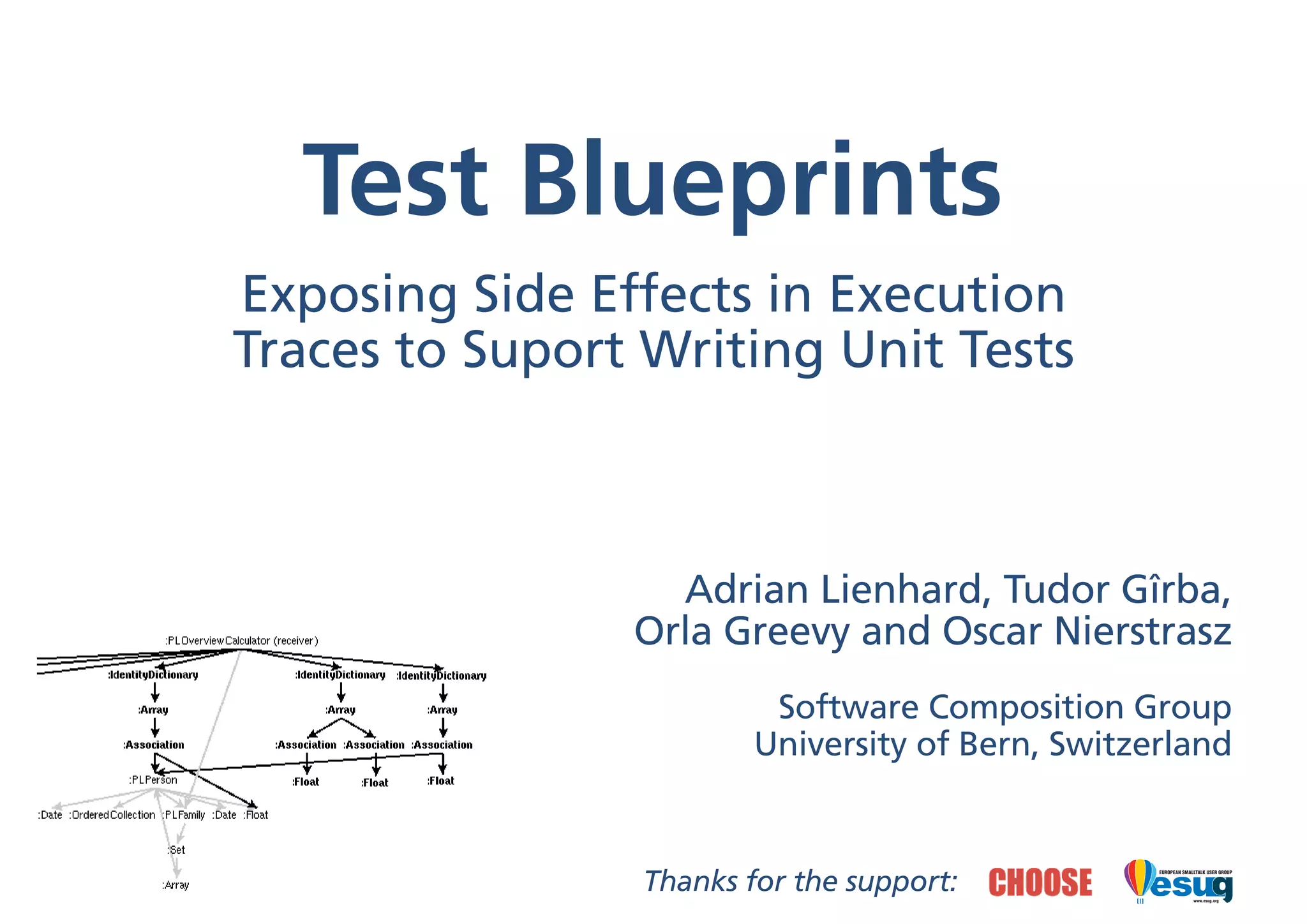
Test Blueprints
Exposing Side Effects in Execution
Traces to Suport Writing Unit Tests


                  Adrian Lienhard, Tudor Gîrba,
                Orla Greevy and Oscar Nierstrasz
                          Software Composition Group
                         University of Bern, Switzerland


                 Thanks for the support:
Unit Testing

Everybody knows
  ...unit tests are important!
  ...write tests first!


CSMR’08 : : Test Blueprints : : Adrian Lienhard : : www.adrian-lienhard.ch : : lienhard@iam.unibe.ch
Unit Testing

Everybody knows
  ...unit tests are important!
  ...write tests first!


Fair enough, but what if
  ...the code exists already?
  ...and you don’t understand it well?


CSMR’08 : : Test Blueprints : : Adrian Lienhard : : www.adrian-lienhard.ch : : lienhard@iam.unibe.ch
Unit Testing

Yet, writing unit tests for
legacy systems is important.


“Tests are your life insurance”


   CSMR’08 : : Test Blueprints : : Adrian Lienhard : : www.adrian-lienhard.ch : : lienhard@iam.unibe.ch
Challenges of Testing
         Legacy Code
   1. Selecting a unit to test
             choose unit of appropriate complexity

   2. Creating a fixture
             instantiate and set up graph of objects

   3. Executing the unit under test
             stimulate the fixture

   4. Verifying the expected behavior
             assert side effects and return value


CSMR’08 : : Test Blueprints : : Adrian Lienhard : : www.adrian-lienhard.ch : : lienhard@iam.unibe.ch
Idea
Use example runs of the program to extract
test scenarios.


Perform a dynamic analysis to extract a test
blueprint that shows:
  - how to create a fixture for a selected unit
  - how to execute the unit
  - how to verify the expected behavior


  CSMR’08 : : Test Blueprints : : Adrian Lienhard : : www.adrian-lienhard.ch : : lienhard@iam.unibe.ch
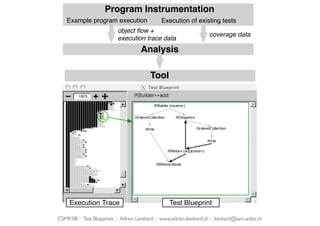
Program Instrumentation
    Example program execution                     Execution of existing tests
                             object flow +
                                                                          coverage data
                             execution trace data
                                        Analysis

                                             Tool


     Execution Trace                                  Test Blueprint

CSMR’08 : : Test Blueprints : : Adrian Lienhard : : www.adrian-lienhard.ch : : lienhard@iam.unibe.ch
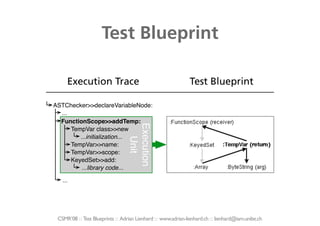
Test Blueprint

     Execution Trace                                             Test Blueprint

ASTChecker>>declareVariableNode:
  ...
  FunctionScope>>addTemp:


                                   Execution
      TempVar class>>new
         ...initialization...
                                     Unit
      TempVar>>name:
      TempVar>>scope:
      KeyedSet>>add:
          ...library code...

   ...


 CSMR’08 : : Test Blueprints : : Adrian Lienhard : : www.adrian-lienhard.ch : : lienhard@iam.unibe.ch
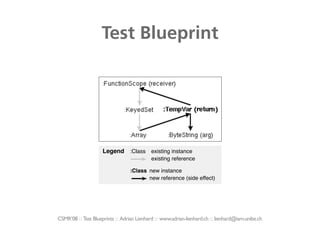
Test Blueprint


                     Legend :Class existing instance
                                             existing reference

                                   :Class new instance
                                          new reference (side effect)


CSMR’08 : : Test Blueprints : : Adrian Lienhard : : www.adrian-lienhard.ch : : lienhard@iam.unibe.ch
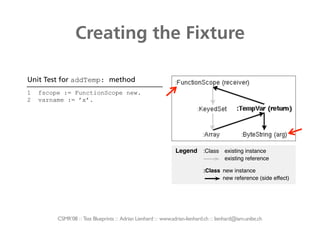
Creating the Fixture

Unit Test for addTemp: method
1   fscope := FunctionScope new.
2   varname := ’x’.


                                                                  Legend :Class existing instance
                                                                                          existing reference

                                                                                :Class new instance
                                                                                       new reference (side effect)


         CSMR’08 : : Test Blueprints : : Adrian Lienhard : : www.adrian-lienhard.ch : : lienhard@iam.unibe.ch
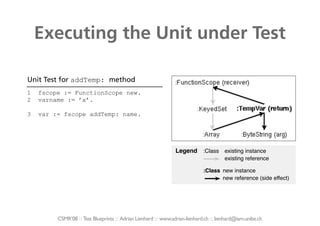
Executing the Unit under Test

Unit Test for addTemp: method
1   fscope := FunctionScope new.
2   varname := ’x’.

3   var := fscope addTemp: name.


                                                                  Legend :Class existing instance
                                                                                          existing reference

                                                                                :Class new instance
                                                                                       new reference (side effect)


         CSMR’08 : : Test Blueprints : : Adrian Lienhard : : www.adrian-lienhard.ch : : lienhard@iam.unibe.ch
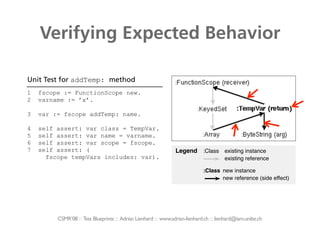
Verifying Expected Behavior

Unit Test for addTemp: method
1   fscope := FunctionScope new.
2   varname := ’x’.

3   var := fscope addTemp: name.

4   self assert: var class = TempVar.
5   self assert: var name = varname.
6   self assert: var scope = fscope.
7   self assert: (                                                Legend :Class existing instance
      fscope tempVars includes: var).                                                     existing reference

                                                                                :Class new instance
                                                                                       new reference (side effect)


         CSMR’08 : : Test Blueprints : : Adrian Lienhard : : www.adrian-lienhard.ch : : lienhard@iam.unibe.ch
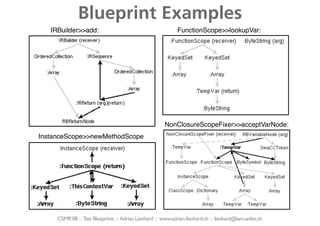
Blueprint Examples
         IRBuilder>>add:                                             FunctionScope>>lookupVar:


                                                               NonClosureScopeFixer>>acceptVarNode:
      InstanceScope>>newMethodScope


ace                Test Blueprint


           CSMR’08 : : Test Blueprints : : Adrian Lienhard : : www.adrian-lienhard.ch : : lienhard@iam.unibe.ch
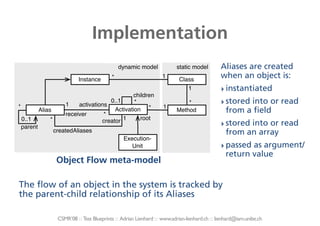
Implementation
                                                    dynamic model               static model         Aliases are created
                                Instance        *                        1
                                                                                 Class
                                                                                                     when an object is:
                                                                                    1                ‣ instantiated
                                                   children
*                        1    activations
                                          0..1      *
                                                                         1
                                                                                    *                ‣ stored into or read
             Alias                          Activation *                        Method                 from a field
                         receiver       *
    0..1         *                     creator 1      root
    parent                                                                                           ‣ stored into or read
                     createdAliases                                                                    from an array
                                                      Execution-
                                                         Unit                                        ‣ passed as argument/
                                                                                                       return value
                      Object Flow meta-model

The flow of an object in the system is tracked by
the parent-child relationship of its Aliases

                      CSMR’08 : : Test Blueprints : : Adrian Lienhard : : www.adrian-lienhard.ch : : lienhard@iam.unibe.ch
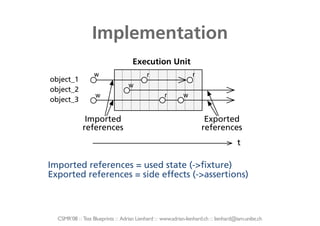
Implementation
                                      Execution Unit
                   w                         r                      r
object_1
                                    w
object_2
                    w                                 r        w
object_3

               Imported                                                  Exported
              references                                                references
                                                                                         t

Imported references = used state (->fixture)
Exported references = side effects (->assertions)


  CSMR’08 : : Test Blueprints : : Adrian Lienhard : : www.adrian-lienhard.ch : : lienhard@iam.unibe.ch
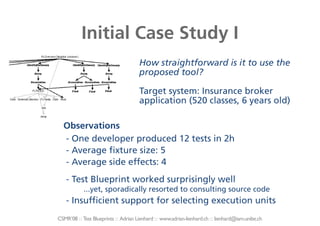
Initial Case Study I
                                       How straightforward is it to use the
                                       proposed tool?

                                       Target system: Insurance broker
                                       application (520 classes, 6 years old)

  Observations
  - One developer produced 12 tests in 2h
  - Average fixture size: 5
  - Average side effects: 4
    - Test Blueprint worked surprisingly well
            ...yet, sporadically resorted to consulting source code
    - Insufficient support for selecting execution units
CSMR’08 : : Test Blueprints : : Adrian Lienhard : : www.adrian-lienhard.ch : : lienhard@iam.unibe.ch
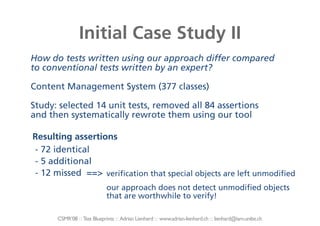
Initial Case Study II
How do tests written using our approach differ compared
to conventional tests written by an expert?

Content Management System (377 classes)

Study: selected 14 unit tests, removed all 84 assertions
and then systematically rewrote them using our tool

Resulting assertions
- 72 identical
- 5 additional
- 12 missed ==> verification that special objects are left unmodified
                             our approach does not detect unmodified objects
                             that are worthwhile to verify!

      CSMR’08 : : Test Blueprints : : Adrian Lienhard : : www.adrian-lienhard.ch : : lienhard@iam.unibe.ch
Conclusions
Yes, we can write unit test for not well known code
  ...by exploiting runtime information

Test Blueprints tell us
  ...how the fixture and assertions have to look like

Difficulties are how to
  ...select good execution units in the trace
  ...initialize objects to bring them into the desired state


     CSMR’08 : : Test Blueprints : : Adrian Lienhard : : www.adrian-lienhard.ch : : lienhard@iam.unibe.ch
Conclusions
Yes, we can write unit test for not well known code
  ...by exploiting runtime information

Test Blueprints tell us
  ...how the fixture and assertions have to look like

Difficulties are how to
  ...select good execution units in the trace
  ...initialize objects to bring them into the desired state


                                     Questions?
     CSMR’08 : : Test Blueprints : : Adrian Lienhard : : www.adrian-lienhard.ch : : lienhard@iam.unibe.ch

Test Blueprints

  • 1.
    Test Blueprints Exposing SideEffects in Execution Traces to Suport Writing Unit Tests Adrian Lienhard, Tudor Gîrba, Orla Greevy and Oscar Nierstrasz Software Composition Group University of Bern, Switzerland Thanks for the support:
  • 2.
    Unit Testing Everybody knows ...unit tests are important! ...write tests first! CSMR’08 : : Test Blueprints : : Adrian Lienhard : : www.adrian-lienhard.ch : : lienhard@iam.unibe.ch
  • 3.
    Unit Testing Everybody knows ...unit tests are important! ...write tests first! Fair enough, but what if ...the code exists already? ...and you don’t understand it well? CSMR’08 : : Test Blueprints : : Adrian Lienhard : : www.adrian-lienhard.ch : : lienhard@iam.unibe.ch
  • 4.
    Unit Testing Yet, writingunit tests for legacy systems is important. “Tests are your life insurance” CSMR’08 : : Test Blueprints : : Adrian Lienhard : : www.adrian-lienhard.ch : : lienhard@iam.unibe.ch
  • 5.
    Challenges of Testing Legacy Code 1. Selecting a unit to test choose unit of appropriate complexity 2. Creating a fixture instantiate and set up graph of objects 3. Executing the unit under test stimulate the fixture 4. Verifying the expected behavior assert side effects and return value CSMR’08 : : Test Blueprints : : Adrian Lienhard : : www.adrian-lienhard.ch : : lienhard@iam.unibe.ch
  • 6.
    Idea Use example runsof the program to extract test scenarios. Perform a dynamic analysis to extract a test blueprint that shows: - how to create a fixture for a selected unit - how to execute the unit - how to verify the expected behavior CSMR’08 : : Test Blueprints : : Adrian Lienhard : : www.adrian-lienhard.ch : : lienhard@iam.unibe.ch
  • 7.
    Program Instrumentation Example program execution Execution of existing tests object flow + coverage data execution trace data Analysis Tool Execution Trace Test Blueprint CSMR’08 : : Test Blueprints : : Adrian Lienhard : : www.adrian-lienhard.ch : : lienhard@iam.unibe.ch
  • 8.
    Test Blueprint Execution Trace Test Blueprint ASTChecker>>declareVariableNode: ... FunctionScope>>addTemp: Execution TempVar class>>new ...initialization... Unit TempVar>>name: TempVar>>scope: KeyedSet>>add: ...library code... ... CSMR’08 : : Test Blueprints : : Adrian Lienhard : : www.adrian-lienhard.ch : : lienhard@iam.unibe.ch
  • 9.
    Test Blueprint Legend :Class existing instance existing reference :Class new instance new reference (side effect) CSMR’08 : : Test Blueprints : : Adrian Lienhard : : www.adrian-lienhard.ch : : lienhard@iam.unibe.ch
  • 10.
    Creating the Fixture UnitTest for addTemp: method 1 fscope := FunctionScope new. 2 varname := ’x’. Legend :Class existing instance existing reference :Class new instance new reference (side effect) CSMR’08 : : Test Blueprints : : Adrian Lienhard : : www.adrian-lienhard.ch : : lienhard@iam.unibe.ch
  • 11.
    Executing the Unitunder Test Unit Test for addTemp: method 1 fscope := FunctionScope new. 2 varname := ’x’. 3 var := fscope addTemp: name. Legend :Class existing instance existing reference :Class new instance new reference (side effect) CSMR’08 : : Test Blueprints : : Adrian Lienhard : : www.adrian-lienhard.ch : : lienhard@iam.unibe.ch
  • 12.
    Verifying Expected Behavior UnitTest for addTemp: method 1 fscope := FunctionScope new. 2 varname := ’x’. 3 var := fscope addTemp: name. 4 self assert: var class = TempVar. 5 self assert: var name = varname. 6 self assert: var scope = fscope. 7 self assert: ( Legend :Class existing instance fscope tempVars includes: var). existing reference :Class new instance new reference (side effect) CSMR’08 : : Test Blueprints : : Adrian Lienhard : : www.adrian-lienhard.ch : : lienhard@iam.unibe.ch
  • 13.
    Blueprint Examples IRBuilder>>add: FunctionScope>>lookupVar: NonClosureScopeFixer>>acceptVarNode: InstanceScope>>newMethodScope ace Test Blueprint CSMR’08 : : Test Blueprints : : Adrian Lienhard : : www.adrian-lienhard.ch : : lienhard@iam.unibe.ch
  • 14.
    Implementation dynamic model static model Aliases are created Instance * 1 Class when an object is: 1 ‣ instantiated children * 1 activations 0..1 * 1 * ‣ stored into or read Alias Activation * Method from a field receiver * 0..1 * creator 1 root parent ‣ stored into or read createdAliases from an array Execution- Unit ‣ passed as argument/ return value Object Flow meta-model The flow of an object in the system is tracked by the parent-child relationship of its Aliases CSMR’08 : : Test Blueprints : : Adrian Lienhard : : www.adrian-lienhard.ch : : lienhard@iam.unibe.ch
  • 15.
    Implementation Execution Unit w r r object_1 w object_2 w r w object_3 Imported Exported references references t Imported references = used state (->fixture) Exported references = side effects (->assertions) CSMR’08 : : Test Blueprints : : Adrian Lienhard : : www.adrian-lienhard.ch : : lienhard@iam.unibe.ch
  • 16.
    Initial Case StudyI How straightforward is it to use the proposed tool? Target system: Insurance broker application (520 classes, 6 years old) Observations - One developer produced 12 tests in 2h - Average fixture size: 5 - Average side effects: 4 - Test Blueprint worked surprisingly well ...yet, sporadically resorted to consulting source code - Insufficient support for selecting execution units CSMR’08 : : Test Blueprints : : Adrian Lienhard : : www.adrian-lienhard.ch : : lienhard@iam.unibe.ch
  • 17.
    Initial Case StudyII How do tests written using our approach differ compared to conventional tests written by an expert? Content Management System (377 classes) Study: selected 14 unit tests, removed all 84 assertions and then systematically rewrote them using our tool Resulting assertions - 72 identical - 5 additional - 12 missed ==> verification that special objects are left unmodified our approach does not detect unmodified objects that are worthwhile to verify! CSMR’08 : : Test Blueprints : : Adrian Lienhard : : www.adrian-lienhard.ch : : lienhard@iam.unibe.ch
  • 18.
    Conclusions Yes, we canwrite unit test for not well known code ...by exploiting runtime information Test Blueprints tell us ...how the fixture and assertions have to look like Difficulties are how to ...select good execution units in the trace ...initialize objects to bring them into the desired state CSMR’08 : : Test Blueprints : : Adrian Lienhard : : www.adrian-lienhard.ch : : lienhard@iam.unibe.ch
  • 19.
    Conclusions Yes, we canwrite unit test for not well known code ...by exploiting runtime information Test Blueprints tell us ...how the fixture and assertions have to look like Difficulties are how to ...select good execution units in the trace ...initialize objects to bring them into the desired state Questions? CSMR’08 : : Test Blueprints : : Adrian Lienhard : : www.adrian-lienhard.ch : : lienhard@iam.unibe.ch