IDEAL
QUESTION
 PAPER
Objectives:
• The attributes of a good test

• The steps required to construct a test.
• The necessity of a Blue Print on the design of a test.
• The physical assembling of questions in a paper.
Validity
 Validity of a test is the extent to which it
 measures what it attempts to measure.

Eg- The train starts from New Delhi at 8:10
 hours and reaches Kanpur at 14:30 hours.

 How much time does the train take to reach
 Kanpur from New Delhi?
Validity
All important areas of the course content
       should be covered in the test.

Ensure that questions asked are not out of
                 syllabus.
Reliability

      Clarity in questions, specific and
    unambiguous-eg- how many examples,
                   points etc

Marking scheme must be specific and uniform
Usability
Only when one is careful about:
 Duration of test
 Marking of test
 Clear instructions, guidelines for solving
 Materials required- graph, map, log books
  etc
Planning

   Testing objectives- KUAS

 Weightage to objectives
 Knowledge- 10%
 Understanding- 40%
 Application – 30%
 Skill -20%
   Type of questions:

   Define
   What
   How Many
   Where
   When
   Who
   Type of questions:

How will you-
-compare/distinguish
-classify
-indicate on graph, map, etc
-calculations
   Type of questions:

 Effects   of a phenomenon, property,
    correlating a certain topic to daily life

 Calculations


 Creative   ideas, expressions, thoughts etc
Type of questions:

 Drawing   of diagrams & labelling

 Numeric


 Map   work-drawing
Three dimensional skeleton of the question
     paper

•   Number of topics
•   Maximum Marks
•   Type of questions
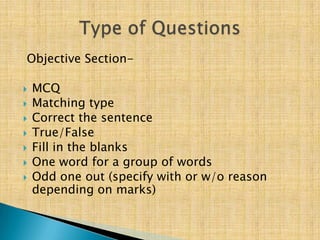
Objective Section-

   MCQ
   Matching type
   Correct the sentence
   True/False
   Fill in the blanks
   One word for a group of words
   Odd one out (specify with or w/o reason
    depending on marks)
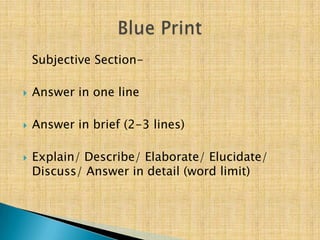
Subjective Section-

   Answer in one line

   Answer in brief (2-3 lines)

   Explain/ Describe/ Elaborate/ Elucidate/
    Discuss/ Answer in detail (word limit)
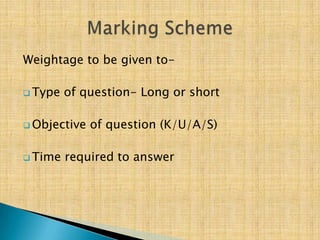
Weightage to be given to-

 Type   of question- Long or short

 Objective   of question (K/U/A/S)

 Time   required to answer
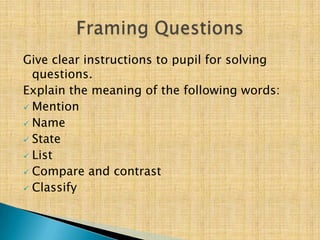
Give clear instructions to pupil for solving
  questions.
Explain the meaning of the following words:
 Mention
 Name
 State
 List
 Compare and contrast
 Classify
   Purpose-

to ensure time limit*
to cross check
to ensure objectivity in evaluation
to maintain consistency in marking *
to ensure ideal marks distribution
 (definition/fill in the blanks)
   define all key words/ key points
   assign weightage to each
   evaluate strictly on the basis of key points
Languages

 Creativity
 Construction of sentences
 Flow of thoughts- sequencing of the content
 Usage of idioms/ phrases/ quotes
 Vocabulary
 Spellings
Mathematics
 Formula
 Statements
 Substitution
 Calculation
 Answer
 Unit or any other step
 Graph- scale/ marking etc
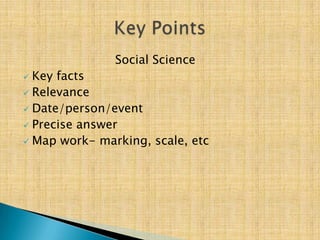
Social Science
 Key facts
 Relevance
 Date/person/event
 Precise answer
 Map work- marking, scale, etc
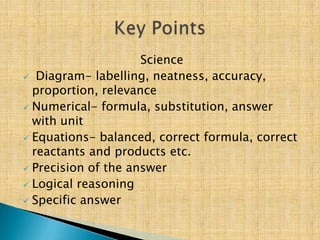
Science
 Diagram- labelling, neatness, accuracy,
  proportion, relevance
 Numerical- formula, substitution, answer
  with unit
 Equations- balanced, correct formula, correct
  reactants and products etc.
 Precision of the answer
 Logical reasoning
 Specific answer
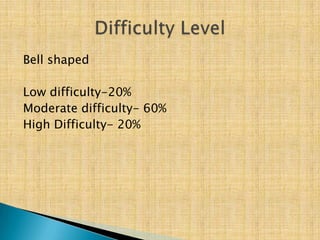
Bell shaped

Low difficulty-20%
Moderate difficulty- 60%
High Difficulty- 20%
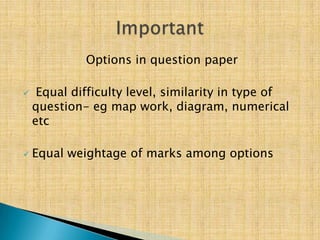
Options in question paper

    Equal difficulty level, similarity in type of
    question- eg map work, diagram, numerical
    etc

   Equal weightage of marks among options
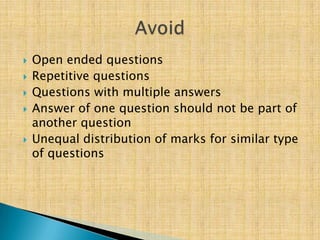
   Open ended questions
   Repetitive questions
   Questions with multiple answers
   Answer of one question should not be part of
    another question
   Unequal distribution of marks for similar type
    of questions
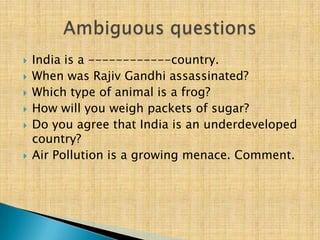
   India is a ------------country.
   When was Rajiv Gandhi assassinated?
   Which type of animal is a frog?
   How will you weigh packets of sugar?
   Do you agree that India is an underdeveloped
    country?
   Air Pollution is a growing menace. Comment.
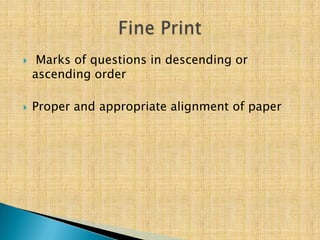
    Marks of questions in descending or
    ascending order

   Proper and appropriate alignment of paper
THANK YOU

Q paper

  • 1.
  • 2.
    Objectives: • The attributesof a good test • The steps required to construct a test. • The necessity of a Blue Print on the design of a test. • The physical assembling of questions in a paper.
  • 3.
    Validity Validity ofa test is the extent to which it measures what it attempts to measure. Eg- The train starts from New Delhi at 8:10 hours and reaches Kanpur at 14:30 hours. How much time does the train take to reach Kanpur from New Delhi?
  • 4.
    Validity All important areasof the course content should be covered in the test. Ensure that questions asked are not out of syllabus.
  • 5.
    Reliability Clarity in questions, specific and unambiguous-eg- how many examples, points etc Marking scheme must be specific and uniform
  • 6.
    Usability Only when oneis careful about:  Duration of test  Marking of test  Clear instructions, guidelines for solving  Materials required- graph, map, log books etc
  • 7.
    Planning  Testing objectives- KUAS  Weightage to objectives  Knowledge- 10%  Understanding- 40%  Application – 30%  Skill -20%
  • 8.
    Type of questions:  Define  What  How Many  Where  When  Who
  • 9.
    Type of questions: How will you- -compare/distinguish -classify -indicate on graph, map, etc -calculations
  • 10.
    Type of questions:  Effects of a phenomenon, property, correlating a certain topic to daily life  Calculations  Creative ideas, expressions, thoughts etc
  • 11.
    Type of questions: Drawing of diagrams & labelling  Numeric  Map work-drawing
  • 12.
    Three dimensional skeletonof the question paper • Number of topics • Maximum Marks • Type of questions
  • 13.
    Objective Section-  MCQ  Matching type  Correct the sentence  True/False  Fill in the blanks  One word for a group of words  Odd one out (specify with or w/o reason depending on marks)
  • 14.
    Subjective Section-  Answer in one line  Answer in brief (2-3 lines)  Explain/ Describe/ Elaborate/ Elucidate/ Discuss/ Answer in detail (word limit)
  • 15.
    Weightage to begiven to-  Type of question- Long or short  Objective of question (K/U/A/S)  Time required to answer
  • 16.
    Give clear instructionsto pupil for solving questions. Explain the meaning of the following words:  Mention  Name  State  List  Compare and contrast  Classify
  • 17.
    Purpose- to ensure time limit* to cross check to ensure objectivity in evaluation to maintain consistency in marking * to ensure ideal marks distribution (definition/fill in the blanks)
  • 18.
    define all key words/ key points  assign weightage to each  evaluate strictly on the basis of key points
  • 19.
    Languages  Creativity  Constructionof sentences  Flow of thoughts- sequencing of the content  Usage of idioms/ phrases/ quotes  Vocabulary  Spellings
  • 20.
    Mathematics  Formula  Statements Substitution  Calculation  Answer  Unit or any other step  Graph- scale/ marking etc
  • 21.
    Social Science  Keyfacts  Relevance  Date/person/event  Precise answer  Map work- marking, scale, etc
  • 22.
    Science  Diagram- labelling,neatness, accuracy, proportion, relevance  Numerical- formula, substitution, answer with unit  Equations- balanced, correct formula, correct reactants and products etc.  Precision of the answer  Logical reasoning  Specific answer
  • 23.
    Bell shaped Low difficulty-20% Moderatedifficulty- 60% High Difficulty- 20%
  • 24.
    Options in questionpaper  Equal difficulty level, similarity in type of question- eg map work, diagram, numerical etc  Equal weightage of marks among options
  • 25.
    Open ended questions  Repetitive questions  Questions with multiple answers  Answer of one question should not be part of another question  Unequal distribution of marks for similar type of questions
  • 26.
    India is a ------------country.  When was Rajiv Gandhi assassinated?  Which type of animal is a frog?  How will you weigh packets of sugar?  Do you agree that India is an underdeveloped country?  Air Pollution is a growing menace. Comment.
  • 27.
    Marks of questions in descending or ascending order  Proper and appropriate alignment of paper
  • 28.