WORKSHOP FOR SECONDARY LEVEL
RTC BIHAR ZONE-E & H
ANNUAL TRAINING PROGRAMME 2024-25
(Under the aegis of DAVCAE, DAV CMC, New Delhi)
Theme – “CAREER GUIDANCE IN SOCIAL SCIENCE”
Venue: ZOOM
Date:09/09/2024-11/09/2024
Career Opportunities in Social
Science
• Academia (Teaching and Research)
• Government and Public Policy
• Non-Profit Organizations
• Corporate Sector (Market Research, Human Resources)
Specific Job Roles
• Social Worker
• Policy Analyst
• Market Researcher
• Psychologist
• Community Organizer
• Academic Researcher
Emerging Fields in Social Science
• Data Science in Social Research
• Environmental Social Science
• Digital Sociology
• Globalization Studies
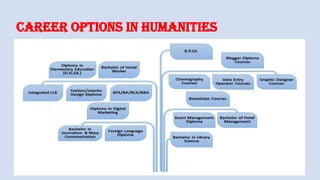
CAREER OPTIONS IN HUMANITIES
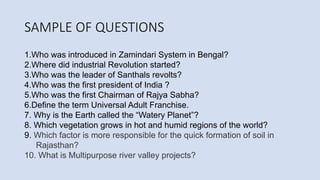
SAMPLE OF QUESTIONS
1.Who was introduced in Zamindari System in Bengal?
2.Where did industrial Revolution started?
3.Who was the leader of Santhals revolts?
4.Who was the first president of India ?
5.Who was the first Chairman of Rajya Sabha?
6.Define the term Universal Adult Franchise.
7. Why is the Earth called the “Watery Planet”?
8. Which vegetation grows in hot and humid regions of the world?
9. Which factor is more responsible for the quick formation of soil in
Rajasthan?
10. What is Multipurpose river valley projects?
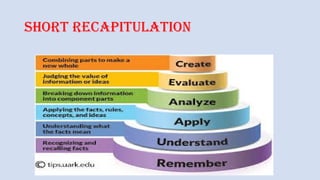
SHORT recapitulation
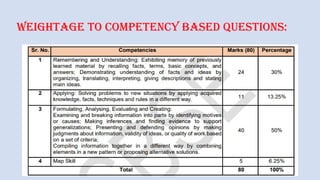
WEIGHTAGE TO COMPETENCY BASED QUESTIONS:
BLOOM’S TAXONOMY ACTION VERBS
....Workshop Materials
revised_blooms_taxonomy_action_ver
bs
(1).pdf
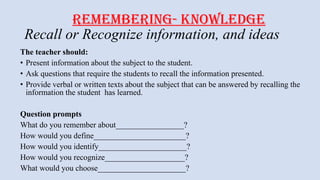
REMEMBERING- KNOWLEDGE
Recall or Recognize information, and ideas
The teacher should:
• Present information about the subject to the student.
• Ask questions that require the students to recall the information presented.
• Provide verbal or written texts about the subject that can be answered by recalling the
information the student has learned.
Question prompts
What do you remember about_________________?
How would you define_______________________?
How would you identify______________________?
How would you recognize____________________?
What would you choose______________________?
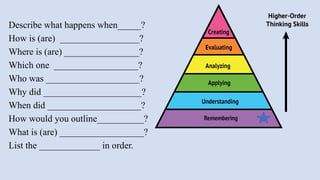
Describe what happens when_____?
How is (are) _________________?
Where is (are) ________________?
Which one __________________?
Who was ____________________?
Why did _____________________?
When did ____________________?
How would you outline__________?
What is (are) __________________?
List the _____________ in order.
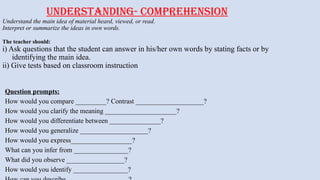
UNDERSTANDING- COMPREHENSION
Understand the main idea of material heard, viewed, or read.
Interpret or summarize the ideas in own words.
The teacher should:
i) Ask questions that the student can answer in his/her own words by stating facts or by
identifying the main idea.
ii) Give tests based on classroom instruction
Question prompts:
How would you compare _________? Contrast ____________________?
How would you clarify the meaning _____________________?
How would you differentiate between _______________?
How would you generalize ____________________?
How would you express__________________?
What can you infer from ________________?
What did you observe _________________?
How would you identify ________________?
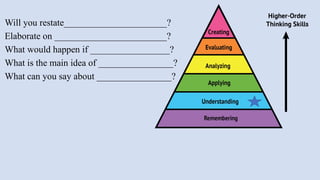
Will you restate______________________?
Elaborate on ________________________?
What would happen if _________________?
What is the main idea of ________________?
What can you say about ________________?
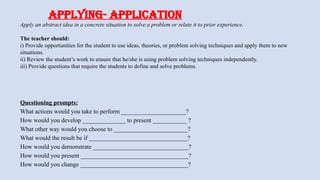
APPLYING- APPLICATION
Apply an abstract idea in a concrete situation to solve a problem or relate it to prior experience.
The teacher should:
i) Provide opportunities for the student to use ideas, theories, or problem solving techniques and apply them to new
situations.
ii) Review the student’s work to ensure that he/she is using problem solving techniques independently.
iii) Provide questions that require the students to define and solve problems.
Questioning prompts:
What actions would you take to perform _____________________?
How would you develop ______________ to present ___________ ?
What other way would you choose to ________________________?
What would the result be if ________________________________?
How would you demonstrate _______________________________?
How would you present ___________________________________?
How would you change ___________________________________?
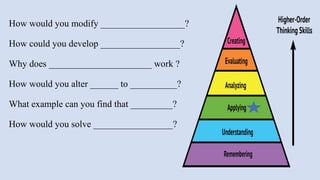
How would you modify __________________?
How could you develop _________________?
Why does ______________________ work ?
How would you alter ______ to __________?
What example can you find that _________?
How would you solve _________________?
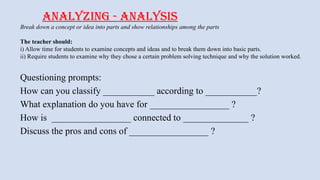
ANALYZING - ANALYSIS
Break down a concept or idea into parts and show relationships among the parts
The teacher should:
i) Allow time for students to examine concepts and ideas and to break them down into basic parts.
ii) Require students to examine why they chose a certain problem solving technique and why the solution worked.
Questioning prompts:
How can you classify ___________ according to ___________?
What explanation do you have for _________________ ?
How is _________________ connected to ______________ ?
Discuss the pros and cons of _________________ ?
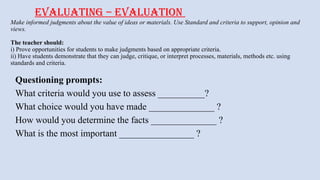
Evaluating – Evaluation
Make informed judgments about the value of ideas or materials. Use Standard and criteria to support, opinion and
views.
The teacher should:
i) Prove opportunities for students to make judgments based on appropriate criteria.
ii) Have students demonstrate that they can judge, critique, or interpret processes, materials, methods etc. using
standards and criteria.
Questioning prompts:
What criteria would you use to assess __________?
What choice would you have made ______________ ?
How would you determine the facts ______________ ?
What is the most important ________________ ?
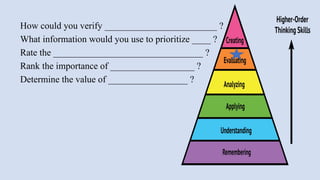
How could you verify ________________________ ?
What information would you use to prioritize ____ ?
Rate the ________________________________ ?
Rank the importance of __________________ ?
Determine the value of _________________ ?
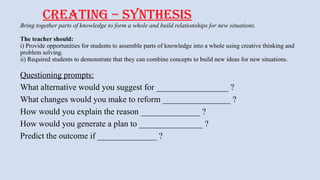
CREATING – SYNTHESIS
Bring together parts of knowledge to form a whole and build relationships for new situations.
The teacher should:
i) Provide opportunities for students to assemble parts of knowledge into a whole using creative thinking and
problem solving.
ii) Required students to demonstrate that they can combine concepts to build new ideas for new situations.
Questioning prompts:
What alternative would you suggest for _________________ ?
What changes would you make to reform ________________ ?
How would you explain the reason ______________ ?
How would you generate a plan to _______________ ?
Predict the outcome if ______________ ?
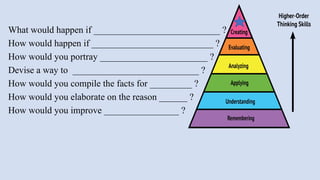
What would happen if ___________________________ ?
How would happen if __________________________ ?
How would you portray _______________________ ?
Devise a way to ___________________________ ?
How would you compile the facts for _________ ?
How would you elaborate on the reason ______ ?
How would you improve ________________ ?
QUESTION PAPER SETTING
QUESTIONS:
Questions are the most commonly applied/ used assessment tool for finding out
what children know, think, imagine, and feel.
Characteristics of a good question:
i) It should be on pre-determined objective:
A question should be based on pre-determined objective and should be framed in
such a way that it tests the objective effectively
ii) Instructions:
It should specify a particular task through clear and precise instructions. For this,
appropriate directional words should be used and structured situations should be
given.
iii) Scope:
It should indicate the limit and the scope of the answer (length of the answer) in
accordance with the estimated time and marks allotted to it.
iv) Content validity:
The question should assess the same area of content which it intends to assess.
v) Language:
A good question is framed in a clear, precise and unambiguous language,
well within the comprehension of the students.
vi) Difficulty level:
A question should be written keeping in view the ability of the students for
whom it is meant. The difficulty of the question depends upon the ability to
be tested, the content area to be tested and the time available to answer it.
vii) Assessing (or Discriminating) power:
A good question must assess or discriminate between the bright students,
average and the other students.
viii) Delimited scope of the answer:
The language of the question should be specific and precise so that the
scope of the expected answer is clearly delimited or defined.
ix) Value points:
Value points or marks carried by a question as a whole and also its sub
parts should be clearly mentioned.
Read the source given below and create the questions as per objectives of the
problem:
The biological loss is strongly correlated with the loss of cultural diversity. Such
losses have increasingly marginalized and impoverished many indigenous and other
forest-dependent communities, who directly depend on various components of the
forest and wildlife for food, drink, medicine, culture, spirituality, etc. Within the
poor, women are affected more than men. In many societies, women bear the major
responsibility of collection of fuel, fodder, water and other basic subsistence needs.
As these resources are depleted, the drudgery of women increases and sometimes
they have to walk for more than 10 km to collect these resources. This causes
serious health problems for women and negligence of home and children because of
the increased hours of work, which often has serious social implications.
The indirect impact of degradation such as severe drought or deforestation-induced
floods, etc. also hits the poor the hardest.
Expected Questions
(i) Mention the importance of forests in our life.
(Knowledge/ Understanding/ Analysis/ Application/ Evaluation/
Creativity)
(ii) How does biological loss of forest and wildlife correlate with the
loss of cultural diversity?
(Knowledge/ Understanding/ Analysis/ Application/ Evaluation/
Creativity)
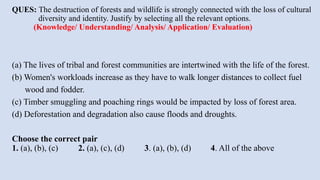
QUES: The destruction of forests and wildlife is strongly connected with the loss of cultural
diversity and identity. Justify by selecting all the relevant options.
(Knowledge/ Understanding/ Analysis/ Application/ Evaluation)
(a) The lives of tribal and forest communities are intertwined with the life of the forest.
(b) Women's workloads increase as they have to walk longer distances to collect fuel
wood and fodder.
(c) Timber smuggling and poaching rings would be impacted by loss of forest area.
(d) Deforestation and degradation also cause floods and droughts.
Choose the correct pair
1. (a), (b), (c) 2. (a), (c), (d) 3. (a), (b), (d) 4. All of the above
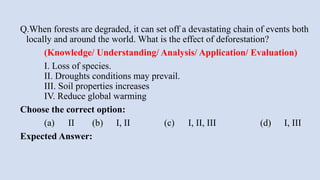
Q.When forests are degraded, it can set off a devastating chain of events both
locally and around the world. What is the effect of deforestation?
(Knowledge/ Understanding/ Analysis/ Application/ Evaluation)
I. Loss of species.
II. Droughts conditions may prevail.
III. Soil properties increases
IV. Reduce global warming
Choose the correct option:
(a) II (b) I, II (c) I, II, III (d) I, III
Expected Answer:
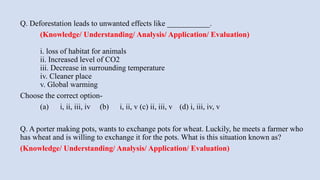
Q. Deforestation leads to unwanted effects like ___________.
(Knowledge/ Understanding/ Analysis/ Application/ Evaluation)
​
i. loss of habitat for animals
ii. Increased level of CO2
iii. Decrease in surrounding temperature
iv. Cleaner place
v. Global warming
Choose the correct option-
(a) i, ii, iii, iv (b) i, ii, v (c) ii, iii, v (d) i, iii, iv, v
Q. A porter making pots, wants to exchange pots for wheat. Luckily, he meets a farmer who
has wheat and is willing to exchange it for the pots. What is this situation known as?
(Knowledge/ Understanding/ Analysis/ Application/ Evaluation)
​
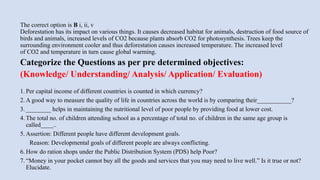
The correct option is B i, ii, v
Deforestation has its impact on various things. It causes decreased habitat for animals, destruction of food source of
birds and animals, increased levels of CO2 because plants absorb CO2 for photosynthesis. Trees keep the
surrounding environment cooler and thus deforestation causes increased temperature. The increased level
of CO2 and temperature in turn cause global warming.
Categorize the Questions as per pre determined objectives:
(Knowledge/ Understanding/ Analysis/ Application/ Evaluation)​
1. Per capital income of different countries is counted in which currency?
2. A good way to measure the quality of life in countries across the world is by comparing their___________?
3. ________ helps in maintaining the nutritional level of poor people by providing food at lower cost.
4. The total no. of children attending school as a percentage of total no. of children in the same age group is
called____..
5. Assertion: Different people have different development goals.
Reason: Developmental goals of different people are always conflicting.
6. How do ration shops under the Public Distribution System (PDS) help Poor?
7. “Money in your pocket cannot buy all the goods and services that you may need to live well.” Is it true or not?
Elucidate.
Categorize the Questions as per pre
determined objectives:
(Knowledge/ Understanding/ Analysis/ Application/ Evaluation)​
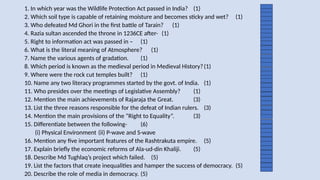
1. In which year was the Wildlife Protection Act passed in India? (1)
2. Which soil type is capable of retaining moisture and becomes sticky and wet? (1)
3. Who defeated Md Ghori in the first battle of Tarain? (1)
4. Razia sultan ascended the throne in 1236CE after- (1)
5. Right to information act was passed in – (1)
6. What is the literal meaning of Atmosphere? (1)
7. Name the various agents of gradation. (1)
8. Which period is known as the medieval period in Medieval History?(1)
9. Where were the rock cut temples built? (1)
10. Name any two literacy programmes started by the govt. of India. (1)
11. Who presides over the meetings of Legislative Assembly? (1)
12. Mention the main achievements of Rajaraja the Great. (3)
13. List the three reasons responsible for the defeat of Indian rulers. (3)
14. Mention the main provisions of the “Right to Equality”. (3)
15. Differentiate between the following- (6)
(i) Physical Environment (ii) P-wave and S-wave
16. Mention any five important features of the Rashtrakuta empire. (5)
17. Explain briefly the economic reforms of Ala-ud-din Khaliji. (5)
18. Describe Md Tughlaq’s project which failed. (5)
19. List the factors that create inequalities and hamper the success of democracy. (5)
20. Describe the role of media in democracy. (5)
THANK YOU

Revised blooms taxonomy- question starters.pptx

  • 1.
    WORKSHOP FOR SECONDARYLEVEL RTC BIHAR ZONE-E & H ANNUAL TRAINING PROGRAMME 2024-25 (Under the aegis of DAVCAE, DAV CMC, New Delhi) Theme – “CAREER GUIDANCE IN SOCIAL SCIENCE” Venue: ZOOM Date:09/09/2024-11/09/2024
  • 2.
    Career Opportunities inSocial Science • Academia (Teaching and Research) • Government and Public Policy • Non-Profit Organizations • Corporate Sector (Market Research, Human Resources)
  • 3.
    Specific Job Roles •Social Worker • Policy Analyst • Market Researcher • Psychologist • Community Organizer • Academic Researcher
  • 4.
    Emerging Fields inSocial Science • Data Science in Social Research • Environmental Social Science • Digital Sociology • Globalization Studies
  • 5.
  • 6.
    SAMPLE OF QUESTIONS 1.Whowas introduced in Zamindari System in Bengal? 2.Where did industrial Revolution started? 3.Who was the leader of Santhals revolts? 4.Who was the first president of India ? 5.Who was the first Chairman of Rajya Sabha? 6.Define the term Universal Adult Franchise. 7. Why is the Earth called the “Watery Planet”? 8. Which vegetation grows in hot and humid regions of the world? 9. Which factor is more responsible for the quick formation of soil in Rajasthan? 10. What is Multipurpose river valley projects?
  • 7.
  • 8.
    WEIGHTAGE TO COMPETENCYBASED QUESTIONS:
  • 9.
    BLOOM’S TAXONOMY ACTIONVERBS ....Workshop Materials revised_blooms_taxonomy_action_ver bs (1).pdf
  • 10.
    REMEMBERING- KNOWLEDGE Recall orRecognize information, and ideas The teacher should: • Present information about the subject to the student. • Ask questions that require the students to recall the information presented. • Provide verbal or written texts about the subject that can be answered by recalling the information the student has learned. Question prompts What do you remember about_________________? How would you define_______________________? How would you identify______________________? How would you recognize____________________? What would you choose______________________?
  • 11.
    Describe what happenswhen_____? How is (are) _________________? Where is (are) ________________? Which one __________________? Who was ____________________? Why did _____________________? When did ____________________? How would you outline__________? What is (are) __________________? List the _____________ in order.
  • 12.
    UNDERSTANDING- COMPREHENSION Understand themain idea of material heard, viewed, or read. Interpret or summarize the ideas in own words. The teacher should: i) Ask questions that the student can answer in his/her own words by stating facts or by identifying the main idea. ii) Give tests based on classroom instruction Question prompts: How would you compare _________? Contrast ____________________? How would you clarify the meaning _____________________? How would you differentiate between _______________? How would you generalize ____________________? How would you express__________________? What can you infer from ________________? What did you observe _________________? How would you identify ________________?
  • 13.
    Will you restate______________________? Elaborateon ________________________? What would happen if _________________? What is the main idea of ________________? What can you say about ________________?
  • 14.
    APPLYING- APPLICATION Apply anabstract idea in a concrete situation to solve a problem or relate it to prior experience. The teacher should: i) Provide opportunities for the student to use ideas, theories, or problem solving techniques and apply them to new situations. ii) Review the student’s work to ensure that he/she is using problem solving techniques independently. iii) Provide questions that require the students to define and solve problems. Questioning prompts: What actions would you take to perform _____________________? How would you develop ______________ to present ___________ ? What other way would you choose to ________________________? What would the result be if ________________________________? How would you demonstrate _______________________________? How would you present ___________________________________? How would you change ___________________________________?
  • 15.
    How would youmodify __________________? How could you develop _________________? Why does ______________________ work ? How would you alter ______ to __________? What example can you find that _________? How would you solve _________________?
  • 16.
    ANALYZING - ANALYSIS Breakdown a concept or idea into parts and show relationships among the parts The teacher should: i) Allow time for students to examine concepts and ideas and to break them down into basic parts. ii) Require students to examine why they chose a certain problem solving technique and why the solution worked. Questioning prompts: How can you classify ___________ according to ___________? What explanation do you have for _________________ ? How is _________________ connected to ______________ ? Discuss the pros and cons of _________________ ?
  • 18.
    Evaluating – Evaluation Makeinformed judgments about the value of ideas or materials. Use Standard and criteria to support, opinion and views. The teacher should: i) Prove opportunities for students to make judgments based on appropriate criteria. ii) Have students demonstrate that they can judge, critique, or interpret processes, materials, methods etc. using standards and criteria. Questioning prompts: What criteria would you use to assess __________? What choice would you have made ______________ ? How would you determine the facts ______________ ? What is the most important ________________ ?
  • 19.
    How could youverify ________________________ ? What information would you use to prioritize ____ ? Rate the ________________________________ ? Rank the importance of __________________ ? Determine the value of _________________ ?
  • 20.
    CREATING – SYNTHESIS Bringtogether parts of knowledge to form a whole and build relationships for new situations. The teacher should: i) Provide opportunities for students to assemble parts of knowledge into a whole using creative thinking and problem solving. ii) Required students to demonstrate that they can combine concepts to build new ideas for new situations. Questioning prompts: What alternative would you suggest for _________________ ? What changes would you make to reform ________________ ? How would you explain the reason ______________ ? How would you generate a plan to _______________ ? Predict the outcome if ______________ ?
  • 21.
    What would happenif ___________________________ ? How would happen if __________________________ ? How would you portray _______________________ ? Devise a way to ___________________________ ? How would you compile the facts for _________ ? How would you elaborate on the reason ______ ? How would you improve ________________ ?
  • 22.
    QUESTION PAPER SETTING QUESTIONS: Questionsare the most commonly applied/ used assessment tool for finding out what children know, think, imagine, and feel. Characteristics of a good question: i) It should be on pre-determined objective: A question should be based on pre-determined objective and should be framed in such a way that it tests the objective effectively ii) Instructions: It should specify a particular task through clear and precise instructions. For this, appropriate directional words should be used and structured situations should be given. iii) Scope: It should indicate the limit and the scope of the answer (length of the answer) in accordance with the estimated time and marks allotted to it. iv) Content validity: The question should assess the same area of content which it intends to assess.
  • 23.
    v) Language: A goodquestion is framed in a clear, precise and unambiguous language, well within the comprehension of the students. vi) Difficulty level: A question should be written keeping in view the ability of the students for whom it is meant. The difficulty of the question depends upon the ability to be tested, the content area to be tested and the time available to answer it. vii) Assessing (or Discriminating) power: A good question must assess or discriminate between the bright students, average and the other students. viii) Delimited scope of the answer: The language of the question should be specific and precise so that the scope of the expected answer is clearly delimited or defined. ix) Value points: Value points or marks carried by a question as a whole and also its sub parts should be clearly mentioned.
  • 24.
    Read the sourcegiven below and create the questions as per objectives of the problem: The biological loss is strongly correlated with the loss of cultural diversity. Such losses have increasingly marginalized and impoverished many indigenous and other forest-dependent communities, who directly depend on various components of the forest and wildlife for food, drink, medicine, culture, spirituality, etc. Within the poor, women are affected more than men. In many societies, women bear the major responsibility of collection of fuel, fodder, water and other basic subsistence needs. As these resources are depleted, the drudgery of women increases and sometimes they have to walk for more than 10 km to collect these resources. This causes serious health problems for women and negligence of home and children because of the increased hours of work, which often has serious social implications. The indirect impact of degradation such as severe drought or deforestation-induced floods, etc. also hits the poor the hardest.
  • 25.
    Expected Questions (i) Mentionthe importance of forests in our life. (Knowledge/ Understanding/ Analysis/ Application/ Evaluation/ Creativity) (ii) How does biological loss of forest and wildlife correlate with the loss of cultural diversity? (Knowledge/ Understanding/ Analysis/ Application/ Evaluation/ Creativity)
  • 26.
    QUES: The destructionof forests and wildlife is strongly connected with the loss of cultural diversity and identity. Justify by selecting all the relevant options. (Knowledge/ Understanding/ Analysis/ Application/ Evaluation) (a) The lives of tribal and forest communities are intertwined with the life of the forest. (b) Women's workloads increase as they have to walk longer distances to collect fuel wood and fodder. (c) Timber smuggling and poaching rings would be impacted by loss of forest area. (d) Deforestation and degradation also cause floods and droughts. Choose the correct pair 1. (a), (b), (c) 2. (a), (c), (d) 3. (a), (b), (d) 4. All of the above
  • 27.
    Q.When forests aredegraded, it can set off a devastating chain of events both locally and around the world. What is the effect of deforestation? (Knowledge/ Understanding/ Analysis/ Application/ Evaluation) I. Loss of species. II. Droughts conditions may prevail. III. Soil properties increases IV. Reduce global warming Choose the correct option: (a) II (b) I, II (c) I, II, III (d) I, III Expected Answer:
  • 28.
    Q. Deforestation leadsto unwanted effects like ___________. (Knowledge/ Understanding/ Analysis/ Application/ Evaluation) ​ i. loss of habitat for animals ii. Increased level of CO2 iii. Decrease in surrounding temperature iv. Cleaner place v. Global warming Choose the correct option- (a) i, ii, iii, iv (b) i, ii, v (c) ii, iii, v (d) i, iii, iv, v Q. A porter making pots, wants to exchange pots for wheat. Luckily, he meets a farmer who has wheat and is willing to exchange it for the pots. What is this situation known as? (Knowledge/ Understanding/ Analysis/ Application/ Evaluation) ​
  • 29.
    The correct optionis B i, ii, v Deforestation has its impact on various things. It causes decreased habitat for animals, destruction of food source of birds and animals, increased levels of CO2 because plants absorb CO2 for photosynthesis. Trees keep the surrounding environment cooler and thus deforestation causes increased temperature. The increased level of CO2 and temperature in turn cause global warming. Categorize the Questions as per pre determined objectives: (Knowledge/ Understanding/ Analysis/ Application/ Evaluation)​ 1. Per capital income of different countries is counted in which currency? 2. A good way to measure the quality of life in countries across the world is by comparing their___________? 3. ________ helps in maintaining the nutritional level of poor people by providing food at lower cost. 4. The total no. of children attending school as a percentage of total no. of children in the same age group is called____.. 5. Assertion: Different people have different development goals. Reason: Developmental goals of different people are always conflicting. 6. How do ration shops under the Public Distribution System (PDS) help Poor? 7. “Money in your pocket cannot buy all the goods and services that you may need to live well.” Is it true or not? Elucidate.
  • 30.
    Categorize the Questionsas per pre determined objectives: (Knowledge/ Understanding/ Analysis/ Application/ Evaluation)​
  • 31.
    1. In whichyear was the Wildlife Protection Act passed in India? (1) 2. Which soil type is capable of retaining moisture and becomes sticky and wet? (1) 3. Who defeated Md Ghori in the first battle of Tarain? (1) 4. Razia sultan ascended the throne in 1236CE after- (1) 5. Right to information act was passed in – (1) 6. What is the literal meaning of Atmosphere? (1) 7. Name the various agents of gradation. (1) 8. Which period is known as the medieval period in Medieval History?(1) 9. Where were the rock cut temples built? (1) 10. Name any two literacy programmes started by the govt. of India. (1) 11. Who presides over the meetings of Legislative Assembly? (1) 12. Mention the main achievements of Rajaraja the Great. (3) 13. List the three reasons responsible for the defeat of Indian rulers. (3) 14. Mention the main provisions of the “Right to Equality”. (3) 15. Differentiate between the following- (6) (i) Physical Environment (ii) P-wave and S-wave 16. Mention any five important features of the Rashtrakuta empire. (5) 17. Explain briefly the economic reforms of Ala-ud-din Khaliji. (5) 18. Describe Md Tughlaq’s project which failed. (5) 19. List the factors that create inequalities and hamper the success of democracy. (5) 20. Describe the role of media in democracy. (5)
  • 32.