OBJECTIVES
• Learning Outcome9:
• Cite rules or guidelines in constructing or formulating a test.
• Learning Outcome 10:
• Construct self-made test items based on the TOS and the guidelines in writing a test.
11.
GUIDELINES IN TESTCONSTRUCTION
Avoid ambiguous and confusing wordings and sentence structures.
Use appropriate vocabulary.
Keep questions short and simple.
Write items that have one correct answer. (Unless you are instructing
student to select more than one.
Don’t ever complicate test items.
12.
Common Observation ofStudent on Test
Questions
Not included in the lessons.
Questions and choices are both too long.
Layout is unorganized.
Sentences are unorganized..
Question are confusing.
Correct answer is not included in the choices.
13.
Possible Reason forFaulty Test Question
Questions are copied and verbatim from the book or other resources.
Not consulting the course outline.
Much consideration is given to reduce printing cost.
No TOS or TOS was made after making test.
14.
Factors to Considerin Preparing Test
Questions
Purpose of the Test.
Time available to prepare, administer and score the test.
Number of students to be tested
Skill of the teacher in writing the test.
Facilities available in reproducing the test.
15.
Characteristic of GoodTest
VALIDITY – the extent to which the test measures what it intends to measure.
RELIABILITY – refers to the degree to which a test is consistent and stable in
measuring what it is intended to measure
USABILITY – the test can be administered with ease, clarity and uniformity.
16.
Other things toconsider:
SCORABILITY – easy to score
INTERPRETABILITY – test result can be properly interpreted and its
major basis in making
sound educational decisions.
ECONOMICAL – the test can be reused without compromising the
validity and reliability.
17.
General Rules inWriting Test Questions
Number test questions continuously.
Keep your test question each test group uniform.
Make your layout presentable
Do not put too many test question in one test group
18.
5 Most Commonlyused Test Format
Multiple Choice
True or False
Matching Type
Fill-in the blanks (Sentence Completion)
Essay
Source: Turn out of test Questions in SSI (2003-2007)
19.
The following areexamples of non-renewable resources except:
A. Fossil fuels
B. Minerals
C. Water
D. Wood
Multiple Choice
answer
alternatives
stem
decoy
20.
Multiple Choice
Avoidpatterns
Stem and alternatives on the same page
Avoid abbreviations or acronyms
Make sure there is only one best answer.
Make the distractors appealing and plausible.
Place the choices in some meaningful order.
21.
TRUE or FALSE
Solarenergy is a renewable energy source.
Is solar energy a renewable energy source?
22.
TRUE or FALSE
Avoid using the word “always”, “never”, “often”, and other adverbs that tend
to be either always true or always false.
Avoid tricky statements with some minor misleading word or spelling
anomaly, misplaced phrases, etc.
Avoid long sentences as these tends to be “true”.
Matching Type
Usenumbers to identify the items in Column A, and capital letters to identify
responses in Column B or vice versa.
Responses must be more in number than the premises to prevent the student
from arriving at the answer by mere process of elimination.
To help the examinee find the answer easier, arrange the option alphabetically
or chronologically, whichever is applicable.
All of the responses and premises for a matching type should appear on the
same page.
25.
Fill-in the blanks
Do not use statements that are copied from the textbook or workbook, since
this encourages memorization.
The required completion should be specific term. There should be only one
possible correct answer.
Be sure that the missing segment of the incomplete item is important.
Provide sufficient space on the answer sheet. Use blanks that are consistently
the same length, so it is not a clue to how long the answer/word is.
Use one blank, or certainly no more than two, in any test item, since more
than two blanks lead to confusion.
26.
Fill-in the blanks
•(Overpopulation) is an example of an environmental problem.
• (Overpopulation) is an example of an environmental problem that
refers to an undesirable condition where the number of the existing
human population exceeds the actual carrying capacity of Earth.
27.
Essay
Unrestricted /Uncontrolled response
Unrestricted response essay question is one where there are no restrictions on the response, including
the amount of time allowed to finish, the number of pages written, or material included.
Example:
• Discuss ecosystem
Restricted / Controlled response
Restricted response usually limits both the content and the response by restricting the scope of the
topic to be discussed. The examinee is required to provide limited response based on a specified
criterion for answering the question.
Example:
• Describe the movement of energy and nutrients in an ecosystem
• In 100 words, describe the characteristics of Mayon Volcano.
28.
Additional guidelines toconsider when
writing items
Avoid humorous items.
Item should measure one’s knowledge of the item context, not their level of
interest.
Write items to measure what students know, not what they do not know.
TEACHER MADE-TEST
Teacher-madetest is the major basis for evaluating the progress or
performance of the students in the classroom.
The teacher therefore, had an obligation to provide their students with best
evaluation.
31.
Step 1 -Planning
What is to be measure?
What areas should be included?
What types of test items are to be included?
32.
Step 2 –Preparing the Tests
In this step, the test items are constructed in accordance with the table of
specification.
33.
Step 3 –Reproducing the Test
in reproducing the test, the duplicating machine and who will facilitate
in typing and mimeographing be consider.
Step 4 – Administering the Test
student must be provided congenial physical and psychological
environment during the time of testing.
34.
Step 5 –Scoring the Test
the best procedure in scoring an objective test is to give one point of credit
for each correct answer.
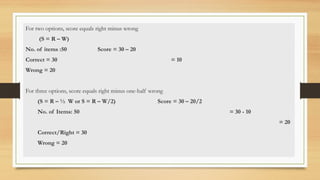
in case of a test with only two or three options to each item, the correct
formula should be applied.
35.
For two options,score equals right minus wrong
(S = R – W)
No. of items :50 Score = 30 – 20
Correct = 30 = 10
Wrong = 20
For three options, score equals right minus one-half wrong
(S = R – ½ W or S = R – W/2) Score = 30 – 20/2
No. of Items: 50 = 30 - 10
= 20
Correct/Right = 30
Wrong = 20
36.
Step 6 –Evaluating the Test
the test is evaluated as to the quality of the student’s responses and the
quality of the test itself.
Step 7 – Interpreting the Test
standardized achievement tests are interpreted based on norm tables. Table
of norm are not applicable to teacher-made test.
1. What isthe capacity to do work?
a. Conversion
b. Ecosystem
c. Energy
d. Transformation
2. Where does energy flow, transfer and move in the ecosystem?
a. Food chain
b. Open system
c. Photosynthesis
d. Thermodynamics
39.
3. It isthe main regulator of carbon dioxide in the atmosphere because carbon dioxide dissolves easily in
it.
a. Ocean
b. River
c. Volcanoes
d. Water
4. Why is the use of too much phosporus-rich fertilizers bad for the environment?
e. Because of toxins in fertilizers
f. Because these fertilizers are harmful to humans.
g. Because these fertilizers cannot cause growth in algae and large aquatic plants
h. Because phosphorus-rich fertilizers contribute to the process of eutrophication which leads to
various changes in water deteriorating its quality.
40.
5. The followingare examples of non-renewable resources except:
a. Air
b. Fossil fuels
c. Minerals
d. Water
IDENTIFICATION. Write your answer on the blank space provided in each item.
6. Through photosynthesis, a plant transforms light energy into chemical energy stored in food and the first
trophic level in the food chain is classified as ________.
7. ______________It is also known as the hydrologic cycle and the continuous movement of water within
the Earth and atmosphere.
41.
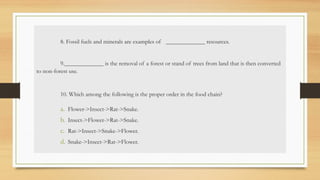
8. Fossil fuelsand minerals are examples of _____________ resources.
9._____________ is the removal of a forest or stand of trees from land that is then converted
to non-forest use.
10. Which among the following is the proper order in the food chain?
a. Flower->Insect->Rat->Snake.
b. Insect->Flower->Rat->Snake.
c. Rat->Insect->Snake->Flower.
d. Snake->Insect->Rat->Flower.
42.
11. Which amongthe following show the flow of energy?
a. A traffic collision of two motor vehicle.
b. A grass absorbing light to produce food.
c. A union of strong predators.
d. A boat sailing in the pacific sea
12. Why is carbon important for life?
e. Cellular respirations provide energy for living things.
f. Important for plant and animal growth
g. To support the water cycle
h. To support decomposition
43.
13. Human activitiesalter nutrient cycles through the following except?
a. Through production of nitrogen fertilizers
b. Through deforestation and burning of fossil fuels.
c. By altering the rate or the amount of nutrients in certain areas.
d. By planting trees
14. The Province of Bulacan have attempted to control the size of mosquito populations to prevent the
spread of certain diseases such as malaria and encephalitis. Which control method is most likely to cause
the least ecological damage?
e. draining the swamps where mosquitoes breed
f. spraying swamps with chemical pesticides to kill mosquitoes
g. increasing populations of native fish that feed on mosquito larvae in the swamps
h. spraying oil over swamps to suffocate mosquito larvae
44.
15. As astudent, what can you contribute to reduce solid waste?
a. Use a refillable container for water in place of bottled water.
b. Make it a habit to separate out all items that are recyclable.
c. Donate your old clothes, books, and other things instead of throwing it away.
d. All of the above.
Write TRUE OR FALSE before each number.
_______ 16. Beetle is an herbivore or a first order consumer because it feeds on the grass.
_______ 17. Food chain is a hierarchical series of organisms, each dependent on the next as a source of
food.
45.
18. The biogeochemicalcycle involves biological, chemical and geological processes.
_______ 19. Water that changes from gas to liquid is called evaporation.
_______ 20. Acid rain can be considered as the result of human activities.
_______ 21. Overfishing has no harmful effect on the ecosystem because fish can reproduce their
population.
46.
22. Which pertainsto the role of the organisms play in their respective habitats?
a. Energy
b. Food Chain
c. Food Web
d. Niche
23. Which of these animals is a carnivore?
e. Deer
f. Giraffe
g. Goat
h. Tiger
47.
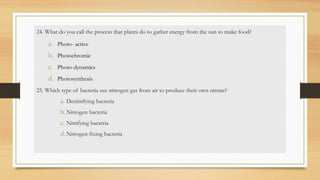
24. What doyou call the process that plants do to gather energy from the sun to make food?
a. Photo- active
b. Photochromic
c. Photo-dynamics
d. Photosynthesis
25. Which type of bacteria use nitrogen gas from air to produce their own nitrate?
a. Denitrifying bacteria
b. Nitrogen bacteria
c. Nitrifying bacteria
d. Nitrogen-fixing bacteria
48.
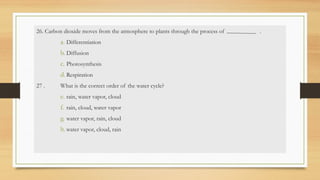
26. Carbon dioxidemoves from the atmosphere to plants through the process of .
a. Differentiation
b. Diffusion
c. Photosynthesis
d. Respiration
27 . What is the correct order of the water cycle?
e. rain, water vapor, cloud
f. rain, cloud, water vapor
g. water vapor, rain, cloud
h.water vapor, cloud, rain
49.
28. Which humanactivity would most likely reduce non-renewable resources?
a. development of wildlife habitat
b. governmental restriction of industrial pollution
c. uncontrolled population growth
d. use of natural enemies to eliminate insect pests
29. Which of the following has the most negative effect on the ecosystem?
e. increasing human population
f. recycling glass, plastic, and metals
g. use of air pollution controls
h. use of natural predators to control insect pests
50.
Short essay
30. Giveone suggestion or solution on how we can solve the different environmental issues we are facing
today.
52.
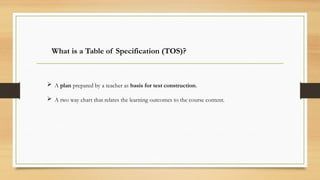
What is aTable of Specification (TOS)?
A plan prepared by a teacher as basis for test construction.
A two way chart that relates the learning outcomes to the course content.
53.
What is theimportance of (TOS)?
It enables the teacher to prepare a test containing a representative sample of student
behavior in each of the areas tested.
It ensures that fair and representative questions appear on the test.
It improves the validity of a teacher’s evaluation based on the test constructed.
It helps identify the type of items to be included on the test.
It provides evidence that a test has content validity, that it covers what should be covered.
It helps measure higher thinking and lower thinking skills of students.
57.
Preparation for theTable of Specification
(Grade 7)
Science
4th
Quarter
Ecosystem
LESSON:
1. The Flow of Energy in the Living System
2. The Flow of Materials in the Ecosystem
3. Impact of Human Activities in an Ecosystem
58.
Table of Specification
for(Grade 7) Science
4th
Quarter: Ecosystem
Learning Competency
Number
of Days
30% 40% 30% Number of
items
Remembering Understanding Applying Analyzing Evaluating Creating
1. Identify the basic needs and animals
such as air, food, water and shelter;
2. Explain how living things depend on
the environment to meet their basic
needs; and
3. Recognize that there is a need to
protect and conserve the environment.
Total Total
59.
STEP 1. Identifythe number of days spent.
STEP 2. Determine the number of total items to
prepare and number of item in each Learning
Competency.
Formula:
n/N days x N 30
items
= n items in each
LC
60.
Learning Competency
Number
of Days
30%40% 30%
Number of
items
Remembering Understanding Applying Analyzing Evaluating Creating
1. Identify the basic needs and animals
such as air, food, water and shelter; 5 (9.9)
2. Explain how living things depend on
the environment to meet their basic
needs; and
5 10
3. Recognize that there is a need to
protect and conserve the environment. 5 10
15 30
61.
STEP 3. Determinethe number of items (NOI) for
each classification of objectives.
Formula:
n of items x % Cognitive Level of
difficulty
= n of items in each CO
STEP 4. Allocate the number of test items for each
topic in each classification of objectives.
62.
Learning Competency
Number
of Days
30%40% 30% Number of
items
Remembering Understanding Applying Analyzing Evaluating Creating
1. Identify the basic needs and animals
such as air, food, water and shelter; 5 2 1 2 2 3 10
2. Explain how living things depend on
the environment to meet their basic
needs; and
5 2 1 2 2 3 10
3. Recognize that there is a need to
protect and conserve the environment.
5 1 2 2 2 2 1 10
15 5 4 6 6 8 1 30
63.
Learning Competency
Number
of Days
30%40% 30% Number of
items
Remembering Understanding Applying Analyzing Evaluating Creating
1. Identify the basic needs and animals
such as air, food, water and shelter;
5 1,2 6 10,11 16,17 22,23,24 10
2. Explain how living things depend on
the environment to meet their basic
needs; and
5 3,4 7 12,13 18,19 25,26,27 10
3. Recognize that there is a need to
protect and conserve the environment.
5 5 8,9 14,15 20,21 28,29 30 10
15 5 4 6 6 8 1 30
STEP 5. Determine the placement of items (POI)
for each classification of objectives.
#31 In planning the test the following should be observed: the objectives of the subjects, the purpose for which the test is administered, the availability of facilities and equipment’s, the nature of the testee, the provision for review and the length of the test.