PALPATION TECHNIQUES- SHOULDER COMPLEX
Dr. Shilpasree Saha (PT), Asst. Professor, NIHS
OBJECTIVES
 The objective of precise palpation of detailed structures is to
obtain local orientation for assessment and treatment.
SAMPLE FOOTER TEXT 20XX 2
CENTRAL ASPECTS OF THE PROCEDURE
 Three essential features characterize the palpatory process:
• The application of the appropriate palpatory technique.
• The expected consistency of tissue.
• Differentiating the resistance felt in palpated structures.
SAMPLE FOOTER TEXT 20XX 3
PALPATORY TECHNIQUES
SAMPLE FOOTER TEXT 20XX
4
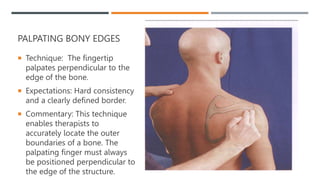
PALPATING BONY EDGES
 Technique: The fingertip
palpates perpendicular to the
edge of the bone.
 Expectations: Hard consistency
and a clearly defined border.
 Commentary: This technique
enables therapists to
accurately locate the outer
boundaries of a bone. The
palpating finger must always
be positioned perpendicular to
the edge of the structure.
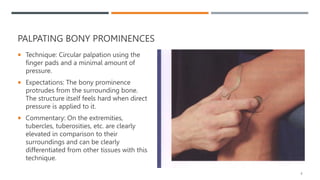
PALPATING BONY PROMINENCES
 Technique: Circular palpation using the
finger pads and a minimal amount of
pressure.
 Expectations: The bony prominence
protrudes from the surrounding bone.
The structure itself feels hard when direct
pressure is applied to it.
 Commentary: On the extremities,
tubercles, tuberosities, etc. are clearly
elevated in comparison to their
surroundings and can be clearly
differentiated from other tissues with this
technique.
6
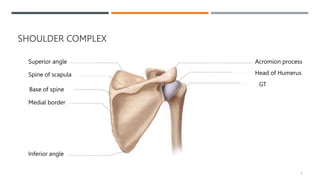
SHOULDER COMPLEX
7
Spine of scapula
Superior angle
Base of spine
Medial border
Inferior angle
Acromion process
Head of Humerus
GT
 The palpation starts posteriorly on the scapula, moves toward the
acromioclavicular (AC) joint, then addresses the region
surrounding the sternoclavicular joint (SC joint), and finishes with
the anterolateral aspect.
 But Therapists can naturally start palpating at any point they wish.
SAMPLE FOOTER TEXT 20XX 8
STARTING POSITION
 Upright-sitting on a stool or a treatment table with the arms
hanging loosely by the sides. In this SP, all components of the
shoulder complex are usually found in a neutral position and all
structures can be reached with ease.
SAMPLE FOOTER TEXT 20XX 9
SAMPLE FOOTER TEXT 20XX 10
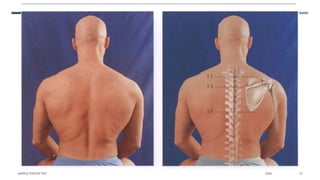
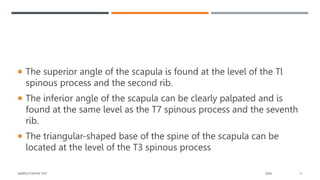
 The superior angle of the scapula is found at the level of the Tl
spinous process and the second rib.
 The inferior angle of the scapula can be clearly palpated and is
found at the same level as the T7 spinous process and the seventh
rib.
 The triangular-shaped base of the spine of the scapula can be
located at the level of the T3 spinous process
SAMPLE FOOTER TEXT 20XX 11
SAMPLE FOOTER TEXT 20XX 12
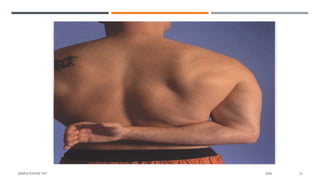
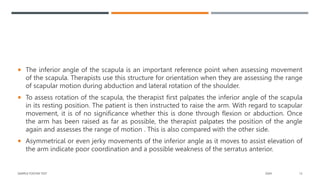
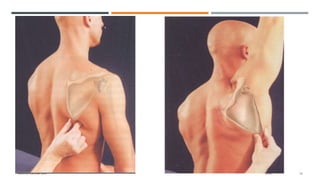
 The inferior angle of the scapula is an important reference point when assessing movement
of the scapula. Therapists use this structure for orientation when they are assessing the range
of scapular motion during abduction and lateral rotation of the shoulder.
 To assess rotation of the scapula, the therapist first palpates the inferior angle of the scapula
in its resting position. The patient is then instructed to raise the arm. With regard to scapular
movement, it is of no significance whether this is done through flexion or abduction. Once
the arm has been raised as far as possible, the therapist palpates the position of the angle
again and assesses the range of motion . This is also compared with the other side.
 Asymmetrical or even jerky movements of the inferior angle as it moves to assist elevation of
the arm indicate poor coordination and a possible weakness of the serratus anterior.
SAMPLE FOOTER TEXT 20XX 13
SAMPLE FOOTER TEXT 20XX 14
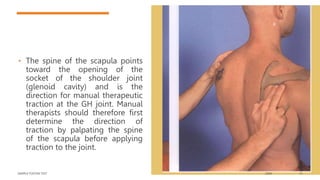
• The spine of the scapula points
toward the opening of the
socket of the shoulder joint
(glenoid cavity) and is the
direction for manual therapeutic
traction at the GH joint. Manual
therapists should therefore first
determine the direction of
traction by palpating the spine
of the scapula before applying
traction to the joint.
SAMPLE FOOTER TEXT 20XX 15
SAMPLE FOOTER TEXT 20XX 16
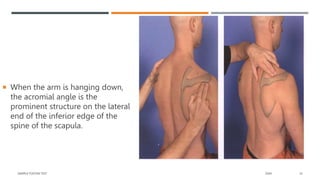
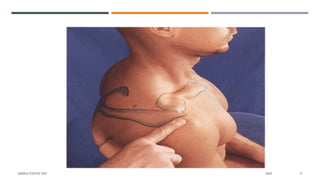
 When the arm is hanging down,
the acromial angle is the
prominent structure on the lateral
end of the inferior edge of the
spine of the scapula.
SAMPLE FOOTER TEXT 20XX 17
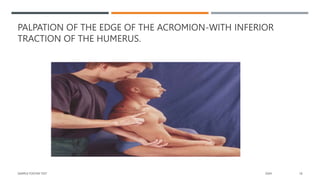
PALPATION OF THE EDGE OF THE ACROMION-WITH INFERIOR
TRACTION OF THE HUMERUS.
SAMPLE FOOTER TEXT 20XX 18
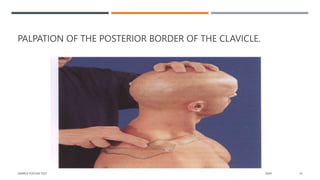
PALPATION OF THE POSTERIOR BORDER OF THE CLAVICLE.
SAMPLE FOOTER TEXT 20XX 19
ACROMIOCLAVICULAR JOINT
 The "posterior V" is defined as the point where both palpable edges (superior border of the spine of the
scapula and the posterior border of the clavicle) meet. The tip of this "V" points anterolaterally.
SAMPLE FOOTER TEXT 20XX 20
SAMPLE FOOTER TEXT 20XX 21
THANK YOU

PalpaTion Techniques- 1.pptx

  • 1.
    PALPATION TECHNIQUES- SHOULDERCOMPLEX Dr. Shilpasree Saha (PT), Asst. Professor, NIHS
  • 2.
    OBJECTIVES  The objectiveof precise palpation of detailed structures is to obtain local orientation for assessment and treatment. SAMPLE FOOTER TEXT 20XX 2
  • 3.
    CENTRAL ASPECTS OFTHE PROCEDURE  Three essential features characterize the palpatory process: • The application of the appropriate palpatory technique. • The expected consistency of tissue. • Differentiating the resistance felt in palpated structures. SAMPLE FOOTER TEXT 20XX 3
  • 4.
  • 5.
    PALPATING BONY EDGES Technique: The fingertip palpates perpendicular to the edge of the bone.  Expectations: Hard consistency and a clearly defined border.  Commentary: This technique enables therapists to accurately locate the outer boundaries of a bone. The palpating finger must always be positioned perpendicular to the edge of the structure.
  • 6.
    PALPATING BONY PROMINENCES Technique: Circular palpation using the finger pads and a minimal amount of pressure.  Expectations: The bony prominence protrudes from the surrounding bone. The structure itself feels hard when direct pressure is applied to it.  Commentary: On the extremities, tubercles, tuberosities, etc. are clearly elevated in comparison to their surroundings and can be clearly differentiated from other tissues with this technique. 6
  • 7.
    SHOULDER COMPLEX 7 Spine ofscapula Superior angle Base of spine Medial border Inferior angle Acromion process Head of Humerus GT
  • 8.
     The palpationstarts posteriorly on the scapula, moves toward the acromioclavicular (AC) joint, then addresses the region surrounding the sternoclavicular joint (SC joint), and finishes with the anterolateral aspect.  But Therapists can naturally start palpating at any point they wish. SAMPLE FOOTER TEXT 20XX 8
  • 9.
    STARTING POSITION  Upright-sittingon a stool or a treatment table with the arms hanging loosely by the sides. In this SP, all components of the shoulder complex are usually found in a neutral position and all structures can be reached with ease. SAMPLE FOOTER TEXT 20XX 9
  • 10.
  • 11.
     The superiorangle of the scapula is found at the level of the Tl spinous process and the second rib.  The inferior angle of the scapula can be clearly palpated and is found at the same level as the T7 spinous process and the seventh rib.  The triangular-shaped base of the spine of the scapula can be located at the level of the T3 spinous process SAMPLE FOOTER TEXT 20XX 11
  • 12.
  • 13.
     The inferiorangle of the scapula is an important reference point when assessing movement of the scapula. Therapists use this structure for orientation when they are assessing the range of scapular motion during abduction and lateral rotation of the shoulder.  To assess rotation of the scapula, the therapist first palpates the inferior angle of the scapula in its resting position. The patient is then instructed to raise the arm. With regard to scapular movement, it is of no significance whether this is done through flexion or abduction. Once the arm has been raised as far as possible, the therapist palpates the position of the angle again and assesses the range of motion . This is also compared with the other side.  Asymmetrical or even jerky movements of the inferior angle as it moves to assist elevation of the arm indicate poor coordination and a possible weakness of the serratus anterior. SAMPLE FOOTER TEXT 20XX 13
  • 14.
  • 15.
    • The spineof the scapula points toward the opening of the socket of the shoulder joint (glenoid cavity) and is the direction for manual therapeutic traction at the GH joint. Manual therapists should therefore first determine the direction of traction by palpating the spine of the scapula before applying traction to the joint. SAMPLE FOOTER TEXT 20XX 15
  • 16.
    SAMPLE FOOTER TEXT20XX 16  When the arm is hanging down, the acromial angle is the prominent structure on the lateral end of the inferior edge of the spine of the scapula.
  • 17.
  • 18.
    PALPATION OF THEEDGE OF THE ACROMION-WITH INFERIOR TRACTION OF THE HUMERUS. SAMPLE FOOTER TEXT 20XX 18
  • 19.
    PALPATION OF THEPOSTERIOR BORDER OF THE CLAVICLE. SAMPLE FOOTER TEXT 20XX 19
  • 20.
    ACROMIOCLAVICULAR JOINT  The"posterior V" is defined as the point where both palpable edges (superior border of the spine of the scapula and the posterior border of the clavicle) meet. The tip of this "V" points anterolaterally. SAMPLE FOOTER TEXT 20XX 20
  • 21.
    SAMPLE FOOTER TEXT20XX 21 THANK YOU