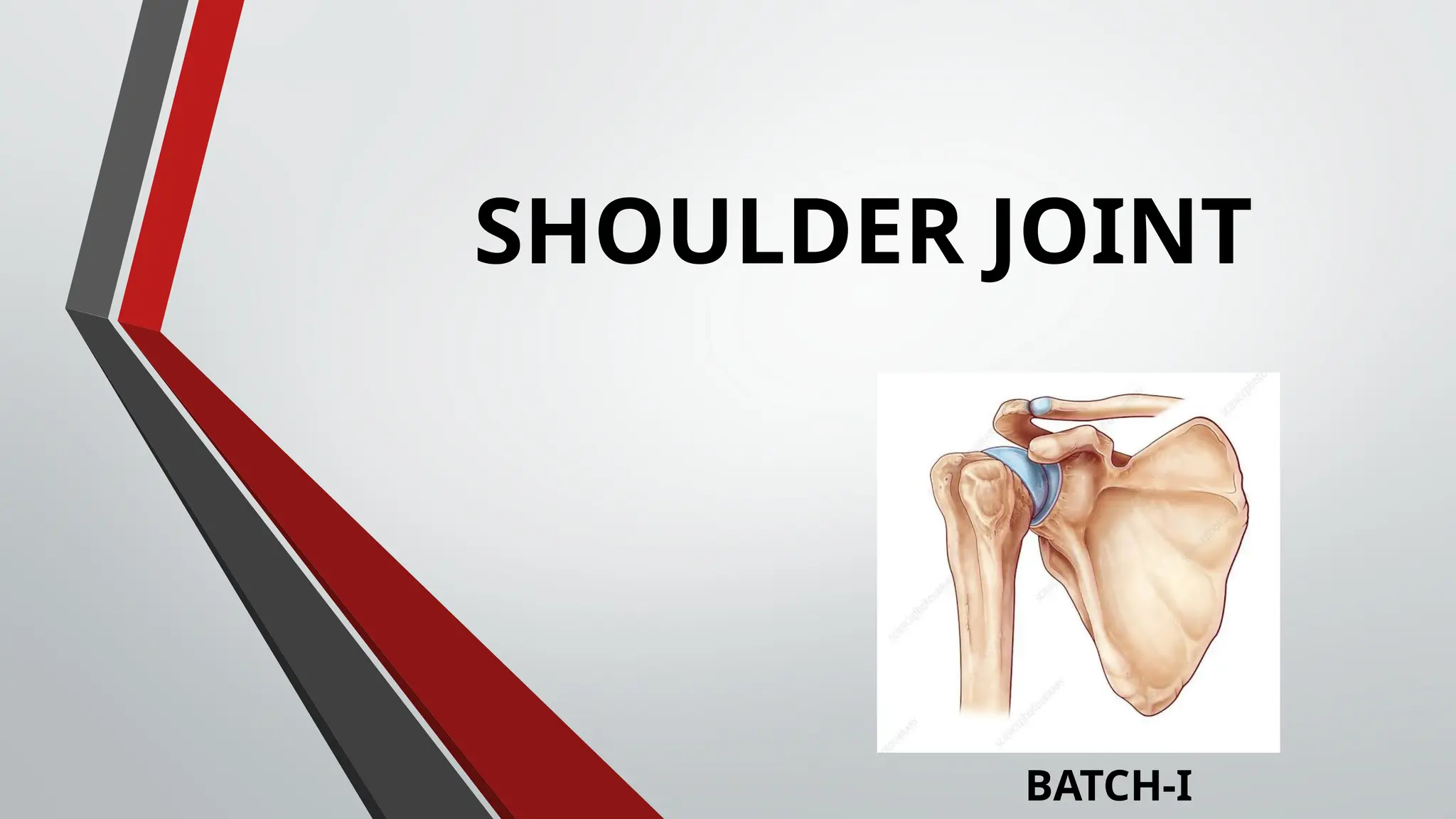
SHOULDER JOINT
BATCH-I
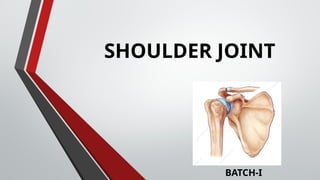
SHOULDER JOINT
ANATOMY
SYNOPSIS:
• Introduction
• Type
• Articular surface
• Stability
• Ligaments
• Bursa
• Relations
• Blood supply
• Nerve supply
• Movements
INTRODUCTION:
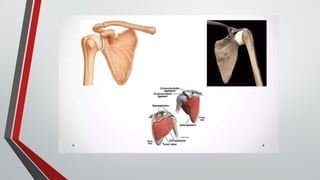
Articulation of two bones scapula and humerus – SHOULDER JOINT
TYPE:
Synovial Joint of Ball and Socket variety
ARTICULAR SURFACE:
Articulation of glenoid cavity of scapula and the head of the
humerus
Termed as Glenohumeral Articulation
STABILITY:
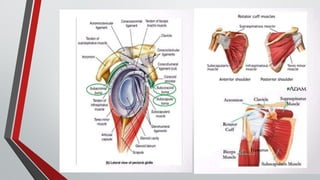
• Coracoacromial arch or secondary socket for the head of the
humerus
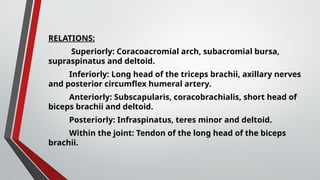
• Musculotendinous cuff of the shoulder from the tendons of the
subscapularis (anteriorly), supraspinatus (above) and infraspinatus
and teres major (posteriorly)
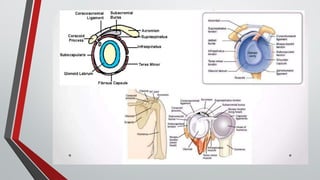
• Glenoid labrum helps in deepening the glenoid fossa.
• Stability also provided by the muscles attaching the
humerus to the pectoral gridle, the long head of the biceps
brachii and long head of triceps brachii.
• Atmospheric Pressure also stabilizes the joint.
LIGAMENTS:
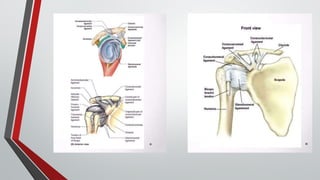
• Capsular ligament
• Coracohumeral ligament
• Transverse humeral ligament
• The glenoid labrum
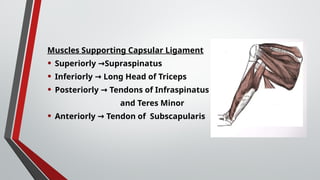
Muscles Supporting Capsular Ligament
• Superiorly Supraspinatus
→
• Inferiorly Long Head of Triceps
→
• Posteriorly Tendons of Infraspinatus
→
and Teres Minor
• Anteriorly Tendon of Subscapularis
→
CAPSULAR LIGAMENT
• Encircles entire glenohumeral joint.
ATTACHED:
• Medially: Above to the circumference of glenoid cavity beyond
the glenoid ligament
• Laterally: Below to anatomical neck of the humerus
• Thicker above and below.
• Loose and lax
• Allow bone to be separated from each other more than an inch
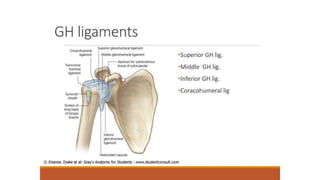
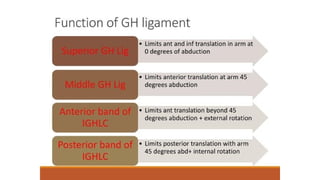
GLENOHUMERAL LIGAMENTS
• SUPERIOR BAND: attached to the upper end of lesser tubercle
• MIDDLE BAND: attached to lower part of lesser tubercle
• INFERIOR BAND: lower part of anatomical neck of humerus.
CORACO-HUMERAL LIGAMENT
• Broad Thick Band
• Strengthens Upper part of Capsular Ligament
• Attachments
Arises from outer border of coracoid process
Blended with tendon of supraspinatus muscles
United to capsule in greater part of its extend.
TRANSVERSE HUMERAL LIGAMENT
• Broad band of fibrous tissues
• Connects the two lips of the upper part of intertubercular
sulcus and acts as a retinaculum to keep the long tendon of
biceps in position.
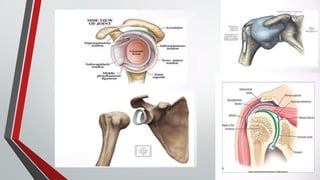
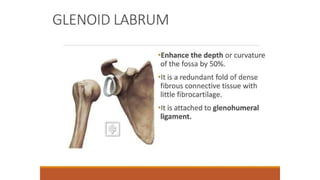
GLENOID LABRUM
• Fibro-cartilage rim attached around margin of glenoid cavity.
• Triangular on section
• The thickest portion at circumference of cavity,free edge is sharp
and thin
• Continuous above with long head of biceps
• Deepens cavity for articulation and protects edges of bone
• Lined by synovial membrane
SYNOVIAL MEMBRANE
• Reflected from margin of glenoid cavity over fibro-cartilaginous
rim surrounding it.
• Over internal surface of capsular ligaments.
• Covers lower part and sides of anatomical neck of humerus.
BURSAE:
Subacromial bursa or subdeltoid bursa.
Subscapularis bursa.
Infraspinatus bursa.
RELATIONS:
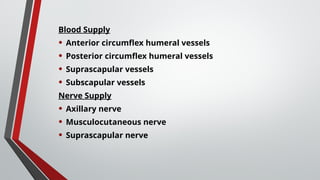
Superiorly: Coracoacromial arch, subacromial bursa,
supraspinatus and deltoid.
Inferiorly: Long head of the triceps brachii, axillary nerves
and posterior circumflex humeral artery.
Anteriorly: Subscapularis, coracobrachialis, short head of
biceps brachii and deltoid.
Posteriorly: Infraspinatus, teres minor and deltoid.
Within the joint: Tendon of the long head of the biceps
brachii.
Blood Supply
• Anterior circumflex humeral vessels
• Posterior circumflex humeral vessels
• Suprascapular vessels
• Subscapular vessels
Nerve Supply
• Axillary nerve
• Musculocutaneous nerve
• Suprascapular nerve
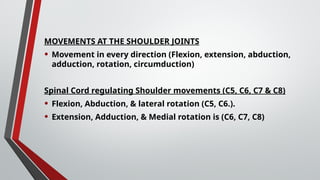
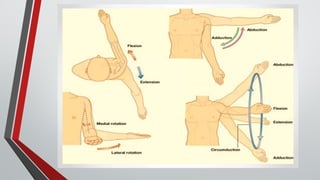
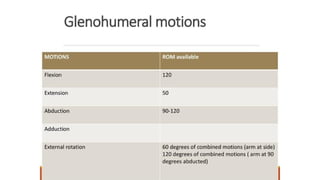
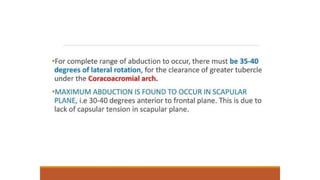
MOVEMENTS AT THE SHOULDER JOINTS
• Movement in every direction (Flexion, extension, abduction,
adduction, rotation, circumduction)
Spinal Cord regulating Shoulder movements (C5, C6, C7 & C8)
• Flexion, Abduction, & lateral rotation (C5, C6.).
• Extension, Adduction, & Medial rotation is (C6, C7, C8)
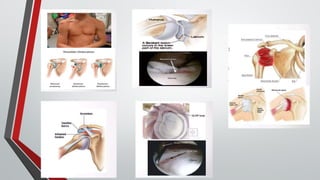
APPLIED ANATOMY:
• Dislocation
• Shoulder Tip Pain
• Frozen Shoulder
• Bankart Lesion
• Slap Lesion
• Shoulder Bursitis
BIOMECHANICS OF SHOULDER COMPLEX
PASSIVE MOVEMENT
DEFINITION
• These movements are produced by an external force during
muscular inactivity or when muscular activity is voluntarily
reduced as much as possible to permit movement.
CLASSIFICATION
• Relaxed passive movements
• Passive manual mobilisation
1. Mobilisation of joints
2. Manipulation of joints
3. Controlled sustained stretching of tightened structures
RELAXED PASSIVE MOVEMENTS
• These are movements performed accurately and smoothly
by the physiotherapist .
• A knowledge of the anatomy of joints is required.
• The movement are performed in the same range and
direction as active movements.
• The joints is moved through the existing free range and
within the limits of pain.
PRINCIPLES
• RELAXATION
• A brief explanation of what is to happen is given to the patient, who is
taught to relax voluntarily, except in case of flaccid paralysis.
• The selection of a suitable starting position ensure comfort and support,
and the bearing of the physiotherapist Will do much to inspire confidence
and cooperation in maintaining relaxation through the movement.
• FIXATION
• The proximal joint should be fixed or stabilized to the joint line as
possible to ensure that the movement is localised to that joint.
• SUPPORT
• Full and comfortable support is given to the part of be moved, so that the
patient has confidence and will remain relaxed.
• TRACTION
• The long axial traction given to the joint
• Traction is thought to facilitate the movement by reducing the
interarticular friction
• RANGE
• The ROM of movement is as full as the condition of the joints
permits without eliciting pain or spasm in the surrounding
muscles.
• SPEED AND DURATION
• The speed must be uniform, fairly slow and rhythmical.
• Same speed should be maintained throughout the movement.
• SEQUENCE
• It should be decided before treating the patients, while treating the
flaccid conditions the movement should be proximal to distal, in
spastic as well as to increase the venous and lymphatic drainage
the movement has to be performed from distal to proximal.
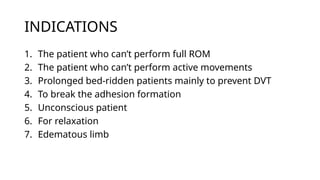
INDICATIONS
1. The patient who can’t perform full ROM
2. The patient who can’t perform active movements
3. Prolonged bed-ridden patients mainly to prevent DVT
4. To break the adhesion formation
5. Unconscious patient
6. For relaxation
7. Edematous limb
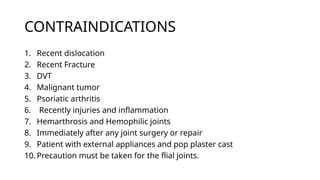
CONTRAINDICATIONS
1. Recent dislocation
2. Recent Fracture
3. DVT
4. Malignant tumor
5. Psoriatic arthritis
6. Recently injuries and inflammation
7. Hemarthrosis and Hemophilic joints
8. Immediately after any joint surgery or repair
9. Patient with external appliances and pop plaster cast
10. Precaution must be taken for the flial joints.
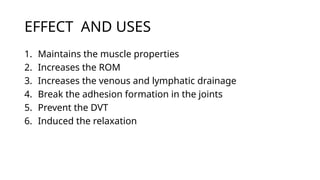
EFFECT AND USES
1. Maintains the muscle properties
2. Increases the ROM
3. Increases the venous and lymphatic drainage
4. Break the adhesion formation in the joints
5. Prevent the DVT
6. Induced the relaxation
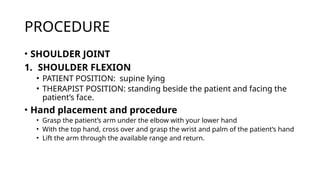
PROCEDURE
• SHOULDER JOINT
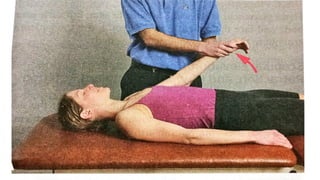
1. SHOULDER FLEXION
• PATIENT POSITION: supine lying
• THERAPIST POSITION: standing beside the patient and facing the
patient’s face.
• Hand placement and procedure
• Grasp the patient’s arm under the elbow with your lower hand
• With the top hand, cross over and grasp the wrist and palm of the patient’s hand
• Lift the arm through the available range and return.
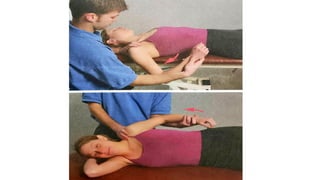
2. SHOULDER EXTENSION
• PATIENT POSITION: side lying or supine lying
• THERAPIST POSITION: standing back to the patient and facing the
shoulder joint.
• Hand placement and procedure
• To obtain extension past zero, position the patient’s shoulder at
edge of the bed when supine or position the patient side- lying,
prone, or sitting.
• In side lying forearm and elbow is placed over the right side
forearm of the therapist by flexing the patient and wrist
movement is restricted by the therapist hand.
• Left hand of the therapist stabilizes the shoulder joint of the
patient.
• It is not possible to apply the long axial traction. Therapist right
hand is performing the extension movement of the shoulder.
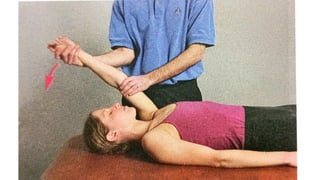
3. SHOULDER ABDUCTION AND ADDUCTION
• PATIENT POSITION: Supine lying
• THERAPIST POSITION: Standing beside the patient and facing the
patient’s face
• HAND PLACEMENT AND PROCEDURE
• Use the same hand placement as with flexion, but move the arm
out to the side. The elbow may be flexed for ease in completing the
arc of motion.
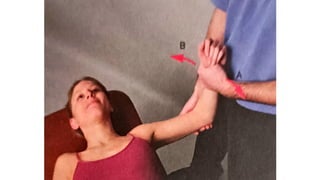
4. SHOULDER INTERNAL (MEDIAL) AND EXTERNAL (LATERAL)
ROTATION
• PATIENT POSITION: supine lying
• THERAPIST POSITION: Standing beside the patient and facing the
patient’s shoulder
• If possible, the arm is abducted in 90 degree, the elbow is flexed to 90
degree and the forearm is held in neutral position. Rotation may also be
performed with the patient’s arm at the side of the thorax, but full
internal rotation is not possible in the position.
• HAND PLACEMENT AND PROCEDURE
• Grasp the hand and wrist with your index finger between the patient’s
thumb and index finger
• place your thumb and the rest of your fingers on either side of the
patient’s wrist, thereby stabilizing the wrist.
• With the other hand, stabilize the elbow.
• Rotate the humerus by moving the forearm like spoke on a wheel.
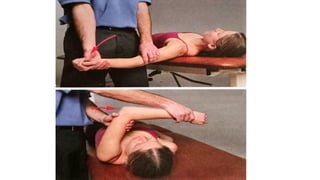
5. SHOULDER HORIZONTAL ADDUCTION (EXTENSION) AND
ADDUCTION (FLEXION)
• PATIENT POSITION: Supine lying
• THERAPIST POSITION: Standing beside the patient and facing the
patient’s face
• To reach full horizontal abduction, position the patient’s shoulder at
edge of the table. Begin with the arm either adducted or abducted 90
degree.
• HAND PLACEMENT AND PROCEDURE
• Hand placement is same as flexion, but turn your body and face the
patient’s head as you move the patient’s arm out to the side and then
across the body.
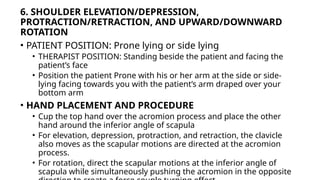
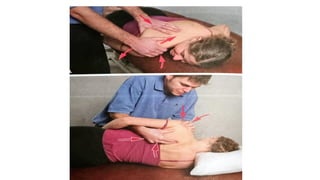
6. SHOULDER ELEVATION/DEPRESSION,
PROTRACTION/RETRACTION, AND UPWARD/DOWNWARD
ROTATION
• PATIENT POSITION: Prone lying or side lying
• THERAPIST POSITION: Standing beside the patient and facing the
patient’s face
• Position the patient Prone with his or her arm at the side or side-
lying facing towards you with the patient’s arm draped over your
bottom arm
• HAND PLACEMENT AND PROCEDURE
• Cup the top hand over the acromion process and place the other
hand around the inferior angle of scapula
• For elevation, depression, protraction, and retraction, the clavicle
also moves as the scapular motions are directed at the acromion
process.
• For rotation, direct the scapular motions at the inferior angle of
scapula while simultaneously pushing the acromion in the opposite
JOINT MOBILIZATION
DEFINITION
Joint mobilization is a passive, skilled manual therapeutic
technique applied to joints and related soft tissue at varying
speeds and amplitudes using physiological or accessory
motions for therapeutic purpose.
INDICATIONS
Pain
Muscle Guarding
Muscle Spasm
Joint Hypomobility
Positional Fault/Subluxations
Progressive Limitation
Functional Immobility
CONTRAINDICATIONS
 Hypermobility
 Joint Effusion
 Inflammation
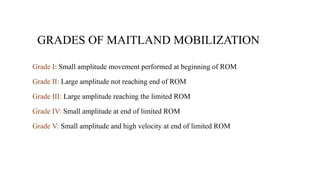
GRADES OF MAITLAND MOBILIZATION
Grade I: Small amplitude movement performed at beginning of ROM
Grade II: Large amplitude not reaching end of ROM
Grade III: Large amplitude reaching the limited ROM
Grade IV: Small amplitude at end of limited ROM
Grade V: Small amplitude and high velocity at end of limited ROM
TECHNIQUES
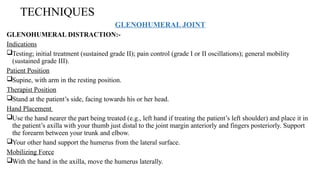
GLENOHUMERAL JOINT
GLENOHUMERAL DISTRACTION:-
Indications
Testing; initial treatment (sustained grade II); pain control (grade I or II oscillations); general mobility
(sustained grade III).
Patient Position
Supine, with arm in the resting position.
Therapist Position
Stand at the patient’s side, facing towards his or her head.
Hand Placement
Use the hand nearer the part being treated (e.g., left hand if treating the patient’s left shoulder) and place it in
the patient’s axilla with your thumb just distal to the joint margin anteriorly and fingers posteriorly. Support
the forearm between your trunk and elbow.
Your other hand support the humerus from the lateral surface.
Mobilizing Force
With the hand in the axilla, move the humerus laterally.
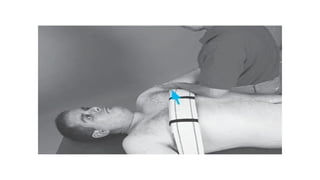
GLENOHUMERAL CAUDAL GLIDE IN RESTING POSITION:-
Indications
To increase abduction (sustained grade III); to reposition
the humeral head if superiorly positioned.
Patient Position
Supine, with arm in the resting position.
Therapist position
Stand lateral to the patient’s arm being treated and support the forearm between your trunk
and elbow.
Hand position
Place one hand in the patient’s axilla to provide a grade I distraction.
 The web space of your other hand is placed just distal to the acromion process.
Mobilizing Force
With the superiorly placed hand, glide the humerus in an inferior direction.
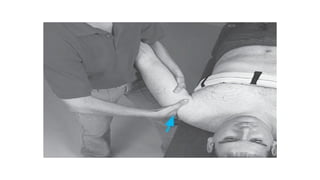
GLENOHUMERAL CAUDAL GLIDE (LONG AXIS TRACTION):-
Patient Position
Supine, with arm in the resting position.
Hand Placement and Mobilizing Force
Support the patient’s forearm between your trunk and elbow. Grasp around
the distal arm with both hands and apply the force in a caudal direction as
your body weight toward the patient’s feet.
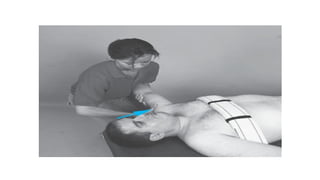
GLENOHUMERAL CAUDAL GLIDE PROGRESSION:-
Indication
To increase abduction.
Patient Position
Supine or sitting, with the arm abducted to the end of its available range.
External rotation of the humerus should be added to the end-range position as the arm
approaches and goes beyond 90.
Therapist Position and Hand Placement
With the patient supine, stand facing the patient’s feet and stabilize the patient’s arm against
your trunk with the hand farthest from the patient. Slight lateral motion of your trunk provides
grade I distraction via long-axis traction.
With the patient sitting, stand behind the patient and cradle the distal humerus with the hand
farthest from the patient; this hand provides a grade I distraction via a long-axis traction.
Place the web space of your other hand just distal to the acromion process on the proximal
humerus.
Mobilizing Force
With the hand on the proximal humerus, glide the humerus in an inferior direction.
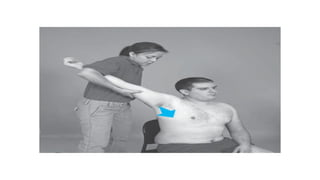
GLENOHUMERAL ELEVATION PROGRESSION:-
Indication
To increase elevation beyond 90 degree of abduction.
Patient Position
Supine or sitting, with the arm abducted and externally rotated to the end of its available range.
Therapist Position and Hand Placement
Hand placement is the same as for caudal glide progression.
Adjust your body position so the hand applying the mobilizing force is aligned with the
treatment plane in the glenoid fossa.
With the hand grasping the elbow, apply a grade I distraction force.
Mobilizing Force
With the hand on the proximal humerus, glide the humerus in a progressively anterior direction
against the inferior folds of the capsule in the axilla.
The direction of force with respect to the patient’s body depends on the amount of upward
rotation and protraction of the scapula.
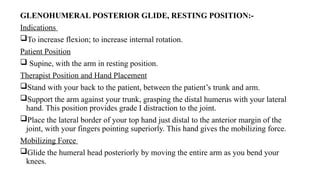
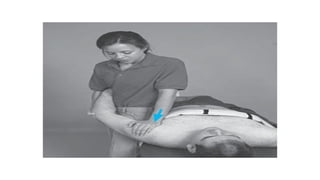
GLENOHUMERAL POSTERIOR GLIDE, RESTING POSITION:-
Indications
To increase flexion; to increase internal rotation.
Patient Position
 Supine, with the arm in resting position.
Therapist Position and Hand Placement
Stand with your back to the patient, between the patient’s trunk and arm.
Support the arm against your trunk, grasping the distal humerus with your lateral
hand. This position provides grade I distraction to the joint.
Place the lateral border of your top hand just distal to the anterior margin of the
joint, with your fingers pointing superiorly. This hand gives the mobilizing force.
Mobilizing Force
Glide the humeral head posteriorly by moving the entire arm as you bend your
knees.
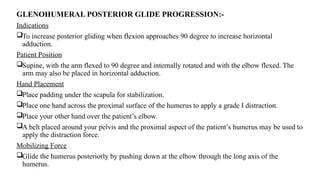
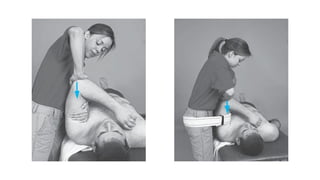
GLENOHUMERAL POSTERIOR GLIDE PROGRESSION:-
Indications
To increase posterior gliding when flexion approaches 90 degree to increase horizontal
adduction.
Patient Position
Supine, with the arm flexed to 90 degree and internally rotated and with the elbow flexed. The
arm may also be placed in horizontal adduction.
Hand Placement
Place padding under the scapula for stabilization.
Place one hand across the proximal surface of the humerus to apply a grade I distraction.
Place your other hand over the patient’s elbow.
A belt placed around your pelvis and the proximal aspect of the patient’s humerus may be used to
apply the distraction force.
Mobilizing Force
Glide the humerus posteriorly by pushing down at the elbow through the long axis of the
humerus.
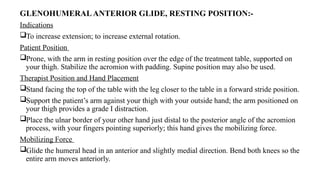
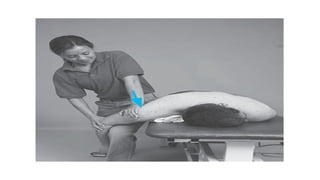
GLENOHUMERALANTERIOR GLIDE, RESTING POSITION:-
Indications
To increase extension; to increase external rotation.
Patient Position
Prone, with the arm in resting position over the edge of the treatment table, supported on
your thigh. Stabilize the acromion with padding. Supine position may also be used.
Therapist Position and Hand Placement
Stand facing the top of the table with the leg closer to the table in a forward stride position.
Support the patient’s arm against your thigh with your outside hand; the arm positioned on
your thigh provides a grade I distraction.
Place the ulnar border of your other hand just distal to the posterior angle of the acromion
process, with your fingers pointing superiorly; this hand gives the mobilizing force.
Mobilizing Force
Glide the humeral head in an anterior and slightly medial direction. Bend both knees so the
entire arm moves anteriorly.
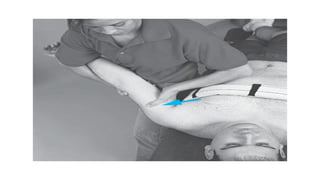
GLENOHUMERAL EXTERNAL ROTATION PROGRESSIONS:-
Indication
To increase external rotation.
Techniques
Because of the danger of subluxation when applying an anterior glide with the
humerus externally rotated, use a distraction progression or elevation progression to
gain range.
Distraction progression: Begin with the shoulder in resting position; externally rotate
the humerus to end range and then apply a grade III distraction perpendicular to the
treatment plane in the glenoid fossa.
Elevation progression: This technique incorporates end-range external rotation.
MANUAL MUSCLE TESTING
SYNOPSIS:
 DEFINITION
 USES
 CONTRAINDICATION
 PRECAUTION
 PRINCIPLES
 TEST PROCEDURE
A.BREAK TEST
B.MAKE TEST
C.ACTIVE RESISTANCE TEST
D.SUBSTITUTION
 BASIC RULES OF PROCEDURE
 SEVERAL POSTION TO ASSESS MMT
 SHOULDER JOINT - MOVEMENT
DEFINITION
MANUAL MUSCLE TESTING IS A PROCEDURE FOR EVALUATION OF
FUNCTION & STRENGTH OF INDIVIDUAL MUSCLE OR GROUP OF
MUSCLE BASED ON EFFECTIVE PERFORMANCE OF MOVEMENT IN
RELATION TO THE FORCE OF GRAVITY & MANUAL RESISTANCE.
USES
TO KNOW THE STRENGTH OF MUSCLE
DIFFERENTIAL DIAGNOSIS-PIN POINTING THE SPECIFIC PROBLEM(EG. CONTRACTURE, DEFORMITY ETC)
TO HELP SURGEON IN PLANNING SURGERY- MINIMUM REQUIREMENT FOR SURGERY IN GRADE 4.
PROGNOSTICATION OF PATIENT
HELP IN PLANNING THE TREATMENT
HELP THE THERAPIST TO SUGGEST WHICH CALIPER TO BE USED AND UPTO WHAT EXTEND HE SHOULD BE
EMBRARED.
THE SITE OR LEVEL OF A PERIPHERAL LESION MAY BE DETERMINED.
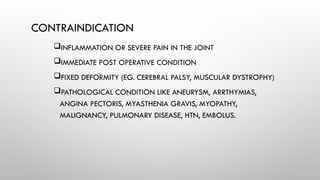
CONTRAINDICATION
INFLAMMATION OR SEVERE PAIN IN THE JOINT
IMMEDIATE POST OPERATIVE CONDITION
FIXED DEFORMITY (EG. CEREBRAL PALSY, MUSCULAR DYSTROPHY)
PATHOLOGICAL CONDITION LIKE ANEURYSM, ARRTHYMIAS,
ANGINA PECTORIS, MYASTHENIA GRAVIS, MYOPATHY,
MALIGNANCY, PULMONARY DISEASE, HTN, EMBOLUS.
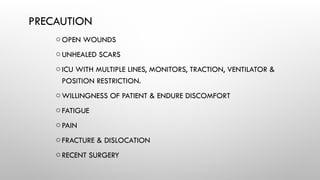
PRECAUTION
oOPEN WOUNDS
oUNHEALED SCARS
oICU WITH MULTIPLE LINES, MONITORS, TRACTION, VENTILATOR &
POSITION RESTRICTION.
oWILLINGNESS OF PATIENT & ENDURE DISCOMFORT
oFATIGUE
oPAIN
oFRACTURE & DISLOCATION
oRECENT SURGERY
PRINCIPLES
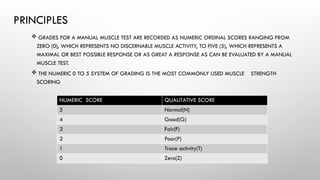
 GRADES FOR A MANUAL MUSCLE TEST ARE RECORDED AS NUMERIC ORDINAL SCORES RANGING FROM
ZERO (0), WHICH REPRESENTS NO DISCERNABLE MUSCLE ACTIVITY, TO FIVE (5), WHICH REPRESENTS A
MAXIMAL OR BEST POSSIBLE RESPONSE OR AS GREAT A RESPONSE AS CAN BE EVALUATED BY A MANUAL
MUSCLE TEST.
 THE NUMERIC 0 TO 5 SYSTEM OF GRADING IS THE MOST COMMONLY USED MUSCLE STRENGTH
SCORING
NUMERIC SCORE QUALITATIVE SCORE
5 Normal(N)
4 Good(G)
3 Fair(F)
2 Poor(P)
1 Trace activity(T)
0 Zero(Z)
TEST PROCEDURE
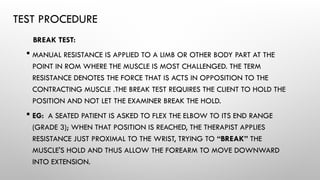
BREAK TEST:
 MANUAL RESISTANCE IS APPLIED TO A LIMB OR OTHER BODY PART AT THE
POINT IN ROM WHERE THE MUSCLE IS MOST CHALLENGED. THE TERM
RESISTANCE DENOTES THE FORCE THAT IS ACTS IN OPPOSITION TO THE
CONTRACTING MUSCLE .THE BREAK TEST REQUIRES THE CLIENT TO HOLD THE
POSITION AND NOT LET THE EXAMINER BREAK THE HOLD.
 EG: A SEATED PATIENT IS ASKED TO FLEX THE ELBOW TO ITS END RANGE
(GRADE 3); WHEN THAT POSITION IS REACHED, THE THERAPIST APPLIES
RESISTANCE JUST PROXIMAL TO THE WRIST, TRYING TO “BREAK” THE
MUSCLE'S HOLD AND THUS ALLOW THE FOREARM TO MOVE DOWNWARD
INTO EXTENSION.
ACTIVE RESISTANCE TEST:
- RESISTANCE IS APPLIED OPPOSITE THE ACTIVELY
CONTRACTING MOVEMENT THROUGHOUT THE RANGE, STARTING
AT THE FULLY LENGTHENED POSITION.
- THE AMOUNT OF RESISTANCE MATCHES THE
PATIENT'S RESISTANCE BUT ALLOWS THE JOINT TO MOVE THROUGH
THE FULL RANGE.
SUBSTITUTION
- SUBSTITUTION RESULTS FROM ONE OR MORE ATTEMPTING TO
COMPENSATE FOR THE LACK OF STRENGTH IN ANOTHER MUSCLE OR GROUP
OF MUSCLE
- SUBSTITUTION IS A GOOD INDICATOR TO PROVE THAT THE TESTED
MUSCLE IS WEAK
EG: 1.FIXATION OF MUSCLE EX. SHOULDER , HIP JT
2.ANTAGONIST EX .FINGER FLEXOR, EXTENSOR
3. AGONIST EX. GLUTEUS MEDIUS , TENSOR FASCIAE LATAE
BASIC RULES OF PROCEDURE
 PLACE THE SUBJECT IN A POSITION THAT OFFERS THE BEST FIXATION OF THE
BODY AS A WHOLE (USUALLY SUPINE, PRONE, OR SIDE-LYING).
STABILIZE THE PART PROXIMAL TO THE TESTED PART OR, AS IN THE CASE OF
THE HAND, ADJACENT TO THE TESTED PART. STABILIZATION IS NECESSARY FOR
SPECIFICITY IN TESTING.
 PLACE THE PART TO BE TESTED IN PRECISE ANTIGRAVITY TEST POSITION,
WHENEVER APPROPRIATE, TO HELP ELICIT THE DESIRED MUSCLE ACTION AND
AID IN GRADING.
USE TEST MOVEMENTS IN THE HORIZONTAL PLANE WHEN TESTING MUSCLES
THAT ARE TOO WEAK TO FUNCTION AGAINST GRAVITY.
USE TEST MOVEMENTS IN ANTIGRAVITY POSITIONS FOR MOST TRUNK MUSCLE
TESTS IN WHICH BODY WEIGHT OFFERS SUFFICIENT RESISTANCE.
APPLY PRESSURE DIRECTLY OPPOSITE THE LINE OF PULL OF THE MUSCLE OR
THE MUSCLE SEGMENT BEING TESTED. LIKE THE ANTIGRAVITY POSITION, THE
DIRECTION OF PRESSURE HELPS TO ELICIT THE DESIRED MUSCLE ACTION.
APPLY PRESSURE GRADUALLY BUT NOT TOO SLOWLY, ALLOWING THE
SUBJECT TO "GET SET AND HOLD."
APPLY UNIFORM PRESSURE; AVOID LOCALIZED PRESSURE THAT CAN CAUSE
DISCOMFORT.
USE A LONG LEVER WHENEVER POSSIBLE, UNLESS CONTRAINDICATED. THE
LENGTH OF THE LEVER IS DETERMINED BY THE LOCATION OF THE PRESSURE
ALONG THE LEVER ARM. BETTER DISCRIMINATION OF STRENGTH FOR
PURPOSES OF GRADING IS OBTAINED THROUGH USE OF A LONG LEVER.
USE A SHORT LEVER IF THE INTERVENING MUSCLES DO NOT PROVIDE
SUFFICIENT FIXATION FOR USE OF A LONG LEVER.
SEVERAL POSITION TO ASSESS MMT
SUPINE - BICEPS , BRACHIORADIALIS, TRICEPS, PEC.MAJOR , PEC.MINOR , SHOULDERMR -
TERES MINOR , INFRASPINATUS SHOULDER LR- SERRATUS ANTERIOR, ANTERIOR DELTOID
PRONE _ LATTISSIMUS DORSI, TRAPEZIUS (MIDDLE , LOWER), POSTERIOR DELTOID , TRICEPS,
TERES MAJOR ,SHOULDER MR &LR , RHOMBOID
SITTING - DELTOID (ANTERIOR , MIDDLE, POSTERIOR ), CORACOBRACHIALIS , UPPER
TRAPEZIUS , SERRATUS ANTERIOR
STANDING - SERRATUS ANTERIOR
SHOULDER JOINT MOVEMENTS
FLEXION
EXTENSION
ABDUCTION
ADDUCTION
EXTERNAL ROTATION
INTERNAL ROTATION
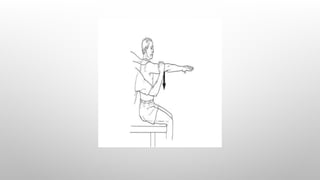
SHOULDER FLEXION
MUSCLE INVOLVED- ANTERIOR DELTOID, ROTATOR CUFF, CLAVICULAR PORTION OF PECTORALIS MAJOR, AND
CORACOBRACHIALIS.
GRADE 5, GRADE 4, AND GRADE 3
POSITION OF PATIENT:
- SHORT SITTING WITH ARMS AT SIDES, ELBOW SLIGHTLY FLEXED, FOREARM PRONATED.
INSTRUCTIONS TO THERAPIST:
- STAND AT TEST SIDE. ASK PATIENT TO RAISE ARM FORWARD TO SHOULDER HEIGHT (90°), KEEPING
ELBOW STRAIGHT.
- IF FULL RANGE IS PRESENT (GRADE 3), POSITION ARM IN TEST POSITION (90°) AND APPLY
APPROPRIATE RESISTANCE.
- THERAPIST'S HAND GIVING RESISTANCE IS CONTOURED OVER THE DISTAL HUMERUS JUST ABOVE
THE ELBOW. THE OTHER HAND MAY STABILIZE THE SHOULDER
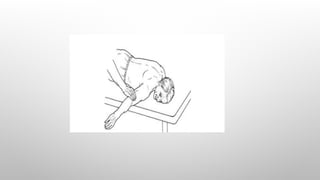
GRADE 2, GRADE 1, AND GRADE 0
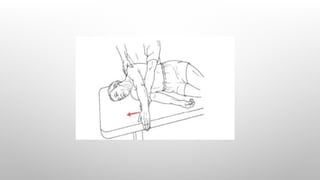
POSITION OF PATIENT: SIDE-LYING POSITION (TEST SIDE UP).
INSTRUCTIONS TO THERAPIST: WITH PATIENT SIDE-LYING TO MINIMIZE
GRAVITY, STAND BEHIND PATIENT AND CRADLE THE TEST ARM AT THE ELBOW. THEN ASK PATIENT
TO FLEX THE SHOULDER. (A POWDER BOARD MAY ALSO BE USED.)
TEST: PATIENT ATTEMPTS TO FLEX SHOULDER.
INSTRUCTIONS TO PATIENT: “TRY TO RAISE YOUR ARM.”
(NOTE: GRADE 1 AND GRADE 0)
INSTRUCTIONS TO THERAPIST: STAND BEHIND PATIENT. FINGERS USED FOR
PALPATION ARE PLACED OVER THE SUPERIOR AND ANTERIOR SURFACES OF THE DELTOID OVER
THE SHOULDER JOINT
SHOULDER EXTENSION
MUSCLE INVOLVED - POSTERIOR DELTOID, LATISSIMUS DORSI, TERES MAJOR, AND LONG HEAD OF
TRICEPS
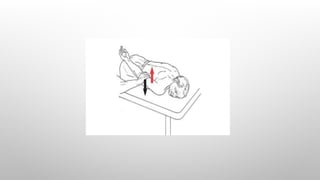
GRADE 5, GRADE 4, GRADE 3, AND GRADE 2
POSITION OF PATIENT: PRONE WITH ARMS AT SIDES AND SHOULDER INTERNALLY ROTATED (PALM
UP)
INSTRUCTIONS TO THERAPIST: STAND AT TEST SIDE. ASK PATIENT TO LIFT ARM AS HIGH AS
POSSIBLE. IF FULL RANGE IS AVAILABLE (GRADE 3), POSITION ARM IN TEST POSITION NEAR END RANGE AND
APPLY APPROPRIATE RESISTANCE.
-THE HAND USED FOR RESISTANCE IS CONTOURED OVER THE POSTERIOR ARM JUST ABOVE THE
ELBOW
TEST: PATIENT RAISES ARM OFF THE TABLE, KEEPING THE ELBOW STRAIGHT
INSTRUCTIONS TO PATIENT: “LIFT YOUR ARM AS HIGH AS YOU CAN. HOLD IT. DON'T LET ME PUSH
IT DOWN.”
GRADE 1 AND GRADE 0
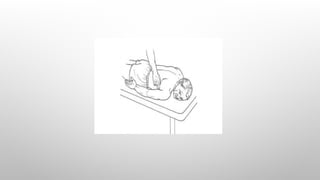
POSITION OF PATIENT: PRONE WITH ARMS AT SIDES AND SHOULDER INTERNALLY ROTATED
(PALM UP).
INSTRUCTIONS TO THERAPIST: STAND AT TEST SIDE. FINGERS FOR PALPATION ARE PLACED
ON THE POSTERIOR ASPECT OF THE UPPER ARM (POSTERIOR DELTOID) PALPATE OVER THE
POSTERIOR SHOULDER JUST SUPERIOR TO THE AXILLA FOR POSTERIOR DELTOID FIBERS.
-PALPATE THE TERES MAJOR ON THE LATERAL BORDER OF THE SCAPULA JUST BELOW
THE AXILLA. THE TERES MAJOR IS THE LOWER OF THE TWO MUSCLES THAT ENTER THE AXILLA AT
THIS POINT; IT FORMS THE LOWER POSTERIOR RIM OF THE AXILLA.
TEST AND INSTRUCTIONS TO PATIENT: PATIENT ATTEMPTS TO LIFT ARM FROM TABLE.
SHOULDER ABDUCTION
MUSCLE INVOLVED – MIDDLE DELTOID, SUPRASPINATUS
GRADE 5, GRADE 4, AND GRADE 3
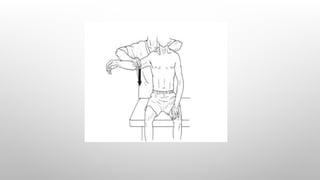
POSITION OF PATIENT: SHORT SITTING WITH ARM AT SIDE AND ELBOW
SLIGHTLY FLEXED.
INSTRUCTIONS TO THERAPIST: STAND BEHIND PATIENT. ASK PATIENT TO LIFT
ARM OUT TO THE SIDE TO SHOULDER LEVEL (TEST POSITION) WITH ARM IN NEUTRAL ROTATION AND
ELBOW STRAIGHT. IF SUFFICIENT RANGE IS PRESENT, PROCEED TO TEST GRADE 5.
- THERAPIST'S HAND GIVING RESISTANCE IS CONTOURED OVER ARM JUST ABOVE
ELBOW (FIG. 5.64). RESISTANCE IS GIVEN IN A DOWNWARD DIRECTION.
TEST: PATIENT ABDUCTS ARM TO 90°.
INSTRUCTIONS TO PATIENT: “LIFT YOUR ARM OUT TO THE SIDE TO SHOULDER
LEVEL. HOLD IT. DON'T LET ME PUSH IT DOWN.”
GRADE 2
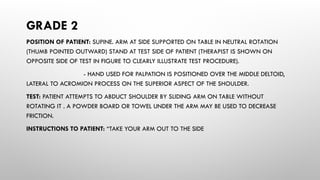
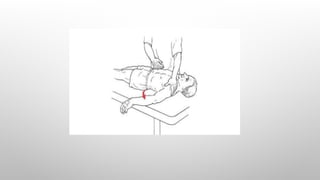
POSITION OF PATIENT: SUPINE. ARM AT SIDE SUPPORTED ON TABLE IN NEUTRAL ROTATION
(THUMB POINTED OUTWARD) STAND AT TEST SIDE OF PATIENT (THERAPIST IS SHOWN ON
OPPOSITE SIDE OF TEST IN FIGURE TO CLEARLY ILLUSTRATE TEST PROCEDURE).
- HAND USED FOR PALPATION IS POSITIONED OVER THE MIDDLE DELTOID,
LATERAL TO ACROMION PROCESS ON THE SUPERIOR ASPECT OF THE SHOULDER.
TEST: PATIENT ATTEMPTS TO ABDUCT SHOULDER BY SLIDING ARM ON TABLE WITHOUT
ROTATING IT . A POWDER BOARD OR TOWEL UNDER THE ARM MAY BE USED TO DECREASE
FRICTION.
INSTRUCTIONS TO PATIENT: “TAKE YOUR ARM OUT TO THE SIDE
GRADE 1 AND GRADE 0
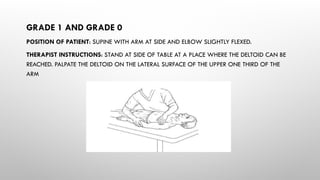
POSITION OF PATIENT: SUPINE WITH ARM AT SIDE AND ELBOW SLIGHTLY FLEXED.
THERAPIST INSTRUCTIONS: STAND AT SIDE OF TABLE AT A PLACE WHERE THE DELTOID CAN BE
REACHED. PALPATE THE DELTOID ON THE LATERAL SURFACE OF THE UPPER ONE THIRD OF THE
ARM
SHOULDER HORIZONTAL ABDUCTION
MUSCLE INVOLVED- POSTERIOR DELTOID.
GRADE 5, GRADE 4, AND GRADE 3
POSITION OF PATIENT: PRONE. SHOULDER ABDUCTED TO 90° AND FOREARM OFF EDGE OF TABLE WITH
ELBOW STRAIGHT.
INSTRUCTIONS TO THERAPIST: STAND AT TEST SIDE. ASK PATIENT TO LIFT ELBOW UP TOWARD THE
CEILING. IF FULL RANGE IS PRESENT (GRADE 3), APPLY APPROPRIATE RESISTANCE. THERAPIST'S HAND GIVING
RESISTANCE IS CONTOURED OVER POSTERIOR ARM JUST ABOVE THE ELBOW
TEST: PATIENT HORIZONTALLY ABDUCTS SHOULDER.
- CARE SHOULD BE PROVIDED TO NOT ALLOW THE HUMERUS TO DROP (LOWER), ALLOWING
SUBSTITUTION OF THE RHOMBOIDS.
INSTRUCTIONS TO PATIENT: “LIFT YOUR ARM UP TOWARD THE CEILING. HOLD IT. DON'T LET ME PUSH IT
DOWN.”
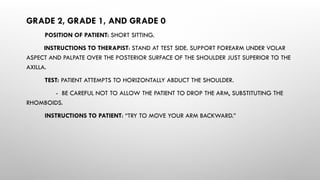
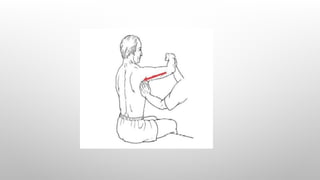
GRADE 2, GRADE 1, AND GRADE 0
POSITION OF PATIENT: SHORT SITTING.
INSTRUCTIONS TO THERAPIST: STAND AT TEST SIDE. SUPPORT FOREARM UNDER VOLAR
ASPECT AND PALPATE OVER THE POSTERIOR SURFACE OF THE SHOULDER JUST SUPERIOR TO THE
AXILLA.
TEST: PATIENT ATTEMPTS TO HORIZONTALLY ABDUCT THE SHOULDER.
- BE CAREFUL NOT TO ALLOW THE PATIENT TO DROP THE ARM, SUBSTITUTING THE
RHOMBOIDS.
INSTRUCTIONS TO PATIENT: “TRY TO MOVE YOUR ARM BACKWARD.”
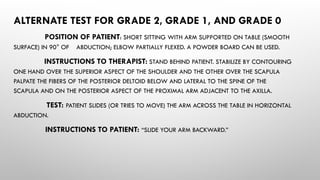
ALTERNATE TEST FOR GRADE 2, GRADE 1, AND GRADE 0
POSITION OF PATIENT: SHORT SITTING WITH ARM SUPPORTED ON TABLE (SMOOTH
SURFACE) IN 90° OF ABDUCTION; ELBOW PARTIALLY FLEXED. A POWDER BOARD CAN BE USED.
INSTRUCTIONS TO THERAPIST: STAND BEHIND PATIENT. STABILIZE BY CONTOURING
ONE HAND OVER THE SUPERIOR ASPECT OF THE SHOULDER AND THE OTHER OVER THE SCAPULA
PALPATE THE FIBERS OF THE POSTERIOR DELTOID BELOW AND LATERAL TO THE SPINE OF THE
SCAPULA AND ON THE POSTERIOR ASPECT OF THE PROXIMAL ARM ADJACENT TO THE AXILLA.
TEST: PATIENT SLIDES (OR TRIES TO MOVE) THE ARM ACROSS THE TABLE IN HORIZONTAL
ABDUCTION.
INSTRUCTIONS TO PATIENT: “SLIDE YOUR ARM BACKWARD.”
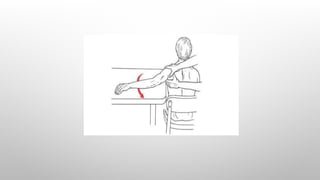
SHOULDER HORIZONTAL ADDUCTION
MUSCLE INVOLVED- PECTORALIS MAJOR
GRADE 5 AND GRADE 4
POSITION OF PATIENT:
WHOLE MUSCLE: SUPINE. SHOULDER ABDUCTED TO 90°; ELBOW FLEXED TO 90°.
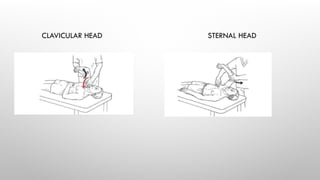
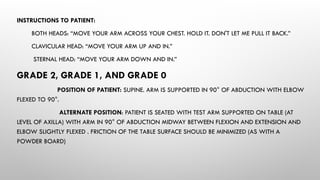
CLAVICULAR HEAD: PATIENT BEGINS TEST WITH SHOULDER IN 60° OF
ABDUCTION WITH ELBOW FLEXED. PATIENT THEN IS ASKED TO HORIZONTALLY ADDUCT THE
SHOULDER IN A SLIGHTLY UPWARD DIAGONAL DIRECTION.
STERNAL HEAD: PATIENT BEGINS TEST WITH SHOULDER IN ABOUT 120° OF
ABDUCTION WITH ELBOW FLEXED. PATIENT IS ASKED TO HORIZONTALLY ADDUCT THE SHOULDER IN
A SLIGHTLY DOWNWARD DIAGONAL DIRECTION.
INSTRUCTIONS TO THERAPIST:
- STAND AT SIDE OF SHOULDER TO BE TESTED. ASK THE PATIENT TO MOVE
THE ARM WITH ELBOW FLEXED IN HORIZONTAL ADDUCTION, KEEPING IT PARALLEL TO
THE FLOOR WITHOUT ROTATION, CHECKING THE RANGE OF MOTION.
- IF THE ARM MOVES ACROSS THE BODY IN A DIAGONAL MOTION, TEST
THE STERNAL AND CLAVICULAR HEADS OF THE MUSCLE SEPARATELY. IF FULL RANGE IS
PRESENT IN A HORIZONTAL ADDUCTED DIRECTION (GRADE 3), TEST THE WHOLE
MUSCLE TOGETHER.
- THERAPIST'S HAND USED FOR RESISTANCE IS CONTOURED AROUND
UPPER ARM, JUST PROXIMAL TO ELBOW, ALLOWING THE FOREARM TO HANG FREE.
RESISTANCE IS APPLIED IN THE DIRECTION OPPOSITE THE TRUNK IN THE TRANSVERSE
PLANE.
CLAVICULAR HEAD: RESISTANCE IS APPLIED ABOVE THE ELBOW IN A DOWNWARD DIRECTION
(TOWARD FLOOR) AND OUTWARD (I.E., OPPOSITE TO THE DIRECTION OF THE FIBERS OF THE
CLAVICULAR HEAD, WHICH MOVES THE ARM DIAGONALLY UP AND INWARD )
STERNAL HEAD: RESISTANCE IS APPLIED ABOVE THE ELBOW IN AN UP AND OUTWARD
DIRECTION (I.E., OPPOSITE TO THE MOTION OF THE STERNAL HEAD, WHICH IS DIAGONALLY
DOWN AND INWARD)
TEST:
- WHEN THE WHOLE MUSCLE IS TESTED, THE PATIENT HORIZONTALLY ADDUCTS THE
SHOULDER IN THE TRANSVERSE PLANE THROUGH THE AVAILABLE RANGE OF MOTION.
- WHEN THE CLAVICULAR HEAD IS TESTED, THE PATIENT'S MOTION BEGINS AT 60° OF
ABDUCTION AND MOVES UP AND IN ACROSS THE BODY.
- WHEN THE STERNAL HEAD IS TESTED, THE MOTION BEGINS AT 120° OF SHOULDER
ABDUCTION AND MOVES DIAGONALLY DOWN AND IN TOWARD THE PATIENT'S OPPOSITE HIP.
CLAVICULAR HEAD STERNAL HEAD
INSTRUCTIONS TO PATIENT:
BOTH HEADS: “MOVE YOUR ARM ACROSS YOUR CHEST. HOLD IT. DON'T LET ME PULL IT BACK.”
CLAVICULAR HEAD: “MOVE YOUR ARM UP AND IN.”
STERNAL HEAD: “MOVE YOUR ARM DOWN AND IN.”
GRADE 2, GRADE 1, AND GRADE 0
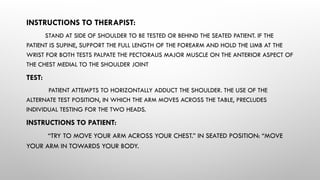
POSITION OF PATIENT: SUPINE. ARM IS SUPPORTED IN 90° OF ABDUCTION WITH ELBOW
FLEXED TO 90°.
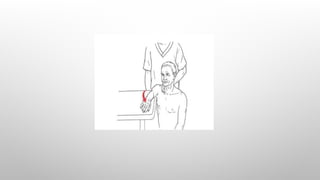
ALTERNATE POSITION: PATIENT IS SEATED WITH TEST ARM SUPPORTED ON TABLE (AT
LEVEL OF AXILLA) WITH ARM IN 90° OF ABDUCTION MIDWAY BETWEEN FLEXION AND EXTENSION AND
ELBOW SLIGHTLY FLEXED . FRICTION OF THE TABLE SURFACE SHOULD BE MINIMIZED (AS WITH A
POWDER BOARD)
INSTRUCTIONS TO THERAPIST:
STAND AT SIDE OF SHOULDER TO BE TESTED OR BEHIND THE SEATED PATIENT. IF THE
PATIENT IS SUPINE, SUPPORT THE FULL LENGTH OF THE FOREARM AND HOLD THE LIMB AT THE
WRIST FOR BOTH TESTS PALPATE THE PECTORALIS MAJOR MUSCLE ON THE ANTERIOR ASPECT OF
THE CHEST MEDIAL TO THE SHOULDER JOINT
TEST:
PATIENT ATTEMPTS TO HORIZONTALLY ADDUCT THE SHOULDER. THE USE OF THE
ALTERNATE TEST POSITION, IN WHICH THE ARM MOVES ACROSS THE TABLE, PRECLUDES
INDIVIDUAL TESTING FOR THE TWO HEADS.
INSTRUCTIONS TO PATIENT:
“TRY TO MOVE YOUR ARM ACROSS YOUR CHEST.” IN SEATED POSITION: “MOVE
YOUR ARM IN TOWARDS YOUR BODY.
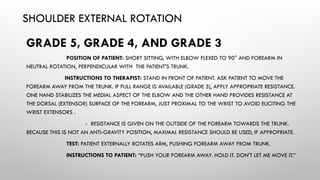
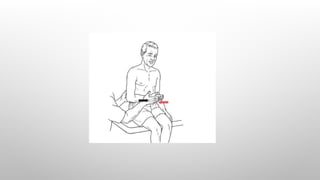
SHOULDER EXTERNAL ROTATION
GRADE 5, GRADE 4, AND GRADE 3
POSITION OF PATIENT: SHORT SITTING, WITH ELBOW FLEXED TO 90° AND FOREARM IN
NEUTRAL ROTATION, PERPENDICULAR WITH THE PATIENT'S TRUNK.
INSTRUCTIONS TO THERAPIST: STAND IN FRONT OF PATIENT. ASK PATIENT TO MOVE THE
FOREARM AWAY FROM THE TRUNK. IF FULL RANGE IS AVAILABLE (GRADE 3), APPLY APPROPRIATE RESISTANCE.
ONE HAND STABILIZES THE MEDIAL ASPECT OF THE ELBOW AND THE OTHER HAND PROVIDES RESISTANCE AT
THE DORSAL (EXTENSOR) SURFACE OF THE FOREARM, JUST PROXIMAL TO THE WRIST TO AVOID ELICITING THE
WRIST EXTENSORS .
- RESISTANCE IS GIVEN ON THE OUTSIDE OF THE FOREARM TOWARDS THE TRUNK.
BECAUSE THIS IS NOT AN ANTI-GRAVITY POSITION, MAXIMAL RESISTANCE SHOULD BE USED, IF APPROPRIATE.
TEST: PATIENT EXTERNALLY ROTATES ARM, PUSHING FOREARM AWAY FROM TRUNK.
INSTRUCTIONS TO PATIENT: “PUSH YOUR FOREARM AWAY. HOLD IT. DON'T LET ME MOVE IT.”
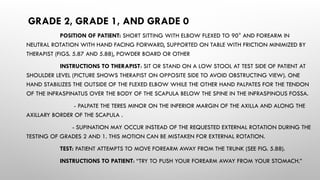
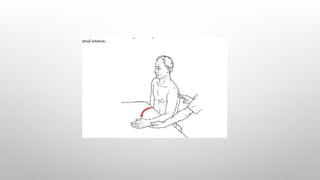
GRADE 2, GRADE 1, AND GRADE 0
POSITION OF PATIENT: SHORT SITTING WITH ELBOW FLEXED TO 90° AND FOREARM IN
NEUTRAL ROTATION WITH HAND FACING FORWARD, SUPPORTED ON TABLE WITH FRICTION MINIMIZED BY
THERAPIST (FIGS. 5.87 AND 5.88), POWDER BOARD OR OTHER
INSTRUCTIONS TO THERAPIST: SIT OR STAND ON A LOW STOOL AT TEST SIDE OF PATIENT AT
SHOULDER LEVEL (PICTURE SHOWS THERAPIST ON OPPOSITE SIDE TO AVOID OBSTRUCTING VIEW). ONE
HAND STABILIZES THE OUTSIDE OF THE FLEXED ELBOW WHILE THE OTHER HAND PALPATES FOR THE TENDON
OF THE INFRASPINATUS OVER THE BODY OF THE SCAPULA BELOW THE SPINE IN THE INFRASPINOUS FOSSA.
- PALPATE THE TERES MINOR ON THE INFERIOR MARGIN OF THE AXILLA AND ALONG THE
AXILLARY BORDER OF THE SCAPULA .
- SUPINATION MAY OCCUR INSTEAD OF THE REQUESTED EXTERNAL ROTATION DURING THE
TESTING OF GRADES 2 AND 1. THIS MOTION CAN BE MISTAKEN FOR EXTERNAL ROTATION.
TEST: PATIENT ATTEMPTS TO MOVE FOREARM AWAY FROM THE TRUNK (SEE FIG. 5.88).
INSTRUCTIONS TO PATIENT: “TRY TO PUSH YOUR FOREARM AWAY FROM YOUR STOMACH.”
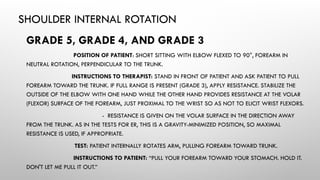
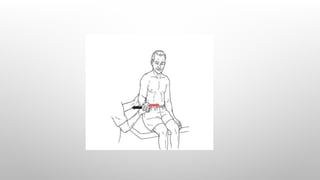
SHOULDER INTERNAL ROTATION
GRADE 5, GRADE 4, AND GRADE 3
POSITION OF PATIENT: SHORT SITTING WITH ELBOW FLEXED TO 90°, FOREARM IN
NEUTRAL ROTATION, PERPENDICULAR TO THE TRUNK.
INSTRUCTIONS TO THERAPIST: STAND IN FRONT OF PATIENT AND ASK PATIENT TO PULL
FOREARM TOWARD THE TRUNK. IF FULL RANGE IS PRESENT (GRADE 3), APPLY RESISTANCE. STABILIZE THE
OUTSIDE OF THE ELBOW WITH ONE HAND WHILE THE OTHER HAND PROVIDES RESISTANCE AT THE VOLAR
(FLEXOR) SURFACE OF THE FOREARM, JUST PROXIMAL TO THE WRIST SO AS NOT TO ELICIT WRIST FLEXORS.
- RESISTANCE IS GIVEN ON THE VOLAR SURFACE IN THE DIRECTION AWAY
FROM THE TRUNK. AS IN THE TESTS FOR ER, THIS IS A GRAVITY-MINIMIZED POSITION, SO MAXIMAL
RESISTANCE IS USED, IF APPROPRIATE.
TEST: PATIENT INTERNALLY ROTATES ARM, PULLING FOREARM TOWARD TRUNK.
INSTRUCTIONS TO PATIENT: “PULL YOUR FOREARM TOWARD YOUR STOMACH. HOLD IT.
DON'T LET ME PULL IT OUT.”
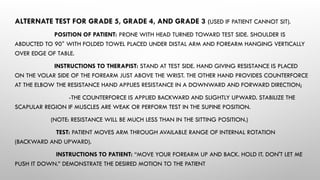
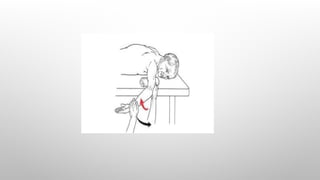
ALTERNATE TEST FOR GRADE 5, GRADE 4, AND GRADE 3 (USED IF PATIENT CANNOT SIT).
POSITION OF PATIENT: PRONE WITH HEAD TURNED TOWARD TEST SIDE. SHOULDER IS
ABDUCTED TO 90° WITH FOLDED TOWEL PLACED UNDER DISTAL ARM AND FOREARM HANGING VERTICALLY
OVER EDGE OF TABLE.
INSTRUCTIONS TO THERAPIST: STAND AT TEST SIDE. HAND GIVING RESISTANCE IS PLACED
ON THE VOLAR SIDE OF THE FOREARM JUST ABOVE THE WRIST. THE OTHER HAND PROVIDES COUNTERFORCE
AT THE ELBOW THE RESISTANCE HAND APPLIES RESISTANCE IN A DOWNWARD AND FORWARD DIRECTION;
-THE COUNTERFORCE IS APPLIED BACKWARD AND SLIGHTLY UPWARD. STABILIZE THE
SCAPULAR REGION IF MUSCLES ARE WEAK OR PERFORM TEST IN THE SUPINE POSITION.
(NOTE: RESISTANCE WILL BE MUCH LESS THAN IN THE SITTING POSITION.)
TEST: PATIENT MOVES ARM THROUGH AVAILABLE RANGE OF INTERNAL ROTATION
(BACKWARD AND UPWARD).
INSTRUCTIONS TO PATIENT: “MOVE YOUR FOREARM UP AND BACK. HOLD IT. DON'T LET ME
PUSH IT DOWN.” DEMONSTRATE THE DESIRED MOTION TO THE PATIENT
GRADE 2, GRADE 1, AND GRADE 0
POSITION OF PATIENT: SHORT SITTING OR SITTING AT A TABLE, WITH ELBOW FLEXED
AND FOREARM IN NEUTRAL ROTATION.
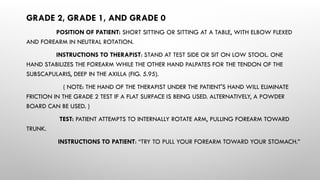
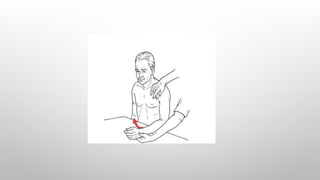
INSTRUCTIONS TO THERAPIST: STAND AT TEST SIDE OR SIT ON LOW STOOL. ONE
HAND STABILIZES THE FOREARM WHILE THE OTHER HAND PALPATES FOR THE TENDON OF THE
SUBSCAPULARIS, DEEP IN THE AXILLA (FIG. 5.95).
( NOTE: THE HAND OF THE THERAPIST UNDER THE PATIENT'S HAND WILL ELIMINATE
FRICTION IN THE GRADE 2 TEST IF A FLAT SURFACE IS BEING USED. ALTERNATIVELY, A POWDER
BOARD CAN BE USED. )
TEST: PATIENT ATTEMPTS TO INTERNALLY ROTATE ARM, PULLING FOREARM TOWARD
TRUNK.
INSTRUCTIONS TO PATIENT: “TRY TO PULL YOUR FOREARM TOWARD YOUR STOMACH.”
ASSISTED EXERCISE
Definition:
Assisted exercise is defined as When muscle strength or coordination is in adequate to perform a movement an external force is
applied to compensate for the deficiency.
Principles:
Adding external force to augment insuffient muscular action for movement or control. Applying this external force in the
direction of muscle action, potentially at a different point to gain mechanical advantage through leverage.
Technique:
1.Starting position:
Ensuring body stability allows the patient to focus entirely on the movement pattern and effort required.
2.Pattern of movement:
The patient must thoroughly understand the movement, which can be taught through passive movement or for limb
movements, by actively moving opposite limb.
3.Fixation:
Adequate fixation of the bone of origin of the prime movers improves their efficiency.
4.Support:
Reducing the load on weakened muscles through various means like a physiotherapists hands, slings, or specialized
equipment, allowing for effective movement in the most suitable plane.
5.Antagonistic muscles:
Minimizing tension in antagonistic muscles to ensure optimal starting positions for movement, thereby facilitating the
primary movement.
6.Traction and Assisting force:
Utilizing preliminary stretching (traction) to elicit the myotatic reflex and applying an assisting force in the
direction Of movement, often manually by a physiotherapist, to augment muscle action.
7.Charector of movement and Repetitions:
Efficient voluntary movement is smooth and requires patient attention. Speed depends on muscle type and
load.Repetitions are determined by the need to avoid muscle fatigue, requiring understanding of the underlying
weakness.
8.Patient cooperation:
Essential for achieving controlled active movement without assistance. Encouragement and visible
results aid patient effort.
EXERCISES
9.Elevators of scapulae
Assisted exercise: In eliminating gravity
Patient position: supine lying
Procedure: Therapist giving applying pressure under the folded elbows (elbow flexion) which leads to shoulder
shrugging (elevation
2.Depressors of scapulae
Assisted exercise: In eliminating gravity
Patient position: supine or side lying
Procedure: Therapist 1 hand support the elbow and other hand placed inferior angle of scapula. Therapist assists
downward movement (scapular depression) gently while the patient attempts the motion.
3.Protractors of scapulae
Assisted exercise: In eliminating gravity
Patient position: side lying
Procedure: patient in side lying and therapist assists forward movement of shoulder gently while the patient attempts the motion.
4.Retractors of scapulae
Assisted exercise: In eliminating gravity.
Patient position: sitting or standing.
Procedure: ask him or her to addict the shoulder with 90° flexed elbow and laterally rotate, therapist one hand assist this movement while other hand on scapula
palpate the retraction of scapula.
5.Shoulder flexors
Assisted exercise: In eliminating gravity
Patient position: side lying
Procedure: with the assistance of therapist hand shoulder flexion can be done.
6.Shoulder extensors
Assisted exercise: In eliminating gravity
Patient position: side lying
Procedure: Therapist one hand support the shoulder and other hand placed over the patient forearm and wrist then therapist assists the extension
movement.
7.shoulder abductors
Assisted exercise: In eliminating gravity
Patient position: supine lying
Procedure: with fully assisted by the therapist while doing abduction of shoulder.
8.shoulder adductors
Assisted exercise: In eliminating gravity .
Patient position: supine lying
Procedure: While doing the movement from shoulder abduction to adduction with assistance of therapist.
9.Medial and lateral Rotators of shoulder joint
Assisted exercise: In eliminating gravity
Patient position: standing or sitting position
Procedure: shoulder adduction with elbow 90° flexion then with the assistance of therapist medial and lateral rotation occurs in eliminating grav
FREE EXERCISE
DEFENITION
Free exercise are performed by patient
himself without any resistance and
assistance by the external force except the
gravity
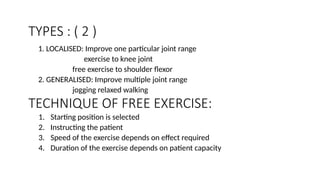
TECHNIQUE OF FREE EXERCISE:
1. LOCALISED: Improve one particular joint range
exercise to knee joint
free exercise to shoulder flexor
2. GENERALISED: Improve multiple joint range
jogging relaxed walking
TYPES : ( 2 )
1. Starting position is selected
2. Instructing the patient
3. Speed of the exercise depends on effect required
4. Duration of the exercise depends on patient capacity
USES:
• Increase the joint range , muscles strength, power And endurance
• Increase the neuromuscular coordination
• Increase the circulation and venous drainage
• Increase the relaxation of the muscle by swinging movements and
pendular movements
• Repeated active movements break the adhesion formation and elongates
the shortened soft tissues
• Regulating the cardiorespiratory function, and the active exercise
increases the respiratory and venous return it Increase O2 supply to
muscle
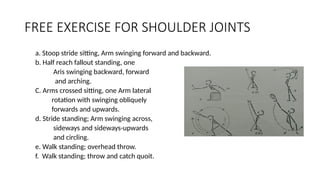
FREE EXERCISE FOR SHOULDER JOINTS
a. Stoop stride sitting, Arm swinging forward and backward.
b. Half reach fallout standing, one
Aris swinging backward, forward
and arching.
C. Arms crossed sitting, one Arm lateral
rotation with swinging obliquely
forwards and upwards.
d. Stride standing; Arm swinging across,
sideways and sideways-upwards
and circling.
e. Walk standing; overhead throw.
f. Walk standing; throw and catch quoit.
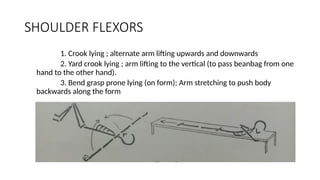
SHOULDER FLEXORS
1. Crook lying ; alternate arm lifting upwards and downwards
2. Yard crook lying ; arm lifting to the vertical (to pass beanbag from one
hand to the other hand).
3. Bend grasp prone lying (on form); Arm stretching to push body
backwards along the form
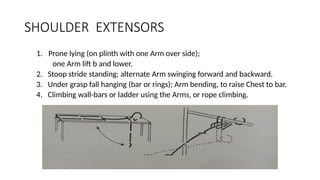
SHOULDER EXTENSORS
1. Prone lying (on plinth with one Arm over side);
one Arm lift b and lower.
2. Stoop stride standing; alternate Arm swinging forward and backward.
3. Under grasp fall hanging (bar or rings); Arm bending, to raise Chest to bar.
4. Climbing wall-bars or ladder using the Arms, or rope climbing.
SHOULDER ABDUCTORS
1. Bend crook lying; Shoulder abduction.
2. Side lying; one Arm lifting and slowly lowering.
3. Bend sitting; Arm stretching sideways and upwards.
4. Yard stride standing; Arm swinging across body and sideways, upward
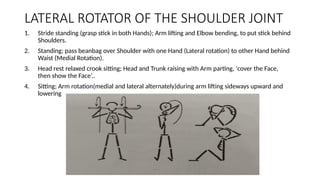
1. Stride standing (grasp stick in both Hands); Arm lifting and Elbow bending, to put stick behind
Shoulders.
2. Standing; pass beanbag over Shoulder with one Hand (Lateral rotation) to other Hand behind
Waist (Medial Rotation).
3. Head rest relaxed crook sitting; Head and Trunk raising with Arm parting, 'cover the Face,
then show the Face’..
4. Sitting; Arm rotation(medial and lateral alternately)during arm lifting sideways upward and
lowering
LATERAL ROTATOR OF THE SHOULDER JOINT
RESISTED EXERCISE
Definition
•An external force may be applied to the body levers to
oppose the force of muscular contraction.
•Tension is increased within the muscles by the
opposing force or resistance and the muscles respond
by an increase in their power and hypertrophy
•Strength, power and endurance are enhanced by
resisted exercise.
Types of resisted exercise:
1.Manual resistance exercise:
manual resisted exercise is a type of active-resisted exercise in
which external resistance is provided by a therapist or other health
professional.
2.Mechanical resistance exercise:
mechanical resisted exercise is a form of active-resisted
exercise in which external resistance is applied through the use
of equipment or mechanical apparatus.
3.Isometric exercise (static exercise):
Isometric exercise is a static form of exercise in which a
muscle contracts and produces force without an appreciable
change in the length of the muscle and without visible joint
4.DYNAMIC EXERCISE:
CONCENTRIC- Refers to a form of dynamic muscle activation
in which tension develops and physical shortening of the muscle
occurs as an external resistance is overcome by internal force, as when
lifting a weight.
ECCENTRIC- It involves dynamic muscle activation and tension
production that is below the level of external resistance so that
physical lengthening of the muscle occurs as it controls the load, as
when lowering a weight.
5.ISOKINETIC EXERCISE:
Isokinetic exercise is a form of dynamic exercise in which the joint
angular velocity is predetermined and held constant by rate limiting device
known as isokinetic dynamometer.
7.CLOSED KINETIC CHAIN EXERCISE:
Closed-chain exercises involves motions in which the body or proximal
segments move on a distal segment that is fixed or stabilized on a support
surface.
Movement at one joint causes simultaneous motion at distal and proximal
joints in a relatively predictable manner.
6.OPEN KINETIC CHAIN EXERCISE:
Open-chain exercise involves motions in which the distal
segment is free to move in space, without necessarily causing
simultaneous motions at adjacent joints.
Limb movement only occurs distal to the moving joint, and
muscle activation occurs in the muscle that cross the moving joint.
Resistances:
• The physiotherapist
• The patient
• Weights
• Weight and pulley circuits
• Springs and other elastic structures
• Substances which are malleable
• water
BENEFITS OF RESISTED EXERCISE:
 Increases muscle strength, power and endurance
 Increased strength of connective tissues- Tendons,
ligaments, intramuscular connective tissues
 Increased bone mineral density
 Reduced risk of soft tissue injury during physical
activity
 Improve balance
 Enhanced physical performance during daily
living activities
PRECAUTIONS TO RESISTANCE EXERCISE:
 Cardiovascular concerns
 Fatigue, secondary to insufficient recovery time
 Muscle substitution as a result of muscle
weakness or fatigue
 Osteoporosis, secondary to increased risk of
avulsion or pathological fractures
 Exercise-induced muscle soreness
 Delayed-onset muscle soreness
CONTRAINDICATION:
 Acute inflammation of the involved tissue
 Presence of an inflammatory neuromuscular
disorder
 Severe muscle or joint pain during active range
of motion or muscle contraction
 Severe cardiopulmonary disease
Resisted exercise for shoulder joint
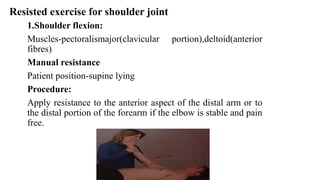
1.Shoulder flexion:
Muscles-pectoralismajor(clavicular portion),deltoid(anterior
fibres)
Manual resistance
Patient position-supine lying
Procedure:
Apply resistance to the anterior aspect of the distal arm or to
the distal portion of the forearm if the elbow is stable and pain
free.
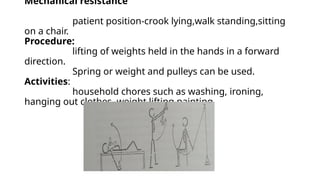
Mechanical resistance
patient position-crook lying,walk standing,sitting
on a chair.
Procedure:
lifting of weights held in the hands in a forward
direction.
Spring or weight and pulleys can be used.
Activities:
household chores such as washing, ironing,
hanging out clothes ,weight lifting,painting
2.Shoulder extension
muscle-deltoid(posterior fiber),teresminor,latissimus dorsi and
pectoralis major
manual resistance:
patient position-prone lying
procedure:
Apply resistance to the posterior aspect of the distal arm or
the distal portion of the forearm.
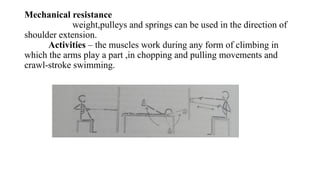
Mechanical resistance
weight,pulleys and springs can be used in the direction of
shoulder extension.
Activities – the muscles work during any form of climbing in
which the arms play a part ,in chopping and pulling movements and
crawl-stroke swimming.
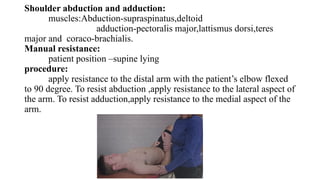
Shoulder abduction and adduction:
muscles:Abduction-supraspinatus,deltoid
adduction-pectoralis major,lattismus dorsi,teres
major and coraco-brachialis.
Manual resistance:
patient position –supine lying
procedure:
apply resistance to the distal arm with the patient’s elbow flexed
to 90 degree. To resist abduction ,apply resistance to the lateral aspect of
the arm. To resist adduction,apply resistance to the medial aspect of the
arm.
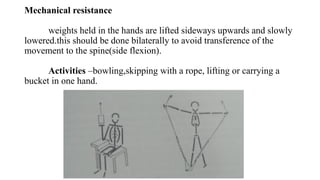
Mechanical resistance
weights held in the hands are lifted sideways upwards and slowly
lowered.this should be done bilaterally to avoid transference of the
movement to the spine(side flexion).
Activities –bowling,skipping with a rope, lifting or carrying a
bucket in one hand.
Shoulder internal and external rotation
muscle: internal rotation-pectoralis major,lattismus
dorsi,deltoid(anterior fiber).
External rotation-infraspinatus,teres minor and
deltoid(posterior fiber).
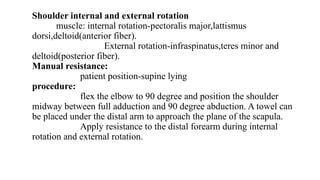
Manual resistance:
patient position-supine lying
procedure:
flex the elbow to 90 degree and position the shoulder
midway between full adduction and 90 degree abduction. A towel can
be placed under the distal arm to approach the plane of the scapula.
Apply resistance to the distal forearm during internal
rotation and external rotation.
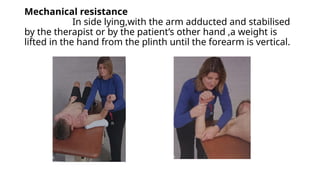
Mechanical resistance
In side lying,with the arm adducted and stabilised
by the therapist or by the patient’s other hand ,a weight is
lifted in the hand from the plinth until the forearm is vertical.
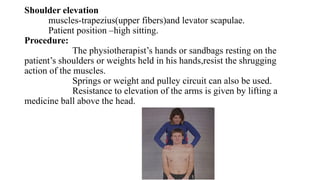
Shoulder elevation
muscles-trapezius(upper fibers)and levator scapulae.
Patient position –high sitting.
Procedure:
The physiotherapist’s hands or sandbags resting on the
patient’s shoulders or weights held in his hands,resist the shrugging
action of the muscles.
Springs or weight and pulley circuit can also be used.
Resistance to elevation of the arms is given by lifting a
medicine ball above the head.
Progressive Resisted
Exercise
Introduction
1. The progressive Resisted Exercise was formed by the De Lorme
and Watkins at 1945 to improve muscle strength, power and
endurance.
2. The purpose of PRE to find out the how much weight has to be
used and how many repetitions to be done by the injured patient
after recovery.
3. The PRE increase weight gradually and also explained about how
many repetitions to be practiced. Before entering into the
exercise should know about the repetition maximum ( RM ).
Definition
• Progressive resisted exercise is a system of dynamic
resistance training in which a constant external load
is applied to the contracting muscle by some
mechanical means and then incrementally
increasing .
• The RM as the basis for determining and
progressing the amount of resistance used during
training.
INDICATIONS
1. Muscle weakness and atrophy
2. Rehabilitation after injury or surgery
3. Chronic diseases
4. General fitness and health
CONTRAINDICATION
1. Acute inflammation of the musculoskeletal system
2. Pain Infection.
3. Recent fracture or non-united fracture
PRECAUTIONS
1. Cardio vascular problem must be controlled during
exercise
2. Avoid reaching to fatigue point
3. Adequate time recovery from fatigue
4. Avoid over to excessive protein breakdown
5. Osteoporosis to avoid pathological fracture
6. Muscle soreness
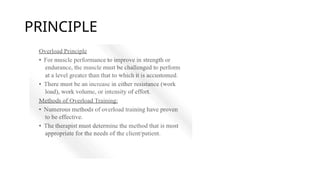
PRINCIPLE
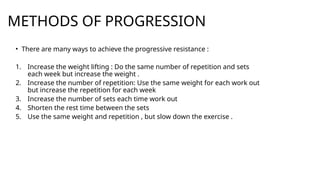
METHODS OF PROGRESSION
• There are many ways to achieve the progressive resistance :
1. Increase the weight lifting : Do the same number of repetition and sets
each week but increase the weight .
2. Increase the number of repetition: Use the same weight for each work out
but increase the repetition for each week
3. Increase the number of sets each time work out
4. Shorten the rest time between the sets
5. Use the same weight and repetition , but slow down the exercise .
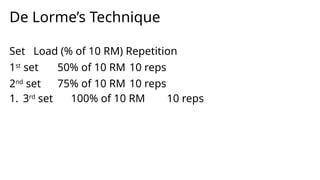
De Lorme’s Technique
Set Load (% of 10 RM) Repetition
1st
set 50% of 10 RM 10 reps
2nd
set 75% of 10 RM 10 reps
1. 3rd
set 100% of 10 RM 10 reps
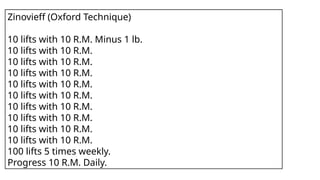
Zinovieff (Oxford Technique)
10 lifts with 10 R.M. Minus 1 lb.
10 lifts with 10 R.M.
100 lifts 5 times weekly.
Progress 10 R.M. Daily.
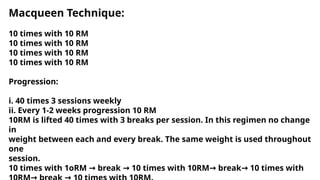
Macqueen Technique:
10 times with 10 RM
10 times with 10 RM
10 times with 10 RM
10 times with 10 RM
Progression:
i. 40 times 3 sessions weekly
ii. Every 1-2 weeks progression 10 RM
10RM is lifted 40 times with 3 breaks per session. In this regimen no change
in
weight between each and every break. The same weight is used throughout
one
session.
10 times with 1oRM break 10 times with 10RM break 10 times with
→ → → →
Exercise for shoulder
• Dumbbell Exercises:
• Examples include shoulder presses, lateral raises, front raises, and rows. These exercises can be
modified by using lighter weights initially and gradually increasing the weight as strength
improves.
• Resistance Band Exercises:
• Exercises like external and internal rotation, rows, and shoulder presses can be performed with
resistance bands. The bands offer adjustable resistance, making them suitable for various fitness
levels.
• Bodyweight Exercises:
• Exercises like wall slides, scapular retractions, and prone T's can be effective in strengthening the
shoulder muscles. Progression can be achieved by increasing the repetitions, sets, or by adding
slight variations to the exercises.
• Specific Rotator Cuff Exercises:
• These exercises, often performed with resistance bands or light weights, focus on strengthening
the rotator cuff muscles that stabilize the shoulder joint. Examples include external rotation,
internal rotation, and abduction.
Shoulder Flexors
1.Front Raises with Resistance Band:
Stand on the middle of a resistance band and hold each end with your hands. Keeping your arms
straight, raise them forward until they are parallel to the floor, then slowly lower them back down.
2. Front Raises with Dumbbells:
Similar to the band exercise, but use dumbbells. Stand with feet shoulder-width apart, holding a
dumbbell in each hand. Keeping your arms straight, raise them forward to shoulder height, and then
slowly lower them.
3. Isometric Wall Push-Ups:
Stand facing a wall, place your hands on the wall at shoulder height, and push against the wall, engaging
your shoulder muscles without actually moving.
4. Active Resisted Shoulder Flexion in Supine:
Lie on your back with your affected arm at your side and elbow bent to 90 degrees. Use your unaffected
side to provide resistance and push your fist upward towards the ceiling, then slowly lower it back down.
Shoulder Extensor
1. Standing resisted shoulder extension with a band:
Stand facing away from a secure anchor point with a resistance
band attached. Hold the band ends with arms extended in front, then
pull the band back towards your body, squeezing the shoulder blades
together.
2. Isometric shoulder extension against a wall:
Stand with your back against a wall, arms extended at your sides.
Push your arms backward into the wall, hold, and then relax.
3. Lying on stomach with arms hanging off the edge of a table:
Hold weights in your hands and lift your arms parallel to the floor,
maintaining straight elbows.
Shoulder Abductors
1. Resisted Shoulder Abduction with Weights:
Setup: Hold a dumbbell in one hand, palm facing the body,
with the arm relaxed by the side.
Execution: Slowly raise the arm out to the side, thumb
pointing up, keeping the elbow straight.
Return: Control the lowering of the arm back to the starting
position.
2. Lateral Raises (with weights or resistance band):
Stand with feet shoulder-width apart, holding a weight or resistance band in each hand.
Keep your elbows slightly bent and your arms at your sides.
Raise your arms out to the sides, maintaining the slight bend in your elbows, until your arms are
parallel to the floor.
According to a physical therapy site, slowly lower your arms back down.
3. Resisted Abduction and External Rotation at 90°:
Stand with feet shoulder-width apart, one end of the band secured at shoulder height.
Hold the other end of the band and pull it back by moving your shoulder back and keeping your
elbow bent.
Externally rotate your arm so that your hand points up to the ceiling, then slowly return to the
starting position.
Shoulder Internal Rotators
1. Standing with Resistance Band:
Setup:
Secure one end of a resistance band to a stable object at waist height. Stand with your affected side
closest to the anchor point.
Positioning:
Bend your elbow to 90 degrees, holding the other end of the band with your hand. Place a towel or small
pad between your upper arm and your side.
Execution:
Keeping your elbow close to your body, rotate your forearm inward, pulling the band towards your
stomach.
Return:
Slowly return to the starting position, controlling the movement against the band’s resistance.
Repetitions:
Perform 10-15 repetitions for 2-3 sets.
2. CABLE MACHINE :
Similar to the band exercise, this version uses a cable pulley
machine to provide resistance, allowing for adjustable weight and
controlled movements.
3.Lying Internal Rotation:
Lie on your side with your elbow bent at 90 degrees and tucked
into your side. Keep your elbow against your side and slowly rotate
your arm at the shoulder, raising your forearm towards the ceiling.
Shoulder External Rotators
1. Resistance Band External Rotation (Standing or Seated):
Setup:
Secure one end of a resistance band to a stable object at about waist height. Hold the
other end of the band with your affected arm, elbow bent at 90 degrees and close to
your side.
Movement:
Keeping your elbow close to your body, slowly rotate your arm outward, pulling against
the band. Squeeze your shoulder blades together during the movement.
Return:
Slowly return to the starting position.
Progression:
Increase resistance by using a stronger band or adjusting the band’s attachment point.
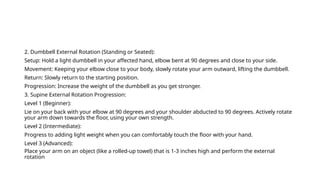
2. Dumbbell External Rotation (Standing or Seated):
Setup: Hold a light dumbbell in your affected hand, elbow bent at 90 degrees and close to your side.
Movement: Keeping your elbow close to your body, slowly rotate your arm outward, lifting the dumbbell.
Return: Slowly return to the starting position.
Progression: Increase the weight of the dumbbell as you get stronger.
3. Supine External Rotation Progression:
Level 1 (Beginner):
Lie on your back with your elbow at 90 degrees and your shoulder abducted to 90 degrees. Actively rotate
your arm down towards the floor, using your own strength.
Level 2 (Intermediate):
Progress to adding light weight when you can comfortably touch the floor with your hand.
Level 3 (Advanced):
Place your arm on an object (like a rolled-up towel) that is 1-3 inches high and perform the external
rotation
Reference:
• Shoulder Joint Anatomy - B.D.Chaurasia's Human anatomy, Eighth Edition, Volume 1-
Upper limb(Pg.no: 158-164).
• Joint Mobilization -Carolyn Kisner, 8th Edition Pg no: 132 to 148.
• MMT for shoulder joint: Principles of C.Sivaraman , Daniels and worthingham ‘s -10th
Edition.
• Free exercise for Shoulder joint- Dena Gardiner , 4th Edition.
• Assisted exercise :Dena Gardiner,4 th edition.
• Resisted exercise: Therapeutic exercise,8th edition- Carolyn kisner, The principles of
exercise therapy, 4th edition -Dena gardiner.
THANK YOU
BY BATCH-I
Aayesha Fathima.N , Abirami.j , Ahamed Ali.N, Akshaya.A, Anintha.N, Aravinth.M, Archana.R, Arthi.V, Arthishwari.R.T, Chandramoulieswaran.P.M.
BPT-FINAL YEAR
Shoulder joint structures fully explained

  • 1.
  • 2.
  • 3.
    SYNOPSIS: • Introduction • Type •Articular surface • Stability • Ligaments • Bursa • Relations • Blood supply • Nerve supply • Movements
  • 5.
    INTRODUCTION: Articulation of twobones scapula and humerus – SHOULDER JOINT TYPE: Synovial Joint of Ball and Socket variety ARTICULAR SURFACE: Articulation of glenoid cavity of scapula and the head of the humerus Termed as Glenohumeral Articulation STABILITY: • Coracoacromial arch or secondary socket for the head of the humerus • Musculotendinous cuff of the shoulder from the tendons of the subscapularis (anteriorly), supraspinatus (above) and infraspinatus and teres major (posteriorly)
  • 6.
    • Glenoid labrumhelps in deepening the glenoid fossa. • Stability also provided by the muscles attaching the humerus to the pectoral gridle, the long head of the biceps brachii and long head of triceps brachii. • Atmospheric Pressure also stabilizes the joint. LIGAMENTS: • Capsular ligament • Coracohumeral ligament • Transverse humeral ligament • The glenoid labrum
  • 7.
    Muscles Supporting CapsularLigament • Superiorly Supraspinatus → • Inferiorly Long Head of Triceps → • Posteriorly Tendons of Infraspinatus → and Teres Minor • Anteriorly Tendon of Subscapularis →
  • 8.
    CAPSULAR LIGAMENT • Encirclesentire glenohumeral joint. ATTACHED: • Medially: Above to the circumference of glenoid cavity beyond the glenoid ligament • Laterally: Below to anatomical neck of the humerus • Thicker above and below. • Loose and lax • Allow bone to be separated from each other more than an inch
  • 9.
    GLENOHUMERAL LIGAMENTS • SUPERIORBAND: attached to the upper end of lesser tubercle • MIDDLE BAND: attached to lower part of lesser tubercle • INFERIOR BAND: lower part of anatomical neck of humerus. CORACO-HUMERAL LIGAMENT • Broad Thick Band • Strengthens Upper part of Capsular Ligament • Attachments Arises from outer border of coracoid process Blended with tendon of supraspinatus muscles United to capsule in greater part of its extend.
  • 11.
    TRANSVERSE HUMERAL LIGAMENT •Broad band of fibrous tissues • Connects the two lips of the upper part of intertubercular sulcus and acts as a retinaculum to keep the long tendon of biceps in position. GLENOID LABRUM • Fibro-cartilage rim attached around margin of glenoid cavity. • Triangular on section • The thickest portion at circumference of cavity,free edge is sharp and thin • Continuous above with long head of biceps • Deepens cavity for articulation and protects edges of bone • Lined by synovial membrane
  • 13.
    SYNOVIAL MEMBRANE • Reflectedfrom margin of glenoid cavity over fibro-cartilaginous rim surrounding it. • Over internal surface of capsular ligaments. • Covers lower part and sides of anatomical neck of humerus. BURSAE: Subacromial bursa or subdeltoid bursa. Subscapularis bursa. Infraspinatus bursa.
  • 15.
    RELATIONS: Superiorly: Coracoacromial arch,subacromial bursa, supraspinatus and deltoid. Inferiorly: Long head of the triceps brachii, axillary nerves and posterior circumflex humeral artery. Anteriorly: Subscapularis, coracobrachialis, short head of biceps brachii and deltoid. Posteriorly: Infraspinatus, teres minor and deltoid. Within the joint: Tendon of the long head of the biceps brachii.
  • 16.
    Blood Supply • Anteriorcircumflex humeral vessels • Posterior circumflex humeral vessels • Suprascapular vessels • Subscapular vessels Nerve Supply • Axillary nerve • Musculocutaneous nerve • Suprascapular nerve
  • 18.
    MOVEMENTS AT THESHOULDER JOINTS • Movement in every direction (Flexion, extension, abduction, adduction, rotation, circumduction) Spinal Cord regulating Shoulder movements (C5, C6, C7 & C8) • Flexion, Abduction, & lateral rotation (C5, C6.). • Extension, Adduction, & Medial rotation is (C6, C7, C8)
  • 20.
    APPLIED ANATOMY: • Dislocation •Shoulder Tip Pain • Frozen Shoulder • Bankart Lesion • Slap Lesion • Shoulder Bursitis
  • 22.
  • 83.
  • 84.
    DEFINITION • These movementsare produced by an external force during muscular inactivity or when muscular activity is voluntarily reduced as much as possible to permit movement.
  • 85.
    CLASSIFICATION • Relaxed passivemovements • Passive manual mobilisation 1. Mobilisation of joints 2. Manipulation of joints 3. Controlled sustained stretching of tightened structures
  • 86.
    RELAXED PASSIVE MOVEMENTS •These are movements performed accurately and smoothly by the physiotherapist . • A knowledge of the anatomy of joints is required. • The movement are performed in the same range and direction as active movements. • The joints is moved through the existing free range and within the limits of pain.
  • 87.
    PRINCIPLES • RELAXATION • Abrief explanation of what is to happen is given to the patient, who is taught to relax voluntarily, except in case of flaccid paralysis. • The selection of a suitable starting position ensure comfort and support, and the bearing of the physiotherapist Will do much to inspire confidence and cooperation in maintaining relaxation through the movement. • FIXATION • The proximal joint should be fixed or stabilized to the joint line as possible to ensure that the movement is localised to that joint. • SUPPORT • Full and comfortable support is given to the part of be moved, so that the patient has confidence and will remain relaxed.
  • 88.
    • TRACTION • Thelong axial traction given to the joint • Traction is thought to facilitate the movement by reducing the interarticular friction • RANGE • The ROM of movement is as full as the condition of the joints permits without eliciting pain or spasm in the surrounding muscles. • SPEED AND DURATION • The speed must be uniform, fairly slow and rhythmical. • Same speed should be maintained throughout the movement. • SEQUENCE • It should be decided before treating the patients, while treating the flaccid conditions the movement should be proximal to distal, in spastic as well as to increase the venous and lymphatic drainage the movement has to be performed from distal to proximal.
  • 89.
    INDICATIONS 1. The patientwho can’t perform full ROM 2. The patient who can’t perform active movements 3. Prolonged bed-ridden patients mainly to prevent DVT 4. To break the adhesion formation 5. Unconscious patient 6. For relaxation 7. Edematous limb
  • 90.
    CONTRAINDICATIONS 1. Recent dislocation 2.Recent Fracture 3. DVT 4. Malignant tumor 5. Psoriatic arthritis 6. Recently injuries and inflammation 7. Hemarthrosis and Hemophilic joints 8. Immediately after any joint surgery or repair 9. Patient with external appliances and pop plaster cast 10. Precaution must be taken for the flial joints.
  • 91.
    EFFECT AND USES 1.Maintains the muscle properties 2. Increases the ROM 3. Increases the venous and lymphatic drainage 4. Break the adhesion formation in the joints 5. Prevent the DVT 6. Induced the relaxation
  • 92.
    PROCEDURE • SHOULDER JOINT 1.SHOULDER FLEXION • PATIENT POSITION: supine lying • THERAPIST POSITION: standing beside the patient and facing the patient’s face. • Hand placement and procedure • Grasp the patient’s arm under the elbow with your lower hand • With the top hand, cross over and grasp the wrist and palm of the patient’s hand • Lift the arm through the available range and return.
  • 95.
    2. SHOULDER EXTENSION •PATIENT POSITION: side lying or supine lying • THERAPIST POSITION: standing back to the patient and facing the shoulder joint. • Hand placement and procedure • To obtain extension past zero, position the patient’s shoulder at edge of the bed when supine or position the patient side- lying, prone, or sitting. • In side lying forearm and elbow is placed over the right side forearm of the therapist by flexing the patient and wrist movement is restricted by the therapist hand. • Left hand of the therapist stabilizes the shoulder joint of the patient. • It is not possible to apply the long axial traction. Therapist right hand is performing the extension movement of the shoulder.
  • 97.
    3. SHOULDER ABDUCTIONAND ADDUCTION • PATIENT POSITION: Supine lying • THERAPIST POSITION: Standing beside the patient and facing the patient’s face • HAND PLACEMENT AND PROCEDURE • Use the same hand placement as with flexion, but move the arm out to the side. The elbow may be flexed for ease in completing the arc of motion.
  • 99.
    4. SHOULDER INTERNAL(MEDIAL) AND EXTERNAL (LATERAL) ROTATION • PATIENT POSITION: supine lying • THERAPIST POSITION: Standing beside the patient and facing the patient’s shoulder • If possible, the arm is abducted in 90 degree, the elbow is flexed to 90 degree and the forearm is held in neutral position. Rotation may also be performed with the patient’s arm at the side of the thorax, but full internal rotation is not possible in the position. • HAND PLACEMENT AND PROCEDURE • Grasp the hand and wrist with your index finger between the patient’s thumb and index finger • place your thumb and the rest of your fingers on either side of the patient’s wrist, thereby stabilizing the wrist. • With the other hand, stabilize the elbow. • Rotate the humerus by moving the forearm like spoke on a wheel.
  • 101.
    5. SHOULDER HORIZONTALADDUCTION (EXTENSION) AND ADDUCTION (FLEXION) • PATIENT POSITION: Supine lying • THERAPIST POSITION: Standing beside the patient and facing the patient’s face • To reach full horizontal abduction, position the patient’s shoulder at edge of the table. Begin with the arm either adducted or abducted 90 degree. • HAND PLACEMENT AND PROCEDURE • Hand placement is same as flexion, but turn your body and face the patient’s head as you move the patient’s arm out to the side and then across the body.
  • 103.
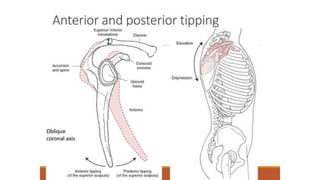
    6. SHOULDER ELEVATION/DEPRESSION, PROTRACTION/RETRACTION,AND UPWARD/DOWNWARD ROTATION • PATIENT POSITION: Prone lying or side lying • THERAPIST POSITION: Standing beside the patient and facing the patient’s face • Position the patient Prone with his or her arm at the side or side- lying facing towards you with the patient’s arm draped over your bottom arm • HAND PLACEMENT AND PROCEDURE • Cup the top hand over the acromion process and place the other hand around the inferior angle of scapula • For elevation, depression, protraction, and retraction, the clavicle also moves as the scapular motions are directed at the acromion process. • For rotation, direct the scapular motions at the inferior angle of scapula while simultaneously pushing the acromion in the opposite
  • 105.
  • 106.
    DEFINITION Joint mobilization isa passive, skilled manual therapeutic technique applied to joints and related soft tissue at varying speeds and amplitudes using physiological or accessory motions for therapeutic purpose.
  • 107.
    INDICATIONS Pain Muscle Guarding Muscle Spasm JointHypomobility Positional Fault/Subluxations Progressive Limitation Functional Immobility
  • 108.
  • 109.
    GRADES OF MAITLANDMOBILIZATION Grade I: Small amplitude movement performed at beginning of ROM Grade II: Large amplitude not reaching end of ROM Grade III: Large amplitude reaching the limited ROM Grade IV: Small amplitude at end of limited ROM Grade V: Small amplitude and high velocity at end of limited ROM
  • 110.
    TECHNIQUES GLENOHUMERAL JOINT GLENOHUMERAL DISTRACTION:- Indications Testing;initial treatment (sustained grade II); pain control (grade I or II oscillations); general mobility (sustained grade III). Patient Position Supine, with arm in the resting position. Therapist Position Stand at the patient’s side, facing towards his or her head. Hand Placement Use the hand nearer the part being treated (e.g., left hand if treating the patient’s left shoulder) and place it in the patient’s axilla with your thumb just distal to the joint margin anteriorly and fingers posteriorly. Support the forearm between your trunk and elbow. Your other hand support the humerus from the lateral surface. Mobilizing Force With the hand in the axilla, move the humerus laterally.
  • 112.
    GLENOHUMERAL CAUDAL GLIDEIN RESTING POSITION:- Indications To increase abduction (sustained grade III); to reposition the humeral head if superiorly positioned. Patient Position Supine, with arm in the resting position. Therapist position Stand lateral to the patient’s arm being treated and support the forearm between your trunk and elbow. Hand position Place one hand in the patient’s axilla to provide a grade I distraction.  The web space of your other hand is placed just distal to the acromion process. Mobilizing Force With the superiorly placed hand, glide the humerus in an inferior direction.
  • 114.
    GLENOHUMERAL CAUDAL GLIDE(LONG AXIS TRACTION):- Patient Position Supine, with arm in the resting position. Hand Placement and Mobilizing Force Support the patient’s forearm between your trunk and elbow. Grasp around the distal arm with both hands and apply the force in a caudal direction as your body weight toward the patient’s feet.
  • 115.
    GLENOHUMERAL CAUDAL GLIDEPROGRESSION:- Indication To increase abduction. Patient Position Supine or sitting, with the arm abducted to the end of its available range. External rotation of the humerus should be added to the end-range position as the arm approaches and goes beyond 90. Therapist Position and Hand Placement With the patient supine, stand facing the patient’s feet and stabilize the patient’s arm against your trunk with the hand farthest from the patient. Slight lateral motion of your trunk provides grade I distraction via long-axis traction. With the patient sitting, stand behind the patient and cradle the distal humerus with the hand farthest from the patient; this hand provides a grade I distraction via a long-axis traction. Place the web space of your other hand just distal to the acromion process on the proximal humerus. Mobilizing Force With the hand on the proximal humerus, glide the humerus in an inferior direction.
  • 117.
    GLENOHUMERAL ELEVATION PROGRESSION:- Indication Toincrease elevation beyond 90 degree of abduction. Patient Position Supine or sitting, with the arm abducted and externally rotated to the end of its available range. Therapist Position and Hand Placement Hand placement is the same as for caudal glide progression. Adjust your body position so the hand applying the mobilizing force is aligned with the treatment plane in the glenoid fossa. With the hand grasping the elbow, apply a grade I distraction force. Mobilizing Force With the hand on the proximal humerus, glide the humerus in a progressively anterior direction against the inferior folds of the capsule in the axilla. The direction of force with respect to the patient’s body depends on the amount of upward rotation and protraction of the scapula.
  • 119.
    GLENOHUMERAL POSTERIOR GLIDE,RESTING POSITION:- Indications To increase flexion; to increase internal rotation. Patient Position  Supine, with the arm in resting position. Therapist Position and Hand Placement Stand with your back to the patient, between the patient’s trunk and arm. Support the arm against your trunk, grasping the distal humerus with your lateral hand. This position provides grade I distraction to the joint. Place the lateral border of your top hand just distal to the anterior margin of the joint, with your fingers pointing superiorly. This hand gives the mobilizing force. Mobilizing Force Glide the humeral head posteriorly by moving the entire arm as you bend your knees.
  • 121.
    GLENOHUMERAL POSTERIOR GLIDEPROGRESSION:- Indications To increase posterior gliding when flexion approaches 90 degree to increase horizontal adduction. Patient Position Supine, with the arm flexed to 90 degree and internally rotated and with the elbow flexed. The arm may also be placed in horizontal adduction. Hand Placement Place padding under the scapula for stabilization. Place one hand across the proximal surface of the humerus to apply a grade I distraction. Place your other hand over the patient’s elbow. A belt placed around your pelvis and the proximal aspect of the patient’s humerus may be used to apply the distraction force. Mobilizing Force Glide the humerus posteriorly by pushing down at the elbow through the long axis of the humerus.
  • 123.
    GLENOHUMERALANTERIOR GLIDE, RESTINGPOSITION:- Indications To increase extension; to increase external rotation. Patient Position Prone, with the arm in resting position over the edge of the treatment table, supported on your thigh. Stabilize the acromion with padding. Supine position may also be used. Therapist Position and Hand Placement Stand facing the top of the table with the leg closer to the table in a forward stride position. Support the patient’s arm against your thigh with your outside hand; the arm positioned on your thigh provides a grade I distraction. Place the ulnar border of your other hand just distal to the posterior angle of the acromion process, with your fingers pointing superiorly; this hand gives the mobilizing force. Mobilizing Force Glide the humeral head in an anterior and slightly medial direction. Bend both knees so the entire arm moves anteriorly.
  • 125.
    GLENOHUMERAL EXTERNAL ROTATIONPROGRESSIONS:- Indication To increase external rotation. Techniques Because of the danger of subluxation when applying an anterior glide with the humerus externally rotated, use a distraction progression or elevation progression to gain range. Distraction progression: Begin with the shoulder in resting position; externally rotate the humerus to end range and then apply a grade III distraction perpendicular to the treatment plane in the glenoid fossa. Elevation progression: This technique incorporates end-range external rotation.
  • 127.
  • 128.
    SYNOPSIS:  DEFINITION  USES CONTRAINDICATION  PRECAUTION  PRINCIPLES  TEST PROCEDURE A.BREAK TEST B.MAKE TEST C.ACTIVE RESISTANCE TEST D.SUBSTITUTION  BASIC RULES OF PROCEDURE  SEVERAL POSTION TO ASSESS MMT  SHOULDER JOINT - MOVEMENT
  • 129.
    DEFINITION MANUAL MUSCLE TESTINGIS A PROCEDURE FOR EVALUATION OF FUNCTION & STRENGTH OF INDIVIDUAL MUSCLE OR GROUP OF MUSCLE BASED ON EFFECTIVE PERFORMANCE OF MOVEMENT IN RELATION TO THE FORCE OF GRAVITY & MANUAL RESISTANCE.
  • 130.
    USES TO KNOW THESTRENGTH OF MUSCLE DIFFERENTIAL DIAGNOSIS-PIN POINTING THE SPECIFIC PROBLEM(EG. CONTRACTURE, DEFORMITY ETC) TO HELP SURGEON IN PLANNING SURGERY- MINIMUM REQUIREMENT FOR SURGERY IN GRADE 4. PROGNOSTICATION OF PATIENT HELP IN PLANNING THE TREATMENT HELP THE THERAPIST TO SUGGEST WHICH CALIPER TO BE USED AND UPTO WHAT EXTEND HE SHOULD BE EMBRARED. THE SITE OR LEVEL OF A PERIPHERAL LESION MAY BE DETERMINED.
  • 131.
    CONTRAINDICATION INFLAMMATION OR SEVEREPAIN IN THE JOINT IMMEDIATE POST OPERATIVE CONDITION FIXED DEFORMITY (EG. CEREBRAL PALSY, MUSCULAR DYSTROPHY) PATHOLOGICAL CONDITION LIKE ANEURYSM, ARRTHYMIAS, ANGINA PECTORIS, MYASTHENIA GRAVIS, MYOPATHY, MALIGNANCY, PULMONARY DISEASE, HTN, EMBOLUS.
  • 132.
    PRECAUTION oOPEN WOUNDS oUNHEALED SCARS oICUWITH MULTIPLE LINES, MONITORS, TRACTION, VENTILATOR & POSITION RESTRICTION. oWILLINGNESS OF PATIENT & ENDURE DISCOMFORT oFATIGUE oPAIN oFRACTURE & DISLOCATION oRECENT SURGERY
  • 133.
    PRINCIPLES  GRADES FORA MANUAL MUSCLE TEST ARE RECORDED AS NUMERIC ORDINAL SCORES RANGING FROM ZERO (0), WHICH REPRESENTS NO DISCERNABLE MUSCLE ACTIVITY, TO FIVE (5), WHICH REPRESENTS A MAXIMAL OR BEST POSSIBLE RESPONSE OR AS GREAT A RESPONSE AS CAN BE EVALUATED BY A MANUAL MUSCLE TEST.  THE NUMERIC 0 TO 5 SYSTEM OF GRADING IS THE MOST COMMONLY USED MUSCLE STRENGTH SCORING NUMERIC SCORE QUALITATIVE SCORE 5 Normal(N) 4 Good(G) 3 Fair(F) 2 Poor(P) 1 Trace activity(T) 0 Zero(Z)
  • 134.
    TEST PROCEDURE BREAK TEST: MANUAL RESISTANCE IS APPLIED TO A LIMB OR OTHER BODY PART AT THE POINT IN ROM WHERE THE MUSCLE IS MOST CHALLENGED. THE TERM RESISTANCE DENOTES THE FORCE THAT IS ACTS IN OPPOSITION TO THE CONTRACTING MUSCLE .THE BREAK TEST REQUIRES THE CLIENT TO HOLD THE POSITION AND NOT LET THE EXAMINER BREAK THE HOLD.  EG: A SEATED PATIENT IS ASKED TO FLEX THE ELBOW TO ITS END RANGE (GRADE 3); WHEN THAT POSITION IS REACHED, THE THERAPIST APPLIES RESISTANCE JUST PROXIMAL TO THE WRIST, TRYING TO “BREAK” THE MUSCLE'S HOLD AND THUS ALLOW THE FOREARM TO MOVE DOWNWARD INTO EXTENSION.
  • 135.
    ACTIVE RESISTANCE TEST: -RESISTANCE IS APPLIED OPPOSITE THE ACTIVELY CONTRACTING MOVEMENT THROUGHOUT THE RANGE, STARTING AT THE FULLY LENGTHENED POSITION. - THE AMOUNT OF RESISTANCE MATCHES THE PATIENT'S RESISTANCE BUT ALLOWS THE JOINT TO MOVE THROUGH THE FULL RANGE.
  • 136.
    SUBSTITUTION - SUBSTITUTION RESULTSFROM ONE OR MORE ATTEMPTING TO COMPENSATE FOR THE LACK OF STRENGTH IN ANOTHER MUSCLE OR GROUP OF MUSCLE - SUBSTITUTION IS A GOOD INDICATOR TO PROVE THAT THE TESTED MUSCLE IS WEAK EG: 1.FIXATION OF MUSCLE EX. SHOULDER , HIP JT 2.ANTAGONIST EX .FINGER FLEXOR, EXTENSOR 3. AGONIST EX. GLUTEUS MEDIUS , TENSOR FASCIAE LATAE
  • 137.
    BASIC RULES OFPROCEDURE  PLACE THE SUBJECT IN A POSITION THAT OFFERS THE BEST FIXATION OF THE BODY AS A WHOLE (USUALLY SUPINE, PRONE, OR SIDE-LYING). STABILIZE THE PART PROXIMAL TO THE TESTED PART OR, AS IN THE CASE OF THE HAND, ADJACENT TO THE TESTED PART. STABILIZATION IS NECESSARY FOR SPECIFICITY IN TESTING.  PLACE THE PART TO BE TESTED IN PRECISE ANTIGRAVITY TEST POSITION, WHENEVER APPROPRIATE, TO HELP ELICIT THE DESIRED MUSCLE ACTION AND AID IN GRADING. USE TEST MOVEMENTS IN THE HORIZONTAL PLANE WHEN TESTING MUSCLES THAT ARE TOO WEAK TO FUNCTION AGAINST GRAVITY. USE TEST MOVEMENTS IN ANTIGRAVITY POSITIONS FOR MOST TRUNK MUSCLE TESTS IN WHICH BODY WEIGHT OFFERS SUFFICIENT RESISTANCE.
  • 138.
    APPLY PRESSURE DIRECTLYOPPOSITE THE LINE OF PULL OF THE MUSCLE OR THE MUSCLE SEGMENT BEING TESTED. LIKE THE ANTIGRAVITY POSITION, THE DIRECTION OF PRESSURE HELPS TO ELICIT THE DESIRED MUSCLE ACTION. APPLY PRESSURE GRADUALLY BUT NOT TOO SLOWLY, ALLOWING THE SUBJECT TO "GET SET AND HOLD." APPLY UNIFORM PRESSURE; AVOID LOCALIZED PRESSURE THAT CAN CAUSE DISCOMFORT. USE A LONG LEVER WHENEVER POSSIBLE, UNLESS CONTRAINDICATED. THE LENGTH OF THE LEVER IS DETERMINED BY THE LOCATION OF THE PRESSURE ALONG THE LEVER ARM. BETTER DISCRIMINATION OF STRENGTH FOR PURPOSES OF GRADING IS OBTAINED THROUGH USE OF A LONG LEVER. USE A SHORT LEVER IF THE INTERVENING MUSCLES DO NOT PROVIDE SUFFICIENT FIXATION FOR USE OF A LONG LEVER.
  • 139.
    SEVERAL POSITION TOASSESS MMT SUPINE - BICEPS , BRACHIORADIALIS, TRICEPS, PEC.MAJOR , PEC.MINOR , SHOULDERMR - TERES MINOR , INFRASPINATUS SHOULDER LR- SERRATUS ANTERIOR, ANTERIOR DELTOID PRONE _ LATTISSIMUS DORSI, TRAPEZIUS (MIDDLE , LOWER), POSTERIOR DELTOID , TRICEPS, TERES MAJOR ,SHOULDER MR &LR , RHOMBOID SITTING - DELTOID (ANTERIOR , MIDDLE, POSTERIOR ), CORACOBRACHIALIS , UPPER TRAPEZIUS , SERRATUS ANTERIOR STANDING - SERRATUS ANTERIOR
  • 140.
  • 141.
    SHOULDER FLEXION MUSCLE INVOLVED-ANTERIOR DELTOID, ROTATOR CUFF, CLAVICULAR PORTION OF PECTORALIS MAJOR, AND CORACOBRACHIALIS. GRADE 5, GRADE 4, AND GRADE 3 POSITION OF PATIENT: - SHORT SITTING WITH ARMS AT SIDES, ELBOW SLIGHTLY FLEXED, FOREARM PRONATED. INSTRUCTIONS TO THERAPIST: - STAND AT TEST SIDE. ASK PATIENT TO RAISE ARM FORWARD TO SHOULDER HEIGHT (90°), KEEPING ELBOW STRAIGHT. - IF FULL RANGE IS PRESENT (GRADE 3), POSITION ARM IN TEST POSITION (90°) AND APPLY APPROPRIATE RESISTANCE. - THERAPIST'S HAND GIVING RESISTANCE IS CONTOURED OVER THE DISTAL HUMERUS JUST ABOVE THE ELBOW. THE OTHER HAND MAY STABILIZE THE SHOULDER
  • 143.
    GRADE 2, GRADE1, AND GRADE 0 POSITION OF PATIENT: SIDE-LYING POSITION (TEST SIDE UP). INSTRUCTIONS TO THERAPIST: WITH PATIENT SIDE-LYING TO MINIMIZE GRAVITY, STAND BEHIND PATIENT AND CRADLE THE TEST ARM AT THE ELBOW. THEN ASK PATIENT TO FLEX THE SHOULDER. (A POWDER BOARD MAY ALSO BE USED.) TEST: PATIENT ATTEMPTS TO FLEX SHOULDER. INSTRUCTIONS TO PATIENT: “TRY TO RAISE YOUR ARM.” (NOTE: GRADE 1 AND GRADE 0) INSTRUCTIONS TO THERAPIST: STAND BEHIND PATIENT. FINGERS USED FOR PALPATION ARE PLACED OVER THE SUPERIOR AND ANTERIOR SURFACES OF THE DELTOID OVER THE SHOULDER JOINT
  • 145.
    SHOULDER EXTENSION MUSCLE INVOLVED- POSTERIOR DELTOID, LATISSIMUS DORSI, TERES MAJOR, AND LONG HEAD OF TRICEPS GRADE 5, GRADE 4, GRADE 3, AND GRADE 2 POSITION OF PATIENT: PRONE WITH ARMS AT SIDES AND SHOULDER INTERNALLY ROTATED (PALM UP) INSTRUCTIONS TO THERAPIST: STAND AT TEST SIDE. ASK PATIENT TO LIFT ARM AS HIGH AS POSSIBLE. IF FULL RANGE IS AVAILABLE (GRADE 3), POSITION ARM IN TEST POSITION NEAR END RANGE AND APPLY APPROPRIATE RESISTANCE. -THE HAND USED FOR RESISTANCE IS CONTOURED OVER THE POSTERIOR ARM JUST ABOVE THE ELBOW TEST: PATIENT RAISES ARM OFF THE TABLE, KEEPING THE ELBOW STRAIGHT INSTRUCTIONS TO PATIENT: “LIFT YOUR ARM AS HIGH AS YOU CAN. HOLD IT. DON'T LET ME PUSH IT DOWN.”
  • 147.
    GRADE 1 ANDGRADE 0 POSITION OF PATIENT: PRONE WITH ARMS AT SIDES AND SHOULDER INTERNALLY ROTATED (PALM UP). INSTRUCTIONS TO THERAPIST: STAND AT TEST SIDE. FINGERS FOR PALPATION ARE PLACED ON THE POSTERIOR ASPECT OF THE UPPER ARM (POSTERIOR DELTOID) PALPATE OVER THE POSTERIOR SHOULDER JUST SUPERIOR TO THE AXILLA FOR POSTERIOR DELTOID FIBERS. -PALPATE THE TERES MAJOR ON THE LATERAL BORDER OF THE SCAPULA JUST BELOW THE AXILLA. THE TERES MAJOR IS THE LOWER OF THE TWO MUSCLES THAT ENTER THE AXILLA AT THIS POINT; IT FORMS THE LOWER POSTERIOR RIM OF THE AXILLA. TEST AND INSTRUCTIONS TO PATIENT: PATIENT ATTEMPTS TO LIFT ARM FROM TABLE.
  • 149.
    SHOULDER ABDUCTION MUSCLE INVOLVED– MIDDLE DELTOID, SUPRASPINATUS GRADE 5, GRADE 4, AND GRADE 3 POSITION OF PATIENT: SHORT SITTING WITH ARM AT SIDE AND ELBOW SLIGHTLY FLEXED. INSTRUCTIONS TO THERAPIST: STAND BEHIND PATIENT. ASK PATIENT TO LIFT ARM OUT TO THE SIDE TO SHOULDER LEVEL (TEST POSITION) WITH ARM IN NEUTRAL ROTATION AND ELBOW STRAIGHT. IF SUFFICIENT RANGE IS PRESENT, PROCEED TO TEST GRADE 5. - THERAPIST'S HAND GIVING RESISTANCE IS CONTOURED OVER ARM JUST ABOVE ELBOW (FIG. 5.64). RESISTANCE IS GIVEN IN A DOWNWARD DIRECTION. TEST: PATIENT ABDUCTS ARM TO 90°. INSTRUCTIONS TO PATIENT: “LIFT YOUR ARM OUT TO THE SIDE TO SHOULDER LEVEL. HOLD IT. DON'T LET ME PUSH IT DOWN.”
  • 151.
    GRADE 2 POSITION OFPATIENT: SUPINE. ARM AT SIDE SUPPORTED ON TABLE IN NEUTRAL ROTATION (THUMB POINTED OUTWARD) STAND AT TEST SIDE OF PATIENT (THERAPIST IS SHOWN ON OPPOSITE SIDE OF TEST IN FIGURE TO CLEARLY ILLUSTRATE TEST PROCEDURE). - HAND USED FOR PALPATION IS POSITIONED OVER THE MIDDLE DELTOID, LATERAL TO ACROMION PROCESS ON THE SUPERIOR ASPECT OF THE SHOULDER. TEST: PATIENT ATTEMPTS TO ABDUCT SHOULDER BY SLIDING ARM ON TABLE WITHOUT ROTATING IT . A POWDER BOARD OR TOWEL UNDER THE ARM MAY BE USED TO DECREASE FRICTION. INSTRUCTIONS TO PATIENT: “TAKE YOUR ARM OUT TO THE SIDE
  • 153.
    GRADE 1 ANDGRADE 0 POSITION OF PATIENT: SUPINE WITH ARM AT SIDE AND ELBOW SLIGHTLY FLEXED. THERAPIST INSTRUCTIONS: STAND AT SIDE OF TABLE AT A PLACE WHERE THE DELTOID CAN BE REACHED. PALPATE THE DELTOID ON THE LATERAL SURFACE OF THE UPPER ONE THIRD OF THE ARM
  • 154.
    SHOULDER HORIZONTAL ABDUCTION MUSCLEINVOLVED- POSTERIOR DELTOID. GRADE 5, GRADE 4, AND GRADE 3 POSITION OF PATIENT: PRONE. SHOULDER ABDUCTED TO 90° AND FOREARM OFF EDGE OF TABLE WITH ELBOW STRAIGHT. INSTRUCTIONS TO THERAPIST: STAND AT TEST SIDE. ASK PATIENT TO LIFT ELBOW UP TOWARD THE CEILING. IF FULL RANGE IS PRESENT (GRADE 3), APPLY APPROPRIATE RESISTANCE. THERAPIST'S HAND GIVING RESISTANCE IS CONTOURED OVER POSTERIOR ARM JUST ABOVE THE ELBOW TEST: PATIENT HORIZONTALLY ABDUCTS SHOULDER. - CARE SHOULD BE PROVIDED TO NOT ALLOW THE HUMERUS TO DROP (LOWER), ALLOWING SUBSTITUTION OF THE RHOMBOIDS. INSTRUCTIONS TO PATIENT: “LIFT YOUR ARM UP TOWARD THE CEILING. HOLD IT. DON'T LET ME PUSH IT DOWN.”
  • 156.
    GRADE 2, GRADE1, AND GRADE 0 POSITION OF PATIENT: SHORT SITTING. INSTRUCTIONS TO THERAPIST: STAND AT TEST SIDE. SUPPORT FOREARM UNDER VOLAR ASPECT AND PALPATE OVER THE POSTERIOR SURFACE OF THE SHOULDER JUST SUPERIOR TO THE AXILLA. TEST: PATIENT ATTEMPTS TO HORIZONTALLY ABDUCT THE SHOULDER. - BE CAREFUL NOT TO ALLOW THE PATIENT TO DROP THE ARM, SUBSTITUTING THE RHOMBOIDS. INSTRUCTIONS TO PATIENT: “TRY TO MOVE YOUR ARM BACKWARD.”
  • 158.
    ALTERNATE TEST FORGRADE 2, GRADE 1, AND GRADE 0 POSITION OF PATIENT: SHORT SITTING WITH ARM SUPPORTED ON TABLE (SMOOTH SURFACE) IN 90° OF ABDUCTION; ELBOW PARTIALLY FLEXED. A POWDER BOARD CAN BE USED. INSTRUCTIONS TO THERAPIST: STAND BEHIND PATIENT. STABILIZE BY CONTOURING ONE HAND OVER THE SUPERIOR ASPECT OF THE SHOULDER AND THE OTHER OVER THE SCAPULA PALPATE THE FIBERS OF THE POSTERIOR DELTOID BELOW AND LATERAL TO THE SPINE OF THE SCAPULA AND ON THE POSTERIOR ASPECT OF THE PROXIMAL ARM ADJACENT TO THE AXILLA. TEST: PATIENT SLIDES (OR TRIES TO MOVE) THE ARM ACROSS THE TABLE IN HORIZONTAL ABDUCTION. INSTRUCTIONS TO PATIENT: “SLIDE YOUR ARM BACKWARD.”
  • 160.
    SHOULDER HORIZONTAL ADDUCTION MUSCLEINVOLVED- PECTORALIS MAJOR GRADE 5 AND GRADE 4 POSITION OF PATIENT: WHOLE MUSCLE: SUPINE. SHOULDER ABDUCTED TO 90°; ELBOW FLEXED TO 90°. CLAVICULAR HEAD: PATIENT BEGINS TEST WITH SHOULDER IN 60° OF ABDUCTION WITH ELBOW FLEXED. PATIENT THEN IS ASKED TO HORIZONTALLY ADDUCT THE SHOULDER IN A SLIGHTLY UPWARD DIAGONAL DIRECTION. STERNAL HEAD: PATIENT BEGINS TEST WITH SHOULDER IN ABOUT 120° OF ABDUCTION WITH ELBOW FLEXED. PATIENT IS ASKED TO HORIZONTALLY ADDUCT THE SHOULDER IN A SLIGHTLY DOWNWARD DIAGONAL DIRECTION.
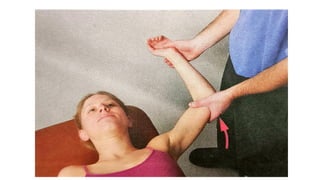
  • 161.
    INSTRUCTIONS TO THERAPIST: -STAND AT SIDE OF SHOULDER TO BE TESTED. ASK THE PATIENT TO MOVE THE ARM WITH ELBOW FLEXED IN HORIZONTAL ADDUCTION, KEEPING IT PARALLEL TO THE FLOOR WITHOUT ROTATION, CHECKING THE RANGE OF MOTION. - IF THE ARM MOVES ACROSS THE BODY IN A DIAGONAL MOTION, TEST THE STERNAL AND CLAVICULAR HEADS OF THE MUSCLE SEPARATELY. IF FULL RANGE IS PRESENT IN A HORIZONTAL ADDUCTED DIRECTION (GRADE 3), TEST THE WHOLE MUSCLE TOGETHER. - THERAPIST'S HAND USED FOR RESISTANCE IS CONTOURED AROUND UPPER ARM, JUST PROXIMAL TO ELBOW, ALLOWING THE FOREARM TO HANG FREE. RESISTANCE IS APPLIED IN THE DIRECTION OPPOSITE THE TRUNK IN THE TRANSVERSE PLANE.
  • 162.
    CLAVICULAR HEAD: RESISTANCEIS APPLIED ABOVE THE ELBOW IN A DOWNWARD DIRECTION (TOWARD FLOOR) AND OUTWARD (I.E., OPPOSITE TO THE DIRECTION OF THE FIBERS OF THE CLAVICULAR HEAD, WHICH MOVES THE ARM DIAGONALLY UP AND INWARD ) STERNAL HEAD: RESISTANCE IS APPLIED ABOVE THE ELBOW IN AN UP AND OUTWARD DIRECTION (I.E., OPPOSITE TO THE MOTION OF THE STERNAL HEAD, WHICH IS DIAGONALLY DOWN AND INWARD) TEST: - WHEN THE WHOLE MUSCLE IS TESTED, THE PATIENT HORIZONTALLY ADDUCTS THE SHOULDER IN THE TRANSVERSE PLANE THROUGH THE AVAILABLE RANGE OF MOTION. - WHEN THE CLAVICULAR HEAD IS TESTED, THE PATIENT'S MOTION BEGINS AT 60° OF ABDUCTION AND MOVES UP AND IN ACROSS THE BODY. - WHEN THE STERNAL HEAD IS TESTED, THE MOTION BEGINS AT 120° OF SHOULDER ABDUCTION AND MOVES DIAGONALLY DOWN AND IN TOWARD THE PATIENT'S OPPOSITE HIP.
  • 163.
  • 164.
    INSTRUCTIONS TO PATIENT: BOTHHEADS: “MOVE YOUR ARM ACROSS YOUR CHEST. HOLD IT. DON'T LET ME PULL IT BACK.” CLAVICULAR HEAD: “MOVE YOUR ARM UP AND IN.” STERNAL HEAD: “MOVE YOUR ARM DOWN AND IN.” GRADE 2, GRADE 1, AND GRADE 0 POSITION OF PATIENT: SUPINE. ARM IS SUPPORTED IN 90° OF ABDUCTION WITH ELBOW FLEXED TO 90°. ALTERNATE POSITION: PATIENT IS SEATED WITH TEST ARM SUPPORTED ON TABLE (AT LEVEL OF AXILLA) WITH ARM IN 90° OF ABDUCTION MIDWAY BETWEEN FLEXION AND EXTENSION AND ELBOW SLIGHTLY FLEXED . FRICTION OF THE TABLE SURFACE SHOULD BE MINIMIZED (AS WITH A POWDER BOARD)
  • 165.
    INSTRUCTIONS TO THERAPIST: STANDAT SIDE OF SHOULDER TO BE TESTED OR BEHIND THE SEATED PATIENT. IF THE PATIENT IS SUPINE, SUPPORT THE FULL LENGTH OF THE FOREARM AND HOLD THE LIMB AT THE WRIST FOR BOTH TESTS PALPATE THE PECTORALIS MAJOR MUSCLE ON THE ANTERIOR ASPECT OF THE CHEST MEDIAL TO THE SHOULDER JOINT TEST: PATIENT ATTEMPTS TO HORIZONTALLY ADDUCT THE SHOULDER. THE USE OF THE ALTERNATE TEST POSITION, IN WHICH THE ARM MOVES ACROSS THE TABLE, PRECLUDES INDIVIDUAL TESTING FOR THE TWO HEADS. INSTRUCTIONS TO PATIENT: “TRY TO MOVE YOUR ARM ACROSS YOUR CHEST.” IN SEATED POSITION: “MOVE YOUR ARM IN TOWARDS YOUR BODY.
  • 167.
    SHOULDER EXTERNAL ROTATION GRADE5, GRADE 4, AND GRADE 3 POSITION OF PATIENT: SHORT SITTING, WITH ELBOW FLEXED TO 90° AND FOREARM IN NEUTRAL ROTATION, PERPENDICULAR WITH THE PATIENT'S TRUNK. INSTRUCTIONS TO THERAPIST: STAND IN FRONT OF PATIENT. ASK PATIENT TO MOVE THE FOREARM AWAY FROM THE TRUNK. IF FULL RANGE IS AVAILABLE (GRADE 3), APPLY APPROPRIATE RESISTANCE. ONE HAND STABILIZES THE MEDIAL ASPECT OF THE ELBOW AND THE OTHER HAND PROVIDES RESISTANCE AT THE DORSAL (EXTENSOR) SURFACE OF THE FOREARM, JUST PROXIMAL TO THE WRIST TO AVOID ELICITING THE WRIST EXTENSORS . - RESISTANCE IS GIVEN ON THE OUTSIDE OF THE FOREARM TOWARDS THE TRUNK. BECAUSE THIS IS NOT AN ANTI-GRAVITY POSITION, MAXIMAL RESISTANCE SHOULD BE USED, IF APPROPRIATE. TEST: PATIENT EXTERNALLY ROTATES ARM, PUSHING FOREARM AWAY FROM TRUNK. INSTRUCTIONS TO PATIENT: “PUSH YOUR FOREARM AWAY. HOLD IT. DON'T LET ME MOVE IT.”
  • 169.
    GRADE 2, GRADE1, AND GRADE 0 POSITION OF PATIENT: SHORT SITTING WITH ELBOW FLEXED TO 90° AND FOREARM IN NEUTRAL ROTATION WITH HAND FACING FORWARD, SUPPORTED ON TABLE WITH FRICTION MINIMIZED BY THERAPIST (FIGS. 5.87 AND 5.88), POWDER BOARD OR OTHER INSTRUCTIONS TO THERAPIST: SIT OR STAND ON A LOW STOOL AT TEST SIDE OF PATIENT AT SHOULDER LEVEL (PICTURE SHOWS THERAPIST ON OPPOSITE SIDE TO AVOID OBSTRUCTING VIEW). ONE HAND STABILIZES THE OUTSIDE OF THE FLEXED ELBOW WHILE THE OTHER HAND PALPATES FOR THE TENDON OF THE INFRASPINATUS OVER THE BODY OF THE SCAPULA BELOW THE SPINE IN THE INFRASPINOUS FOSSA. - PALPATE THE TERES MINOR ON THE INFERIOR MARGIN OF THE AXILLA AND ALONG THE AXILLARY BORDER OF THE SCAPULA . - SUPINATION MAY OCCUR INSTEAD OF THE REQUESTED EXTERNAL ROTATION DURING THE TESTING OF GRADES 2 AND 1. THIS MOTION CAN BE MISTAKEN FOR EXTERNAL ROTATION. TEST: PATIENT ATTEMPTS TO MOVE FOREARM AWAY FROM THE TRUNK (SEE FIG. 5.88). INSTRUCTIONS TO PATIENT: “TRY TO PUSH YOUR FOREARM AWAY FROM YOUR STOMACH.”
  • 171.
    SHOULDER INTERNAL ROTATION GRADE5, GRADE 4, AND GRADE 3 POSITION OF PATIENT: SHORT SITTING WITH ELBOW FLEXED TO 90°, FOREARM IN NEUTRAL ROTATION, PERPENDICULAR TO THE TRUNK. INSTRUCTIONS TO THERAPIST: STAND IN FRONT OF PATIENT AND ASK PATIENT TO PULL FOREARM TOWARD THE TRUNK. IF FULL RANGE IS PRESENT (GRADE 3), APPLY RESISTANCE. STABILIZE THE OUTSIDE OF THE ELBOW WITH ONE HAND WHILE THE OTHER HAND PROVIDES RESISTANCE AT THE VOLAR (FLEXOR) SURFACE OF THE FOREARM, JUST PROXIMAL TO THE WRIST SO AS NOT TO ELICIT WRIST FLEXORS. - RESISTANCE IS GIVEN ON THE VOLAR SURFACE IN THE DIRECTION AWAY FROM THE TRUNK. AS IN THE TESTS FOR ER, THIS IS A GRAVITY-MINIMIZED POSITION, SO MAXIMAL RESISTANCE IS USED, IF APPROPRIATE. TEST: PATIENT INTERNALLY ROTATES ARM, PULLING FOREARM TOWARD TRUNK. INSTRUCTIONS TO PATIENT: “PULL YOUR FOREARM TOWARD YOUR STOMACH. HOLD IT. DON'T LET ME PULL IT OUT.”
  • 173.
    ALTERNATE TEST FORGRADE 5, GRADE 4, AND GRADE 3 (USED IF PATIENT CANNOT SIT). POSITION OF PATIENT: PRONE WITH HEAD TURNED TOWARD TEST SIDE. SHOULDER IS ABDUCTED TO 90° WITH FOLDED TOWEL PLACED UNDER DISTAL ARM AND FOREARM HANGING VERTICALLY OVER EDGE OF TABLE. INSTRUCTIONS TO THERAPIST: STAND AT TEST SIDE. HAND GIVING RESISTANCE IS PLACED ON THE VOLAR SIDE OF THE FOREARM JUST ABOVE THE WRIST. THE OTHER HAND PROVIDES COUNTERFORCE AT THE ELBOW THE RESISTANCE HAND APPLIES RESISTANCE IN A DOWNWARD AND FORWARD DIRECTION; -THE COUNTERFORCE IS APPLIED BACKWARD AND SLIGHTLY UPWARD. STABILIZE THE SCAPULAR REGION IF MUSCLES ARE WEAK OR PERFORM TEST IN THE SUPINE POSITION. (NOTE: RESISTANCE WILL BE MUCH LESS THAN IN THE SITTING POSITION.) TEST: PATIENT MOVES ARM THROUGH AVAILABLE RANGE OF INTERNAL ROTATION (BACKWARD AND UPWARD). INSTRUCTIONS TO PATIENT: “MOVE YOUR FOREARM UP AND BACK. HOLD IT. DON'T LET ME PUSH IT DOWN.” DEMONSTRATE THE DESIRED MOTION TO THE PATIENT
  • 175.
    GRADE 2, GRADE1, AND GRADE 0 POSITION OF PATIENT: SHORT SITTING OR SITTING AT A TABLE, WITH ELBOW FLEXED AND FOREARM IN NEUTRAL ROTATION. INSTRUCTIONS TO THERAPIST: STAND AT TEST SIDE OR SIT ON LOW STOOL. ONE HAND STABILIZES THE FOREARM WHILE THE OTHER HAND PALPATES FOR THE TENDON OF THE SUBSCAPULARIS, DEEP IN THE AXILLA (FIG. 5.95). ( NOTE: THE HAND OF THE THERAPIST UNDER THE PATIENT'S HAND WILL ELIMINATE FRICTION IN THE GRADE 2 TEST IF A FLAT SURFACE IS BEING USED. ALTERNATIVELY, A POWDER BOARD CAN BE USED. ) TEST: PATIENT ATTEMPTS TO INTERNALLY ROTATE ARM, PULLING FOREARM TOWARD TRUNK. INSTRUCTIONS TO PATIENT: “TRY TO PULL YOUR FOREARM TOWARD YOUR STOMACH.”
  • 177.
    ASSISTED EXERCISE Definition: Assisted exerciseis defined as When muscle strength or coordination is in adequate to perform a movement an external force is applied to compensate for the deficiency. Principles: Adding external force to augment insuffient muscular action for movement or control. Applying this external force in the direction of muscle action, potentially at a different point to gain mechanical advantage through leverage. Technique: 1.Starting position: Ensuring body stability allows the patient to focus entirely on the movement pattern and effort required. 2.Pattern of movement: The patient must thoroughly understand the movement, which can be taught through passive movement or for limb movements, by actively moving opposite limb. 3.Fixation: Adequate fixation of the bone of origin of the prime movers improves their efficiency. 4.Support: Reducing the load on weakened muscles through various means like a physiotherapists hands, slings, or specialized equipment, allowing for effective movement in the most suitable plane. 5.Antagonistic muscles: Minimizing tension in antagonistic muscles to ensure optimal starting positions for movement, thereby facilitating the primary movement.
  • 178.
    6.Traction and Assistingforce: Utilizing preliminary stretching (traction) to elicit the myotatic reflex and applying an assisting force in the direction Of movement, often manually by a physiotherapist, to augment muscle action. 7.Charector of movement and Repetitions: Efficient voluntary movement is smooth and requires patient attention. Speed depends on muscle type and load.Repetitions are determined by the need to avoid muscle fatigue, requiring understanding of the underlying weakness. 8.Patient cooperation: Essential for achieving controlled active movement without assistance. Encouragement and visible results aid patient effort. EXERCISES 9.Elevators of scapulae Assisted exercise: In eliminating gravity Patient position: supine lying Procedure: Therapist giving applying pressure under the folded elbows (elbow flexion) which leads to shoulder shrugging (elevation 2.Depressors of scapulae Assisted exercise: In eliminating gravity Patient position: supine or side lying Procedure: Therapist 1 hand support the elbow and other hand placed inferior angle of scapula. Therapist assists downward movement (scapular depression) gently while the patient attempts the motion.
  • 179.
    3.Protractors of scapulae Assistedexercise: In eliminating gravity Patient position: side lying Procedure: patient in side lying and therapist assists forward movement of shoulder gently while the patient attempts the motion. 4.Retractors of scapulae Assisted exercise: In eliminating gravity. Patient position: sitting or standing. Procedure: ask him or her to addict the shoulder with 90° flexed elbow and laterally rotate, therapist one hand assist this movement while other hand on scapula palpate the retraction of scapula. 5.Shoulder flexors Assisted exercise: In eliminating gravity Patient position: side lying Procedure: with the assistance of therapist hand shoulder flexion can be done. 6.Shoulder extensors Assisted exercise: In eliminating gravity Patient position: side lying Procedure: Therapist one hand support the shoulder and other hand placed over the patient forearm and wrist then therapist assists the extension movement.
  • 180.
    7.shoulder abductors Assisted exercise:In eliminating gravity Patient position: supine lying Procedure: with fully assisted by the therapist while doing abduction of shoulder. 8.shoulder adductors Assisted exercise: In eliminating gravity . Patient position: supine lying Procedure: While doing the movement from shoulder abduction to adduction with assistance of therapist. 9.Medial and lateral Rotators of shoulder joint Assisted exercise: In eliminating gravity Patient position: standing or sitting position Procedure: shoulder adduction with elbow 90° flexion then with the assistance of therapist medial and lateral rotation occurs in eliminating grav
  • 181.
  • 182.
    DEFENITION Free exercise areperformed by patient himself without any resistance and assistance by the external force except the gravity
  • 183.
    TECHNIQUE OF FREEEXERCISE: 1. LOCALISED: Improve one particular joint range exercise to knee joint free exercise to shoulder flexor 2. GENERALISED: Improve multiple joint range jogging relaxed walking TYPES : ( 2 ) 1. Starting position is selected 2. Instructing the patient 3. Speed of the exercise depends on effect required 4. Duration of the exercise depends on patient capacity
  • 184.
    USES: • Increase thejoint range , muscles strength, power And endurance • Increase the neuromuscular coordination • Increase the circulation and venous drainage • Increase the relaxation of the muscle by swinging movements and pendular movements • Repeated active movements break the adhesion formation and elongates the shortened soft tissues • Regulating the cardiorespiratory function, and the active exercise increases the respiratory and venous return it Increase O2 supply to muscle
  • 185.
    FREE EXERCISE FORSHOULDER JOINTS a. Stoop stride sitting, Arm swinging forward and backward. b. Half reach fallout standing, one Aris swinging backward, forward and arching. C. Arms crossed sitting, one Arm lateral rotation with swinging obliquely forwards and upwards. d. Stride standing; Arm swinging across, sideways and sideways-upwards and circling. e. Walk standing; overhead throw. f. Walk standing; throw and catch quoit.
  • 186.
    SHOULDER FLEXORS 1. Crooklying ; alternate arm lifting upwards and downwards 2. Yard crook lying ; arm lifting to the vertical (to pass beanbag from one hand to the other hand). 3. Bend grasp prone lying (on form); Arm stretching to push body backwards along the form
  • 187.
    SHOULDER EXTENSORS 1. Pronelying (on plinth with one Arm over side); one Arm lift b and lower. 2. Stoop stride standing; alternate Arm swinging forward and backward. 3. Under grasp fall hanging (bar or rings); Arm bending, to raise Chest to bar. 4. Climbing wall-bars or ladder using the Arms, or rope climbing.
  • 188.
    SHOULDER ABDUCTORS 1. Bendcrook lying; Shoulder abduction. 2. Side lying; one Arm lifting and slowly lowering. 3. Bend sitting; Arm stretching sideways and upwards. 4. Yard stride standing; Arm swinging across body and sideways, upward
  • 189.
    1. Stride standing(grasp stick in both Hands); Arm lifting and Elbow bending, to put stick behind Shoulders. 2. Standing; pass beanbag over Shoulder with one Hand (Lateral rotation) to other Hand behind Waist (Medial Rotation). 3. Head rest relaxed crook sitting; Head and Trunk raising with Arm parting, 'cover the Face, then show the Face’.. 4. Sitting; Arm rotation(medial and lateral alternately)during arm lifting sideways upward and lowering LATERAL ROTATOR OF THE SHOULDER JOINT
  • 190.
  • 191.
    Definition •An external forcemay be applied to the body levers to oppose the force of muscular contraction. •Tension is increased within the muscles by the opposing force or resistance and the muscles respond by an increase in their power and hypertrophy •Strength, power and endurance are enhanced by resisted exercise.
  • 192.
    Types of resistedexercise: 1.Manual resistance exercise: manual resisted exercise is a type of active-resisted exercise in which external resistance is provided by a therapist or other health professional. 2.Mechanical resistance exercise: mechanical resisted exercise is a form of active-resisted exercise in which external resistance is applied through the use of equipment or mechanical apparatus. 3.Isometric exercise (static exercise): Isometric exercise is a static form of exercise in which a muscle contracts and produces force without an appreciable change in the length of the muscle and without visible joint
  • 193.
    4.DYNAMIC EXERCISE: CONCENTRIC- Refersto a form of dynamic muscle activation in which tension develops and physical shortening of the muscle occurs as an external resistance is overcome by internal force, as when lifting a weight. ECCENTRIC- It involves dynamic muscle activation and tension production that is below the level of external resistance so that physical lengthening of the muscle occurs as it controls the load, as when lowering a weight. 5.ISOKINETIC EXERCISE: Isokinetic exercise is a form of dynamic exercise in which the joint angular velocity is predetermined and held constant by rate limiting device known as isokinetic dynamometer.
  • 194.
    7.CLOSED KINETIC CHAINEXERCISE: Closed-chain exercises involves motions in which the body or proximal segments move on a distal segment that is fixed or stabilized on a support surface. Movement at one joint causes simultaneous motion at distal and proximal joints in a relatively predictable manner. 6.OPEN KINETIC CHAIN EXERCISE: Open-chain exercise involves motions in which the distal segment is free to move in space, without necessarily causing simultaneous motions at adjacent joints. Limb movement only occurs distal to the moving joint, and muscle activation occurs in the muscle that cross the moving joint.
  • 195.
    Resistances: • The physiotherapist •The patient • Weights • Weight and pulley circuits • Springs and other elastic structures • Substances which are malleable • water
  • 196.
    BENEFITS OF RESISTEDEXERCISE:  Increases muscle strength, power and endurance  Increased strength of connective tissues- Tendons, ligaments, intramuscular connective tissues  Increased bone mineral density  Reduced risk of soft tissue injury during physical activity  Improve balance  Enhanced physical performance during daily living activities
  • 197.
    PRECAUTIONS TO RESISTANCEEXERCISE:  Cardiovascular concerns  Fatigue, secondary to insufficient recovery time  Muscle substitution as a result of muscle weakness or fatigue  Osteoporosis, secondary to increased risk of avulsion or pathological fractures  Exercise-induced muscle soreness  Delayed-onset muscle soreness
  • 198.
    CONTRAINDICATION:  Acute inflammationof the involved tissue  Presence of an inflammatory neuromuscular disorder  Severe muscle or joint pain during active range of motion or muscle contraction  Severe cardiopulmonary disease
  • 199.
    Resisted exercise forshoulder joint 1.Shoulder flexion: Muscles-pectoralismajor(clavicular portion),deltoid(anterior fibres) Manual resistance Patient position-supine lying Procedure: Apply resistance to the anterior aspect of the distal arm or to the distal portion of the forearm if the elbow is stable and pain free.
  • 200.
    Mechanical resistance patient position-crooklying,walk standing,sitting on a chair. Procedure: lifting of weights held in the hands in a forward direction. Spring or weight and pulleys can be used. Activities: household chores such as washing, ironing, hanging out clothes ,weight lifting,painting
  • 201.
    2.Shoulder extension muscle-deltoid(posterior fiber),teresminor,latissimusdorsi and pectoralis major manual resistance: patient position-prone lying procedure: Apply resistance to the posterior aspect of the distal arm or the distal portion of the forearm.
  • 202.
    Mechanical resistance weight,pulleys andsprings can be used in the direction of shoulder extension. Activities – the muscles work during any form of climbing in which the arms play a part ,in chopping and pulling movements and crawl-stroke swimming.
  • 203.
    Shoulder abduction andadduction: muscles:Abduction-supraspinatus,deltoid adduction-pectoralis major,lattismus dorsi,teres major and coraco-brachialis. Manual resistance: patient position –supine lying procedure: apply resistance to the distal arm with the patient’s elbow flexed to 90 degree. To resist abduction ,apply resistance to the lateral aspect of the arm. To resist adduction,apply resistance to the medial aspect of the arm.
  • 204.
    Mechanical resistance weights heldin the hands are lifted sideways upwards and slowly lowered.this should be done bilaterally to avoid transference of the movement to the spine(side flexion). Activities –bowling,skipping with a rope, lifting or carrying a bucket in one hand.
  • 205.
    Shoulder internal andexternal rotation muscle: internal rotation-pectoralis major,lattismus dorsi,deltoid(anterior fiber). External rotation-infraspinatus,teres minor and deltoid(posterior fiber). Manual resistance: patient position-supine lying procedure: flex the elbow to 90 degree and position the shoulder midway between full adduction and 90 degree abduction. A towel can be placed under the distal arm to approach the plane of the scapula. Apply resistance to the distal forearm during internal rotation and external rotation.
  • 206.
    Mechanical resistance In sidelying,with the arm adducted and stabilised by the therapist or by the patient’s other hand ,a weight is lifted in the hand from the plinth until the forearm is vertical.
  • 207.
    Shoulder elevation muscles-trapezius(upper fibers)andlevator scapulae. Patient position –high sitting. Procedure: The physiotherapist’s hands or sandbags resting on the patient’s shoulders or weights held in his hands,resist the shrugging action of the muscles. Springs or weight and pulley circuit can also be used. Resistance to elevation of the arms is given by lifting a medicine ball above the head.
  • 208.
  • 209.
    Introduction 1. The progressiveResisted Exercise was formed by the De Lorme and Watkins at 1945 to improve muscle strength, power and endurance. 2. The purpose of PRE to find out the how much weight has to be used and how many repetitions to be done by the injured patient after recovery. 3. The PRE increase weight gradually and also explained about how many repetitions to be practiced. Before entering into the exercise should know about the repetition maximum ( RM ).
  • 210.
    Definition • Progressive resistedexercise is a system of dynamic resistance training in which a constant external load is applied to the contracting muscle by some mechanical means and then incrementally increasing . • The RM as the basis for determining and progressing the amount of resistance used during training.
  • 211.
    INDICATIONS 1. Muscle weaknessand atrophy 2. Rehabilitation after injury or surgery 3. Chronic diseases 4. General fitness and health
  • 212.
    CONTRAINDICATION 1. Acute inflammationof the musculoskeletal system 2. Pain Infection. 3. Recent fracture or non-united fracture
  • 213.
    PRECAUTIONS 1. Cardio vascularproblem must be controlled during exercise 2. Avoid reaching to fatigue point 3. Adequate time recovery from fatigue 4. Avoid over to excessive protein breakdown 5. Osteoporosis to avoid pathological fracture 6. Muscle soreness
  • 214.
  • 215.
    METHODS OF PROGRESSION •There are many ways to achieve the progressive resistance : 1. Increase the weight lifting : Do the same number of repetition and sets each week but increase the weight . 2. Increase the number of repetition: Use the same weight for each work out but increase the repetition for each week 3. Increase the number of sets each time work out 4. Shorten the rest time between the sets 5. Use the same weight and repetition , but slow down the exercise .
  • 216.
    De Lorme’s Technique SetLoad (% of 10 RM) Repetition 1st set 50% of 10 RM 10 reps 2nd set 75% of 10 RM 10 reps 1. 3rd set 100% of 10 RM 10 reps
  • 217.
    Zinovieff (Oxford Technique) 10lifts with 10 R.M. Minus 1 lb. 10 lifts with 10 R.M. 10 lifts with 10 R.M. 10 lifts with 10 R.M. 10 lifts with 10 R.M. 10 lifts with 10 R.M. 10 lifts with 10 R.M. 10 lifts with 10 R.M. 10 lifts with 10 R.M. 10 lifts with 10 R.M. 100 lifts 5 times weekly. Progress 10 R.M. Daily.
  • 218.
    Macqueen Technique: 10 timeswith 10 RM 10 times with 10 RM 10 times with 10 RM 10 times with 10 RM Progression: i. 40 times 3 sessions weekly ii. Every 1-2 weeks progression 10 RM 10RM is lifted 40 times with 3 breaks per session. In this regimen no change in weight between each and every break. The same weight is used throughout one session. 10 times with 1oRM break 10 times with 10RM break 10 times with → → → →
  • 219.
    Exercise for shoulder •Dumbbell Exercises: • Examples include shoulder presses, lateral raises, front raises, and rows. These exercises can be modified by using lighter weights initially and gradually increasing the weight as strength improves. • Resistance Band Exercises: • Exercises like external and internal rotation, rows, and shoulder presses can be performed with resistance bands. The bands offer adjustable resistance, making them suitable for various fitness levels. • Bodyweight Exercises: • Exercises like wall slides, scapular retractions, and prone T's can be effective in strengthening the shoulder muscles. Progression can be achieved by increasing the repetitions, sets, or by adding slight variations to the exercises. • Specific Rotator Cuff Exercises: • These exercises, often performed with resistance bands or light weights, focus on strengthening the rotator cuff muscles that stabilize the shoulder joint. Examples include external rotation, internal rotation, and abduction.
  • 220.
    Shoulder Flexors 1.Front Raiseswith Resistance Band: Stand on the middle of a resistance band and hold each end with your hands. Keeping your arms straight, raise them forward until they are parallel to the floor, then slowly lower them back down. 2. Front Raises with Dumbbells: Similar to the band exercise, but use dumbbells. Stand with feet shoulder-width apart, holding a dumbbell in each hand. Keeping your arms straight, raise them forward to shoulder height, and then slowly lower them. 3. Isometric Wall Push-Ups: Stand facing a wall, place your hands on the wall at shoulder height, and push against the wall, engaging your shoulder muscles without actually moving. 4. Active Resisted Shoulder Flexion in Supine: Lie on your back with your affected arm at your side and elbow bent to 90 degrees. Use your unaffected side to provide resistance and push your fist upward towards the ceiling, then slowly lower it back down.
  • 221.
    Shoulder Extensor 1. Standingresisted shoulder extension with a band: Stand facing away from a secure anchor point with a resistance band attached. Hold the band ends with arms extended in front, then pull the band back towards your body, squeezing the shoulder blades together. 2. Isometric shoulder extension against a wall: Stand with your back against a wall, arms extended at your sides. Push your arms backward into the wall, hold, and then relax. 3. Lying on stomach with arms hanging off the edge of a table: Hold weights in your hands and lift your arms parallel to the floor, maintaining straight elbows.
  • 222.
    Shoulder Abductors 1. ResistedShoulder Abduction with Weights: Setup: Hold a dumbbell in one hand, palm facing the body, with the arm relaxed by the side. Execution: Slowly raise the arm out to the side, thumb pointing up, keeping the elbow straight. Return: Control the lowering of the arm back to the starting position.
  • 223.
    2. Lateral Raises(with weights or resistance band): Stand with feet shoulder-width apart, holding a weight or resistance band in each hand. Keep your elbows slightly bent and your arms at your sides. Raise your arms out to the sides, maintaining the slight bend in your elbows, until your arms are parallel to the floor. According to a physical therapy site, slowly lower your arms back down. 3. Resisted Abduction and External Rotation at 90°: Stand with feet shoulder-width apart, one end of the band secured at shoulder height. Hold the other end of the band and pull it back by moving your shoulder back and keeping your elbow bent. Externally rotate your arm so that your hand points up to the ceiling, then slowly return to the starting position.
  • 224.
    Shoulder Internal Rotators 1.Standing with Resistance Band: Setup: Secure one end of a resistance band to a stable object at waist height. Stand with your affected side closest to the anchor point. Positioning: Bend your elbow to 90 degrees, holding the other end of the band with your hand. Place a towel or small pad between your upper arm and your side. Execution: Keeping your elbow close to your body, rotate your forearm inward, pulling the band towards your stomach. Return: Slowly return to the starting position, controlling the movement against the band’s resistance. Repetitions: Perform 10-15 repetitions for 2-3 sets.
  • 225.
    2. CABLE MACHINE: Similar to the band exercise, this version uses a cable pulley machine to provide resistance, allowing for adjustable weight and controlled movements. 3.Lying Internal Rotation: Lie on your side with your elbow bent at 90 degrees and tucked into your side. Keep your elbow against your side and slowly rotate your arm at the shoulder, raising your forearm towards the ceiling.
  • 226.
    Shoulder External Rotators 1.Resistance Band External Rotation (Standing or Seated): Setup: Secure one end of a resistance band to a stable object at about waist height. Hold the other end of the band with your affected arm, elbow bent at 90 degrees and close to your side. Movement: Keeping your elbow close to your body, slowly rotate your arm outward, pulling against the band. Squeeze your shoulder blades together during the movement. Return: Slowly return to the starting position. Progression: Increase resistance by using a stronger band or adjusting the band’s attachment point.
  • 227.
    2. Dumbbell ExternalRotation (Standing or Seated): Setup: Hold a light dumbbell in your affected hand, elbow bent at 90 degrees and close to your side. Movement: Keeping your elbow close to your body, slowly rotate your arm outward, lifting the dumbbell. Return: Slowly return to the starting position. Progression: Increase the weight of the dumbbell as you get stronger. 3. Supine External Rotation Progression: Level 1 (Beginner): Lie on your back with your elbow at 90 degrees and your shoulder abducted to 90 degrees. Actively rotate your arm down towards the floor, using your own strength. Level 2 (Intermediate): Progress to adding light weight when you can comfortably touch the floor with your hand. Level 3 (Advanced): Place your arm on an object (like a rolled-up towel) that is 1-3 inches high and perform the external rotation
  • 228.
    Reference: • Shoulder JointAnatomy - B.D.Chaurasia's Human anatomy, Eighth Edition, Volume 1- Upper limb(Pg.no: 158-164). • Joint Mobilization -Carolyn Kisner, 8th Edition Pg no: 132 to 148. • MMT for shoulder joint: Principles of C.Sivaraman , Daniels and worthingham ‘s -10th Edition. • Free exercise for Shoulder joint- Dena Gardiner , 4th Edition. • Assisted exercise :Dena Gardiner,4 th edition. • Resisted exercise: Therapeutic exercise,8th edition- Carolyn kisner, The principles of exercise therapy, 4th edition -Dena gardiner.
  • 229.
    THANK YOU BY BATCH-I AayeshaFathima.N , Abirami.j , Ahamed Ali.N, Akshaya.A, Anintha.N, Aravinth.M, Archana.R, Arthi.V, Arthishwari.R.T, Chandramoulieswaran.P.M. BPT-FINAL YEAR