Palliative Care
AHA/ASA Policy Statement: Palliative care is an
essential health benefit that is central to high-
quality overall care. Integrating palliative care in
the management of patients with advanced CVD
and stroke may provide the following benefits:
• Improved patient and caregiver
understanding of disease, treatment, and
prognosis
• Improved treatment of symptoms and relief
of suffering
• Shared decision making based on patient
values, preferences, and goals
• Enhanced patient-clinician communication
• Individual advance care planning based on
benefits, risks, and burdens of care
• Improved patient and caregiver outcomes
• Improved preparation for end-of-life and
associated care
• Bereavement support
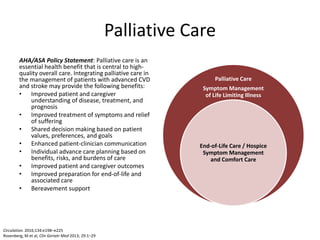
Palliative Care
Symptom Management
of Life Limiting Illness
End-of-Life Care / Hospice
Symptom Management
and Comfort Care
Circulation. 2016;134:e198–e225
Rosenberg, M et al, Clin Geriatr Med 2013; 29:1–29
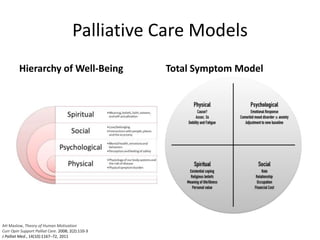
Palliative Care Models
Hierarchy of Well-Being Total Symptom Model
AH Maslow, Theory of Human Motivation
Curr Opin Support Palliat Care. 2008; 2(2):110-3
J Palliat Med., 14(10):1167–72, 2011
Carle Palliative Medicine Referral
Criteria
General Referral Criteria1
Presence of a serious illness and one or more of the following:
• New diagnosis of life-limiting illness for symptom control,
patient/family support
• Declining ability to complete activities of daily living
• Weight loss
• Progressive metastatic cancer
• Admission from long-term care facility (nursing home or assisted
living)
• Two or more hospitalizations for illness within three months
• Difficult-to-control physical or emotional symptoms
• Patient, family or physician uncertainty regarding prognosis
• Patient, family or physician uncertainty regarding
appropriateness of treatment options
• Patient or family requests for futile care
• DNR order conflicts
• Conflicts or uncertainty regarding the use of non-oral
feeding/hydration in cognitively impaired, seriously ill, or dying
patients
• Limited social support in setting of a serious illness (e.g.,
homeless, no family or friends, chronic mental illness,
overwhelmed family caregivers)
• Patient, family or physician request for information regarding
hospice appropriateness
• Patient or family psychological or spiritual/existential distress
Heart Failure2
• Symptoms
• NYHA class III/IV symptoms
• Frequent heart failure readmissions
• Recurrent ICD shocks
• Refractory angina
• Anxiety or depression adversely affecting
patient's quality of life or ability to best
manage illness
• Milestones
• Referral
• VAD
• Transplant
• TAVR
• Home inotropic therapy
• Caregiver distress.
1 www.capc.org
2 www.acc.org/latest-in-cardiology/articles/2016/02/11/08/02/palliative-care-for-
patients-with-heart-failure#sthash.ddHLsX9W.dpuf
Communicating About Palliative Care
What NOT to say!
• “There’s nothing left to
do…let’s have palliative care
see you.”
There is always something to
do for the patient even if there
is nothing left to treat the
disease.
What to say!
• “Palliative care works with me, your
cardiologist, to better manage your [pain,
shortness of breath or other symptom
(anxiety, fatigue, nausea)]. They are
experts in looking at this holistically and
make a comprehensive plan for how best
to relieve your [symptom].
• They can answer some of the questions
you may have about what to expect in
future as your [disease] worsens.
• They help me formulate a treatment plan
that is based on what is important to you
and what is going on with your family.
• There is support staff at the clinic who
works with the palliative care providers to
help you and your family cope with these
changes and plan for the future”
J Palliat Med, 11(6):823–828, 2008.

Palliative Care in Cardiology

  • 1.
    Palliative Care AHA/ASA PolicyStatement: Palliative care is an essential health benefit that is central to high- quality overall care. Integrating palliative care in the management of patients with advanced CVD and stroke may provide the following benefits: • Improved patient and caregiver understanding of disease, treatment, and prognosis • Improved treatment of symptoms and relief of suffering • Shared decision making based on patient values, preferences, and goals • Enhanced patient-clinician communication • Individual advance care planning based on benefits, risks, and burdens of care • Improved patient and caregiver outcomes • Improved preparation for end-of-life and associated care • Bereavement support Palliative Care Symptom Management of Life Limiting Illness End-of-Life Care / Hospice Symptom Management and Comfort Care Circulation. 2016;134:e198–e225 Rosenberg, M et al, Clin Geriatr Med 2013; 29:1–29
  • 2.
    Palliative Care Models Hierarchyof Well-Being Total Symptom Model AH Maslow, Theory of Human Motivation Curr Opin Support Palliat Care. 2008; 2(2):110-3 J Palliat Med., 14(10):1167–72, 2011
  • 3.
    Carle Palliative MedicineReferral Criteria General Referral Criteria1 Presence of a serious illness and one or more of the following: • New diagnosis of life-limiting illness for symptom control, patient/family support • Declining ability to complete activities of daily living • Weight loss • Progressive metastatic cancer • Admission from long-term care facility (nursing home or assisted living) • Two or more hospitalizations for illness within three months • Difficult-to-control physical or emotional symptoms • Patient, family or physician uncertainty regarding prognosis • Patient, family or physician uncertainty regarding appropriateness of treatment options • Patient or family requests for futile care • DNR order conflicts • Conflicts or uncertainty regarding the use of non-oral feeding/hydration in cognitively impaired, seriously ill, or dying patients • Limited social support in setting of a serious illness (e.g., homeless, no family or friends, chronic mental illness, overwhelmed family caregivers) • Patient, family or physician request for information regarding hospice appropriateness • Patient or family psychological or spiritual/existential distress Heart Failure2 • Symptoms • NYHA class III/IV symptoms • Frequent heart failure readmissions • Recurrent ICD shocks • Refractory angina • Anxiety or depression adversely affecting patient's quality of life or ability to best manage illness • Milestones • Referral • VAD • Transplant • TAVR • Home inotropic therapy • Caregiver distress. 1 www.capc.org 2 www.acc.org/latest-in-cardiology/articles/2016/02/11/08/02/palliative-care-for- patients-with-heart-failure#sthash.ddHLsX9W.dpuf
  • 4.
    Communicating About PalliativeCare What NOT to say! • “There’s nothing left to do…let’s have palliative care see you.” There is always something to do for the patient even if there is nothing left to treat the disease. What to say! • “Palliative care works with me, your cardiologist, to better manage your [pain, shortness of breath or other symptom (anxiety, fatigue, nausea)]. They are experts in looking at this holistically and make a comprehensive plan for how best to relieve your [symptom]. • They can answer some of the questions you may have about what to expect in future as your [disease] worsens. • They help me formulate a treatment plan that is based on what is important to you and what is going on with your family. • There is support staff at the clinic who works with the palliative care providers to help you and your family cope with these changes and plan for the future” J Palliat Med, 11(6):823–828, 2008.