1
Symptom Management in
Palliative Care
Michael Aref, MD, PhD, FACP, FHM
Assistant Medical Director of Palliative Medicine
2
I
DISCLOSURES
3
Disclosures
• None
4
II
OBJECTIVES
5
Objectives
• Identify models of pain.
• Describe pain pathways.
• Discuss how biochemical and neurohormonal mechanisms
are influenced by physical, psychological, social, and
spiritual components of pain.
• Explain uses and complications of opioids in pain
management, specifically constipation and nausea.
• Identify pharmacological targets for nausea management.
• Review options for medical management of malignant
bowel obstruction and dysfunction.
6
III
PAIN: MODELS
7
Central Neuropathic
• Non-dermatomal
• Direct central nervous injury
• Radiating or specific
• Burning, prickling, tingling,
electric, shock-like or lancinating
Peripheral Neuropathic
• Dermatomal
• Direct peripheral nervous injury
• Radiating or specific
• Burning, prickling, tingling,
electric, shock-like or lancinating
Visceral (,)
• C fiber activity
• Distension, ischemia and
inflammation of organs
• Diffuse, deep ache,
pressure, sickening,
squeeze, dull or sharp
Types of Pain
Psychogenic
• Pain that is caused, increased, or prolonged
by mental, emotional, or behavioral factors.
Acute < 3 months
Chronic > 3 months
Malignant pain is due
to a progressive disease
that will lead to death.

Non-malignant pain is due to a
non-threatening cause that may
persist until, but is not the cause of,
death.

1st
2nd
tramadol
oxycodone
methadone
3rd
Never
Opioid?
2nd – 3rd
Somatic (,)
•  fiber activity
• Skin and deep tissue
damage
• Pinprick, stabbing or
sharp
Goldstein and Morrison, Evidenced-Based Practice of Palliative Care: Expert Consult, Ch 1, 2
Mann and Carr, Pain: Creative Approaches to Effective Management
8
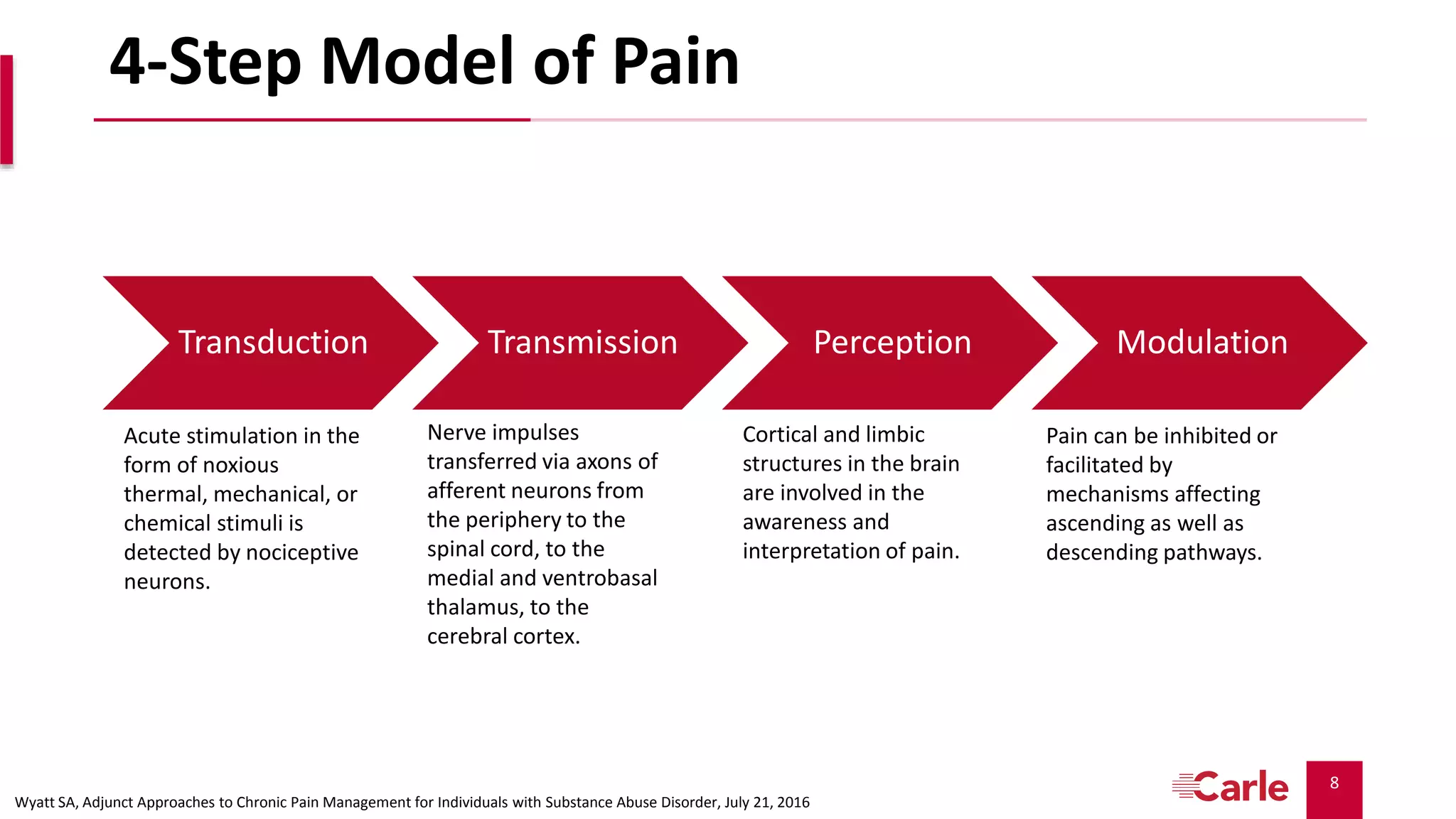
4-Step Model of Pain
Transduction Transmission Perception Modulation
Acute stimulation in the
form of noxious
thermal, mechanical, or
chemical stimuli is
detected by nociceptive
neurons.
Nerve impulses
transferred via axons of
afferent neurons from
the periphery to the
spinal cord, to the
medial and ventrobasal
thalamus, to the
cerebral cortex.
Cortical and limbic
structures in the brain
are involved in the
awareness and
interpretation of pain.
Pain can be inhibited or
facilitated by
mechanisms affecting
ascending as well as
descending pathways.
Wyatt SA, Adjunct Approaches to Chronic Pain Management for Individuals with Substance Abuse Disorder, July 21, 2016
9
Total Pain
Social
Psychological
Physical
•Role
•Relationships
•Occupation
•Financial cost
•Emotional response
•Comorbid mood disorder  anxiety
•Adjustment to new baseline
•Cause?
•Associated symptoms
•Debility and fatigue
Superimposed on Maslow’s Hierarchy of Needs
Spiritual
•Existential coping
•Religious beliefs
•Meaning of life/illness
•Personal value
Interventional Pain Service
Other Specialties
Pharmacy
Physical Therapy
Social Work
Financial Navigator
Occupational Therapy
Chaplaincy
Art & Music Therapy
Social Work
Psychology
Psychiatry
Curr Opin Support Palliat Care. 2008; 2(2):110-3
Maslow AH, A Theory of Human Motivation, 1943
10
IV
PAIN: PATHWAYS
11
Nocioceptive Nerve Conduction Pathways
J Pain. 2010 Aug;11(8):701-9
nobaproject.com/modules/touch-and-pain
12
Peripheral Nerve and Spinal Neurotransmitters of Pain
Int Clin Psychopharmacol. 1995 Jan;9 Suppl 4:41-5
Neuron. 2012; 76(1): 175-191
Nat Rev Drug Discov. 2014 Jul;13(7):533-48
www.rnceus.com
13
V
OPIATES
14
Procedural Interventions
• Patient controlled analgesia pump
• Neurolysis
• Spinal stimulator
• Intrathecal pump
• Neurosurgery
Methadone PO
Fentanyl IV (0.05 mg = 50 mcg)
Hydromorphone IV (0.8 mg)
Hydromorphone PO (4 mg)
Oxycodone PO (10 mg)
Morphine PO (15 mg) Morphine IV (5 mg)
Hydrocodone PO (15 mg)
Tramadol PO (100 mg)
Codeine PO (100 mg)
Ibuprofen PO (1100 mg)
Acetaminophen PO (3610 mg)
Salicylate (choline magnesium
trisalicylate)
Ascending WHO Analgesic Ladder
Adjuncts
• Anticonvulsants
• Neuropathic pain + muscle spasm = gabapentin
• Neuropathic pain + anxiety - depression = pregabalin
• Post-operative pain + anxiety - depression = pregabalin
• Antidepressants (SNRI, TCA)
• Muscle spasm + anxiety = diazepam
• Depression  anxiety + neuropathic pain = duloxetine
• Baclofen
• Cyclobenzaprine (muscle relaxant, fibromyalgia)
• Corticosteroids
• Ketamine
Interventions
• Transcutaneous electrical nerve stimulation
• Acupuncture
• Art / Music Therapy
• Massage
• Physical Therapy
• Psychological Treatment
Procedures
• Nerve blocks
Canadian Family Physician 2010; 56(6):514-517
Opioid tablet images WebMD
Chronic pain
Non-malignant pain
Malignant pain
Morphine IV comes in 4 and 6 mg
Actually 120 mg of codeine
Sedation
36-72 hours
Nausea / Vomiting
Pruritus
7-10 days
Constipation
Flushing / Sweating
Never
15
Descending WHO Analgesic Ladder
0
100
200
300
400
500
0 2 4 6 8 10 12 14 16 18 20 22 24 26
OralMorphineEquivalents
Days
10% wean everyday
20% wean everyday
50% wean everyday
Acute Pain
Acute pain
Chronic pain without control
Acute crises of chronic pain
paincommunity.org/blog/wp-content/uploads/Safely_Tapering_Opioids.pdf
AAPM 2005
USVA 2003
Hydromorphone 1 mg IV every hour
Oxycodone-APAP 10-325 mg PO every 2 hours
Hydrocodone-APAP 10-300 mg PO every 2 hours
Morphine 30 mg PO every 3 hours
Slow wean, if:
• Tachycardia
• Diaphoresis, lacrimation, salivation
• Diarrhea
16
VI
PAIN CASE #1
17
Case
• 23-year-old white female with chronic abdominal pain, nausea, and
food aversion secondary to multiple surgeries for hereditary
pancreatitis and complications thereof.
• Non-malignant abdominal pain managed with progressive increases in
opiates, now on high-dose opiates, 200 mcg/hr fentanyl patch with 4-8
mg of hydromorphone as needed every 2-3 hours.
• Mother strong advocate for patient.
• Consulted for pain management.
18
How is she NOT dead?
19
CDC Grand Rounds, January 13, 2012 / 61(01);10-13
Dose and Overdose
20
Course
• Basal opiates increased and discharged home.
• Patient seen on subsequent hospitalizations for other
complications, e.g. line infection, portal vein thrombosis.
Abdominal pain continues to worsen without change in
pathology.
• Having built a relationship with patient, discussed
concerns that opiates were worsening her pain.
Agreeable to weaning off opiates.
21
Narcotic Bowel Syndrome
• The pain worsens or incompletely resolves with continued or escalating dosages
of narcotics.
• There is marked worsening of pain when the narcotic dose wanes and
improvement when narcotics are reinstituted (“Soar and Crash”).
• There is a progression of the frequency, duration and intensity of pain episodes.
• The nature and intensity of the pain is not explained by a current or previous
gastrointestinal diagnosis:
– A patient may have a structural diagnosis (e.g., inflammatory bowel disease,
chronic pancreatitis) but the character or activity of the disease process is
not sufficient to explain the pain.
Chronic or frequently recurring abdominal pain that is treated with acute high dose or chronic
narcotics and all of the following:
Clin Gastroenterol Hepatol. Oct 2007; 5(10): 1126–1122.
22
VII
PAIN CASE #2
23
Case
• 72-year-old white male with metastatic pancreatic
cancer, admitted for pain control.
• Patient has been on rapidly escalating doses of
morphine. Delirious, in his lucid moments he weeps,
morphine has been aggressively increased. In the past 24
hours he developed intermittent jerking of his limbs.
• Consulted for pain management.
24
Course
• Patient was switched to fentanyl, but at 75%
equianalgesic dose.
• Pain controlled, delirium improved, myoclonic jerks
resolved.
• Patient died on in-patient hospice.
25
Opiate-Induced Hyperalgesia
• Increasing sensitivity to pain stimuli (hyperalgesia). Pain
elicited from ordinarily non-painful stimuli, such as stroking
skin with cotton (allodynia).
• Worsening pain despite increasing doses of opioids.
• Pain that becomes more diffuse, extending beyond the
distribution of pre-existing pain.
• Presence of other opioid hyperexcitability effects: myoclonus,
delirium or seizures.
• Can occur at any dose of opioid, but more commonly with
high parenteral doses of morphine or hydromorphone and/or
in the setting of renal failure.
www.mypcnow.org/blank-h5muh
26
VIII
CONSTIPATION
27
Constipation Prevention and Management Options
Non-pharmacological ways to prevent and treat
constipation
1. Optimize oral hydration
2. Physical activity
3. Scheduled visits to the
commode
4. Privacy when using the
commode
Yakima Valley Anti-Constipation Fruit Paste
1 lb pitted prunes
4 oz senna tea leaves (at health foods store)
1 lb raisins
1 lb figs
1 cup lemon juice
1. Prepare tea; use about 2 1/2 cups boiled water, add to tea leaves
and steep for 5 minutes.
2. Strain tea and remove tea leaves.
3. Place 2 cups of tea, or amount left, in large pot.
4. Add all of the fruit to the tea.
5. Boil fruit and tea for 15 - 20 minutes, until soft.
6. Remove from heat and add lemon juice. Allow to cool.
7. Use hand mixer/blender or food processor to turn fruit and tea
mix into a paste.
8. Place in glass jars or Tupperware and place in freezer (paste will
not freeze but will keep forever in freezer also very long in
fridge).
DOSAGE: 1 - 2 Tablespoons per day
28
Bowel movement frequency
normal for you without needing
other as needed medications
Bowel movement frequency
normal for you without needing
other medications
Bowel movement frequency
normal for you without other
medications
Bowel movement frequency
normal for you without needing
other medications
All opiates cause constipation and
unlike other side effects this does
not improve with time!
Start senna 1 tablet
twice daily plus as
needed adjunct*
Increase senna to 2
tablets twice daily plus
as needed adjunct*
Increase senna to 4
tablets twice daily plus
as needed adjunct*
Continue senna 4
tablets twice daily and
add MiraLax daily plus
as needed adjunct*
Contact your provider
for other
pharmacological
options for managing
your constipation
No changes
No changes
No changes
No changes
Yes
Yes
Yes
Yes
No
No
No
No
*Adjunct medications should be
used if there is no bowel
movement in the last 48 hours,
firstly:
• MiraLax 17g 1-2 times daily
If no relief or unable to tolerate
MiraLax consider:
• Bisacodyl suppository 10 mg
daily
• Glycerin suppository daily
• Soaps suds or tap water
enema daily
29
IX
CONSTIPATION CASE
30
Case
• 52-year-old white female with history of Ehlers-Danlos
syndrome, lumbar stenosis with radiculopathy, anxiety,
fibromyalgia, and opiate-induced constipation.
• She is followed in the ambulatory palliative care clinic.
• She is on high-doses of opiates and normally has issues
with constipation, she took extra doses of her bowel
regimen and developed diarrhea with nausea and
vomiting. She has mild acute kidney injury and CT
abdomen/pelvis without contrast reveals colitis.
31
Colonoscopy
Acute presentation of inflammatory bowel disease suggestive of severe ulcerative pan-colitis favored
over infections colitis (especially in light of negative GPP stool tests).
32
Course
• Pathology however consistent with acute ischemic
colitis. Confirmed at Mayo.
• CTA abdomen and pelvis showed no
hemodynamically significant stenosis or occlusion.
Aorta normal diameter.
33
Follow-Up Colonoscopy
4 months later
34
Acute Ischemic Colitis
• Ehlers-Danlos does have a higher incidence of ischemic colitis but due to
vascular malformations (aneurysms, dissections, fistulas).
• Increased incidence of inflammatory bowel disease (CD > UC) in Ehlers-
Danlos.
• Case report of lubiprostone induced ischemic colitis.
• Constipation causes increased intraluminal pressure that reduces blood
flow, predisposing the patient to regional colonic wall ischemia.
• Relative risk for ischemic colitis 2.78 times higher for patients with
constipation. Constipation is more prevalent in younger patients with
ischemic colitis.
• Use of laxatives during ischemic colitis increases risk of perforation.
Discussion
World J Gastroenterol. 2013 Jan 14;19(2):299-303
Front Surg. 2017; 4: 47
Aliment Pharmacol Ther (2007) 25:681–692.
35
X
NAUSEA
36
Nausea
Cause Receptors Drug Classes Examples
Vestibular Cholinergic, Histaminic
Anticholinergic,
Antihistaminic
Scopolamine patch,
Promethazine
Obstipation
Cholinergic, Histaminic,
likely 5HT3
Stimulate myenteric plexus Senna products
Motility
Cholinergic, Histaminic,
5HT3, 5HT4
Prokinetics which
stimulate 5HT4 receptors
Metoclopromide
Infection/Inflammation
Cholinergic,
Histaminic, 5HT3,
Neurokinin 1
Anticholinergic,
Antihistaminic, 5HT3
antagonists, Neurokinin 1
antagonists
Promethazine (e.g. for
labyrinthitis),
Prochlorperazine
Toxins Dopamine 2, 5HT3
Antidopaminergic, 5HT3
Antagonists
Prochlorperazine,
Haloperidol, Olanzapine,
Ondansetron
Fast Facts www.mypcnow.org/blank-ggr79
37
XI
NAUSEA CASE
38
Case
• 77-year-old white male recently diagnosed with Stage IB, T2
N0 M0 metastatic pancreatic adenocarcinoma. Past medical
history otherwise significant for heart disease and chronic
obstructive pulmonary disease.
• Presents with nausea and vomiting intractable to
ondansetron, promethazine, prochlorperazine, and
metoclopramide. Possibly alleviated some by lorazepam.
• He describes his nausea and vomiting as being precipitated
by hiccoughs that occur after drinking or eating small
amounts which then causes substernal pain, regurgitation,
and dyspnea.
39
Course
• Chlorpromazine 25 mg IV Q6H PRN for hiccoughs.
• No change in nausea with olanzapine and
haloperidol.
• One time dose of fosaprepitant did alleviate
refluxing of food or drink after eating for about 24
hours.
• Scheduled chlorpromazine 25 mg PO BID.
• Added diltiazem 30 mg PO Q6H.
40
Esophageal Spasm
• The patient had essentially been refractory to “all”
drug targets to manage nausea.
• Symptomatology used to guide management rather
than definitive testing (e.g. esophageal
manometry).
• More comfort focused care means avoiding invasive
testing and limiting non-invasive testing to highest
yield studies.
41
XII
MALIGNANT BOWEL OBSTRUCTION
42
Malignant Bowel Obstruction
• Prevalence 5-25% in ovarian carcinoma or
colorectal cancer, in advanced ovarian cancer
frequency up to 42%.
• Imaging of choice: CT abdomen and pelvis with
contrast (ACR Appropriateness Criteria Rating 9)
followed by without contrast (ACR 7). X-ray
abdomen and pelvis is ACR 5.
Partial or Complete
www.cancer.gov/resources-for/hp/education/epeco/self-study/module-3/module-3e.pdf
acsearch.acr.org/docs/69476/Narrative/
43
Management
• Venting gastrostomy is definitive management.
• Dexamethasone 6-16 mg IV may bring about resolution
of bowel obstruction.
• Dexamethasone + ranitidine = octreotide
• Dexamethasone + octreotide + metoclopramide
– MBO: Pain and nausea improved within 24 hours, PO intake
within 48 hours
– MBD: 84% of patients had improved pain and nausea within
24 hours, PO intake within 1-4 days
Inoperable
Support Care Cancer. 2009 Dec;17(12):1463-8
Am J Hosp Palliat Care. 2016 May;33(4):407-10
Support Care Cancer. 2009 Dec;17(12):1463-8
Am J Hosp Palliat Care. 2016 May;33(4):407-10
44
XIII
BUY ONE GET ONE FREE
45
Some Considerations
• Opioid-induced nausea = haloperidol PRN (max 2 mg
TID) + olanzapine QHS
• Superficial somatic pain + minimize opioids = lidocaine
topical
• Deep somatic pain = orphenadrine
• NSAID + renal impairment = diclofenac topical
• NSAID + bleeding risk = choline magnesium trisalicylate
• Pruritus + anxiety = hydroxyzine
Two symptoms for the price of one
46
THANK YOU
QUESTIONS? CONCERNS? COMMENTS?

Symptom Management in Palliative Care

  • 1.
    1 Symptom Management in PalliativeCare Michael Aref, MD, PhD, FACP, FHM Assistant Medical Director of Palliative Medicine
  • 2.
  • 3.
  • 4.
  • 5.
    5 Objectives • Identify modelsof pain. • Describe pain pathways. • Discuss how biochemical and neurohormonal mechanisms are influenced by physical, psychological, social, and spiritual components of pain. • Explain uses and complications of opioids in pain management, specifically constipation and nausea. • Identify pharmacological targets for nausea management. • Review options for medical management of malignant bowel obstruction and dysfunction.
  • 6.
  • 7.
    7 Central Neuropathic • Non-dermatomal •Direct central nervous injury • Radiating or specific • Burning, prickling, tingling, electric, shock-like or lancinating Peripheral Neuropathic • Dermatomal • Direct peripheral nervous injury • Radiating or specific • Burning, prickling, tingling, electric, shock-like or lancinating Visceral (,) • C fiber activity • Distension, ischemia and inflammation of organs • Diffuse, deep ache, pressure, sickening, squeeze, dull or sharp Types of Pain Psychogenic • Pain that is caused, increased, or prolonged by mental, emotional, or behavioral factors. Acute < 3 months Chronic > 3 months Malignant pain is due to a progressive disease that will lead to death.  Non-malignant pain is due to a non-threatening cause that may persist until, but is not the cause of, death.  1st 2nd tramadol oxycodone methadone 3rd Never Opioid? 2nd – 3rd Somatic (,) •  fiber activity • Skin and deep tissue damage • Pinprick, stabbing or sharp Goldstein and Morrison, Evidenced-Based Practice of Palliative Care: Expert Consult, Ch 1, 2 Mann and Carr, Pain: Creative Approaches to Effective Management
  • 8.
    8 4-Step Model ofPain Transduction Transmission Perception Modulation Acute stimulation in the form of noxious thermal, mechanical, or chemical stimuli is detected by nociceptive neurons. Nerve impulses transferred via axons of afferent neurons from the periphery to the spinal cord, to the medial and ventrobasal thalamus, to the cerebral cortex. Cortical and limbic structures in the brain are involved in the awareness and interpretation of pain. Pain can be inhibited or facilitated by mechanisms affecting ascending as well as descending pathways. Wyatt SA, Adjunct Approaches to Chronic Pain Management for Individuals with Substance Abuse Disorder, July 21, 2016
  • 9.
    9 Total Pain Social Psychological Physical •Role •Relationships •Occupation •Financial cost •Emotionalresponse •Comorbid mood disorder  anxiety •Adjustment to new baseline •Cause? •Associated symptoms •Debility and fatigue Superimposed on Maslow’s Hierarchy of Needs Spiritual •Existential coping •Religious beliefs •Meaning of life/illness •Personal value Interventional Pain Service Other Specialties Pharmacy Physical Therapy Social Work Financial Navigator Occupational Therapy Chaplaincy Art & Music Therapy Social Work Psychology Psychiatry Curr Opin Support Palliat Care. 2008; 2(2):110-3 Maslow AH, A Theory of Human Motivation, 1943
  • 10.
  • 11.
    11 Nocioceptive Nerve ConductionPathways J Pain. 2010 Aug;11(8):701-9 nobaproject.com/modules/touch-and-pain
  • 12.
    12 Peripheral Nerve andSpinal Neurotransmitters of Pain Int Clin Psychopharmacol. 1995 Jan;9 Suppl 4:41-5 Neuron. 2012; 76(1): 175-191 Nat Rev Drug Discov. 2014 Jul;13(7):533-48 www.rnceus.com
  • 13.
  • 14.
    14 Procedural Interventions • Patientcontrolled analgesia pump • Neurolysis • Spinal stimulator • Intrathecal pump • Neurosurgery Methadone PO Fentanyl IV (0.05 mg = 50 mcg) Hydromorphone IV (0.8 mg) Hydromorphone PO (4 mg) Oxycodone PO (10 mg) Morphine PO (15 mg) Morphine IV (5 mg) Hydrocodone PO (15 mg) Tramadol PO (100 mg) Codeine PO (100 mg) Ibuprofen PO (1100 mg) Acetaminophen PO (3610 mg) Salicylate (choline magnesium trisalicylate) Ascending WHO Analgesic Ladder Adjuncts • Anticonvulsants • Neuropathic pain + muscle spasm = gabapentin • Neuropathic pain + anxiety - depression = pregabalin • Post-operative pain + anxiety - depression = pregabalin • Antidepressants (SNRI, TCA) • Muscle spasm + anxiety = diazepam • Depression  anxiety + neuropathic pain = duloxetine • Baclofen • Cyclobenzaprine (muscle relaxant, fibromyalgia) • Corticosteroids • Ketamine Interventions • Transcutaneous electrical nerve stimulation • Acupuncture • Art / Music Therapy • Massage • Physical Therapy • Psychological Treatment Procedures • Nerve blocks Canadian Family Physician 2010; 56(6):514-517 Opioid tablet images WebMD Chronic pain Non-malignant pain Malignant pain Morphine IV comes in 4 and 6 mg Actually 120 mg of codeine Sedation 36-72 hours Nausea / Vomiting Pruritus 7-10 days Constipation Flushing / Sweating Never
  • 15.
    15 Descending WHO AnalgesicLadder 0 100 200 300 400 500 0 2 4 6 8 10 12 14 16 18 20 22 24 26 OralMorphineEquivalents Days 10% wean everyday 20% wean everyday 50% wean everyday Acute Pain Acute pain Chronic pain without control Acute crises of chronic pain paincommunity.org/blog/wp-content/uploads/Safely_Tapering_Opioids.pdf AAPM 2005 USVA 2003 Hydromorphone 1 mg IV every hour Oxycodone-APAP 10-325 mg PO every 2 hours Hydrocodone-APAP 10-300 mg PO every 2 hours Morphine 30 mg PO every 3 hours Slow wean, if: • Tachycardia • Diaphoresis, lacrimation, salivation • Diarrhea
  • 16.
  • 17.
    17 Case • 23-year-old whitefemale with chronic abdominal pain, nausea, and food aversion secondary to multiple surgeries for hereditary pancreatitis and complications thereof. • Non-malignant abdominal pain managed with progressive increases in opiates, now on high-dose opiates, 200 mcg/hr fentanyl patch with 4-8 mg of hydromorphone as needed every 2-3 hours. • Mother strong advocate for patient. • Consulted for pain management.
  • 18.
    18 How is sheNOT dead?
  • 19.
    19 CDC Grand Rounds,January 13, 2012 / 61(01);10-13 Dose and Overdose
  • 20.
    20 Course • Basal opiatesincreased and discharged home. • Patient seen on subsequent hospitalizations for other complications, e.g. line infection, portal vein thrombosis. Abdominal pain continues to worsen without change in pathology. • Having built a relationship with patient, discussed concerns that opiates were worsening her pain. Agreeable to weaning off opiates.
  • 21.
    21 Narcotic Bowel Syndrome •The pain worsens or incompletely resolves with continued or escalating dosages of narcotics. • There is marked worsening of pain when the narcotic dose wanes and improvement when narcotics are reinstituted (“Soar and Crash”). • There is a progression of the frequency, duration and intensity of pain episodes. • The nature and intensity of the pain is not explained by a current or previous gastrointestinal diagnosis: – A patient may have a structural diagnosis (e.g., inflammatory bowel disease, chronic pancreatitis) but the character or activity of the disease process is not sufficient to explain the pain. Chronic or frequently recurring abdominal pain that is treated with acute high dose or chronic narcotics and all of the following: Clin Gastroenterol Hepatol. Oct 2007; 5(10): 1126–1122.
  • 22.
  • 23.
    23 Case • 72-year-old whitemale with metastatic pancreatic cancer, admitted for pain control. • Patient has been on rapidly escalating doses of morphine. Delirious, in his lucid moments he weeps, morphine has been aggressively increased. In the past 24 hours he developed intermittent jerking of his limbs. • Consulted for pain management.
  • 24.
    24 Course • Patient wasswitched to fentanyl, but at 75% equianalgesic dose. • Pain controlled, delirium improved, myoclonic jerks resolved. • Patient died on in-patient hospice.
  • 25.
    25 Opiate-Induced Hyperalgesia • Increasingsensitivity to pain stimuli (hyperalgesia). Pain elicited from ordinarily non-painful stimuli, such as stroking skin with cotton (allodynia). • Worsening pain despite increasing doses of opioids. • Pain that becomes more diffuse, extending beyond the distribution of pre-existing pain. • Presence of other opioid hyperexcitability effects: myoclonus, delirium or seizures. • Can occur at any dose of opioid, but more commonly with high parenteral doses of morphine or hydromorphone and/or in the setting of renal failure. www.mypcnow.org/blank-h5muh
  • 26.
  • 27.
    27 Constipation Prevention andManagement Options Non-pharmacological ways to prevent and treat constipation 1. Optimize oral hydration 2. Physical activity 3. Scheduled visits to the commode 4. Privacy when using the commode Yakima Valley Anti-Constipation Fruit Paste 1 lb pitted prunes 4 oz senna tea leaves (at health foods store) 1 lb raisins 1 lb figs 1 cup lemon juice 1. Prepare tea; use about 2 1/2 cups boiled water, add to tea leaves and steep for 5 minutes. 2. Strain tea and remove tea leaves. 3. Place 2 cups of tea, or amount left, in large pot. 4. Add all of the fruit to the tea. 5. Boil fruit and tea for 15 - 20 minutes, until soft. 6. Remove from heat and add lemon juice. Allow to cool. 7. Use hand mixer/blender or food processor to turn fruit and tea mix into a paste. 8. Place in glass jars or Tupperware and place in freezer (paste will not freeze but will keep forever in freezer also very long in fridge). DOSAGE: 1 - 2 Tablespoons per day
  • 28.
    28 Bowel movement frequency normalfor you without needing other as needed medications Bowel movement frequency normal for you without needing other medications Bowel movement frequency normal for you without other medications Bowel movement frequency normal for you without needing other medications All opiates cause constipation and unlike other side effects this does not improve with time! Start senna 1 tablet twice daily plus as needed adjunct* Increase senna to 2 tablets twice daily plus as needed adjunct* Increase senna to 4 tablets twice daily plus as needed adjunct* Continue senna 4 tablets twice daily and add MiraLax daily plus as needed adjunct* Contact your provider for other pharmacological options for managing your constipation No changes No changes No changes No changes Yes Yes Yes Yes No No No No *Adjunct medications should be used if there is no bowel movement in the last 48 hours, firstly: • MiraLax 17g 1-2 times daily If no relief or unable to tolerate MiraLax consider: • Bisacodyl suppository 10 mg daily • Glycerin suppository daily • Soaps suds or tap water enema daily
  • 29.
  • 30.
    30 Case • 52-year-old whitefemale with history of Ehlers-Danlos syndrome, lumbar stenosis with radiculopathy, anxiety, fibromyalgia, and opiate-induced constipation. • She is followed in the ambulatory palliative care clinic. • She is on high-doses of opiates and normally has issues with constipation, she took extra doses of her bowel regimen and developed diarrhea with nausea and vomiting. She has mild acute kidney injury and CT abdomen/pelvis without contrast reveals colitis.
  • 31.
    31 Colonoscopy Acute presentation ofinflammatory bowel disease suggestive of severe ulcerative pan-colitis favored over infections colitis (especially in light of negative GPP stool tests).
  • 32.
    32 Course • Pathology howeverconsistent with acute ischemic colitis. Confirmed at Mayo. • CTA abdomen and pelvis showed no hemodynamically significant stenosis or occlusion. Aorta normal diameter.
  • 33.
  • 34.
    34 Acute Ischemic Colitis •Ehlers-Danlos does have a higher incidence of ischemic colitis but due to vascular malformations (aneurysms, dissections, fistulas). • Increased incidence of inflammatory bowel disease (CD > UC) in Ehlers- Danlos. • Case report of lubiprostone induced ischemic colitis. • Constipation causes increased intraluminal pressure that reduces blood flow, predisposing the patient to regional colonic wall ischemia. • Relative risk for ischemic colitis 2.78 times higher for patients with constipation. Constipation is more prevalent in younger patients with ischemic colitis. • Use of laxatives during ischemic colitis increases risk of perforation. Discussion World J Gastroenterol. 2013 Jan 14;19(2):299-303 Front Surg. 2017; 4: 47 Aliment Pharmacol Ther (2007) 25:681–692.
  • 35.
  • 36.
    36 Nausea Cause Receptors DrugClasses Examples Vestibular Cholinergic, Histaminic Anticholinergic, Antihistaminic Scopolamine patch, Promethazine Obstipation Cholinergic, Histaminic, likely 5HT3 Stimulate myenteric plexus Senna products Motility Cholinergic, Histaminic, 5HT3, 5HT4 Prokinetics which stimulate 5HT4 receptors Metoclopromide Infection/Inflammation Cholinergic, Histaminic, 5HT3, Neurokinin 1 Anticholinergic, Antihistaminic, 5HT3 antagonists, Neurokinin 1 antagonists Promethazine (e.g. for labyrinthitis), Prochlorperazine Toxins Dopamine 2, 5HT3 Antidopaminergic, 5HT3 Antagonists Prochlorperazine, Haloperidol, Olanzapine, Ondansetron Fast Facts www.mypcnow.org/blank-ggr79
  • 37.
  • 38.
    38 Case • 77-year-old whitemale recently diagnosed with Stage IB, T2 N0 M0 metastatic pancreatic adenocarcinoma. Past medical history otherwise significant for heart disease and chronic obstructive pulmonary disease. • Presents with nausea and vomiting intractable to ondansetron, promethazine, prochlorperazine, and metoclopramide. Possibly alleviated some by lorazepam. • He describes his nausea and vomiting as being precipitated by hiccoughs that occur after drinking or eating small amounts which then causes substernal pain, regurgitation, and dyspnea.
  • 39.
    39 Course • Chlorpromazine 25mg IV Q6H PRN for hiccoughs. • No change in nausea with olanzapine and haloperidol. • One time dose of fosaprepitant did alleviate refluxing of food or drink after eating for about 24 hours. • Scheduled chlorpromazine 25 mg PO BID. • Added diltiazem 30 mg PO Q6H.
  • 40.
    40 Esophageal Spasm • Thepatient had essentially been refractory to “all” drug targets to manage nausea. • Symptomatology used to guide management rather than definitive testing (e.g. esophageal manometry). • More comfort focused care means avoiding invasive testing and limiting non-invasive testing to highest yield studies.
  • 41.
  • 42.
    42 Malignant Bowel Obstruction •Prevalence 5-25% in ovarian carcinoma or colorectal cancer, in advanced ovarian cancer frequency up to 42%. • Imaging of choice: CT abdomen and pelvis with contrast (ACR Appropriateness Criteria Rating 9) followed by without contrast (ACR 7). X-ray abdomen and pelvis is ACR 5. Partial or Complete www.cancer.gov/resources-for/hp/education/epeco/self-study/module-3/module-3e.pdf acsearch.acr.org/docs/69476/Narrative/
  • 43.
    43 Management • Venting gastrostomyis definitive management. • Dexamethasone 6-16 mg IV may bring about resolution of bowel obstruction. • Dexamethasone + ranitidine = octreotide • Dexamethasone + octreotide + metoclopramide – MBO: Pain and nausea improved within 24 hours, PO intake within 48 hours – MBD: 84% of patients had improved pain and nausea within 24 hours, PO intake within 1-4 days Inoperable Support Care Cancer. 2009 Dec;17(12):1463-8 Am J Hosp Palliat Care. 2016 May;33(4):407-10 Support Care Cancer. 2009 Dec;17(12):1463-8 Am J Hosp Palliat Care. 2016 May;33(4):407-10
  • 44.
  • 45.
    45 Some Considerations • Opioid-inducednausea = haloperidol PRN (max 2 mg TID) + olanzapine QHS • Superficial somatic pain + minimize opioids = lidocaine topical • Deep somatic pain = orphenadrine • NSAID + renal impairment = diclofenac topical • NSAID + bleeding risk = choline magnesium trisalicylate • Pruritus + anxiety = hydroxyzine Two symptoms for the price of one
  • 46.