Paget's disease
INTRODUCTION
๏‚ท Pagetโ€™s disease is a chronic condition of bone characterized by disorder of the normal
bone remodeling process.
๏‚ท Characterized by excessive breakdown of bone tissue followed by abnormal bone
formation.
๏‚ท Also known as Osteitis Deformans is a bone disease unknown cause.
๏‚ท Affecting men twice as frequently as women.
๏‚ท Named after the England Surgeons Sir James Paget.
DISEASE CLASSIFICATION
INFLAMMATORY DISEASE
โ€ข Multifocal chronic skeletal disease due to Chronic paramyxoviral Virus infection.
โ€ข As a result, the bone that is formed is abnormal.
CONGENITAL
โ€ข Certain of genes may Been associated with Pagetโ€™s disease, including the Sequestrosome
1 Gene On Chromosome 5.
ETIOLOGY
๏‚ท The cause of Pagetโ€™s disease is unknown.
๏‚ท Disease may be caused by a virus.
๏‚ท Paramyxovirus infection of osteoblasts may activate of the c-fos proto-oncogene,
resulting in localized abnormal osteoclastic activity typical of pagetโ€™s disease.
๏‚ท Also, a personโ€™s genes may predispose them to developing pagetโ€™s disease.
๏‚ท Pagetโ€™s disease affects older skeletal bone of adults.
๏‚ท There is also an extremely rare form of pagetโ€™s disease in children, referred to as Juvenile
Pagetโ€™s disease.
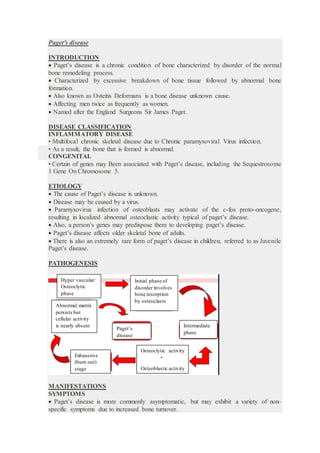
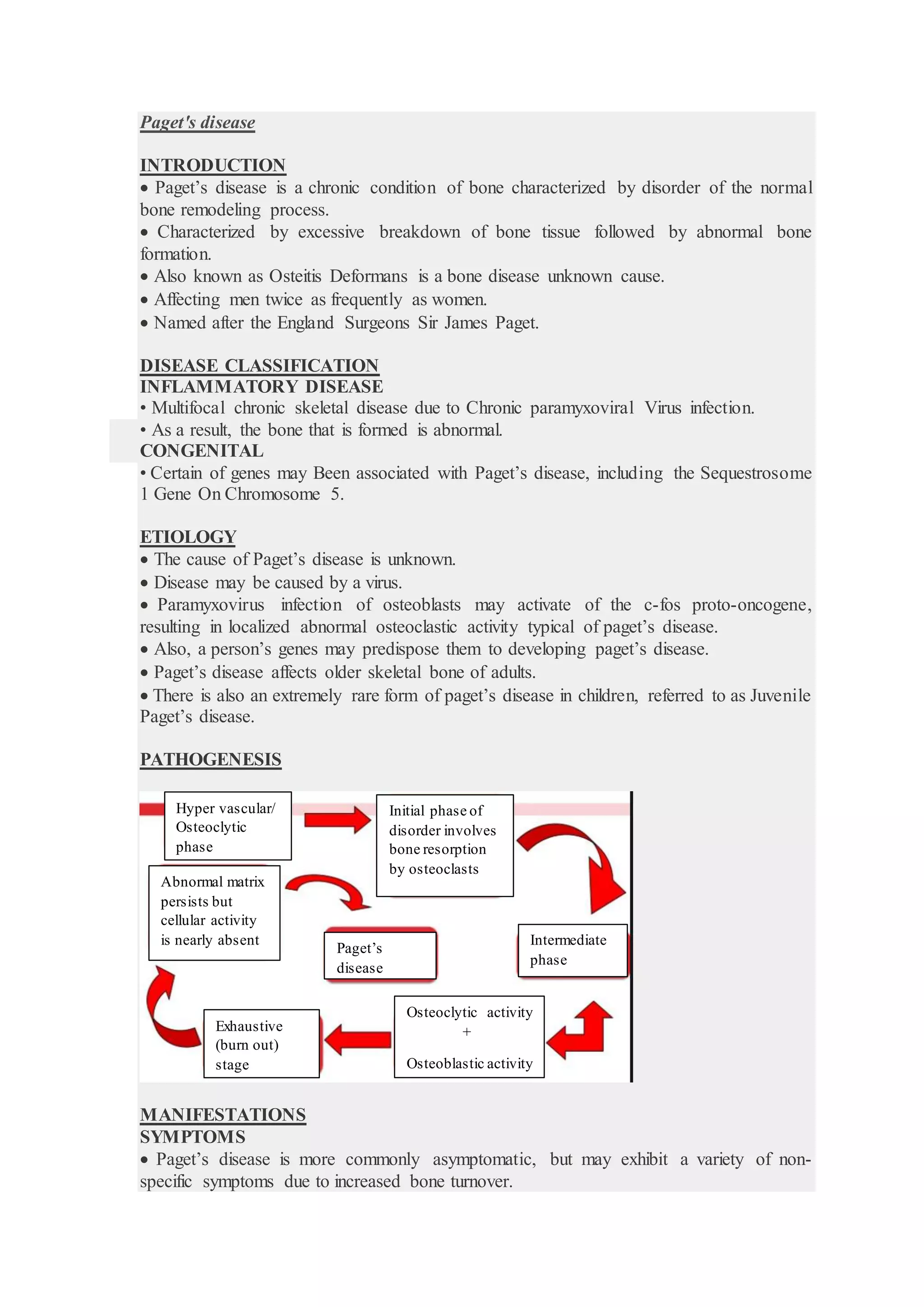
PATHOGENESIS
MANIFESTATIONS
SYMPTOMS
๏‚ท Pagetโ€™s disease is more commonly asymptomatic, but may exhibit a variety of non-
specific symptoms due to increased bone turnover.
Hyper vascular/
Osteoclytic
phase
Initial phase of
disorder involves
bone resorption
by osteoclasts
Abnormal matrix
persists but
cellular activity
is nearly absent
Pagetโ€™s
disease
Intermediate
phase
Exhaustive
(burn out)
stage
Osteoclytic activity
+
Osteoblastic activity
๏‚ท The bones that are move commonly affected include the pelvis, spine, skull, and the long
bone.
๏‚ท Individuals may experience any or a combination of the following symptoms;
๏‚ฎ Bone pain
๏‚ฎ Fractures
๏‚ฎ Skeletal Deformities โ€“ bowed legs, Fronto-occipital skull enlargement.
๏‚ฎ Warm sensation โ€“ due to increased blood supply to abnormal bones.
๏‚ฎ Nerve damage โ€“ hearing loss, visual abnormalities.
๏‚ฎ Cardiac abnormalities โ€“ shortness of breath.
SIGNS
๏‚ท Signs may be bitemporal skull enlargement with frontal โ€œbossingโ€, diluted scalp veins,
nerve deafness in one or both ears.
๏‚ท Also angioid streaks in the fundus of the eyes and a short kyphotic trunk.
SIGNIFICANT LAB TESTS
๏‚ท Blood chemistry (blood patient who have Pagetโ€™s disease) results indicate very high
alkaline phosphates levels with normal serum calcium and phosphorus.
๏‚ท There is no known cure for this disease.
๏‚ท Most cases are mild and asymptomatic no treatment is necessary in symptomatic cases
medications.
IMAGING CONSIDERATION
๏‚ท X-ray of the skull, spine, pelvis and long bone.
๏‚ท CT scan
๏‚ท MRI (Magnetic Resonance Imaging)
๏‚ท Radionuclide bone scan or RNI (Radionuclide Imaging).
RADIOLOGICAL APPEARANCE
๏‚ท Radionuclide bone scans readily detect Pagetโ€™s disease even in its very early stage.
๏‚ท Radiographically the affected bone typically demonstrate cortical thickening, with a
coarse, thickened trabecular pattern.
๏‚ท Mixed areas of radiolucent Osteolysis and radiopaque Osteosclerosis may be seen.
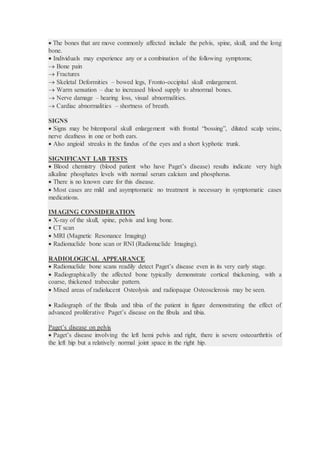
๏‚ท Radiograph of the fibula and tibia of the patient in figure demonstrating the effect of
advanced proliferative Pagetโ€™s disease on the fibula and tibia.
Pagetโ€™s disease on pelvis
๏‚ท Pagetโ€™s disease involving the left hemi pelvis and right, there is severe osteoarthritis of
the left hip but a relatively normal joint space in the right hip.

Paget's disease

  • 1.
    Paget's disease INTRODUCTION ๏‚ท Pagetโ€™sdisease is a chronic condition of bone characterized by disorder of the normal bone remodeling process. ๏‚ท Characterized by excessive breakdown of bone tissue followed by abnormal bone formation. ๏‚ท Also known as Osteitis Deformans is a bone disease unknown cause. ๏‚ท Affecting men twice as frequently as women. ๏‚ท Named after the England Surgeons Sir James Paget. DISEASE CLASSIFICATION INFLAMMATORY DISEASE โ€ข Multifocal chronic skeletal disease due to Chronic paramyxoviral Virus infection. โ€ข As a result, the bone that is formed is abnormal. CONGENITAL โ€ข Certain of genes may Been associated with Pagetโ€™s disease, including the Sequestrosome 1 Gene On Chromosome 5. ETIOLOGY ๏‚ท The cause of Pagetโ€™s disease is unknown. ๏‚ท Disease may be caused by a virus. ๏‚ท Paramyxovirus infection of osteoblasts may activate of the c-fos proto-oncogene, resulting in localized abnormal osteoclastic activity typical of pagetโ€™s disease. ๏‚ท Also, a personโ€™s genes may predispose them to developing pagetโ€™s disease. ๏‚ท Pagetโ€™s disease affects older skeletal bone of adults. ๏‚ท There is also an extremely rare form of pagetโ€™s disease in children, referred to as Juvenile Pagetโ€™s disease. PATHOGENESIS MANIFESTATIONS SYMPTOMS ๏‚ท Pagetโ€™s disease is more commonly asymptomatic, but may exhibit a variety of non- specific symptoms due to increased bone turnover. Hyper vascular/ Osteoclytic phase Initial phase of disorder involves bone resorption by osteoclasts Abnormal matrix persists but cellular activity is nearly absent Pagetโ€™s disease Intermediate phase Exhaustive (burn out) stage Osteoclytic activity + Osteoblastic activity
  • 2.
    ๏‚ท The bonesthat are move commonly affected include the pelvis, spine, skull, and the long bone. ๏‚ท Individuals may experience any or a combination of the following symptoms; ๏‚ฎ Bone pain ๏‚ฎ Fractures ๏‚ฎ Skeletal Deformities โ€“ bowed legs, Fronto-occipital skull enlargement. ๏‚ฎ Warm sensation โ€“ due to increased blood supply to abnormal bones. ๏‚ฎ Nerve damage โ€“ hearing loss, visual abnormalities. ๏‚ฎ Cardiac abnormalities โ€“ shortness of breath. SIGNS ๏‚ท Signs may be bitemporal skull enlargement with frontal โ€œbossingโ€, diluted scalp veins, nerve deafness in one or both ears. ๏‚ท Also angioid streaks in the fundus of the eyes and a short kyphotic trunk. SIGNIFICANT LAB TESTS ๏‚ท Blood chemistry (blood patient who have Pagetโ€™s disease) results indicate very high alkaline phosphates levels with normal serum calcium and phosphorus. ๏‚ท There is no known cure for this disease. ๏‚ท Most cases are mild and asymptomatic no treatment is necessary in symptomatic cases medications. IMAGING CONSIDERATION ๏‚ท X-ray of the skull, spine, pelvis and long bone. ๏‚ท CT scan ๏‚ท MRI (Magnetic Resonance Imaging) ๏‚ท Radionuclide bone scan or RNI (Radionuclide Imaging). RADIOLOGICAL APPEARANCE ๏‚ท Radionuclide bone scans readily detect Pagetโ€™s disease even in its very early stage. ๏‚ท Radiographically the affected bone typically demonstrate cortical thickening, with a coarse, thickened trabecular pattern. ๏‚ท Mixed areas of radiolucent Osteolysis and radiopaque Osteosclerosis may be seen. ๏‚ท Radiograph of the fibula and tibia of the patient in figure demonstrating the effect of advanced proliferative Pagetโ€™s disease on the fibula and tibia. Pagetโ€™s disease on pelvis ๏‚ท Pagetโ€™s disease involving the left hemi pelvis and right, there is severe osteoarthritis of the left hip but a relatively normal joint space in the right hip.