
Subtalar Dislocations
Jennifer Gerres DPM, PGY-3
 To discuss…
 The Mechanism of Injury
 Types of Subtalar Dislocations
 Therapeutic Approach
 Prognosis
 Simultaneous dislocation
 Talocalcaneal and talonavicular joints
 Four types described
 Uncommon injury = 1 -2% of dislocations
 Most published series = small number of patients
 Occur in the 3rd decade of life
 Men > women (6-10x more)
 55% of medial and 72% of lateral dislocations have
associated injury
 30% are irreducible by closed means
Mechanisms of Injury
 High energy
 MVA, falls from a height
 68% of all dislocations with
trend toward open
 Sports injury
 “basketball foot”
 Low energy
 Tripping over a step
 10% in the literature =
heavy selection bias?
Grantham SA. J Trauma. 1964.
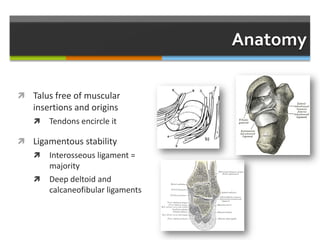
Anatomy
 Talus free of muscular
insertions and origins
 Tendons encircle it
 Ligamentous stability
 Interosseous ligament =
majority
 Deep deltoid and
calcaneofibular ligaments

Types of Dislocation
Medial, Lateral, Posterior, and Anterior
Direction of the foot in relation to the talus
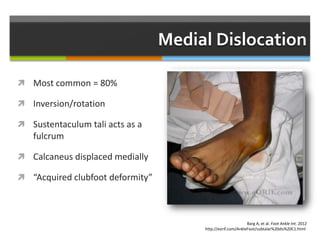
Medial Dislocation
 Most common = 80%
 Inversion/rotation
 Sustentaculum tali acts as a
fulcrum
 Calcaneus displaced medially
 “Acquired clubfoot deformity”
Barg A, et al. Foot Ankle Int. 2012
http://eorif.com/AnkleFoot/subtalar%20dis%20C1.html
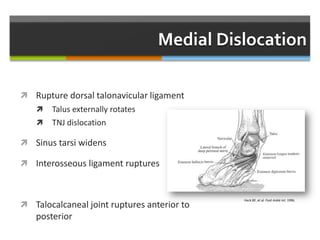
Medial Dislocation
 Rupture dorsal talonavicular ligament
 Talus externally rotates
 TNJ dislocation
 Sinus tarsi widens
 Interosseous ligament ruptures
 Talocalcaneal joint ruptures anterior to
posterior
Heck BE, et al. Foot Ankle Int. 1996.
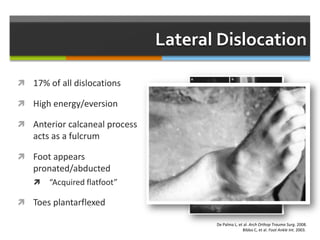
Lateral Dislocation
 17% of all dislocations
 High energy/eversion
 Anterior calcaneal process
acts as a fulcrum
 Foot appears
pronated/abducted
 “Acquired flatfoot”
 Toes plantarflexed
De Palma L, et al. Arch Orthop Trauma Surg. 2008.
Bibbo C, et al. Foot Ankle Int. 2003.
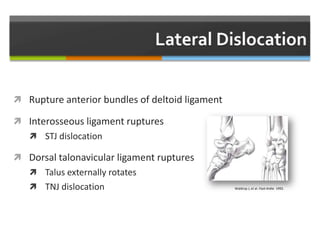
 Rupture anterior bundles of deltoid ligament
 Interosseous ligament ruptures
 STJ dislocation
 Dorsal talonavicular ligament ruptures
 Talus externally rotates
 TNJ dislocation Waldrop J, et al. Foot Ankle. 1992.
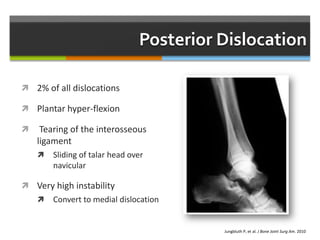
Posterior Dislocation
 2% of all dislocations
 Plantar hyper-flexion
 Tearing of the interosseous
ligament
 Sliding of talar head over
navicular
 Very high instability
 Convert to medial dislocation
Jungbluth P, et al. J Bone Joint Surg Am. 2010
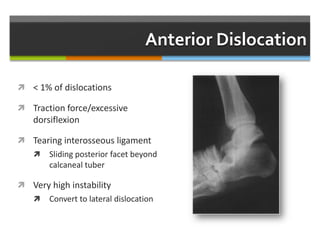
Anterior Dislocation
 < 1% of dislocations
 Traction force/excessive
dorsiflexion
 Tearing interosseous ligament
 Sliding posterior facet beyond
calcaneal tuber
 Very high instability
 Convert to lateral dislocation

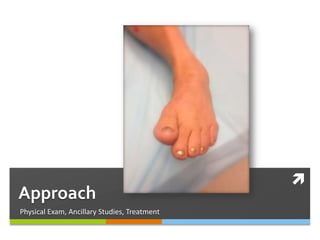
Approach
Physical Exam, Ancillary Studies, Treatment
Physical Exam
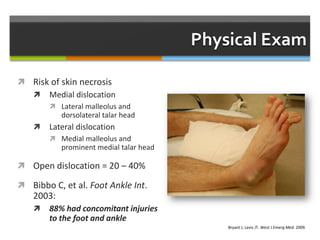
 Risk of skin necrosis
 Medial dislocation
 Lateral malleolus and
dorsolateral talar head
 Lateral dislocation
 Medial malleolus and
prominent medial talar head
 Open dislocation = 20 – 40%
 Bibbo C, et al. Foot Ankle Int.
2003:
 88% had concomitant injuries
to the foot and ankle
Bryant J, Levis JT. West J Emerg Med. 2009.
Radiographs
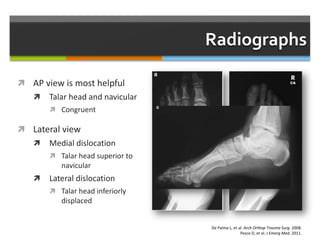
 AP view is most helpful
 Talar head and navicular
 Congruent
 Lateral view
 Medial dislocation
 Talar head superior to
navicular
 Lateral dislocation
 Talar head inferiorly
displaced
De Palma L, et al. Arch Orthop Trauma Surg. 2008.
Pesce D, et al. J Emerg Med. 2011.
 Bibbo C, et al. Foot Ankle Int. 2001:
 9 cases in a 3 year period
 Plain films diagnosed subtalar joint dislocation in all cases
 5 associated injuries observed
 CT identified additional injuries missed = 100%
 Total of 13 new findings
 44% of cases, new information changed treatment
 Subtalar fusion (n=3), tarsal tunnel release, excision of bone
fragments
 Bohay DR and Manoli A 2nd. Foot Ankle Int. 1996:
 Occult intra-articular fractures identified on CT of 4 patients
“…invaluable tool to assess for associated
injuries in STJ dislocation, and should be
performed in all cases of STJ dislocation.”
Bibbo C, et al. Foot Ankle Int. 2001
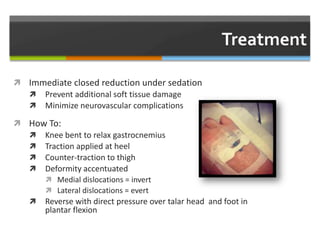
 Immediate closed reduction under sedation
 Prevent additional soft tissue damage
 Minimize neurovascular complications
 How To:
 Knee bent to relax gastrocnemius
 Traction applied at heel
 Counter-traction to thigh
 Deformity accentuated
 Medial dislocations = invert
 Lateral dislocations = evert
 Reverse with direct pressure over talar head and foot in
plantar flexion
Treatment
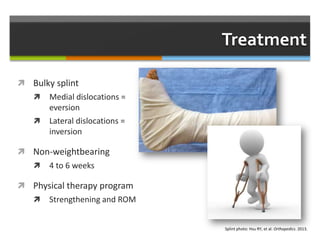
 Bulky splint
 Medial dislocations =
eversion
 Lateral dislocations =
inversion
 Non-weightbearing
 4 to 6 weeks
 Physical therapy program
 Strengthening and ROM
Splint photo: Hsu RY, et al. Orthopedics. 2013.
Obstacles to Reduction
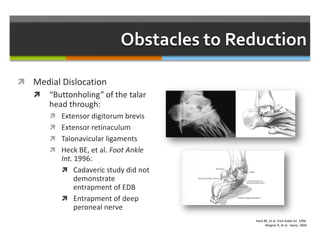
 Medial Dislocation
 “Buttonholing” of the talar
head through:
 Extensor digitorum brevis
 Extensor retinaculum
 Talonavicular ligaments
 Heck BE, et al. Foot Ankle
Int. 1996:
 Cadaveric study did not
demonstrate
entrapment of EDB
 Entrapment of deep
peroneal nerve
Heck BE, et al. Foot Ankle Int. 1996.
Wagner R, et al. Injury. 2004
Obstacles to Reduction
 Lateral Dislocation
 Posterior tibial tendon
 Osteochondral fx fragments
 TNJ or STJ
 May act as bony block
Waldrop J, et al. Foot Ankle. 1992.
 Medial Dislocation
 Longitudinal anteromedial incision over talar head/neck
 Lateral Dislocation
 Longitudinal medial incision over talar head
 Allows access to posterior tibial tendon
 Disimpaction of talus and navicular
 Small, loose fragments removed
 Larger fragments fixed with k-wires or screws
 Immobilization in SLC for 4 to 6 weeks
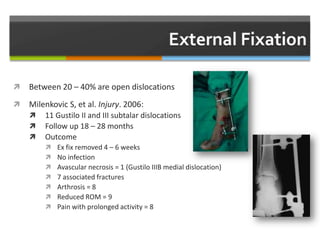
 Between 20 – 40% are open dislocations
 Milenkovic S, et al. Injury. 2006:
 11 Gustilo II and III subtalar dislocations
 Follow up 18 – 28 months
 Outcome
 Ex fix removed 4 – 6 weeks
 No infection
 Avascular necrosis = 1 (Gustilo IIIB medial dislocation)
 7 associated fractures
 Arthrosis = 8
 Reduced ROM = 9
 Pain with prolonged activity = 8

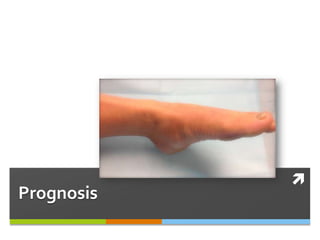
Prognosis
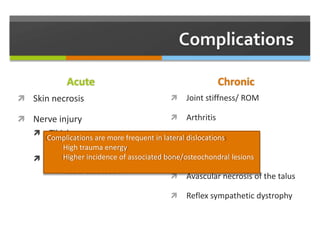
Acute
 Skin necrosis
 Nerve injury
 Tibial nerve
 Lateral dislocation
 Medial plantar nerve
 Medial dislocation
Chronic
 Joint stiffness/ ROM
 Arthritis
 Chronic pain
 Instability
 Avascular necrosis of the talus
 Reflex sympathetic dystrophy
Complications are more frequent in lateral dislocations
High trauma energy
Higher incidence of associated bone/osteochondral lesions
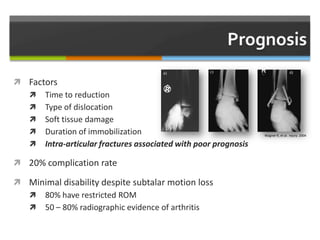
 Factors
 Time to reduction
 Type of dislocation
 Soft tissue damage
 Duration of immobilization
 Intra-articular fractures associated with poor prognosis
 20% complication rate
 Minimal disability despite subtalar motion loss
 80% have restricted ROM
 50 – 80% radiographic evidence of arthritis
Wagner R, et al. Injury. 2004
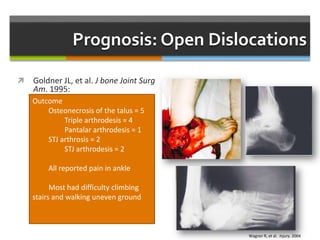
Prognosis: Open Dislocations
 Goldner JL, et al. J bone Joint Surg
Am. 1995:
 15 patients Gustilo Grade 3
 I&D followed by reduction and
immobilization
 Mean 18 year follow up
 Associated injuries:
 Tibial nerve injury = 10
 PTT rupture = 5
 PT artery laceration = 5
 Articular fx = 12
 Navicular fx = 3
 Talar dome fx = 3
 Malleolar fx = 3
Outcome
Osteonecrosis of the talus = 5
Triple arthrodesis = 4
Pantalar arthrodesis = 1
STJ arthrosis = 2
STJ arthrodesis = 2
All reported pain in ankle
Most had difficulty climbing
stairs and walking uneven ground
Wagner R, et al. Injury. 2004
 Perugia D, et al. Int Orthop. 2002:
 45 patients (37 medial and 8 lateral)
 Mean follow up of 7.5 years (2-17 years)
 Treatment
 Closed reduction, SLC x 4 weeks, aggressive rehab
 Outcome
 Mean AOFAS score = 84
 No significant difference between medial and lateral
 Minimal or no limitation to activity
 1 STJ arthrodesis due to chronic instability and pain
“…pure subtalar dislocation produced by low energy
trauma, promptly reduced and immobilized for four
weeks has a favorable long-term outcome.”
 Jungbluth P, et al. J Bone Joint Surg Am. 2010:
 23 patients (16 medial, 6 lateral, 1 posterior)
 Mean follow up = 58.3 months
 Treatment
 13 closed reduced
 7 open reduction with external fixation
 NWB 6 weeks with progressive WB and aggressive PT
 Full weight 10.6 weeks
Outcome
AOFAS Score
Closed = 83.3
Open = 80.9
Mean = 82.3
No differences observed between medial and lateral dislocations
No difference in ROM of affected and unaffected side
9 patients
Minor degenerative changes
No pain or restriction of movement

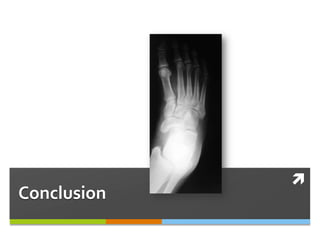
Conclusion
 Uncommon Injury = <2%
 88% have concomitant injuries to foot/ankle
 Prompt reduction is key
 CT invaluable tool
 Intra-articular fractures = worse prognosis

References
Barg A, Tochigi Y, Amendola A, Phisitkul P, Hintermann B, Saltzmann CL. Subtalar instability: diagnosis
and treatment. Foot Ankle Int. 2012; 33(2):151-160.
Bibbo C, Lin SS, Abidi N, Berberian W, Grossman M, Gebauer G, Behren FF. Missed and associated
injuries after subtalar dislocation: the role of ct. Foot Ankle Int. 2001; 22(4):324-328.
Bibbo C, Robert B, Anderson RB, Hodges W, Davis WH. Injury characteristics and the clinical outcome
of subtalar dislocations: a clinical and radiographic analysis of 25 cases. Foot Ankle Int. 2003;
24(2)158-163.
Bohay DR, Manoli A II. Occult fractures following subtalar joint injuries. Foot Ankle Int. 1996;
17(3):164-169.
Bohay DR, Manoli A II. Subtalar joint dislocations. Foot Ankle Int. 1995; 16(12):803-808.
Conesa X, Barro V, Barastegui D, Batalla L, Tomas J, Molero V. Lateral subtalar dislocation associated
with bimalleolar fracture: case report and literature review. J Foot Ankle Surg. 2011; 50(5):612-615.
DeLee JC, Curtis R. Subtalar dislocation of the foot. J Bone Joint Surg Am. 1982; 64(3):433-437.
de Palma L, Santucci A, Marinelli M. Irreducible isolated subtalar dislocation: a case report. Foot
Ankle Int. 2008; 29(5): 523-526.
Goldner JL, Poletti SC, Gates HS III, Richardson WJ. Severe open subtalar dislocations. Long-term
results. J Bone Joint Surg Am. 1995; 77(7):1075-1079.
Heck BE, Ebraheim NA, Jackson WT. Anatomical considerations of irreducible medial subtalar
dislocation. Foot Ankle Int. 1996; 17(2):103-106.
Horning J, DiPretaJ. Subtalar Dislocation. Orthopedics. 2009; 32(12):904-908.
Hyder N, Jones S, Nair B. Medial subtalar dislocation. The Foot. 1997; 7:34-36.
Jungbluth P, Wild M, Hakimi M, Gehrmann S, Djurisic M, Windolf J, Muhr G, Kälicke T. Isolated
subtalar dislocation. J Bone Joint Surg Am. 2010; 92:890-894.
Lasanianos NG, Lyras DN, Mouzopoulos G, Tsutseos N, Garnavos C. Early
mobilization after uncomplicated medial subtalar dislocation provides successful
functional results. J Orthop Traumatol. 2011: 12(1):37-43.
Love JN, Dhindsa HS, Hayden DK. Subtalar dislocation: evaluation and
management in the emergency department. J Emer Med. 1995; 13(6):787-793.
Merchan ECR. Subtalar dislocations: long-term follow-up of 39 cases. Injury.
1992; 23(2):97-100.
Milenkovic S, Mitkovic M, Bumbasirevi. External fixation of open subtalar
dislocation. Injury. 2006; 37(9): 909-913.
Perugia D, Basile A, Massoni C, Gumina S, Rossi F, Ferretti A. Conservative
treatment of subtalar dislocations. Int Orthop. 2002; 26(1):56-60.
Pesce D, Wethern J, Patel P. Rare case of medial subtalar dislocation from a low-
velocity mechanism. J Emer Med. 2008; 41(6):121-124.
Sanders DW. Fractures of the talus. In: Bucholz RW, Heckman JD, Court-Brown C, eds.
Rockwood and Green’s Fractures in Adults. Vol 1. 6th ed. Philadelphia, PA: Lippincott
Williams & Wilkins; 2006:2249-2292.
Tucker DJ, Burian G, Boylan J. Lateral subtalar dislocation: review of the literature and
case presentation. J Foot Ankle Surg. 1998; 37(3):239-247.
Wagner R, Blattert TR, Weckbach A. Talar dislocations. Injury. 2004; 35(Suppl2):SB36-
45.
Waldrop J, Ebraheim NA, Shapiro P, Jackson WT. Anatomical considerations of
posterior tibialis tendon entrapment in irreducible lateral subtalar dislocation. Foot
Ankle. 1992; 13(8):458-461.

ThankYou

Subtalar Dislocations

  • 1.
  • 2.
     To discuss… The Mechanism of Injury  Types of Subtalar Dislocations  Therapeutic Approach  Prognosis
  • 3.
     Simultaneous dislocation Talocalcaneal and talonavicular joints  Four types described  Uncommon injury = 1 -2% of dislocations  Most published series = small number of patients  Occur in the 3rd decade of life  Men > women (6-10x more)  55% of medial and 72% of lateral dislocations have associated injury  30% are irreducible by closed means
  • 4.
    Mechanisms of Injury High energy  MVA, falls from a height  68% of all dislocations with trend toward open  Sports injury  “basketball foot”  Low energy  Tripping over a step  10% in the literature = heavy selection bias? Grantham SA. J Trauma. 1964.
  • 5.
    Anatomy  Talus freeof muscular insertions and origins  Tendons encircle it  Ligamentous stability  Interosseous ligament = majority  Deep deltoid and calcaneofibular ligaments
  • 6.
     Types of Dislocation Medial,Lateral, Posterior, and Anterior Direction of the foot in relation to the talus
  • 7.
    Medial Dislocation  Mostcommon = 80%  Inversion/rotation  Sustentaculum tali acts as a fulcrum  Calcaneus displaced medially  “Acquired clubfoot deformity” Barg A, et al. Foot Ankle Int. 2012 http://eorif.com/AnkleFoot/subtalar%20dis%20C1.html
  • 8.
    Medial Dislocation  Rupturedorsal talonavicular ligament  Talus externally rotates  TNJ dislocation  Sinus tarsi widens  Interosseous ligament ruptures  Talocalcaneal joint ruptures anterior to posterior Heck BE, et al. Foot Ankle Int. 1996.
  • 9.
    Lateral Dislocation  17%of all dislocations  High energy/eversion  Anterior calcaneal process acts as a fulcrum  Foot appears pronated/abducted  “Acquired flatfoot”  Toes plantarflexed De Palma L, et al. Arch Orthop Trauma Surg. 2008. Bibbo C, et al. Foot Ankle Int. 2003.
  • 10.
     Rupture anteriorbundles of deltoid ligament  Interosseous ligament ruptures  STJ dislocation  Dorsal talonavicular ligament ruptures  Talus externally rotates  TNJ dislocation Waldrop J, et al. Foot Ankle. 1992.
  • 11.
    Posterior Dislocation  2%of all dislocations  Plantar hyper-flexion  Tearing of the interosseous ligament  Sliding of talar head over navicular  Very high instability  Convert to medial dislocation Jungbluth P, et al. J Bone Joint Surg Am. 2010
  • 12.
    Anterior Dislocation  <1% of dislocations  Traction force/excessive dorsiflexion  Tearing interosseous ligament  Sliding posterior facet beyond calcaneal tuber  Very high instability  Convert to lateral dislocation
  • 13.
  • 14.
    Physical Exam  Riskof skin necrosis  Medial dislocation  Lateral malleolus and dorsolateral talar head  Lateral dislocation  Medial malleolus and prominent medial talar head  Open dislocation = 20 – 40%  Bibbo C, et al. Foot Ankle Int. 2003:  88% had concomitant injuries to the foot and ankle Bryant J, Levis JT. West J Emerg Med. 2009.
  • 15.
    Radiographs  AP viewis most helpful  Talar head and navicular  Congruent  Lateral view  Medial dislocation  Talar head superior to navicular  Lateral dislocation  Talar head inferiorly displaced De Palma L, et al. Arch Orthop Trauma Surg. 2008. Pesce D, et al. J Emerg Med. 2011.
  • 16.
     Bibbo C,et al. Foot Ankle Int. 2001:  9 cases in a 3 year period  Plain films diagnosed subtalar joint dislocation in all cases  5 associated injuries observed  CT identified additional injuries missed = 100%  Total of 13 new findings  44% of cases, new information changed treatment  Subtalar fusion (n=3), tarsal tunnel release, excision of bone fragments  Bohay DR and Manoli A 2nd. Foot Ankle Int. 1996:  Occult intra-articular fractures identified on CT of 4 patients “…invaluable tool to assess for associated injuries in STJ dislocation, and should be performed in all cases of STJ dislocation.” Bibbo C, et al. Foot Ankle Int. 2001
  • 17.
     Immediate closedreduction under sedation  Prevent additional soft tissue damage  Minimize neurovascular complications  How To:  Knee bent to relax gastrocnemius  Traction applied at heel  Counter-traction to thigh  Deformity accentuated  Medial dislocations = invert  Lateral dislocations = evert  Reverse with direct pressure over talar head and foot in plantar flexion
  • 18.
    Treatment  Bulky splint Medial dislocations = eversion  Lateral dislocations = inversion  Non-weightbearing  4 to 6 weeks  Physical therapy program  Strengthening and ROM Splint photo: Hsu RY, et al. Orthopedics. 2013.
  • 19.
    Obstacles to Reduction Medial Dislocation  “Buttonholing” of the talar head through:  Extensor digitorum brevis  Extensor retinaculum  Talonavicular ligaments  Heck BE, et al. Foot Ankle Int. 1996:  Cadaveric study did not demonstrate entrapment of EDB  Entrapment of deep peroneal nerve Heck BE, et al. Foot Ankle Int. 1996. Wagner R, et al. Injury. 2004
  • 20.
    Obstacles to Reduction Lateral Dislocation  Posterior tibial tendon  Osteochondral fx fragments  TNJ or STJ  May act as bony block Waldrop J, et al. Foot Ankle. 1992.
  • 21.
     Medial Dislocation Longitudinal anteromedial incision over talar head/neck  Lateral Dislocation  Longitudinal medial incision over talar head  Allows access to posterior tibial tendon  Disimpaction of talus and navicular  Small, loose fragments removed  Larger fragments fixed with k-wires or screws  Immobilization in SLC for 4 to 6 weeks
  • 22.
     Between 20– 40% are open dislocations  Milenkovic S, et al. Injury. 2006:  11 Gustilo II and III subtalar dislocations  Follow up 18 – 28 months  Outcome  Ex fix removed 4 – 6 weeks  No infection  Avascular necrosis = 1 (Gustilo IIIB medial dislocation)  7 associated fractures  Arthrosis = 8  Reduced ROM = 9  Pain with prolonged activity = 8
  • 23.
  • 24.
    Acute  Skin necrosis Nerve injury  Tibial nerve  Lateral dislocation  Medial plantar nerve  Medial dislocation Chronic  Joint stiffness/ ROM  Arthritis  Chronic pain  Instability  Avascular necrosis of the talus  Reflex sympathetic dystrophy Complications are more frequent in lateral dislocations High trauma energy Higher incidence of associated bone/osteochondral lesions
  • 25.
     Factors  Timeto reduction  Type of dislocation  Soft tissue damage  Duration of immobilization  Intra-articular fractures associated with poor prognosis  20% complication rate  Minimal disability despite subtalar motion loss  80% have restricted ROM  50 – 80% radiographic evidence of arthritis Wagner R, et al. Injury. 2004
  • 26.
    Prognosis: Open Dislocations Goldner JL, et al. J bone Joint Surg Am. 1995:  15 patients Gustilo Grade 3  I&D followed by reduction and immobilization  Mean 18 year follow up  Associated injuries:  Tibial nerve injury = 10  PTT rupture = 5  PT artery laceration = 5  Articular fx = 12  Navicular fx = 3  Talar dome fx = 3  Malleolar fx = 3 Outcome Osteonecrosis of the talus = 5 Triple arthrodesis = 4 Pantalar arthrodesis = 1 STJ arthrosis = 2 STJ arthrodesis = 2 All reported pain in ankle Most had difficulty climbing stairs and walking uneven ground Wagner R, et al. Injury. 2004
  • 27.
     Perugia D,et al. Int Orthop. 2002:  45 patients (37 medial and 8 lateral)  Mean follow up of 7.5 years (2-17 years)  Treatment  Closed reduction, SLC x 4 weeks, aggressive rehab  Outcome  Mean AOFAS score = 84  No significant difference between medial and lateral  Minimal or no limitation to activity  1 STJ arthrodesis due to chronic instability and pain “…pure subtalar dislocation produced by low energy trauma, promptly reduced and immobilized for four weeks has a favorable long-term outcome.”
  • 28.
     Jungbluth P,et al. J Bone Joint Surg Am. 2010:  23 patients (16 medial, 6 lateral, 1 posterior)  Mean follow up = 58.3 months  Treatment  13 closed reduced  7 open reduction with external fixation  NWB 6 weeks with progressive WB and aggressive PT  Full weight 10.6 weeks Outcome AOFAS Score Closed = 83.3 Open = 80.9 Mean = 82.3 No differences observed between medial and lateral dislocations No difference in ROM of affected and unaffected side 9 patients Minor degenerative changes No pain or restriction of movement
  • 29.
  • 30.
     Uncommon Injury= <2%  88% have concomitant injuries to foot/ankle  Prompt reduction is key  CT invaluable tool  Intra-articular fractures = worse prognosis
  • 31.
  • 32.
    Barg A, TochigiY, Amendola A, Phisitkul P, Hintermann B, Saltzmann CL. Subtalar instability: diagnosis and treatment. Foot Ankle Int. 2012; 33(2):151-160. Bibbo C, Lin SS, Abidi N, Berberian W, Grossman M, Gebauer G, Behren FF. Missed and associated injuries after subtalar dislocation: the role of ct. Foot Ankle Int. 2001; 22(4):324-328. Bibbo C, Robert B, Anderson RB, Hodges W, Davis WH. Injury characteristics and the clinical outcome of subtalar dislocations: a clinical and radiographic analysis of 25 cases. Foot Ankle Int. 2003; 24(2)158-163. Bohay DR, Manoli A II. Occult fractures following subtalar joint injuries. Foot Ankle Int. 1996; 17(3):164-169. Bohay DR, Manoli A II. Subtalar joint dislocations. Foot Ankle Int. 1995; 16(12):803-808. Conesa X, Barro V, Barastegui D, Batalla L, Tomas J, Molero V. Lateral subtalar dislocation associated with bimalleolar fracture: case report and literature review. J Foot Ankle Surg. 2011; 50(5):612-615.
  • 33.
    DeLee JC, CurtisR. Subtalar dislocation of the foot. J Bone Joint Surg Am. 1982; 64(3):433-437. de Palma L, Santucci A, Marinelli M. Irreducible isolated subtalar dislocation: a case report. Foot Ankle Int. 2008; 29(5): 523-526. Goldner JL, Poletti SC, Gates HS III, Richardson WJ. Severe open subtalar dislocations. Long-term results. J Bone Joint Surg Am. 1995; 77(7):1075-1079. Heck BE, Ebraheim NA, Jackson WT. Anatomical considerations of irreducible medial subtalar dislocation. Foot Ankle Int. 1996; 17(2):103-106. Horning J, DiPretaJ. Subtalar Dislocation. Orthopedics. 2009; 32(12):904-908. Hyder N, Jones S, Nair B. Medial subtalar dislocation. The Foot. 1997; 7:34-36. Jungbluth P, Wild M, Hakimi M, Gehrmann S, Djurisic M, Windolf J, Muhr G, Kälicke T. Isolated subtalar dislocation. J Bone Joint Surg Am. 2010; 92:890-894.
  • 34.
    Lasanianos NG, LyrasDN, Mouzopoulos G, Tsutseos N, Garnavos C. Early mobilization after uncomplicated medial subtalar dislocation provides successful functional results. J Orthop Traumatol. 2011: 12(1):37-43. Love JN, Dhindsa HS, Hayden DK. Subtalar dislocation: evaluation and management in the emergency department. J Emer Med. 1995; 13(6):787-793. Merchan ECR. Subtalar dislocations: long-term follow-up of 39 cases. Injury. 1992; 23(2):97-100. Milenkovic S, Mitkovic M, Bumbasirevi. External fixation of open subtalar dislocation. Injury. 2006; 37(9): 909-913. Perugia D, Basile A, Massoni C, Gumina S, Rossi F, Ferretti A. Conservative treatment of subtalar dislocations. Int Orthop. 2002; 26(1):56-60.
  • 35.
    Pesce D, WethernJ, Patel P. Rare case of medial subtalar dislocation from a low- velocity mechanism. J Emer Med. 2008; 41(6):121-124. Sanders DW. Fractures of the talus. In: Bucholz RW, Heckman JD, Court-Brown C, eds. Rockwood and Green’s Fractures in Adults. Vol 1. 6th ed. Philadelphia, PA: Lippincott Williams & Wilkins; 2006:2249-2292. Tucker DJ, Burian G, Boylan J. Lateral subtalar dislocation: review of the literature and case presentation. J Foot Ankle Surg. 1998; 37(3):239-247. Wagner R, Blattert TR, Weckbach A. Talar dislocations. Injury. 2004; 35(Suppl2):SB36- 45. Waldrop J, Ebraheim NA, Shapiro P, Jackson WT. Anatomical considerations of posterior tibialis tendon entrapment in irreducible lateral subtalar dislocation. Foot Ankle. 1992; 13(8):458-461.
  • 36.

Editor's Notes

  • #5 Grantham SA. Medial subtalar dislocation: five cases with a common etiology. J Trauma. 1964; (4):845-849.
  • #10 Toes appear plantarflexed due to lengthening of route of flexor tendons Talus palpable over medial aspect of the foot and heel displaced laterally
  • #15 Risk of local ischemia over tented areasThorough neurovascular examination
  • #16 J
  • #17 13 new findings, fracture medial aspect posterior facet, comminution posterior talar facet, medial talar process fracture, cuboid fracture, metatarsal base fracture
  • #18 Reassess with radiographs \Reassess NVS of limb. Get CT after reduction
  • #22 Once exposed, talar head is manipulated from incarcerating structures. Can visualize impacted bone.
  • #29 Cohort of 97 with 23 purely isolated subtalar