Abdul salim al shehin
Group 52
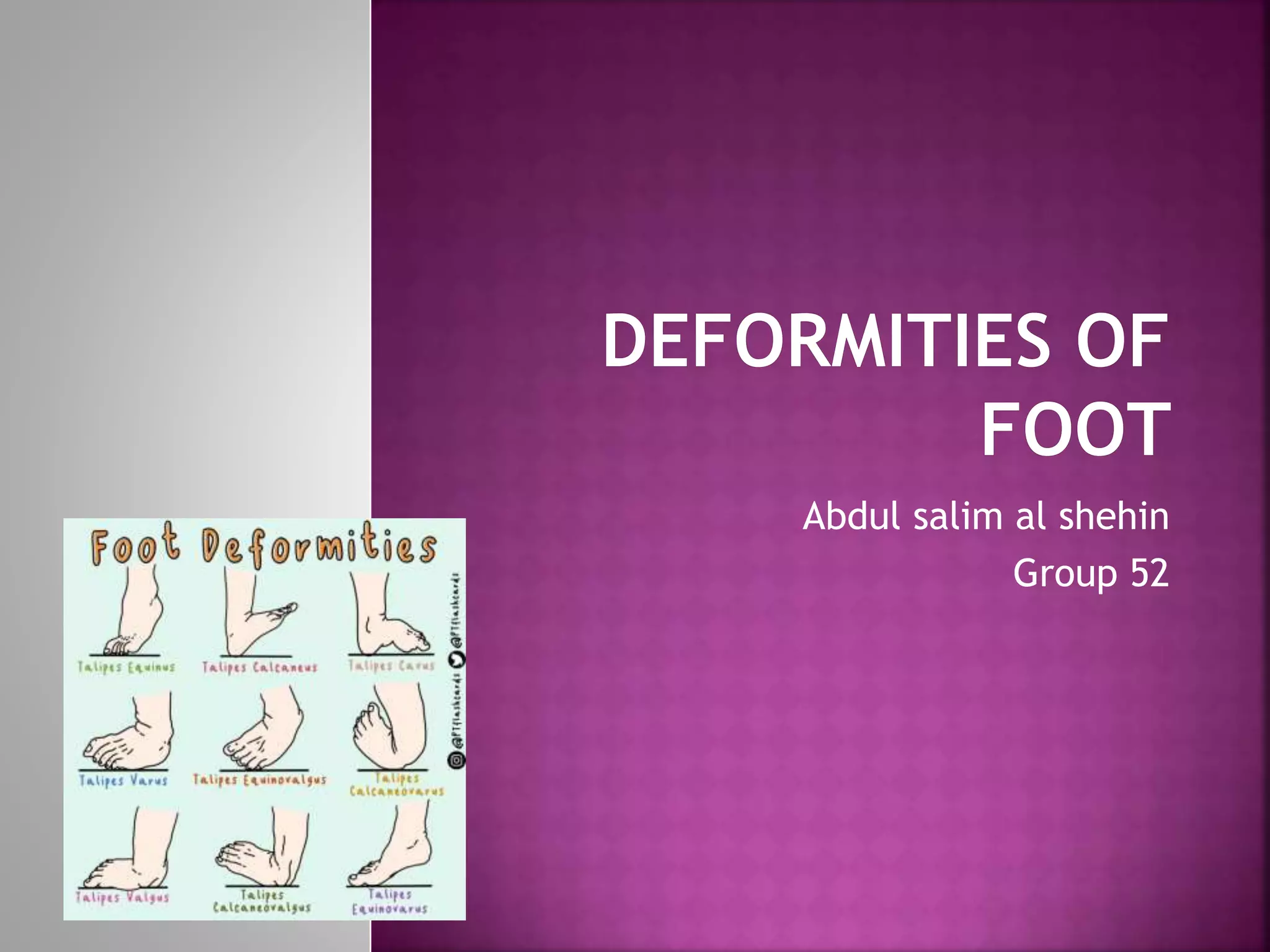
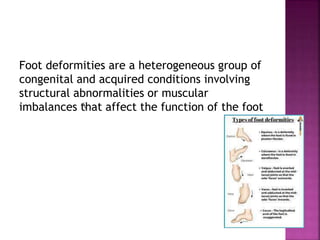
Foot deformities are a heterogeneous group of
congenital and acquired conditions involving
structural abnormalities or muscular
imbalances that affect the function of the foot
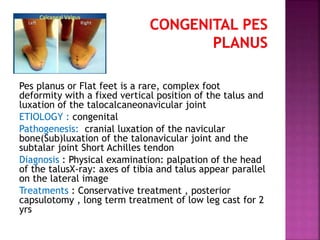
Pes planus or Flat feet is a rare, complex foot
deformity with a fixed vertical position of the talus and
luxation of the talocalcaneonavicular joint
ETIOLOGY : congenital
Pathogenesis: cranial luxation of the navicular
bone(Sub)luxation of the talonavicular joint and the
subtalar joint Short Achilles tendon
Diagnosis : Physical examination: palpation of the head
of the talusX-ray: axes of tibia and talus appear parallel
on the lateral image
Treatments : Conservative treatment , posterior
capsulotomy , long term treatment of low leg cast for 2
yrs
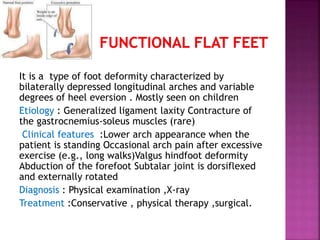
It is a type of foot deformity characterized by
bilaterally depressed longitudinal arches and variable
degrees of heel eversion . Mostly seen on children
Etiology : Generalized ligament laxity Contracture of
the gastrocnemius-soleus muscles (rare)
Clinical features :Lower arch appearance when the
patient is standing Occasional arch pain after excessive
exercise (e.g., long walks)Valgus hindfoot deformity
Abduction of the forefoot Subtalar joint is dorsiflexed
and externally rotated
Diagnosis : Physical examination ,X-ray
Treatment :Conservative , physical therapy ,surgical.
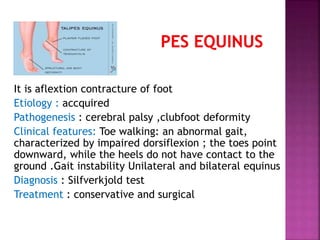
It is aflextion contracture of foot
Etiology : accquired
Pathogenesis : cerebral palsy ,clubfoot deformity
Clinical features: Toe walking: an abnormal gait,
characterized by impaired dorsiflexion ; the toes point
downward, while the heels do not have contact to the
ground .Gait instability Unilateral and bilateral equinus
Diagnosis : Silfverkjold test
Treatment : conservative and surgical
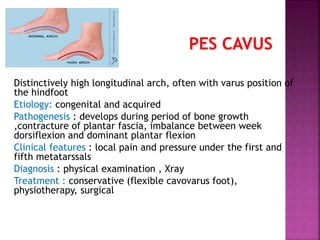
Distinctively high longitudinal arch, often with varus position of
the hindfoot
Etiology: congenital and acquired
Pathogenesis : develops during period of bone growth
,contracture of plantar fascia, imbalance between week
dorsiflexion and dominant plantar flexion
Clinical features : local pain and pressure under the first and
fifth metatarssals
Diagnosis : physical examination , Xray
Treatment : conservative (flexible cavovarus foot),
physiotherapy, surgical
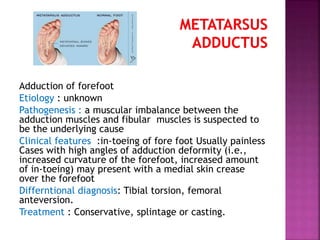
Adduction of forefoot
Etiology : unknown
Pathogenesis : a muscular imbalance between the
adduction muscles and fibular muscles is suspected to
be the underlying cause
Clinical features :in-toeing of fore foot Usually painless
Cases with high angles of adduction deformity (i.e.,
increased curvature of the forefoot, increased amount
of in-toeing) may present with a medial skin crease
over the forefoot
Differntional diagnosis: Tibial torsion, femoral
anteversion.
Treatment : Conservative, splintage or casting.
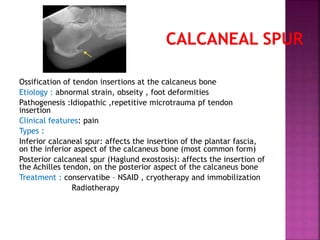
Ossification of tendon insertions at the calcaneus bone
Etiology : abnormal strain, obseity , foot deformities
Pathogenesis :Idiopathic ,repetitive microtrauma pf tendon
insertion
Clinical features: pain
Types :
Inferior calcaneal spur: affects the insertion of the plantar fascia,
on the inferior aspect of the calcaneus bone (most common form)
Posterior calcaneal spur (Haglund exostosis): affects the insertion of
the Achilles tendon, on the posterior aspect of the calcaneus bone
Treatment : conservatibe – NSAID , cryotherapy and immobilization
Radiotherapy
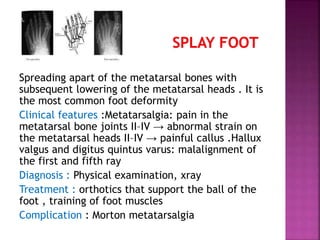
Spreading apart of the metatarsal bones with
subsequent lowering of the metatarsal heads . It is
the most common foot deformity
Clinical features :Metatarsalgia: pain in the
metatarsal bone joints II–IV → abnormal strain on
the metatarsal heads II–IV → painful callus .Hallux
valgus and digitus quintus varus: malalignment of
the first and fifth ray
Diagnosis : Physical examination, xray
Treatment : orthotics that support the ball of the
foot , training of foot muscles
Complication : Morton metatarsalgia
THANK YOU

DEFORMITIES OF FOOT.pptx

  • 1.
    Abdul salim alshehin Group 52
  • 2.
    Foot deformities area heterogeneous group of congenital and acquired conditions involving structural abnormalities or muscular imbalances that affect the function of the foot
  • 3.
    Pes planus orFlat feet is a rare, complex foot deformity with a fixed vertical position of the talus and luxation of the talocalcaneonavicular joint ETIOLOGY : congenital Pathogenesis: cranial luxation of the navicular bone(Sub)luxation of the talonavicular joint and the subtalar joint Short Achilles tendon Diagnosis : Physical examination: palpation of the head of the talusX-ray: axes of tibia and talus appear parallel on the lateral image Treatments : Conservative treatment , posterior capsulotomy , long term treatment of low leg cast for 2 yrs
  • 4.
    It is atype of foot deformity characterized by bilaterally depressed longitudinal arches and variable degrees of heel eversion . Mostly seen on children Etiology : Generalized ligament laxity Contracture of the gastrocnemius-soleus muscles (rare) Clinical features :Lower arch appearance when the patient is standing Occasional arch pain after excessive exercise (e.g., long walks)Valgus hindfoot deformity Abduction of the forefoot Subtalar joint is dorsiflexed and externally rotated Diagnosis : Physical examination ,X-ray Treatment :Conservative , physical therapy ,surgical.
  • 5.
    It is aflextioncontracture of foot Etiology : accquired Pathogenesis : cerebral palsy ,clubfoot deformity Clinical features: Toe walking: an abnormal gait, characterized by impaired dorsiflexion ; the toes point downward, while the heels do not have contact to the ground .Gait instability Unilateral and bilateral equinus Diagnosis : Silfverkjold test Treatment : conservative and surgical
  • 6.
    Distinctively high longitudinalarch, often with varus position of the hindfoot Etiology: congenital and acquired Pathogenesis : develops during period of bone growth ,contracture of plantar fascia, imbalance between week dorsiflexion and dominant plantar flexion Clinical features : local pain and pressure under the first and fifth metatarssals Diagnosis : physical examination , Xray Treatment : conservative (flexible cavovarus foot), physiotherapy, surgical
  • 7.
    Adduction of forefoot Etiology: unknown Pathogenesis : a muscular imbalance between the adduction muscles and fibular muscles is suspected to be the underlying cause Clinical features :in-toeing of fore foot Usually painless Cases with high angles of adduction deformity (i.e., increased curvature of the forefoot, increased amount of in-toeing) may present with a medial skin crease over the forefoot Differntional diagnosis: Tibial torsion, femoral anteversion. Treatment : Conservative, splintage or casting.
  • 8.
    Ossification of tendoninsertions at the calcaneus bone Etiology : abnormal strain, obseity , foot deformities Pathogenesis :Idiopathic ,repetitive microtrauma pf tendon insertion Clinical features: pain Types : Inferior calcaneal spur: affects the insertion of the plantar fascia, on the inferior aspect of the calcaneus bone (most common form) Posterior calcaneal spur (Haglund exostosis): affects the insertion of the Achilles tendon, on the posterior aspect of the calcaneus bone Treatment : conservatibe – NSAID , cryotherapy and immobilization Radiotherapy
  • 9.
    Spreading apart ofthe metatarsal bones with subsequent lowering of the metatarsal heads . It is the most common foot deformity Clinical features :Metatarsalgia: pain in the metatarsal bone joints II–IV → abnormal strain on the metatarsal heads II–IV → painful callus .Hallux valgus and digitus quintus varus: malalignment of the first and fifth ray Diagnosis : Physical examination, xray Treatment : orthotics that support the ball of the foot , training of foot muscles Complication : Morton metatarsalgia
  • 10.