

The transport
layer plus ICMP.
Page 2
Instructor, PACE-IT Program – Edmonds Community College
Areas of Expertise Industry Certifications
 PC Hardware
 Network Administration
 IT Project Management
 Network Design
 User Training
 IT Troubleshooting
Qualifications Summary
Education
 M.B.A., IT Management, Western Governor’s University
 B.S., IT Security, Western Governor’s University
Entrepreneur, executive leader, and proven manger
with 10+ years of experience turning complex issues
into efficient and effective solutions.
Strengths include developing and mentoring diverse
workforces, improving processes, analyzing
business needs and creating the solutions
required— with a focus on technology.
Page 3
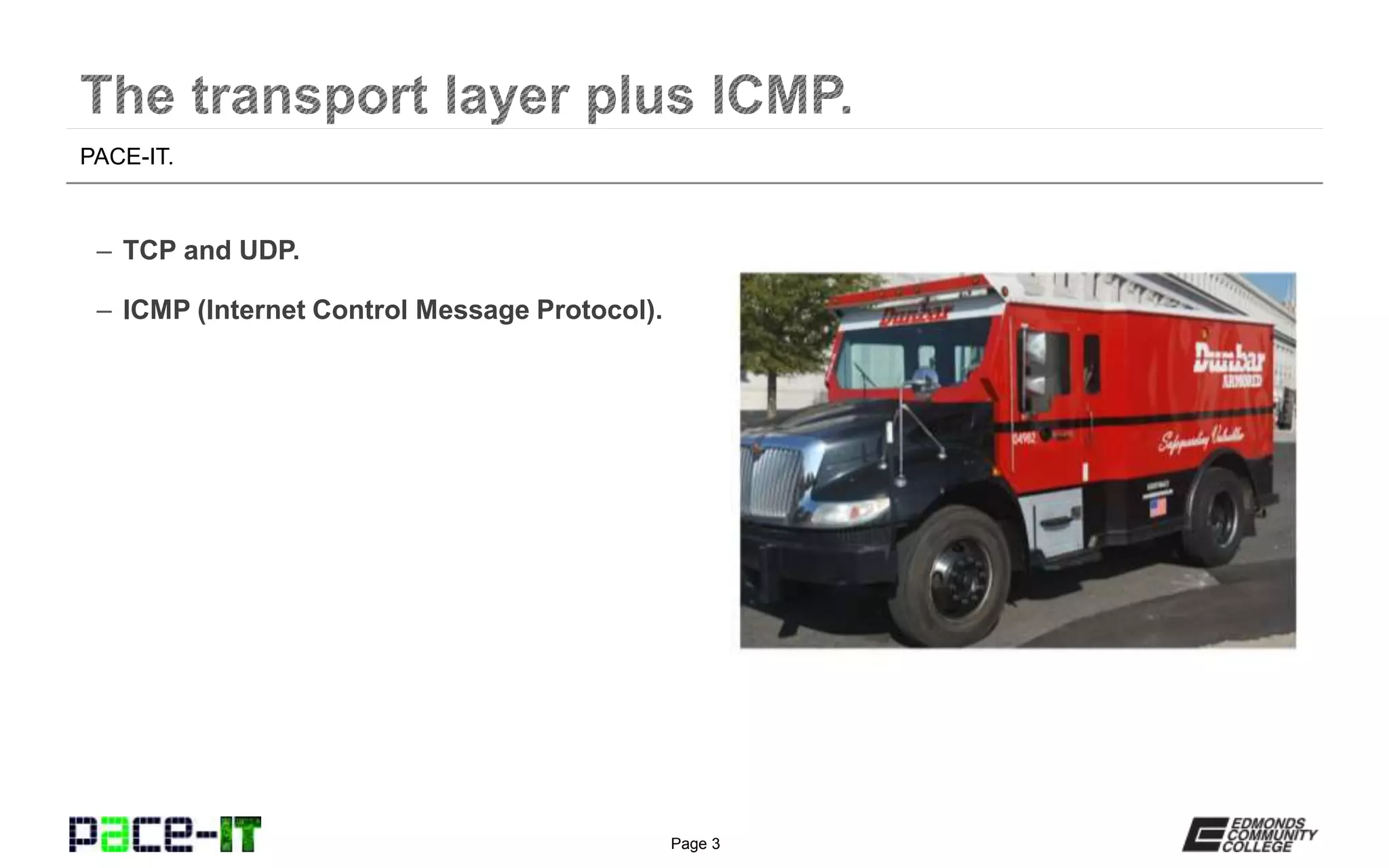
– TCP and UDP.
– ICMP (Internet Control Message Protocol).
PACE-IT.
Page 4
The transport layer plus ICMP.
Page 5
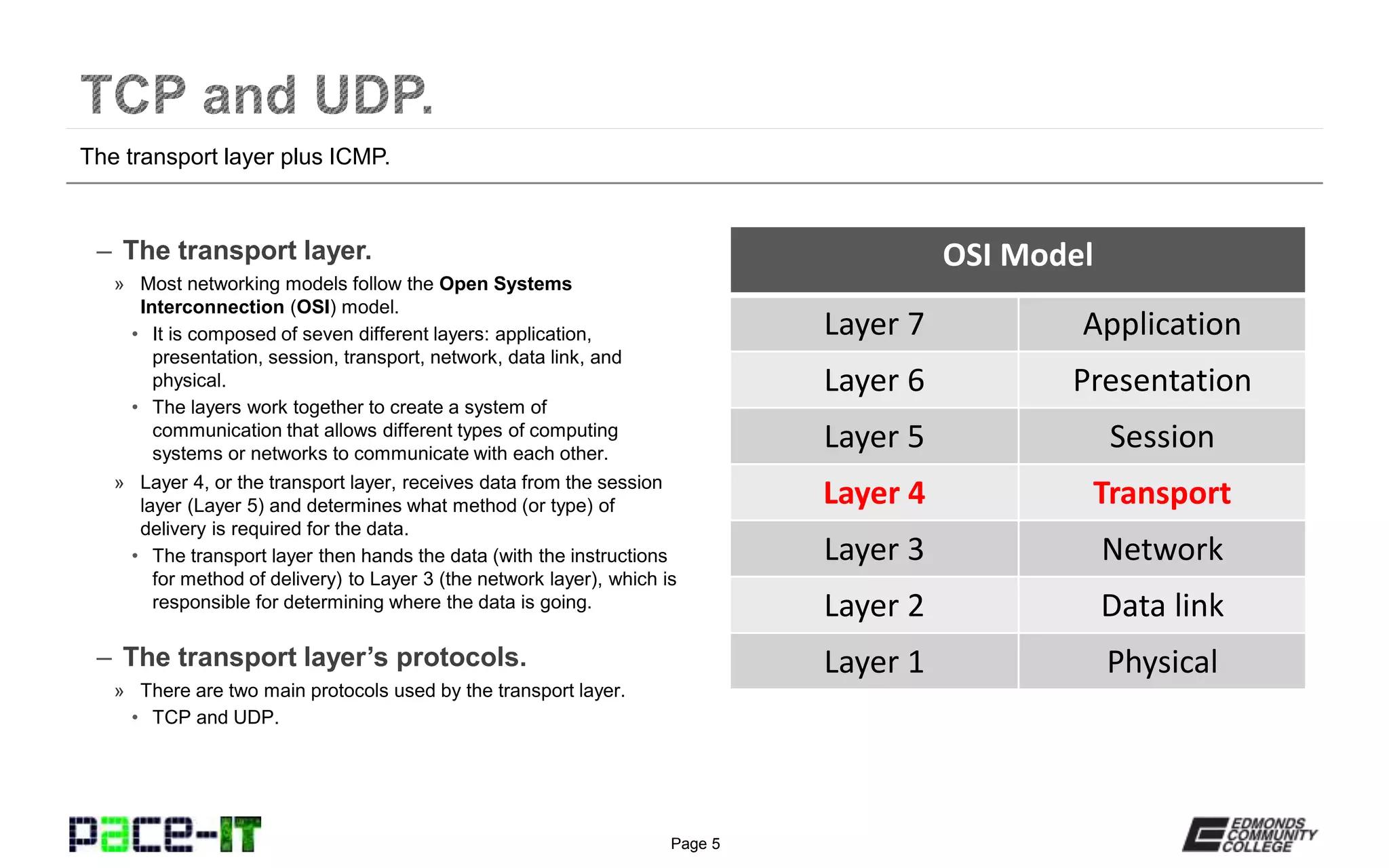
– The transport layer.
» Most networking models follow the Open Systems
Interconnection (OSI) model.
• It is composed of seven different layers: application,
presentation, session, transport, network, data link, and
physical.
• The layers work together to create a system of
communication that allows different types of computing
systems or networks to communicate with each other.
» Layer 4, or the transport layer, receives data from the session
layer (Layer 5) and determines what method (or type) of
delivery is required for the data.
• The transport layer then hands the data (with the instructions
for method of delivery) to Layer 3 (the network layer), which is
responsible for determining where the data is going.
– The transport layer’s protocols.
» There are two main protocols used by the transport layer.
• TCP and UDP.
The transport layer plus ICMP.
OSI Model
Layer 7 Application
Layer 6 Presentation
Layer 5 Session
Layer 4 Transport
Layer 3 Network
Layer 2 Data link
Layer 1 Physical
Page 6
– Introduction to TCP (Transmission Control
Protocol).
» A protocol that determines the type of delivery method that will
be used in network communication.
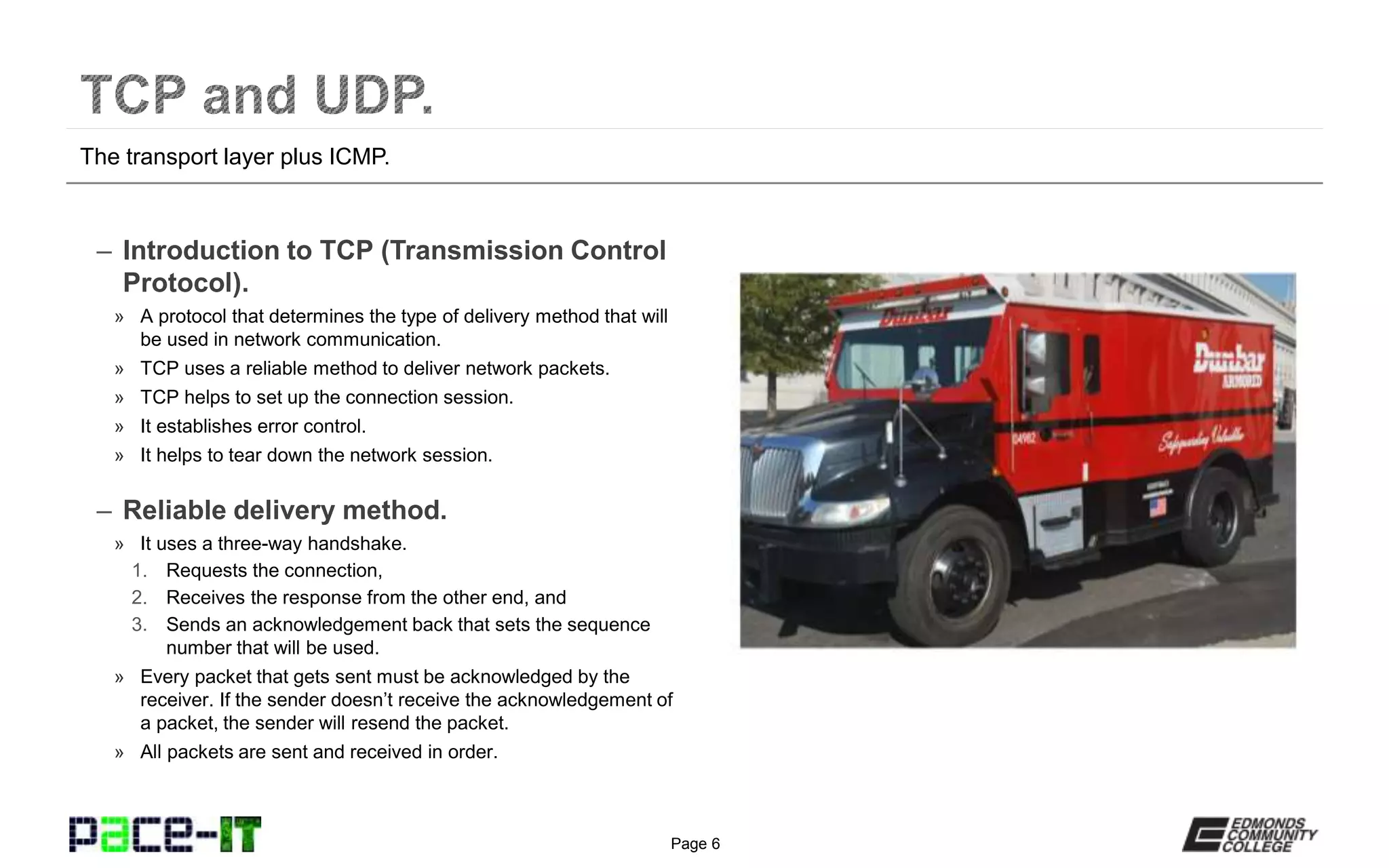
» TCP uses a reliable method to deliver network packets.
» TCP helps to set up the connection session.
» It establishes error control.
» It helps to tear down the network session.
– Reliable delivery method.
» It uses a three-way handshake.
1. Requests the connection,
2. Receives the response from the other end, and
3. Sends an acknowledgement back that sets the sequence
number that will be used.
» Every packet that gets sent must be acknowledged by the
receiver. If the sender doesn’t receive the acknowledgement of
a packet, the sender will resend the packet.
» All packets are sent and received in order.
The transport layer plus ICMP.
Page 7
– Introduction to UDP (User Datagram
Protocol).
» A protocol that determines the type of delivery method that will
be used in network communication.
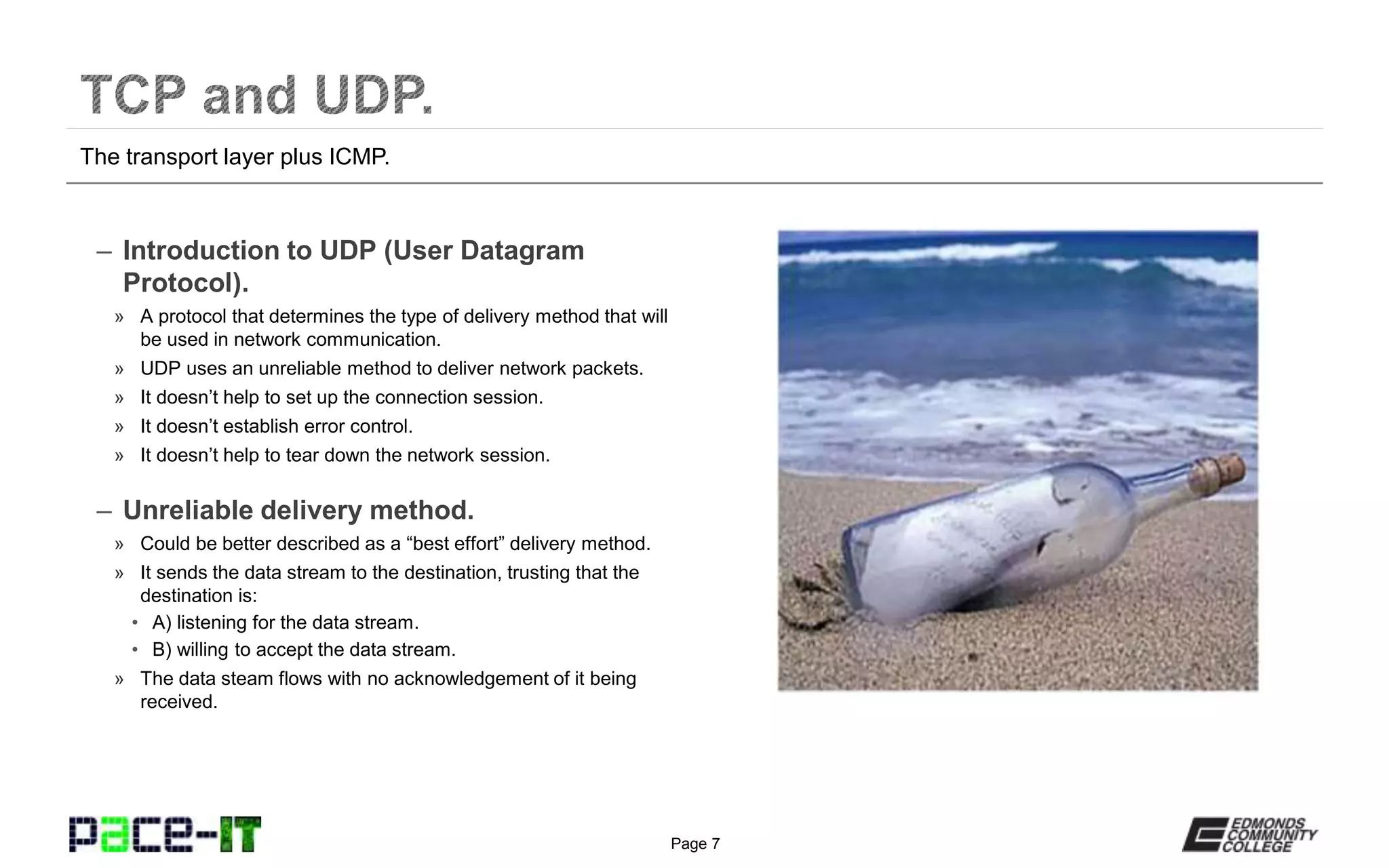
» UDP uses an unreliable method to deliver network packets.
» It doesn’t help to set up the connection session.
» It doesn’t establish error control.
» It doesn’t help to tear down the network session.
– Unreliable delivery method.
» Could be better described as a “best effort” delivery method.
» It sends the data stream to the destination, trusting that the
destination is:
• A) listening for the data stream.
• B) willing to accept the data stream.
» The data steam flows with no acknowledgement of it being
received.
The transport layer plus ICMP.
Page 8
Not all communication can
be treated the same; that is
why there are both reliable
and unreliable delivery
methods.
With TCP, the sender can be assured that the other end of the
line has received all of the packets that were sent and that the
packets were received in the proper order. This works well for
communication that is not sensitive to latency issues that are
associated with the overhead of reliable deliveries.
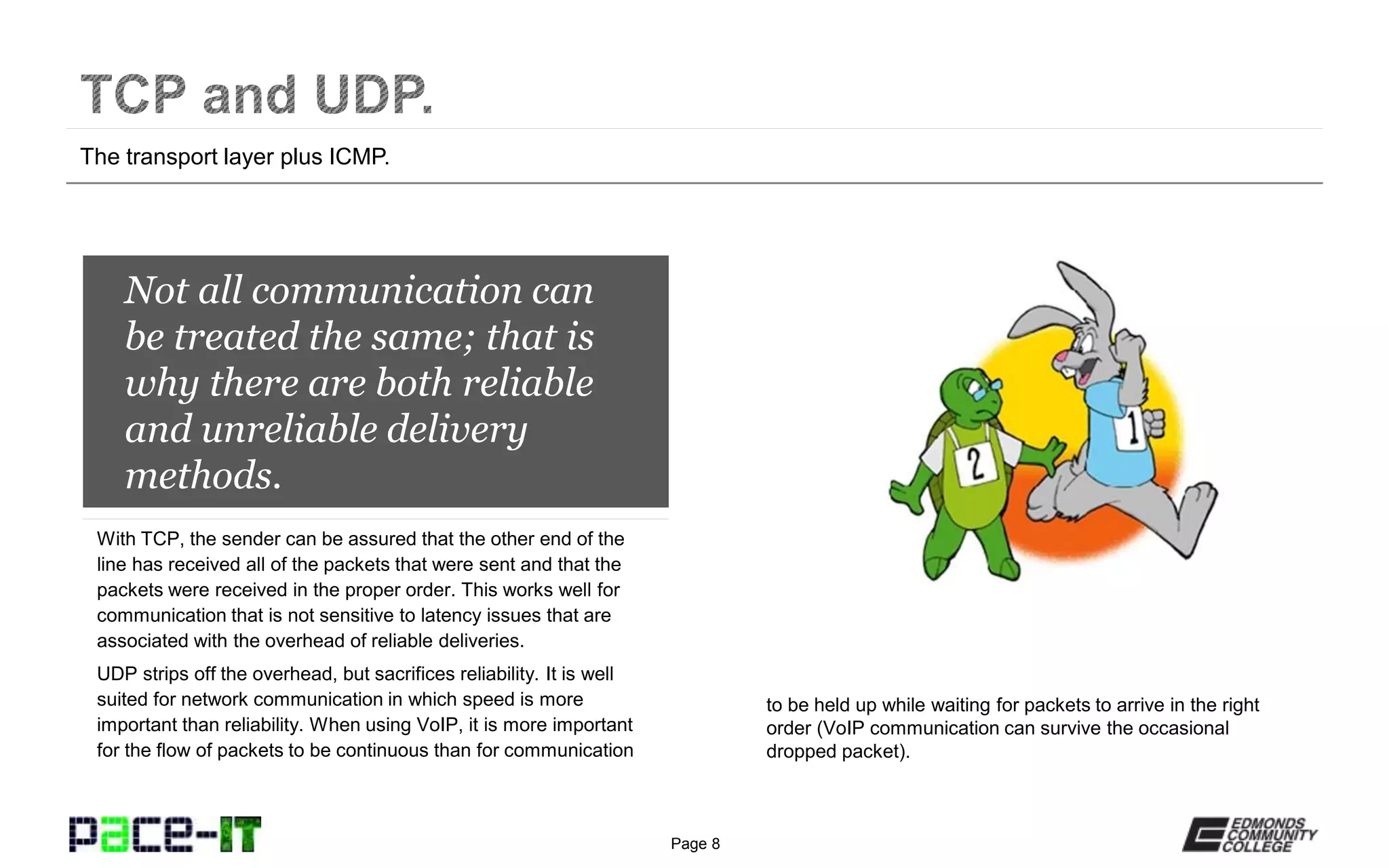
UDP strips off the overhead, but sacrifices reliability. It is well
suited for network communication in which speed is more
important than reliability. When using VoIP, it is more important
for the flow of packets to be continuous than for communication
The transport layer plus ICMP.
to be held up while waiting for packets to arrive in the right
order (VoIP communication can survive the occasional
dropped packet).
Page 9
The transport layer plus ICMP.
Page 10
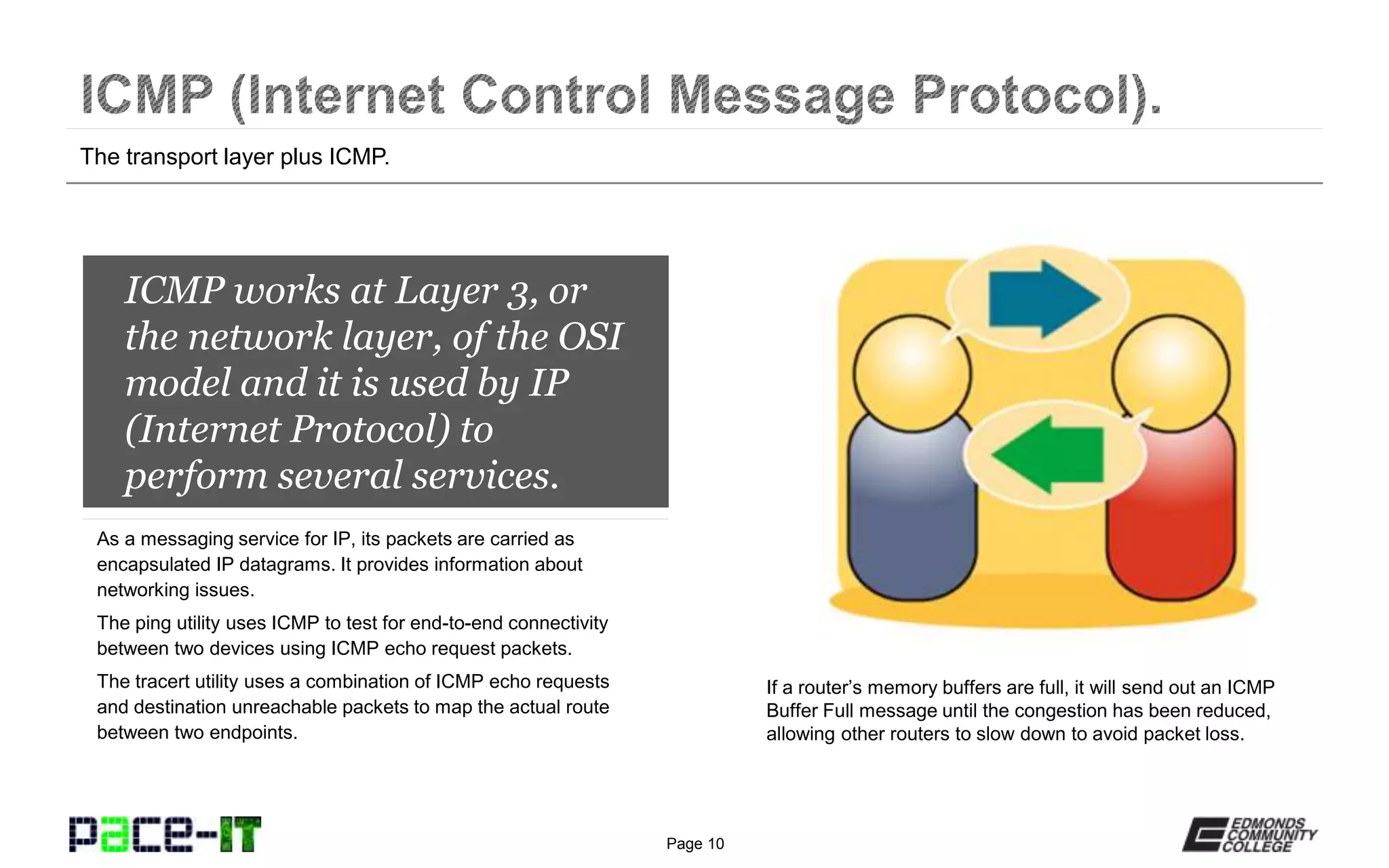
ICMP works at Layer 3, or
the network layer, of the OSI
model and it is used by IP
(Internet Protocol) to
perform several services.
As a messaging service for IP, its packets are carried as
encapsulated IP datagrams. It provides information about
networking issues.
The ping utility uses ICMP to test for end-to-end connectivity
between two devices using ICMP echo request packets.
The tracert utility uses a combination of ICMP echo requests
and destination unreachable packets to map the actual route
between two endpoints.
The transport layer plus ICMP.
If a router’s memory buffers are full, it will send out an ICMP
Buffer Full message until the congestion has been reduced,
allowing other routers to slow down to avoid packet loss.
Page 11
The transport layer plus ICMP.
The transport layer is the fourth layer of the OSI reference model. This layer
is responsible for the delivery of network packets. The two main protocols
used by the transport layer are TCP and UDP. TCP is a reliable delivery
protocol that uses a variety of methods to ensure that the packets sent are
delivered. UDP is an unreliable delivery protocol that transports network
packets without regard to them being received.
Topic
TCP and UDP.
Summary
ICMP is a network layer protocol and functions as a messaging service and
management protocol for IP. ICMP messages are encapsulated as IP
datagrams. Both the ping and tracert utilities use ICMP to fulfill their
functions. A router that is suffering from a full memory buffer will also use
ICMP messages to inform other routers of the issue.
ICMP (Internet Control
Message Protocol).
Page 12
THANK YOU!
This workforce solution was 100 percent funded by a $3 million grant awarded by the
U.S. Department of Labor's Employment and Training Administration. The solution was
created by the grantee and does not necessarily reflect the official position of the U.S.
Department of Labor. The Department of Labor makes no guarantees, warranties, or
assurances of any kind, express or implied, with respect to such information, including
any information on linked sites and including, but not limited to, accuracy of the
information or its completeness, timeliness, usefulness, adequacy, continued availability
or ownership. Funded by the Department of Labor, Employment and Training
Administration, Grant #TC-23745-12-60-A-53.
PACE-IT is an equal opportunity employer/program and auxiliary aids and services are
available upon request to individuals with disabilities. For those that are hearing
impaired, a video phone is available at the Services for Students with Disabilities (SSD)
office in Mountlake Terrace Hall 159. Check www.edcc.edu/ssd for office hours. Call
425.354.3113 on a video phone for more information about the PACE-IT program. For
any additional special accommodations needed, call the SSD office at 425.640.1814.
Edmonds Community College does not discriminate on the basis of race; color; religion;
national origin; sex; disability; sexual orientation; age; citizenship, marital, or veteran
status; or genetic information in its programs and activities.

PACE-IT: The Transport Layer Plus ICMP

  • 1.
  • 2.
    Page 2 Instructor, PACE-ITProgram – Edmonds Community College Areas of Expertise Industry Certifications  PC Hardware  Network Administration  IT Project Management  Network Design  User Training  IT Troubleshooting Qualifications Summary Education  M.B.A., IT Management, Western Governor’s University  B.S., IT Security, Western Governor’s University Entrepreneur, executive leader, and proven manger with 10+ years of experience turning complex issues into efficient and effective solutions. Strengths include developing and mentoring diverse workforces, improving processes, analyzing business needs and creating the solutions required— with a focus on technology.
  • 3.
    Page 3 – TCPand UDP. – ICMP (Internet Control Message Protocol). PACE-IT.
  • 4.
    Page 4 The transportlayer plus ICMP.
  • 5.
    Page 5 – Thetransport layer. » Most networking models follow the Open Systems Interconnection (OSI) model. • It is composed of seven different layers: application, presentation, session, transport, network, data link, and physical. • The layers work together to create a system of communication that allows different types of computing systems or networks to communicate with each other. » Layer 4, or the transport layer, receives data from the session layer (Layer 5) and determines what method (or type) of delivery is required for the data. • The transport layer then hands the data (with the instructions for method of delivery) to Layer 3 (the network layer), which is responsible for determining where the data is going. – The transport layer’s protocols. » There are two main protocols used by the transport layer. • TCP and UDP. The transport layer plus ICMP. OSI Model Layer 7 Application Layer 6 Presentation Layer 5 Session Layer 4 Transport Layer 3 Network Layer 2 Data link Layer 1 Physical
  • 6.
    Page 6 – Introductionto TCP (Transmission Control Protocol). » A protocol that determines the type of delivery method that will be used in network communication. » TCP uses a reliable method to deliver network packets. » TCP helps to set up the connection session. » It establishes error control. » It helps to tear down the network session. – Reliable delivery method. » It uses a three-way handshake. 1. Requests the connection, 2. Receives the response from the other end, and 3. Sends an acknowledgement back that sets the sequence number that will be used. » Every packet that gets sent must be acknowledged by the receiver. If the sender doesn’t receive the acknowledgement of a packet, the sender will resend the packet. » All packets are sent and received in order. The transport layer plus ICMP.
  • 7.
    Page 7 – Introductionto UDP (User Datagram Protocol). » A protocol that determines the type of delivery method that will be used in network communication. » UDP uses an unreliable method to deliver network packets. » It doesn’t help to set up the connection session. » It doesn’t establish error control. » It doesn’t help to tear down the network session. – Unreliable delivery method. » Could be better described as a “best effort” delivery method. » It sends the data stream to the destination, trusting that the destination is: • A) listening for the data stream. • B) willing to accept the data stream. » The data steam flows with no acknowledgement of it being received. The transport layer plus ICMP.
  • 8.
    Page 8 Not allcommunication can be treated the same; that is why there are both reliable and unreliable delivery methods. With TCP, the sender can be assured that the other end of the line has received all of the packets that were sent and that the packets were received in the proper order. This works well for communication that is not sensitive to latency issues that are associated with the overhead of reliable deliveries. UDP strips off the overhead, but sacrifices reliability. It is well suited for network communication in which speed is more important than reliability. When using VoIP, it is more important for the flow of packets to be continuous than for communication The transport layer plus ICMP. to be held up while waiting for packets to arrive in the right order (VoIP communication can survive the occasional dropped packet).
  • 9.
    Page 9 The transportlayer plus ICMP.
  • 10.
    Page 10 ICMP worksat Layer 3, or the network layer, of the OSI model and it is used by IP (Internet Protocol) to perform several services. As a messaging service for IP, its packets are carried as encapsulated IP datagrams. It provides information about networking issues. The ping utility uses ICMP to test for end-to-end connectivity between two devices using ICMP echo request packets. The tracert utility uses a combination of ICMP echo requests and destination unreachable packets to map the actual route between two endpoints. The transport layer plus ICMP. If a router’s memory buffers are full, it will send out an ICMP Buffer Full message until the congestion has been reduced, allowing other routers to slow down to avoid packet loss.
  • 11.
    Page 11 The transportlayer plus ICMP. The transport layer is the fourth layer of the OSI reference model. This layer is responsible for the delivery of network packets. The two main protocols used by the transport layer are TCP and UDP. TCP is a reliable delivery protocol that uses a variety of methods to ensure that the packets sent are delivered. UDP is an unreliable delivery protocol that transports network packets without regard to them being received. Topic TCP and UDP. Summary ICMP is a network layer protocol and functions as a messaging service and management protocol for IP. ICMP messages are encapsulated as IP datagrams. Both the ping and tracert utilities use ICMP to fulfill their functions. A router that is suffering from a full memory buffer will also use ICMP messages to inform other routers of the issue. ICMP (Internet Control Message Protocol).
  • 12.
  • 13.
    This workforce solutionwas 100 percent funded by a $3 million grant awarded by the U.S. Department of Labor's Employment and Training Administration. The solution was created by the grantee and does not necessarily reflect the official position of the U.S. Department of Labor. The Department of Labor makes no guarantees, warranties, or assurances of any kind, express or implied, with respect to such information, including any information on linked sites and including, but not limited to, accuracy of the information or its completeness, timeliness, usefulness, adequacy, continued availability or ownership. Funded by the Department of Labor, Employment and Training Administration, Grant #TC-23745-12-60-A-53. PACE-IT is an equal opportunity employer/program and auxiliary aids and services are available upon request to individuals with disabilities. For those that are hearing impaired, a video phone is available at the Services for Students with Disabilities (SSD) office in Mountlake Terrace Hall 159. Check www.edcc.edu/ssd for office hours. Call 425.354.3113 on a video phone for more information about the PACE-IT program. For any additional special accommodations needed, call the SSD office at 425.640.1814. Edmonds Community College does not discriminate on the basis of race; color; religion; national origin; sex; disability; sexual orientation; age; citizenship, marital, or veteran status; or genetic information in its programs and activities.