IP(Internet Protocol)
Explained By:
Aditya Kumar Pandey
20221010125006
BCA(CS)-42
Under Guidence of:
Er. Prabhdeep Singh
Web Technology(UCS4001
Introduction to
Internet Protocols
Explore the foundational protocols that power the global internet and enable
seamless digital communication. Learn how these standards facilitate the
exchange of information, from the low-level TCP/IP to the higher-level
protocols like HTTP and SMTP.
TCP/IP Model
Network Layers
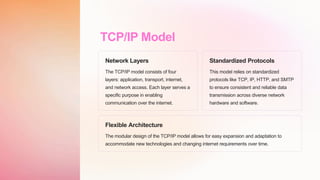
The TCP/IP model consists of four
layers: application, transport, internet,
and network access. Each layer serves a
specific purpose in enabling
communication over the internet.
Standardized Protocols
This model relies on standardized
protocols like TCP, IP, HTTP, and SMTP
to ensure consistent and reliable data
transmission across diverse network
hardware and software.
Flexible Architecture
The modular design of the TCP/IP model allows for easy expansion and adaptation to
accommodate new technologies and changing internet requirements over time.
IP Addressing and Subnetting
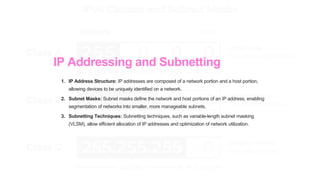
1. IP Address Structure: IP addresses are composed of a network portion and a host portion,
allowing devices to be uniquely identified on a network.
2. Subnet Masks: Subnet masks define the network and host portions of an IP address, enabling
segmentation of networks into smaller, more manageable subnets.
3. Subnetting Techniques: Subnetting techniques, such as variable-length subnet masking
(VLSM), allow efficient allocation of IP addresses and optimization of network utilization.
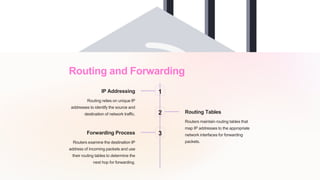
Routing and Forwarding
1
IP Addressing
Routing relies on unique IP
addresses to identify the source and
destination of network traffic. 2 Routing Tables
Routers maintain routing tables that
map IP addresses to the appropriate
network interfaces for forwarding
packets.
3
Forwarding Process
Routers examine the destination IP
address of incoming packets and use
their routing tables to determine the
next hop for forwarding.
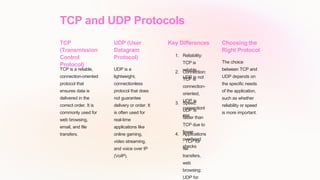
TCP and UDP Protocols
TCP
(Transmission
Control
Protocol)
TCP is a reliable,
connection-oriented
protocol that
ensures data is
delivered in the
correct order. It is
commonly used for
web browsing,
email, and file
transfers.
UDP (User
Datagram
Protocol)
UDP is a
lightweight,
connectionless
protocol that does
not guarantee
delivery or order. It
is often used for
real-time
applications like
online gaming,
video streaming,
and voice over IP
(VoIP).
Key Differences
1. Reliability:
TCP is
reliable,
UDP is not
2. Connection:
TCP is
connection-
oriented,
UDP is
connectionl
ess
3. Speed:
UDP is
faster than
TCP due to
fewer
overhead
checks
4. Applications
: TCP for
file
transfers,
web
browsing;
UDP for
Choosing the
Right Protocol
The choice
between TCP and
UDP depends on
the specific needs
of the application,
such as whether
reliability or speed
is more important.
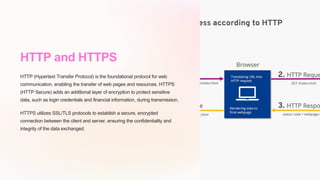
HTTP and HTTPS
HTTP (Hypertext Transfer Protocol) is the foundational protocol for web
communication, enabling the transfer of web pages and resources. HTTPS
(HTTP Secure) adds an additional layer of encryption to protect sensitive
data, such as login credentials and financial information, during transmission.
HTTPS utilizes SSL/TLS protocols to establish a secure, encrypted
connection between the client and server, ensuring the confidentiality and
integrity of the data exchanged.
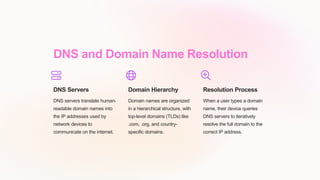
DNS and Domain Name Resolution
DNS Servers
DNS servers translate human-
readable domain names into
the IP addresses used by
network devices to
communicate on the internet.
Domain Hierarchy
Domain names are organized
in a hierarchical structure, with
top-level domains (TLDs) like
.com, .org, and country-
specific domains.
Resolution Process
When a user types a domain
name, their device queries
DNS servers to iteratively
resolve the full domain to the
correct IP address.
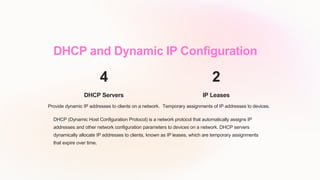
DHCP and Dynamic IP Configuration
4
DHCP Servers
Provide dynamic IP addresses to clients on a network.
2
IP Leases
Temporary assignments of IP addresses to devices.
DHCP (Dynamic Host Configuration Protocol) is a network protocol that automatically assigns IP
addresses and other network configuration parameters to devices on a network. DHCP servers
dynamically allocate IP addresses to clients, known as IP leases, which are temporary assignments
that expire over time.
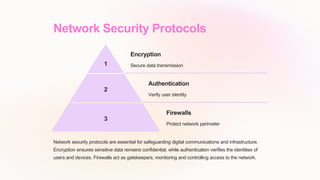
Network Security Protocols
1
Encryption
Secure data transmission
2
Authentication
Verify user identity
3
Firewalls
Protect network perimeter
Network security protocols are essential for safeguarding digital communications and infrastructure.
Encryption ensures sensitive data remains confidential, while authentication verifies the identities of
users and devices. Firewalls act as gatekeepers, monitoring and controlling access to the network.

adity.pptx internet protocol web technology

  • 1.
    IP(Internet Protocol) Explained By: AdityaKumar Pandey 20221010125006 BCA(CS)-42 Under Guidence of: Er. Prabhdeep Singh Web Technology(UCS4001
  • 2.
    Introduction to Internet Protocols Explorethe foundational protocols that power the global internet and enable seamless digital communication. Learn how these standards facilitate the exchange of information, from the low-level TCP/IP to the higher-level protocols like HTTP and SMTP.
  • 3.
    TCP/IP Model Network Layers TheTCP/IP model consists of four layers: application, transport, internet, and network access. Each layer serves a specific purpose in enabling communication over the internet. Standardized Protocols This model relies on standardized protocols like TCP, IP, HTTP, and SMTP to ensure consistent and reliable data transmission across diverse network hardware and software. Flexible Architecture The modular design of the TCP/IP model allows for easy expansion and adaptation to accommodate new technologies and changing internet requirements over time.
  • 4.
    IP Addressing andSubnetting 1. IP Address Structure: IP addresses are composed of a network portion and a host portion, allowing devices to be uniquely identified on a network. 2. Subnet Masks: Subnet masks define the network and host portions of an IP address, enabling segmentation of networks into smaller, more manageable subnets. 3. Subnetting Techniques: Subnetting techniques, such as variable-length subnet masking (VLSM), allow efficient allocation of IP addresses and optimization of network utilization.
  • 5.
    Routing and Forwarding 1 IPAddressing Routing relies on unique IP addresses to identify the source and destination of network traffic. 2 Routing Tables Routers maintain routing tables that map IP addresses to the appropriate network interfaces for forwarding packets. 3 Forwarding Process Routers examine the destination IP address of incoming packets and use their routing tables to determine the next hop for forwarding.
  • 6.
    TCP and UDPProtocols TCP (Transmission Control Protocol) TCP is a reliable, connection-oriented protocol that ensures data is delivered in the correct order. It is commonly used for web browsing, email, and file transfers. UDP (User Datagram Protocol) UDP is a lightweight, connectionless protocol that does not guarantee delivery or order. It is often used for real-time applications like online gaming, video streaming, and voice over IP (VoIP). Key Differences 1. Reliability: TCP is reliable, UDP is not 2. Connection: TCP is connection- oriented, UDP is connectionl ess 3. Speed: UDP is faster than TCP due to fewer overhead checks 4. Applications : TCP for file transfers, web browsing; UDP for Choosing the Right Protocol The choice between TCP and UDP depends on the specific needs of the application, such as whether reliability or speed is more important.
  • 7.
    HTTP and HTTPS HTTP(Hypertext Transfer Protocol) is the foundational protocol for web communication, enabling the transfer of web pages and resources. HTTPS (HTTP Secure) adds an additional layer of encryption to protect sensitive data, such as login credentials and financial information, during transmission. HTTPS utilizes SSL/TLS protocols to establish a secure, encrypted connection between the client and server, ensuring the confidentiality and integrity of the data exchanged.
  • 8.
    DNS and DomainName Resolution DNS Servers DNS servers translate human- readable domain names into the IP addresses used by network devices to communicate on the internet. Domain Hierarchy Domain names are organized in a hierarchical structure, with top-level domains (TLDs) like .com, .org, and country- specific domains. Resolution Process When a user types a domain name, their device queries DNS servers to iteratively resolve the full domain to the correct IP address.
  • 9.
    DHCP and DynamicIP Configuration 4 DHCP Servers Provide dynamic IP addresses to clients on a network. 2 IP Leases Temporary assignments of IP addresses to devices. DHCP (Dynamic Host Configuration Protocol) is a network protocol that automatically assigns IP addresses and other network configuration parameters to devices on a network. DHCP servers dynamically allocate IP addresses to clients, known as IP leases, which are temporary assignments that expire over time.
  • 10.
    Network Security Protocols 1 Encryption Securedata transmission 2 Authentication Verify user identity 3 Firewalls Protect network perimeter Network security protocols are essential for safeguarding digital communications and infrastructure. Encryption ensures sensitive data remains confidential, while authentication verifies the identities of users and devices. Firewalls act as gatekeepers, monitoring and controlling access to the network.