Lecture#04
Computer Communications
& Networks CS-576
TCP/IP Protocol Suite
 Transmission Control Protocol/internetworking Protocol
 Developed Prior to OSI Model
 Widely used in the Internet Today
 Layers in TCP/IP Protocol Suite
i. Physical and Data Link Layer
ii. Network Layer
iii. Transport Layer
iv. Application Layer
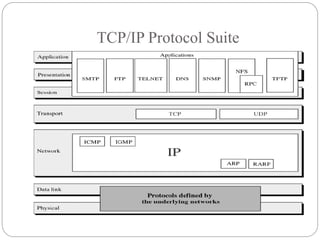
TCP/IP Protocol Suite
Physical and Data Link Layer
 TCP/IP does not define any specific protocol.
 It supports all the standard and proprietary
protocols
 Network can be LAN or WAN
Network Layer
 TCP/IP support the internetworking Protocol.
 IP uses 4 supporting protocols: ARP, RARP, ICMP and IGMP.
 ARP(Address Resolution Protocol).
 Used to find physical address of the node when its internet address is known.
 RARP(Reverse Address Resolution Protocol).
 It allows host to discover its internet address when its physical address is known.
 ICMP (Internet Control Message Protocol).
 Used by host and gateways to send notification of error to sender. It sends query and
error reporting message .
 IGMP (Internet Group Message Protocol).
 It facilitates group messages to no. of recipients.
Transport Layer
 TCP/IP in transport layer works through 2 protocols:
UDP, TCP
 UDP (User Datagram Protocol)
 Process-to-process protocol
 It adds port address, checksum error control and length information to the
data.
 TCP (Transmission Control Protocol)
 TCP is reliable and connection oriented protocol.
 It divides data packets into smaller data segments, include sequence number,
collects frames and record transmission.
SCTP(Stream Control Transmission Protocol)
 It is combination of best features of UDP and TCP.
 It supports for newer applications such as Voice Over The
Internet.
Application Layer
 It is equivalent to combined session, presentation
and application layer of OSI model.
 Several protocol are defined in this layer.
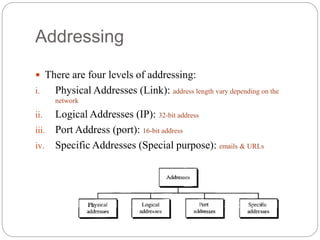
Addressing
 There are four levels of addressing:
i. Physical Addresses (Link): address length vary depending on the
network
ii. Logical Addresses (IP): 32-bit address
iii. Port Address (port): 16-bit address
iv. Specific Addresses (Special purpose): emails & URLs
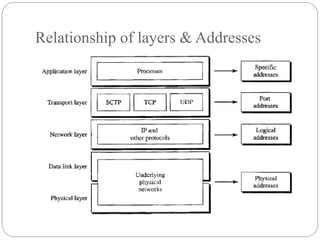
Relationship of layers & Addresses

Lecture 04

  • 1.
  • 2.
    TCP/IP Protocol Suite Transmission Control Protocol/internetworking Protocol  Developed Prior to OSI Model  Widely used in the Internet Today  Layers in TCP/IP Protocol Suite i. Physical and Data Link Layer ii. Network Layer iii. Transport Layer iv. Application Layer
  • 3.
  • 4.
    Physical and DataLink Layer  TCP/IP does not define any specific protocol.  It supports all the standard and proprietary protocols  Network can be LAN or WAN
  • 5.
    Network Layer  TCP/IPsupport the internetworking Protocol.  IP uses 4 supporting protocols: ARP, RARP, ICMP and IGMP.  ARP(Address Resolution Protocol).  Used to find physical address of the node when its internet address is known.  RARP(Reverse Address Resolution Protocol).  It allows host to discover its internet address when its physical address is known.  ICMP (Internet Control Message Protocol).  Used by host and gateways to send notification of error to sender. It sends query and error reporting message .  IGMP (Internet Group Message Protocol).  It facilitates group messages to no. of recipients.
  • 6.
    Transport Layer  TCP/IPin transport layer works through 2 protocols: UDP, TCP  UDP (User Datagram Protocol)  Process-to-process protocol  It adds port address, checksum error control and length information to the data.  TCP (Transmission Control Protocol)  TCP is reliable and connection oriented protocol.  It divides data packets into smaller data segments, include sequence number, collects frames and record transmission.
  • 7.
    SCTP(Stream Control TransmissionProtocol)  It is combination of best features of UDP and TCP.  It supports for newer applications such as Voice Over The Internet.
  • 8.
    Application Layer  Itis equivalent to combined session, presentation and application layer of OSI model.  Several protocol are defined in this layer.
  • 9.
    Addressing  There arefour levels of addressing: i. Physical Addresses (Link): address length vary depending on the network ii. Logical Addresses (IP): 32-bit address iii. Port Address (port): 16-bit address iv. Specific Addresses (Special purpose): emails & URLs
  • 10.