8
7
6
5
4
3
 
 
Oxygenation Group 10 BSN III - C
Gas Exchange in Lungs   The body requires oxygen in order to produce energy for our cells to do work. Therefore, it is essential that we have an efficient system of obtaining oxygen from the air. Our bodies also produce a toxic gas called carbon dioxide that must be efficiently removed from the body to prevent cell damage.   When we inhale, we pick up oxygen from air.  When we exhale, we flush out carbon dioxide.
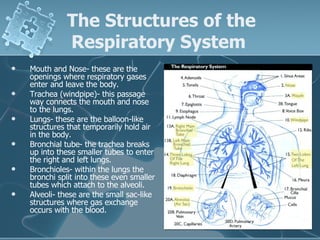
The Structures of the Respiratory System   Mouth and Nose- these are the openings where respiratory gases enter and leave the body.  Trachea (windpipe)- this passage way connects the mouth and nose to the lungs.  Lungs- these are the balloon-like structures that temporarily hold air in the body.  Bronchial tube- the trachea breaks up into these smaller tubes to enter the right and left lungs.  Bronchioles- within the lungs the bronchi split into these even smaller tubes which attach to the alveoli.  Alveoli- these are the small sac-like structures where gas exchange occurs with the blood.
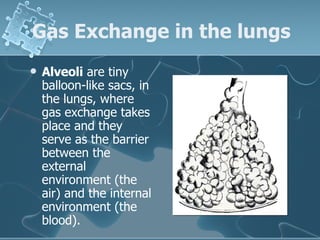
Gas Exchange in the lungs Alveoli  are tiny balloon-like sacs, in the lungs, where gas exchange takes place and they serve as the barrier between the external environment (the air) and the internal environment (the blood).
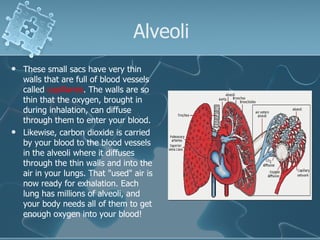
Alveoli These small sacs have very thin walls that are full of blood vessels called  capillaries . The walls are so thin that the oxygen, brought in during inhalation, can diffuse through them to enter your blood.   Likewise, carbon dioxide is carried by your blood to the blood vessels in the alveoli where it diffuses through the thin walls and into the air in your lungs. That "used" air is now ready for exhalation. Each lung has millions of alveoli, and your body needs all of them to get enough oxygen into your blood! 
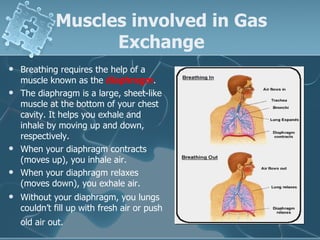
Muscles involved in Gas Exchange Breathing requires the help of a muscle known as the  diaphragm .   The diaphragm is a large, sheet-like muscle at the bottom of your chest cavity. It helps you exhale and inhale by moving up and down, respectively.   When your diaphragm contracts (moves up), you inhale air.   When your diaphragm relaxes (moves down), you exhale air.   Without your diaphragm, you lungs couldn’t fill up with fresh air or push old air out.
Five Parts of Gas Exchange Breathing External Respiration Gas Transport Internal Respiration Cellular Respiration
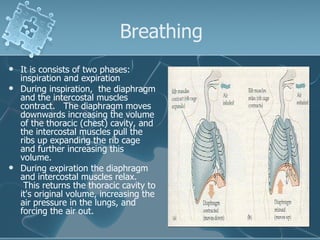
Breathing It is consists of two phases: inspiration and expiration During inspiration,  the diaphragm and the intercostal muscles contract.   The diaphragm moves downwards increasing the volume of the thoracic (chest) cavity, and the intercostal muscles pull the ribs up expanding the rib cage and further increasing this volume.  During expiration the diaphragm and intercostal muscles relax.  This returns the thoracic cavity to it's original volume, increasing the air pressure in the lungs, and forcing the air out.
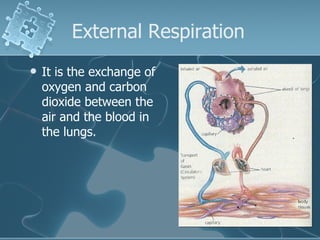
External Respiration  It is the exchange of oxygen and carbon dioxide between the air and the blood in the lungs.
Gas Transport Haemoglobin, the main means of oxygen transport in the body. The respiratory pigment haemoglobin is made up of an iron-containing porphyron, haem, combined with the protein globin.  Each iron atom in haem is attached to four pyrole groups by covalent bonds.  A fifth covalent bond of the iron is attached to the globin part of the molecule and the sixth covalent bond is available for combination with oxygen.  There are four iron atoms in each heamoglobin molecule and therefore four heam groups.
Oxygen Transport  Oxygen needs to be transported from the lungs to the tissues.  Most of the oxygen (97%) combines loosely with hemoglobin in the RBC and is carried to the tissues as oxyhemoglobin. The remaining oxygen is dissolved and transported in the fluid of the plasma and cells.
Carbon Dioxide Transport Out of the carbon dioxide released from respiring cells, 7% dissolves into the plasma, 23% binds to the multiple amino groups of haemoglobin (Caroxyhaemoglobin), and 70% is carried as bicarbonate ions.  Carbon dioxide created by respiring cells diffuses into the blood plasma and then into the red blood cells, where most of it is converted to bicarbonate ions.
Internal Respiration  The  body tissues need the oxygen and have to get rid of the carbon dioxide, so the blood carried throughout the body exchanges oxygen and carbon dioxide with the body's tissues.  Internal respirtaion is basically the exchange of gasses between the blood in the capillaries and the body's cells.
Cellular Respiration Cellular respiration  describes the metabolism reactions and processes that take place in a cell to obtain biochemical energy from fuel molecules and the release of the cells' waste products. Energy is released by the oxidation of fuel molecules and is stored as "high-energy" carriers. The reactions involved in respiration are catabolic reactions in metabolism.
Gas Transport  (Circulatory System) The   heart, the blood, and the blood vessels  make up a system for the transport of gases, nutrients, and chemical wastes.  The primary functions of the circulatory system are the following:  To transport nutrients and oxygen to the cells.  To remove waste and carbon dioxide from the cells.  To provide for efficient gas exchange.  Blood vessels allow oxygenated blood and nutrients to reach the tissues and wastes to be removed from the tissues. The blood is the medium that carries oxygen and nutrients to the tissue and is also the medium by which waste is transported to the appropriate locations.
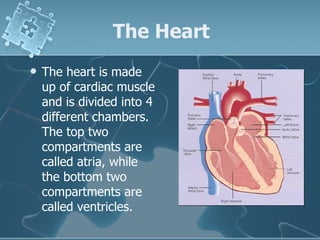
The Heart The heart is made up of cardiac muscle and is divided into 4 different chambers. The top two compartments are called atria, while the bottom two compartments are called ventricles.
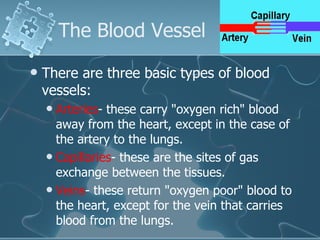
The Blood Vessel There are three basic types of blood vessels: Arteries - these carry "oxygen rich" blood away from the heart, except in the case of the artery to the lungs. Capillaries - these are the sites of gas exchange between the tissues. Veins - these return "oxygen poor" blood to the heart, except for the vein that carries blood from the lungs.
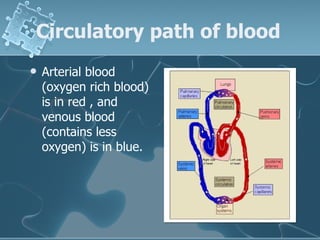
Circulatory path of blood   Arterial blood (oxygen rich blood)  is in red , and venous blood (contains less oxygen) is in blue.
Blood Flow For gas exchange to occur in the lungs and the rest of the body's tissues, blood must flow continuously through the tissues.   The heart pushes blood through the tissues and provides a constant force for blood flow to occur. The heart provides enough force to propel the blood through the arteries and veins in the body. The arteries entering tissues, called arterioles, can constrict (become more narrow) or dilate (become relaxed and less narrow) to change the amount of blood flowing to an area. If an  arteriole constricts , less blood is available for the tissues it supplies. If an  arteriole dilates , more blood reaches the tissues it supplies.
Oxygen Therapy The administration of oxygen at a concentration greater than that found in the environmental atmosphere. The goal of oxygen therapy is to provide adequate transport of oxygen in the blood while decreasing the work of breathing and reducing stress in the myocardium.
Indication Hypoxemia – a decrease in arterial oxygen tension in the blood
Oxygen Administration Devices Low Flow Systems 1.Cannula Suggested flow rate: 1-2 L/min, 3-6L/min; 6L/min Oxygen Percentage Setting: 23-30; 30-40; 42 Advantages: lightweight, comfortable, inexpensive, continuous use with meals and activities. Disadvantages: nasal mucosal drying, variable FiO2
Low Flow Systems 2. Oropharyngeal  catheter Suggested flow rate: 1-6 L/min Oxygen percentage: 23-42 Advantages: inexpensive does not require tracheostomy  Disadvantages: nasal mucosa irritation; catheter should be changed frequently to alternate nostril
Low Flow Systems 3. Simple Mask Suggested flow rate: 6-8 L/min Oxygen percentage setting: 40-60 Advantages: simple to use, inexpensive Disadvantage: poor fitting, variable FiO2, must remove to eat
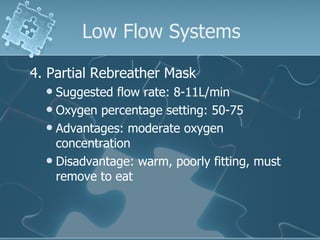
Low Flow Systems 4. Partial Rebreather Mask Suggested flow rate: 8-11L/min Oxygen percentage setting: 50-75 Advantages: moderate oxygen concentration  Disadvantage: warm, poorly fitting, must remove to eat
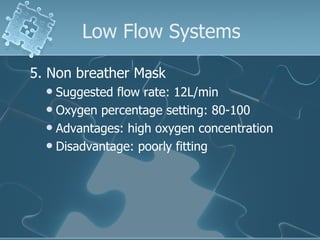
Low Flow Systems 5. Non breather Mask Suggested flow rate: 12L/min Oxygen percentage setting: 80-100 Advantages: high oxygen concentration  Disadvantage: poorly fitting
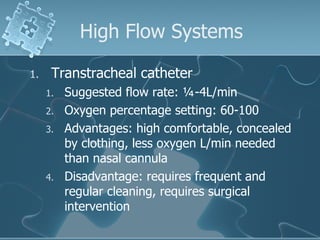
High Flow Systems Transtracheal catheter Suggested flow rate: ¼-4L/min Oxygen percentage setting: 60-100 Advantages: high comfortable, concealed by clothing, less oxygen L/min needed than nasal cannula Disadvantage: requires frequent and regular cleaning, requires surgical intervention
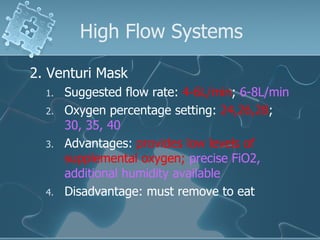
High Flow Systems 2. Venturi Mask Suggested flow rate:  4-6L/min ;  6-8L/min Oxygen percentage setting:  24,26,28 ;  30, 35, 40 Advantages:  provides low levels of supplemental oxygen;  precise FiO2, additional humidity available Disadvantage: must remove to eat
High Flow Systems 3. Aerosol Mask Suggested flow rate: 8-10L/min Oxygen percentage setting: 30-100 Advantages: good humidity, accurate FiO2 Disadvantage: uncomfortable for some
High Flow Systems 4. Tracheostomy Collar Suggested flow rate: 8-10L/min Oxygen percentage setting: 30-100 Advantages: good humidity, comfortable, fairly accurate FiO2
High Flow Systems 5. T – piece  Suggested flow rate: 8-10L/min Oxygen percentage setting: 30-100 Advantages: good humidity, comfortable, fairly accurate FiO2 Disadvantage: heavy with tubing
High Flow Systems 6. Face Tent Suggested flow rate: 8-10L/min Oxygen percentage setting: 30-100 Advantages: good humidity, fairly accurate FiO2 Disadvantage: Bulky and cumbersome
Common Nursing Diagnosis for Clients with oxygenation problems  Ineffective Airway Pattern- inability to clear secretions or obstructions from respiratory tract to maintain a clear airway.  Ineffective Breathing Pattern- inspiration and expiration that does not provide adequate ventilation. Impaired Gas Exchange- Excess or deficit in oxygenation and/or carbon dioxide elimination at the alveolar-capillary membrane. Activity intolerance- Insufficient physiological or psychological energy to endure or complete required or desired daily activities.
Other related Nursing Diagnosis  Anxiety related to ineffective airway clearance and feeling of suffocation. Fear related to chronic disabling respiratory illness.  Powerlessness related to inability to maintain independence in self-care activities because of the ineffective breathing pattern. Disturbed Sleeping Pattern  related to orthopnea and required O2 therapy. Social Isolation related to activity intolerance and inability to travel to usual social activities.
Intervention by the nurse to maintain the normal respirations of  clients include  Positioning the client to  allow for maximum chest expansion. Encouraging or providing frequent changes in position. Encouraging ambulation. Implementing measures that promote comfort, such as giving pain medications.
Promoting Healthy Breathing Sit straight and stand erect to permit full lung expansion.  Exercise regularly. Breathe through the  nose. Breathe in to expand the chest fully. Do not smoke cigarettes, cigars or pipes. Eliminate or reduce the use of household pesticides and irritating chemical substances.
Do not incinerate garbage in the house. Avoid exposure to second hand smoke. Use building materials that do not emit vapors. Make sure furnaces, ovens and wood stoves are correctly ventilated. Support a pollution-free environment. Promoting Healthy Breathing
Abdominal and Pursed-lip Breathing Controlled and Huff Coughing  Using Cough Medications Using an Incentive Spirometer  Health Education

Oxygenation

  • 1.
  • 2.
  • 3.
  • 4.
  • 5.
  • 6.
  • 7.
  • 8.
  • 9.
  • 10.
    Gas Exchange inLungs The body requires oxygen in order to produce energy for our cells to do work. Therefore, it is essential that we have an efficient system of obtaining oxygen from the air. Our bodies also produce a toxic gas called carbon dioxide that must be efficiently removed from the body to prevent cell damage.  When we inhale, we pick up oxygen from air.  When we exhale, we flush out carbon dioxide.
  • 11.
    The Structures ofthe Respiratory System Mouth and Nose- these are the openings where respiratory gases enter and leave the body. Trachea (windpipe)- this passage way connects the mouth and nose to the lungs. Lungs- these are the balloon-like structures that temporarily hold air in the body. Bronchial tube- the trachea breaks up into these smaller tubes to enter the right and left lungs. Bronchioles- within the lungs the bronchi split into these even smaller tubes which attach to the alveoli. Alveoli- these are the small sac-like structures where gas exchange occurs with the blood.
  • 12.
    Gas Exchange inthe lungs Alveoli are tiny balloon-like sacs, in the lungs, where gas exchange takes place and they serve as the barrier between the external environment (the air) and the internal environment (the blood).
  • 13.
    Alveoli These smallsacs have very thin walls that are full of blood vessels called capillaries . The walls are so thin that the oxygen, brought in during inhalation, can diffuse through them to enter your blood.  Likewise, carbon dioxide is carried by your blood to the blood vessels in the alveoli where it diffuses through the thin walls and into the air in your lungs. That "used" air is now ready for exhalation. Each lung has millions of alveoli, and your body needs all of them to get enough oxygen into your blood! 
  • 14.
    Muscles involved inGas Exchange Breathing requires the help of a muscle known as the diaphragm .  The diaphragm is a large, sheet-like muscle at the bottom of your chest cavity. It helps you exhale and inhale by moving up and down, respectively.  When your diaphragm contracts (moves up), you inhale air.  When your diaphragm relaxes (moves down), you exhale air.  Without your diaphragm, you lungs couldn’t fill up with fresh air or push old air out.
  • 15.
    Five Parts ofGas Exchange Breathing External Respiration Gas Transport Internal Respiration Cellular Respiration
  • 16.
    Breathing It isconsists of two phases: inspiration and expiration During inspiration,  the diaphragm and the intercostal muscles contract.   The diaphragm moves downwards increasing the volume of the thoracic (chest) cavity, and the intercostal muscles pull the ribs up expanding the rib cage and further increasing this volume. During expiration the diaphragm and intercostal muscles relax.  This returns the thoracic cavity to it's original volume, increasing the air pressure in the lungs, and forcing the air out.
  • 17.
    External Respiration It is the exchange of oxygen and carbon dioxide between the air and the blood in the lungs.
  • 18.
    Gas Transport Haemoglobin,the main means of oxygen transport in the body. The respiratory pigment haemoglobin is made up of an iron-containing porphyron, haem, combined with the protein globin.  Each iron atom in haem is attached to four pyrole groups by covalent bonds.  A fifth covalent bond of the iron is attached to the globin part of the molecule and the sixth covalent bond is available for combination with oxygen.  There are four iron atoms in each heamoglobin molecule and therefore four heam groups.
  • 19.
    Oxygen Transport Oxygen needs to be transported from the lungs to the tissues. Most of the oxygen (97%) combines loosely with hemoglobin in the RBC and is carried to the tissues as oxyhemoglobin. The remaining oxygen is dissolved and transported in the fluid of the plasma and cells.
  • 20.
    Carbon Dioxide TransportOut of the carbon dioxide released from respiring cells, 7% dissolves into the plasma, 23% binds to the multiple amino groups of haemoglobin (Caroxyhaemoglobin), and 70% is carried as bicarbonate ions.  Carbon dioxide created by respiring cells diffuses into the blood plasma and then into the red blood cells, where most of it is converted to bicarbonate ions.
  • 21.
    Internal Respiration The  body tissues need the oxygen and have to get rid of the carbon dioxide, so the blood carried throughout the body exchanges oxygen and carbon dioxide with the body's tissues.  Internal respirtaion is basically the exchange of gasses between the blood in the capillaries and the body's cells.
  • 22.
    Cellular Respiration Cellularrespiration describes the metabolism reactions and processes that take place in a cell to obtain biochemical energy from fuel molecules and the release of the cells' waste products. Energy is released by the oxidation of fuel molecules and is stored as "high-energy" carriers. The reactions involved in respiration are catabolic reactions in metabolism.
  • 23.
    Gas Transport (Circulatory System) The  heart, the blood, and the blood vessels make up a system for the transport of gases, nutrients, and chemical wastes.  The primary functions of the circulatory system are the following: To transport nutrients and oxygen to the cells. To remove waste and carbon dioxide from the cells. To provide for efficient gas exchange. Blood vessels allow oxygenated blood and nutrients to reach the tissues and wastes to be removed from the tissues. The blood is the medium that carries oxygen and nutrients to the tissue and is also the medium by which waste is transported to the appropriate locations.
  • 24.
    The Heart Theheart is made up of cardiac muscle and is divided into 4 different chambers. The top two compartments are called atria, while the bottom two compartments are called ventricles.
  • 25.
    The Blood VesselThere are three basic types of blood vessels: Arteries - these carry "oxygen rich" blood away from the heart, except in the case of the artery to the lungs. Capillaries - these are the sites of gas exchange between the tissues. Veins - these return "oxygen poor" blood to the heart, except for the vein that carries blood from the lungs.
  • 26.
    Circulatory path ofblood Arterial blood (oxygen rich blood)  is in red , and venous blood (contains less oxygen) is in blue.
  • 27.
    Blood Flow Forgas exchange to occur in the lungs and the rest of the body's tissues, blood must flow continuously through the tissues.  The heart pushes blood through the tissues and provides a constant force for blood flow to occur. The heart provides enough force to propel the blood through the arteries and veins in the body. The arteries entering tissues, called arterioles, can constrict (become more narrow) or dilate (become relaxed and less narrow) to change the amount of blood flowing to an area. If an arteriole constricts , less blood is available for the tissues it supplies. If an arteriole dilates , more blood reaches the tissues it supplies.
  • 28.
    Oxygen Therapy Theadministration of oxygen at a concentration greater than that found in the environmental atmosphere. The goal of oxygen therapy is to provide adequate transport of oxygen in the blood while decreasing the work of breathing and reducing stress in the myocardium.
  • 29.
    Indication Hypoxemia –a decrease in arterial oxygen tension in the blood
  • 30.
    Oxygen Administration DevicesLow Flow Systems 1.Cannula Suggested flow rate: 1-2 L/min, 3-6L/min; 6L/min Oxygen Percentage Setting: 23-30; 30-40; 42 Advantages: lightweight, comfortable, inexpensive, continuous use with meals and activities. Disadvantages: nasal mucosal drying, variable FiO2
  • 31.
    Low Flow Systems2. Oropharyngeal catheter Suggested flow rate: 1-6 L/min Oxygen percentage: 23-42 Advantages: inexpensive does not require tracheostomy Disadvantages: nasal mucosa irritation; catheter should be changed frequently to alternate nostril
  • 32.
    Low Flow Systems3. Simple Mask Suggested flow rate: 6-8 L/min Oxygen percentage setting: 40-60 Advantages: simple to use, inexpensive Disadvantage: poor fitting, variable FiO2, must remove to eat
  • 33.
    Low Flow Systems4. Partial Rebreather Mask Suggested flow rate: 8-11L/min Oxygen percentage setting: 50-75 Advantages: moderate oxygen concentration Disadvantage: warm, poorly fitting, must remove to eat
  • 34.
    Low Flow Systems5. Non breather Mask Suggested flow rate: 12L/min Oxygen percentage setting: 80-100 Advantages: high oxygen concentration Disadvantage: poorly fitting
  • 35.
    High Flow SystemsTranstracheal catheter Suggested flow rate: ¼-4L/min Oxygen percentage setting: 60-100 Advantages: high comfortable, concealed by clothing, less oxygen L/min needed than nasal cannula Disadvantage: requires frequent and regular cleaning, requires surgical intervention
  • 36.
    High Flow Systems2. Venturi Mask Suggested flow rate: 4-6L/min ; 6-8L/min Oxygen percentage setting: 24,26,28 ; 30, 35, 40 Advantages: provides low levels of supplemental oxygen; precise FiO2, additional humidity available Disadvantage: must remove to eat
  • 37.
    High Flow Systems3. Aerosol Mask Suggested flow rate: 8-10L/min Oxygen percentage setting: 30-100 Advantages: good humidity, accurate FiO2 Disadvantage: uncomfortable for some
  • 38.
    High Flow Systems4. Tracheostomy Collar Suggested flow rate: 8-10L/min Oxygen percentage setting: 30-100 Advantages: good humidity, comfortable, fairly accurate FiO2
  • 39.
    High Flow Systems5. T – piece Suggested flow rate: 8-10L/min Oxygen percentage setting: 30-100 Advantages: good humidity, comfortable, fairly accurate FiO2 Disadvantage: heavy with tubing
  • 40.
    High Flow Systems6. Face Tent Suggested flow rate: 8-10L/min Oxygen percentage setting: 30-100 Advantages: good humidity, fairly accurate FiO2 Disadvantage: Bulky and cumbersome
  • 41.
    Common Nursing Diagnosisfor Clients with oxygenation problems Ineffective Airway Pattern- inability to clear secretions or obstructions from respiratory tract to maintain a clear airway. Ineffective Breathing Pattern- inspiration and expiration that does not provide adequate ventilation. Impaired Gas Exchange- Excess or deficit in oxygenation and/or carbon dioxide elimination at the alveolar-capillary membrane. Activity intolerance- Insufficient physiological or psychological energy to endure or complete required or desired daily activities.
  • 42.
    Other related NursingDiagnosis Anxiety related to ineffective airway clearance and feeling of suffocation. Fear related to chronic disabling respiratory illness. Powerlessness related to inability to maintain independence in self-care activities because of the ineffective breathing pattern. Disturbed Sleeping Pattern related to orthopnea and required O2 therapy. Social Isolation related to activity intolerance and inability to travel to usual social activities.
  • 43.
    Intervention by thenurse to maintain the normal respirations of clients include Positioning the client to allow for maximum chest expansion. Encouraging or providing frequent changes in position. Encouraging ambulation. Implementing measures that promote comfort, such as giving pain medications.
  • 44.
    Promoting Healthy BreathingSit straight and stand erect to permit full lung expansion. Exercise regularly. Breathe through the nose. Breathe in to expand the chest fully. Do not smoke cigarettes, cigars or pipes. Eliminate or reduce the use of household pesticides and irritating chemical substances.
  • 45.
    Do not incinerategarbage in the house. Avoid exposure to second hand smoke. Use building materials that do not emit vapors. Make sure furnaces, ovens and wood stoves are correctly ventilated. Support a pollution-free environment. Promoting Healthy Breathing
  • 46.
    Abdominal and Pursed-lipBreathing Controlled and Huff Coughing Using Cough Medications Using an Incentive Spirometer Health Education