10/6/2010


   NURSING FUNDAMENTALS
                                                         STAGGERING STATISTICS
          FOCUS VI

             OXYGENATION                             • Cardiovascular Diseases – # 1 killer
                                                      • HTN – 65 million
                                                      • Artheriosclerosis
                                                      • Arteriosclerosis
                                                      • Stroke
                                                      • Hypercholesterolemia
                                                        • 107 million - a risk factor for CVD
                                                      • AMI – 7.5 Million per year, 460,000 die
                                                      • Americans will pay 393.5 billion in 2005 for
                                                        CVD related medical costs


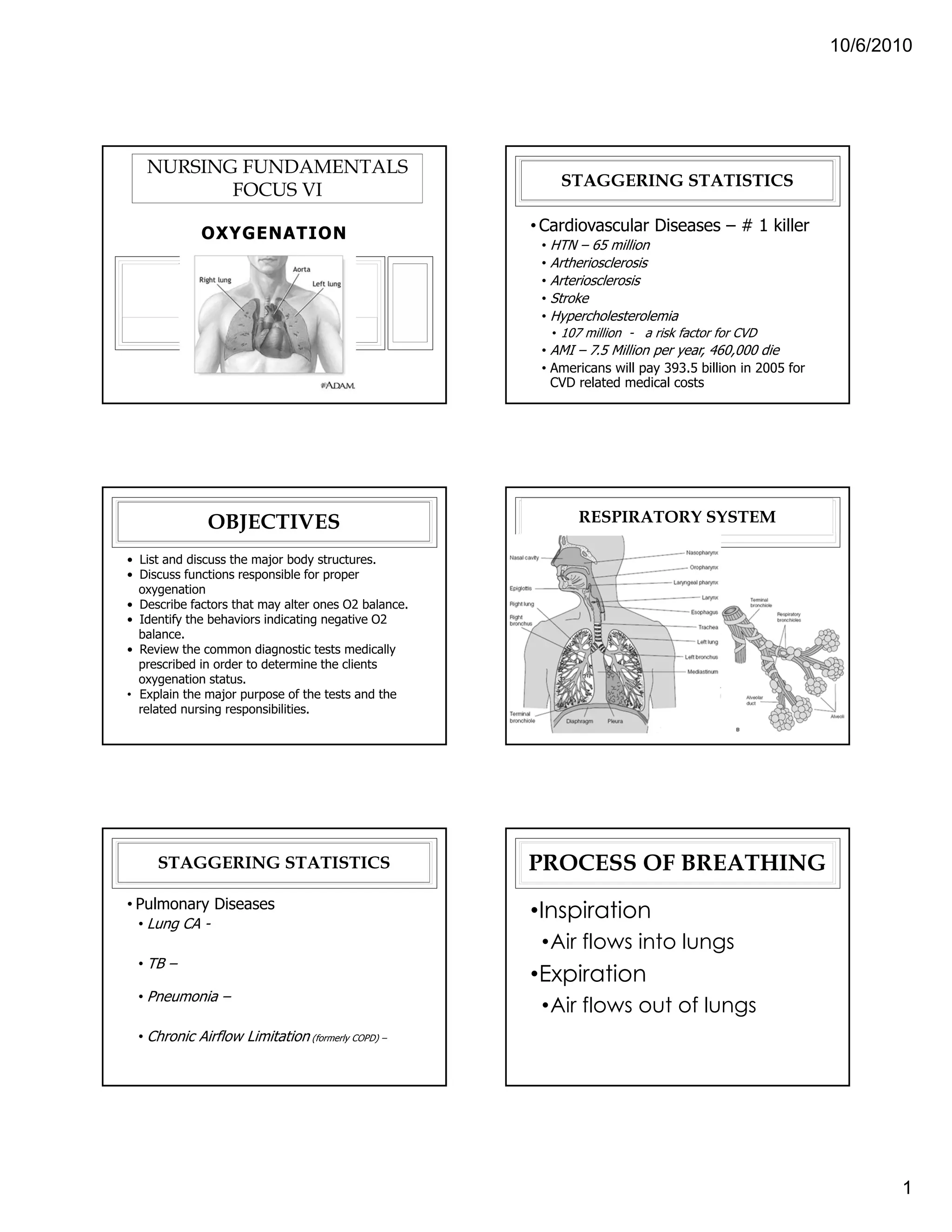
              OBJECTIVES                                    RESPIRATORY SYSTEM

• List and discuss the major body structures.
• Discuss functions responsible for proper
  oxygenation
• Describe factors that may alter ones O2 balance.
• Identify the behaviors indicating negative O2
  balance.
• Review the common diagnostic tests medically
  prescribed in order to determine the clients
  oxygenation status.
• Explain the major purpose of the tests and the
  related nursing responsibilities.


     STAGGERING STATISTICS                           PROCESS OF BREATHING
• Pulmonary Diseases
  • Lung CA -
                                                     •Inspiration
                                                      •Air flows into lungs
  • TB –
                                                     •Expiration
  • Pneumonia –
                                                      •Air flows out of lungs
  • Chronic Airflow Limitation (formerly COPD) –


                                                                                                              1
10/6/2010


 NORMAL OXYGENATION PROCESS              INSPIRATION

• Cardiovascular:             • Diaphragm and intercostals contact
                              • Thoracic cavity size increases
                              • Volume of lungs increases
                              • Intrapulmonary pressure decreases
                              • Air rushes into the lungs to equalize
                                pressure


 NORMAL OXYGENATION PROCESS              EXPIRATION
• Systemic:                   • Diaphragm and intercostals
                                relax
                              • Volume of the lungs decreases
                              • Intrapulmonary pressure rises
                              • Air is expelled


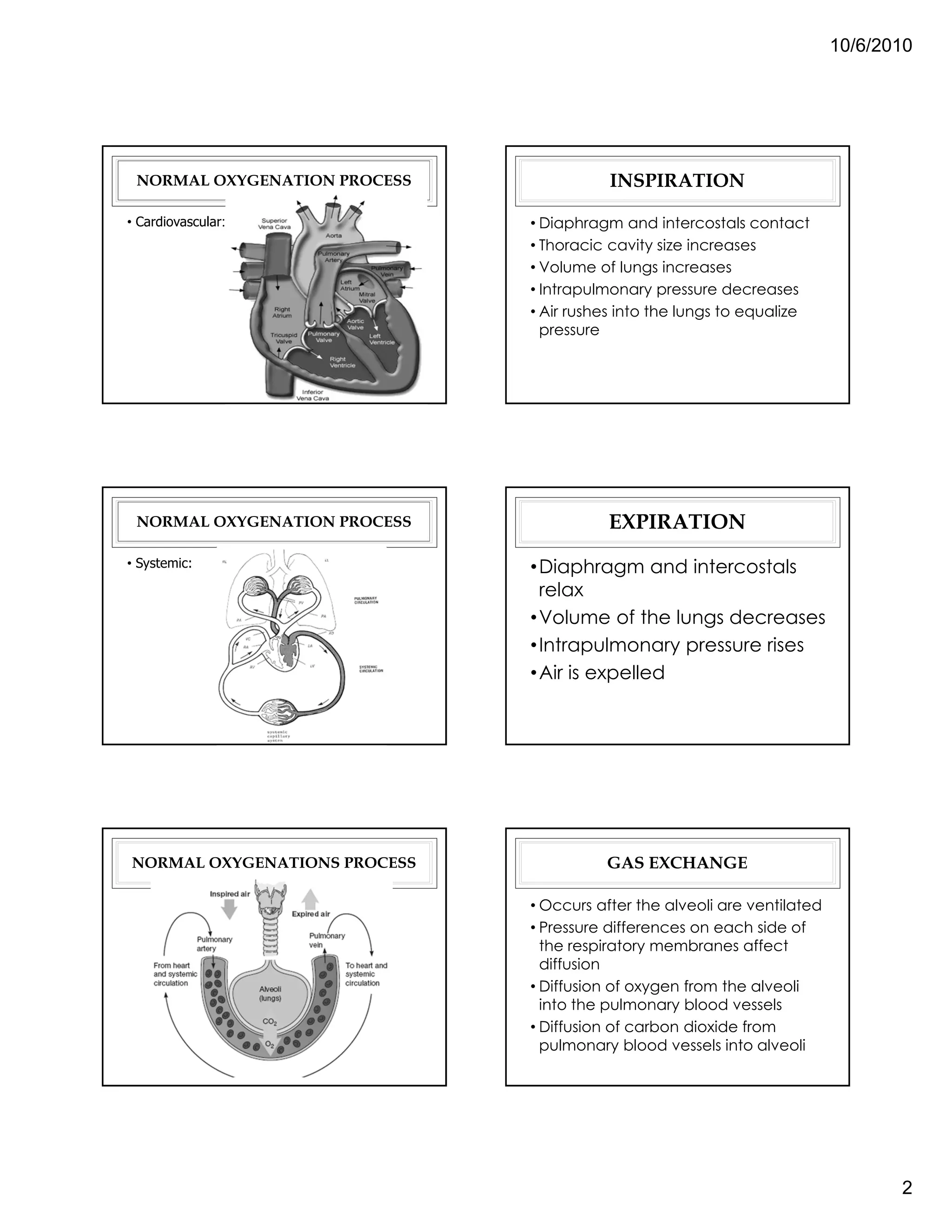
NORMAL OXYGENATIONS PROCESS             GAS EXCHANGE

                              • Occurs after the alveoli are ventilated
                              • Pressure differences on each side of
                                the respiratory membranes affect
                                diffusion
                              • Diffusion of oxygen from the alveoli
                                into the pulmonary blood vessels
                              • Diffusion of carbon dioxide from
                                pulmonary blood vessels into alveoli


                                                                                 2
10/6/2010


    ADEQUATE O2 BALANCE                              CARBON DIOXIDE TRANSPORT

• Maintenance of adequate O2 balance Gas Exchange   • Must be transported from the tissues to
                                                      the lungs
                                                    • Continually produced in the process of
                                                      cell metabolism
                                                    • 65% is carried inside the red blood cells as
                                                      bicarbonate
                                                    • 30% combines with hemoglobin as
                                                      carbhemoglobin
                                                    • 5% transported in solution in plasma and
                                                      as carbonic acid


                                                       FACTORS THAT INFLUENCE
       OXYGEN TRANSPORT
                                                        RESPIRATORY FUNCTION
• Transported from the lungs to the                 •Age
  tissues
• 97% of oxygen combines with
                                                    •Environment
  hemoglobin in red blood cells and                 •Lifestyle
  carried to tissues as oxyhemoglobin
                                                    •Health status
• Remaining oxygen is dissolved and
  transported in plasma and cells                   •Medications
                                                    •Stress


                                                      COMMON MANIFESTATIONS OF
NORMAL OXYGENATION PROCESS
                                                    IMPAIRED RESPIRATORY FUNCTION

• Cell environment/ O2 carrying capacity:           •Hypoxia
• O2 Carrying capacity of blood is expressed
  by:                                               •Altered breathing
  • Red blood cells
  • Hematocrit
                                                     patterns
  • Hemoglobin
                                                    •Obstructed or partially
                                                     obstructed airway


                                                                                                            3
10/6/2010


                                                     OBSTRUCTED OR PARTIALLY
                HYPOXIA
                                                       OBSTRUCTED AIRWAY
• Condition of insufficient oxygen anywhere in
  the body
                                                 •Partial obstruction
• Rapid pulse                                        •low-pitched snoring during
• Rapid, shallow respirations and dyspnea             inhalation
• Increased restlessness or lightheadedness
• Flaring of nares                               •Complete obstruction
• Substernal or intercostal retractions              •extreme inspiratory effort with
• Cyanosis
                                                      no chest movement


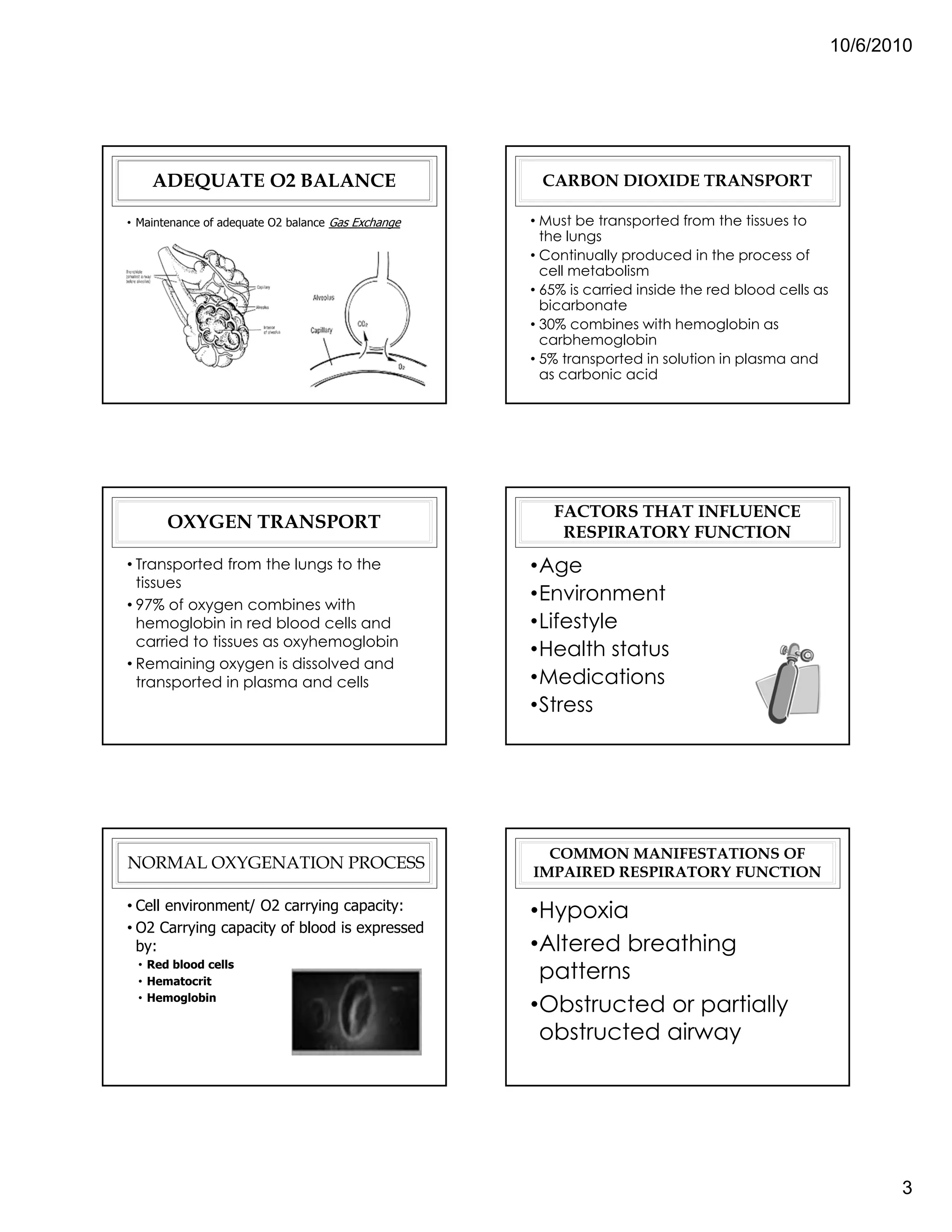
ABNORMAL RESPIRATORY PATTERNS                         ADEQUATE O2 BALANCE

• Tachypnea (rapid rate)                         •       Example of Obstructive Disease   Asthma

• Bradypnea (abnormally slow rate)
• Apnea (cessation of breathing)
• Kussmaul’s breathing
• Cheyne-Stokes respirations
• Biot’s respirations


      ALTERATIONS IN EASE OF
           BREATHING
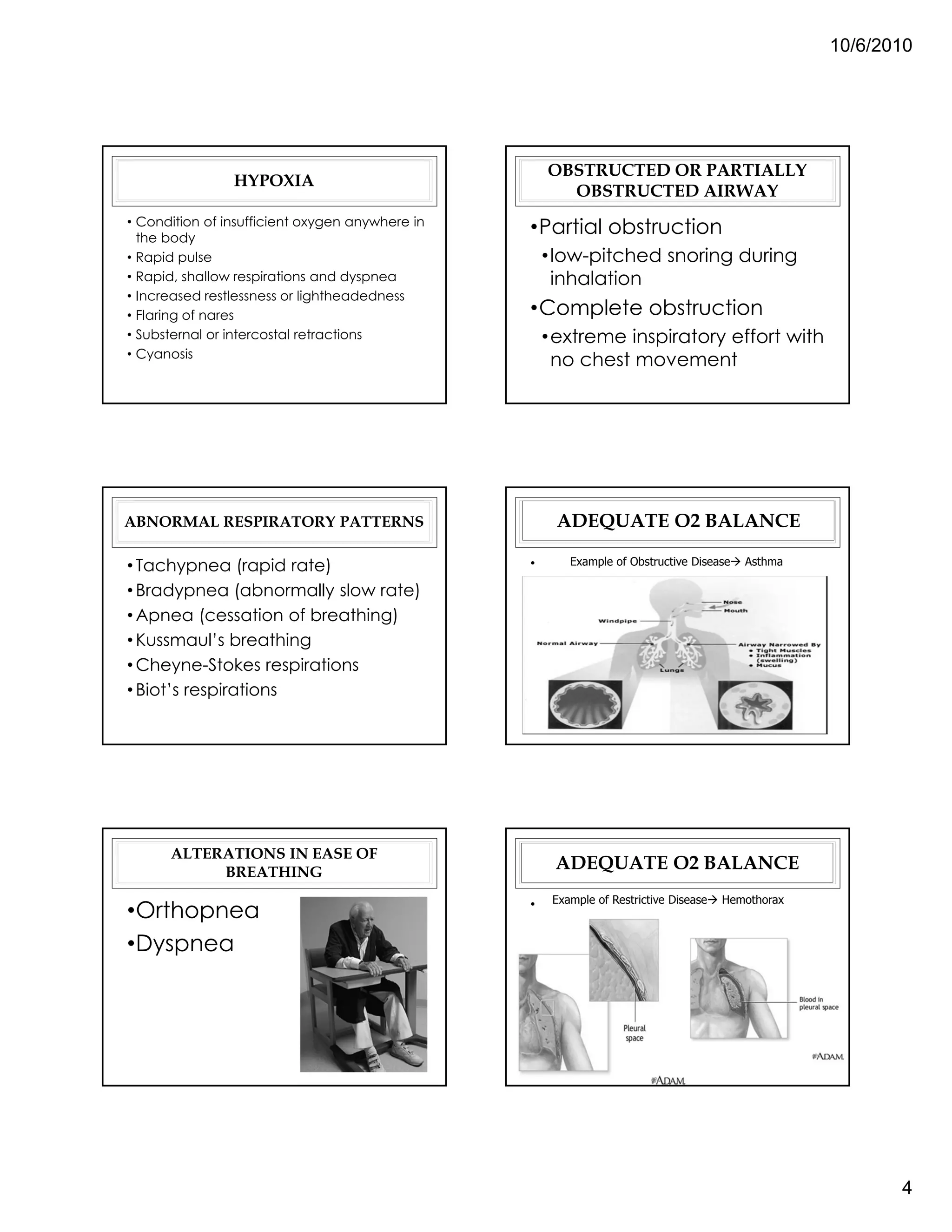
                                                      ADEQUATE O2 BALANCE

                                                 •    Example of Restrictive Disease   Hemothorax
•Orthopnea
•Dyspnea


                                                                                                           4
10/6/2010


                                                                  NURSING MEASURES TO PROMOTE
     INADEQUATE O2 BALANCE                                           RESPIRATORY FUNCTION
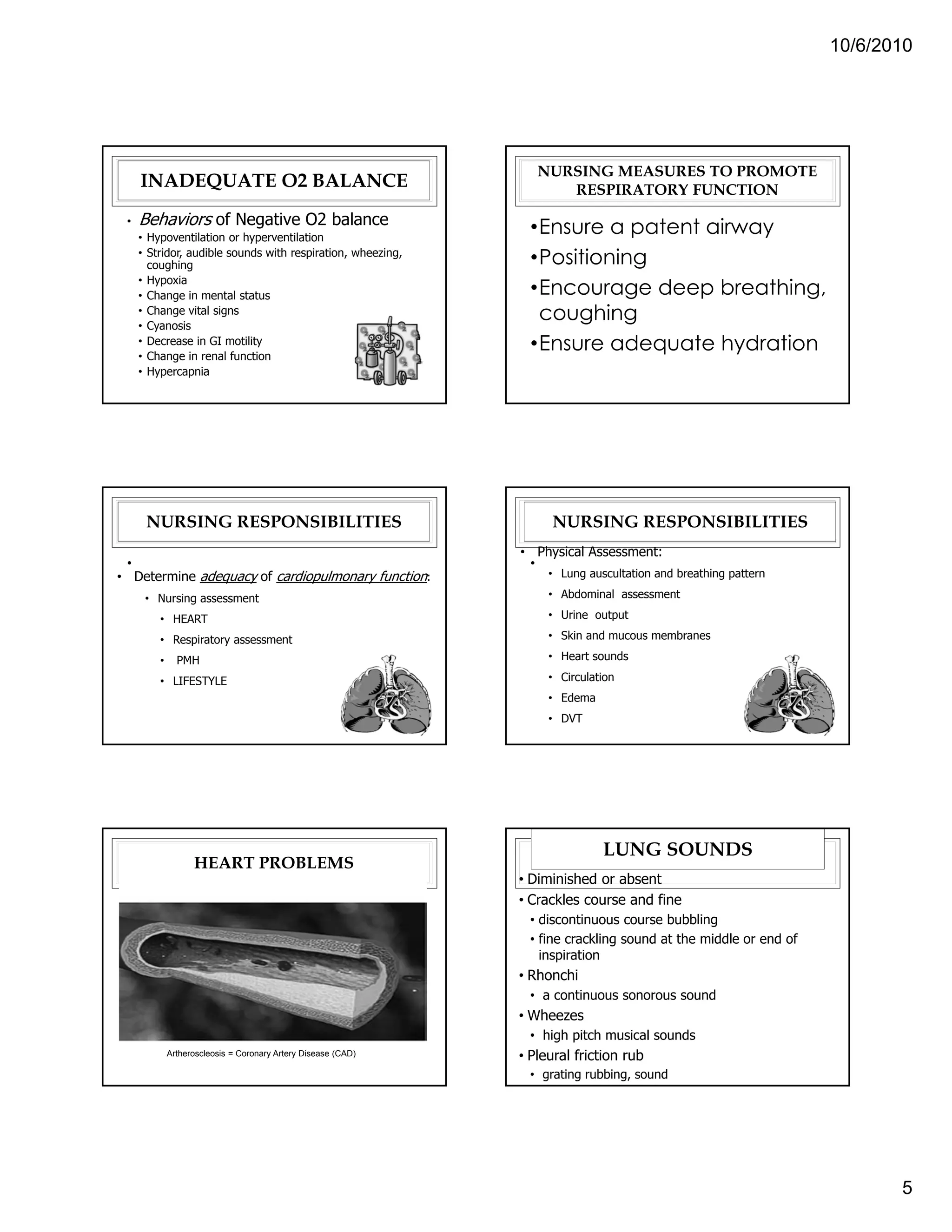
 •   Behaviors of Negative O2 balance                            •Ensure a patent airway
     • Hypoventilation or hyperventilation
     • Stridor, audible sounds with respiration, wheezing,
       coughing                                                  •Positioning
     • Hypoxia
     • Change in mental status                                   •Encourage deep breathing,
     • Change vital signs
     • Cyanosis
                                                                  coughing
     • Decrease in GI motility
     • Change in renal function
                                                                 •Ensure adequate hydration
     • Hypercapnia


      NURSING RESPONSIBILITIES                                      NURSING RESPONSIBILITIES
                                                               • Physical Assessment:
 •                                                              •
• Determine adequacy of cardiopulmonary function:                   • Lung auscultation and breathing pattern

      • Nursing assessment                                          • Abdominal assessment

         • HEART                                                    • Urine output

         • Respiratory assessment                                   • Skin and mucous membranes

         •     PMH                                                  • Heart sounds

         • LIFESTYLE                                                • Circulation
                                                                    • Edema
                                                                    • DVT


                                                                              LUNG SOUNDS
                   HEART PROBLEMS
                                                               • Diminished or absent
                                                               • Crackles course and fine
                                                                • discontinuous course bubbling
                                                                • fine crackling sound at the middle or end of
                                                                  inspiration
                                                               • Rhonchi
                                                                • a continuous sonorous sound
                                                               • Wheezes
                                                                • high pitch musical sounds
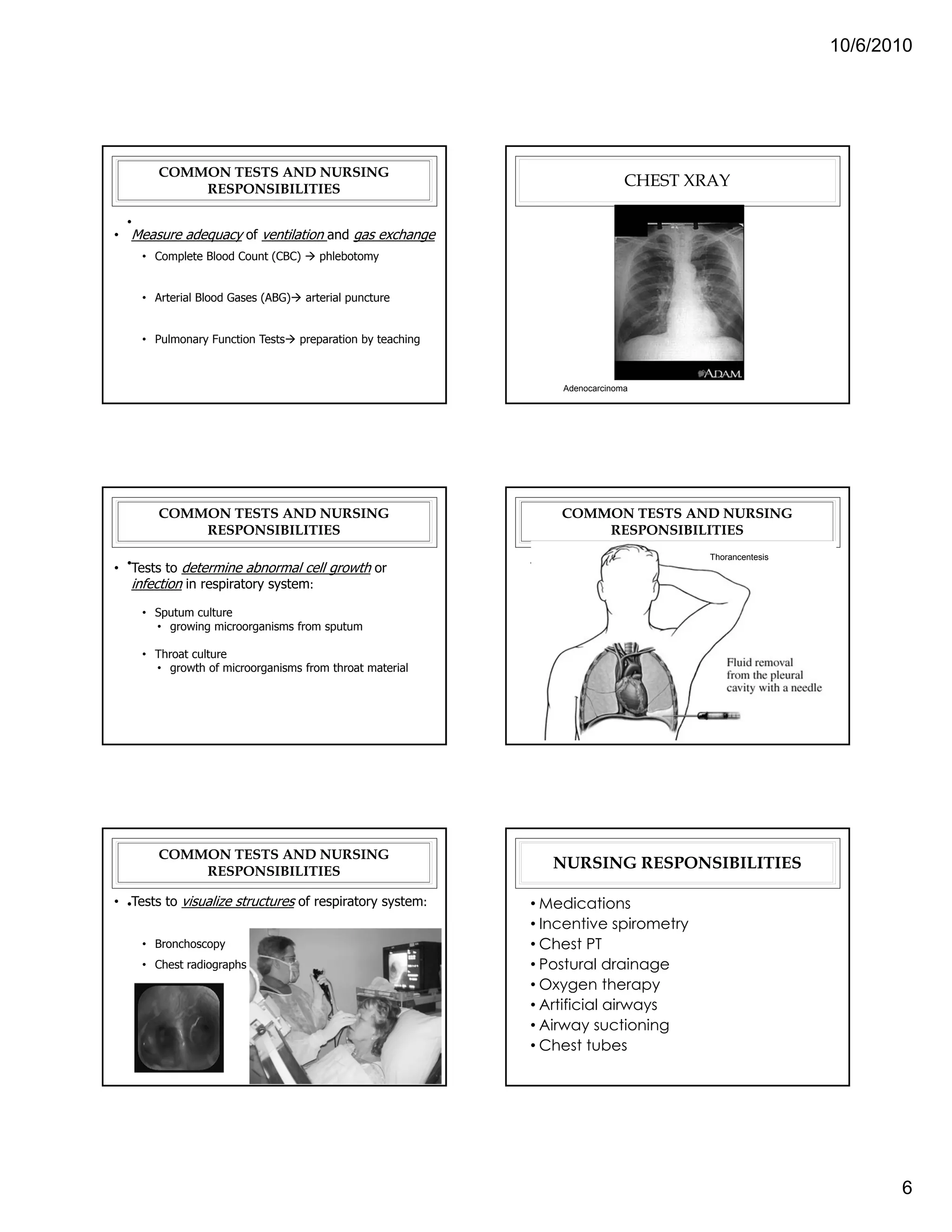
             Artheroscleosis = Coronary Artery Disease (CAD)   • Pleural friction rub
                                                                • grating rubbing, sound


                                                                                                                        5
10/6/2010


       COMMON TESTS AND NURSING
           RESPONSIBILITIES
                                                                               CHEST XRAY

  •
• Measure adequacy of ventilation and gas exchange
    • Complete Blood Count (CBC)      phlebotomy


    • Arterial Blood Gases (ABG)    arterial puncture


    • Pulmonary Function Tests     preparation by teaching


                                                                  Adenocarcinoma


       COMMON TESTS AND NURSING                                  COMMON TESTS AND NURSING
           RESPONSIBILITIES                                          RESPONSIBILITIES
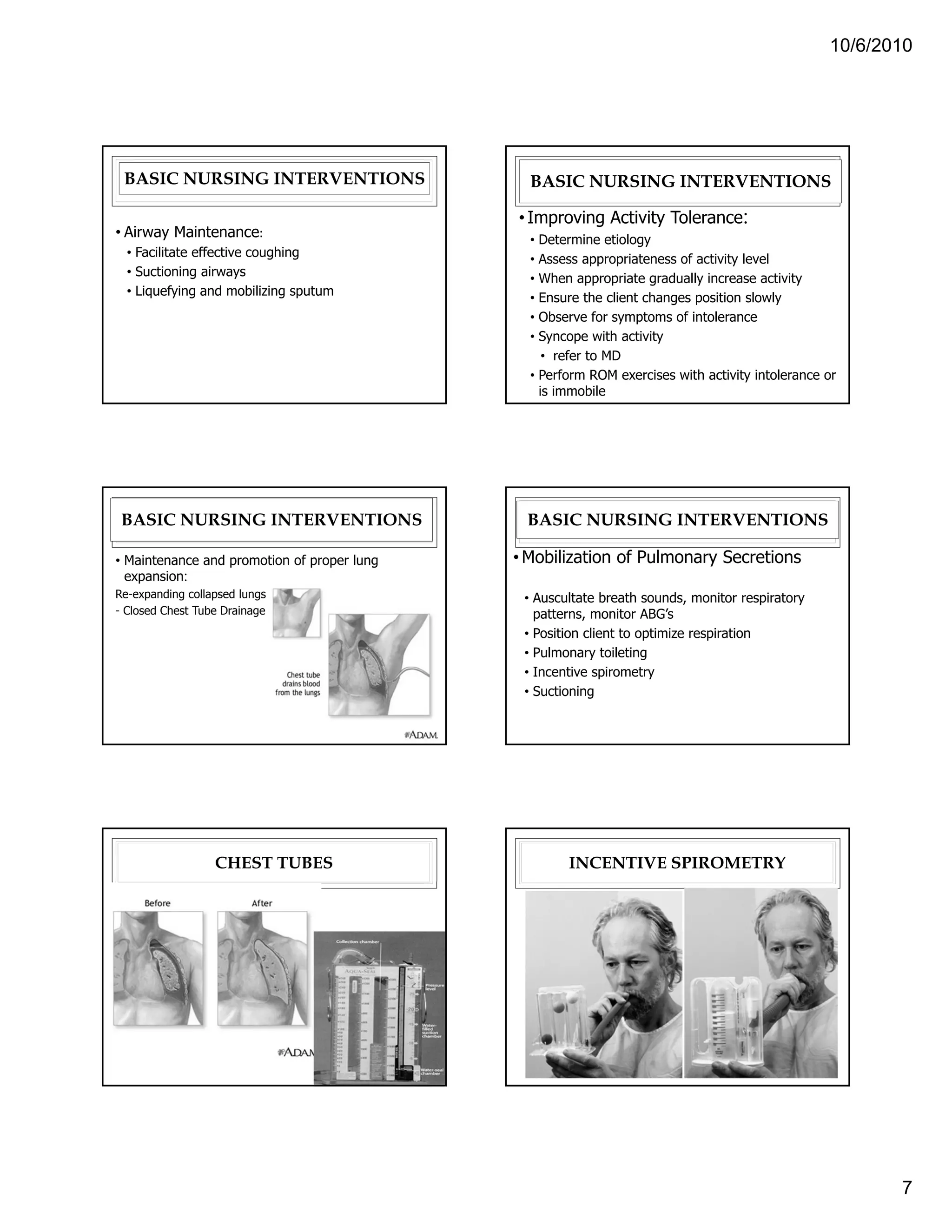
                                                                                       Thorancentesis
• •Tests to determine abnormal cell growth or                • Thoracentesis:
   infection in respiratory system:
    • Sputum culture
      • growing microorganisms from sputum

    • Throat culture
      • growth of microorganisms from throat material


       COMMON TESTS AND NURSING
           RESPONSIBILITIES
                                                                NURSING RESPONSIBILITIES

• •Tests to visualize structures of respiratory system:      • Medications
                                                             • Incentive spirometry
    • Bronchoscopy                                           • Chest PT
    • Chest radiographs                                      • Postural drainage
                                                             • Oxygen therapy
                                                             • Artificial airways
                                                             • Airway suctioning
                                                             • Chest tubes


                                                                                                               6
10/6/2010


 BASIC NURSING INTERVENTIONS                   BASIC NURSING INTERVENTIONS

                                             • Improving Activity Tolerance:
• Airway Maintenance:                          • Determine etiology
  • Facilitate effective coughing              • Assess appropriateness of activity level
  • Suctioning airways                         • When appropriate gradually increase activity
  • Liquefying and mobilizing sputum           • Ensure the client changes position slowly
                                               • Observe for symptoms of intolerance
                                               • Syncope with activity
                                                  • refer to MD
                                               • Perform ROM exercises with activity intolerance or
                                                 is immobile


 BASIC NURSING INTERVENTIONS                  BASIC NURSING INTERVENTIONS

• Maintenance and promotion of proper lung   • Mobilization of Pulmonary Secretions
  expansion:
Re-expanding collapsed lungs                  • Auscultate breath sounds, monitor respiratory
- Closed Chest Tube Drainage                    patterns, monitor ABG’s
                                              • Position client to optimize respiration
                                              • Pulmonary toileting
                                              • Incentive spirometry
                                              • Suctioning


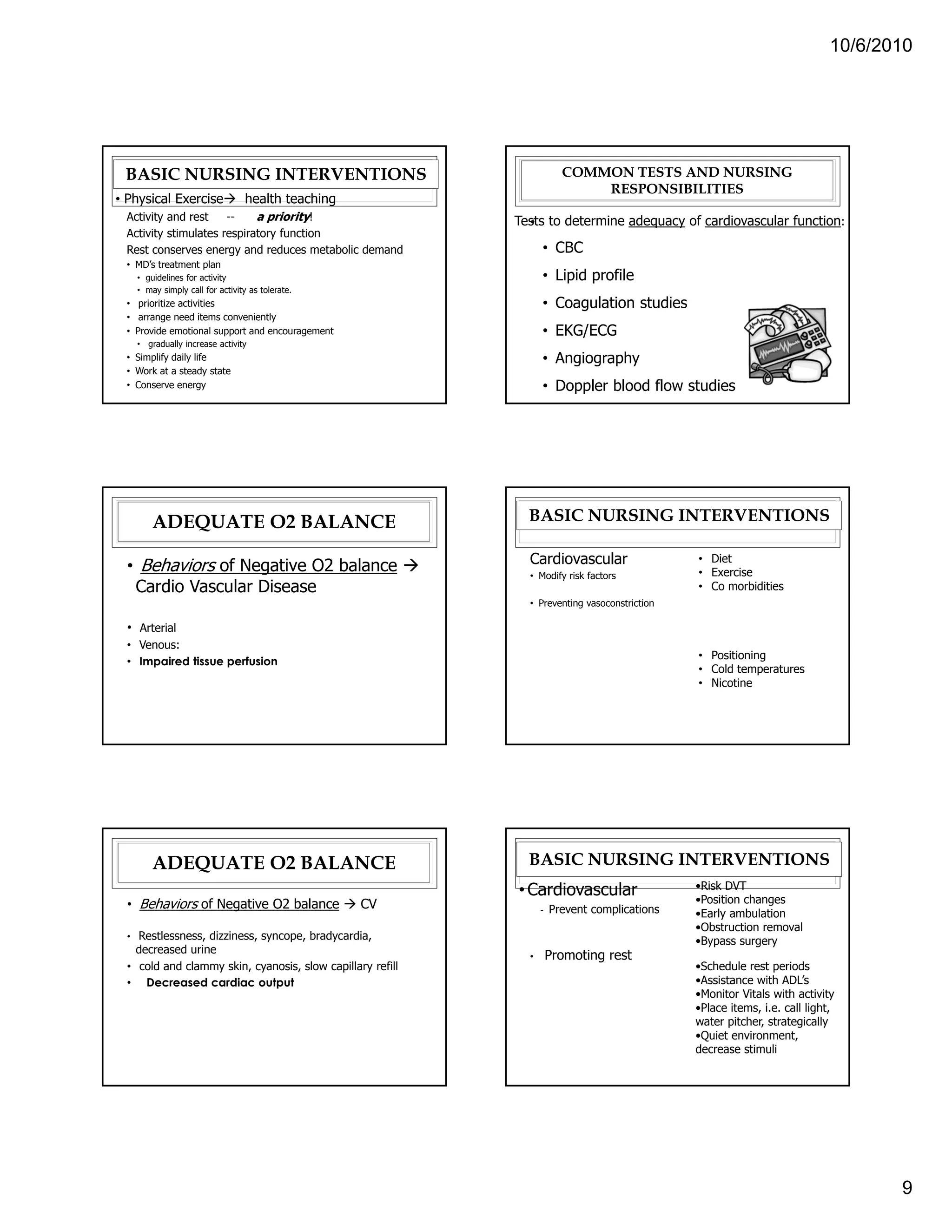
                  CHEST TUBES                        INCENTIVE SPIROMETRY


                                                                                                        7
10/6/2010


                                                     BASIC NURSING INTERVENTIONS


                                                         • Effective Breathing Techniques

                                                    • Position for maximal respiratory function

                                                    • Pursed lip breathing

                                                    • Diaphragmatic or abdominal breathing


  BASIC NURSING INTERVENTIONS                        BASIC NURSING INTERVENTIONS
• Mobilization of Pulmonary Secretions              Stress and anxiety reduction:
 • Encourage activity and ambulation as tolerated   • Remove pertinent cause of anxiety at that moment
                                                       - help client gain control over respiration
 • Encourage increased fluid intake                    - reassure client not in immediate danger
 • Chest physiotherapy
 • O2                                               • Chronic clients
                                                      • exacerbations and remissions
 • Medications as ordered
                                                      • goal is to reduce general level of anxiety
                                                      • learn to control episodes of anxiety to improve quality
                                                        of life
                                                        • desensitization program
                                                        • guided mastery


  BASIC NURSING INTERVENTIONS                               ADMINISTRATION OF
                                                          PRESCRIBED MEDICATIONS
• O2 Therapy:                                        • Expectorants                  • Vasoconstrictors
  • Low flow                                         • Mucolytics
  • High flow                                        • Bronchodilators
  • Humidification                                   • Cough suppressants
  • Nasal cannula                                    • Corticosteroids
  • Simple mask                                      • Antihistamines
  • Nonrebreathing mask                              • Antibiotics
  • Partial rebreathing


                                                                                                                    8
10/6/2010


 BASIC NURSING INTERVENTIONS                                            COMMON TESTS AND NURSING
                                                                            RESPONSIBILITIES
• Physical Exercise              health teaching
 Activity and rest    --    a priority!                     Tests to determine adequacy of cardiovascular function:
                                                              •
 Activity stimulates respiratory function
 Rest conserves energy and reduces metabolic demand               • CBC
 • MD’s treatment plan
    • guidelines for activity                                     • Lipid profile
    • may simply call for activity as tolerate.
 • prioritize activities                                          • Coagulation studies
 • arrange need items conveniently
 • Provide emotional support and encouragement                    • EKG/ECG
    • gradually increase activity
 • Simplify daily life                                            • Angiography
 • Work at a steady state
 • Conserve energy                                                • Doppler blood flow studies


        ADEQUATE O2 BALANCE                                   BASIC NURSING INTERVENTIONS

  • Behaviors of Negative O2 balance                          Cardiovascular                  • Diet
                                                              • Modify risk factors           • Exercise
   Cardio Vascular Disease                                                                    • Co morbidities
                                                              • Preventing vasoconstriction

  • Arterial
  • Venous:
                                                                                              • Positioning
  • Impaired tissue perfusion
                                                                                              • Cold temperatures
                                                                                              • Nicotine


        ADEQUATE O2 BALANCE                                   BASIC NURSING INTERVENTIONS
                                                            • Cardiovascular                  •Risk DVT
                                                                                              •Position changes
  • Behaviors of Negative O2 balance               CV             -   Prevent complications   •Early ambulation
                                                                                              •Obstruction removal
  • Restlessness, dizziness, syncope, bradycardia,
                                                                                              •Bypass surgery
    decreased urine
                                                              •       Promoting rest
  • cold and clammy skin, cyanosis, slow capillary refill                                     •Schedule rest periods
  • Decreased cardiac output                                                                  •Assistance with ADL’s
                                                                                              •Monitor Vitals with activity
                                                                                              •Place items, i.e. call light,
                                                                                              water pitcher, strategically
                                                                                              •Quiet environment,
                                                                                              decrease stimuli


                                                                                                                                 9
10/6/2010


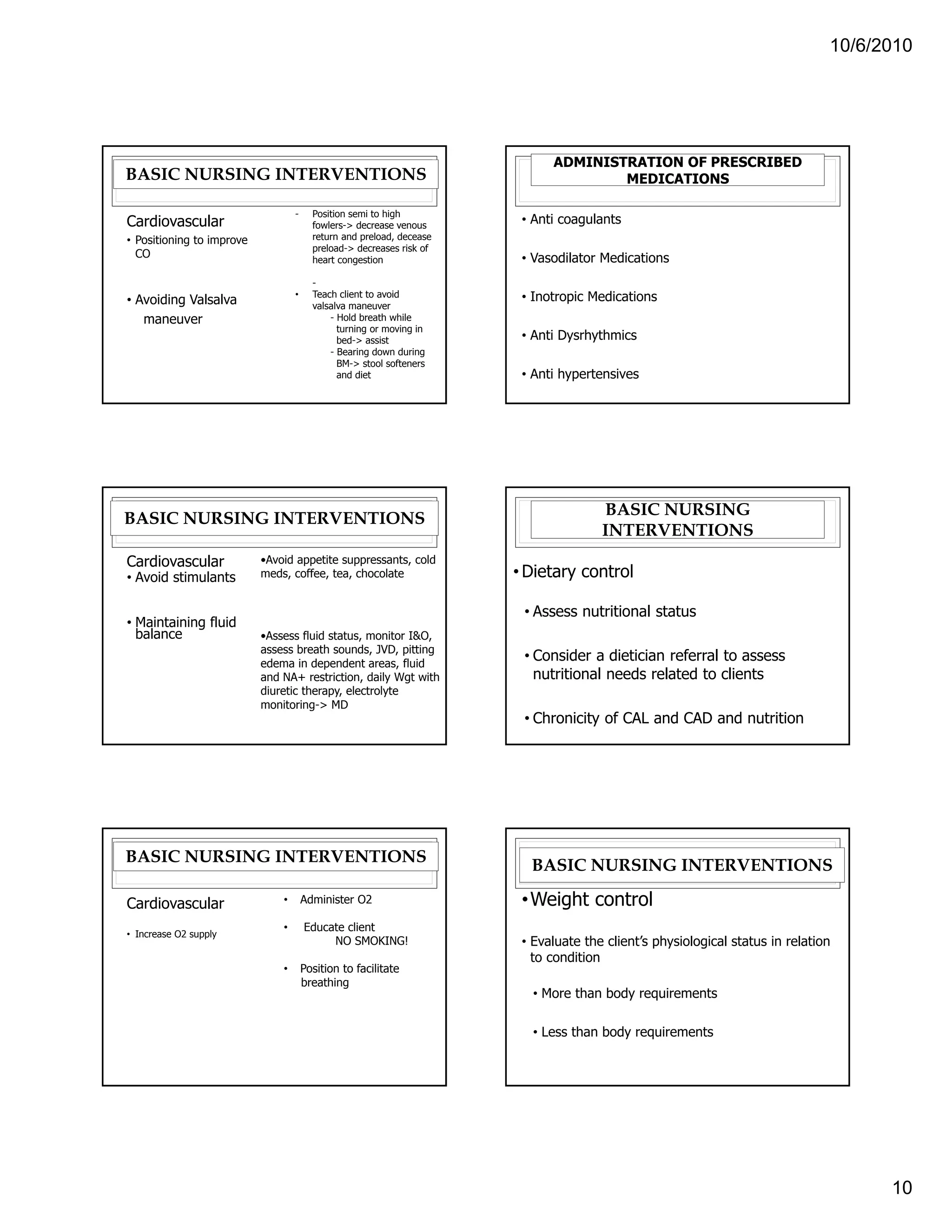
                                                                             ADMINISTRATION OF PRESCRIBED
BASIC NURSING INTERVENTIONS                                                          MEDICATIONS

                                   -     Position semi to high
Cardiovascular                           fowlers-> decrease venous
                                                                        • Anti coagulants
• Positioning to improve                 return and preload, decease
                                         preload-> decreases risk of
  CO                                     heart congestion               • Vasodilator Medications
                                         -
• Avoiding Valsalva                •     Teach client to avoid          • Inotropic Medications
                                         valsalva maneuver
   maneuver                                  - Hold breath while
                                               turning or moving in
                                               bed-> assist             • Anti Dysrhythmics
                                             - Bearing down during
                                               BM-> stool softeners
                                               and diet                 • Anti hypertensives


                                                                                      BASIC NURSING
BASIC NURSING INTERVENTIONS
                                                                                      INTERVENTIONS
Cardiovascular             •Avoid appetite suppressants, cold
• Avoid stimulants         meds, coffee, tea, chocolate                • Dietary control

                                                                        • Assess nutritional status
• Maintaining fluid
  balance                  •Assess fluid status, monitor I&O,
                           assess breath sounds, JVD, pitting
                           edema in dependent areas, fluid
                                                                        • Consider a dietician referral to assess
                           and NA+ restriction, daily Wgt with            nutritional needs related to clients
                           diuretic therapy, electrolyte
                           monitoring-> MD
                                                                        • Chronicity of CAL and CAD and nutrition


BASIC NURSING INTERVENTIONS
                                                                         BASIC NURSING INTERVENTIONS

Cardiovascular                 •       Administer O2                    • Weight control
                               •       Educate client
• Increase O2 supply
                                            NO SMOKING!                 • Evaluate the client’s physiological status in relation
                                                                          to condition
                               •       Position to facilitate
                                       breathing
                                                                          • More than body requirements

                                                                          • Less than body requirements


                                                                                                                                     10

53 a focus 8 oxygenation pdf

  • 1.
    10/6/2010 NURSING FUNDAMENTALS STAGGERING STATISTICS FOCUS VI OXYGENATION • Cardiovascular Diseases – # 1 killer • HTN – 65 million • Artheriosclerosis • Arteriosclerosis • Stroke • Hypercholesterolemia • 107 million - a risk factor for CVD • AMI – 7.5 Million per year, 460,000 die • Americans will pay 393.5 billion in 2005 for CVD related medical costs OBJECTIVES RESPIRATORY SYSTEM • List and discuss the major body structures. • Discuss functions responsible for proper oxygenation • Describe factors that may alter ones O2 balance. • Identify the behaviors indicating negative O2 balance. • Review the common diagnostic tests medically prescribed in order to determine the clients oxygenation status. • Explain the major purpose of the tests and the related nursing responsibilities. STAGGERING STATISTICS PROCESS OF BREATHING • Pulmonary Diseases • Lung CA - •Inspiration •Air flows into lungs • TB – •Expiration • Pneumonia – •Air flows out of lungs • Chronic Airflow Limitation (formerly COPD) – 1
  • 2.
    10/6/2010 NORMAL OXYGENATIONPROCESS INSPIRATION • Cardiovascular: • Diaphragm and intercostals contact • Thoracic cavity size increases • Volume of lungs increases • Intrapulmonary pressure decreases • Air rushes into the lungs to equalize pressure NORMAL OXYGENATION PROCESS EXPIRATION • Systemic: • Diaphragm and intercostals relax • Volume of the lungs decreases • Intrapulmonary pressure rises • Air is expelled NORMAL OXYGENATIONS PROCESS GAS EXCHANGE • Occurs after the alveoli are ventilated • Pressure differences on each side of the respiratory membranes affect diffusion • Diffusion of oxygen from the alveoli into the pulmonary blood vessels • Diffusion of carbon dioxide from pulmonary blood vessels into alveoli 2
  • 3.
    10/6/2010 ADEQUATE O2 BALANCE CARBON DIOXIDE TRANSPORT • Maintenance of adequate O2 balance Gas Exchange • Must be transported from the tissues to the lungs • Continually produced in the process of cell metabolism • 65% is carried inside the red blood cells as bicarbonate • 30% combines with hemoglobin as carbhemoglobin • 5% transported in solution in plasma and as carbonic acid FACTORS THAT INFLUENCE OXYGEN TRANSPORT RESPIRATORY FUNCTION • Transported from the lungs to the •Age tissues • 97% of oxygen combines with •Environment hemoglobin in red blood cells and •Lifestyle carried to tissues as oxyhemoglobin •Health status • Remaining oxygen is dissolved and transported in plasma and cells •Medications •Stress COMMON MANIFESTATIONS OF NORMAL OXYGENATION PROCESS IMPAIRED RESPIRATORY FUNCTION • Cell environment/ O2 carrying capacity: •Hypoxia • O2 Carrying capacity of blood is expressed by: •Altered breathing • Red blood cells • Hematocrit patterns • Hemoglobin •Obstructed or partially obstructed airway 3
  • 4.
    10/6/2010 OBSTRUCTED OR PARTIALLY HYPOXIA OBSTRUCTED AIRWAY • Condition of insufficient oxygen anywhere in the body •Partial obstruction • Rapid pulse •low-pitched snoring during • Rapid, shallow respirations and dyspnea inhalation • Increased restlessness or lightheadedness • Flaring of nares •Complete obstruction • Substernal or intercostal retractions •extreme inspiratory effort with • Cyanosis no chest movement ABNORMAL RESPIRATORY PATTERNS ADEQUATE O2 BALANCE • Tachypnea (rapid rate) • Example of Obstructive Disease Asthma • Bradypnea (abnormally slow rate) • Apnea (cessation of breathing) • Kussmaul’s breathing • Cheyne-Stokes respirations • Biot’s respirations ALTERATIONS IN EASE OF BREATHING ADEQUATE O2 BALANCE • Example of Restrictive Disease Hemothorax •Orthopnea •Dyspnea 4
  • 5.
    10/6/2010 NURSING MEASURES TO PROMOTE INADEQUATE O2 BALANCE RESPIRATORY FUNCTION • Behaviors of Negative O2 balance •Ensure a patent airway • Hypoventilation or hyperventilation • Stridor, audible sounds with respiration, wheezing, coughing •Positioning • Hypoxia • Change in mental status •Encourage deep breathing, • Change vital signs • Cyanosis coughing • Decrease in GI motility • Change in renal function •Ensure adequate hydration • Hypercapnia NURSING RESPONSIBILITIES NURSING RESPONSIBILITIES • Physical Assessment: • • • Determine adequacy of cardiopulmonary function: • Lung auscultation and breathing pattern • Nursing assessment • Abdominal assessment • HEART • Urine output • Respiratory assessment • Skin and mucous membranes • PMH • Heart sounds • LIFESTYLE • Circulation • Edema • DVT LUNG SOUNDS HEART PROBLEMS • Diminished or absent • Crackles course and fine • discontinuous course bubbling • fine crackling sound at the middle or end of inspiration • Rhonchi • a continuous sonorous sound • Wheezes • high pitch musical sounds Artheroscleosis = Coronary Artery Disease (CAD) • Pleural friction rub • grating rubbing, sound 5
  • 6.
    10/6/2010 COMMON TESTS AND NURSING RESPONSIBILITIES CHEST XRAY • • Measure adequacy of ventilation and gas exchange • Complete Blood Count (CBC) phlebotomy • Arterial Blood Gases (ABG) arterial puncture • Pulmonary Function Tests preparation by teaching Adenocarcinoma COMMON TESTS AND NURSING COMMON TESTS AND NURSING RESPONSIBILITIES RESPONSIBILITIES Thorancentesis • •Tests to determine abnormal cell growth or • Thoracentesis: infection in respiratory system: • Sputum culture • growing microorganisms from sputum • Throat culture • growth of microorganisms from throat material COMMON TESTS AND NURSING RESPONSIBILITIES NURSING RESPONSIBILITIES • •Tests to visualize structures of respiratory system: • Medications • Incentive spirometry • Bronchoscopy • Chest PT • Chest radiographs • Postural drainage • Oxygen therapy • Artificial airways • Airway suctioning • Chest tubes 6
  • 7.
    10/6/2010 BASIC NURSINGINTERVENTIONS BASIC NURSING INTERVENTIONS • Improving Activity Tolerance: • Airway Maintenance: • Determine etiology • Facilitate effective coughing • Assess appropriateness of activity level • Suctioning airways • When appropriate gradually increase activity • Liquefying and mobilizing sputum • Ensure the client changes position slowly • Observe for symptoms of intolerance • Syncope with activity • refer to MD • Perform ROM exercises with activity intolerance or is immobile BASIC NURSING INTERVENTIONS BASIC NURSING INTERVENTIONS • Maintenance and promotion of proper lung • Mobilization of Pulmonary Secretions expansion: Re-expanding collapsed lungs • Auscultate breath sounds, monitor respiratory - Closed Chest Tube Drainage patterns, monitor ABG’s • Position client to optimize respiration • Pulmonary toileting • Incentive spirometry • Suctioning CHEST TUBES INCENTIVE SPIROMETRY 7
  • 8.
    10/6/2010 BASIC NURSING INTERVENTIONS • Effective Breathing Techniques • Position for maximal respiratory function • Pursed lip breathing • Diaphragmatic or abdominal breathing BASIC NURSING INTERVENTIONS BASIC NURSING INTERVENTIONS • Mobilization of Pulmonary Secretions Stress and anxiety reduction: • Encourage activity and ambulation as tolerated • Remove pertinent cause of anxiety at that moment - help client gain control over respiration • Encourage increased fluid intake - reassure client not in immediate danger • Chest physiotherapy • O2 • Chronic clients • exacerbations and remissions • Medications as ordered • goal is to reduce general level of anxiety • learn to control episodes of anxiety to improve quality of life • desensitization program • guided mastery BASIC NURSING INTERVENTIONS ADMINISTRATION OF PRESCRIBED MEDICATIONS • O2 Therapy: • Expectorants • Vasoconstrictors • Low flow • Mucolytics • High flow • Bronchodilators • Humidification • Cough suppressants • Nasal cannula • Corticosteroids • Simple mask • Antihistamines • Nonrebreathing mask • Antibiotics • Partial rebreathing 8
  • 9.
    10/6/2010 BASIC NURSINGINTERVENTIONS COMMON TESTS AND NURSING RESPONSIBILITIES • Physical Exercise health teaching Activity and rest -- a priority! Tests to determine adequacy of cardiovascular function: • Activity stimulates respiratory function Rest conserves energy and reduces metabolic demand • CBC • MD’s treatment plan • guidelines for activity • Lipid profile • may simply call for activity as tolerate. • prioritize activities • Coagulation studies • arrange need items conveniently • Provide emotional support and encouragement • EKG/ECG • gradually increase activity • Simplify daily life • Angiography • Work at a steady state • Conserve energy • Doppler blood flow studies ADEQUATE O2 BALANCE BASIC NURSING INTERVENTIONS • Behaviors of Negative O2 balance Cardiovascular • Diet • Modify risk factors • Exercise Cardio Vascular Disease • Co morbidities • Preventing vasoconstriction • Arterial • Venous: • Positioning • Impaired tissue perfusion • Cold temperatures • Nicotine ADEQUATE O2 BALANCE BASIC NURSING INTERVENTIONS • Cardiovascular •Risk DVT •Position changes • Behaviors of Negative O2 balance CV - Prevent complications •Early ambulation •Obstruction removal • Restlessness, dizziness, syncope, bradycardia, •Bypass surgery decreased urine • Promoting rest • cold and clammy skin, cyanosis, slow capillary refill •Schedule rest periods • Decreased cardiac output •Assistance with ADL’s •Monitor Vitals with activity •Place items, i.e. call light, water pitcher, strategically •Quiet environment, decrease stimuli 9
  • 10.
    10/6/2010 ADMINISTRATION OF PRESCRIBED BASIC NURSING INTERVENTIONS MEDICATIONS - Position semi to high Cardiovascular fowlers-> decrease venous • Anti coagulants • Positioning to improve return and preload, decease preload-> decreases risk of CO heart congestion • Vasodilator Medications - • Avoiding Valsalva • Teach client to avoid • Inotropic Medications valsalva maneuver maneuver - Hold breath while turning or moving in bed-> assist • Anti Dysrhythmics - Bearing down during BM-> stool softeners and diet • Anti hypertensives BASIC NURSING BASIC NURSING INTERVENTIONS INTERVENTIONS Cardiovascular •Avoid appetite suppressants, cold • Avoid stimulants meds, coffee, tea, chocolate • Dietary control • Assess nutritional status • Maintaining fluid balance •Assess fluid status, monitor I&O, assess breath sounds, JVD, pitting edema in dependent areas, fluid • Consider a dietician referral to assess and NA+ restriction, daily Wgt with nutritional needs related to clients diuretic therapy, electrolyte monitoring-> MD • Chronicity of CAL and CAD and nutrition BASIC NURSING INTERVENTIONS BASIC NURSING INTERVENTIONS Cardiovascular • Administer O2 • Weight control • Educate client • Increase O2 supply NO SMOKING! • Evaluate the client’s physiological status in relation to condition • Position to facilitate breathing • More than body requirements • Less than body requirements 10