1
Mechanism of breathing
Instructor: Ma’am Faiza Frasat
Presentation No 1 BS DT
M. Hanif, Waheed Qureshi, Abdullah
Wazir, Sahiba Rahim, Maryam
Saleem, Iqra, Mahnoor Waheed, Sara
Rajpoot.
Introduction
Respiration is the process of exchanging oxygen and carbon dioxide
between the body and the environment.

It's a complex process that involves many parts of the body working
together to ensure that the body gets enough oxygen for energy and
gets rid of carbon dioxide efficiently.
2
05/13/2025 3
Overview of Respiratory System
• Key Components:
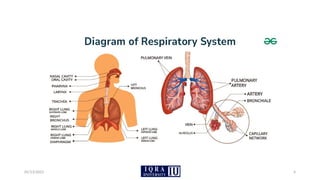
• Nose/Mouth – Entry points for air.
• Trachea – Air passageway to lungs.
• Bronchi & Bronchioles – Branching airways leading to alveoli.
• Alveoli – Tiny air sacs where gas exchange occurs.
• Function of the Respiratory System:
• Air conduction
• Gas exchange (O2 in, CO2 out)
• Regulation of blood pH
05/13/2025 4
5
Mechanism of Breathing
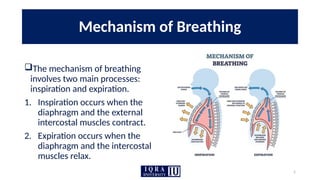
The mechanism of breathing
involves two main processes:
inspiration and expiration.
1. Inspiration occurs when the
diaphragm and the external
intercostal muscles contract.
2. Expiration occurs when the
diaphragm and the intercostal
muscles relax.
6
Inhalation (Inspiration)
Active process: Requires energy.
Contraction of the diaphragm:
The diaphragm moves downward, increasing the volume of the thoracic cavity.
External intercostal muscle contraction:
The rib cage expands, further increasing the thoracic cavity volume.
Lung expansion:
As the volume of the thoracic cavity increases, the pressure inside the lungs
(intrapulmonary pressure) drops below atmospheric pressure.
05/13/2025 7
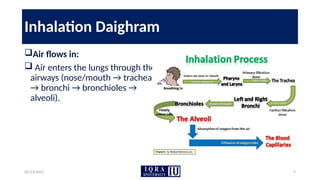
Inhalation Daighram
Air flows in:
 Air enters the lungs through the
airways (nose/mouth → trachea
→ bronchi → bronchioles →
alveoli).
8
The action of the inspiratory
The action of the inspiratory muscles results in an increase in
the volume of the thoracic cavity.
 As the lungs are held against the inner thoracic wall by
the pleural seal, they also undergo an increase in volume.
9
Boyle’s law
As per Boyle’s law, an increase in lung volume results in a decrease in
the pressure within the lungs.
 The pressure of the environment external to the lungs is now greater
than the environment within the lungs, meaning air moves into the lungs
down the pressure gradient.
10
Exhalation (Expiration)
Air moves out of the lungs.
Usually passive, due to relaxation of muscles and recoil of lungs.
Mechanism of Exhalation
1.Diaphragm Relaxes: The diaphragm moves upward, decreasing the
volume of the thoracic cavity.
2.Internal Intercostal Muscles Contract (in forceful exhalation): Pulling
the ribs inward.
11
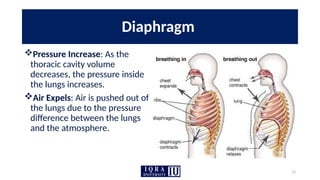
Diaphragm
Pressure Increase: As the
thoracic cavity volume
decreases, the pressure inside
the lungs increases.
Air Expels: Air is pushed out of
the lungs due to the pressure
difference between the lungs
and the atmosphere.
12
Boyle’s law
As per Boyle’s law, a decrease in lung volume results in an increase
in the pressure within the lungs. The pressure inside the lungs is
now greater than in the external environment, meaning air moves
out of the lungs down the pressure gradient.
13
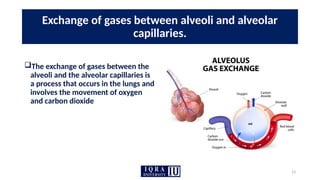
Exchange of gases between alveoli and alveolar
capillaries.
The exchange of gases between the
alveoli and the alveolar capillaries is
a process that occurs in the lungs and
involves the movement of oxygen
and carbon dioxide
14
Exchange of gases
Oxygen
Oxygen moves from the alveoli
into the blood in the capillaries.
Oxygen molecules attach to red
blood cells and travel to the
heart.
Carbon dioxid
Carbon dioxide moves from the
blood in the capillaries into the
air in the alveoli.
15
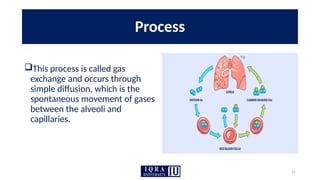
Process
This process is called gas
exchange and occurs through
simple diffusion, which is the
spontaneous movement of gases
between the alveoli and
capillaries.
16
Factors
The exchange of gases is made possible by the following factors:
1.Large surface area: The human lungs contain about 500 million alveoli, which
creates a large surface area for gases to diffuse over.
2.Thin lining: The lining of the alveoli is very thin so that gases can quickly diffuse
through it.
3.Good blood supply: The alveoli have a dense capillary network so that large
volumes of gases can be exchanged.
4.Moisture: The layer of moisture in the alveoli allows gases to dissolve so that they
can diffuse quickly.
17
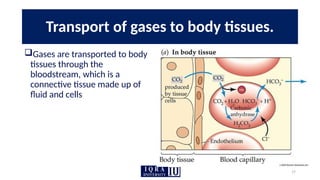
Transport of gases to body tissues.
Gases are transported to body
tissues through the
bloodstream, which is a
connective tissue made up of
fluid and cells
18
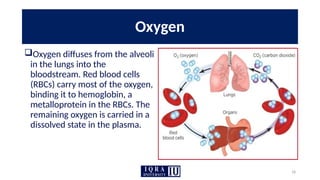
Oxygen
Oxygen diffuses from the alveoli
in the lungs into the
bloodstream. Red blood cells
(RBCs) carry most of the oxygen,
binding it to hemoglobin, a
metalloprotein in the RBCs. The
remaining oxygen is carried in a
dissolved state in the plasma.
19
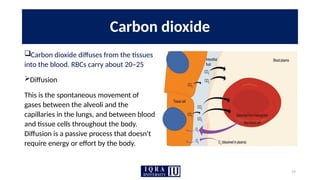
Carbon dioxide
Carbon dioxide diffuses from the tissues
into the blood. RBCs carry about 20–25
Diffusion
This is the spontaneous movement of
gases between the alveoli and the
capillaries in the lungs, and between blood
and tissue cells throughout the body.
Diffusion is a passive process that doesn't
require energy or effort by the body.
20
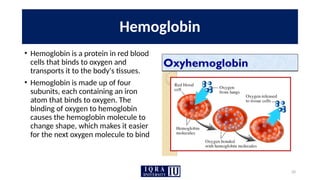
Hemoglobin
• Hemoglobin is a protein in red blood
cells that binds to oxygen and
transports it to the body's tissues.
• Hemoglobin is made up of four
subunits, each containing an iron
atom that binds to oxygen. The
binding of oxygen to hemoglobin
causes the hemoglobin molecule to
change shape, which makes it easier
for the next oxygen molecule to bind
21
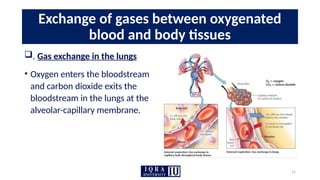
Exchange of gases between oxygenated
blood and body tissues
. Gas exchange in the lungs
• Oxygen enters the bloodstream
and carbon dioxide exits the
bloodstream in the lungs at the
alveolar-capillary membrane.
22
Gas exchange in tissues
Oxygen Delivery:
1. Oxygen (O ) is carried by hemoglobin in red blood cells.
₂
2. As blood reaches tissues with lower O concentration, hemoglobin
₂
releases oxygen.
3. O diffuses across the capillary walls into tissue cells, where it's used in
₂
cellular respiration.
•Carbon Dioxide Removal:
1. CO , produced by cells during metabolism, diffuses from tissues into the
₂
bloodstream.
2. CO is transported as bicarbonate (HCO ) in the plasma, while some
₂ ₃⁻
bind to hemoglobin.
3. Blood moves to the lungs, where CO is expelled.
₂
23
Factors that can affect gas exchange include
Exercise:
• Regular exercise improves the efficiency of the heart muscles and
increases the amount of oxygen delivered to tissues.
Respiratory diseases:
• Respiratory diseases can affect gas exchange.
24
Factors that can affect gas exchange include
High altitude:
• High altitude can affect gas exchange.
Deep or forced breathing: Deep or forced breathing causes the
alveolar air composition to change more rapidly, which affects the
diffusion process.
25
Usage of oxygen for cellular respiration and
releasing carbon dioxide in the process.
isms use oxygen to break down food and release energy in the form
of ATP, while also producing carbon dioxide and water as waste
products:
1. Glycolysis (Occurs in the cytoplasm)
2. Pyruvate Decarboxylation (Occurs in mitochondria)
3. Citric Acid Cycle (Krebs Cycle) (Occurs in mitochondria)
26
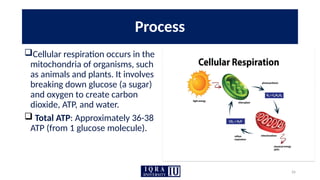
Process
Cellular respiration occurs in the
mitochondria of organisms, such
as animals and plants. It involves
breaking down glucose (a sugar)
and oxygen to create carbon
dioxide, ATP, and water.
 Total ATP: Approximately 36-38
ATP (from 1 glucose molecule).
27
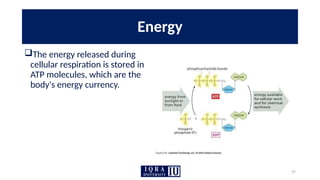
Energy
The energy released during
cellular respiration is stored in
ATP molecules, which are the
body's energy currency.
28
Oxygen & Carbon dioxide
Oxygen
Oxygen acts as the final electron
acceptor in the electron
transport chain, collecting two
electrons and two hydrogen ions
from the mitochondrial matrix to
form water.
Carbon dioxide
Carbon dioxide is a toxic waste
product that must be removed
from the body through
exhalation.
29
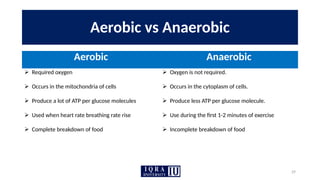
Aerobic vs Anaerobic
Aerobic Anaerobic
 Required oxygen  Oxygen is not required.
 Occurs in the mitochondria of cells  Occurs in the cytoplasm of cells.
 Produce a lot of ATP per glucose molecules  Produce less ATP per glucose molecule.
 Used when heart rate breathing rate rise  Use during the first 1-2 minutes of exercise
 Complete breakdown of food  Incomplete breakdown of food
05/13/2025 30
Diseases
Chronic Obstructive Pulmonary Disease (COPD):
Mechanism: Chronic inflammation and narrowing of the airways (bronchi
and bronchioles), causing obstruction to airflow.
Result: Difficulty exhaling, leading to air trapping in the lungs, decreased
oxygen intake, and CO₂ buildup.
Treatment
Bronchodilator ,Inhaled Corticosteroids, Oxygen Therapy, Pulmonary
Rehabilitation, Smoking Cessation
Count…
05/13/2025 31
Asthma:
Mechanism: Inflammation and constriction of bronchial
smooth muscles due to
allergens or
irritants, leading to airway hyperresponsiveness.
Result: Acute episodes of wheezing, coughing, and
shortness of breath due to
restricted airflow.
Treatment
Short-acting Beta Agonists (SABAs),
Inhaled Corticosteroids, Allergen Avoidance, Immunotherapy
05/13/2025 32
Pulmonary Fibrosis:
Mechanism: Scarring and stiffening of lung tissue, reducing
lung compliance and
gas exchange.
Result: Impaired oxygen transfer from the alveoli to the
bloodstream, leading to
hypoxia.
Treatment
Antifibrotic Medications, Oxygen Therapy, Lung Transplant
33
34

presentation_01_Phyisology[2].pptxiqrauni

  • 1.
    1 Mechanism of breathing Instructor:Ma’am Faiza Frasat Presentation No 1 BS DT M. Hanif, Waheed Qureshi, Abdullah Wazir, Sahiba Rahim, Maryam Saleem, Iqra, Mahnoor Waheed, Sara Rajpoot.
  • 2.
    Introduction Respiration is theprocess of exchanging oxygen and carbon dioxide between the body and the environment.  It's a complex process that involves many parts of the body working together to ensure that the body gets enough oxygen for energy and gets rid of carbon dioxide efficiently. 2
  • 3.
    05/13/2025 3 Overview ofRespiratory System • Key Components: • Nose/Mouth – Entry points for air. • Trachea – Air passageway to lungs. • Bronchi & Bronchioles – Branching airways leading to alveoli. • Alveoli – Tiny air sacs where gas exchange occurs. • Function of the Respiratory System: • Air conduction • Gas exchange (O2 in, CO2 out) • Regulation of blood pH
  • 4.
  • 5.
    5 Mechanism of Breathing Themechanism of breathing involves two main processes: inspiration and expiration. 1. Inspiration occurs when the diaphragm and the external intercostal muscles contract. 2. Expiration occurs when the diaphragm and the intercostal muscles relax.
  • 6.
    6 Inhalation (Inspiration) Active process:Requires energy. Contraction of the diaphragm: The diaphragm moves downward, increasing the volume of the thoracic cavity. External intercostal muscle contraction: The rib cage expands, further increasing the thoracic cavity volume. Lung expansion: As the volume of the thoracic cavity increases, the pressure inside the lungs (intrapulmonary pressure) drops below atmospheric pressure.
  • 7.
    05/13/2025 7 Inhalation Daighram Airflows in:  Air enters the lungs through the airways (nose/mouth → trachea → bronchi → bronchioles → alveoli).
  • 8.
    8 The action ofthe inspiratory The action of the inspiratory muscles results in an increase in the volume of the thoracic cavity.  As the lungs are held against the inner thoracic wall by the pleural seal, they also undergo an increase in volume.
  • 9.
    9 Boyle’s law As perBoyle’s law, an increase in lung volume results in a decrease in the pressure within the lungs.  The pressure of the environment external to the lungs is now greater than the environment within the lungs, meaning air moves into the lungs down the pressure gradient.
  • 10.
    10 Exhalation (Expiration) Air movesout of the lungs. Usually passive, due to relaxation of muscles and recoil of lungs. Mechanism of Exhalation 1.Diaphragm Relaxes: The diaphragm moves upward, decreasing the volume of the thoracic cavity. 2.Internal Intercostal Muscles Contract (in forceful exhalation): Pulling the ribs inward.
  • 11.
    11 Diaphragm Pressure Increase: Asthe thoracic cavity volume decreases, the pressure inside the lungs increases. Air Expels: Air is pushed out of the lungs due to the pressure difference between the lungs and the atmosphere.
  • 12.
    12 Boyle’s law As perBoyle’s law, a decrease in lung volume results in an increase in the pressure within the lungs. The pressure inside the lungs is now greater than in the external environment, meaning air moves out of the lungs down the pressure gradient.
  • 13.
    13 Exchange of gasesbetween alveoli and alveolar capillaries. The exchange of gases between the alveoli and the alveolar capillaries is a process that occurs in the lungs and involves the movement of oxygen and carbon dioxide
  • 14.
    14 Exchange of gases Oxygen Oxygenmoves from the alveoli into the blood in the capillaries. Oxygen molecules attach to red blood cells and travel to the heart. Carbon dioxid Carbon dioxide moves from the blood in the capillaries into the air in the alveoli.
  • 15.
    15 Process This process iscalled gas exchange and occurs through simple diffusion, which is the spontaneous movement of gases between the alveoli and capillaries.
  • 16.
    16 Factors The exchange ofgases is made possible by the following factors: 1.Large surface area: The human lungs contain about 500 million alveoli, which creates a large surface area for gases to diffuse over. 2.Thin lining: The lining of the alveoli is very thin so that gases can quickly diffuse through it. 3.Good blood supply: The alveoli have a dense capillary network so that large volumes of gases can be exchanged. 4.Moisture: The layer of moisture in the alveoli allows gases to dissolve so that they can diffuse quickly.
  • 17.
    17 Transport of gasesto body tissues. Gases are transported to body tissues through the bloodstream, which is a connective tissue made up of fluid and cells
  • 18.
    18 Oxygen Oxygen diffuses fromthe alveoli in the lungs into the bloodstream. Red blood cells (RBCs) carry most of the oxygen, binding it to hemoglobin, a metalloprotein in the RBCs. The remaining oxygen is carried in a dissolved state in the plasma.
  • 19.
    19 Carbon dioxide Carbon dioxidediffuses from the tissues into the blood. RBCs carry about 20–25 Diffusion This is the spontaneous movement of gases between the alveoli and the capillaries in the lungs, and between blood and tissue cells throughout the body. Diffusion is a passive process that doesn't require energy or effort by the body.
  • 20.
    20 Hemoglobin • Hemoglobin isa protein in red blood cells that binds to oxygen and transports it to the body's tissues. • Hemoglobin is made up of four subunits, each containing an iron atom that binds to oxygen. The binding of oxygen to hemoglobin causes the hemoglobin molecule to change shape, which makes it easier for the next oxygen molecule to bind
  • 21.
    21 Exchange of gasesbetween oxygenated blood and body tissues . Gas exchange in the lungs • Oxygen enters the bloodstream and carbon dioxide exits the bloodstream in the lungs at the alveolar-capillary membrane.
  • 22.
    22 Gas exchange intissues Oxygen Delivery: 1. Oxygen (O ) is carried by hemoglobin in red blood cells. ₂ 2. As blood reaches tissues with lower O concentration, hemoglobin ₂ releases oxygen. 3. O diffuses across the capillary walls into tissue cells, where it's used in ₂ cellular respiration. •Carbon Dioxide Removal: 1. CO , produced by cells during metabolism, diffuses from tissues into the ₂ bloodstream. 2. CO is transported as bicarbonate (HCO ) in the plasma, while some ₂ ₃⁻ bind to hemoglobin. 3. Blood moves to the lungs, where CO is expelled. ₂
  • 23.
    23 Factors that canaffect gas exchange include Exercise: • Regular exercise improves the efficiency of the heart muscles and increases the amount of oxygen delivered to tissues. Respiratory diseases: • Respiratory diseases can affect gas exchange.
  • 24.
    24 Factors that canaffect gas exchange include High altitude: • High altitude can affect gas exchange. Deep or forced breathing: Deep or forced breathing causes the alveolar air composition to change more rapidly, which affects the diffusion process.
  • 25.
    25 Usage of oxygenfor cellular respiration and releasing carbon dioxide in the process. isms use oxygen to break down food and release energy in the form of ATP, while also producing carbon dioxide and water as waste products: 1. Glycolysis (Occurs in the cytoplasm) 2. Pyruvate Decarboxylation (Occurs in mitochondria) 3. Citric Acid Cycle (Krebs Cycle) (Occurs in mitochondria)
  • 26.
    26 Process Cellular respiration occursin the mitochondria of organisms, such as animals and plants. It involves breaking down glucose (a sugar) and oxygen to create carbon dioxide, ATP, and water.  Total ATP: Approximately 36-38 ATP (from 1 glucose molecule).
  • 27.
    27 Energy The energy releasedduring cellular respiration is stored in ATP molecules, which are the body's energy currency.
  • 28.
    28 Oxygen & Carbondioxide Oxygen Oxygen acts as the final electron acceptor in the electron transport chain, collecting two electrons and two hydrogen ions from the mitochondrial matrix to form water. Carbon dioxide Carbon dioxide is a toxic waste product that must be removed from the body through exhalation.
  • 29.
    29 Aerobic vs Anaerobic AerobicAnaerobic  Required oxygen  Oxygen is not required.  Occurs in the mitochondria of cells  Occurs in the cytoplasm of cells.  Produce a lot of ATP per glucose molecules  Produce less ATP per glucose molecule.  Used when heart rate breathing rate rise  Use during the first 1-2 minutes of exercise  Complete breakdown of food  Incomplete breakdown of food
  • 30.
    05/13/2025 30 Diseases Chronic ObstructivePulmonary Disease (COPD): Mechanism: Chronic inflammation and narrowing of the airways (bronchi and bronchioles), causing obstruction to airflow. Result: Difficulty exhaling, leading to air trapping in the lungs, decreased oxygen intake, and CO₂ buildup. Treatment Bronchodilator ,Inhaled Corticosteroids, Oxygen Therapy, Pulmonary Rehabilitation, Smoking Cessation Count…
  • 31.
    05/13/2025 31 Asthma: Mechanism: Inflammationand constriction of bronchial smooth muscles due to allergens or irritants, leading to airway hyperresponsiveness. Result: Acute episodes of wheezing, coughing, and shortness of breath due to restricted airflow. Treatment Short-acting Beta Agonists (SABAs), Inhaled Corticosteroids, Allergen Avoidance, Immunotherapy
  • 32.
    05/13/2025 32 Pulmonary Fibrosis: Mechanism:Scarring and stiffening of lung tissue, reducing lung compliance and gas exchange. Result: Impaired oxygen transfer from the alveoli to the bloodstream, leading to hypoxia. Treatment Antifibrotic Medications, Oxygen Therapy, Lung Transplant
  • 33.
  • 34.