

Oxygen Therapy Devices
Dr. Swarnalingam Thangavelu M.D
Associate Professor
Department of Anaesthesiology,
Tagore Medical College & Hopsital
Basics
Peak Inspiratory flow- Importance
The flow at the peak of inspiration is called peak
inspiratory flow rate
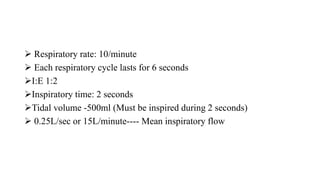
 Respiratory rate: 10/minute
 Each respiratory cycle lasts for 6 seconds
I:E 1:2
Inspiratory time: 2 seconds
Tidal volume -500ml (Must be inspired during 2 seconds)
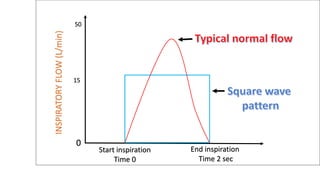
 0.25L/sec or 15L/minute---- Mean inspiratory flow
INSPIRATORYFLOW(L/min)
Start inspiration
Time 0
End inspiration
Time 2 sec
0
15
50
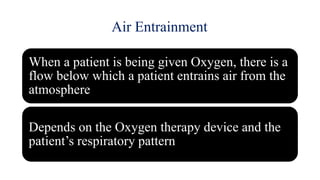
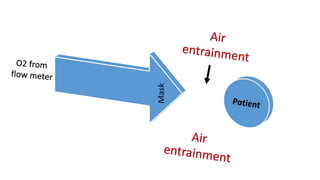
Air Entrainment
When a patient is being given Oxygen, there is a
flow below which a patient entrains air from the
atmosphere
Depends on the Oxygen therapy device and the
patient’s respiratory pattern
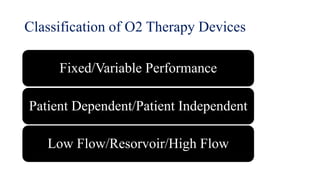
Classification of O2 Therapy Devices
Fixed/Variable Performance
Patient Dependent/Patient Independent
Low Flow/Resorvoir/High Flow
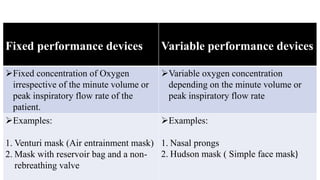
Fixed performance devices Variable performance devices
Fixed concentration of Oxygen
irrespective of the minute volume or
peak inspiratory flow rate of the
patient.
Variable oxygen concentration
depending on the minute volume or
peak inspiratory flow rate
Examples:
1. Venturi mask (Air entrainment mask)
2. Mask with reservoir bag and a non-
rebreathing valve
Examples:
1. Nasal prongs
2. Hudson mask ( Simple face mask)
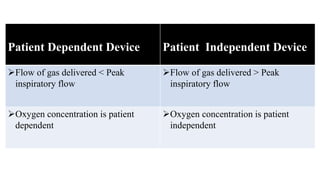
Patient Dependent Device Patient Independent Device
Flow of gas delivered < Peak
inspiratory flow
Flow of gas delivered > Peak
inspiratory flow
Oxygen concentration is patient
dependent
Oxygen concentration is patient
independent
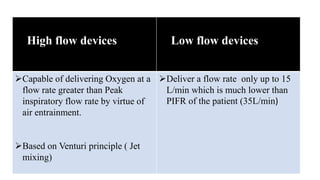
High flow devices Low flow devices
Capable of delivering Oxygen at a
flow rate greater than Peak
inspiratory flow rate by virtue of
air entrainment.
Based on Venturi principle ( Jet
mixing)
Deliver a flow rate only up to 15
L/min which is much lower than
PIFR of the patient (35L/min)
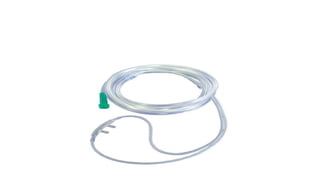
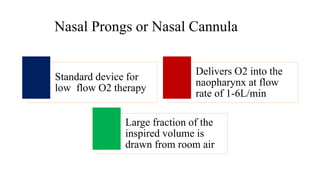
Nasal Prongs or Nasal Cannula
Standard device for
low flow O2 therapy
Delivers O2 into the
naopharynx at flow
rate of 1-6L/min
Large fraction of the
inspired volume is
drawn from room air
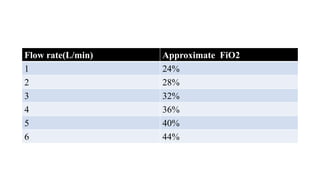
Flow rate(L/min) Approximate FiO2
1 24%
2 28%
3 32%
4 36%
5 40%
6 44%
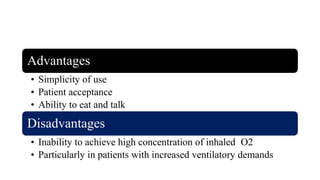
Advantages
• Simplicity of use
• Patient acceptance
• Ability to eat and talk
Disadvantages
• Inability to achieve high concentration of inhaled O2
• Particularly in patients with increased ventilatory demands
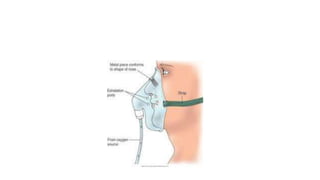
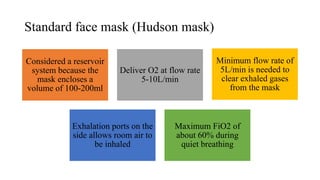
Standard face mask (Hudson mask)
Considered a reservoir
system because the
mask encloses a
volume of 100-200ml
Deliver O2 at flow rate
5-10L/min
Minimum flow rate of
5L/min is needed to
clear exhaled gases
from the mask
Exhalation ports on the
side allows room air to
be inhaled
Maximum FiO2 of
about 60% during
quiet breathing
Advantages
• Slightly higher maximum FiO2 than low flow nasal prongs
Disadvantages
• Like nasal prongs, Fio2 varies with the ventilator demand of the
patient
• No oral feeding or conversation
Mask with reservoir bags
Addition of
reservoir bag to a
standard face
mask
Increases the
capacity of O2
reservoir by 600-
1000ml
If reservoir is
kept inflated, the
patient will draw
primarily from
the gas in the bag
Two types of Resorvoir bag
Partial Rebreather
Non-Rebreather
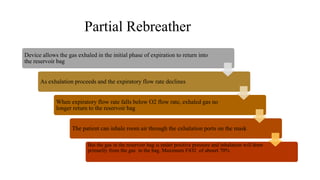
Partial Rebreather
Device allows the gas exhaled in the initial phase of expiration to return into
the reservoir bag
As exhalation proceeds and the expiratory flow rate declines
When expiratory flow rate falls below O2 flow rate, exhaled gas no
longer return to the reservoir bag
The patient can inhale room air through the exhalation ports on the mask
But the gas in the reservoir bag is under positive pressure and inhalation will draw
primarily from the gas in the bag. Maximum FiO2 of abourt 70%
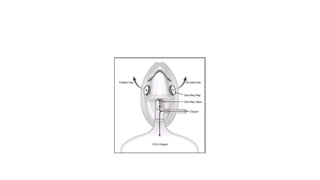
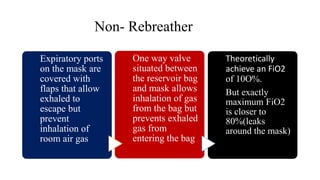
Non- Rebreather
Expiratory ports
on the mask are
covered with
flaps that allow
exhaled to
escape but
prevent
inhalation of
room air gas
One way valve
situated between
the reservoir bag
and mask allows
inhalation of gas
from the bag but
prevents exhaled
gas from
entering the bag
Theoretically
achieve an FiO2
of 10O%.
But exactly
maximum FiO2
is closer to
80%(leaks
around the mask)
Advantage
• Ability to deliver higher concentration of inhaled O2
Disadvantages
• Same as for face mask
• Aerosolised bronchodilator therapy not possible
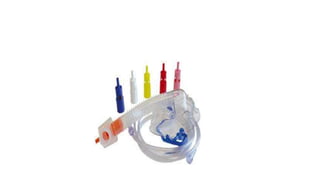
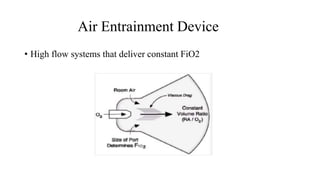
Air Entrainment Device
• High flow systems that deliver constant FiO2
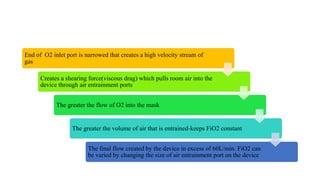
End of O2 inlet port is narrowed that creates a high velocity stream of
gas
Creates a shearing force(viscous drag) which pulls room air into the
device through air entrainment ports
The greater the flow of O2 into the mask
The greater the volume of air that is entrained-keeps FiO2 constant
The final flow created by the device in excess of 60L/min. FiO2 can
be varied by changing the size of air entrainment port on the device
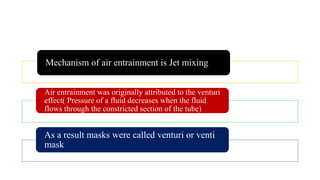
Mechanism of air entrainment is Jet mixing
Air entrainment was originally attributed to the venturi
effect( Pressure of a fluid decreases when the fluid
flows through the constricted section of the tube)
As a result masks were called venturi or venti
mask
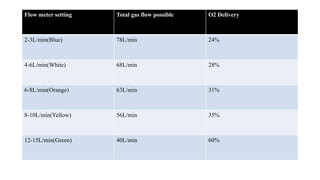
Flow meter setting Total gas flow possible O2 Delivery
2-3L/min(Blue) 78L/min 24%
4-6L/min(White) 68L/min 28%
6-8L/min(Orange) 63L/min 31%
8-10L/min(Yellow) 56L/min 35%
12-15L/min(Green) 40L/min 60%
Advantages
• Ability to deliver a constant FiO2
• Desirable in patients with chronic CO2 retention( Inadvertent
increase in FiO2- further increase in arterial PCO2)
Disadvantages
• Inability to deliver higher concentration of inhaled O2
High Flow Nasal Oxygen
The newest technique of O2 delivery using heated (to body
temperature)and humidified gas(Supersaturated with water)
O2 flow rate up to 40-60 L/min can be delivered through wide
nasal prongs without discomfort and mucosal injury
Allows adjustment for flow rate 1-40L/min, FiO2 21-100%
Temperature 37 degree Celsius
Clinical Experience
Encouraging initial
experience
Significant
improvement in
measures of respiratory
distress along with
improved gas exchange
High flow nasal O2
creates positive
pressure in nasopharynx
It could act like PEEP
to prevent collapse of
alveoli at the end of
expiration
It avoids intubation and
mechanical ventilation
T
A
H
N
K
YOU

Oxygen therapy devices [autosaved]

  • 1.
    Oxygen Therapy Devices Dr.Swarnalingam Thangavelu M.D Associate Professor Department of Anaesthesiology, Tagore Medical College & Hopsital
  • 2.
  • 3.
    Peak Inspiratory flow-Importance The flow at the peak of inspiration is called peak inspiratory flow rate
  • 4.
     Respiratory rate:10/minute  Each respiratory cycle lasts for 6 seconds I:E 1:2 Inspiratory time: 2 seconds Tidal volume -500ml (Must be inspired during 2 seconds)  0.25L/sec or 15L/minute---- Mean inspiratory flow
  • 5.
  • 6.
    Air Entrainment When apatient is being given Oxygen, there is a flow below which a patient entrains air from the atmosphere Depends on the Oxygen therapy device and the patient’s respiratory pattern
  • 8.
    Classification of O2Therapy Devices Fixed/Variable Performance Patient Dependent/Patient Independent Low Flow/Resorvoir/High Flow
  • 9.
    Fixed performance devicesVariable performance devices Fixed concentration of Oxygen irrespective of the minute volume or peak inspiratory flow rate of the patient. Variable oxygen concentration depending on the minute volume or peak inspiratory flow rate Examples: 1. Venturi mask (Air entrainment mask) 2. Mask with reservoir bag and a non- rebreathing valve Examples: 1. Nasal prongs 2. Hudson mask ( Simple face mask)
  • 10.
    Patient Dependent DevicePatient Independent Device Flow of gas delivered < Peak inspiratory flow Flow of gas delivered > Peak inspiratory flow Oxygen concentration is patient dependent Oxygen concentration is patient independent
  • 11.
    High flow devicesLow flow devices Capable of delivering Oxygen at a flow rate greater than Peak inspiratory flow rate by virtue of air entrainment. Based on Venturi principle ( Jet mixing) Deliver a flow rate only up to 15 L/min which is much lower than PIFR of the patient (35L/min)
  • 13.
    Nasal Prongs orNasal Cannula Standard device for low flow O2 therapy Delivers O2 into the naopharynx at flow rate of 1-6L/min Large fraction of the inspired volume is drawn from room air
  • 14.
    Flow rate(L/min) ApproximateFiO2 1 24% 2 28% 3 32% 4 36% 5 40% 6 44%
  • 15.
    Advantages • Simplicity ofuse • Patient acceptance • Ability to eat and talk Disadvantages • Inability to achieve high concentration of inhaled O2 • Particularly in patients with increased ventilatory demands
  • 17.
    Standard face mask(Hudson mask) Considered a reservoir system because the mask encloses a volume of 100-200ml Deliver O2 at flow rate 5-10L/min Minimum flow rate of 5L/min is needed to clear exhaled gases from the mask Exhalation ports on the side allows room air to be inhaled Maximum FiO2 of about 60% during quiet breathing
  • 18.
    Advantages • Slightly highermaximum FiO2 than low flow nasal prongs Disadvantages • Like nasal prongs, Fio2 varies with the ventilator demand of the patient • No oral feeding or conversation
  • 20.
    Mask with reservoirbags Addition of reservoir bag to a standard face mask Increases the capacity of O2 reservoir by 600- 1000ml If reservoir is kept inflated, the patient will draw primarily from the gas in the bag
  • 21.
    Two types ofResorvoir bag Partial Rebreather Non-Rebreather
  • 22.
    Partial Rebreather Device allowsthe gas exhaled in the initial phase of expiration to return into the reservoir bag As exhalation proceeds and the expiratory flow rate declines When expiratory flow rate falls below O2 flow rate, exhaled gas no longer return to the reservoir bag The patient can inhale room air through the exhalation ports on the mask But the gas in the reservoir bag is under positive pressure and inhalation will draw primarily from the gas in the bag. Maximum FiO2 of abourt 70%
  • 23.
    Non- Rebreather Expiratory ports onthe mask are covered with flaps that allow exhaled to escape but prevent inhalation of room air gas One way valve situated between the reservoir bag and mask allows inhalation of gas from the bag but prevents exhaled gas from entering the bag Theoretically achieve an FiO2 of 10O%. But exactly maximum FiO2 is closer to 80%(leaks around the mask)
  • 24.
    Advantage • Ability todeliver higher concentration of inhaled O2 Disadvantages • Same as for face mask • Aerosolised bronchodilator therapy not possible
  • 26.
    Air Entrainment Device •High flow systems that deliver constant FiO2
  • 27.
    End of O2inlet port is narrowed that creates a high velocity stream of gas Creates a shearing force(viscous drag) which pulls room air into the device through air entrainment ports The greater the flow of O2 into the mask The greater the volume of air that is entrained-keeps FiO2 constant The final flow created by the device in excess of 60L/min. FiO2 can be varied by changing the size of air entrainment port on the device
  • 28.
    Mechanism of airentrainment is Jet mixing Air entrainment was originally attributed to the venturi effect( Pressure of a fluid decreases when the fluid flows through the constricted section of the tube) As a result masks were called venturi or venti mask
  • 29.
    Flow meter settingTotal gas flow possible O2 Delivery 2-3L/min(Blue) 78L/min 24% 4-6L/min(White) 68L/min 28% 6-8L/min(Orange) 63L/min 31% 8-10L/min(Yellow) 56L/min 35% 12-15L/min(Green) 40L/min 60%
  • 30.
    Advantages • Ability todeliver a constant FiO2 • Desirable in patients with chronic CO2 retention( Inadvertent increase in FiO2- further increase in arterial PCO2) Disadvantages • Inability to deliver higher concentration of inhaled O2
  • 31.
    High Flow NasalOxygen The newest technique of O2 delivery using heated (to body temperature)and humidified gas(Supersaturated with water) O2 flow rate up to 40-60 L/min can be delivered through wide nasal prongs without discomfort and mucosal injury Allows adjustment for flow rate 1-40L/min, FiO2 21-100% Temperature 37 degree Celsius
  • 32.
    Clinical Experience Encouraging initial experience Significant improvementin measures of respiratory distress along with improved gas exchange High flow nasal O2 creates positive pressure in nasopharynx It could act like PEEP to prevent collapse of alveoli at the end of expiration It avoids intubation and mechanical ventilation
  • 33.
  • 34.