Methods of oxygenadministration
Oxygen
delivery
administration
Low flow
system
Nasal cannula Simple face
mask Reservoir mask
High flow
system
Venturi mask
High flow nasal
cannula
Partial
rebreather
Non-rebreather
6.
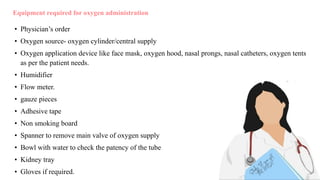
Equipment required foroxygen administration
• Physician’s order
• Oxygen source- oxygen cylinder/central supply
• Oxygen application device like face mask, oxygen hood, nasal prongs, nasal catheters, oxygen tents
as per the patient needs.
• Humidifier
• Flow meter.
• gauze pieces
• Adhesive tape
• Non smoking board
• Spanner to remove main valve of oxygen supply
• Bowl with water to check the patency of the tube
• Kidney tray
• Gloves if required.
7.
LOW FLOW SYSTEM
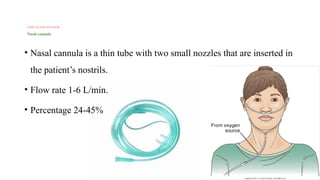
Nasalcannula
• Nasal cannula is a thin tube with two small nozzles that are inserted in
the patient’s nostrils.
• Flow rate 1-6 L/min.
• Percentage 24-45%
8.
Advantages and disadvantagesof nasal cannula
ADVANTAGES DISADVANTAGES
Easy to use in home setting Easily dislodges from the
place(nares)
Simple and safe to use Difficult to use in case of patients
with nasal obstructions
Patient is able to talk and eat with the
oxygen in place
Dries the mucus membrane, so we
need humidifier in case of flow high
than 4 L/min.
9.
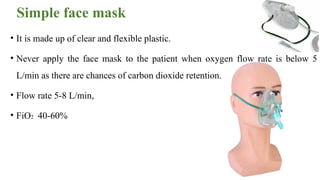
Simple face mask
•It is made up of clear and flexible plastic.
• Never apply the face mask to the patient when oxygen flow rate is below 5
L/min as there are chances of carbon dioxide retention.
• Flow rate 5-8 L/min,
• FiO2 40-60%
10.
Advantages and disadvantagesof simple
face mask
ADVANTAGES DISADVANTAGES
Used when oxygen therapy is required for short
period of time and when increased delivery of
oxygen is remanded.
Tight seal is required to provide increased
delivery of oxygen.
Sometimes it becomes difficult to keep the face
mask in place due to tight fit over face.
Chances of skin breakdown due to moisture
formation.
Becomes uncomfortable for patient while eating
and talking.
11.
Reservoir mask
Partial rebreathermask
• This mask is same as face mask but it contains a reservoir bag which
collects the air exhales by the patient, and remaining air is vent out
from the vents on both the side of mask.
• This reservoir mask inflated during inspiration and expiration.
• It allows the patient to rebreathe the first third of the exhaled air.
• Partial rebreather mask delivers 35-60% oxygen.
12.
Advantages and disadvantagesof Partial
rebreather mask
ADVANTAGES DISADVANTAGES
In case of oxygen disruption patient can inhale
room air through the opening present in the mask
It is uncomfortable for the patient while eating
and talking
Chances of skin breakdown are there.
13.
Non-rebreather mask
• Anon-rebreather mask consists of a face mask connected to a reservoir bag that’s filled
with a high concentration of oxygen.
• The reservoir bag is connected to an oxygen tank.
• The mask covers both your nose and mouth. One-way valves prevent exhaled air from
reentering the oxygen reservoir.
• A non-rebreather mask is used in emergency situations to prevent hypoxemia, also known
as low blood oxygen. Conditions that disrupt your lungs’ ability to uptake oxygen or your
heart’s ability to pump blood can cause low blood oxygen levels.
14.
Cont…
• A non-rebreathermask may be used after traumatic injury, smoke
inhalation, or carbon monoxide poisoning to keep blood oxygen levels
within a normal range.
• this mask provide the low flow oxygen at a rate of 10-12 L/min which
delivers 95% of oxygen.
15.
Advantages and disadvantagesof Partial
rebreather mask
ADVANTAGES DISADVANTAGES
Suitable for the patient with severe Malfunction of bag could lead to buildup
of carbon dioxide
Expensive
Uncomfortable for the patient
17.
High flow system
venturimask
• The venturi mask has got its name from the effect named as
venturi effect, which allow the mask to deliver a specific
concentration of oxygen.
• This mask has a large tube with an oxygen inlet.
• It consist of a mask with the holes on each side that helps in
the escape of exhaled air.
• There are colour coded ports that are present at the base of
mask, that allow the regulation of different concentrations of
oxygen to be administered.
18.
Advantages and disadvantagesof venturi
mask
ADVANTAGES DISADVANTAGES
A fixed and specific concentration of
oxygen is delivered
In case of COPD patients, if oxygen is
delivered at high concentration, it may
produces respiratory depression.
Does not dry the mucus membrane Skin irritation
Uncomfortable for patients
20.
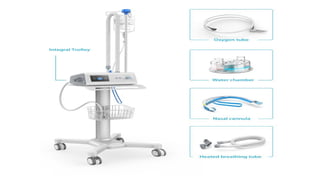
High flow nasalcannula
• The high-flow nasal cannula (HFNC) is a unique mode of noninvasive
respiratory support that delivers warmed, humidified oxygen with a
fraction of inspired oxygen (FiO 2) of 0.21 to 1.0
• flow rate as high as 60 L/min.
• HFNC is indicated for patients with respiratory failure due to various
underlying conditions.
Advantages and disadvantagesof HFNC
ADVANTAGES DISADVANTAGES
It decreases cardiac and breathing workload,
which directly reduces carbon dioxide production
Not immediately available
Patients can communicate, eat, and drink Potential discomfort due to high flow and
relatively hot air sensation.