Hyperventilation
• It isdefined as the ventilation occurs in excess of metabolic
requirement.
• In hyperventilation the breathing pattern will be deeper and more rapid
than the normal breathing.
• The immediate results of hyperventilation is decreased in alveolar
carbon dioxide pressure (hypocapnia) and increase of pH in the blood
(respiratory alkalosis).
4.
Hypoventilation
• Hypoventilation occurswhen there is retention of co2 due to decrease in the rate and
depth of respiration and alveolar ventilation is also compromised.
• In other words hypoventilation includes hypercapnia and respiratory acidosis.
• There are certain cause and conditions which lead to hypoventilation like
COPD
Stroke affecting the respiratory center
Voluntary breath holding
Mountain sickness
Drug overdose like opioid overdose causes respiratory depression
5.
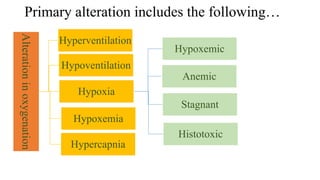
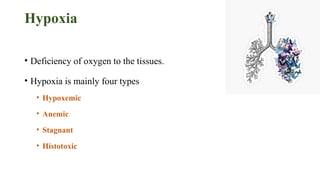
Hypoxia
• Deficiency ofoxygen to the tissues.
• Hypoxia is mainly four types
• Hypoxemic
• Anemic
• Stagnant
• Histotoxic
Hypoxemia
• Low levelof oxygen in the blood / deficiency of oxygen in the arterial
blood.
• Respiratory disorders are the main reason of Hypoxemic
8.
Causes of Hypoxemic
•Mismatch of ventilation perfusion ratio.
• Impaired alveolar diffusion.
• Decrease in the partial pressure of oxygen in inhaled air.
• Alveolar hypotension.
9.
Anemic
• Anemia isa problem of not having enough healthy red blood cells or
hemoglobin to carry oxygen to the body's tissues.
• The capacity of blood to carry oxygen is too low.
• The hemoglobin is too small to supply the oxygen needs.
10.
Stagnant
• The bloodflow to the tissue is reduced or low, and the blood may be
normal
• There may be insufficient blood flow through the capillaries to supply
the tissues.
• It may be due to heart disease that affects the circulation or impaired
venous in return.
• It may reduce the blood supply to a particular area like Raynaud’s
disease and Buerger’s disease.
11.
Histotoxic
• In thistype of hypoxia, tissue cells are unable to make proper use of
oxygen due to poisoning of tissue cells but the amount of blood may
be normal.
• Mainly caused by the cyanide, narcotics, alcohol,
12.
Hypercapnia
• It isalso known as retention of carbon dioxide.
• There is an increase carbon dioxide level in the blood.
• Hypercapnia causes increase in the breathing and arousal during the
sleep.




![hypoxia ppt[1].pptx.. 1ST BDS, PHYSIOLOGY](https://cdn.slidesharecdn.com/ss_thumbnails/hypoxiappt1-250205172113-e50bde9e-thumbnail.jpg?width=640&height=640&fit=bounds)


