DR G SHYLAKAR REDDY MD
 a nebulizer (or nebuliser) is a drug delivery
device used to administer medication in the form of a
mist inhaled into the lungs.
 Nebulization is means of administering drugs by
inhalation.
 Equalizer breaks up the solution to be inhaled into
fine droplets which are then suspended in a stream of
gas.
• A chamber into which the dilute drug is poured.
A gas (usually oxygen) is then driven through the
nebulizer and the drug is forced through a narrow jet.
This aerosolizes the drug so that the normal
ventilation gases can carry the drug to the patient.
4
Definition of an aerosol
 Aero air
 Sol solution
 Liquid or solid suspensions into gas medium
 Particles which are sufficiently small so as to remain
airborne for a considerable period of time
5
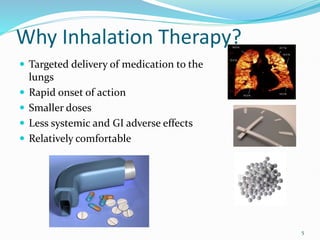
Why Inhalation Therapy?
 Targeted delivery of medication to the
lungs
 Rapid onset of action
 Smaller doses
 Less systemic and GI adverse effects
 Relatively comfortable
6
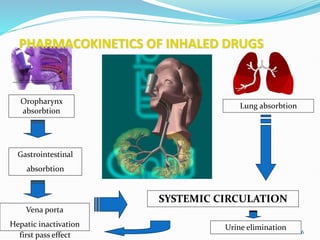
Oropharynx
absorbtion
Lung absorbtion
Vena porta
Hepatic inactivation
Gastrointestinal
absorbtion
SYSTEMIC CIRCULATION
Urine elimination
first pass effect
PHARMACOKINETICS OF INHALED DRUGS
 Nebulizers use oxygen, compressed
air or ultrasonic power to break up medical solutions
and suspensions into small aerosol droplets that can
be directly inhaled from the mouthpiece of the device.
 The definition of an aerosol is a "mixture of gas and
liquid particles," and the best example of a naturally
occurring aerosol is mist,
 Which is formed when small vaporized water particles
mixed with hot ambient air are cooled down and
condense into a fine cloud of visible airborne water
droplets
history
 The first "powered" or pressurized inhaler was invented in
France by Sales-Girons in 1858. This device used pressure to
atomize the liquid medication. The pump handle is
operated like a bicycle pump. When the pump is pulled up,
it draws liquid from the reservoir, and upon the force of the
user's hand, the liquid is pressurized through an atomizer,
to be sprayed out for inhalation near the user's mouth.
 The first electrical nebulizer was invented in the 1930s and
called a Pneumostat n
 1956, a technology competing against the nebulizer was
launched by Riker Laboratories , in the form of
pressurized metered-dose inhalers, .
 In 1964, a new type of electronic nebulizer was
introduced: the "ultrasonic wave nebulizer". Today the
nebulizing technology is not only used for medical
purposes. Ultrasonic wave nebulizers are also used
in humidifiers, to spray out water aerosols to moisten
dry air in buildings.
 The lung deposition characteristics and efficacy of an
aerosol depend largely on the particle or droplet size.
Generally, the smaller the particle the greater its
chance of peripheral penetration and retention.
However, for very fine particles below 0.5 µm in
diameter there is a chance of avoiding deposition
altogether and being exhaled.
13
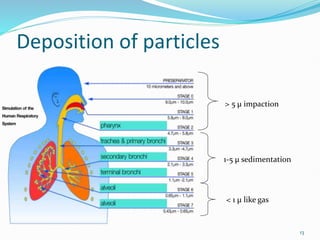
Deposition of particles
> 5 µ impaction
1-5 µ sedimentation
< 1 µ like gas
Indications of Nebulization: -
 1) Delivery of bronchodilator drugs : -
 On acute attack of asthma Nebulization is the most
common means of delivery.
 Respiratory patients who are too short of breath to use
pressurized aerosol or Rota haler effectively may be
prescribed bronchodilators.
 2) Infants and children with asthma : -
 Inhalation by nebulizer is the only means of effective
inhalation therapy until a child is about 4 yrs. Old.
 3) Administration of antibiotics and antifungal
agents.
In some cases of resistant chest infections for e.g.
cystic fibrosis or bronchiectasis,
antibiotics may be prescribed to be inhaled directly
into the lungs.
 4) To aid expectoration: -
Inhalation of hypertonic saline has been found to
increase clearance of bronchial secretions.
 5) Local analgesia : -
To relieve dyspnea in some terminally in patients such
as those suffering from alveolar carcinoma
Why?
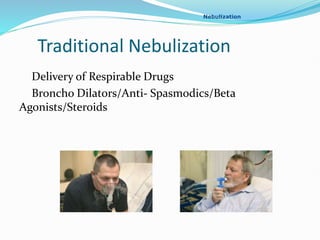
• Delivery of Respirable Drugs
• Broncho Dilators/Anti- Spasmodics/Beta
Agonists/Steroids
Traditional Nebulization
Nebulization
19
4 Types of Inhaler Devices
 MDI/ DPI
 Small volumes
 Ready for use
 Stable obstructive
disease
 Jet /Ultrasound
nebulizer
 High fill volume > 1 ml
 Preparation required
 Severe respiratory
insufficiency (asthma
attack, COPD exac., CF)
Types of nebulizers
 Mechanical
 Home made
 A nebulizer can be made at home with a sealed bottle that
can be safely pumped to a moderately high air pressure. A
plug is made by drilling a hole through a cork and inserting
a ball inflating needle connected to a bicycle pump.
 A small amount of volatile liquid, such as alcohol, is placed
in the bottle and the cork and bicycle pump apparatus is
used to increase the pressure in the bottle. When the cork
is removed, the rapid change in air pressure will vaporize
the liquid. The same effect can be achieved using less
volatile substances such as water, although vaporization
occurs to a lesser extent.
 Soft Mist Inhaler
 Respimat Soft Mist Inhaler in 1997. This new
technology provides a metered dose to the user, as the
liquid bottom of the inhaler is rotated clockwise 180
degrees by hand, adding a build up tension into a
spring around the flexible liquid container. When the
user activates the bottom of the inhaler, the energy
from the spring is released and imposes pressure on
the flexible liquid container, causing liquid to spray
out of 2 nozzles, thus forming a soft mist to be
inhaled. The device features no gas propellant and no
need for battery/power to operate. The average droplet
size in the mist was measured to a somewhat
disappointing 5.8 micrometers, which could indicate
some potential efficiency problems for the inhaled
medicine to reach the lungs.]
 Human Powered Nebulizer (HPN)
 The most recent innovation in nebulizer technology .
 The human-powered nebulizer (HPN) is designed to
provide relief to patients suffering from respiratory
diseases such as asthma, TB, or chronic obstructive
pulmonary disease in areas with limited access to
electricity. Invented in 2009 by a team of doctors from
Marquette University, HPN uses a bicycle frame and
pedals—each connected to a piston and some
tubing—to turn liquid medicine into mist that flows
directly into a patient's lungs through an attached
mouthpiece. Commercial nebulizers typically use an
electric compressor to maintain their rate of airflow,
but with HPN, healthcare workers achieve the same
goal by pedaling the equivalent of 8 miles per hour.[7]
 Electrical
 Vibrating Mesh Technology
 A new significant innovation was made in the nebulizer
with creation of the ultrasonic Vibrating Mesh Technology
(VMT). With this technology a mesh/membrane with
1000-7000 laser drilled holes vibrates at the top of the
liquid reservoir, and thereby pressures out a mist of very
fine droplets through the holes. This technology is more
efficient than having a vibrating piezoelectric element at
the bottom of the liquid reservoir, and thereby shorter
treatment times are also achieved.
 Jet nebulizer
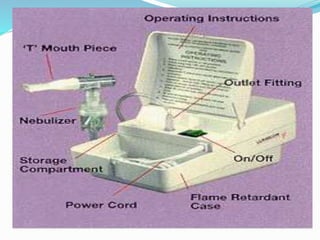
 The most commonly used nebulizers are Jet nebulizers,
which are also called "atomizers".Jet nebulizers are
connected by tubing to a compressor, that
causes compressed air or oxygen to flow at high velocity
through a liquid medicine to turn it into an aerosol, which
is then inhaled by the patient. Jet nebulizers are commonly
used for patients in hospitals who have difficulty using
inhalers, such as in serious cases of respiratory disease, or
severe asthma attacks. The main advantage of the Jet
nebulizer is related to its low operational cost.
 Today several manufacturers have also managed to
lower the weight of the Jet nebulizer down to 635
grams (22.4 oz), and thereby started to label it as a
portable device. Compared to all the competing
inhalers and nebulizers, the noise and heavy weight is
however still the biggest draw back of the Jet nebulizer.
 A high velocity of gas is blown through a fine hole
creating an area of negative pressure. Fluid is drawn
from the reservoir by the Bernoille effect into the jet
stream and is impacted.
 on a battle breaking the fluid into droplets large
droplets fall back to into the reservoir while the
smaller ones may be inhaled.
 Large volume Nebulizer:-
 Used for long term therapy delivers heated or cool
mist.
 Cool mist can be more comfortable for recently
diagnosed patients.
 Cool mist also indicated for patients with trauma or
recent tracheotomy, because. Heated mist increase
bleeding.
 Heated mist is indicated for patients with artificial
airway and for neonate (cold mist can cause
hypothermia in neonate)
 Side – stream Nebulizer : - It is attached to a
ventilator or to an intermittent positive pressure
breathing machine
 Mini Nebulizer or Maxi mist: - It is hand held and
used to deliver aerosol medications.
 Ultrasonic wave nebulizer
 Ultrasonic wave nebulizers were invented in 1964 as a new
more portable nebulizer. The technology inside an ultrasonic
wave nebulizer is to have an electronic oscillator generate a high
frequency ultrasonic wave, which causes the mechanical
vibration of a piezoelectric element. This vibrating element is in
contact with a liquid reservoir and its high frequency vibration is
sufficient to produce a vapor mist.
 As they create aerosols from ultrasonic vibration instead of using
a heavy air compressor, they only have a weight around 170 grams
(6.0 oz).
 Another advantage is that the ultrasonic vibration is almost
silent.
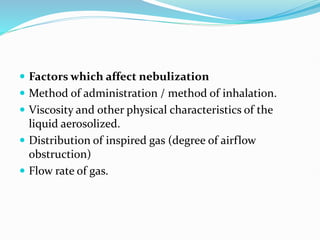
 Factors which affect nebulization
 Method of administration / method of inhalation.
 Viscosity and other physical characteristics of the
liquid aerosolized.
 Distribution of inspired gas (degree of airflow
obstruction)
 Flow rate of gas.
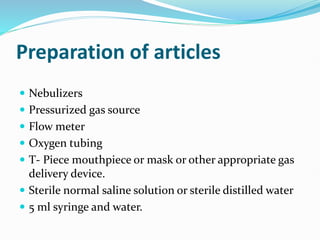
Preparation of articles
 Nebulizers
 Pressurized gas source
 Flow meter
 Oxygen tubing
 T- Piece mouthpiece or mask or other appropriate gas
delivery device.
 Sterile normal saline solution or sterile distilled water
 5 ml syringe and water.
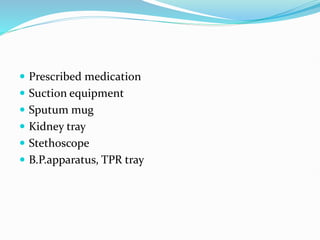
 Prescribed medication
 Suction equipment
 Sputum mug
 Kidney tray
 Stethoscope
 B.P.apparatus, TPR tray
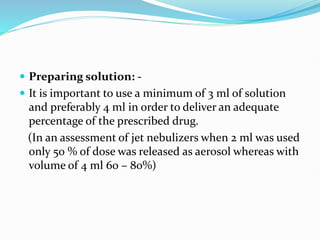
 Preparing solution: -
 It is important to use a minimum of 3 ml of solution
and preferably 4 ml in order to deliver an adequate
percentage of the prescribed drug.
(In an assessment of jet nebulizers when 2 ml was used
only 50 % of dose was released as aerosol whereas with
volume of 4 ml 60 – 80%)
 Preparation of patient: -
 Explain the procedure to the patient
 The patient should be in a well supported position.
 Ask the patient Breathe slowly and deeply using the
lower chest.
Preparation of Nurse : -
 Verify the order on the patient’s medication record by
checking it against doctor’s order.
 Check the label of the medication (expiry date)
 Confirm patient’s identity by asking his name and by
checking his name, room number, bed no .
 Check gas flow.
 Wash hands before procedure.
Administration of Nebulization: -
 Explain procedure to patient.
 Record patient’s vital signs to establishment a baseline.
 Place patient in sitting or high fowlers position to
facility lung expansion an aerosol dispersion.
 Attach free end of the oxygen tubing to pressurized gas
source .
 Turn on the gas source and check outflow port, usually
a setting of 5 – 6 liters / min is adequate.
 Instruct the patient to breathe slowly deeply and
evenly through his mouth.
 After about three deep breaths he should breath gently
using his lower chest (breathing control) It encouraged to
breathe deeply throughout the entire treatment the patient
suffer from effect of hyperventilation .
 It possible, remain with the patient during treatment
(usually 15 – 20 minutes )
 Take vital signs to detect adverse reactions to medications.
 Encourage and assist the patient to cough and expectorate,.
 Briefly stop the treatment if he needs rest.
 Instruct patient to report warmth discomfort or hot tubing.
 Check water level frequently to prevent complications from
inhaling drug hot air .
complications
• Environmental Contamination
• Inaccurate Drug Delivery-Residual Volumes
• Interference with the circuit- Increased risk of VAP and other
infections
• Cleaning and Re use of Nebulizers- Increased risk of infection
• Nursing Time and Device Cost Issues
• Not compatible with closed suctioning requires the circuit to be
 disrupted twice each time we nebulize, 8 times+ per day!!
• If oxygen is used to drive the drug then we must wait 20 mins to
do ABG
• Additional gas being delivered can interfere with critical
ventilator settings
• Difficult to use in IPPB, NIV and Bi Level modes of ventilation
Complications of Nebulization
 Prevention
 clean the container every time, fill with fresh sterile
solution each time.
 Increased water absorption can cause over hydration
leading to pulmonary edema inpatients with decreased
cardiac output.
 Ultra fine particulate can act as irritant to susceptible
patients and cause bronchospasms.
 Monitor vital sings of Auscultate chest for wheezes during
procedure.
 Should be used cautiously in patients with delicate fluid
balance and in asthmatic patients with active or potential
bronchospsm
 Care of patient
 Make sure the patient is comfortable
 Provide a sputum mug for spiting the expectoration
 Documentations: -
 Record time date and duration of therapy type,
amount of medication added to nebulizer.
 Baseline and subsequent vital signs and breath sounds.
 Result of therapy such as loosened secretions.
 Any complications and nursing action taken.
 Patient’s tolerance of the treatment .
 Continuously watch changes.
 An inhaler or puffer is a medical device used for
delivering medication into the body via the lungs. It is
mainly used in the treatment of asthma and Chronic
Obstructive Pulmonary Disease (COPD). used to
treat influenza, must be administered via inhaler.
 Metered-dose inhalers
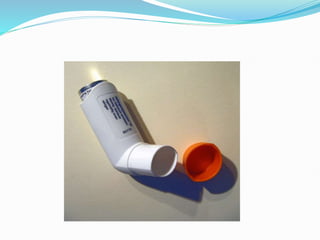
 MDI — The most common type of inhaler is the
pressurized metered-dose inhaler (MDI). In MDIs,
medication is most commonly stored in solution in a
pressurized canister that contains a propellant, although it
may also be a suspension.
 The MDI canister is attached to a plastic, hand-operated
actuator. On activation, the metered-dose inhaler releases
a fixed dose of medication in aerosol form.
 The correct procedure for using an MDI is to first fully
exhale, place the mouth-piece of the device into the
mouth, and having just started to inhale at a moderate rate,
depress the canister to release the medicine.
 The aerosolized medication is drawn into the lungs by
continuing to inhale deeply before holding the breath for
10 seconds to allow the aerosol to settle onto the walls of
the bronchial and other airways of the lung.
45
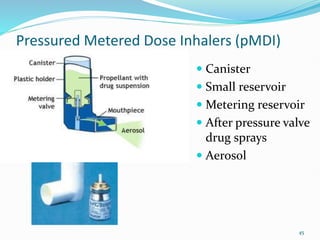
Pressured Metered Dose Inhalers (pMDI)
 Canister
 Small reservoir
 Metering reservoir
 After pressure valve
drug sprays
 Aerosol
46
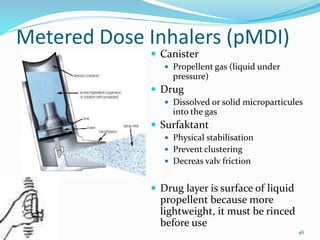
Metered Dose Inhalers (pMDI)
 Canister
 Propellent gas (liquid under
pressure)
 Drug
 Dissolved or solid microparticules
into the gas
 Surfaktant
 Physical stabilisation
 Prevent clustering
 Decreas valv friction
 Drug layer is surface of liquid
propellent because more
lightweight, it must be rinced
before use
47
 Rapid application
 Handling
 Multidose
MDI advantages
49
 Hand-breathe coordinations
 İneffective use in poor ventilated patiens
 Oropharyngeal deposition and local side effects
 Not include dosimeter
MDI Disadvantages
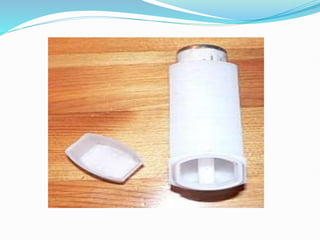
 Dry powder inhaler
 DPI — Dry powder inhalers release a metered or
device-measured dose of powdered medication that is
inhaled through a DPI device
 Short-Acting Beta-2 Agonists
 The two short-acting beta-2 agonist nebulizer
medications on the market include albuterol sulfate
and levalbuterol hydrochloride.
Short-acting beta-2 agonists are a class of quick relief
drugs used to treat asthma and other pulmonary
diseases by relaxing the smooth muscles in the airway
within a relatively short period of time. Albuterol
sulfate and levalbuterol hydrochloride are U. S. Federal
Drug Administration-approved generic medication.
 Long-Acting Beta-2 Agonists
 The two long-acting beta-2 agonist drugs on the
market include arformoterol tartrate and formoterol
fumarate.
 Combination Nebulizer Drugs
 Ipratropium bromide and albuterol sulfate are
bronchodilators used to prevent and treat
bronchospasms.
 A DuoNeb contains 0.5 mg of ipratropium bromide
and 3.0 mg of albuterol sulfate premeasured and
premixed in a single vial.
 Corticosteroid
 Budesonide, a corticosteroid, prevents wheezing and
shortness of breath. Budesonide should not be mixed
with other nebulized medications.

NEBULIZATION.pptx, anesthesia, pediatric

  • 1.
    DR G SHYLAKARREDDY MD
  • 2.
     a nebulizer(or nebuliser) is a drug delivery device used to administer medication in the form of a mist inhaled into the lungs.  Nebulization is means of administering drugs by inhalation.  Equalizer breaks up the solution to be inhaled into fine droplets which are then suspended in a stream of gas.
  • 3.
    • A chamberinto which the dilute drug is poured. A gas (usually oxygen) is then driven through the nebulizer and the drug is forced through a narrow jet. This aerosolizes the drug so that the normal ventilation gases can carry the drug to the patient.
  • 4.
    4 Definition of anaerosol  Aero air  Sol solution  Liquid or solid suspensions into gas medium  Particles which are sufficiently small so as to remain airborne for a considerable period of time
  • 5.
    5 Why Inhalation Therapy? Targeted delivery of medication to the lungs  Rapid onset of action  Smaller doses  Less systemic and GI adverse effects  Relatively comfortable
  • 6.
    6 Oropharynx absorbtion Lung absorbtion Vena porta Hepaticinactivation Gastrointestinal absorbtion SYSTEMIC CIRCULATION Urine elimination first pass effect PHARMACOKINETICS OF INHALED DRUGS
  • 8.
     Nebulizers useoxygen, compressed air or ultrasonic power to break up medical solutions and suspensions into small aerosol droplets that can be directly inhaled from the mouthpiece of the device.  The definition of an aerosol is a "mixture of gas and liquid particles," and the best example of a naturally occurring aerosol is mist,  Which is formed when small vaporized water particles mixed with hot ambient air are cooled down and condense into a fine cloud of visible airborne water droplets
  • 9.
    history  The first"powered" or pressurized inhaler was invented in France by Sales-Girons in 1858. This device used pressure to atomize the liquid medication. The pump handle is operated like a bicycle pump. When the pump is pulled up, it draws liquid from the reservoir, and upon the force of the user's hand, the liquid is pressurized through an atomizer, to be sprayed out for inhalation near the user's mouth.  The first electrical nebulizer was invented in the 1930s and called a Pneumostat n  1956, a technology competing against the nebulizer was launched by Riker Laboratories , in the form of pressurized metered-dose inhalers, .
  • 10.
     In 1964,a new type of electronic nebulizer was introduced: the "ultrasonic wave nebulizer". Today the nebulizing technology is not only used for medical purposes. Ultrasonic wave nebulizers are also used in humidifiers, to spray out water aerosols to moisten dry air in buildings.
  • 11.
     The lungdeposition characteristics and efficacy of an aerosol depend largely on the particle or droplet size. Generally, the smaller the particle the greater its chance of peripheral penetration and retention. However, for very fine particles below 0.5 µm in diameter there is a chance of avoiding deposition altogether and being exhaled.
  • 13.
    13 Deposition of particles >5 µ impaction 1-5 µ sedimentation < 1 µ like gas
  • 14.
    Indications of Nebulization:-  1) Delivery of bronchodilator drugs : -  On acute attack of asthma Nebulization is the most common means of delivery.  Respiratory patients who are too short of breath to use pressurized aerosol or Rota haler effectively may be prescribed bronchodilators.
  • 15.
     2) Infantsand children with asthma : -  Inhalation by nebulizer is the only means of effective inhalation therapy until a child is about 4 yrs. Old.  3) Administration of antibiotics and antifungal agents. In some cases of resistant chest infections for e.g. cystic fibrosis or bronchiectasis, antibiotics may be prescribed to be inhaled directly into the lungs.
  • 16.
     4) Toaid expectoration: - Inhalation of hypertonic saline has been found to increase clearance of bronchial secretions.  5) Local analgesia : - To relieve dyspnea in some terminally in patients such as those suffering from alveolar carcinoma
  • 17.
    Why? • Delivery ofRespirable Drugs • Broncho Dilators/Anti- Spasmodics/Beta Agonists/Steroids Traditional Nebulization Nebulization
  • 19.
    19 4 Types ofInhaler Devices  MDI/ DPI  Small volumes  Ready for use  Stable obstructive disease  Jet /Ultrasound nebulizer  High fill volume > 1 ml  Preparation required  Severe respiratory insufficiency (asthma attack, COPD exac., CF)
  • 20.
    Types of nebulizers Mechanical  Home made  A nebulizer can be made at home with a sealed bottle that can be safely pumped to a moderately high air pressure. A plug is made by drilling a hole through a cork and inserting a ball inflating needle connected to a bicycle pump.  A small amount of volatile liquid, such as alcohol, is placed in the bottle and the cork and bicycle pump apparatus is used to increase the pressure in the bottle. When the cork is removed, the rapid change in air pressure will vaporize the liquid. The same effect can be achieved using less volatile substances such as water, although vaporization occurs to a lesser extent.
  • 21.
     Soft MistInhaler  Respimat Soft Mist Inhaler in 1997. This new technology provides a metered dose to the user, as the liquid bottom of the inhaler is rotated clockwise 180 degrees by hand, adding a build up tension into a spring around the flexible liquid container. When the user activates the bottom of the inhaler, the energy from the spring is released and imposes pressure on the flexible liquid container, causing liquid to spray out of 2 nozzles, thus forming a soft mist to be inhaled. The device features no gas propellant and no need for battery/power to operate. The average droplet size in the mist was measured to a somewhat disappointing 5.8 micrometers, which could indicate some potential efficiency problems for the inhaled medicine to reach the lungs.]
  • 22.
     Human PoweredNebulizer (HPN)  The most recent innovation in nebulizer technology .  The human-powered nebulizer (HPN) is designed to provide relief to patients suffering from respiratory diseases such as asthma, TB, or chronic obstructive pulmonary disease in areas with limited access to electricity. Invented in 2009 by a team of doctors from Marquette University, HPN uses a bicycle frame and pedals—each connected to a piston and some tubing—to turn liquid medicine into mist that flows directly into a patient's lungs through an attached mouthpiece. Commercial nebulizers typically use an electric compressor to maintain their rate of airflow, but with HPN, healthcare workers achieve the same goal by pedaling the equivalent of 8 miles per hour.[7]
  • 23.
     Electrical  VibratingMesh Technology  A new significant innovation was made in the nebulizer with creation of the ultrasonic Vibrating Mesh Technology (VMT). With this technology a mesh/membrane with 1000-7000 laser drilled holes vibrates at the top of the liquid reservoir, and thereby pressures out a mist of very fine droplets through the holes. This technology is more efficient than having a vibrating piezoelectric element at the bottom of the liquid reservoir, and thereby shorter treatment times are also achieved.
  • 24.
     Jet nebulizer The most commonly used nebulizers are Jet nebulizers, which are also called "atomizers".Jet nebulizers are connected by tubing to a compressor, that causes compressed air or oxygen to flow at high velocity through a liquid medicine to turn it into an aerosol, which is then inhaled by the patient. Jet nebulizers are commonly used for patients in hospitals who have difficulty using inhalers, such as in serious cases of respiratory disease, or severe asthma attacks. The main advantage of the Jet nebulizer is related to its low operational cost.
  • 25.
     Today severalmanufacturers have also managed to lower the weight of the Jet nebulizer down to 635 grams (22.4 oz), and thereby started to label it as a portable device. Compared to all the competing inhalers and nebulizers, the noise and heavy weight is however still the biggest draw back of the Jet nebulizer.
  • 27.
     A highvelocity of gas is blown through a fine hole creating an area of negative pressure. Fluid is drawn from the reservoir by the Bernoille effect into the jet stream and is impacted.  on a battle breaking the fluid into droplets large droplets fall back to into the reservoir while the smaller ones may be inhaled.
  • 28.
     Large volumeNebulizer:-  Used for long term therapy delivers heated or cool mist.  Cool mist can be more comfortable for recently diagnosed patients.  Cool mist also indicated for patients with trauma or recent tracheotomy, because. Heated mist increase bleeding.  Heated mist is indicated for patients with artificial airway and for neonate (cold mist can cause hypothermia in neonate)
  • 29.
     Side –stream Nebulizer : - It is attached to a ventilator or to an intermittent positive pressure breathing machine  Mini Nebulizer or Maxi mist: - It is hand held and used to deliver aerosol medications.
  • 30.
     Ultrasonic wavenebulizer  Ultrasonic wave nebulizers were invented in 1964 as a new more portable nebulizer. The technology inside an ultrasonic wave nebulizer is to have an electronic oscillator generate a high frequency ultrasonic wave, which causes the mechanical vibration of a piezoelectric element. This vibrating element is in contact with a liquid reservoir and its high frequency vibration is sufficient to produce a vapor mist.  As they create aerosols from ultrasonic vibration instead of using a heavy air compressor, they only have a weight around 170 grams (6.0 oz).  Another advantage is that the ultrasonic vibration is almost silent.
  • 31.
     Factors whichaffect nebulization  Method of administration / method of inhalation.  Viscosity and other physical characteristics of the liquid aerosolized.  Distribution of inspired gas (degree of airflow obstruction)  Flow rate of gas.
  • 32.
    Preparation of articles Nebulizers  Pressurized gas source  Flow meter  Oxygen tubing  T- Piece mouthpiece or mask or other appropriate gas delivery device.  Sterile normal saline solution or sterile distilled water  5 ml syringe and water.
  • 33.
     Prescribed medication Suction equipment  Sputum mug  Kidney tray  Stethoscope  B.P.apparatus, TPR tray
  • 34.
     Preparing solution:-  It is important to use a minimum of 3 ml of solution and preferably 4 ml in order to deliver an adequate percentage of the prescribed drug. (In an assessment of jet nebulizers when 2 ml was used only 50 % of dose was released as aerosol whereas with volume of 4 ml 60 – 80%)
  • 35.
     Preparation ofpatient: -  Explain the procedure to the patient  The patient should be in a well supported position.  Ask the patient Breathe slowly and deeply using the lower chest.
  • 36.
    Preparation of Nurse: -  Verify the order on the patient’s medication record by checking it against doctor’s order.  Check the label of the medication (expiry date)  Confirm patient’s identity by asking his name and by checking his name, room number, bed no .  Check gas flow.  Wash hands before procedure.
  • 37.
    Administration of Nebulization:-  Explain procedure to patient.  Record patient’s vital signs to establishment a baseline.  Place patient in sitting or high fowlers position to facility lung expansion an aerosol dispersion.  Attach free end of the oxygen tubing to pressurized gas source .  Turn on the gas source and check outflow port, usually a setting of 5 – 6 liters / min is adequate.  Instruct the patient to breathe slowly deeply and evenly through his mouth.
  • 38.
     After aboutthree deep breaths he should breath gently using his lower chest (breathing control) It encouraged to breathe deeply throughout the entire treatment the patient suffer from effect of hyperventilation .  It possible, remain with the patient during treatment (usually 15 – 20 minutes )  Take vital signs to detect adverse reactions to medications.  Encourage and assist the patient to cough and expectorate,.  Briefly stop the treatment if he needs rest.  Instruct patient to report warmth discomfort or hot tubing.  Check water level frequently to prevent complications from inhaling drug hot air .
  • 39.
    complications • Environmental Contamination •Inaccurate Drug Delivery-Residual Volumes • Interference with the circuit- Increased risk of VAP and other infections • Cleaning and Re use of Nebulizers- Increased risk of infection • Nursing Time and Device Cost Issues • Not compatible with closed suctioning requires the circuit to be  disrupted twice each time we nebulize, 8 times+ per day!! • If oxygen is used to drive the drug then we must wait 20 mins to do ABG • Additional gas being delivered can interfere with critical ventilator settings • Difficult to use in IPPB, NIV and Bi Level modes of ventilation
  • 40.
    Complications of Nebulization Prevention  clean the container every time, fill with fresh sterile solution each time.  Increased water absorption can cause over hydration leading to pulmonary edema inpatients with decreased cardiac output.  Ultra fine particulate can act as irritant to susceptible patients and cause bronchospasms.  Monitor vital sings of Auscultate chest for wheezes during procedure.  Should be used cautiously in patients with delicate fluid balance and in asthmatic patients with active or potential bronchospsm
  • 41.
     Care ofpatient  Make sure the patient is comfortable  Provide a sputum mug for spiting the expectoration
  • 42.
     Documentations: - Record time date and duration of therapy type, amount of medication added to nebulizer.  Baseline and subsequent vital signs and breath sounds.  Result of therapy such as loosened secretions.  Any complications and nursing action taken.  Patient’s tolerance of the treatment .  Continuously watch changes.
  • 43.
     An inhaleror puffer is a medical device used for delivering medication into the body via the lungs. It is mainly used in the treatment of asthma and Chronic Obstructive Pulmonary Disease (COPD). used to treat influenza, must be administered via inhaler.
  • 44.
     Metered-dose inhalers MDI — The most common type of inhaler is the pressurized metered-dose inhaler (MDI). In MDIs, medication is most commonly stored in solution in a pressurized canister that contains a propellant, although it may also be a suspension.  The MDI canister is attached to a plastic, hand-operated actuator. On activation, the metered-dose inhaler releases a fixed dose of medication in aerosol form.  The correct procedure for using an MDI is to first fully exhale, place the mouth-piece of the device into the mouth, and having just started to inhale at a moderate rate, depress the canister to release the medicine.  The aerosolized medication is drawn into the lungs by continuing to inhale deeply before holding the breath for 10 seconds to allow the aerosol to settle onto the walls of the bronchial and other airways of the lung.
  • 45.
    45 Pressured Metered DoseInhalers (pMDI)  Canister  Small reservoir  Metering reservoir  After pressure valve drug sprays  Aerosol
  • 46.
    46 Metered Dose Inhalers(pMDI)  Canister  Propellent gas (liquid under pressure)  Drug  Dissolved or solid microparticules into the gas  Surfaktant  Physical stabilisation  Prevent clustering  Decreas valv friction  Drug layer is surface of liquid propellent because more lightweight, it must be rinced before use
  • 47.
    47  Rapid application Handling  Multidose MDI advantages
  • 49.
    49  Hand-breathe coordinations İneffective use in poor ventilated patiens  Oropharyngeal deposition and local side effects  Not include dosimeter MDI Disadvantages
  • 50.
     Dry powderinhaler  DPI — Dry powder inhalers release a metered or device-measured dose of powdered medication that is inhaled through a DPI device
  • 53.
     Short-Acting Beta-2Agonists  The two short-acting beta-2 agonist nebulizer medications on the market include albuterol sulfate and levalbuterol hydrochloride. Short-acting beta-2 agonists are a class of quick relief drugs used to treat asthma and other pulmonary diseases by relaxing the smooth muscles in the airway within a relatively short period of time. Albuterol sulfate and levalbuterol hydrochloride are U. S. Federal Drug Administration-approved generic medication.
  • 54.
     Long-Acting Beta-2Agonists  The two long-acting beta-2 agonist drugs on the market include arformoterol tartrate and formoterol fumarate.  Combination Nebulizer Drugs  Ipratropium bromide and albuterol sulfate are bronchodilators used to prevent and treat bronchospasms.  A DuoNeb contains 0.5 mg of ipratropium bromide and 3.0 mg of albuterol sulfate premeasured and premixed in a single vial.
  • 55.
     Corticosteroid  Budesonide,a corticosteroid, prevents wheezing and shortness of breath. Budesonide should not be mixed with other nebulized medications.