


OVERVIEW
 PHILIPPINE LITERATURE
HOW DO WE
   DEFINE
LITERATURE?
WHY IS
 LITERATURE
USEFUL IN OUR
    LIVES?
WHEN DO YOU
     SAY THAT
LITERATURE IS FOR
    PLEASURE?
HOW DOES
LITERATURE MIRROR
   THE DEPTH OF A
     CULTURE?
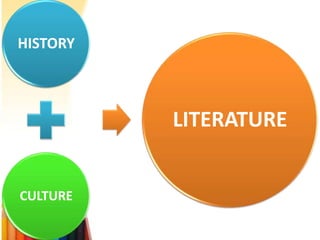
HISTORY


          LITERATURE


CULTURE
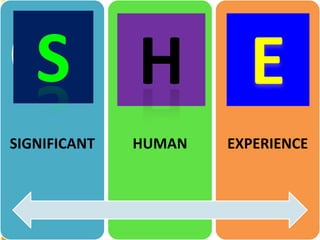
SIGNIFICANT   HUMAN   EXPERIENCE
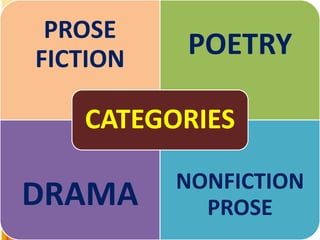
PROSE
FICTION   POETRY

   CATEGORIES

          NONFICTION
DRAMA       PROSE
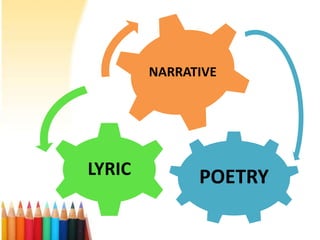
NARRATIVE


LYRIC         POETRY
LYRIC POETRY
• Usually brief
• Focuses on the emotions
  or thoughts of the speaker
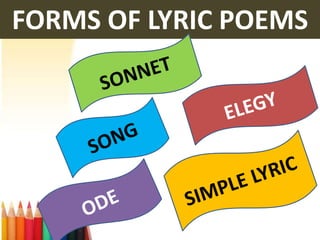
FORMS OF LYRIC POEMS
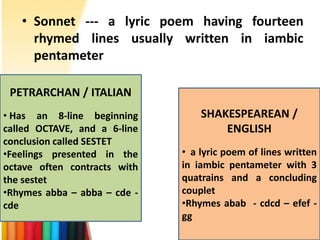
• Sonnet --- a lyric poem having fourteen
     rhymed lines usually written in iambic
     pentameter

 PETRARCHAN / ITALIAN
• Has an 8-line beginning         SHAKESPEAREAN /
called OCTAVE, and a 6-line           ENGLISH
conclusion called SESTET
•Feelings presented in the    • a lyric poem of lines written
octave often contracts with   in iambic pentameter with 3
the sestet                    quatrains and a concluding
•Rhymes abba – abba – cde -   couplet
cde                           •Rhymes abab - cdcd – efef -
                              gg
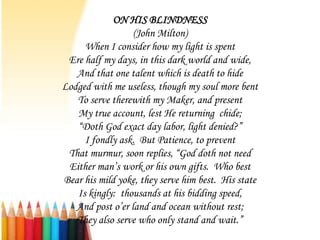
ON HIS BLINDNESS
                  (John Milton)
     When I consider how my light is spent
 Ere half my days, in this dark world and wide,
   And that one talent which is death to hide
Lodged with me useless, though my soul more bent
   To serve therewith my Maker, and present
   My true account, lest He returning chide;
   “Doth God exact day labor, light denied?”
     I fondly ask. But Patience, to prevent
 That murmur, soon replies, “God doth not need
 Either man’s work or his own gifts. Who best
Bear his mild yoke, they serve him best. His state
   Is kingly: thousands at his bidding speed,
   And post o’er land and ocean without rest;
   They also serve who only stand and wait.”
SONNET 18
               (William Shakespeare)
      Shall I compare thee to a summer’s day?
     Thou art more lovely and more temperate:
 Rough winds do shake the darling buds of May,
   And summer’s lease hath all too short a date;
    Sometimes too hot the eye of heaven shines,
     And often is his gold complexion dimmed;
         And every fair sometime declines,
By chance, or nature’s changing course, untrimmed.
       But thy eternal summer shall not fade
    Nor lose possession of that fair thou owest;
Nor shall death brag thou wanderest in his shade,
   When in eternal line to time thou growest ---
    So long as men can breathe, or eyes can see,
   So long lives this, and this gives life to thee.
ELEGY
• A lyric poem which expresses mourning,
  usually over the death of an individual
• May also be a lament over the passing of life
  and beauty, or meditation on the nature of
  death
• Usually formal in language and structure, and
  solemn or even melancholy in tone
• Mostly long
• Another word for this is epitaph.
Excerpt from “ELEGY”
              (Gene Derwood)

 Gone, gone is Gordon, tall and brilliant lad
Whose mind was science. Now hollow his skull,
   A noble sculpture, is but sunken bone,
  His cells from water come, by water laid
        Grave – deep, to water gone.
         Lost, lost the hope he had,
Washed to a cipher his splendour and his skill.
ODE

• A complex and often lengthy
  lyric poem written in a
  dignified formal style on some
  serious subjects
• Has no definite pattern
SONG ---A short lyric poem
 intended to be sung; Can be
 secular or non-religious

SIMPLE LYRIC --- A short
 descriptive pictorial or meditative
 poem
NARRATIVE
•A poem that
 narrates a story
•Can be long or short
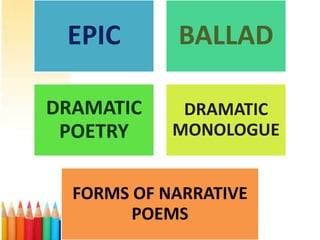
EPIC       BALLAD

DRAMATIC     DRAMATIC
 POETRY     MONOLOGUE


  FORMS OF NARRATIVE
        POEMS
EPIC
• A narrative poem that
  usually centers on a single
  important character who
  embodies the values of a
  particular society
BALLAD
• A narrative poem that depends
  on a regular verse patterns and
  strong rhymes for its effect
• Most have lost of action and
  adventure
• Mostly tragic
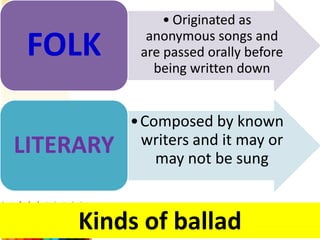
• Originated as

 FOLK        anonymous songs and
            are passed orally before
              being written down


           •Composed by known
LITERARY    writers and it may or
              may not be sung


     Kinds of ballad
DRAMATIC POETRY
• Poetry in which one or more characters
  speak
• Allows the writer to reveal characters
  directly through dialogue, just as a
  playwright does
• Has many of the characteristics of a play; a
  definite setting; a dramatic situation,
  emotional conflict, with vigorous and natural
  long rhythms
DRAMATIC MONOLOGUE
• A special kind of dramatic poem
• In dramatic monologue, one character
  speaks to one or more characters,
  whose replies are not given in the
  poem.
• The speaker in a moment of great
  personal crisis, reveals his or her
  deepest thoughts and feelings.
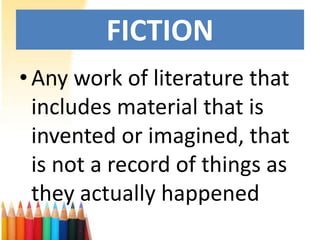
FICTION
• Any work of literature that
  includes material that is
  invented or imagined, that
  is not a record of things as
  they actually happened
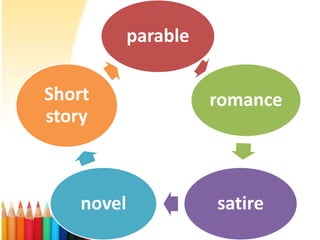
parable

Short                 romance
story


    novel             satire
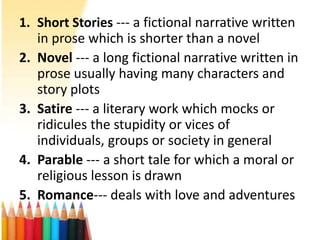
1. Short Stories --- a fictional narrative written
   in prose which is shorter than a novel
2. Novel --- a long fictional narrative written in
   prose usually having many characters and
   story plots
3. Satire --- a literary work which mocks or
   ridicules the stupidity or vices of
   individuals, groups or society in general
4. Parable --- a short tale for which a moral or
   religious lesson is drawn
5. Romance--- deals with love and adventures
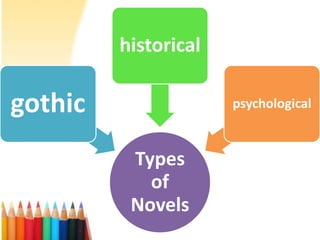
historical

gothic                psychological


          Types
            of
          Novels
1. Gothic novel --- creates an atmosphere of
  mystery and danger in a picturesque setting,
  usually involving a threat combined with
  love, intrigue for a romantic young heroine
2. Historical novel --- creates the
  atmosphere, customs, and events of an
  actual historical period, and may even
  include actual historical figures
3. Psychological novel --- explores the
  complex emotional lives of the characters
DRAMA
• A Story written to be acted out on stage
• The playwright usually emphasizes
  characters, conflicts and actions which
  are developed by the use of a dialogue.
• Stage direction is provided to help actors
  and directors.
• Additional elements such as
  set, props, and lighting effects are used .
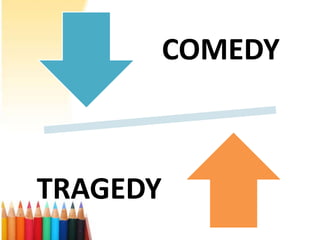
COMEDY


TRAGEDY
FORMS OF DRAMA
1. Comedy --- a literary work generally
  amusing which usually ends happily
  because the hero or heroine is able to
  overcome obstacles and get what he or
  she wants
2. Tragedy --- a literary work dealing with
  very serious and important themes, in
  which a dignified tragic figure meets
  destruction
NON-FICTION
• A prose that deals with real
  events and people
• Characters, setting and action
  must conform to what is true.
• Cannot be manipulated by the
  imagination of the writers
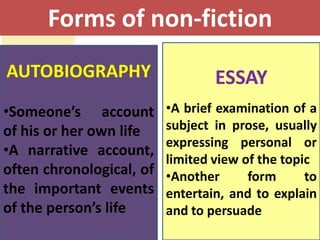
Forms of non-fiction
AUTOBIOGRAPHY                     ESSAY
•Someone’s account        •A brief examination of a
of his or her own life    subject in prose, usually
                          expressing personal or
•A narrative account,
                          limited view of the topic
often chronological, of   •Another      form      to
the important events      entertain, and to explain
of the person’s life      and to persuade
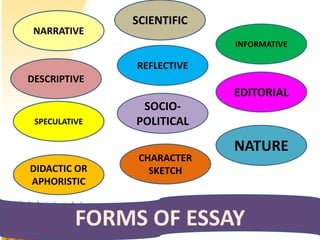
SCIENTIFIC
 NARRATIVE
                            INFORMATIVE

               REFLECTIVE
DESCRIPTIVE
                            EDITORIAL
                SOCIO-
 SPECULATIVE   POLITICAL

                            NATURE
                CHARACTER
DIDACTIC OR       SKETCH
APHORISTIC


          FORMS OF ESSAY
ELEMENTS OF
FICTION AND
   DRAMA
1. PLOT

•The causality of
 events that makes up
 the action of a work of
 fiction
2. CHARACTERS


•The personages in a
 literary work
3. SETTING

•The time and place
 where the action of a
 play or narrative occurs
4. POINT OF VIEW

•The outlook or position
 from which a story or
 novel is presented
5. THEME

• The idea, general truths or
  commentary on life or
  people brought by the
  literary work
6. SYMBOL

•The object that stands
 for or represents the
 idea or belief
 presented in the story
7. TONE

•The writer’s attitude
 towards his subject that
 affects his style of
 writing and choice of
 words
8. MOOD

•The state of feelings
 created by the literary
 work
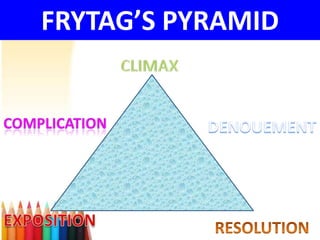
FRYTAG’S PYRAMID

Overview lit1

  • 1.
  • 3.
    HOW DO WE DEFINE LITERATURE?
  • 4.
  • 5.
    WHEN DO YOU SAY THAT LITERATURE IS FOR PLEASURE?
  • 6.
    HOW DOES LITERATURE MIRROR THE DEPTH OF A CULTURE?
  • 7.
    HISTORY LITERATURE CULTURE
  • 8.
    SIGNIFICANT HUMAN EXPERIENCE
  • 9.
    PROSE FICTION POETRY CATEGORIES NONFICTION DRAMA PROSE
  • 10.
  • 11.
    LYRIC POETRY • Usuallybrief • Focuses on the emotions or thoughts of the speaker
  • 12.
  • 13.
    • Sonnet ---a lyric poem having fourteen rhymed lines usually written in iambic pentameter PETRARCHAN / ITALIAN • Has an 8-line beginning SHAKESPEAREAN / called OCTAVE, and a 6-line ENGLISH conclusion called SESTET •Feelings presented in the • a lyric poem of lines written octave often contracts with in iambic pentameter with 3 the sestet quatrains and a concluding •Rhymes abba – abba – cde - couplet cde •Rhymes abab - cdcd – efef - gg
  • 14.
    ON HIS BLINDNESS (John Milton) When I consider how my light is spent Ere half my days, in this dark world and wide, And that one talent which is death to hide Lodged with me useless, though my soul more bent To serve therewith my Maker, and present My true account, lest He returning chide; “Doth God exact day labor, light denied?” I fondly ask. But Patience, to prevent That murmur, soon replies, “God doth not need Either man’s work or his own gifts. Who best Bear his mild yoke, they serve him best. His state Is kingly: thousands at his bidding speed, And post o’er land and ocean without rest; They also serve who only stand and wait.”
  • 15.
    SONNET 18 (William Shakespeare) Shall I compare thee to a summer’s day? Thou art more lovely and more temperate: Rough winds do shake the darling buds of May, And summer’s lease hath all too short a date; Sometimes too hot the eye of heaven shines, And often is his gold complexion dimmed; And every fair sometime declines, By chance, or nature’s changing course, untrimmed. But thy eternal summer shall not fade Nor lose possession of that fair thou owest; Nor shall death brag thou wanderest in his shade, When in eternal line to time thou growest --- So long as men can breathe, or eyes can see, So long lives this, and this gives life to thee.
  • 16.
    ELEGY • A lyricpoem which expresses mourning, usually over the death of an individual • May also be a lament over the passing of life and beauty, or meditation on the nature of death • Usually formal in language and structure, and solemn or even melancholy in tone • Mostly long • Another word for this is epitaph.
  • 17.
    Excerpt from “ELEGY” (Gene Derwood) Gone, gone is Gordon, tall and brilliant lad Whose mind was science. Now hollow his skull, A noble sculpture, is but sunken bone, His cells from water come, by water laid Grave – deep, to water gone. Lost, lost the hope he had, Washed to a cipher his splendour and his skill.
  • 18.
    ODE • A complexand often lengthy lyric poem written in a dignified formal style on some serious subjects • Has no definite pattern
  • 19.
    SONG ---A shortlyric poem intended to be sung; Can be secular or non-religious SIMPLE LYRIC --- A short descriptive pictorial or meditative poem
  • 20.
    NARRATIVE •A poem that narrates a story •Can be long or short
  • 21.
    EPIC BALLAD DRAMATIC DRAMATIC POETRY MONOLOGUE FORMS OF NARRATIVE POEMS
  • 22.
    EPIC • A narrativepoem that usually centers on a single important character who embodies the values of a particular society
  • 23.
    BALLAD • A narrativepoem that depends on a regular verse patterns and strong rhymes for its effect • Most have lost of action and adventure • Mostly tragic
  • 24.
    • Originated as FOLK anonymous songs and are passed orally before being written down •Composed by known LITERARY writers and it may or may not be sung Kinds of ballad
  • 25.
    DRAMATIC POETRY • Poetryin which one or more characters speak • Allows the writer to reveal characters directly through dialogue, just as a playwright does • Has many of the characteristics of a play; a definite setting; a dramatic situation, emotional conflict, with vigorous and natural long rhythms
  • 26.
    DRAMATIC MONOLOGUE • Aspecial kind of dramatic poem • In dramatic monologue, one character speaks to one or more characters, whose replies are not given in the poem. • The speaker in a moment of great personal crisis, reveals his or her deepest thoughts and feelings.
  • 27.
    FICTION • Any workof literature that includes material that is invented or imagined, that is not a record of things as they actually happened
  • 28.
    parable Short romance story novel satire
  • 29.
    1. Short Stories--- a fictional narrative written in prose which is shorter than a novel 2. Novel --- a long fictional narrative written in prose usually having many characters and story plots 3. Satire --- a literary work which mocks or ridicules the stupidity or vices of individuals, groups or society in general 4. Parable --- a short tale for which a moral or religious lesson is drawn 5. Romance--- deals with love and adventures
  • 30.
    historical gothic psychological Types of Novels
  • 31.
    1. Gothic novel--- creates an atmosphere of mystery and danger in a picturesque setting, usually involving a threat combined with love, intrigue for a romantic young heroine 2. Historical novel --- creates the atmosphere, customs, and events of an actual historical period, and may even include actual historical figures 3. Psychological novel --- explores the complex emotional lives of the characters
  • 32.
    DRAMA • A Storywritten to be acted out on stage • The playwright usually emphasizes characters, conflicts and actions which are developed by the use of a dialogue. • Stage direction is provided to help actors and directors. • Additional elements such as set, props, and lighting effects are used .
  • 33.
  • 34.
    FORMS OF DRAMA 1.Comedy --- a literary work generally amusing which usually ends happily because the hero or heroine is able to overcome obstacles and get what he or she wants 2. Tragedy --- a literary work dealing with very serious and important themes, in which a dignified tragic figure meets destruction
  • 35.
    NON-FICTION • A prosethat deals with real events and people • Characters, setting and action must conform to what is true. • Cannot be manipulated by the imagination of the writers
  • 36.
    Forms of non-fiction AUTOBIOGRAPHY ESSAY •Someone’s account •A brief examination of a of his or her own life subject in prose, usually expressing personal or •A narrative account, limited view of the topic often chronological, of •Another form to the important events entertain, and to explain of the person’s life and to persuade
  • 37.
    SCIENTIFIC NARRATIVE INFORMATIVE REFLECTIVE DESCRIPTIVE EDITORIAL SOCIO- SPECULATIVE POLITICAL NATURE CHARACTER DIDACTIC OR SKETCH APHORISTIC FORMS OF ESSAY
  • 38.
  • 39.
    1. PLOT •The causalityof events that makes up the action of a work of fiction
  • 40.
  • 41.
    3. SETTING •The timeand place where the action of a play or narrative occurs
  • 42.
    4. POINT OFVIEW •The outlook or position from which a story or novel is presented
  • 43.
    5. THEME • Theidea, general truths or commentary on life or people brought by the literary work
  • 44.
    6. SYMBOL •The objectthat stands for or represents the idea or belief presented in the story
  • 45.
    7. TONE •The writer’sattitude towards his subject that affects his style of writing and choice of words
  • 46.
    8. MOOD •The stateof feelings created by the literary work
  • 47.