21ST CENTURY
LITERATURE
BRANCHES OF LITERATURE
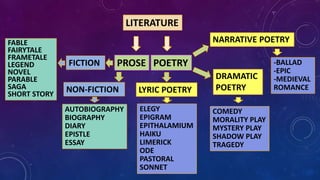
LITERATURE
PROSE POETRY
FICTION
NON-FICTION
AUTOBIOGRAPHY
BIOGRAPHY
DIARY
EPISTLE
ESSAY
FABLE
FAIRYTALE
FRAMETALE
LEGEND
NOVEL
PARABLE
SAGA
SHORT STORY LYRIC POETRY
NARRATIVE POETRY
DRAMATIC
POETRY
ELEGY
EPIGRAM
EPITHALAMIUM
HAIKU
LIMERICK
ODE
PASTORAL
SONNET
-BALLAD
-EPIC
-MEDIEVAL
ROMANCE
COMEDY
MORALITY PLAY
MYSTERY PLAY
SHADOW PLAY
TRAGEDY
PROSE
• Latin “prosa oratio” – direct or straightforward
speech
• Does not use rhymes, meters, or line breaks
• Follows conventions, like grammar, structure,
organization, etc.
• Divided into two: FICTION and NONFICTION
A. NON-FICTION
• More informative and factual prose writing.
• Does not invent characters, events, or places.
1. AUTOBIOGRAPHY
• Greek words, autos (self), bios (life), and
graphien (write)
• An account of a person’s life written by that
person
• Literally writing about oneself
2. BIOGRPAPHY
• An account of a person’s life written by
another person.
• About historical or influential persons
• May get information from diaries, letters, and
history books.
3. DIARY
• Latin dies (day)
• A book in which one keeps a daily record of
experiences and events
• A person’s thoughts, feelings, and fears are
written here
• It is generally meant to be read by NO ONE
except its writer.
4. EPISTLE
• A literary work in the form of a letter or a
series of letters
• Other literary genres, like the novel, may use
letters to tell stories (epistolary)
5. ESSAY
• A short piece of writing on a particular subject
• May attempt to explain, define, and/or discuss
the specific subject in a few paragraphs or
more.
• French writer Michel de Montaigne is the
originator of the modern essay.
FICTION
• Describes imaginary events and people
• Invented or made-up
1. FABLE
• Short stories in which main characters are
animals that talk like humans and retain their
animal characteristics
• Are written or told to teach lessons or convey
a moral
2. FAIRY TALE
• A simple folk narrative and oral in origin.
• Described as being magical, idealized, or
blissful
• Involves supernatural or magical elements
such as fairies, wizards, and other enchanted
beings.
3. FRAME-TALE
• Contains other tales within it.
• Described as a story within a story
• EXAMPLES
Titanic
Inception
Harry Potter
4. LEGEND
• Generally stories of origins
• Mostly creation stories and the origins of
people, places, animals, or objects.
5. NOVEL
• A narrative prose of book length
• Can use fantasy, comedy, tragedy, romance,
suspense, etc.
6. PARABLE
• A simple story used to illustrate a moral or
spiritual lesson
• Mostly found in the Bible’s New Testament
7. SAGA
• Refers not only to a long story of heroic
achievement but also to any fictional history
involving several generations of a family
8. SHORT STORY
• Significantly shorter and less elaborated than
the novel since it tends to focus on a single
event or episode.
POETRY
• It is said to have come from ancient songs,
prayers, or rituals.
• It is associated with the expression of feelings
and ideas.
• Classified into three: LYRIC, NARRATIVE, and
DRAMA
A. LYRIC POETRY
• Lyric comes from the word lyre, a stringed
instrument especially used by the ancient
Greeks to accompany their poems.
• It is usually short and in stanzas
• The focus is more on description or
expression, narration in lyric poetry is very
limited.
1. ELEGY
• A poem of serious reflection
• It has death as its main theme
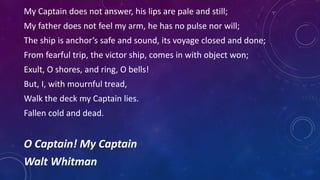
My Captain does not answer, his lips are pale and still;
My father does not feel my arm, he has no pulse nor will;
The ship is anchor’s safe and sound, its voyage closed and done;
From fearful trip, the victor ship, comes in with object won;
Exult, O shores, and ring, O bells!
But, I, with mournful tread,
Walk the deck my Captain lies.
Fallen cold and dead.
O Captain! My Captain
Walt Whitman
2. EPIGRAM
• A short and satirical poem with a witty or
ingenious ending,
• Often used for remembrance, in epitaphs or
dedications.
2. EPIGRAM
• I can resist anything but temptation
- Oscar Wilde
• An unbending tree is easily broken
- Lao Tzu
2. EPIGRAM
Samuel Taylor Coleridge
Sir, I admit your general rule,
That every poet is a fool,
But you yourself may serve to show it,
That every fool is not a poet.
3. EPITHALAMIUM
• Originally written in praise of Greek god of
marriage, Hymen.
• It is a song or poem featuring a wedding
celebration.
Raise up the roof-tree ---
a wedding song!
High up, carpenters ---
a wedding song!
The bridegroom is coming,
the equal of Ares,
much bigger than a big man.
Sappho
4. HAIKU
• A traditional Japanese poem of seventeen
syllables in three lines of five, seven, and five.
• It generally evokes images of the natural world
or scenes taken from daily life.
4. HAIKU
Trees, brush, waterfalls;
strong stiff stride of hiker’s trek;
nature’s theater.
- Roger Hancock
MATSUO BASHO “SPRING IS PASSING”
Yuku haru ya
Tori naki uwo no
Me ha namida
Spring is passing
The birds cry, and the fishes fill
With tears on their eyes
5. LIMERICK
• A humorous five-line poem with a rhyme
scheme of a a b b a.
5. LIMERICK
There was an old man from Peru,
who dreamt he was eating his shoe.
He awoke in a fright,
in the middle of the night,
and found it was perfectly true.
- Spongebob Squarepants
5. LIMERICK
A wonderful bird is the pelican,
His bill can hold more than his beli-can
He can take in his beak
Food enough for a week
But I’m damned if I see how the heli-can
Ogden Nash
6. ODE
• From a Greek word meaning “song”
• A lyric poem written in a dignified tone to
idealize objects, qualities, or ideas.
• The poetry of praise or tribute
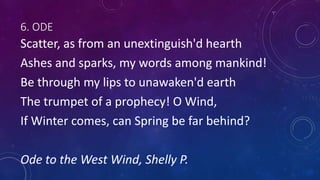
6. ODE
Scatter, as from an unextinguish'd hearth
Ashes and sparks, my words among mankind!
Be through my lips to unawaken'd earth
The trumpet of a prophecy! O Wind,
If Winter comes, can Spring be far behind?
Ode to the West Wind, Shelly P.
7. PASTORAL
• A literary work the features shepherds and
portrays or evokes country life, typically in a
romanticized or idealized form.
• This is an excerpt from Christopher Marlowe’s
The Passionate Shepherd to His Love, 1599.
Come live with me and be my love,
And we will all the pleasures prove
That valleys, groves, hills, and fields,
Woods, or steepy mountain yields
And I will make thee beds of roses
And a thousand fragrant poises,
A cap of flowers, and a kirtle
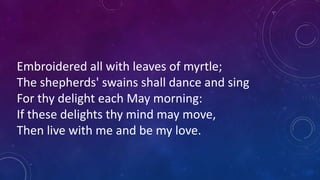
Embroidered all with leaves of myrtle;
The shepherds' swains shall dance and sing
For thy delight each May morning:
If these delights thy mind may move,
Then live with me and be my love.
8. SONNET
• Usually relating to love
• A poem that is generally classified as either
PETRARCHAN or ELIZABETHAN
Petrarchan – used by Italian poet Francesco Petrarca
with an octave (eight lines) rhyming abbaabba
Elizabethan – has three quatrains (four lines) rhyming
abab cdcd efef, and a couplet (two lines) rhyming gg.
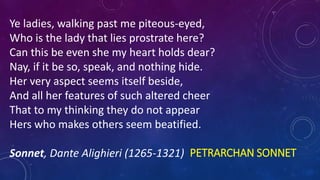
PETRARCHAN SONNET
Ye ladies, walking past me piteous-eyed,
Who is the lady that lies prostrate here?
Can this be even she my heart holds dear?
Nay, if it be so, speak, and nothing hide.
Her very aspect seems itself beside,
And all her features of such altered cheer
That to my thinking they do not appear
Hers who makes others seem beatified.
Sonnet, Dante Alighieri (1265-1321)
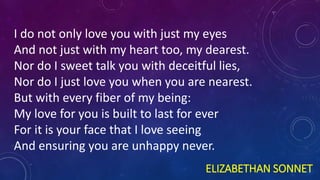
ELIZABETHAN SONNET
I do not only love you with just my eyes
And not just with my heart too, my dearest.
Nor do I sweet talk you with deceitful lies,
Nor do I just love you when you are nearest.
But with every fiber of my being:
My love for you is built to last for ever
For it is your face that I love seeing
And ensuring you are unhappy never.
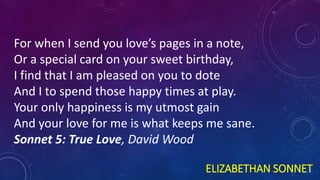
ELIZABETHAN SONNET
For when I send you love’s pages in a note,
Or a special card on your sweet birthday,
I find that I am pleased on you to dote
And I to spend those happy times at play.
Your only happiness is my utmost gain
And your love for me is what keeps me sane.
Sonnet 5: True Love, David Wood
B. NARRATIVE POETRY
• It uses rhymes and other poetic devices but it
tells of a longer and larger series of events.
• The emphasis is also on the progression of
action and the settings of stories.
• Classified into three: BALLAD, EPIC, and
MEDIEVAL ROMANCE.
1. BALLAD
• A poem or song narrating a story in short
stanzas that usually uses abab rhyme scheme
• Traditional ballads are generally of unknown
authorship since it has been passed orally
from one generation to the next.
• The main feature in all ballads was their
narrative structure and repetition of certain
lines or even whole stanzas.
1. BALLAD
• The Rime of the Ancient Mariner” by Samuel
Taylor Coleridge)
It is an ancient Mariner,
And he stoppeth one of three.
‘By thy long grey beard and glittering eye,
Now wherefore stopp’st thou me?
2. EPIC
• A long poem, typically one derived from
ancient oral tradition.
• It narrates the deeds and adventures of
legendary or heroic people such as gods, kings,
princes, knights, and other people of high
stature, and may also feature past history of a
nation.
2. EPIC
• Biag ni Lam-ang (Ilokano Epic poem)
• The Iliad and the Odyssey by Homer
3. MEDIEVAL ROMANCE
• Are tales dealing with heroes of chivalry like
famous kings and knights.
• Also features Christian morals and courtly love
C. DRAMATIC POETRY
• It is generally performed on stage which,
therefore, allows the audience to see stories
unfold before them.
• Classified into five: COMEDY, MORALITY PLAY,
MYSTERY PLAY, SHADOW PLAY, and TRAGEDY.
1. COMEDY
• Characterized by its humorous or satirical tone
and its depiction of amusing people or events.
• The comedy is a kind of drama in which the
characters ultimately triumph over adversity.
2. MORALITY PLAY
• A medieval allegorical drama which personifies
abstract qualities such as faith and mercy as
the main characters and presents a lesson
about good conduct.
3. MYSTERY PLAY
• A popular medieval play based on Biblical
stories or the lives of saints.
4. SHADOW PLAY
• A unique dramatic performance in which
shadows cast from puppets are used to enact.
5. TRAGEDY
• A play dealing with tragic events like death,
suffering, hopelessness, and pain.
• It has an unhappy ending, especially one
concerning the downfall of the main character.
LITERARY COMPILATION
1. COMPILATION (From other authors)
o BIOGRAPHY – (1 PHILIPPINES 1 WORLD)
o SHORT STORY – (1 PHILIPPINES 1 WORLD)
o POEM (2 PHILIPPINES 2 WORLD)
o HAIKU (1 Japanese 1 Foreign)
o LIMERICK 2
o Sonnet
PETRARCHAN 1
ELIZABETHAN/ SHAKESPEREAN 1
LITERARY COMPILATION
2. OWN COMPOSITON
o AUTOBIOGRAPHY (1) English
o LEGEND (1)
o SHORT STORY (1)
o POEMS (10)
o LIMERICK (3) ENGLISH
o HAIKUS (3) ENGLISH
o ELIZABETHAN SONNET (1)
o POEMS (3) 1 ENGLISH
o NOVEL 3 CHAPTERS (1)
LITERARY COMPILATION
3. ASSIGNMENTS

branches-of-lit.pptx

  • 1.
  • 2.
    LITERATURE PROSE POETRY FICTION NON-FICTION AUTOBIOGRAPHY BIOGRAPHY DIARY EPISTLE ESSAY FABLE FAIRYTALE FRAMETALE LEGEND NOVEL PARABLE SAGA SHORT STORYLYRIC POETRY NARRATIVE POETRY DRAMATIC POETRY ELEGY EPIGRAM EPITHALAMIUM HAIKU LIMERICK ODE PASTORAL SONNET -BALLAD -EPIC -MEDIEVAL ROMANCE COMEDY MORALITY PLAY MYSTERY PLAY SHADOW PLAY TRAGEDY
  • 3.
    PROSE • Latin “prosaoratio” – direct or straightforward speech • Does not use rhymes, meters, or line breaks • Follows conventions, like grammar, structure, organization, etc. • Divided into two: FICTION and NONFICTION
  • 4.
    A. NON-FICTION • Moreinformative and factual prose writing. • Does not invent characters, events, or places.
  • 5.
    1. AUTOBIOGRAPHY • Greekwords, autos (self), bios (life), and graphien (write) • An account of a person’s life written by that person • Literally writing about oneself
  • 6.
    2. BIOGRPAPHY • Anaccount of a person’s life written by another person. • About historical or influential persons • May get information from diaries, letters, and history books.
  • 7.
    3. DIARY • Latindies (day) • A book in which one keeps a daily record of experiences and events • A person’s thoughts, feelings, and fears are written here • It is generally meant to be read by NO ONE except its writer.
  • 8.
    4. EPISTLE • Aliterary work in the form of a letter or a series of letters • Other literary genres, like the novel, may use letters to tell stories (epistolary)
  • 9.
    5. ESSAY • Ashort piece of writing on a particular subject • May attempt to explain, define, and/or discuss the specific subject in a few paragraphs or more. • French writer Michel de Montaigne is the originator of the modern essay.
  • 10.
    FICTION • Describes imaginaryevents and people • Invented or made-up
  • 11.
    1. FABLE • Shortstories in which main characters are animals that talk like humans and retain their animal characteristics • Are written or told to teach lessons or convey a moral
  • 12.
    2. FAIRY TALE •A simple folk narrative and oral in origin. • Described as being magical, idealized, or blissful • Involves supernatural or magical elements such as fairies, wizards, and other enchanted beings.
  • 13.
    3. FRAME-TALE • Containsother tales within it. • Described as a story within a story • EXAMPLES Titanic Inception Harry Potter
  • 14.
    4. LEGEND • Generallystories of origins • Mostly creation stories and the origins of people, places, animals, or objects.
  • 15.
    5. NOVEL • Anarrative prose of book length • Can use fantasy, comedy, tragedy, romance, suspense, etc.
  • 16.
    6. PARABLE • Asimple story used to illustrate a moral or spiritual lesson • Mostly found in the Bible’s New Testament
  • 17.
    7. SAGA • Refersnot only to a long story of heroic achievement but also to any fictional history involving several generations of a family
  • 18.
    8. SHORT STORY •Significantly shorter and less elaborated than the novel since it tends to focus on a single event or episode.
  • 19.
    POETRY • It issaid to have come from ancient songs, prayers, or rituals. • It is associated with the expression of feelings and ideas. • Classified into three: LYRIC, NARRATIVE, and DRAMA
  • 20.
    A. LYRIC POETRY •Lyric comes from the word lyre, a stringed instrument especially used by the ancient Greeks to accompany their poems. • It is usually short and in stanzas • The focus is more on description or expression, narration in lyric poetry is very limited.
  • 21.
    1. ELEGY • Apoem of serious reflection • It has death as its main theme
  • 22.
    My Captain doesnot answer, his lips are pale and still; My father does not feel my arm, he has no pulse nor will; The ship is anchor’s safe and sound, its voyage closed and done; From fearful trip, the victor ship, comes in with object won; Exult, O shores, and ring, O bells! But, I, with mournful tread, Walk the deck my Captain lies. Fallen cold and dead. O Captain! My Captain Walt Whitman
  • 23.
    2. EPIGRAM • Ashort and satirical poem with a witty or ingenious ending, • Often used for remembrance, in epitaphs or dedications.
  • 24.
    2. EPIGRAM • Ican resist anything but temptation - Oscar Wilde • An unbending tree is easily broken - Lao Tzu
  • 25.
    2. EPIGRAM Samuel TaylorColeridge Sir, I admit your general rule, That every poet is a fool, But you yourself may serve to show it, That every fool is not a poet.
  • 26.
    3. EPITHALAMIUM • Originallywritten in praise of Greek god of marriage, Hymen. • It is a song or poem featuring a wedding celebration.
  • 27.
    Raise up theroof-tree --- a wedding song! High up, carpenters --- a wedding song! The bridegroom is coming, the equal of Ares, much bigger than a big man. Sappho
  • 28.
    4. HAIKU • Atraditional Japanese poem of seventeen syllables in three lines of five, seven, and five. • It generally evokes images of the natural world or scenes taken from daily life.
  • 29.
    4. HAIKU Trees, brush,waterfalls; strong stiff stride of hiker’s trek; nature’s theater. - Roger Hancock
  • 30.
    MATSUO BASHO “SPRINGIS PASSING” Yuku haru ya Tori naki uwo no Me ha namida Spring is passing The birds cry, and the fishes fill With tears on their eyes
  • 31.
    5. LIMERICK • Ahumorous five-line poem with a rhyme scheme of a a b b a.
  • 32.
    5. LIMERICK There wasan old man from Peru, who dreamt he was eating his shoe. He awoke in a fright, in the middle of the night, and found it was perfectly true. - Spongebob Squarepants
  • 33.
    5. LIMERICK A wonderfulbird is the pelican, His bill can hold more than his beli-can He can take in his beak Food enough for a week But I’m damned if I see how the heli-can Ogden Nash
  • 34.
    6. ODE • Froma Greek word meaning “song” • A lyric poem written in a dignified tone to idealize objects, qualities, or ideas. • The poetry of praise or tribute
  • 35.
    6. ODE Scatter, asfrom an unextinguish'd hearth Ashes and sparks, my words among mankind! Be through my lips to unawaken'd earth The trumpet of a prophecy! O Wind, If Winter comes, can Spring be far behind? Ode to the West Wind, Shelly P.
  • 36.
    7. PASTORAL • Aliterary work the features shepherds and portrays or evokes country life, typically in a romanticized or idealized form. • This is an excerpt from Christopher Marlowe’s The Passionate Shepherd to His Love, 1599.
  • 37.
    Come live withme and be my love, And we will all the pleasures prove That valleys, groves, hills, and fields, Woods, or steepy mountain yields
  • 38.
    And I willmake thee beds of roses And a thousand fragrant poises, A cap of flowers, and a kirtle Embroidered all with leaves of myrtle;
  • 39.
    Embroidered all withleaves of myrtle; The shepherds' swains shall dance and sing For thy delight each May morning: If these delights thy mind may move, Then live with me and be my love.
  • 40.
    8. SONNET • Usuallyrelating to love • A poem that is generally classified as either PETRARCHAN or ELIZABETHAN Petrarchan – used by Italian poet Francesco Petrarca with an octave (eight lines) rhyming abbaabba Elizabethan – has three quatrains (four lines) rhyming abab cdcd efef, and a couplet (two lines) rhyming gg.
  • 41.
    PETRARCHAN SONNET Ye ladies,walking past me piteous-eyed, Who is the lady that lies prostrate here? Can this be even she my heart holds dear? Nay, if it be so, speak, and nothing hide. Her very aspect seems itself beside, And all her features of such altered cheer That to my thinking they do not appear Hers who makes others seem beatified. Sonnet, Dante Alighieri (1265-1321)
  • 42.
    ELIZABETHAN SONNET I donot only love you with just my eyes And not just with my heart too, my dearest. Nor do I sweet talk you with deceitful lies, Nor do I just love you when you are nearest. But with every fiber of my being: My love for you is built to last for ever For it is your face that I love seeing And ensuring you are unhappy never.
  • 43.
    ELIZABETHAN SONNET For whenI send you love’s pages in a note, Or a special card on your sweet birthday, I find that I am pleased on you to dote And I to spend those happy times at play. Your only happiness is my utmost gain And your love for me is what keeps me sane. Sonnet 5: True Love, David Wood
  • 44.
    B. NARRATIVE POETRY •It uses rhymes and other poetic devices but it tells of a longer and larger series of events. • The emphasis is also on the progression of action and the settings of stories. • Classified into three: BALLAD, EPIC, and MEDIEVAL ROMANCE.
  • 45.
    1. BALLAD • Apoem or song narrating a story in short stanzas that usually uses abab rhyme scheme • Traditional ballads are generally of unknown authorship since it has been passed orally from one generation to the next. • The main feature in all ballads was their narrative structure and repetition of certain lines or even whole stanzas.
  • 46.
    1. BALLAD • TheRime of the Ancient Mariner” by Samuel Taylor Coleridge) It is an ancient Mariner, And he stoppeth one of three. ‘By thy long grey beard and glittering eye, Now wherefore stopp’st thou me?
  • 47.
    2. EPIC • Along poem, typically one derived from ancient oral tradition. • It narrates the deeds and adventures of legendary or heroic people such as gods, kings, princes, knights, and other people of high stature, and may also feature past history of a nation.
  • 48.
    2. EPIC • Biagni Lam-ang (Ilokano Epic poem) • The Iliad and the Odyssey by Homer
  • 49.
    3. MEDIEVAL ROMANCE •Are tales dealing with heroes of chivalry like famous kings and knights. • Also features Christian morals and courtly love
  • 50.
    C. DRAMATIC POETRY •It is generally performed on stage which, therefore, allows the audience to see stories unfold before them. • Classified into five: COMEDY, MORALITY PLAY, MYSTERY PLAY, SHADOW PLAY, and TRAGEDY.
  • 51.
    1. COMEDY • Characterizedby its humorous or satirical tone and its depiction of amusing people or events. • The comedy is a kind of drama in which the characters ultimately triumph over adversity.
  • 52.
    2. MORALITY PLAY •A medieval allegorical drama which personifies abstract qualities such as faith and mercy as the main characters and presents a lesson about good conduct.
  • 53.
    3. MYSTERY PLAY •A popular medieval play based on Biblical stories or the lives of saints.
  • 54.
    4. SHADOW PLAY •A unique dramatic performance in which shadows cast from puppets are used to enact.
  • 55.
    5. TRAGEDY • Aplay dealing with tragic events like death, suffering, hopelessness, and pain. • It has an unhappy ending, especially one concerning the downfall of the main character.
  • 56.
    LITERARY COMPILATION 1. COMPILATION(From other authors) o BIOGRAPHY – (1 PHILIPPINES 1 WORLD) o SHORT STORY – (1 PHILIPPINES 1 WORLD) o POEM (2 PHILIPPINES 2 WORLD) o HAIKU (1 Japanese 1 Foreign) o LIMERICK 2 o Sonnet PETRARCHAN 1 ELIZABETHAN/ SHAKESPEREAN 1
  • 57.
    LITERARY COMPILATION 2. OWNCOMPOSITON o AUTOBIOGRAPHY (1) English o LEGEND (1) o SHORT STORY (1) o POEMS (10) o LIMERICK (3) ENGLISH o HAIKUS (3) ENGLISH o ELIZABETHAN SONNET (1) o POEMS (3) 1 ENGLISH o NOVEL 3 CHAPTERS (1)
  • 58.