Outbreak Investigation COL.POTE AIMPUN, MD., Dr.PH Medical Specialist Office for Medical Services Office of Permanent Secretary of Defense
Contents Definition of outbreak Purpose of outbreak investigation Principles and steps of an outbreak investigation
Definition of outbreak The occurrence of cases of an illness, specific health-related behavior, or other health-related events clearly in excess of normal expectancy.  ( >Mean +2SD)  The area and the period in which the cases occur are specified precisely Adapted from WHO recommended surveillance standards, 2 nd  edition, 1999
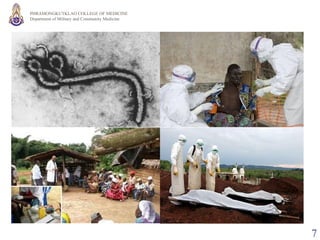
Outbreak Investigation Processes of finding cause(s) of an epidemic by collecting, analyzing the data to propose the control program(s) of this outbreak and to prevent the future one. The prevention and control program is the outcome of the finding about time place and person of what when where why and how.
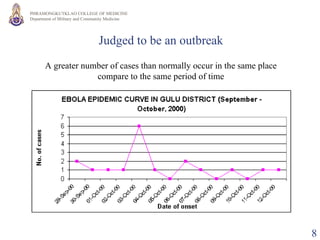
Judged to be an outbreak A greater number of cases than normally occur in the same place compare to the same period of time
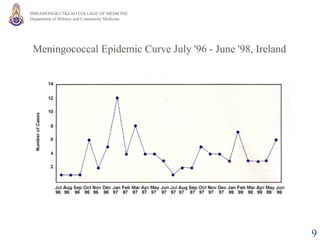
Meningococcal Epidemic Curve July '96 - June '98, Ireland
Judged to be an outbreak A cluster of cases which can be linked to the same exposure. The number of meningococcal cases associated with pilgrims who have traveled for the Haj has increased, and the total number of cases to date is 14 including 4 death  Judged to be an outbreak A single case of disease that has never been occurred . A 3 year old boy, case of Avian flu (HSN1), alerted the public health people around the world to start a full scale investigation
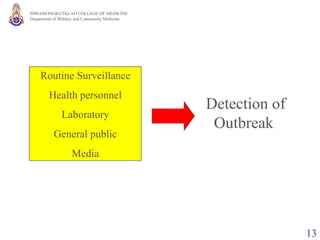
Routine Surveillance Health personnel Laboratory General public Media Detection of Outbreak
Purpose of outbreak investigation To control current outbreak To prevent occurrence of future outbreak Research for more knowledge of the disease To evaluate the effectiveness of prevention program To evaluate the effectiveness of the existing surveillance To train health professional
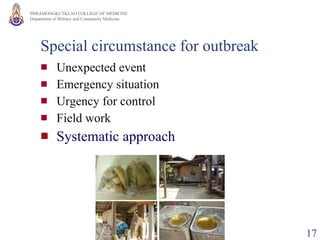
Special circumstance for outbreak  Unexpected event Emergency situation Urgency for control Field work  Systematic approach
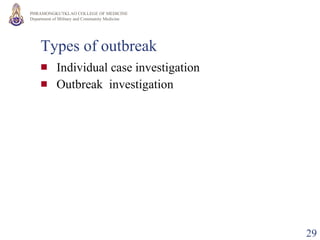
Types of outbreak  Individual case investigation Outbreak  investigation
Individual case investigation Objectives Confirm an outbreak Prevent spreading of disease Natural history of the disease in individual
Individual case investigation Steps in invest igation Patient data collection Determine the spreading of the disease Specimen collection Disease control Writing a report
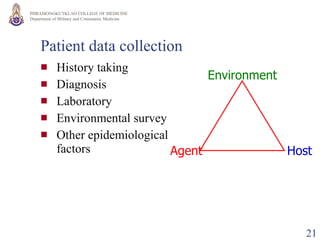
Patient data collection History taking Diagnosis Laboratory Environmental survey Other epidemiological factors Environment Host Agent
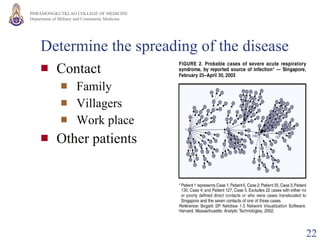
Determine the spreading of the disease Contact Family Villagers Work place Other patients
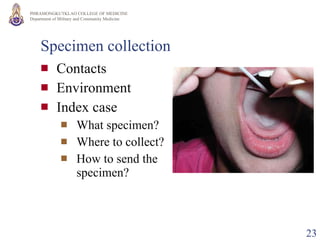
Specimen collection Contacts Environment Index case What specimen? Where to collect? How to send the specimen?
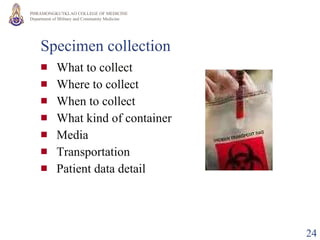
Specimen collection What to collect Where to collect When to collect What kind of container Media Transportation Patient data detail
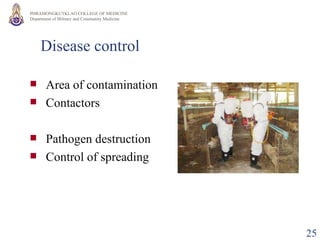
Disease control Area of contamination Contactors Pathogen destruction Control of spreading
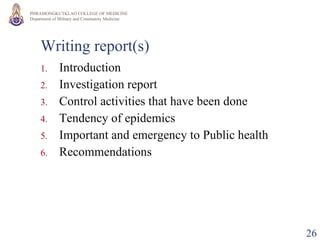
Writing report(s) Introduction Investigation report Control activities that have been done Tendency of epidemics Important and emergency to Public health Recommendations
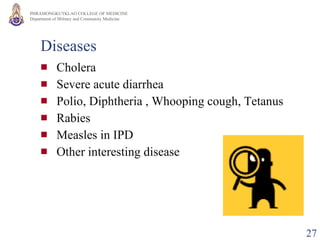
Diseases  Cholera Severe acute diarrhea Polio, Diphtheria , Whooping cough , Tetanus Rabies Measles in IPD Other interesting disease
Types of outbreak  Individual case investigation Outbreak  investigation
Outbreak  investigation More than mean (>2 SD) Common exposure Never occur in the area before
Types of epidemics Common source epidemics Propagated source epidemics
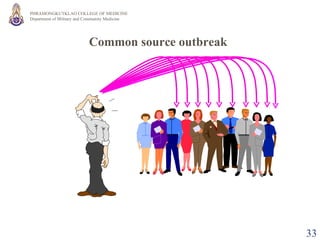
Common source epidemics Group of people Common exposure of pathogen Short incubation period Etc. food poisoning,  hepatitis for common needle user
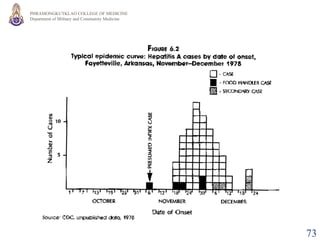
Common source outbreak
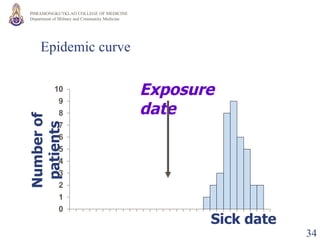
Epidemic curve Sick date Exposure date Number of patients
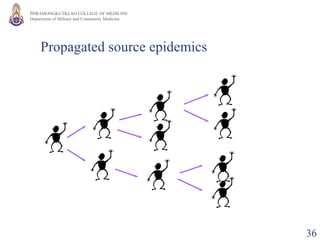
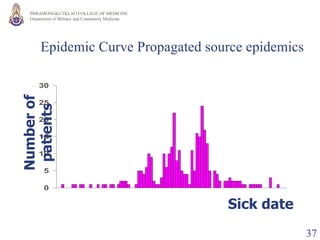
Propagated source epidemics Person Individual contact Spreading in community Etc. influenza in household, tuberculosis in factory
Propagated source epidemics
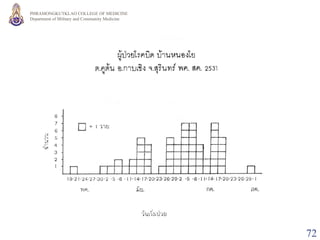
Epidemic Curve  Propagated source epidemics Sick date Number of patients
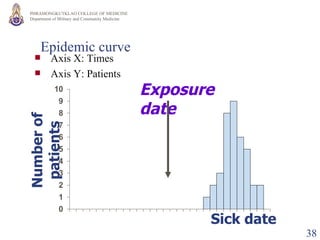
Epidemic curve Sick date Exposure date Number of patients Axis X: Times Axis   Y: Patients
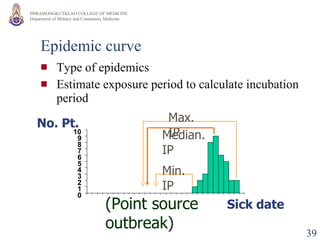
Epidemic curve Type of epidemics Estimate exposure period to calculate incubation period No. Pt. Sick date (Point source outbreak) Min. IP Max. IP Median. IP 0 1 2 3 4 5 6 7 8 9 10
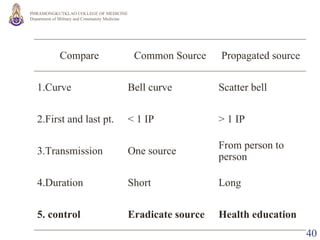
Compare Common Source Propagated source 1.Curve Bell curve Scatter bell 2.First and last pt. < 1 IP > 1 IP 3.Transmission One source From person to person 4.Duration  Short Long 5. control Eradicate source Health education
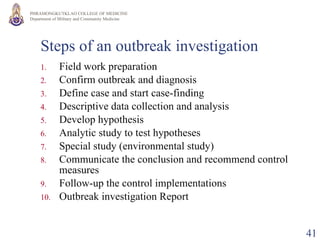
Steps of an outbreak investigation Field work preparation Confirm outbreak and diagnosis Define case and start case-finding Descriptive data collection and analysis Develop hypothesis Analytic study to test hypotheses Special study (environmental study) Communicate the conclusion and recommend control measures Follow-up the control implementations Outbreak investigation Report
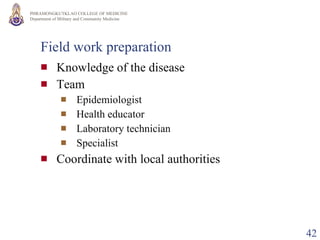
Field work preparation Knowledge of the disease Team Epidemiologist Health educator Laboratory technician Specialist Coordinate with local authorities
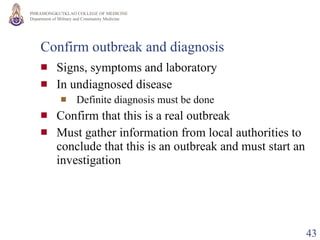
Confirm outbreak and diagnosis Signs, symptoms  and laboratory In undiagnosed disease Definite diagnosis must be done Confirm that this is a real outbreak Must gather information from local authorities to conclude that this is an outbreak and must start an investigation
Define case and start case-finding Must comply to clinical Easy to diagnose Sense and Specificity Finding cases Passive case detection:  From hospital or clinic  Seriously ill Active case detection From community Subclinical
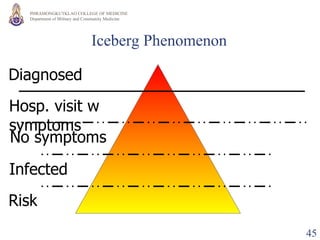
Iceberg Phenomenon Hosp. visit w symptoms No symptoms Infected Risk Diagnosed
Case definition Standard set of criteria to identify cases Clinical criteria restriction of time, place, person Simple, practical, objective Sensitivity vs. specificity Example Patient older than 5 years with severe dehydration or dying of acute watery diarrhea in town “A” between 1 January and 1 June 2002
Case definiteion Possible/Suspected Symptoms/signs not clear Probable Dx from Hx and PE Confirmed Dx from Hx, PE and laboratory testing
Case definiteion Possible/Suspected Severe diarrhea Probable 5 y/o with severe diarrhea and dehydration Confirmed Positive culture for  Vibrio cholera  0139  Normally case definition will not contain risk factors
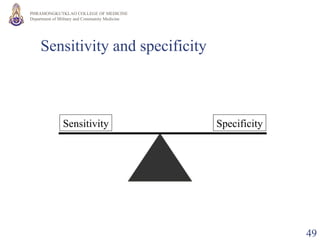
Sensitivity and specificity Sensitivity Specificity
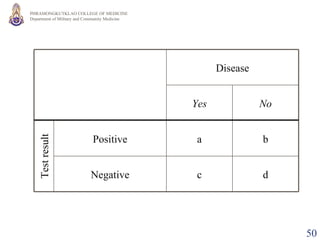
Test result d c Negative b a Positive No Yes Disease
Accuracy Sensitivity Ability of the test to identify correctly those who have the disease Probability of a positive test in people with the disease
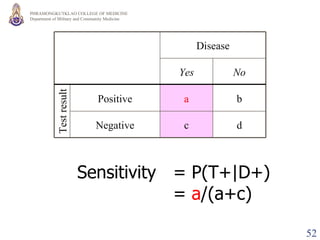
Test result d c Negative b a Positive No Yes Disease Sensitivity  = P(T+|D+)   =  a /(a+c)
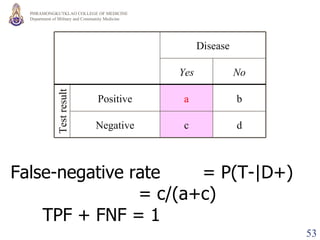
Test result d c Negative b a Positive No Yes Disease False-negative rate  = P(T-|D+)   = c/(a+c) TPF + FNF = 1
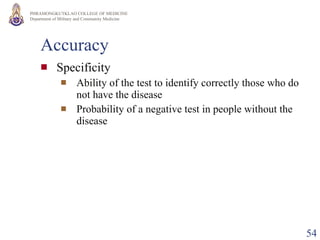
Accuracy Specificity Ability of the test to identify correctly those who do not have the disease Probability of a negative test in people without the disease
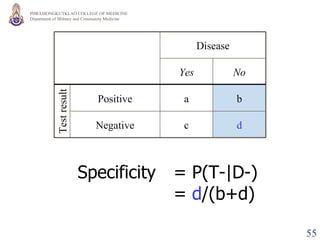
Test result d c Negative b a Positive No Yes Disease Specificity  = P(T-|D-)   =  d /(b+d)
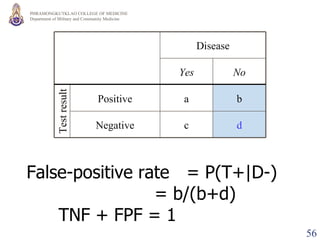
Test result d c Negative b a Positive No Yes Disease False-positive rate  = P(T+|D-)   = b/(b+d) TNF + FPF = 1
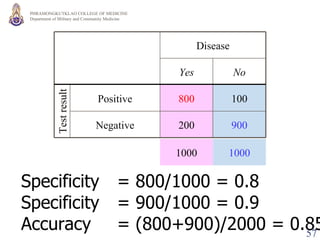
Test result 900 200 Negative 100 800 Positive No Yes Disease Specificity  = 800/1000 = 0.8 Specificity  = 900/1000 = 0.9 Accuracy  = (800+900)/2000 = 0.85 1000 1000
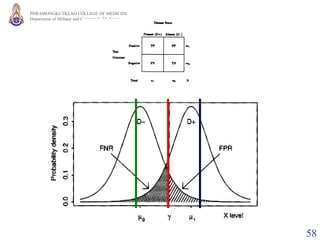
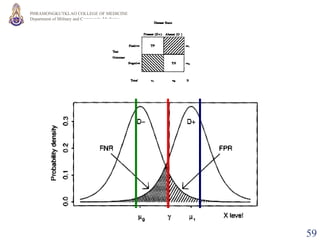
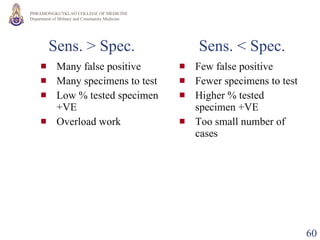
Sens. > Spec.  Sens. < Spec. Many false positive Many specimens to test Low % tested specimen +VE Overload work Few false positive Fewer specimens to test Higher % tested specimen +VE Too small number of cases
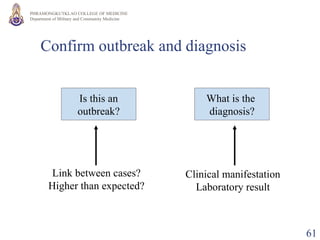
Confirm outbreak and diagnosis Is this an outbreak? What is the  diagnosis? Link between cases? Higher than expected? Clinical manifestation Laboratory result
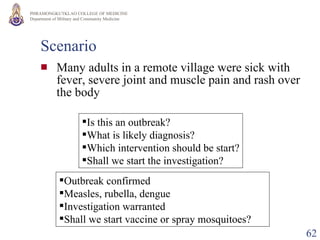
Scenario Many adults in a remote village were sick with fever, severe joint and muscle pain and rash over the body Is this an outbreak? What is likely diagnosis? Which intervention should be start? Shall we start the investigation? Outbreak confirmed Measles, rubella, dengue Investigation warranted Shall we start vaccine or spray mosquitoes?
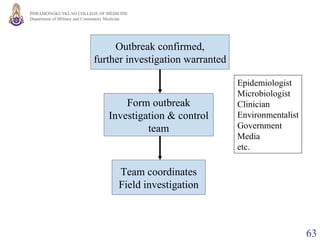
Outbreak confirmed, further investigation warranted Form outbreak Investigation & control team Epidemiologist Microbiologist Clinician Environmentalist Government Media etc. Team coordinates Field investigation
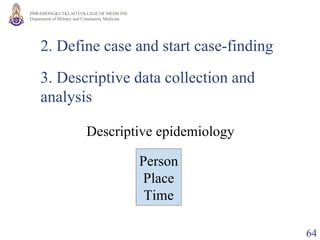
2. Define case and start case-finding 3. Descriptive data collection and analysis Descriptive epidemiology Person Place Time
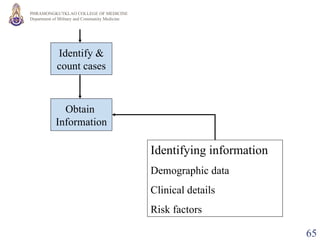
Identify & count cases Obtain  Information Identifying information Demographic data Clinical details Risk factors
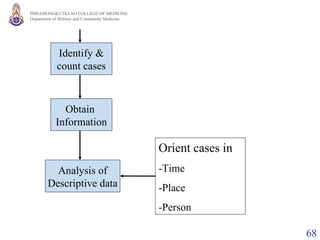
Identify & count cases Obtain  Information Orient cases in -Time  -Place -Person Analysis of Descriptive data
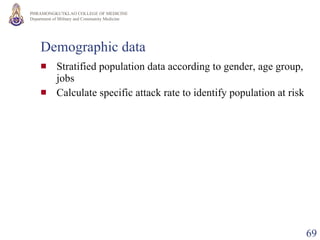
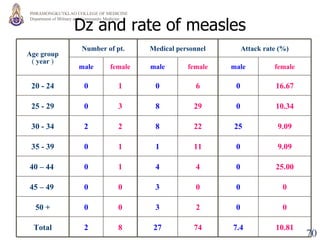
Demographic data Stratified population data according to gender, age group, jobs Calculate specific attack rate to identify population at risk
Dz and rate of measles Age group (  year  ) Number of pt. Medical personnel Attack rate (%) male female male female male female 20 - 24 0 1 0 6 0 16.67 25 - 29 0 3 8 29 0 10.34 30 - 34 2 2 8 22 25 9.09 35 - 39 0 1 1 11 0 9.09 40 – 44  0 1 4 4 0 25.00 45 – 49  0 0 3 0 0 0 50 + 0 0 3 2 0 0 Total 2 8 27 74 7.4 10.81
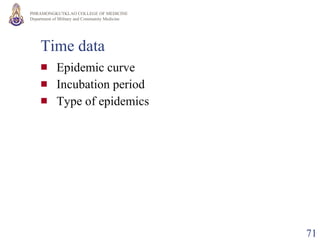
Time data Epidemic curve Incubation period Type of epidemics
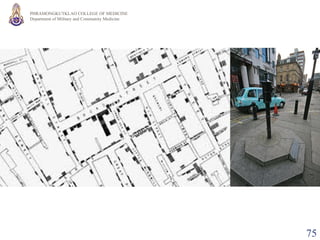
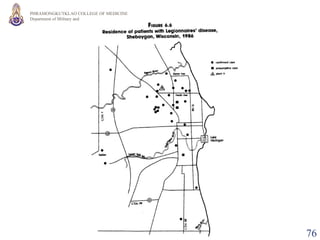
Place data Mapping Locations  Distribution Spreading of the disease
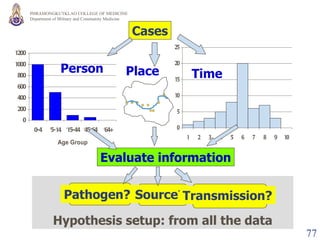
Cases Evaluate information Pathogen? Source? Transmission? Person Place Time Hypothesis setup :  from all the data
5. Develop hypothesis Who is at  risk   of becoming ill? What is the  source  and the vehicle? What is the mode of  transmission ? Example Tattoo was the risk of getting hepatitis A because 13 of 15 cases had new tattoos. A shallow well was he source of shigellosis because most of cases use water from there.
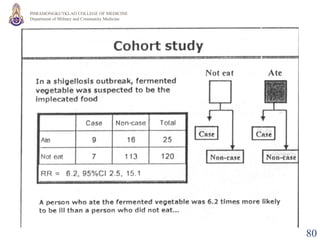
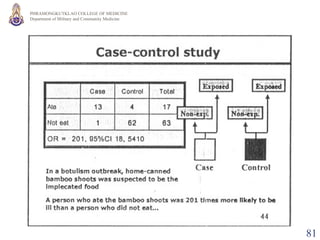
6. Analytic study to test hypotheses Compare hypotheses with facts Prove hypotheses from descriptive studies Test specific hypotheses with analytic studies between cases and none cases Case-control studies Cohort studies
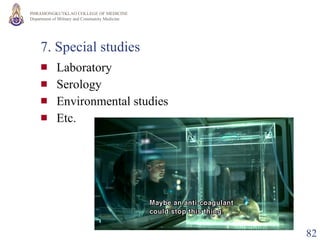
7. Special studies Laboratory Serology Environmental studies Etc.
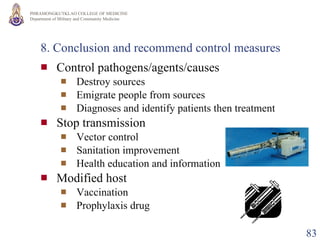
8. Conclusion and recommend control measures Control pathogens/agents/causes Destroy sources Emigrate people from sources Diagnoses and identify patients then treatment Stop transmission Vector control Sanitation improvement Health education and information Modified host  Vaccination Prophylaxis drug
9. Follow-up the control implementations Assess prevention and control programs Surveillance the future outbreak
10.  Outbreak investigation Report  Format Introduction Materials and methods Results Prevention and control programs that have been conducted Recommendations
10.  Outbreak investigation Report Return the information back to Prevention and control authorities Health personnel  Population

Outbreak Investigation

  • 1.
  • 3.
    Outbreak Investigation COL.POTEAIMPUN, MD., Dr.PH Medical Specialist Office for Medical Services Office of Permanent Secretary of Defense
  • 4.
    Contents Definition ofoutbreak Purpose of outbreak investigation Principles and steps of an outbreak investigation
  • 5.
    Definition of outbreakThe occurrence of cases of an illness, specific health-related behavior, or other health-related events clearly in excess of normal expectancy. ( >Mean +2SD) The area and the period in which the cases occur are specified precisely Adapted from WHO recommended surveillance standards, 2 nd edition, 1999
  • 6.
    Outbreak Investigation Processesof finding cause(s) of an epidemic by collecting, analyzing the data to propose the control program(s) of this outbreak and to prevent the future one. The prevention and control program is the outcome of the finding about time place and person of what when where why and how.
  • 8.
    Judged to bean outbreak A greater number of cases than normally occur in the same place compare to the same period of time
  • 9.
    Meningococcal Epidemic CurveJuly '96 - June '98, Ireland
  • 10.
    Judged to bean outbreak A cluster of cases which can be linked to the same exposure. The number of meningococcal cases associated with pilgrims who have traveled for the Haj has increased, and the total number of cases to date is 14 including 4 death Judged to be an outbreak A single case of disease that has never been occurred . A 3 year old boy, case of Avian flu (HSN1), alerted the public health people around the world to start a full scale investigation
  • 13.
    Routine Surveillance Healthpersonnel Laboratory General public Media Detection of Outbreak
  • 14.
    Purpose of outbreakinvestigation To control current outbreak To prevent occurrence of future outbreak Research for more knowledge of the disease To evaluate the effectiveness of prevention program To evaluate the effectiveness of the existing surveillance To train health professional
  • 17.
    Special circumstance foroutbreak Unexpected event Emergency situation Urgency for control Field work Systematic approach
  • 18.
    Types of outbreak Individual case investigation Outbreak investigation
  • 19.
    Individual case investigationObjectives Confirm an outbreak Prevent spreading of disease Natural history of the disease in individual
  • 20.
    Individual case investigationSteps in invest igation Patient data collection Determine the spreading of the disease Specimen collection Disease control Writing a report
  • 21.
    Patient data collectionHistory taking Diagnosis Laboratory Environmental survey Other epidemiological factors Environment Host Agent
  • 22.
    Determine the spreadingof the disease Contact Family Villagers Work place Other patients
  • 23.
    Specimen collection ContactsEnvironment Index case What specimen? Where to collect? How to send the specimen?
  • 24.
    Specimen collection Whatto collect Where to collect When to collect What kind of container Media Transportation Patient data detail
  • 25.
    Disease control Areaof contamination Contactors Pathogen destruction Control of spreading
  • 26.
    Writing report(s) IntroductionInvestigation report Control activities that have been done Tendency of epidemics Important and emergency to Public health Recommendations
  • 27.
    Diseases CholeraSevere acute diarrhea Polio, Diphtheria , Whooping cough , Tetanus Rabies Measles in IPD Other interesting disease
  • 29.
    Types of outbreak Individual case investigation Outbreak investigation
  • 30.
    Outbreak investigationMore than mean (>2 SD) Common exposure Never occur in the area before
  • 31.
    Types of epidemicsCommon source epidemics Propagated source epidemics
  • 32.
    Common source epidemicsGroup of people Common exposure of pathogen Short incubation period Etc. food poisoning, hepatitis for common needle user
  • 33.
  • 34.
    Epidemic curve Sickdate Exposure date Number of patients
  • 35.
    Propagated source epidemicsPerson Individual contact Spreading in community Etc. influenza in household, tuberculosis in factory
  • 36.
  • 37.
    Epidemic Curve Propagated source epidemics Sick date Number of patients
  • 38.
    Epidemic curve Sickdate Exposure date Number of patients Axis X: Times Axis Y: Patients
  • 39.
    Epidemic curve Typeof epidemics Estimate exposure period to calculate incubation period No. Pt. Sick date (Point source outbreak) Min. IP Max. IP Median. IP 0 1 2 3 4 5 6 7 8 9 10
  • 40.
    Compare Common SourcePropagated source 1.Curve Bell curve Scatter bell 2.First and last pt. < 1 IP > 1 IP 3.Transmission One source From person to person 4.Duration Short Long 5. control Eradicate source Health education
  • 41.
    Steps of anoutbreak investigation Field work preparation Confirm outbreak and diagnosis Define case and start case-finding Descriptive data collection and analysis Develop hypothesis Analytic study to test hypotheses Special study (environmental study) Communicate the conclusion and recommend control measures Follow-up the control implementations Outbreak investigation Report
  • 42.
    Field work preparationKnowledge of the disease Team Epidemiologist Health educator Laboratory technician Specialist Coordinate with local authorities
  • 43.
    Confirm outbreak anddiagnosis Signs, symptoms and laboratory In undiagnosed disease Definite diagnosis must be done Confirm that this is a real outbreak Must gather information from local authorities to conclude that this is an outbreak and must start an investigation
  • 44.
    Define case andstart case-finding Must comply to clinical Easy to diagnose Sense and Specificity Finding cases Passive case detection: From hospital or clinic Seriously ill Active case detection From community Subclinical
  • 45.
    Iceberg Phenomenon Hosp.visit w symptoms No symptoms Infected Risk Diagnosed
  • 46.
    Case definition Standardset of criteria to identify cases Clinical criteria restriction of time, place, person Simple, practical, objective Sensitivity vs. specificity Example Patient older than 5 years with severe dehydration or dying of acute watery diarrhea in town “A” between 1 January and 1 June 2002
  • 47.
    Case definiteion Possible/SuspectedSymptoms/signs not clear Probable Dx from Hx and PE Confirmed Dx from Hx, PE and laboratory testing
  • 48.
    Case definiteion Possible/SuspectedSevere diarrhea Probable 5 y/o with severe diarrhea and dehydration Confirmed Positive culture for Vibrio cholera 0139 Normally case definition will not contain risk factors
  • 49.
    Sensitivity and specificitySensitivity Specificity
  • 50.
    Test result dc Negative b a Positive No Yes Disease
  • 51.
    Accuracy Sensitivity Abilityof the test to identify correctly those who have the disease Probability of a positive test in people with the disease
  • 52.
    Test result dc Negative b a Positive No Yes Disease Sensitivity = P(T+|D+) = a /(a+c)
  • 53.
    Test result dc Negative b a Positive No Yes Disease False-negative rate = P(T-|D+) = c/(a+c) TPF + FNF = 1
  • 54.
    Accuracy Specificity Abilityof the test to identify correctly those who do not have the disease Probability of a negative test in people without the disease
  • 55.
    Test result dc Negative b a Positive No Yes Disease Specificity = P(T-|D-) = d /(b+d)
  • 56.
    Test result dc Negative b a Positive No Yes Disease False-positive rate = P(T+|D-) = b/(b+d) TNF + FPF = 1
  • 57.
    Test result 900200 Negative 100 800 Positive No Yes Disease Specificity = 800/1000 = 0.8 Specificity = 900/1000 = 0.9 Accuracy = (800+900)/2000 = 0.85 1000 1000
  • 60.
    Sens. > Spec. Sens. < Spec. Many false positive Many specimens to test Low % tested specimen +VE Overload work Few false positive Fewer specimens to test Higher % tested specimen +VE Too small number of cases
  • 61.
    Confirm outbreak anddiagnosis Is this an outbreak? What is the diagnosis? Link between cases? Higher than expected? Clinical manifestation Laboratory result
  • 62.
    Scenario Many adultsin a remote village were sick with fever, severe joint and muscle pain and rash over the body Is this an outbreak? What is likely diagnosis? Which intervention should be start? Shall we start the investigation? Outbreak confirmed Measles, rubella, dengue Investigation warranted Shall we start vaccine or spray mosquitoes?
  • 63.
    Outbreak confirmed, furtherinvestigation warranted Form outbreak Investigation & control team Epidemiologist Microbiologist Clinician Environmentalist Government Media etc. Team coordinates Field investigation
  • 64.
    2. Define caseand start case-finding 3. Descriptive data collection and analysis Descriptive epidemiology Person Place Time
  • 65.
    Identify & countcases Obtain Information Identifying information Demographic data Clinical details Risk factors
  • 68.
    Identify & countcases Obtain Information Orient cases in -Time -Place -Person Analysis of Descriptive data
  • 69.
    Demographic data Stratifiedpopulation data according to gender, age group, jobs Calculate specific attack rate to identify population at risk
  • 70.
    Dz and rateof measles Age group ( year ) Number of pt. Medical personnel Attack rate (%) male female male female male female 20 - 24 0 1 0 6 0 16.67 25 - 29 0 3 8 29 0 10.34 30 - 34 2 2 8 22 25 9.09 35 - 39 0 1 1 11 0 9.09 40 – 44 0 1 4 4 0 25.00 45 – 49 0 0 3 0 0 0 50 + 0 0 3 2 0 0 Total 2 8 27 74 7.4 10.81
  • 71.
    Time data Epidemiccurve Incubation period Type of epidemics
  • 74.
    Place data MappingLocations Distribution Spreading of the disease
  • 77.
    Cases Evaluate informationPathogen? Source? Transmission? Person Place Time Hypothesis setup : from all the data
  • 78.
    5. Develop hypothesisWho is at risk of becoming ill? What is the source and the vehicle? What is the mode of transmission ? Example Tattoo was the risk of getting hepatitis A because 13 of 15 cases had new tattoos. A shallow well was he source of shigellosis because most of cases use water from there.
  • 79.
    6. Analytic studyto test hypotheses Compare hypotheses with facts Prove hypotheses from descriptive studies Test specific hypotheses with analytic studies between cases and none cases Case-control studies Cohort studies
  • 82.
    7. Special studiesLaboratory Serology Environmental studies Etc.
  • 83.
    8. Conclusion andrecommend control measures Control pathogens/agents/causes Destroy sources Emigrate people from sources Diagnoses and identify patients then treatment Stop transmission Vector control Sanitation improvement Health education and information Modified host Vaccination Prophylaxis drug
  • 84.
    9. Follow-up thecontrol implementations Assess prevention and control programs Surveillance the future outbreak
  • 85.
    10. Outbreakinvestigation Report Format Introduction Materials and methods Results Prevention and control programs that have been conducted Recommendations
  • 86.
    10. Outbreakinvestigation Report Return the information back to Prevention and control authorities Health personnel Population