INTRODUCTION
OF OUTBREAK
DR. JHONNIFER ARELLANO ABARAO
DOCTOR OF HEALTH CARE MANAGEMENT
MASTER OF ARTS IN NURSING - MS
REGISTERED NURSE, PHILIPPINES & USA- STATE OF NY
INTRODUCTION:
VIRUS OUTBREAK IN THE TWENTY FIRST CENTURY ESPECIALLY EMERGING VIRUSES
(SARS AND MERS CORONAVIRUS) REQUIRES PUBLIC HEALTH INTERVENTION
EMERGING VIRUSES ENCOUNTERED TO DEVELOP INTO LARGE EPIDEMIC OR GLOBAL
PANDEMIC OUTBREAK,
THE INITIAL DETECTION AND CHARACTERIZATION OF THE OUTBREAK VIRUS , TO
TRASMISSION, AND MAPPING CAN BE ACCUTERATELY DONE OF THE RECENT
ADVANCES IN VIRUS SEQUENCING AND PHYLOGENETICS.
PROPER DIAGNOSTIC TEST CAN IDENTIFY CAUSAL PATHOGEN LIKE OTHER VIRUS
IDENTIFICATION PCR AND ELISA TEST DIRECTLY IDENTIFY THE PATHOGEN.
SESSION OBJECTIVE:
• Define the terms outbreak, epidemic, endemic, and pandemic.
• List the steps in the investigation of an outbreak.
• Given the initial information of a possible disease outbreak, describe how to
determine whether an epidemic exists.
• Describe the importance of having a case definition and the factors to consider in
developing a case definition.
• Explain how to gather, record, and analyze descriptive data related to characteristics
of person, place, and time that will generate hypotheses about the source of an
outbreak.
DEFETION OF TERMS:
• EPIDEMIC – a widespread occurrence of an infectious disease in a community at a particular time or is a disease
that affects a large number of people within a community, population, or region.
• PANDEMIC – an epidemic that spread over multiple countries or continents.
• ENDEMIC – is something that belongs to a particular people or country.
• EPIDEMIC CURVE – a visual representation in the form of a graph or chart depicting the onset and progression of
an outbreak of disease and especially infectious disease in a particular population.
• EPICENTER - is a “focal point, as of activity.” If a country or region is called the epicenter of a pandemic disease,
that means more or an accelerating number of cases are being confirmed there than anywhere else in the world.
Also called a HOTSPOT.
• DISCRIPTIVE STUDY – describe one or more variables in a sample or occasionally population.
• ANALYTICAL STUDY -attempt to quantify a relationship or association between two variables – an exposure and an
outcome.
• HYPOTHESIS RESEARCH – is a statement of expectation or prediction that will tested by research.
OUTBREAK:
• An outbreak is essentially the same thing as an epidemic.
• An increased frequency of a disease above the usual rate (endemic rate) in a
given population or geographic area.
• Traditionally, these terms referred to infectious diseases, but they can also be
used to describe non-infectious diseases and chronic condition.
IDENTIFYING OUTBREAKS
Outbreaks generally come to the attention of state or local health
departments in one of two ways:
• In a individuals (citizens, physicians, nurses, laboratory workers) will notice cases
of disease occurring close together with respect to time and/or location or they
will notice several individuals with unusual features of disease and report them to
health authorities.
• Public health surveillance systems collect data of‘ reportable diseases.
WHY INVESTIGATE OUTBREAKS?
• The primary reason for conducting outbreak investigations is to identify the
source in order to establish control and to institute measures that will prevent
future episodes of disease.
• They are also sometimes undertaken to train new personnel or to learn more
about the disease and its mechanisms for transmission.
• It can be conducted also by influenced of the severity of the disease, the potential
for spread, the availability of resources, and sometimes by political considerations
or the level of concern among the general public.
STEPS OF AN OUTBREAK:
• Preparation for the investigation
• Verifying the diagnosis and establishing the existence of an outbreak
• Establishing a case definition and finding cases
• Conducting descriptive epidemiology to determine the personal characteristics of the
cases, changes in disease frequency over time, and differences in disease frequency
based on location.
• Developing hypotheses about the cause or source
• Evaluating the hypothesIs & refining the hypothesIs and conducting additional studies
if necessary
• Implementing control and prevention measures
• Communicating the findings
STEP 1: PREPARE FOR THE INVESTIGATION
• If the disease is known, research will be paying particular attention to symptoms,
case definitions, modes of transmission, diagnostic tests and control measures.
• Should list the necessary supplies and equipment.
• Since outbreak investigations frequently involve multiple agencies and
jurisdictions, coordinate with them will clarify each role in the investigation and
establish contacts.
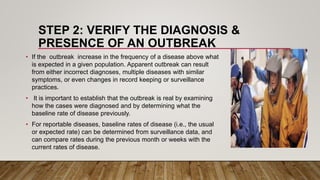
STEP 2: VERIFY THE DIAGNOSIS &
PRESENCE OF AN OUTBREAK
• If the outbreak increase in the frequency of a disease above what
is expected in a given population. Apparent outbreak can result
from either incorrect diagnoses, multiple diseases with similar
symptoms, or even changes in record keeping or surveillance
practices.
• It is important to establish that the outbreak is real by examining
how the cases were diagnosed and by determining what the
baseline rate of disease previously.
• For reportable diseases, baseline rates of disease (i.e., the usual
or expected rate) can be determined from surveillance data, and
can compare rates during the previous month or weeks with the
current rates of disease.
BE AWARE THAT APPARENT CHANGES IN
DISEASE FREQUENCY CAN RESULT FROM:
• Changes in case definitions or changes in local reporting procedures
• Increased interest in a disease because of local or national awareness might
result in greater scrutiny by health care workers or more frequent requests from
patients for exams and diagnostic procedures
• Improvements or changes in diagnostic or screening procedures
• Sudden changes in the size or composition of the population
Laboratory testing can be important for several reasons:
• It can provide verification of the diagnosis. It is not necessary or feasible to
confirm the diagnosis all cases, but verification in at least a subset is important. It
is also important to verify that lab results are consistent with the signs and
symptoms that were reported.
STEP 3: ESTABLISH A CASE DEFINITION;
IDENTIFY CASES
• Case Definitions
• The standard criteria for categorizing an individual as a case. Establishing a case
definition (the criteria that need to be met in order to be considered "a case") can be
tricky, particularly in the initial phases of the investigation.
• Case definitions may include four types of information:
• Clinical information such as symptoms or lab results, e.g. the presence of fever, headache, cough, chest
heaviness, difficulty breathing and sore throat and positive SARS CoV-2 rapid test polymerase chain
reaction (rtpcr)
• Personal characteristics of the cases, e.g., individuals in a certain age group
• Limits with respect to the location of the case (e.g., residing or working in seafood market in Wuhan,
China)
• A specified time period for this particular outbreak (e.g., during Chinese New Year among people who
attended a specific holiday)
CATEGORIES OF CASES: CONFIRMED,
PROBABLE, AND POSSIBLE CASES
• Confirmed cases: These are usually laboratory confirmed cases, e.g., persons who
attended the Chinese New Year 2019 from a blood sample is isolated and cultured.
• Probable cases: These usually have characteristic clinical features of the disease, but
lack laboratory confirmation.
• Possible cases: These have some of the clinical features, e.g., fever, cough, flu like, sore
throat and difficulty of breathing (at a incubation period of symptoms in a 5-7 days period)
who attended the Chinese Holiday on December , 2019.
CASE FINDING
• Once a case definition has been established, there should be a
concerted effort to identify as many cases as possible in order to
accurately establish the magnitude and scope of the outbreak. The
cases that are reported to the state and local health departments may
represent only a small fraction of the total cases for the outbreak.
• The cases identified via passive surveillance (i.e., cases that self-
report or are reported to the state and local health department by
physicians offices, clinics, hospitals, and laboratories) it is often fruitful
to conduct active surveillance by calling hospitals, laboratories, clinics,
and physicians offices in order to identify potential cases that
otherwise would have gone unreported.
STEP 4: CONDUCT DESCRIPTIVE EPIDEMIOLOGY
• Descriptive epidemiology focuses on "person, place, and time", i.e., the personal
characteristics of the cases, changes in disease frequency over time, and differences
in disease frequency based on location. Characteristics of person, place, and time are
the essential elements of for both descriptive epidemiology (to identify possible
sources) and for analytic epidemiology (to definitively identify the source).
 Collecting and Recording Data: The Line Listing
• As cases are identified it is important to record information in a systematic way and to
organize it in a way that will make analysis much easier. Traditionally, the data
collected during outbreak investigations was recorded on paper in a "line listing", with
each case on a separate row and with the items of information in columns.
WHAT INFORMATION SHOULD BE
COLLECTED?
• Since the investigation will come to analysis of factors related to person, place, and time, the following
information should be collected from cases:
• Personal information: Name, address, phone number, age, sex, race, occupation
• Signs and symptoms, as appropriate for the type of outbreak. For example, for SARS CoV-2 one would
record the presence or absence of symptoms (fever, cough, sore throat, difficulty of breathing, headache,
body malaise) and relevant signs (fever, loss taste, loss of smell, chest heaviness, shortness of breath, etc.).
These will be helpful in confirming the diagnosis and determining that the subject meets the case definition.
• Laboratory Test Results
• Relevant Exposures: e.g., for SARS Cov-2:
• - Sources of food (especially ready to eat or uncooked food)
• - Recent travel, especially to foreign countries
• - Close contacts
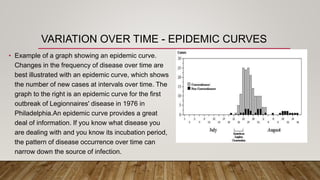
VARIATION OVER TIME - EPIDEMIC CURVES
• Example of a graph showing an epidemic curve.
Changes in the frequency of disease over time are
best illustrated with an epidemic curve, which shows
the number of new cases at intervals over time. The
graph to the right is an epidemic curve for the first
outbreak of Legionnaires' disease in 1976 in
Philadelphia.An epidemic curve provides a great
deal of information. If you know what disease you
are dealing with and you know its incubation period,
the pattern of disease occurrence over time can
narrow down the source of infection.
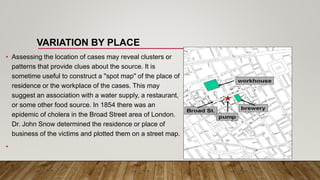
VARIATION BY PLACE
• Assessing the location of cases may reveal clusters or
patterns that provide clues about the source. It is
sometime useful to construct a "spot map" of the place of
residence or the workplace of the cases. This may
suggest an association with a water supply, a restaurant,
or some other food source. In 1854 there was an
epidemic of cholera in the Broad Street area of London.
Dr. John Snow determined the residence or place of
business of the victims and plotted them on a street map.
•
VARIATION BY PERSONAL CHARACTERISTICS
• Information about the cases is typically recorded in a "line listing," on which
information for each case is summarized with a separate column for each
variable.
• Demographic information is always relevant, e.g., age, sex, and address,
because they are often the characteristics most strongly related to exposure and
to the risk of disease.
• In the beginning of an investigation a small number of cases will be interviewed to
look for some common link. These are referred to as "hypothesis-generating
interviews." Depending on the means by which the disease is generally
transmitted, the investigator might also want to know about other personal
characteristics, such as travel, occupation, leisure activities, use of medications,
tobacco, drugs. What did these victims have in common? Had they traveled? Had
they been exposed to other people who had been ill?
STEP 6: DEVELOP HYPOTHESIS
• These steps will be undertaken simultaneously.
• As soon as an outbreak is suspected, one automatically considers what the cause
might be and the factors that are fueling it.
• One of the most important steps in generating hypothesIs when investigating an
outbreak is to consider what is known about the biology of the disease, including
it's possible modes of transmission, whether there are animal reservoirs of
disease, and the length of its incubation and infectious periods.
HYPOTHESIS ARE GENERATED BY CONSCIOUSLY OR
SUBCONSCIOUSLY LOOKING FOR DIFFERENCES,
SIMILARITIES, AND CORRELATIONS:
• Differences: If the frequency of disease differs in two locations or circumstances, it may be
due to a factor that differs in the two circumstances.
• Similarities: If there are similarities among the cases (e.g., many reported eating at a
particular seafood market), then that common factor may be the cause.
• Correlations: If the frequency of disease varies in relation to some factor, then that factor
may be a cause of the disease. For example, communities with low rates of measles
immunization may have high rates of measles cases.
• Consider the information obtaining during hypothesis-generating interviews, and also
consider the location of cases (spot map) and the time course of the epidemic in
relation to the incubation period of the disease (the epidemic curve).
STEP 7: EVALUATE HYPOTHESIS
• In some outbreaks the descriptive epidemiology rapidly points
convincingly to a particular source, and further analysis is
unnecessary. For example, in 2019 Wuhan, China had an outbreak
of SARS CoV-2 in which all of the affected cases reported been in
the seafood market. In other situations if the source is unclear, and
analytic epidemiology must be utilized to more formally test the
hypothesis.
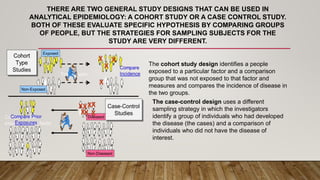
THERE ARE TWO GENERAL STUDY DESIGNS THAT CAN BE USED IN
ANALYTICAL EPIDEMIOLOGY: A COHORT STUDY OR A CASE CONTROL STUDY.
BOTH OF THESE EVALUATE SPECIFIC HYPOTHESIS BY COMPARING GROUPS
OF PEOPLE, BUT THE STRATEGIES FOR SAMPLING SUBJECTS FOR THE
STUDY ARE VERY DIFFERENT.
The cohort study design identifies a people
exposed to a particular factor and a comparison
group that was not exposed to that factor and
measures and compares the incidence of disease in
the two groups.
The case-control design uses a different
sampling strategy in which the investigators
identify a group of individuals who had developed
the disease (the cases) and a comparison of
individuals who did not have the disease of
interest.
STEP 8: REFINE HYPOTHESIS AND CARRY OUT
ADDITIONAL STUDIES IF NECESSARY
• In addition, even if analytical studies establish the source, it may be
necessary to pursue the investigation in order to refine your
understanding of the source. For example, in the COVID-19 outbreak
described it was clear that the raw cooked food (bat) mode
transmission from animal to human was responsible, but what was the
specific source? etc
STEP 9: IMPLEMENT CONTROL AND
PREVENTION MEASURES
• This step is listed toward the end, but, you obviously want to initiate
prevention measures as soon as possible if you have identified the
source, even if you haven't worked out all of the details.
STEP 10: COMMUNICATE THE FINDINGS
• When the investigation is concluded, it is important to communicate
findings to the local health authorities and to those responsible for
implementing control and prevention measures.
• The communications usually require both oral and written reports. The
written report should follow standard scientific guidelines, and it should
include an introduction, background, methods, results, discussion, and
recommendations.
REFERENCE:
• phweb.bumc.bu.edu/otlt/mph-
modules/ph/outbreak/outbreak_print.html
THANK YOU
YOURS IN SAFETY & HEALTH
HAROLD D. BANEZ,RN,MD,DPAMS,DPBA,OSHP

Introduction to Outbreaks

  • 1.
    INTRODUCTION OF OUTBREAK DR. JHONNIFERARELLANO ABARAO DOCTOR OF HEALTH CARE MANAGEMENT MASTER OF ARTS IN NURSING - MS REGISTERED NURSE, PHILIPPINES & USA- STATE OF NY
  • 2.
    INTRODUCTION: VIRUS OUTBREAK INTHE TWENTY FIRST CENTURY ESPECIALLY EMERGING VIRUSES (SARS AND MERS CORONAVIRUS) REQUIRES PUBLIC HEALTH INTERVENTION EMERGING VIRUSES ENCOUNTERED TO DEVELOP INTO LARGE EPIDEMIC OR GLOBAL PANDEMIC OUTBREAK, THE INITIAL DETECTION AND CHARACTERIZATION OF THE OUTBREAK VIRUS , TO TRASMISSION, AND MAPPING CAN BE ACCUTERATELY DONE OF THE RECENT ADVANCES IN VIRUS SEQUENCING AND PHYLOGENETICS. PROPER DIAGNOSTIC TEST CAN IDENTIFY CAUSAL PATHOGEN LIKE OTHER VIRUS IDENTIFICATION PCR AND ELISA TEST DIRECTLY IDENTIFY THE PATHOGEN.
  • 3.
    SESSION OBJECTIVE: • Definethe terms outbreak, epidemic, endemic, and pandemic. • List the steps in the investigation of an outbreak. • Given the initial information of a possible disease outbreak, describe how to determine whether an epidemic exists. • Describe the importance of having a case definition and the factors to consider in developing a case definition. • Explain how to gather, record, and analyze descriptive data related to characteristics of person, place, and time that will generate hypotheses about the source of an outbreak.
  • 4.
    DEFETION OF TERMS: •EPIDEMIC – a widespread occurrence of an infectious disease in a community at a particular time or is a disease that affects a large number of people within a community, population, or region. • PANDEMIC – an epidemic that spread over multiple countries or continents. • ENDEMIC – is something that belongs to a particular people or country. • EPIDEMIC CURVE – a visual representation in the form of a graph or chart depicting the onset and progression of an outbreak of disease and especially infectious disease in a particular population. • EPICENTER - is a “focal point, as of activity.” If a country or region is called the epicenter of a pandemic disease, that means more or an accelerating number of cases are being confirmed there than anywhere else in the world. Also called a HOTSPOT. • DISCRIPTIVE STUDY – describe one or more variables in a sample or occasionally population. • ANALYTICAL STUDY -attempt to quantify a relationship or association between two variables – an exposure and an outcome. • HYPOTHESIS RESEARCH – is a statement of expectation or prediction that will tested by research.
  • 5.
    OUTBREAK: • An outbreakis essentially the same thing as an epidemic. • An increased frequency of a disease above the usual rate (endemic rate) in a given population or geographic area. • Traditionally, these terms referred to infectious diseases, but they can also be used to describe non-infectious diseases and chronic condition.
  • 6.
    IDENTIFYING OUTBREAKS Outbreaks generallycome to the attention of state or local health departments in one of two ways: • In a individuals (citizens, physicians, nurses, laboratory workers) will notice cases of disease occurring close together with respect to time and/or location or they will notice several individuals with unusual features of disease and report them to health authorities. • Public health surveillance systems collect data of‘ reportable diseases.
  • 7.
    WHY INVESTIGATE OUTBREAKS? •The primary reason for conducting outbreak investigations is to identify the source in order to establish control and to institute measures that will prevent future episodes of disease. • They are also sometimes undertaken to train new personnel or to learn more about the disease and its mechanisms for transmission. • It can be conducted also by influenced of the severity of the disease, the potential for spread, the availability of resources, and sometimes by political considerations or the level of concern among the general public.
  • 8.
    STEPS OF ANOUTBREAK: • Preparation for the investigation • Verifying the diagnosis and establishing the existence of an outbreak • Establishing a case definition and finding cases • Conducting descriptive epidemiology to determine the personal characteristics of the cases, changes in disease frequency over time, and differences in disease frequency based on location. • Developing hypotheses about the cause or source • Evaluating the hypothesIs & refining the hypothesIs and conducting additional studies if necessary • Implementing control and prevention measures • Communicating the findings
  • 9.
    STEP 1: PREPAREFOR THE INVESTIGATION • If the disease is known, research will be paying particular attention to symptoms, case definitions, modes of transmission, diagnostic tests and control measures. • Should list the necessary supplies and equipment. • Since outbreak investigations frequently involve multiple agencies and jurisdictions, coordinate with them will clarify each role in the investigation and establish contacts.
  • 10.
    STEP 2: VERIFYTHE DIAGNOSIS & PRESENCE OF AN OUTBREAK • If the outbreak increase in the frequency of a disease above what is expected in a given population. Apparent outbreak can result from either incorrect diagnoses, multiple diseases with similar symptoms, or even changes in record keeping or surveillance practices. • It is important to establish that the outbreak is real by examining how the cases were diagnosed and by determining what the baseline rate of disease previously. • For reportable diseases, baseline rates of disease (i.e., the usual or expected rate) can be determined from surveillance data, and can compare rates during the previous month or weeks with the current rates of disease.
  • 11.
    BE AWARE THATAPPARENT CHANGES IN DISEASE FREQUENCY CAN RESULT FROM: • Changes in case definitions or changes in local reporting procedures • Increased interest in a disease because of local or national awareness might result in greater scrutiny by health care workers or more frequent requests from patients for exams and diagnostic procedures • Improvements or changes in diagnostic or screening procedures • Sudden changes in the size or composition of the population Laboratory testing can be important for several reasons: • It can provide verification of the diagnosis. It is not necessary or feasible to confirm the diagnosis all cases, but verification in at least a subset is important. It is also important to verify that lab results are consistent with the signs and symptoms that were reported.
  • 12.
    STEP 3: ESTABLISHA CASE DEFINITION; IDENTIFY CASES • Case Definitions • The standard criteria for categorizing an individual as a case. Establishing a case definition (the criteria that need to be met in order to be considered "a case") can be tricky, particularly in the initial phases of the investigation. • Case definitions may include four types of information: • Clinical information such as symptoms or lab results, e.g. the presence of fever, headache, cough, chest heaviness, difficulty breathing and sore throat and positive SARS CoV-2 rapid test polymerase chain reaction (rtpcr) • Personal characteristics of the cases, e.g., individuals in a certain age group • Limits with respect to the location of the case (e.g., residing or working in seafood market in Wuhan, China) • A specified time period for this particular outbreak (e.g., during Chinese New Year among people who attended a specific holiday)
  • 13.
    CATEGORIES OF CASES:CONFIRMED, PROBABLE, AND POSSIBLE CASES • Confirmed cases: These are usually laboratory confirmed cases, e.g., persons who attended the Chinese New Year 2019 from a blood sample is isolated and cultured. • Probable cases: These usually have characteristic clinical features of the disease, but lack laboratory confirmation. • Possible cases: These have some of the clinical features, e.g., fever, cough, flu like, sore throat and difficulty of breathing (at a incubation period of symptoms in a 5-7 days period) who attended the Chinese Holiday on December , 2019.
  • 14.
    CASE FINDING • Oncea case definition has been established, there should be a concerted effort to identify as many cases as possible in order to accurately establish the magnitude and scope of the outbreak. The cases that are reported to the state and local health departments may represent only a small fraction of the total cases for the outbreak. • The cases identified via passive surveillance (i.e., cases that self- report or are reported to the state and local health department by physicians offices, clinics, hospitals, and laboratories) it is often fruitful to conduct active surveillance by calling hospitals, laboratories, clinics, and physicians offices in order to identify potential cases that otherwise would have gone unreported.
  • 15.
    STEP 4: CONDUCTDESCRIPTIVE EPIDEMIOLOGY • Descriptive epidemiology focuses on "person, place, and time", i.e., the personal characteristics of the cases, changes in disease frequency over time, and differences in disease frequency based on location. Characteristics of person, place, and time are the essential elements of for both descriptive epidemiology (to identify possible sources) and for analytic epidemiology (to definitively identify the source).  Collecting and Recording Data: The Line Listing • As cases are identified it is important to record information in a systematic way and to organize it in a way that will make analysis much easier. Traditionally, the data collected during outbreak investigations was recorded on paper in a "line listing", with each case on a separate row and with the items of information in columns.
  • 16.
    WHAT INFORMATION SHOULDBE COLLECTED? • Since the investigation will come to analysis of factors related to person, place, and time, the following information should be collected from cases: • Personal information: Name, address, phone number, age, sex, race, occupation • Signs and symptoms, as appropriate for the type of outbreak. For example, for SARS CoV-2 one would record the presence or absence of symptoms (fever, cough, sore throat, difficulty of breathing, headache, body malaise) and relevant signs (fever, loss taste, loss of smell, chest heaviness, shortness of breath, etc.). These will be helpful in confirming the diagnosis and determining that the subject meets the case definition. • Laboratory Test Results • Relevant Exposures: e.g., for SARS Cov-2: • - Sources of food (especially ready to eat or uncooked food) • - Recent travel, especially to foreign countries • - Close contacts
  • 17.
    VARIATION OVER TIME- EPIDEMIC CURVES • Example of a graph showing an epidemic curve. Changes in the frequency of disease over time are best illustrated with an epidemic curve, which shows the number of new cases at intervals over time. The graph to the right is an epidemic curve for the first outbreak of Legionnaires' disease in 1976 in Philadelphia.An epidemic curve provides a great deal of information. If you know what disease you are dealing with and you know its incubation period, the pattern of disease occurrence over time can narrow down the source of infection.
  • 18.
    VARIATION BY PLACE •Assessing the location of cases may reveal clusters or patterns that provide clues about the source. It is sometime useful to construct a "spot map" of the place of residence or the workplace of the cases. This may suggest an association with a water supply, a restaurant, or some other food source. In 1854 there was an epidemic of cholera in the Broad Street area of London. Dr. John Snow determined the residence or place of business of the victims and plotted them on a street map. •
  • 19.
    VARIATION BY PERSONALCHARACTERISTICS • Information about the cases is typically recorded in a "line listing," on which information for each case is summarized with a separate column for each variable. • Demographic information is always relevant, e.g., age, sex, and address, because they are often the characteristics most strongly related to exposure and to the risk of disease. • In the beginning of an investigation a small number of cases will be interviewed to look for some common link. These are referred to as "hypothesis-generating interviews." Depending on the means by which the disease is generally transmitted, the investigator might also want to know about other personal characteristics, such as travel, occupation, leisure activities, use of medications, tobacco, drugs. What did these victims have in common? Had they traveled? Had they been exposed to other people who had been ill?
  • 20.
    STEP 6: DEVELOPHYPOTHESIS • These steps will be undertaken simultaneously. • As soon as an outbreak is suspected, one automatically considers what the cause might be and the factors that are fueling it. • One of the most important steps in generating hypothesIs when investigating an outbreak is to consider what is known about the biology of the disease, including it's possible modes of transmission, whether there are animal reservoirs of disease, and the length of its incubation and infectious periods.
  • 21.
    HYPOTHESIS ARE GENERATEDBY CONSCIOUSLY OR SUBCONSCIOUSLY LOOKING FOR DIFFERENCES, SIMILARITIES, AND CORRELATIONS: • Differences: If the frequency of disease differs in two locations or circumstances, it may be due to a factor that differs in the two circumstances. • Similarities: If there are similarities among the cases (e.g., many reported eating at a particular seafood market), then that common factor may be the cause. • Correlations: If the frequency of disease varies in relation to some factor, then that factor may be a cause of the disease. For example, communities with low rates of measles immunization may have high rates of measles cases. • Consider the information obtaining during hypothesis-generating interviews, and also consider the location of cases (spot map) and the time course of the epidemic in relation to the incubation period of the disease (the epidemic curve).
  • 22.
    STEP 7: EVALUATEHYPOTHESIS • In some outbreaks the descriptive epidemiology rapidly points convincingly to a particular source, and further analysis is unnecessary. For example, in 2019 Wuhan, China had an outbreak of SARS CoV-2 in which all of the affected cases reported been in the seafood market. In other situations if the source is unclear, and analytic epidemiology must be utilized to more formally test the hypothesis.
  • 23.
    THERE ARE TWOGENERAL STUDY DESIGNS THAT CAN BE USED IN ANALYTICAL EPIDEMIOLOGY: A COHORT STUDY OR A CASE CONTROL STUDY. BOTH OF THESE EVALUATE SPECIFIC HYPOTHESIS BY COMPARING GROUPS OF PEOPLE, BUT THE STRATEGIES FOR SAMPLING SUBJECTS FOR THE STUDY ARE VERY DIFFERENT. The cohort study design identifies a people exposed to a particular factor and a comparison group that was not exposed to that factor and measures and compares the incidence of disease in the two groups. The case-control design uses a different sampling strategy in which the investigators identify a group of individuals who had developed the disease (the cases) and a comparison of individuals who did not have the disease of interest.
  • 24.
    STEP 8: REFINEHYPOTHESIS AND CARRY OUT ADDITIONAL STUDIES IF NECESSARY • In addition, even if analytical studies establish the source, it may be necessary to pursue the investigation in order to refine your understanding of the source. For example, in the COVID-19 outbreak described it was clear that the raw cooked food (bat) mode transmission from animal to human was responsible, but what was the specific source? etc
  • 25.
    STEP 9: IMPLEMENTCONTROL AND PREVENTION MEASURES • This step is listed toward the end, but, you obviously want to initiate prevention measures as soon as possible if you have identified the source, even if you haven't worked out all of the details.
  • 26.
    STEP 10: COMMUNICATETHE FINDINGS • When the investigation is concluded, it is important to communicate findings to the local health authorities and to those responsible for implementing control and prevention measures. • The communications usually require both oral and written reports. The written report should follow standard scientific guidelines, and it should include an introduction, background, methods, results, discussion, and recommendations.
  • 27.
  • 28.
    THANK YOU YOURS INSAFETY & HEALTH HAROLD D. BANEZ,RN,MD,DPAMS,DPBA,OSHP