Investigating an outbreak
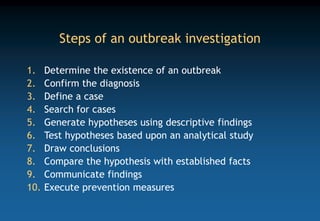
Steps of an outbreak investigation
1. Determine the existence of an outbreak
2. Confirm the diagnosis
3. Define a case
4. Search for cases
5. Generate hypotheses using descriptive findings
6. Test hypotheses based upon an analytical study
7. Draw conclusions
8. Compare the hypothesis with established facts
9. Communicate findings
10. Execute prevention measures
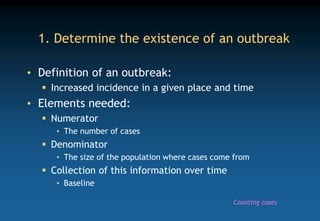
1. Determine the existence of an outbreak
• Definition of an outbreak:
 Increased incidence in a given place and time
• Elements needed:
 Numerator
• The number of cases
 Denominator
• The size of the population where cases come from
 Collection of this information over time
• Baseline
Counting cases
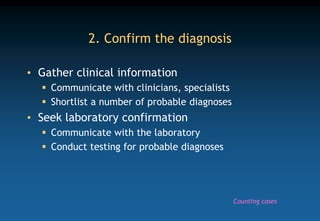
2. Confirm the diagnosis
• Gather clinical information
 Communicate with clinicians, specialists
 Shortlist a number of probable diagnoses
• Seek laboratory confirmation
 Communicate with the laboratory
 Conduct testing for probable diagnoses
Counting cases
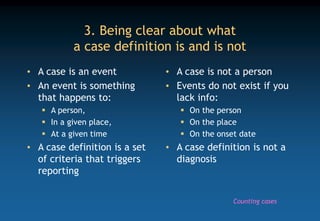
3. Being clear about what
a case definition is and is not
• A case is an event
• An event is something
that happens to:
 A person,
 In a given place,
 At a given time
• A case definition is a set
of criteria that triggers
reporting
• A case is not a person
• Events do not exist if you
lack info:
 On the person
 On the place
 On the onset date
• A case definition is not a
diagnosis
Counting cases
Prototype case definition
• A case is the occurrence of [spell out syndrome]
in a resident of [ spell out location] between
[beginning date] and [end date]
• Use of standardized syndromic case definition is
preferable
 Integrated Disease Surveillance Programme
 WHO
 CDC
Counting cases
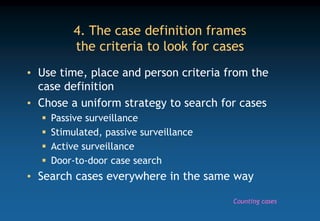
4. The case definition frames
the criteria to look for cases
• Use time, place and person criteria from the
case definition
• Chose a uniform strategy to search for cases
 Passive surveillance
 Stimulated, passive surveillance
 Active surveillance
 Door-to-door case search
• Search cases everywhere in the same way
Counting cases
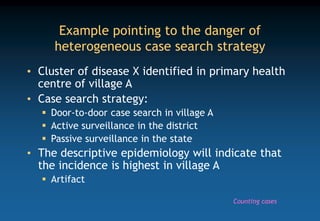
Example pointing to the danger of
heterogeneous case search strategy
• Cluster of disease X identified in primary health
centre of village A
• Case search strategy:
 Door-to-door case search in village A
 Active surveillance in the district
 Passive surveillance in the state
• The descriptive epidemiology will indicate that
the incidence is highest in village A
 Artifact
Counting cases
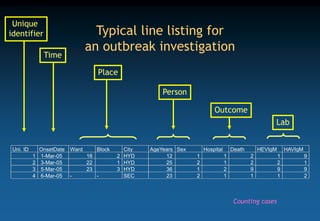
Typical line listing for
an outbreak investigation
Uni. ID OnsetDate Ward Block City AgeYears Sex Hospital Death HEVIgM HAVIgM
1 1-Mar-05 18 2 HYD 12 1 1 2 1 9
2 3-Mar-05 22 1 HYD 25 2 1 2 2 1
3 5-Mar-05 23 3 HYD 36 1 2 9 9 9
4 6-Mar-05 - - SEC 23 2 1 1 1 2
Unique
identifier
Time
Place
Person
Outcome
Lab
Counting cases
5. Count, divide and compare (CDC)
• Count
 Aggregate the cases in the line listing by
characteristic (e.g., age, sex, residence)
• Divide
 Divide the number of cases by the relevant
denominator
• Compare
 Compare incidence across groups
Generating hypotheses
Using time, place and person information to
generate hypotheses
• Time
 Epidemic curve
• Place
 Spot map
 Incidence by area
• Person
 Incidence by age, sex, etc.
 Trawling questionnaire of cases
 Interview of outliers
Generating hypotheses
6. From hypothesis generating to
hypothesis testing
• Characteristics that are common among cases
lead to the generation of hypotheses
• More than one hypotheses may be generated
 There may be more than one source
 The investigator may be following a red herring
• Analytical study tests hypotheses to sort out:
 Characteristics common to all individuals
 Characteristics specific to cases
Testing hypotheses
Testing hypotheses using an
analytical study
• Define study objectives
 One hypothesis or multiple hypotheses
• Write mini-protocol
 Cohort or case control studies, as appropriate
• Define referent exposure period for cases and
controls
 Time - comparability
Testing hypotheses
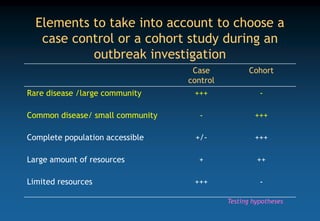
Elements to take into account to choose a
case control or a cohort study during an
outbreak investigation
Case
control
Cohort
Rare disease /large community +++ -
Common disease/ small community - +++
Complete population accessible +/- +++
Large amount of resources + ++
Limited resources +++ -
Testing hypotheses
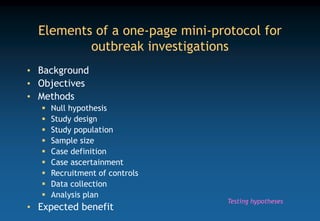
Elements of a one-page mini-protocol for
outbreak investigations
• Background
• Objectives
• Methods
 Null hypothesis
 Study design
 Study population
 Sample size
 Case definition
 Case ascertainment
 Recruitment of controls
 Data collection
 Analysis plan
• Expected benefit
Testing hypotheses
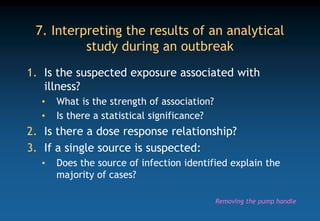
7. Interpreting the results of an analytical
study during an outbreak
1. Is the suspected exposure associated with
illness?
• What is the strength of association?
• Is there a statistical significance?
2. Is there a dose response relationship?
3. If a single source is suspected:
• Does the source of infection identified explain the
majority of cases?
Removing the pump handle
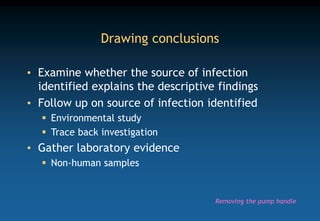
Drawing conclusions
• Examine whether the source of infection
identified explains the descriptive findings
• Follow up on source of infection identified
 Environmental study
 Trace back investigation
• Gather laboratory evidence
 Non-human samples
Removing the pump handle
8. Compare the conclusion with
established facts
• Contacts with headquarters / supervisors
• Literature review
• Medline search
• Internet
Removing the pump handle
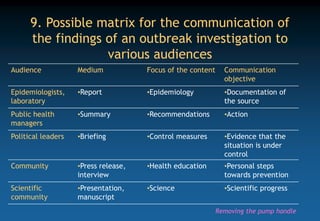
9. Possible matrix for the communication of
the findings of an outbreak investigation to
various audiences
Audience Medium Focus of the content Communication
objective
Epidemiologists,
laboratory
•Report •Epidemiology •Documentation of
the source
Public health
managers
•Summary •Recommendations •Action
Political leaders •Briefing •Control measures •Evidence that the
situation is under
control
Community •Press release,
interview
•Health education •Personal steps
towards prevention
Scientific
community
•Presentation,
manuscript
•Science •Scientific progress
Removing the pump handle
Preliminary epidemiological report to
conclude an outbreak investigation
• A written report must be left in the field
• It should be:
 Short
 Preliminary (disclaimer)
 Factual
• Several formats can be used:
 Abstract
 Slide set
 Bulleted list
 Table
Removing the pump handle
10. Standard control measures
• May be formulated initially
 Before the results of the investigations
• Should be different from idealistic blanket
recommendations
 E.g., Provide piped water to all residents of the village
• Should be feasible and focused
 E.g., Health care workers should wash hands while
managing cholera patients in the hospital
Removing the pump handle
Executing prevention measures following an
outbreak investigation
• Short, medium and long term recommendations
• Characteristics of good recommendations
 Evidence based
 Specific
 Feasible
 Cost effective
 Acceptable (Discuss with health officials)
 Ethical
Removing the pump handle
Example: A well that caused an outbreak of
cholera, 2003
• Short term
 Bar access to the well
• Medium term
 Protect the well that caused the outbreak
• Long term
 Ensure that all new wells are protected
Removing the pump handle
Take-home messages
• Get ready!
• Look at cases
• Describe the outbreak by time, place and
persons to generate hypotheses
• Test hypotheses in analytical studies
• Find the cause of the outbreak and remove
the pump handle

DHA11_Outbreak investigation.ppt

  • 1.
  • 2.
    Steps of anoutbreak investigation 1. Determine the existence of an outbreak 2. Confirm the diagnosis 3. Define a case 4. Search for cases 5. Generate hypotheses using descriptive findings 6. Test hypotheses based upon an analytical study 7. Draw conclusions 8. Compare the hypothesis with established facts 9. Communicate findings 10. Execute prevention measures
  • 3.
    1. Determine theexistence of an outbreak • Definition of an outbreak:  Increased incidence in a given place and time • Elements needed:  Numerator • The number of cases  Denominator • The size of the population where cases come from  Collection of this information over time • Baseline Counting cases
  • 4.
    2. Confirm thediagnosis • Gather clinical information  Communicate with clinicians, specialists  Shortlist a number of probable diagnoses • Seek laboratory confirmation  Communicate with the laboratory  Conduct testing for probable diagnoses Counting cases
  • 5.
    3. Being clearabout what a case definition is and is not • A case is an event • An event is something that happens to:  A person,  In a given place,  At a given time • A case definition is a set of criteria that triggers reporting • A case is not a person • Events do not exist if you lack info:  On the person  On the place  On the onset date • A case definition is not a diagnosis Counting cases
  • 6.
    Prototype case definition •A case is the occurrence of [spell out syndrome] in a resident of [ spell out location] between [beginning date] and [end date] • Use of standardized syndromic case definition is preferable  Integrated Disease Surveillance Programme  WHO  CDC Counting cases
  • 7.
    4. The casedefinition frames the criteria to look for cases • Use time, place and person criteria from the case definition • Chose a uniform strategy to search for cases  Passive surveillance  Stimulated, passive surveillance  Active surveillance  Door-to-door case search • Search cases everywhere in the same way Counting cases
  • 8.
    Example pointing tothe danger of heterogeneous case search strategy • Cluster of disease X identified in primary health centre of village A • Case search strategy:  Door-to-door case search in village A  Active surveillance in the district  Passive surveillance in the state • The descriptive epidemiology will indicate that the incidence is highest in village A  Artifact Counting cases
  • 9.
    Typical line listingfor an outbreak investigation Uni. ID OnsetDate Ward Block City AgeYears Sex Hospital Death HEVIgM HAVIgM 1 1-Mar-05 18 2 HYD 12 1 1 2 1 9 2 3-Mar-05 22 1 HYD 25 2 1 2 2 1 3 5-Mar-05 23 3 HYD 36 1 2 9 9 9 4 6-Mar-05 - - SEC 23 2 1 1 1 2 Unique identifier Time Place Person Outcome Lab Counting cases
  • 10.
    5. Count, divideand compare (CDC) • Count  Aggregate the cases in the line listing by characteristic (e.g., age, sex, residence) • Divide  Divide the number of cases by the relevant denominator • Compare  Compare incidence across groups Generating hypotheses
  • 11.
    Using time, placeand person information to generate hypotheses • Time  Epidemic curve • Place  Spot map  Incidence by area • Person  Incidence by age, sex, etc.  Trawling questionnaire of cases  Interview of outliers Generating hypotheses
  • 12.
    6. From hypothesisgenerating to hypothesis testing • Characteristics that are common among cases lead to the generation of hypotheses • More than one hypotheses may be generated  There may be more than one source  The investigator may be following a red herring • Analytical study tests hypotheses to sort out:  Characteristics common to all individuals  Characteristics specific to cases Testing hypotheses
  • 13.
    Testing hypotheses usingan analytical study • Define study objectives  One hypothesis or multiple hypotheses • Write mini-protocol  Cohort or case control studies, as appropriate • Define referent exposure period for cases and controls  Time - comparability Testing hypotheses
  • 14.
    Elements to takeinto account to choose a case control or a cohort study during an outbreak investigation Case control Cohort Rare disease /large community +++ - Common disease/ small community - +++ Complete population accessible +/- +++ Large amount of resources + ++ Limited resources +++ - Testing hypotheses
  • 15.
    Elements of aone-page mini-protocol for outbreak investigations • Background • Objectives • Methods  Null hypothesis  Study design  Study population  Sample size  Case definition  Case ascertainment  Recruitment of controls  Data collection  Analysis plan • Expected benefit Testing hypotheses
  • 16.
    7. Interpreting theresults of an analytical study during an outbreak 1. Is the suspected exposure associated with illness? • What is the strength of association? • Is there a statistical significance? 2. Is there a dose response relationship? 3. If a single source is suspected: • Does the source of infection identified explain the majority of cases? Removing the pump handle
  • 17.
    Drawing conclusions • Examinewhether the source of infection identified explains the descriptive findings • Follow up on source of infection identified  Environmental study  Trace back investigation • Gather laboratory evidence  Non-human samples Removing the pump handle
  • 18.
    8. Compare theconclusion with established facts • Contacts with headquarters / supervisors • Literature review • Medline search • Internet Removing the pump handle
  • 19.
    9. Possible matrixfor the communication of the findings of an outbreak investigation to various audiences Audience Medium Focus of the content Communication objective Epidemiologists, laboratory •Report •Epidemiology •Documentation of the source Public health managers •Summary •Recommendations •Action Political leaders •Briefing •Control measures •Evidence that the situation is under control Community •Press release, interview •Health education •Personal steps towards prevention Scientific community •Presentation, manuscript •Science •Scientific progress Removing the pump handle
  • 20.
    Preliminary epidemiological reportto conclude an outbreak investigation • A written report must be left in the field • It should be:  Short  Preliminary (disclaimer)  Factual • Several formats can be used:  Abstract  Slide set  Bulleted list  Table Removing the pump handle
  • 21.
    10. Standard controlmeasures • May be formulated initially  Before the results of the investigations • Should be different from idealistic blanket recommendations  E.g., Provide piped water to all residents of the village • Should be feasible and focused  E.g., Health care workers should wash hands while managing cholera patients in the hospital Removing the pump handle
  • 22.
    Executing prevention measuresfollowing an outbreak investigation • Short, medium and long term recommendations • Characteristics of good recommendations  Evidence based  Specific  Feasible  Cost effective  Acceptable (Discuss with health officials)  Ethical Removing the pump handle
  • 23.
    Example: A wellthat caused an outbreak of cholera, 2003 • Short term  Bar access to the well • Medium term  Protect the well that caused the outbreak • Long term  Ensure that all new wells are protected Removing the pump handle
  • 24.
    Take-home messages • Getready! • Look at cases • Describe the outbreak by time, place and persons to generate hypotheses • Test hypotheses in analytical studies • Find the cause of the outbreak and remove the pump handle