

Deliver On-the- 
Job Training 
Deliver On-the-Job Training 
Http://www.power-hour.co.uk – Bite Size Training Materials
Deliver On-the- 
Job Training 
By the end of the Power Hour you will be able to: 
• Explain why and how people learn 
• Describe a model for delivering on-the-job training 
• Explain the skills and procedures involved in each 
stage of the model. 
Http://www.power-hour.co.uk – Bite Size Training Materials 2012
Deliver On-the- 
Job Training 
WHY do People Learn? 
Http://www.power-hour.co.uk – Bite Size Training Materials 2012
Deliver On-the- 
Job Training 
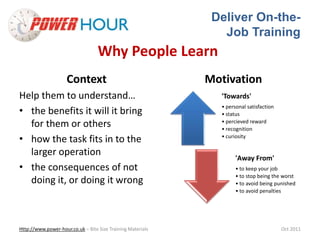
Why People Learn 
Context 
Help them to understand… 
• the benefits it will it bring 
for them or others 
• how the task fits in to the 
larger operation 
• the consequences of not 
doing it, or doing it wrong 
Motivation 
'Towards' 
• personal satisfaction 
• status 
• percieved reward 
• recognition 
• curiosity 
'Away From' 
• to keep your job 
• to stop being the worst 
• to avoid being punished 
• to avoid penalties 
Http://www.power-hour.co.uk – Bite Size Training Materials Oct 2011
Deliver On-the- 
Job Training 
What would be the WORST one-to-one 
Training Session be like? 
Http://www.power-hour.co.uk – Bite Size Training Materials 2012
Deliver On-the- 
Job Training 
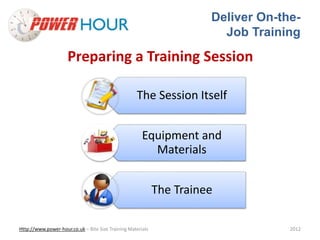
Preparing a Training Session 
The Session Itself 
Equipment and 
Materials 
The Trainee 
Http://www.power-hour.co.uk – Bite Size Training Materials 2012
Deliver On-the- 
Job Training 
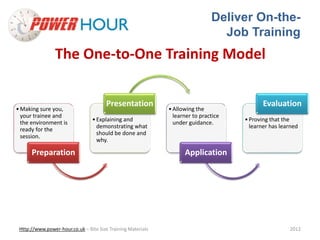
The One-to-One Training Model 
• Making sure you, 
your trainee and 
the environment is 
ready for the 
session. 
Preparation 
Presentation 
• Explaining and 
demonstrating what 
should be done and 
why. 
• Allowing the 
learner to practice 
under guidance. 
Application 
Evaluation 
• Proving that the 
learner has learned 
Http://www.power-hour.co.uk – Bite Size Training Materials 2012
Deliver On-the- 
Job Training 
Preparation 
• Give a context 
• Provide an incentive 
• Prepare the session 
• Prepare equipment 
• Prepare the trainee 
Http://www.power-hour.co.uk – Bite Size Training Materials Oct 2011
Deliver On-the- 
Job Training 
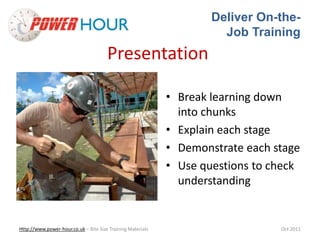
Presentation 
• Break learning down 
into chunks 
• Explain each stage 
• Demonstrate each stage 
• Use questions to check 
understanding 
Http://www.power-hour.co.uk – Bite Size Training Materials Oct 2011
Deliver On-the- 
Job Training 
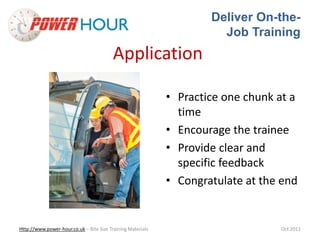
Application 
• Practice one chunk at a 
time 
• Encourage the trainee 
• Provide clear and 
specific feedback 
• Congratulate at the end 
Http://www.power-hour.co.uk – Bite Size Training Materials Oct 2011
Deliver On-the- 
Job Training 
Evaluation 
• Allow the trainee to 
demonstrate the task from 
start to finish 
• Check that it has been carried 
out correctly and to the 
required standard 
• Check knowledge with 
questions 
• Provide feedback and 
congratulations 
• Continue to monitor ‘on the 
job’ 
Http://www.power-hour.co.uk – Bite Size Training Materials Oct 2011
Deliver On-the- 
Job Training 
Make it Work at Work 
What are you going 
to DO as a result of 
this Power Hour 
Session? 
Http://www.power-hour.co.uk – Bite Size Training Materials 2012
Deliver On-the- 
Job Training 
These slides have been produced as an optional 
resource to support a Bite-Size Training session on this 
subject. 
A full set of materials, including detailed Session 
Leader’s Guide, Delegate Workbook and supporting 
activities can be purchased from our Training Shop 
Our Training materials are licence-free, but are for use 
by the purchaser only. 
They CANNOT be passed or sold on. 
Http://www.power-hour.co.uk – Bite Size Training Materials 2012

Deliver On-the-Job Training

  • 1.
    Deliver On-the- JobTraining Deliver On-the-Job Training Http://www.power-hour.co.uk – Bite Size Training Materials
  • 2.
    Deliver On-the- JobTraining By the end of the Power Hour you will be able to: • Explain why and how people learn • Describe a model for delivering on-the-job training • Explain the skills and procedures involved in each stage of the model. Http://www.power-hour.co.uk – Bite Size Training Materials 2012
  • 3.
    Deliver On-the- JobTraining WHY do People Learn? Http://www.power-hour.co.uk – Bite Size Training Materials 2012
  • 4.
    Deliver On-the- JobTraining Why People Learn Context Help them to understand… • the benefits it will it bring for them or others • how the task fits in to the larger operation • the consequences of not doing it, or doing it wrong Motivation 'Towards' • personal satisfaction • status • percieved reward • recognition • curiosity 'Away From' • to keep your job • to stop being the worst • to avoid being punished • to avoid penalties Http://www.power-hour.co.uk – Bite Size Training Materials Oct 2011
  • 5.
    Deliver On-the- JobTraining What would be the WORST one-to-one Training Session be like? Http://www.power-hour.co.uk – Bite Size Training Materials 2012
  • 6.
    Deliver On-the- JobTraining Preparing a Training Session The Session Itself Equipment and Materials The Trainee Http://www.power-hour.co.uk – Bite Size Training Materials 2012
  • 7.
    Deliver On-the- JobTraining The One-to-One Training Model • Making sure you, your trainee and the environment is ready for the session. Preparation Presentation • Explaining and demonstrating what should be done and why. • Allowing the learner to practice under guidance. Application Evaluation • Proving that the learner has learned Http://www.power-hour.co.uk – Bite Size Training Materials 2012
  • 8.
    Deliver On-the- JobTraining Preparation • Give a context • Provide an incentive • Prepare the session • Prepare equipment • Prepare the trainee Http://www.power-hour.co.uk – Bite Size Training Materials Oct 2011
  • 9.
    Deliver On-the- JobTraining Presentation • Break learning down into chunks • Explain each stage • Demonstrate each stage • Use questions to check understanding Http://www.power-hour.co.uk – Bite Size Training Materials Oct 2011
  • 10.
    Deliver On-the- JobTraining Application • Practice one chunk at a time • Encourage the trainee • Provide clear and specific feedback • Congratulate at the end Http://www.power-hour.co.uk – Bite Size Training Materials Oct 2011
  • 11.
    Deliver On-the- JobTraining Evaluation • Allow the trainee to demonstrate the task from start to finish • Check that it has been carried out correctly and to the required standard • Check knowledge with questions • Provide feedback and congratulations • Continue to monitor ‘on the job’ Http://www.power-hour.co.uk – Bite Size Training Materials Oct 2011
  • 12.
    Deliver On-the- JobTraining Make it Work at Work What are you going to DO as a result of this Power Hour Session? Http://www.power-hour.co.uk – Bite Size Training Materials 2012
  • 13.
    Deliver On-the- JobTraining These slides have been produced as an optional resource to support a Bite-Size Training session on this subject. A full set of materials, including detailed Session Leader’s Guide, Delegate Workbook and supporting activities can be purchased from our Training Shop Our Training materials are licence-free, but are for use by the purchaser only. They CANNOT be passed or sold on. Http://www.power-hour.co.uk – Bite Size Training Materials 2012

Editor's Notes

  • #2 The Power Hour series has been developed to allow line managers or trainers to deliver short, sharp, effective training sessions to their teams or small groups with minimal disruption to normal every-day operations. Experience of delivering training is not essential, as each Power Hour session comes with detailed notes for the leader, and two useful take-aways for those attending: A short workbook to accompany the session, and a 2-sided ‘key points’ sheet, that can be laminated and kept handy at work. Supporting slides are OPTIONAL, as managers do not always have the facility to run PowerPoint presentations. As such the slides do not provide a complete picture of the session. All important information is provided in the Session Leader’s Guide and Delegates’ Workbook. Designed to be run in 60 minutes, Power Hour sessions can be run in place of an ordinary team meeting, or as part of a longer meeting. If you have longer than an hour, optional additional material is provided to stretch the sessions to 90 minutes or even 2 hours. You can also combine a number of Power Hour sessions on similar themes to create a half or full-day workshop if desired. Suggestions about which topics go well together are provided in the Session Leader’s Notes. Extra supporting materials are minimal, and clearly identified in the Session Leader’s Notes so that everything can be prepared in advance. To ensure that your team gets the most out this Power Hour, it is vital that they put their learning into practice. To enable them to do this, at least 4 measurable activities are suggested at the end of the Session Leader’s Notes and delegate workbook. Of course, other similar actions that are more specific to your business or function may be set by you, or agreed with individuals instead. Power Hour sessions are designed to be interactive and 6-8 delegates is ideal, although it is possible to run them with only 2 people, or for larger groups. Just bear in mind, the larger the group, the more discussion, and this could make it difficult to complete the session in just 60 minutes.   This Power Hour Session includes extra optional activities that can turn this 60 minute session into a session lasting 2 hours and 25 minutes
  • #3 The Outline for this session is as follows: Welcome and Introduction – Trainer and delegate input Successful V Unsuccessful training – (Optional) Group discussion Why do people learn? – Post-it note exercise and trainer input Preparing to Train – Reverse brainstorm and discussion The one-to-one training model – Trainer input Key skills for on-the-job (one-to-one) training – (Optional) group work Exploring the 4-step Model – Group exercises and discussion Using the 4-step model – (Optional) Pairs/Threes activity to use the model in a practical exercise Summary and putting it into practice Power Hour is intended as an activity and discussion based session rather than a slide driven one. As such, no further notes are provided on the slides. All details required to run the session as well as all supporting information is provided in the Session Leader’s Guide and associated materials.