EFFECTIVE
SUPERVISORY SKILLS
TRAINING
Shahinur Alam,
HR-Manager,
Apex Footwear Ltd.
LCMC-IBA
naoshinshahin@gmail.com,
+880 1712204694
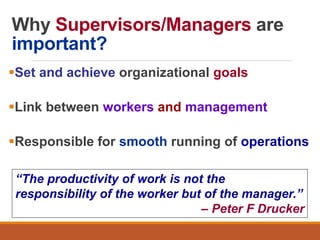
Why Supervisors/Managers are
important?
Set and achieve organizational goals
Link between workers and management
Responsible for smooth running of operations
“The productivity of work is not the
responsibility of the worker but of the manager.”
– Peter F Drucker
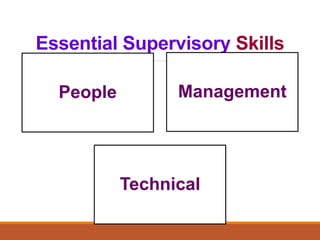
Essential Supervisory Skills
People Management
Technical
People Skills
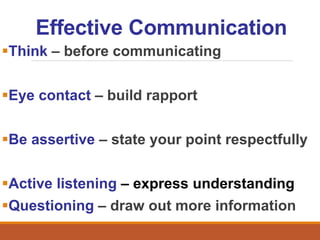
Effective Communication
Think – before communicating
Eye contact – build rapport
Be assertive – state your point respectfully
Active listening – express understanding
Questioning – draw out more information
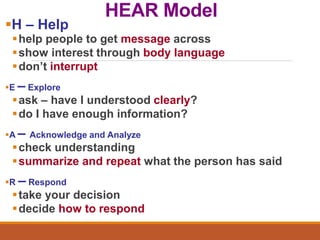
HEAR Model
H – Help
help people to get message across
show interest through body language
don’t interrupt
E – Explore
ask – have I understood clearly?
do I have enough information?
A – Acknowledge and Analyze
check understanding
summarize and repeat what the person has said
R – Respond
take your decision
decide how to respond
How to delegate better?
Consider the task
Give clear, complete instructions
Check for understanding
Follow-up
Encourage to learn and take decisions
Once delegated – don’t take back
Feedbacks – positive
Should be clear, specific
Tell why it’s important to do well
Encourage to do better
Giving Feedbacks – constructive
Never attack the person
Talk about specific behaviors
Find out weaknesses
Management Skills
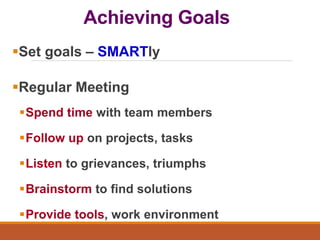
Achieving Goals
Set goals – SMARTly
Regular Meeting
Spend time with team members
Follow up on projects, tasks
Listen to grievances, triumphs
Brainstorm to find solutions
Provide tools, work environment
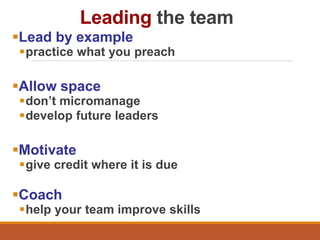
Leading the team
Lead by example
practice what you preach
Allow space
don’t micromanage
develop future leaders
Motivate
give credit where it is due
Coach
help your team improve skills
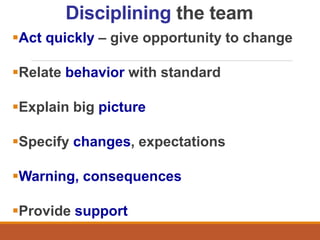
Disciplining the team
Act quickly – give opportunity to change
Relate behavior with standard
Explain big picture
Specify changes, expectations
Warning, consequences
Provide support
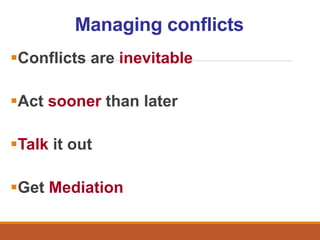
Managing conflicts
Conflicts are inevitable
Act sooner than later
Talk it out
Get Mediation
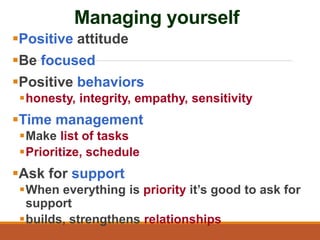
Managing yourself
Positive attitude
Be focused
Positive behaviors
honesty, integrity, empathy, sensitivity
Time management
Make list of tasks
Prioritize, schedule
Ask for support
When everything is priority it’s good to ask for
support
builds, strengthens relationships
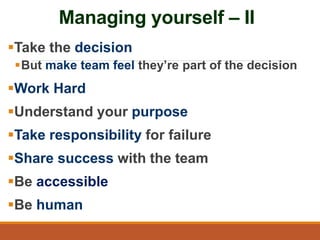
Managing yourself – II
Take the decision
But make team feel they’re part of the decision
Work Hard
Understand your purpose
Take responsibility for failure
Share success with the team
Be accessible
Be human
Technical Skills
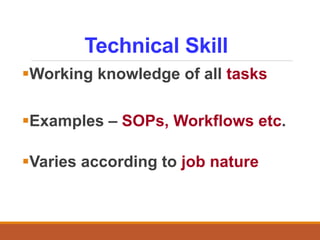
Technical Skill
Working knowledge of all tasks
Examples – SOPs, Workflows etc.
Varies according to job nature
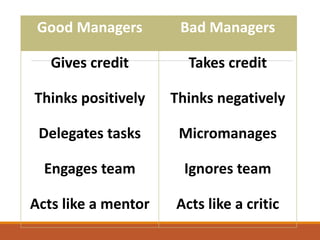
Good Managers Bad Managers
Gives credit Takes credit
Thinks positively Thinks negatively
Delegates tasks Micromanages
Engages team Ignores team
Acts like a mentor Acts like a critic
Questions?

Effective supervisory skill trainig

  • 1.
    EFFECTIVE SUPERVISORY SKILLS TRAINING Shahinur Alam, HR-Manager, ApexFootwear Ltd. LCMC-IBA naoshinshahin@gmail.com, +880 1712204694
  • 4.
    Why Supervisors/Managers are important? Setand achieve organizational goals Link between workers and management Responsible for smooth running of operations “The productivity of work is not the responsibility of the worker but of the manager.” – Peter F Drucker
  • 5.
  • 6.
  • 7.
    Effective Communication Think –before communicating Eye contact – build rapport Be assertive – state your point respectfully Active listening – express understanding Questioning – draw out more information
  • 8.
    HEAR Model H –Help help people to get message across show interest through body language don’t interrupt E – Explore ask – have I understood clearly? do I have enough information? A – Acknowledge and Analyze check understanding summarize and repeat what the person has said R – Respond take your decision decide how to respond
  • 9.
    How to delegatebetter? Consider the task Give clear, complete instructions Check for understanding Follow-up Encourage to learn and take decisions Once delegated – don’t take back
  • 10.
    Feedbacks – positive Shouldbe clear, specific Tell why it’s important to do well Encourage to do better
  • 11.
    Giving Feedbacks –constructive Never attack the person Talk about specific behaviors Find out weaknesses
  • 12.
  • 13.
    Achieving Goals Set goals– SMARTly Regular Meeting Spend time with team members Follow up on projects, tasks Listen to grievances, triumphs Brainstorm to find solutions Provide tools, work environment
  • 14.
    Leading the team Leadby example practice what you preach Allow space don’t micromanage develop future leaders Motivate give credit where it is due Coach help your team improve skills
  • 15.
    Disciplining the team Actquickly – give opportunity to change Relate behavior with standard Explain big picture Specify changes, expectations Warning, consequences Provide support
  • 16.
    Managing conflicts Conflicts areinevitable Act sooner than later Talk it out Get Mediation
  • 17.
    Managing yourself Positive attitude Befocused Positive behaviors honesty, integrity, empathy, sensitivity Time management Make list of tasks Prioritize, schedule Ask for support When everything is priority it’s good to ask for support builds, strengthens relationships
  • 18.
    Managing yourself –II Take the decision But make team feel they’re part of the decision Work Hard Understand your purpose Take responsibility for failure Share success with the team Be accessible Be human
  • 19.
  • 20.
    Technical Skill Working knowledgeof all tasks Examples – SOPs, Workflows etc. Varies according to job nature
  • 21.
    Good Managers BadManagers Gives credit Takes credit Thinks positively Thinks negatively Delegates tasks Micromanages Engages team Ignores team Acts like a mentor Acts like a critic
  • 22.

Editor's Notes

  • #2 Respected teacher, fellow students Good Evening and welcome to a short presentation on ‘Effective Supervisory Skills Training’ by Group – 71.
  • #5 Before we start discussing supervisory skills, let us take few moments to understand why supervisory skills are important to the organization or what roles supervisors/managers they play in organizations? Effective managers also take part in setting organizational goals and make sure they’re achieved. Managers are the connecting point between management and workers. They interpret management expectation into specific tasks and goals And as management guru Peter F Drucker has said, although its workers who do the work but the responsibility of productivity lies on managers.
  • #6 Coming to Supervisory Skills, they are many. Ranging from basic communication skill, motivation, positive attitude, delegation, decision making, team management, conflict management etc. In this discussion we’ve grouped supervisory skills in 3 broad categories which are People, Management and Technical.
  • #7 We are going to discuss People skill first. In other words, these are basic intercommunication skills. These skills are personal attributes of manager and doesn’t come with designation and/or capacity. With practice and self discipline these skills can be learned over time by any individual.
  • #8 This slide contains some tips for ensuring effective communication This applies to all forms of communication i.e. written, verbal or non-verbal. A good manager must have a thought process before communicating such considering the audience, deciding on the message whether it is positive, neutral or negative etc. Eye contact is very important to build rapport with the person or audience. It also helps keep audience attention. Active listening involves listener to feed back what they hear by way of paraphrasing and to confirm understanding. Manager often has to explore, hunt for more information through questions.
  • #9 HEAR Model is a very simple model designed for managers in face to face communications. It starts with helping the person to communicate. showing him/her that you’re interested in his message and waiting for the message to finish. Then as a good manager I should ask myself whether I’ve understood the message clearly and completely? After I’ve got the message completely I can check my understanding of the situation through repeating briefly what I’ve just heard And finally, responding which has two parts first deciding whether to respond in positive, negative or neutral manner and then responding.
  • #10 In this slide we are going to learn some tips of how to delegate better Consider the task i.e. how much time, what resource are needed to complete the task Give clear and complete instructions about completing the task Make sure the person has understood what, how, when it needs to be done. Follow up after some time to track progress Give subordinates freedom to learn and take decisions Don’t take back assignments unless it is absolutely necessary i.e. deadline and the person is incapable of carrying out
  • #11 Giving Feedbacks may be the most important communication manager has to do in terms of team management. First lets discuss on giving out positive feedbacks. - Feedbacks has to be clear and specific so that the person receiving the feedback must understand for which activity or behavior he/she is receiving this feedback. Explain big picture to the person. That is explain to him or her why the activity is important to the organization. Example can be explaining staff bus drivers importance of picking staff on time. If the staffs are on time, more work can be done etc. Positive feedback must always end with a message that encourages the person to do more of it.
  • #12 We are going to call negative feedback as constructive feedback as the word ‘constructive’ has positive feeling to it. - A good manager must never attack the person Talk about specific behaviors And help the person find and solve the weakness causing the behavior
  • #13 A good manager’s management responsibilities involve both managing organizational goals as well as managing the team. We are going to discuss both in the next few slides.
  • #14 Achieving organizational goals are perhaps the most important task of a manager. But in order to achieve the target, manager has to set it first. The goal must be set smartly. That is the goal should be specific, measurable, achievable, realistic and time bound. In order to achieve the goal a manager has meet the team regularly or at certain intervals. - A good manager must make it a point to spend time with his team in order to know members better, to build conducive relationships. - During meetings projects, tasks can be discussed and evaluated against standard. - Manager must listen to members’ complaints, achievements and react accordingly. - If there’s a problem where the team is stuck manager can brainstorm with the team to find solution. If need be manager can opt of expert help. - Manager has to make sure the team has appropriate tools (software, equipment) and working environment.
  • #15 A good manager is also a leader. He or she leads the team through example. That is ‘do what you say’ Manager must also allow controlled freedom to team members to learn leadership. After all a good leader is the one who nurtures more leaders. Manager must motivate the team for good work. Coach the team to improve skills.
  • #16 Disciplining the team comes with the package of team management. Here are few steps that can be followed in order to discipline any erratic team member Manager must act soon. In fact the quicker the better because it will avoid worse picture in future. While talking to the delinquent member, manager must relate the behavior with standard. Explain big picture i.e. because a customer wasn’t serviced properly he/she went to a competitor. Warn the team of future consequence if behavior is repeated. Ask and give support to the member if needed i.e. training.
  • #17 Conflicts are often part of managing the team. It mainly happens because of diverse mindset, backgrounds of different team members. Avoiding and/or solving conflicts within and beyond team (among team members or with other departments) is among important task of managers. Some tips on managing conflicts Conflicts cannot be avoided 100%. In fact in some cases, conflicts are healthy and enhances displays competition. Like discipline, its better to root out conflicts earlier the better Talk – Ask the conflicting members to talk and sort it out. Ask for mediation from HR or senior colleagues.
  • #18 To be an example to team members is the easiest way for managers to manage their team. In order to be a role model certain personal attributes are required, which are: Having a positive mindset Being focused to the goal Showing integrity, sensitivity Valuing time through prioritizing, scheduling Building relationship with team by asking for their cooperation.
  • #19 - Managers must never shy away from taking decision. It is a good idea to involve team while taking decision but it is also important to make the team feel they are part of the decision. It helps create ownership among team members. Manager has to work harder than any other team members. Perks aren’t free. Must be absolutely clear about the purpose of team. That is to achieve target. Good manager takes responsibility of team failure. Success should be share with team. It builds trust to the manager. A good manager must avoid be accessible in the simplest manner. Should be empathetic and have emotional intelligence.
  • #20 Although a manager doesn’t work hands-on on the shop floor but having technical skills helps a great deal in different aspects like understanding the tasks or member complaints.
  • #21 Nature of job defines the technical skill required to carry out the role. It means its not easy to generalize what sort of technical skill a manager requires. But some examples are SOPs, Workflows etc. In short manager should have working knowledge of the tasks, functions the team performs.
  • #22 Some of the key differences between good and bad managers are shown.
  • #23 Although a manager doesn’t work hands-on on the shop floor but having technical skills helps a great deal in different aspects like understanding the tasks or member complaints.