Communicate on the
Telephone
Http://www.power-hour.co.uk – Bite Size Training Materials
Communicate on the Telephone
Communicate on the
Telephone
Http://www.power-hour.co.uk – Bite Size Training Materials 2012
By the end of the Power Hour you will be able to:
• Open or answer a call professionally
• Structure a call to retain control and make sure that
it achieves its objectives
• Close and follow up a call effectively
Communicate on the
Telephone
Http://www.power-hour.co.uk – Bite Size Training Materials 2012
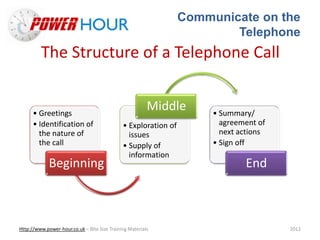
The Structure of a Telephone Call
• Greetings
• Identification of
the nature of
the call
Beginning
• Exploration of
issues
• Supply of
information
Middle • Summary/
agreement of
next actions
• Sign off
End
Communicate on the
Telephone
Http://www.power-hour.co.uk – Bite Size Training MaterialsTrain the Trainer Oct 2011
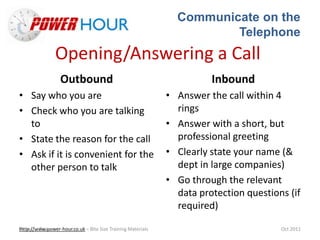
Opening/Answering a Call
Outbound
• Say who you are
• Check who you are talking
to
• State the reason for the call
• Ask if it is convenient for the
other person to talk
Inbound
• Answer the call within 4
rings
• Answer with a short, but
professional greeting
• Clearly state your name (&
dept in large companies)
• Go through the relevant
data protection questions (if
required)
Communicate on the
Telephone
Http://www.power-hour.co.uk – Bite Size Training Materials 2012
Voice Tone
Volume
Energy
Speed
Pitch
Articulation
Communicate on the
Telephone
Http://www.power-hour.co.uk – Bite Size Training Materials 2012
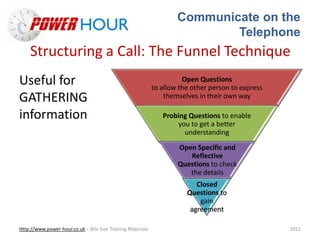
Structuring a Call: The Funnel Technique
Useful for
GATHERING
information
Open Questions
to allow the other person to express
themselves in their own way
Probing Questions to enable
you to get a better
understanding
Open Specific and
Reflective
Questions to check
the details
Closed
Questions to
gain
agreement
Communicate on the
Telephone
Http://www.power-hour.co.uk – Bite Size Training Materials 2012
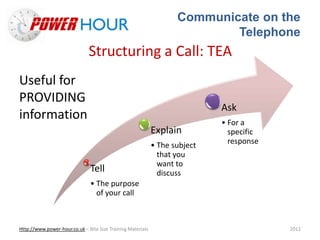
Structuring a Call: TEA
Useful for
PROVIDING
information
Tell
• The purpose
of your call
Explain
• The subject
that you
want to
discuss
Ask
• For a
specific
response
Communicate on the
Telephone
Http://www.power-hour.co.uk – Bite Size Training Materials 2012
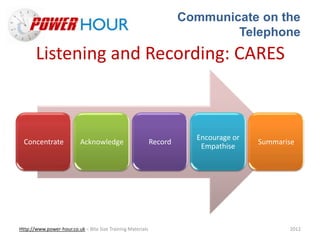
Listening and Recording: CARES
Concentrate Acknowledge Record
Encourage or
Empathise
Summarise
Communicate on the
Telephone
Http://www.power-hour.co.uk – Bite Size Training Materials 2012
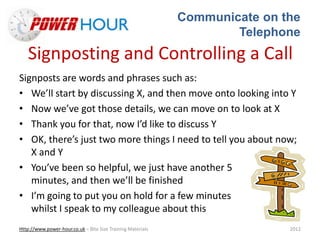
Signposting and Controlling a Call
Signposts are words and phrases such as:
• We’ll start by discussing X, and then move onto looking into Y
• Now we’ve got those details, we can move on to look at X
• Thank you for that, now I’d like to discuss Y
• OK, there’s just two more things I need to tell you about now;
X and Y
• You’ve been so helpful, we just have another 5
minutes, and then we’ll be finished
• I’m going to put you on hold for a few minutes
whilst I speak to my colleague about this
Communicate on the
Telephone
Http://www.power-hour.co.uk – Bite Size Training MaterialsTrain the Trainer Oct 2011
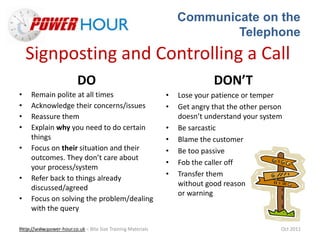
Signposting and Controlling a Call
DO
• Remain polite at all times
• Acknowledge their concerns/issues
• Reassure them
• Explain why you need to do certain
things
• Focus on their situation and their
outcomes. They don’t care about
your process/system
• Refer back to things already
discussed/agreed
• Focus on solving the problem/dealing
with the query
DON’T
• Lose your patience or temper
• Get angry that the other person
doesn’t understand your system
• Be sarcastic
• Blame the customer
• Be too passive
• Fob the caller off
• Transfer them
without good reason
or warning
Communicate on the
Telephone
Http://www.power-hour.co.uk – Bite Size Training Materials 2012
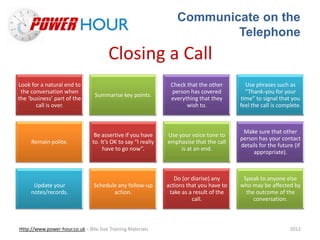
Closing a Call
Look for a natural end to
the conversation when
the ‘business’ part of the
call is over.
Summarise key points.
Check that the other
person has covered
everything that they
wish to.
Use phrases such as
“Thank-you for your
time” to signal that you
feel the call is complete.
Remain polite.
Be assertive if you have
to. It’s OK to say “I really
have to go now”.
Use your voice tone to
emphasise that the call
is at an end.
Make sure that other
person has your contact
details for the future (if
appropriate).
Update your
notes/records.
Schedule any follow-up
action.
Do (or diarise) any
actions that you have to
take as a result of the
call.
Speak to anyone else
who may be affected by
the outcome of the
conversation.
Communicate on the
Telephone
Http://www.power-hour.co.uk – Bite Size Training Materials 2012
Make it Work at Work
What are you going
to DO as a result of
this Power Hour
Session?
Communicate on the
Telephone
Http://www.power-hour.co.uk – Bite Size Training Materials 2012
These slides have been produced as an optional
resource to support a Bite-Size Training session on this
subject.
A full set of materials, including detailed Session
Leader’s Guide, Delegate Workbook and supporting
activities can be purchased from our Training Shop
Our Training materials are licence-free, but are for use
by the purchaser only.
They CANNOT be passed or sold on.

Telephone communication

  • 1.
    Communicate on the Telephone Http://www.power-hour.co.uk– Bite Size Training Materials Communicate on the Telephone
  • 2.
    Communicate on the Telephone Http://www.power-hour.co.uk– Bite Size Training Materials 2012 By the end of the Power Hour you will be able to: • Open or answer a call professionally • Structure a call to retain control and make sure that it achieves its objectives • Close and follow up a call effectively
  • 3.
    Communicate on the Telephone Http://www.power-hour.co.uk– Bite Size Training Materials 2012 The Structure of a Telephone Call • Greetings • Identification of the nature of the call Beginning • Exploration of issues • Supply of information Middle • Summary/ agreement of next actions • Sign off End
  • 4.
    Communicate on the Telephone Http://www.power-hour.co.uk– Bite Size Training MaterialsTrain the Trainer Oct 2011 Opening/Answering a Call Outbound • Say who you are • Check who you are talking to • State the reason for the call • Ask if it is convenient for the other person to talk Inbound • Answer the call within 4 rings • Answer with a short, but professional greeting • Clearly state your name (& dept in large companies) • Go through the relevant data protection questions (if required)
  • 5.
    Communicate on the Telephone Http://www.power-hour.co.uk– Bite Size Training Materials 2012 Voice Tone Volume Energy Speed Pitch Articulation
  • 6.
    Communicate on the Telephone Http://www.power-hour.co.uk– Bite Size Training Materials 2012 Structuring a Call: The Funnel Technique Useful for GATHERING information Open Questions to allow the other person to express themselves in their own way Probing Questions to enable you to get a better understanding Open Specific and Reflective Questions to check the details Closed Questions to gain agreement
  • 7.
    Communicate on the Telephone Http://www.power-hour.co.uk– Bite Size Training Materials 2012 Structuring a Call: TEA Useful for PROVIDING information Tell • The purpose of your call Explain • The subject that you want to discuss Ask • For a specific response
  • 8.
    Communicate on the Telephone Http://www.power-hour.co.uk– Bite Size Training Materials 2012 Listening and Recording: CARES Concentrate Acknowledge Record Encourage or Empathise Summarise
  • 9.
    Communicate on the Telephone Http://www.power-hour.co.uk– Bite Size Training Materials 2012 Signposting and Controlling a Call Signposts are words and phrases such as: • We’ll start by discussing X, and then move onto looking into Y • Now we’ve got those details, we can move on to look at X • Thank you for that, now I’d like to discuss Y • OK, there’s just two more things I need to tell you about now; X and Y • You’ve been so helpful, we just have another 5 minutes, and then we’ll be finished • I’m going to put you on hold for a few minutes whilst I speak to my colleague about this
  • 10.
    Communicate on the Telephone Http://www.power-hour.co.uk– Bite Size Training MaterialsTrain the Trainer Oct 2011 Signposting and Controlling a Call DO • Remain polite at all times • Acknowledge their concerns/issues • Reassure them • Explain why you need to do certain things • Focus on their situation and their outcomes. They don’t care about your process/system • Refer back to things already discussed/agreed • Focus on solving the problem/dealing with the query DON’T • Lose your patience or temper • Get angry that the other person doesn’t understand your system • Be sarcastic • Blame the customer • Be too passive • Fob the caller off • Transfer them without good reason or warning
  • 11.
    Communicate on the Telephone Http://www.power-hour.co.uk– Bite Size Training Materials 2012 Closing a Call Look for a natural end to the conversation when the ‘business’ part of the call is over. Summarise key points. Check that the other person has covered everything that they wish to. Use phrases such as “Thank-you for your time” to signal that you feel the call is complete. Remain polite. Be assertive if you have to. It’s OK to say “I really have to go now”. Use your voice tone to emphasise that the call is at an end. Make sure that other person has your contact details for the future (if appropriate). Update your notes/records. Schedule any follow-up action. Do (or diarise) any actions that you have to take as a result of the call. Speak to anyone else who may be affected by the outcome of the conversation.
  • 12.
    Communicate on the Telephone Http://www.power-hour.co.uk– Bite Size Training Materials 2012 Make it Work at Work What are you going to DO as a result of this Power Hour Session?
  • 13.
    Communicate on the Telephone Http://www.power-hour.co.uk– Bite Size Training Materials 2012 These slides have been produced as an optional resource to support a Bite-Size Training session on this subject. A full set of materials, including detailed Session Leader’s Guide, Delegate Workbook and supporting activities can be purchased from our Training Shop Our Training materials are licence-free, but are for use by the purchaser only. They CANNOT be passed or sold on.