

Mentoring for Success 
What does it take to be a Mentor? 
What does it take to be a Mentee?
2 
Seven Steps 
1. Learn what mentoring is all about 
2. Discuss keys to successful mentoring 
3. Have your first meeting 
4. Continue the partnership 
5. Have a six month check-up 
6. Conclude the mentoring partnership 
7. Consider participating in the Goddard Mentoring 
Program
Step One: Learn What Mentoring 
Is All About 
 The mentoring partnership is an agreement 
between two people sharing experiences and 
expertise to help with personal and professional 
growth. 
 “In it’s simple form it is people helping people 
grow and develop.” 
3
Step One: Learn What Mentoring 
is All About (cont’d) 
 To learn about mentoring, you need to 
know: 
 What does it take to be a mentor? 
 What are the mentors responsibilities? 
 What does the mentor get out of it? 
 What are the mentee responsibilities? 
 What does the mentee get out of it? 
 What are the different types of mentoring? 
4
5 
What Does it Take to Be a 
Mentor? 
 Desire 
 Time 
 Reality Check (i.e., in touch with organization 
structure) 
 Experience/Wisdom 
 Individual career development plan
6 
What Are the Mentors’ 
Responsibilities? 
 Share organizational insight 
 Expand mentees network 
 Act as a sounding board 
 Assist mentee with setting developmental 
goals 
 Provide developmental feedback
7 
What Does the Mentor Get Out 
of it? 
 Pass on successes 
 Practice interpersonal & management skills 
 Expand their horizons 
 Recognition 
 Gain more than the mentee does
8 
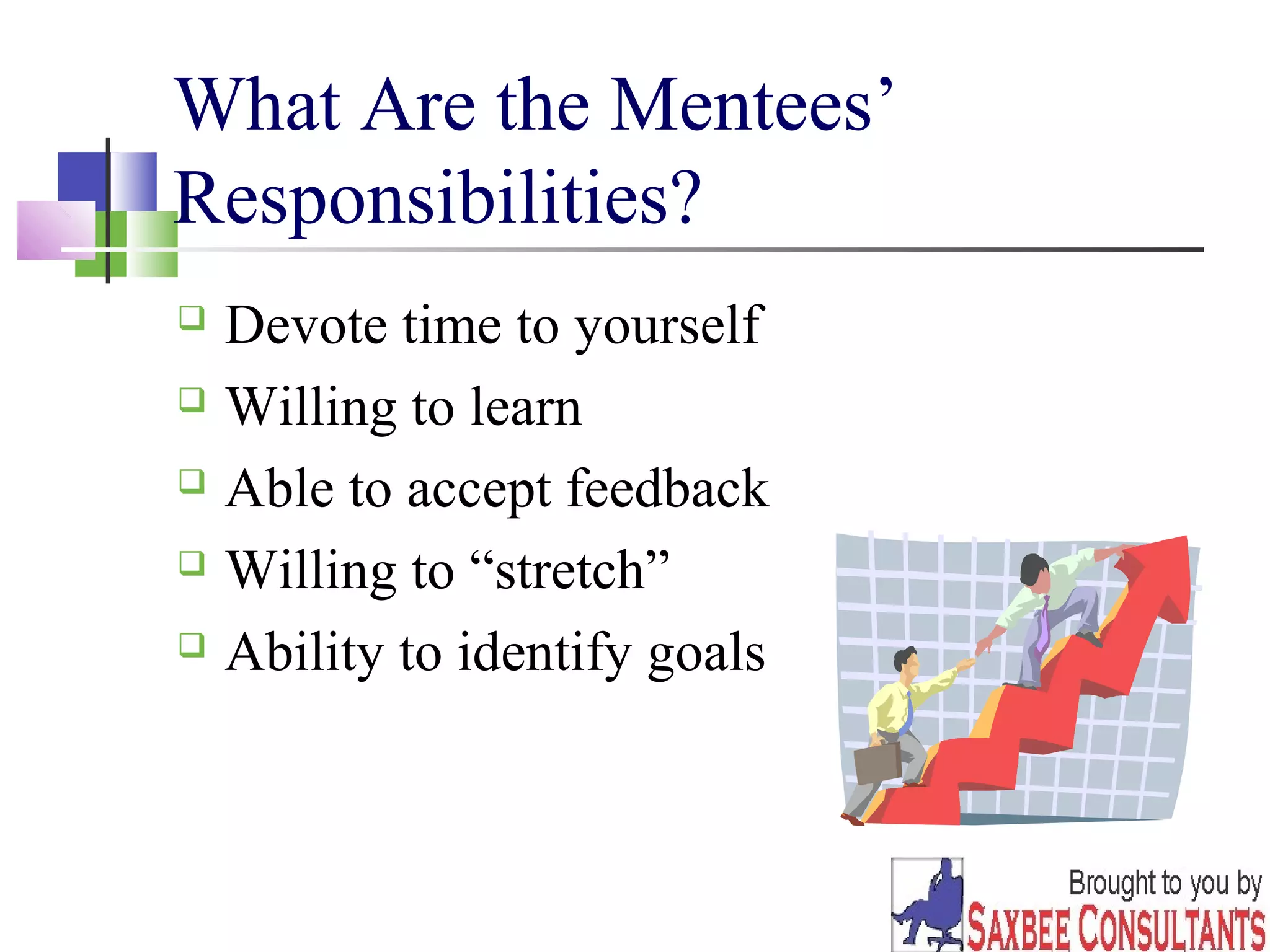
What Are the Mentees’ 
Responsibilities? 
 Devote time to yourself 
 Willing to learn 
 Able to accept feedback 
 Willing to “stretch” 
 Ability to identify goals
9 
What Does the Mentee Get Out 
of It? 
 Listening ear 
 Valuable insight 
 Understandings of strengths and 
opportunities for improvement 
 Doors opened 
 Different perspective
What Are the Different Types of 
Mentoring? 
 It is important to understand that there 
are several types of mentoring: 
10 
 Informal mentoring 
 Situational mentoring 
 Supervisory mentoring 
 Formal facilitated mentoring
11 
Step Two: Discuss Keys to 
Successful Mentoring 
 Establish a mentoring agreement 
 Commit to partnership 
 Discuss “no-fault” termination 
 Have a six month check-ups 
 Create a mentee development plan
12 
Step Three: Have Your First 
Meeting 
 Schedule a face-to-face meeting 
 Discuss mentee and mentor expectations 
 Choose a location free from distractions 
 Discuss when you will meet and how often 
 Discuss when it’s okay to phone 
 Agree to confidentiality 
 Get to know each other
13 
Step Four: Continue the 
Partnership 
 Mentor will use listening, counseling, 
coaching, career advising, and goals setting 
to help mentee make progress on their 
Career Development Plan Goals 
 Expand available options 
 Explore referral resources 
 Build self-esteem 
 Evaluate each meeting
14 
Step Five: Have a Six-month 
Check-up 
 Describe progress (i.e, what’s working, 
what’s not working, what do we need to 
change) 
 Review Career Development Plan 
 Ask questions
Reasons to Conclude Mentoring 
Partnership 
15 
 If your mentor moves into the same 
management chain 
 If your mentor moves into a different 
directorate 
 Discomfort in the relationship 
 If you grow in your career and the 
relationship is no longer valuable
16 
Step Six: Conclude the 
Mentoring Partnership 
 Many partnerships continue 
 Notify if you decide to end it early 
 Give feedback 
 Review and revise goals 
 Express gratitude
Step Seven: Consider Participating in 
the Goddard Mentoring Program 
 Center-wide Formal Mentoring Program 
 1-year in length 
 Will provide additional tools and resources 
to enable your mentoring partnership to be 
successful 
 Opportunity to network formally and 
informally with other mentors and mentees 
across the Center 
17
18 
For more Information 
 OHR Mentoring Web-site 
 AETD Minority Career Mentoring Program 
Web-site 
 Flight Programs Project Directorate Web-Site 
 Business Information Management Center 
Web-site 
 Mentoring Program Coordinators
19 
Back-Up Charts
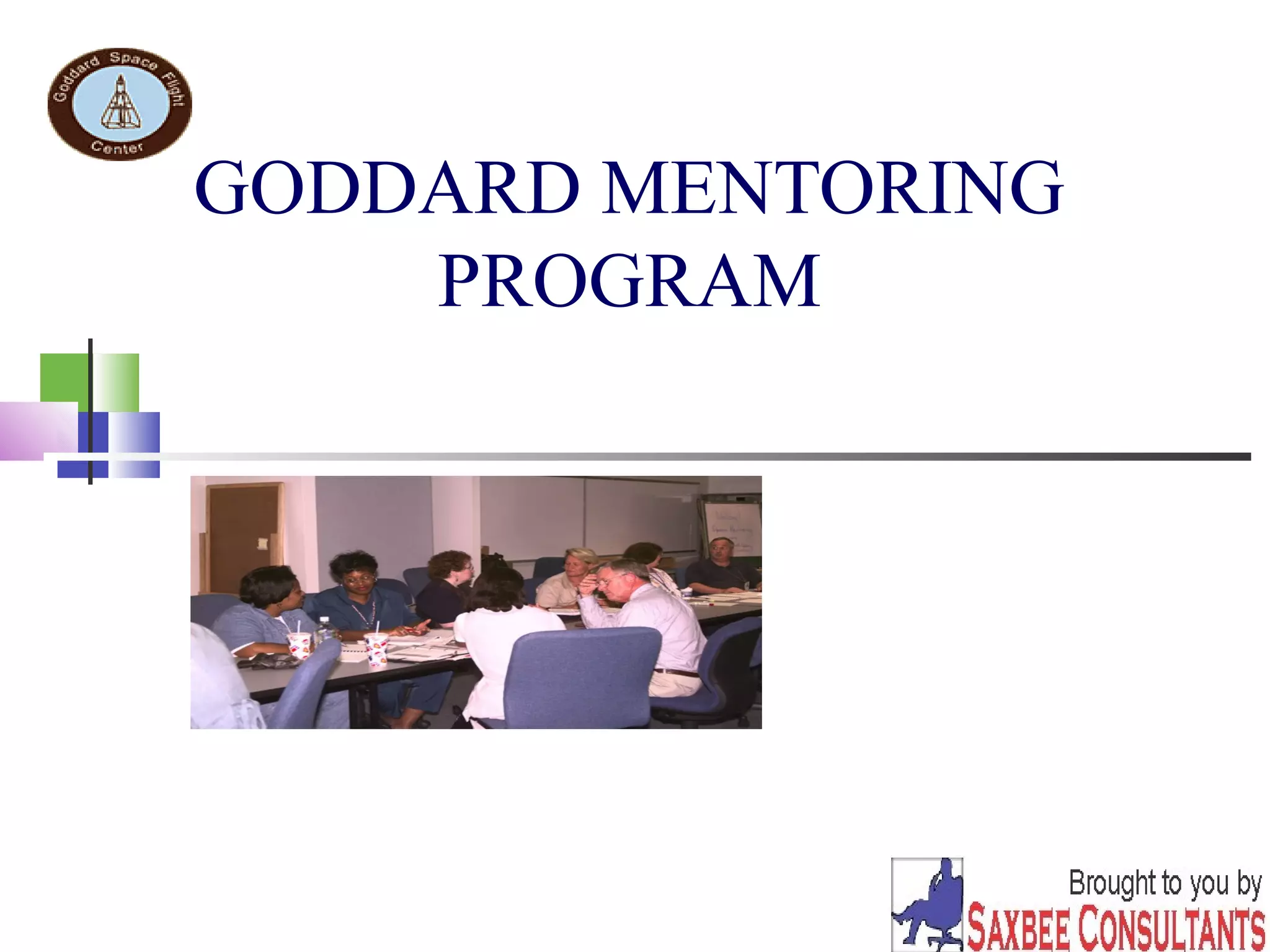
GODDARD MENTORING 
PROGRAM
21 
Mentoring Program-Background 
 Pilot Program - began January 1997 
 Program Evaluation-Issues and 
Recommendations 
 Institutionalized Goddard Mentoring 
Program -June 1999
22 
Program Purpose 
 Provide opportunity for all Goddard 
employees to benefit from mentoring 
relationship 
 Provide structure for mentoring 
relationships 
 Provide networking opportunities 
 Support goal 4, strategies 2 and 3 of the 
strategic implementation plan
23 
Program Goals 
 Gain exposure and access to different levels 
throughout the NASA Community 
 Gain an understanding of organizational values, 
relationships and unwritten rules 
 Recognize skills needed for success at NASA 
 Make realistic, achievable career plans 
 Identify developmental opportunities
24 
Mentoring Program- 
Matching Process (Cont.) 
 Identify and Select a Pool of Mentors 
 Issue Center-wide announcement requesting Mentors 
 Mentor Information Form and format for a career 
profile will be included with Announcement 
 Review Submissions and finalize selections for mentors 
 Market Program 
 Issue Center-wide announcement for Protégés 
 Protégé Information Form and format for a career 
profile will be attached to Announcement
25 
Mentoring Program- 
Matching Process (Cont.) 
 Hold Joint Orientation Session 
 Brief participants on Program requirements 
 Provide participants with matching forms and guidelines for 
selecting a mentors and protégés 
 Selection Process 
 Protégés will review profiles, research potential mentors and 
submit a matching form to the Mentoring Program Coordinator 
 Forms will be be reviewed by Mentoring Program 
Coordination Team 
 Match Mentors and Protégés 
 Notify Mentors and Protégés of Matches
26 
Mentoring Program- 
Roles and Responsibilities 
Protégés 
 Meet with Mentor at least once a month during normal work 
hours 
 Develop a Mentoring Action Plan with feedback from mentor 
and supervisor 
 Attend formal mentoring training, progress reviews and 
mentoring forums 
 Participate in 360 multi-rater feedback process 
 Keep supervisors informed 
 Give feedback on mentoring progress and design
27 
Mentoring Program- 
Roles and Responsibilities (Cont.) 
Mentor 
 Meet at least once a month 
 Attend formal mentoring training 
 Share organizational insight 
 Act as a sounding board 
 Expand protégés network 
 Assist protégé in setting developmental goals 
 Provide Developmental feedback 
 Accompany protégé to one face-to-face meeting with protégés 
supervisors 
 Give feedback on mentoring program progress and design
28 
Mentoring Program- 
Roles and Responsibilities (Cont..) 
Supervisor 
 Attend Program Orientation Session 
 Meet with mentor and protégé to provide 
collaboration input & sign-off on the Mentoring 
Action Plan 
 Provide flexibility in work schedule 
 Support the protégé during the mentoring process
29 
Program Design 
 Length 1-Year 
 Systematic matching of mentors and protégés 
 Joint Program Overview session potential mentors, 
protégés, and supervisors 
 2-day Orientation Session for mentors and protégés 
 360 Feedback Assessment for protégés 
 Mentor Experiential Coach Training 
 Monthly meetings between mentor and protégés
30 
Program Design (Cont.) 
 Mentoring Agreement 
 Mentoring Action Plans 
 Developmental Assignments 
 Networking Opportunities 
 Monthly Mentoring Forums-Informal 
Brown Bags 
 Mid-Year and End -of Year Assessments 
 Formal Recognition Ceremony
31 
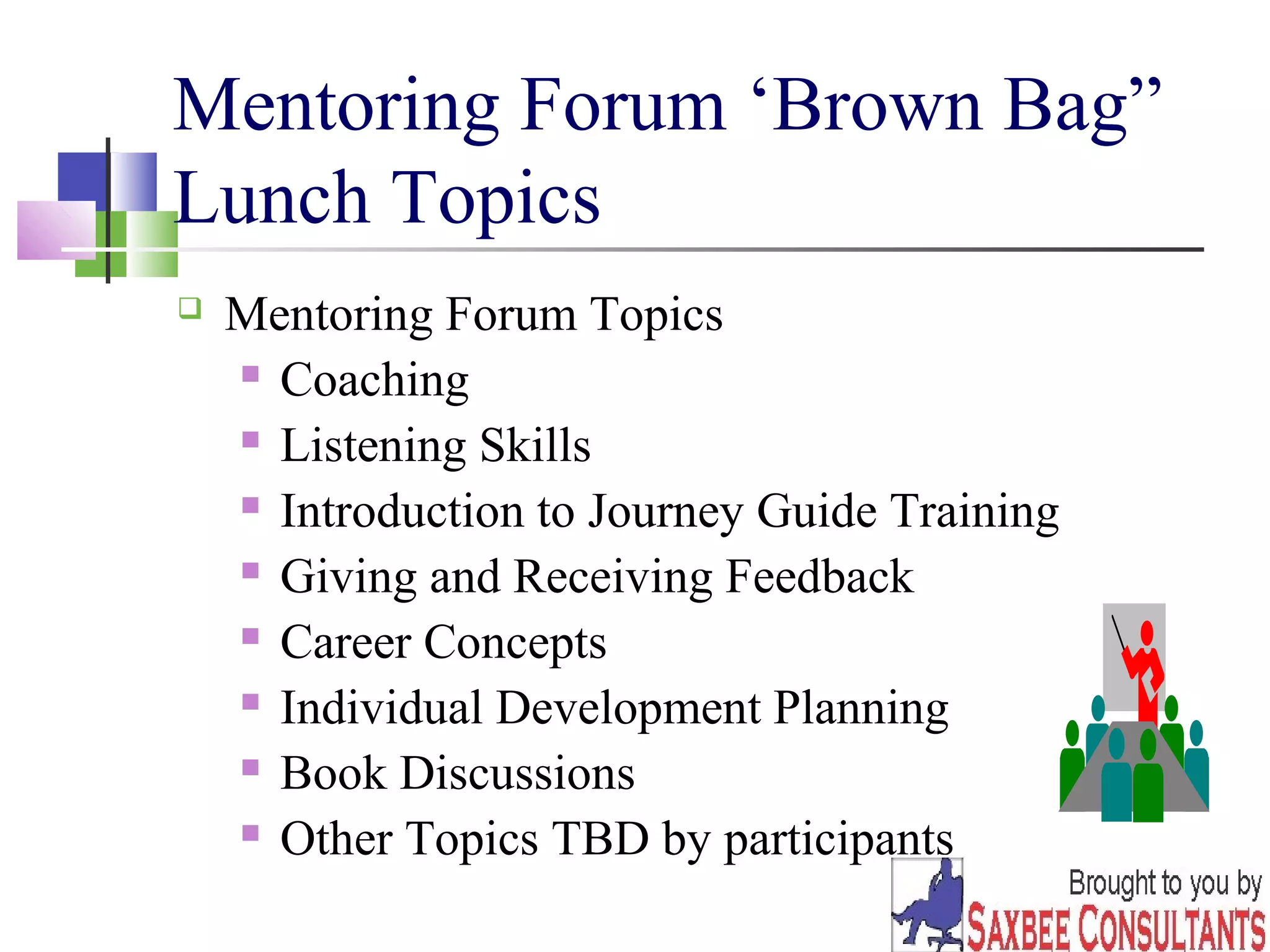
Mentoring Forum ‘Brown Bag” 
Lunch Topics 
 Mentoring Forum Topics 
 Coaching 
 Listening Skills 
 Introduction to Journey Guide Training 
 Giving and Receiving Feedback 
 Career Concepts 
 Individual Development Planning 
 Book Discussions 
 Other Topics TBD by participants
32 
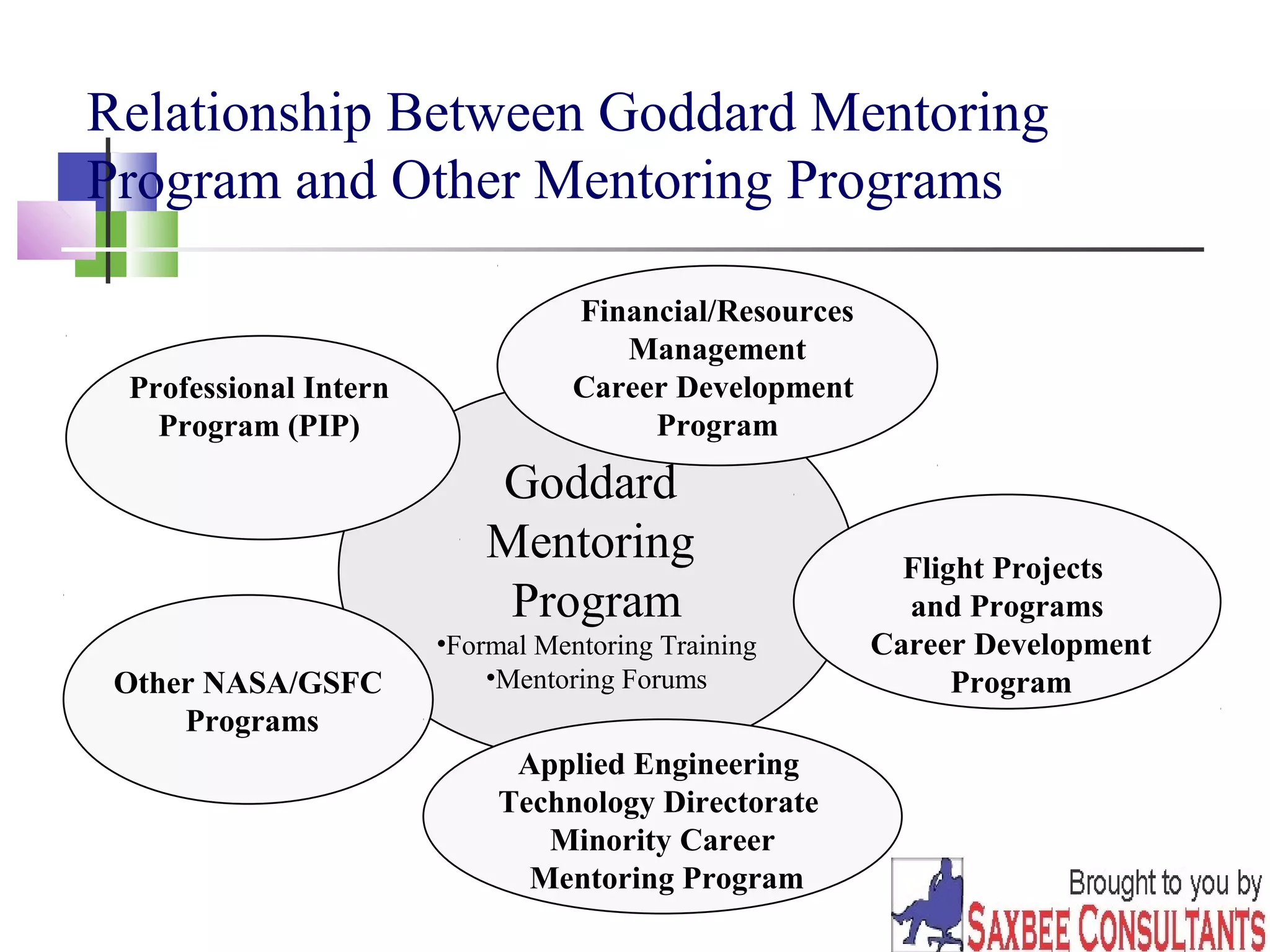
Relat ionship Between Goddard Mentoring 
Program and Other Mentoring Programs 
Goddard 
Mentoring 
Program 
•Formal Mentoring Training 
Other NASA/GSFC •Mentoring Forums 
Programs 
Flight Projects 
and Programs 
Career Development 
Program 
Professional Intern 
Program (PIP) 
Financial/Resources 
Management 
Career Development 
Program 
Applied Engineering 
Technology Directorate 
Minority Career 
Mentoring Program
33 
2000-2001 Program Schedule 
 Call for Mentors and Protégés issued on August 
21, 2000. 
 Applications due on September 13, 2000 
 Goddard Mentoring Program Overview scheduled 
for September 26, 2000 
 Goddard Mentoring Program Orientation Session 
scheduled for October 11, 2000 
 Dynamic Mentoring Workshop scheduled for 
November 7-8, 2000 & December 4-5, 2000
34 
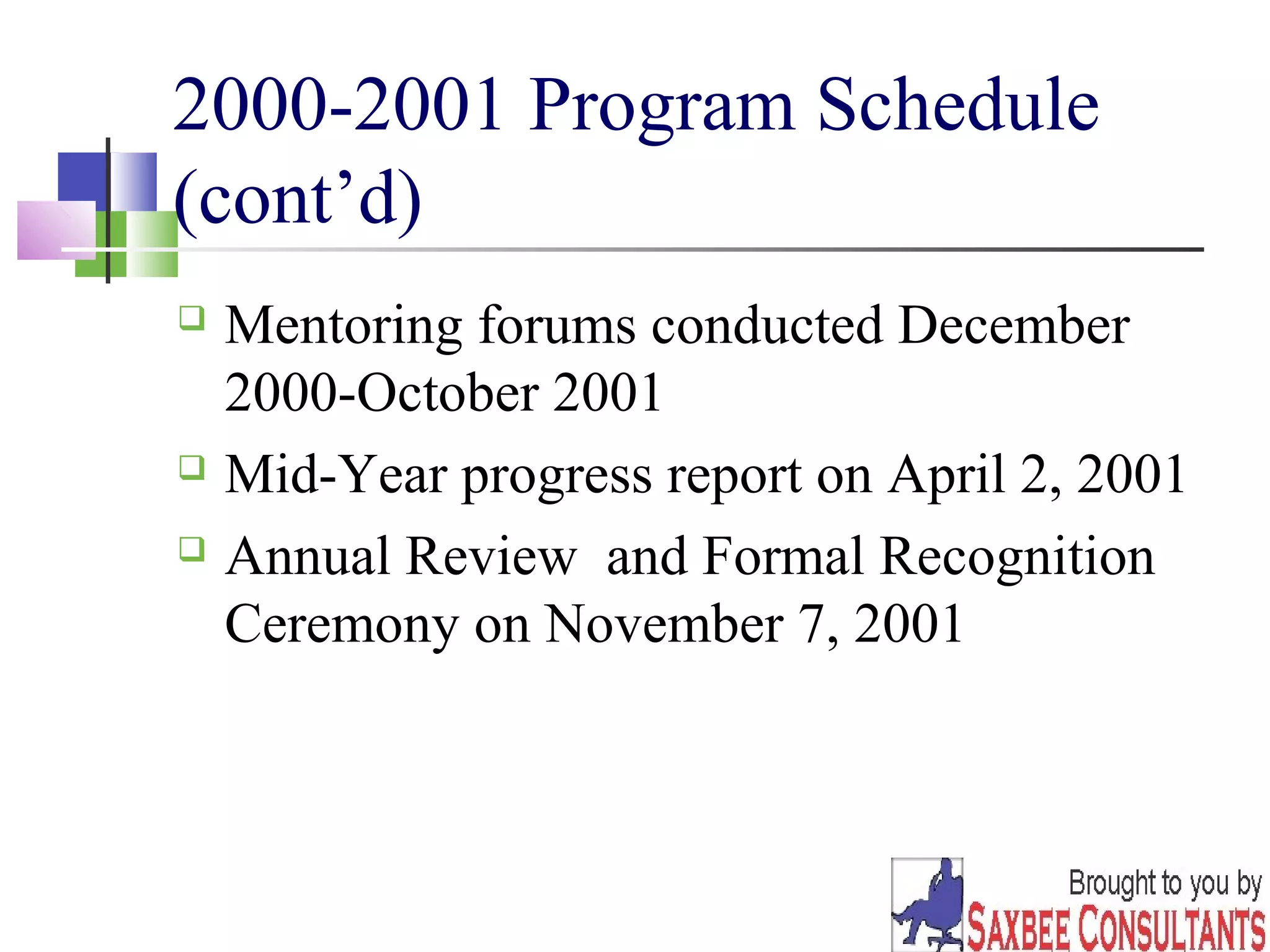
2000-2001 Program Schedule 
(cont’d) 
 Mentoring forums conducted December 
2000-October 2001 
 Mid-Year progress report on April 2, 2001 
 Annual Review and Formal Recognition 
Ceremony on November 7, 2001
Contact us 
Parveen Kumar Chadha… THINK TANK 
(Founder and C.E.O of Saxbee Consultants) 
Email :-saxbeeconsultants@gmail.com 
Mobile No. +91-9818308353 
Address:-First Floor G-20(A), Kirti Nagar, New Delhi India Postal 
Code-110015 
Should you have Good qualification, experience, expertise, 
contacts join the community of saxbee consultants

Mentoring for success

  • 1.
    Mentoring for Success What does it take to be a Mentor? What does it take to be a Mentee?
  • 2.
    2 Seven Steps 1. Learn what mentoring is all about 2. Discuss keys to successful mentoring 3. Have your first meeting 4. Continue the partnership 5. Have a six month check-up 6. Conclude the mentoring partnership 7. Consider participating in the Goddard Mentoring Program
  • 3.
    Step One: LearnWhat Mentoring Is All About  The mentoring partnership is an agreement between two people sharing experiences and expertise to help with personal and professional growth.  “In it’s simple form it is people helping people grow and develop.” 3
  • 4.
    Step One: LearnWhat Mentoring is All About (cont’d)  To learn about mentoring, you need to know:  What does it take to be a mentor?  What are the mentors responsibilities?  What does the mentor get out of it?  What are the mentee responsibilities?  What does the mentee get out of it?  What are the different types of mentoring? 4
  • 5.
    5 What Doesit Take to Be a Mentor?  Desire  Time  Reality Check (i.e., in touch with organization structure)  Experience/Wisdom  Individual career development plan
  • 6.
    6 What Arethe Mentors’ Responsibilities?  Share organizational insight  Expand mentees network  Act as a sounding board  Assist mentee with setting developmental goals  Provide developmental feedback
  • 7.
    7 What Doesthe Mentor Get Out of it?  Pass on successes  Practice interpersonal & management skills  Expand their horizons  Recognition  Gain more than the mentee does
  • 8.
    8 What Arethe Mentees’ Responsibilities?  Devote time to yourself  Willing to learn  Able to accept feedback  Willing to “stretch”  Ability to identify goals
  • 9.
    9 What Doesthe Mentee Get Out of It?  Listening ear  Valuable insight  Understandings of strengths and opportunities for improvement  Doors opened  Different perspective
  • 10.
    What Are theDifferent Types of Mentoring?  It is important to understand that there are several types of mentoring: 10  Informal mentoring  Situational mentoring  Supervisory mentoring  Formal facilitated mentoring
  • 11.
    11 Step Two:Discuss Keys to Successful Mentoring  Establish a mentoring agreement  Commit to partnership  Discuss “no-fault” termination  Have a six month check-ups  Create a mentee development plan
  • 12.
    12 Step Three:Have Your First Meeting  Schedule a face-to-face meeting  Discuss mentee and mentor expectations  Choose a location free from distractions  Discuss when you will meet and how often  Discuss when it’s okay to phone  Agree to confidentiality  Get to know each other
  • 13.
    13 Step Four:Continue the Partnership  Mentor will use listening, counseling, coaching, career advising, and goals setting to help mentee make progress on their Career Development Plan Goals  Expand available options  Explore referral resources  Build self-esteem  Evaluate each meeting
  • 14.
    14 Step Five:Have a Six-month Check-up  Describe progress (i.e, what’s working, what’s not working, what do we need to change)  Review Career Development Plan  Ask questions
  • 15.
    Reasons to ConcludeMentoring Partnership 15  If your mentor moves into the same management chain  If your mentor moves into a different directorate  Discomfort in the relationship  If you grow in your career and the relationship is no longer valuable
  • 16.
    16 Step Six:Conclude the Mentoring Partnership  Many partnerships continue  Notify if you decide to end it early  Give feedback  Review and revise goals  Express gratitude
  • 17.
    Step Seven: ConsiderParticipating in the Goddard Mentoring Program  Center-wide Formal Mentoring Program  1-year in length  Will provide additional tools and resources to enable your mentoring partnership to be successful  Opportunity to network formally and informally with other mentors and mentees across the Center 17
  • 18.
    18 For moreInformation  OHR Mentoring Web-site  AETD Minority Career Mentoring Program Web-site  Flight Programs Project Directorate Web-Site  Business Information Management Center Web-site  Mentoring Program Coordinators
  • 19.
  • 20.
  • 21.
    21 Mentoring Program-Background  Pilot Program - began January 1997  Program Evaluation-Issues and Recommendations  Institutionalized Goddard Mentoring Program -June 1999
  • 22.
    22 Program Purpose  Provide opportunity for all Goddard employees to benefit from mentoring relationship  Provide structure for mentoring relationships  Provide networking opportunities  Support goal 4, strategies 2 and 3 of the strategic implementation plan
  • 23.
    23 Program Goals  Gain exposure and access to different levels throughout the NASA Community  Gain an understanding of organizational values, relationships and unwritten rules  Recognize skills needed for success at NASA  Make realistic, achievable career plans  Identify developmental opportunities
  • 24.
    24 Mentoring Program- Matching Process (Cont.)  Identify and Select a Pool of Mentors  Issue Center-wide announcement requesting Mentors  Mentor Information Form and format for a career profile will be included with Announcement  Review Submissions and finalize selections for mentors  Market Program  Issue Center-wide announcement for Protégés  Protégé Information Form and format for a career profile will be attached to Announcement
  • 25.
    25 Mentoring Program- Matching Process (Cont.)  Hold Joint Orientation Session  Brief participants on Program requirements  Provide participants with matching forms and guidelines for selecting a mentors and protégés  Selection Process  Protégés will review profiles, research potential mentors and submit a matching form to the Mentoring Program Coordinator  Forms will be be reviewed by Mentoring Program Coordination Team  Match Mentors and Protégés  Notify Mentors and Protégés of Matches
  • 26.
    26 Mentoring Program- Roles and Responsibilities Protégés  Meet with Mentor at least once a month during normal work hours  Develop a Mentoring Action Plan with feedback from mentor and supervisor  Attend formal mentoring training, progress reviews and mentoring forums  Participate in 360 multi-rater feedback process  Keep supervisors informed  Give feedback on mentoring progress and design
  • 27.
    27 Mentoring Program- Roles and Responsibilities (Cont.) Mentor  Meet at least once a month  Attend formal mentoring training  Share organizational insight  Act as a sounding board  Expand protégés network  Assist protégé in setting developmental goals  Provide Developmental feedback  Accompany protégé to one face-to-face meeting with protégés supervisors  Give feedback on mentoring program progress and design
  • 28.
    28 Mentoring Program- Roles and Responsibilities (Cont..) Supervisor  Attend Program Orientation Session  Meet with mentor and protégé to provide collaboration input & sign-off on the Mentoring Action Plan  Provide flexibility in work schedule  Support the protégé during the mentoring process
  • 29.
    29 Program Design  Length 1-Year  Systematic matching of mentors and protégés  Joint Program Overview session potential mentors, protégés, and supervisors  2-day Orientation Session for mentors and protégés  360 Feedback Assessment for protégés  Mentor Experiential Coach Training  Monthly meetings between mentor and protégés
  • 30.
    30 Program Design(Cont.)  Mentoring Agreement  Mentoring Action Plans  Developmental Assignments  Networking Opportunities  Monthly Mentoring Forums-Informal Brown Bags  Mid-Year and End -of Year Assessments  Formal Recognition Ceremony
  • 31.
    31 Mentoring Forum‘Brown Bag” Lunch Topics  Mentoring Forum Topics  Coaching  Listening Skills  Introduction to Journey Guide Training  Giving and Receiving Feedback  Career Concepts  Individual Development Planning  Book Discussions  Other Topics TBD by participants
  • 32.
    32 Relat ionshipBetween Goddard Mentoring Program and Other Mentoring Programs Goddard Mentoring Program •Formal Mentoring Training Other NASA/GSFC •Mentoring Forums Programs Flight Projects and Programs Career Development Program Professional Intern Program (PIP) Financial/Resources Management Career Development Program Applied Engineering Technology Directorate Minority Career Mentoring Program
  • 33.
    33 2000-2001 ProgramSchedule  Call for Mentors and Protégés issued on August 21, 2000.  Applications due on September 13, 2000  Goddard Mentoring Program Overview scheduled for September 26, 2000  Goddard Mentoring Program Orientation Session scheduled for October 11, 2000  Dynamic Mentoring Workshop scheduled for November 7-8, 2000 & December 4-5, 2000
  • 34.
    34 2000-2001 ProgramSchedule (cont’d)  Mentoring forums conducted December 2000-October 2001  Mid-Year progress report on April 2, 2001  Annual Review and Formal Recognition Ceremony on November 7, 2001
  • 35.
    Contact us ParveenKumar Chadha… THINK TANK (Founder and C.E.O of Saxbee Consultants) Email :-saxbeeconsultants@gmail.com Mobile No. +91-9818308353 Address:-First Floor G-20(A), Kirti Nagar, New Delhi India Postal Code-110015 Should you have Good qualification, experience, expertise, contacts join the community of saxbee consultants