SRI PARAMAKALYANI COLLEGE
( Reaccredited with B Grade with a CGPA of 2.71 in the II Cycle by NAAC
Affiliated to Manonmaniam Sundaranar University, Tirunelveli)
ALWARKURICHI 627 412 TAMIL NADU, INDIA
POST GRADUATE & RESEARCH CENTRE - DEPARTMENT OF MICROBIOLOGY
(Government Aided)
II SEM - CORE –VIROLOGY
UNIT – 4
MYXOVIRUS
K.PETCHIMUTHU
REG NO: 20211232516119
I M.SC.MICROBIOLOGY
ASSIGNED ON:
TAKE ON :
Submitted to,
GUIDE: Dr.C.MARIAPPAN, Ph.D,
ASSISTANT PROFESSOR,
SRI PARAMAKALYANI COLLEGE,
ALWARKURICHI.
MYXOVIRUS
Synopsis
Definition
Structure
Classification
I.orthomyxovirus,
II .paramyxovirus.
MYXOVIRUS
Definition
• Myxovirus, any of the group of viruses of the families
“Orthomyxoviridae (agents of influenza) and paramyxoviridae”
members of with can cause of common cold, mumps, and measles in
humans.
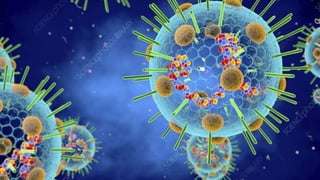
• The virus particle is enveloped in a fatty membrane, is variable in
shape. From spheroidal to filamentous, and in size 300-600nm. in
longest dimension.
Continue
• Is studded with spike like protein projections.
• It’s contains ribonuleic acid (RNA).
Structure
• The influenza virus is pleomorphic.
• The viral envelope can occur in spherical and filamentous forms.
• The virus's morphology is ellipsoidal with particles 100–120 nm in diameter, or
filamentous with particles 80–100 nm in diameter and up to 20 µm long.
• There are approximately 500 distinct spike-like surface projections in the
envelope.
• The major glycoprotein spike is interposed irregularly by clusters
of neuraminidase spikes, with a ratio about 10 to 1.
• The ribonuclearproteins are filamentous and fall in the range of 50–130 nm long
and 9–15 nm in diameter with helical symmetry.
Classification
• It is classified into two types, they are following
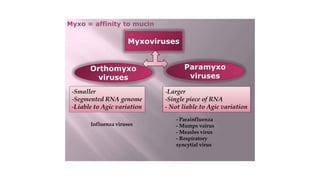
I.) Orthomyxovirus,
II.) Paramyxovirus .
I.) Orthomyxovirus
• Definition :
Any of a family of single stranded RNA viruses that have a
spherical or filamentous virion with numerous surface projection of
glycoprotein and include the causative agents of influenza.
• The family Orthomyxoviridae contain significant pathogens of
human and animals .
• Spherical to filamentous.
• 100nm in diameter.
• Genomes are segmented, single –stranded negative –strand RNA
Genera Included :
I.) Alpha influenzavirus .
II.) Beta influenzavirus.
III.) delta influenzavirus .
IV.)Gamma influenzavirus.
V.) Isavirus (Infectious Salmon Anaemia virus).
VI.) Thogotovirus.
VII.) Quaranjavirus.
Causing Diseases:
• Alpha influenza viruses infect humans other mammals and birds.
• Beta influenza viruses infect humans and seals.
• Gamma influenza viruses infect humans, pigs and dogs.
• Delta influenza viruses infect pigs and cattle.
• Isaviruses infect salmon.
• Thogotoviruses are arboviruses, infecting vertebrates and
invertebrates.
• Thogotoviruses are also arboviruses infecting vertebrates and
invertebrates.
Structure :
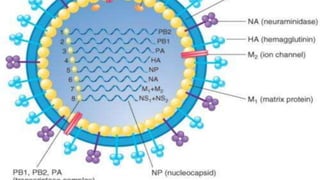
• Influenza viruses are spherical or filamentous enveloped particles 80 to
120 nm in diameter.
• The genomes Orthomyxovirus consist of multiple segment of negative
senes, single strand RNA molecules each packaged in the form of rod –
shaped, double –helical ribonucleoprotin (RNP) complexes.
• The envelope carries a hemagglutinin attachment protein and a
neuraminidase.
• The antisense RNA genome occurs in eight separate segments containing
10 genes.
• The nucleocapsid is enclosed in an envelope consisting of a lipid bilayer
and two surface glycoproteins, a hemagglutinin and a neuraminidase.
Pathogenesis :
• The virus is transmitted in aerosols of respiratory secretions.
• Influenza virus is transmitted from person to person primarily in
droplets released by sneezing and coughing.
• In an uncomplicated case, virus can be recovered from respiratory
secretions for 3 to 8 days.
• Infection of mucosal cells results in cellular destruction and
desquamation of the superficial mucosa.
• It multiplies in the respiratory mucosa, causing cellular destruction
and inflammation.
Host defense :
• The immune mechanisms responsible for recovery from influenza have
not been clearly delineated.
• Both a cell –mediated responses and antibody develop after infection.
• Antibody provides long-lasting immunity against the infecting strain.
• Several mechanisms probably act in concert.
• Immunity to an influenza virus strain lasts for many years.
• Recurrent cases of influenza are caused primarily by antigenically
different strains.
Epidemiology :
• Influenza epidemic involving all age groups occur each winter.
• World wide pandemic appear irregularly.
• Changes in the hemagglutinin and neuraminidase surface antigens
are responsible for the appearance of antigenically novel strains that
evade host immunity and cause reinfections.
• In the initial phases of an epidemic, infection and illness appear
predominantly in school-aged children, as indicated by a sharp rise in
school absences, physician visits, and pediatric hospital admissions.
Diagnosis :
• A diagnosis of influenza is suggested by the clinical picture of sudden
onset of fever, malaise, headache, marked muscle aches, sore throat,
nonproductive cough, and coryza.
• The diagnosis is suggested by the symptoms, particularlly it an
influenza epidemic is under way.
• Influenza virus is usually isolated from respiratory secretions by being
grown in tissue cultures or chick embryos.
• Definitive diagnosis depends on detecting the virus or a rise in
antibody titer
Prevention and control :
• Inactivated influenza virus vaccines have been used for about 40
years to prevent influenza.
• The viruses for the vaccine are grown in chick embryos, inactivated
by formalin, purified to some extent, and adjusted to a dosage known
to elicit an antibody response in most individuals.
• An inactivated virus vaccine is developed each year against the strains
most likely to cause disease the next winter.
• The drugs “amantadine and rimantadine” can be used for prophylaxis
and treatment of influenza A infection.
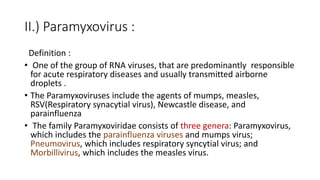
II.) Paramyxovirus :
Definition :
• One of the group of RNA viruses, that are predominantly responsible
for acute respiratory diseases and usually transmitted airborne
droplets .
• The Paramyxoviruses include the agents of mumps, measles,
RSV(Respiratory synacytial virus), Newcastle disease, and
parainfluenza
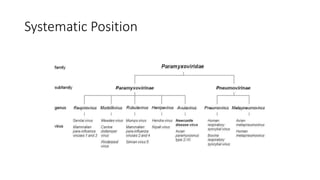
• The family Paramyxoviridae consists of three genera: Paramyxovirus,
which includes the parainfluenza viruses and mumps virus;
Pneumovirus, which includes respiratory syncytial virus; and
Morbillivirus, which includes the measles virus.
Systematic Position
Diseases caused
•Paramyxovirus infections, including measles,
mumps, croup, parainfluenza virus, and
respiratory syncytial virus, is often seen by
physicians and health care providers in a clinic or
in an emergency department, especially during
the winter times.
Structure
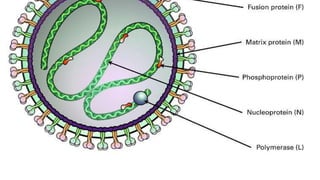
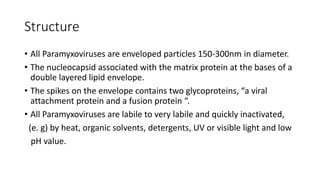
• All Paramyxoviruses are enveloped particles 150-300nm in diameter.
• The nucleocapsid associated with the matrix protein at the bases of a
double layered lipid envelope.
• The spikes on the envelope contains two glycoproteins, “a viral
attachment protein and a fusion protein “.
• All Paramyxoviruses are labile to very labile and quickly inactivated,
(e. g) by heat, organic solvents, detergents, UV or visible light and low
pH value.
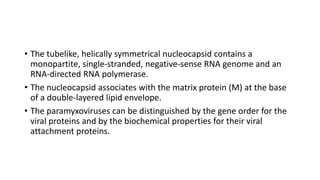
• The tubelike, helically symmetrical nucleocapsid contains a
monopartite, single-stranded, negative-sense RNA genome and an
RNA-directed RNA polymerase.
• The nucleocapsid associates with the matrix protein (M) at the base
of a double-layered lipid envelope.
• The paramyxoviruses can be distinguished by the gene order for the
viral proteins and by the biochemical properties for their viral
attachment proteins.
Pathognesis :
• Pathognesis of Paramyxoviruses and respiratory syncytial virus
infection.
• These viruses first infect the ciliated epithelial cell of the nose and
throat.
• Infection may extend to the paranasal Sinuses the middle ear, and
occasionally to the lower respiratory tract.
• Transmission is by droplets or direct contact.
• The virus disseminates locally in the ciliated epithelial cells of the
respiratory mucosa.
Host defense :
• The immunologic events during and after natural infection with
parainfluenza viruses in infants and children are not well understood.
• Nonspecific defense including interferon, are followed by the
appearance of secretory and humeral andibodies and cell mediated
immune responses.
• Reinfections occurs, but the frequency and severity of disease
decreases with age.
• Serum antibodies usually are not significant in resistance to
reinfection with the nonsystemic respiratory viruses, but their
presence in high titers may restrict local virus multiplication and
disease manifestation.
Epidemiology :
• The Paramyxoviruses are distributed worldwide, causing infection and
illness in young children.
• These virus infection are endemic, sometimes reaching epidemic
proportions.
• Infections with parainfluenza virus types 1 and 2 peak in the winter
months, whereas parainfluenza virus type 3 appears throughout the
year.
Diagnosis
• Diagnosis based on clinical manifestations is not possible.
• Laboratory diagnosis is made by detection of viral antigens by
fluorescent-antibody staining of nasopharyngeal cells or the enzyme-
linked immunosorbent assay in sonicated nasopharyngeal specimens.
• A reverse transcription PCR enzyme immunoassay is available for
rapid detection of parainfluenza type 3 RNA in respiratory specimens.
• Serologic evidence of infection may be obtained by demonstrating a
significant rise in antibody titer between two serum samples.
• Serodiagnosis by this means is clouded by the heterotypic
anamnestic responses to previous parainfluenza infection.
• Vaccination is a very effective means of controlling Paramyxovirus
infection.
• Both live attenuated and inactivated vaccines have been developed
for major animal Paramyxovirus pathogens.
• Live attenuated vaccines topicaly are more effective than the
inactivated vaccines.
• Active immunization against parainfluenza viruses is desirable but not
yet available. Experimental killed vaccines are not effective.
• Ribavirin may be effective but it also has toxic side effects.
Prevention and control :
NEVER STOP
LEARNING, BECAUSE
LIFE NEVER STOPS
TEACHING .
THANKS TO

Myxovirus.pptx

  • 1.
    SRI PARAMAKALYANI COLLEGE (Reaccredited with B Grade with a CGPA of 2.71 in the II Cycle by NAAC Affiliated to Manonmaniam Sundaranar University, Tirunelveli) ALWARKURICHI 627 412 TAMIL NADU, INDIA POST GRADUATE & RESEARCH CENTRE - DEPARTMENT OF MICROBIOLOGY (Government Aided) II SEM - CORE –VIROLOGY UNIT – 4 MYXOVIRUS K.PETCHIMUTHU REG NO: 20211232516119 I M.SC.MICROBIOLOGY ASSIGNED ON: TAKE ON : Submitted to, GUIDE: Dr.C.MARIAPPAN, Ph.D, ASSISTANT PROFESSOR, SRI PARAMAKALYANI COLLEGE, ALWARKURICHI.
  • 2.
  • 3.
  • 4.
  • 6.
    Definition • Myxovirus, anyof the group of viruses of the families “Orthomyxoviridae (agents of influenza) and paramyxoviridae” members of with can cause of common cold, mumps, and measles in humans. • The virus particle is enveloped in a fatty membrane, is variable in shape. From spheroidal to filamentous, and in size 300-600nm. in longest dimension.
  • 7.
    Continue • Is studdedwith spike like protein projections. • It’s contains ribonuleic acid (RNA).
  • 8.
    Structure • The influenzavirus is pleomorphic. • The viral envelope can occur in spherical and filamentous forms. • The virus's morphology is ellipsoidal with particles 100–120 nm in diameter, or filamentous with particles 80–100 nm in diameter and up to 20 µm long. • There are approximately 500 distinct spike-like surface projections in the envelope. • The major glycoprotein spike is interposed irregularly by clusters of neuraminidase spikes, with a ratio about 10 to 1. • The ribonuclearproteins are filamentous and fall in the range of 50–130 nm long and 9–15 nm in diameter with helical symmetry.
  • 9.
    Classification • It isclassified into two types, they are following I.) Orthomyxovirus, II.) Paramyxovirus .
  • 11.
    I.) Orthomyxovirus • Definition: Any of a family of single stranded RNA viruses that have a spherical or filamentous virion with numerous surface projection of glycoprotein and include the causative agents of influenza. • The family Orthomyxoviridae contain significant pathogens of human and animals . • Spherical to filamentous. • 100nm in diameter. • Genomes are segmented, single –stranded negative –strand RNA
  • 12.
    Genera Included : I.)Alpha influenzavirus . II.) Beta influenzavirus. III.) delta influenzavirus . IV.)Gamma influenzavirus. V.) Isavirus (Infectious Salmon Anaemia virus). VI.) Thogotovirus. VII.) Quaranjavirus.
  • 13.
    Causing Diseases: • Alphainfluenza viruses infect humans other mammals and birds. • Beta influenza viruses infect humans and seals. • Gamma influenza viruses infect humans, pigs and dogs. • Delta influenza viruses infect pigs and cattle. • Isaviruses infect salmon. • Thogotoviruses are arboviruses, infecting vertebrates and invertebrates. • Thogotoviruses are also arboviruses infecting vertebrates and invertebrates.
  • 14.
    Structure : • Influenzaviruses are spherical or filamentous enveloped particles 80 to 120 nm in diameter. • The genomes Orthomyxovirus consist of multiple segment of negative senes, single strand RNA molecules each packaged in the form of rod – shaped, double –helical ribonucleoprotin (RNP) complexes. • The envelope carries a hemagglutinin attachment protein and a neuraminidase. • The antisense RNA genome occurs in eight separate segments containing 10 genes. • The nucleocapsid is enclosed in an envelope consisting of a lipid bilayer and two surface glycoproteins, a hemagglutinin and a neuraminidase.
  • 15.
    Pathogenesis : • Thevirus is transmitted in aerosols of respiratory secretions. • Influenza virus is transmitted from person to person primarily in droplets released by sneezing and coughing. • In an uncomplicated case, virus can be recovered from respiratory secretions for 3 to 8 days. • Infection of mucosal cells results in cellular destruction and desquamation of the superficial mucosa. • It multiplies in the respiratory mucosa, causing cellular destruction and inflammation.
  • 16.
    Host defense : •The immune mechanisms responsible for recovery from influenza have not been clearly delineated. • Both a cell –mediated responses and antibody develop after infection. • Antibody provides long-lasting immunity against the infecting strain. • Several mechanisms probably act in concert. • Immunity to an influenza virus strain lasts for many years. • Recurrent cases of influenza are caused primarily by antigenically different strains.
  • 17.
    Epidemiology : • Influenzaepidemic involving all age groups occur each winter. • World wide pandemic appear irregularly. • Changes in the hemagglutinin and neuraminidase surface antigens are responsible for the appearance of antigenically novel strains that evade host immunity and cause reinfections. • In the initial phases of an epidemic, infection and illness appear predominantly in school-aged children, as indicated by a sharp rise in school absences, physician visits, and pediatric hospital admissions.
  • 18.
    Diagnosis : • Adiagnosis of influenza is suggested by the clinical picture of sudden onset of fever, malaise, headache, marked muscle aches, sore throat, nonproductive cough, and coryza. • The diagnosis is suggested by the symptoms, particularlly it an influenza epidemic is under way. • Influenza virus is usually isolated from respiratory secretions by being grown in tissue cultures or chick embryos. • Definitive diagnosis depends on detecting the virus or a rise in antibody titer
  • 19.
    Prevention and control: • Inactivated influenza virus vaccines have been used for about 40 years to prevent influenza. • The viruses for the vaccine are grown in chick embryos, inactivated by formalin, purified to some extent, and adjusted to a dosage known to elicit an antibody response in most individuals. • An inactivated virus vaccine is developed each year against the strains most likely to cause disease the next winter. • The drugs “amantadine and rimantadine” can be used for prophylaxis and treatment of influenza A infection.
  • 21.
    II.) Paramyxovirus : Definition: • One of the group of RNA viruses, that are predominantly responsible for acute respiratory diseases and usually transmitted airborne droplets . • The Paramyxoviruses include the agents of mumps, measles, RSV(Respiratory synacytial virus), Newcastle disease, and parainfluenza • The family Paramyxoviridae consists of three genera: Paramyxovirus, which includes the parainfluenza viruses and mumps virus; Pneumovirus, which includes respiratory syncytial virus; and Morbillivirus, which includes the measles virus.
  • 22.
  • 23.
    Diseases caused •Paramyxovirus infections,including measles, mumps, croup, parainfluenza virus, and respiratory syncytial virus, is often seen by physicians and health care providers in a clinic or in an emergency department, especially during the winter times.
  • 24.
    Structure • All Paramyxovirusesare enveloped particles 150-300nm in diameter. • The nucleocapsid associated with the matrix protein at the bases of a double layered lipid envelope. • The spikes on the envelope contains two glycoproteins, “a viral attachment protein and a fusion protein “. • All Paramyxoviruses are labile to very labile and quickly inactivated, (e. g) by heat, organic solvents, detergents, UV or visible light and low pH value.
  • 25.
    • The tubelike,helically symmetrical nucleocapsid contains a monopartite, single-stranded, negative-sense RNA genome and an RNA-directed RNA polymerase. • The nucleocapsid associates with the matrix protein (M) at the base of a double-layered lipid envelope. • The paramyxoviruses can be distinguished by the gene order for the viral proteins and by the biochemical properties for their viral attachment proteins.
  • 26.
    Pathognesis : • Pathognesisof Paramyxoviruses and respiratory syncytial virus infection. • These viruses first infect the ciliated epithelial cell of the nose and throat. • Infection may extend to the paranasal Sinuses the middle ear, and occasionally to the lower respiratory tract. • Transmission is by droplets or direct contact. • The virus disseminates locally in the ciliated epithelial cells of the respiratory mucosa.
  • 27.
    Host defense : •The immunologic events during and after natural infection with parainfluenza viruses in infants and children are not well understood. • Nonspecific defense including interferon, are followed by the appearance of secretory and humeral andibodies and cell mediated immune responses. • Reinfections occurs, but the frequency and severity of disease decreases with age. • Serum antibodies usually are not significant in resistance to reinfection with the nonsystemic respiratory viruses, but their presence in high titers may restrict local virus multiplication and disease manifestation.
  • 28.
    Epidemiology : • TheParamyxoviruses are distributed worldwide, causing infection and illness in young children. • These virus infection are endemic, sometimes reaching epidemic proportions. • Infections with parainfluenza virus types 1 and 2 peak in the winter months, whereas parainfluenza virus type 3 appears throughout the year.
  • 29.
    Diagnosis • Diagnosis basedon clinical manifestations is not possible. • Laboratory diagnosis is made by detection of viral antigens by fluorescent-antibody staining of nasopharyngeal cells or the enzyme- linked immunosorbent assay in sonicated nasopharyngeal specimens. • A reverse transcription PCR enzyme immunoassay is available for rapid detection of parainfluenza type 3 RNA in respiratory specimens. • Serologic evidence of infection may be obtained by demonstrating a significant rise in antibody titer between two serum samples. • Serodiagnosis by this means is clouded by the heterotypic anamnestic responses to previous parainfluenza infection.
  • 30.
    • Vaccination isa very effective means of controlling Paramyxovirus infection. • Both live attenuated and inactivated vaccines have been developed for major animal Paramyxovirus pathogens. • Live attenuated vaccines topicaly are more effective than the inactivated vaccines. • Active immunization against parainfluenza viruses is desirable but not yet available. Experimental killed vaccines are not effective. • Ribavirin may be effective but it also has toxic side effects. Prevention and control :
  • 32.
    NEVER STOP LEARNING, BECAUSE LIFENEVER STOPS TEACHING .
  • 33.