Musculoskeletal Disorders Part I
Degenerative & Metabolic bone disorders
    Maria Carmela L. Domocmat, RN,MSN
    Instructor
    School of Nursing
    Northern Luzon Adventist College
    Artacho, Sison, Pangasinan
2

                                       Maria Carmela L.   3/5/2012
                                    Domocmat, RN, MSN


Overview
• Part 1: Degenerative & Metabolic bone disorders
    ▫   OA
    ▫   Gout and gouty arthritis
    ▫   Osteoporosis
    ▫   Paget’s dse
    ▫   Osteomalacia
•   Part 2: Bone infections
•   Part 3: Muscular disorders
•   Part 4: Disorders of the hand
•   Part 5: Spinal column deformities
•   Part 6 : Disorders of foot
•   Part 7: Sports Injuries
3


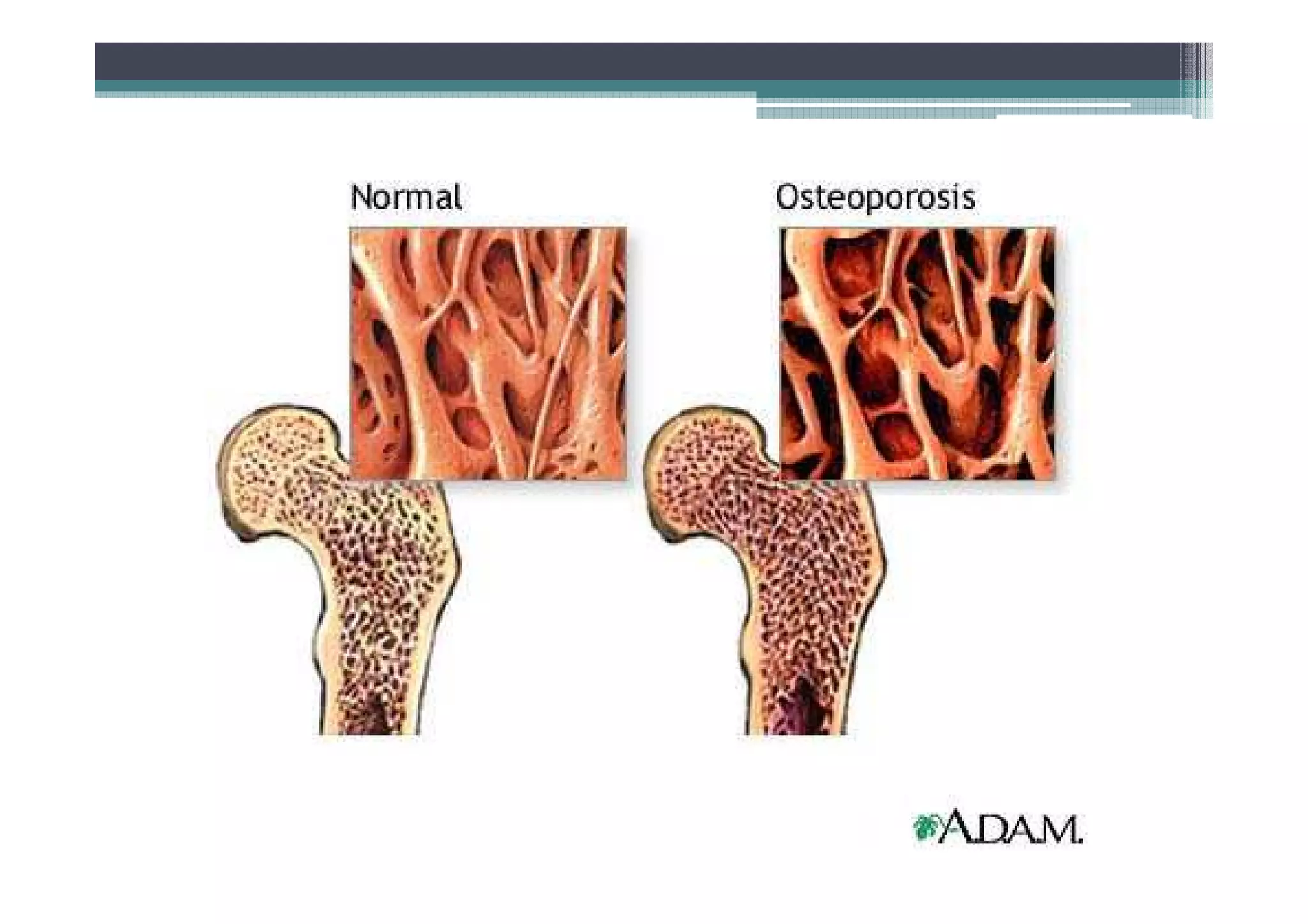
Osteoporosis
                  Maria Carmela L.   3/5/2012
               Domocmat, RN, MSN
4

   Maria Carmela L.   3/5/2012
Domocmat, RN, MSN
Skeleton
The skeleton consists of groups of bones
which protect and move the body.
Osteoporosis risk factors mnemonic
• ACCESS:
 ▫   Alcohol
 ▫   Corticosteroid
 ▫   Calcium low
 ▫   Estrogen low
 ▫   Smoking
 ▫   Sedentary lifestyle
http://www.myphysio.ca/site_assets/www.myphysio.ca/images/dynamic/ost
eoporosis.jpg
14

   Maria Carmela L.   3/5/2012
Domocmat, RN, MSN
http://healthinfo.fitnessguide101.com/wp-
content/uploads/2010/10/Boneloss.jpg
21

   Maria Carmela L.   3/5/2012
Domocmat, RN, MSN
http://images.emedicinehealth.com/images/SlideShow/Osteoporosis_s1_bo
ne_density.jpg
Osteoporosis Symptoms: Stress Fracture
A fracture that occurs during the course of normal activity is
called a minimal trauma fracture or stress fracture. For
example, some patients with osteoporosis develop stress
fractures of the feet while walking or stepping off a curb.
Osteoporosis
Symptoms: Hip Fracture
Hip fractures typically occur
as a result of a fall. With
osteoporosis, hip fractures
can occur as a result of
trivial accidents. Hip
fractures may also be
difficult to heal after surgical
repair because of poor bone
quality
30

                          Maria Carmela L.   3/5/2012
                       Domocmat, RN, MSN


Orthotics (thoracolumbosacral
orthosis)
• decrease flexion
  forces
• prevent worsening
  of kyphosis
• reduce pressure on
  fracture sites
Osteomalacia
• Osteomalacia means "soft bones".
• is softening of the bones due to a lack of vitamin
  D or a problem with the body's ability to break
  down and use this vitamin.


   http://www.ncbi.nlm.nih.gov/pubmedhealth/PMH0001414/
Osteomalacia
• characterized by incomplete mineralization of
  normal osteoid tissue following closure of the
  growth plates.


   http://www.ncbi.nlm.nih.gov/pubmedhealth/PMH0001414/
• Osteoid
  ▫ bone protein matrix, composed primarily of type 1 collagen.
  ▫ When there is insufficient mineral or osteoblast
    dysfunction, the osteoid does not mineralize properly, and
    it accumulates.
• When the newly formed bone of the growth plate does
  not mineralize, the growth plate becomes thick, wide and
  irregular. This results in the clinical diagnosis of rickets,
  and is seen only in children because adults no longer
  have growth plates. When the remodeled bone does not
  mineralize, osteomalacia occurs, and this happens in all
  ages. Most of the hereditary causes of osteomalacia
  appear during childhood and cause rickets.
        http://courses.washington.edu/bonephys/hypercalU/opmal2.html
35

   Maria Carmela L.   3/5/2012
Domocmat, RN, MSN
36

   Maria Carmela L.   3/5/2012
Domocmat, RN, MSN
http://www.moondragon.org/health/graphics/osteomalaciaadult.jpg
38

   Maria Carmela L.   3/5/2012
Domocmat, RN, MSN
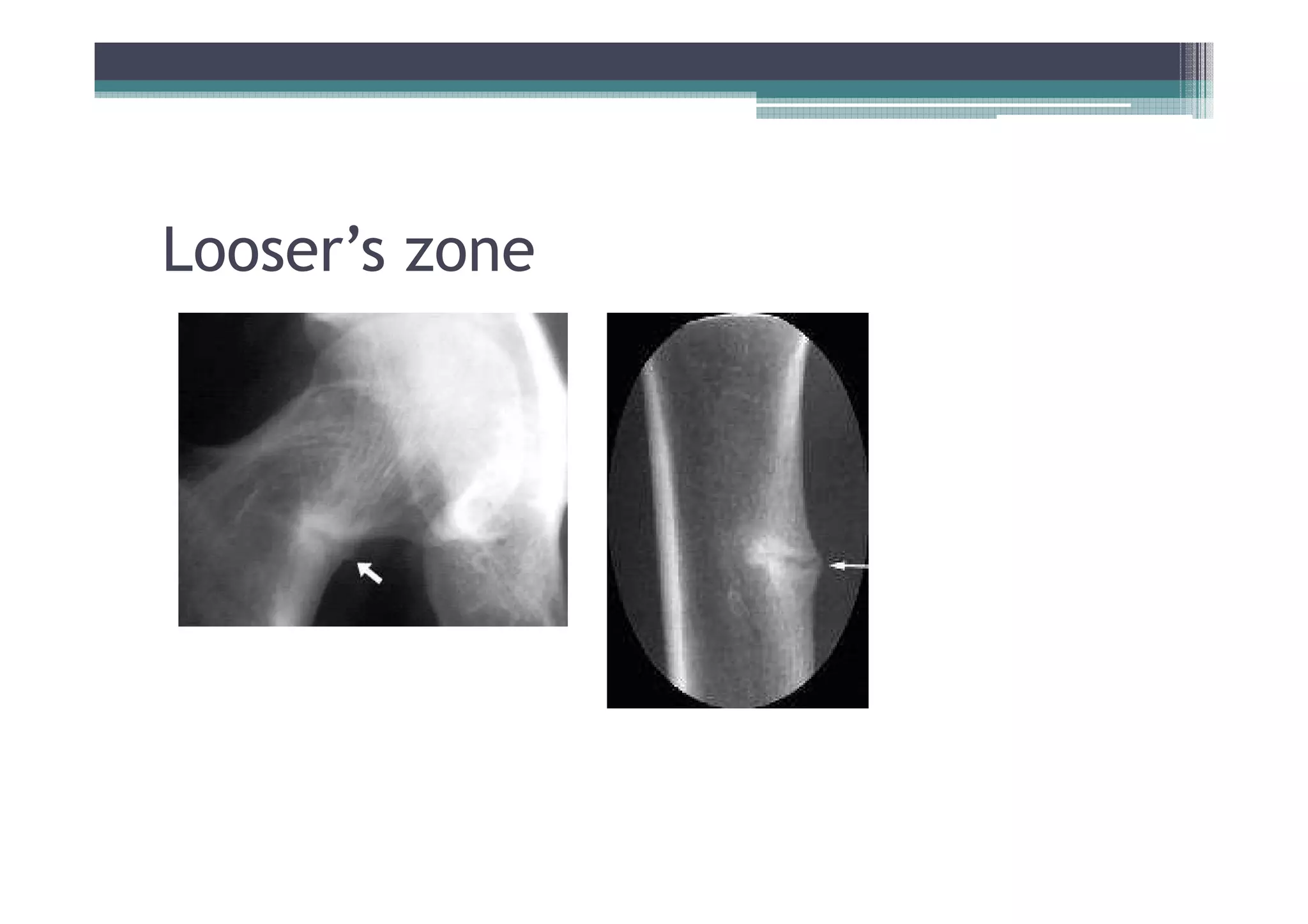
Looser’s zone
• xray showing a pseudofracture      • This is an xray of a child with
  (red arrow) from an adult who        bowed legs due to rickets
  has x-linked
  hypophosphatemic rickets.
• This is a classic pseudofracture
  and is pathognomonic for
  osteomalacia.
Treatment
• vitamin D, calcium, and phosphorus
  supplements, taken by mouth.
• Larger doses of vitamin D and calcium may be
  needed for people who cannot properly absorb
  nutrients into the intestines.
• Regular blood tests may be needed to monitor
  blood levels of phosphorus and calcium in
  persons with certain underlying conditions.
http://www.ncbi.nlm.nih.gov/pubmedhealth/PMH0001414/
47
http://ods.od.nih.gov/factsheets/VitaminD-                          Maria Carmela L.   3/5/2012
HealthProfessional/                                              Domocmat, RN, MSN


   Recommended Dietary Allowances
   (RDAs) for Vitamin D
 Age                  Male                   Female              Pregnancy                        Lactation

                                400 IU                  400 IU
 0–12 months*
                              (10 mcg)                (10 mcg)
                                 600 IU                 600 IU
 1–13 years
                               (15 mcg)               (15 mcg)
                                 600 IU                 600 IU                   600 IU                    600 IU
 14–18 years
                               (15 mcg)               (15 mcg)                 (15 mcg)                  (15 mcg)
                                 600 IU                 600 IU                   600 IU                    600 IU
 19–50 years
                               (15 mcg)               (15 mcg)                 (15 mcg)                  (15 mcg)
                                 600 IU                 600 IU
 51–70 years
                               (15 mcg)               (15 mcg)
                                800 IU              800 IU
 >70 years
                              (20 mcg)            (20 mcg)
48

                                                    Maria Carmela L.   3/5/2012
                                                 Domocmat, RN, MSN


  Tolerable Upper Intake Levels (ULs) for
  Vitamin D
                                                                                  Lactation
Age           Male               Female          Pregnancy

                      1,000 IU        1,000 IU
0–6 months
                      (25 mcg)        (25 mcg)
                      1,500 IU        1,500 IU
7–12 months
                      (38 mcg)        (38 mcg)
                      2,500 IU        2,500 IU
1–3 years
                      (63 mcg)        (63 mcg)
                     3,000 IU         3,000 IU
4–8 years
                     (75 mcg)         (75 mcg)
                      4,000 IU        4,000 IU             4,000 IU                    4,000 IU
≥9 years
                     (100 mcg)       (100 mcg)            (100 mcg)                   (100 mcg)
49
http://ods.od.nih.gov/factsheets/VitaminD-                    Maria Carmela L.   3/5/2012
HealthProfessional/                                        Domocmat, RN, MSN


    Selected Food Sources of Vitamin D
                                                                                            IUs per Percent
Food
                                                                                            serving* DV**
Cod liver oil, 1 tablespoon                                                                    1,360    340
Swordfish, cooked, 3 ounces                                                                      566    142
Salmon (sockeye), cooked, 3 ounces                                                               447     112
Tuna fish, canned in water, drained, 3 ounces                                                    154      39
Orange juice fortified with vitamin D, 1 cup (check product labels, as amount
                                                                                                 137     34
of added vitamin D varies)
Milk, nonfat, reduced fat, and whole, vitamin D-fortified, 1 cup                             115-124   29-31
Yogurt, fortified with 20% of the DV for vitamin D, 6 ounces (more heavily
                                                                                                 80      20
fortified yogurts provide more of the DV)
Margarine, fortified, 1 tablespoon                                                               60      15
Sardines, canned in oil, drained, 2 sardines                                                     46      12
Liver, beef, cooked, 3 ounces                                                                    42      11
Egg, 1 large (vitamin D is found in yolk)                                                        41      10
Ready-to-eat cereal, fortified with 10% of the DV for vitamin D, 0.75-1 cup
                                                                                                 40      10
(more heavily fortified cereals might provide more of the DV)
Cheese, Swiss, 1 ounce                                                                            6       2
Expectations (prognosis)
• Improvement can be seen within a few weeks in
  some people with vitamin deficiency disorders.
  Complete healing with treatment takes place in 6
  months.


http://www.ncbi.nlm.nih.gov/pubmedhealth/PMH0001414/
Prevention
• diet rich in vitamin D
• get plenty of sunlight


http://www.ncbi.nlm.nih.gov/pubmedhealth/PMH0001414/
53

   Maria Carmela L.   3/5/2012
Domocmat, RN, MSN
54

   Maria Carmela L.   3/5/2012
Domocmat, RN, MSN
Paget's disease
• AKA: Osteitis deformans
• is a disorder that involves abnormal bone
  destruction and regrowth, which results in
  deformity.
• there is an abnormal breakdown of bone tissue,
  followed by abnormal bone formation. The new
  bone is bigger, but weakened and filled with new
  blood vessels.
56

   Maria Carmela L.   3/5/2012
Domocmat, RN, MSN
57

   Maria Carmela L.   3/5/2012
Domocmat, RN, MSN
58

   Maria Carmela L.   3/5/2012
Domocmat, RN, MSN
Paget’s disease
• Sir James Paget first described chronic
  inflammation of bone as osteitis deformans in
  1877.
• Paget disease, as the condition came to be
  known,
• second most common bone disorder
  (after osteoporosis) in elderly persons.
Paget’s Disease (Osteitis Deformans)
• Excess of bone destruction & unorganized bone
  formation and repair.
• 2nd most common bone disorder in the U.S.
• etiology is unknown
s/s
• Usually affects the axial skeleton, vertebrae and
  skull, although the pelvis, tibia, femur are the
  other common sites of disease.
Symptoms
• Most persons are asymptomatic & diagnosis is
  incidental.
• Old Hat don’t fit anymore!
    ▫ hat gets tighter
    ▫ head diameter becomes larger
•   pathologic fractures
•   congestive heart failure
•   hearing loss
•   dysesthesias and weakness due to nerve-root
    compression.
Symptoms
•   Bone pain (may be severe and persistent)
•   Bowing of the legs and other visible deformities
•   Enlarged head
•   Fracture
•   Headache
•   Hearing loss
•   Joint pain or stiffness
•   Neck pain
•   Reduced height
•   Skull deformities
•   Warmth of skin over the affected bone
•   Note: Most patients have no symptoms.
S/s
• Vascularity is increased in affected portions of
  the skeleton.
  ▫ Lesions may occur in one or more bones, does not
    spread from bone to bone.
• Deformities & bony enlargement often occur.
  ▫ Bowing of the limbs & spinal curvature in persons
    with advanced disease.
S/s
• Bone pain- is the most common symptom.
 ▫ usually worse with ambulation or activity but may
   also occur at rest.
 ▫ Involved bones may feel spongy & warm because
   of increased vascularity.
 ▫ Skull pain is usually accompanied with headache,
   warmth, tenderness & enlargement of the head.
Dx
• Bone scan
• Bone x-ray
• Elevated markers of bone breakdown (for
  instance, N-telopeptide)
• Elevated serum alkaline phosphatase
• This disease may also affect the results of the
  following tests:
• ALP (alkaline phosphatase) isoenzyme
• Serum calcium
Dx
• Pathologic fractures- because of the increased
  vascularity of the involved bone-bleeding is a
  potential danger.
• Alkaline phosphatase levels- markedly elevated
  as the result of osteoblast activity.
Dx
• Serum calcium are normal except with
  generalized disease or immobilization.
• Gout and hyperurecemia may develop as a result
  of increased bone activity, which causes an
  increase in nucleic acid catabolism.
Dx
• Radiograph reveals radiolucent areas in the
  bone, typical of increased bone resorption.
  Deformities & fractures may also be present.
Management
• Not all patients need treatment.
 ▫ For example, patients who have abnormal blood
   tests only may not need treatment.
• People with Paget's disease who are commonly
  treated include:
• Patients with deformities
 ▫ Patients with no symptoms when certain bones
   (such as weight-bearing bones) are involved,
   especially if the bony changes are progressing
   quickly, to reduce the risk of fractures
Management
• Patients with symptoms
• Bisphosphonates
  ▫   Alendronate (Fosamax)
  ▫   Etidronate (Didronel)
  ▫   Pamidronate (Aredia)
  ▫   Risedronate (Actonel)
  ▫   Tiludronate (Skelid)
  ▫   Zoledronic acid (Zometa)
• Calcitonin
  ▫ Intranasal (Miacalcin)
  ▫ Subcutaneous (Calcimar)
• Plicamycin (Mithracin)
• Analgesics or nonsteroidal anti-inflammatory medications
  (NSAIDs)
Management
• Goals of the treatment- to relieve pain & prevent
  fracture & deformities.
 ▫ Pharmacologic agents are used to suppress
   osteoclastic activity. Bisphosphonates & calcitonin
   are effective agents to decrease bone pain & bone
   warmth & also relieve neural decompression, joint
   pain & lytic lesions.
 ▫ Use of analgesics & NSAIDs. Assistive devices,
   including cane, walker.
Management
• Deformities may be corrected by surgical
  intervention (osteotomy).
• ORIF may be necessary for fractures.
• The patient may benefit from a PT referral.
• Local application of ice or heat may help
  alleviate pain.
Management
• A regular exercise should be maintained;
  walking is best. Avoid extended periods of
  immobility to avoid hypercalcemia.
• A nutritionally adequate diet is recommended.
  Assistance in learning to use canes or other
  ambulatory aids.
• The Arthritis Foundation & Paget Foundation
  are useful resources for patients & their families.
Treatment
• Patients with symptoms
  ▫ Drug therapy helps prevent further bone breakdown.
    Currently, there are several classes of medications used to
    treat Paget's disease. These include:
      Bisphosphonates -- the first-line treatment; help increase bone
      density.
      Calcitonin – hormone involved in bone metabolism.
      Plicamycin (Mithracin)
      Analgesics or nonsteroidal anti-inflammatory medications
      (NSAIDs) - for pain.
• Localized Paget's disease needs no treatment, if there are
  no symptoms and no evidence of active disease.
• Orthopedic surgery may be needed to correct a deformity
  in severe cases.
Outlook (Prognosis)
• Disease activity and symptoms can generally be
  controlled with current medications.
• A small percentage of patients may develop a
  cancer of the bone called osteosarcoma.
• Some patients will need joint replacement
  surgery.
Possible Complications
•   Bone fractures
•   Deafness
•   Deformities
•   Heart failure
•   Paraplegia
•   Spinal stenosis
http://orthoinfo.aaos.org/topic.cfm?topic=A00076


      Left, Paget's disease of the spine. The white, patchy appearance of the bone on
      this X-ray is characteristic of the dense but disordered bone in this disease.
      Right, Paget's disease of the pelvis. The bone is thick, wide, and patchy.
81

   Maria Carmela L.   3/5/2012
Domocmat, RN, MSN
Osteoporosis, Osteomalacia, Paget's disease

Osteoporosis, Osteomalacia, Paget's disease

  • 1.
    Musculoskeletal Disorders PartI Degenerative & Metabolic bone disorders Maria Carmela L. Domocmat, RN,MSN Instructor School of Nursing Northern Luzon Adventist College Artacho, Sison, Pangasinan
  • 2.
    2 Maria Carmela L. 3/5/2012 Domocmat, RN, MSN Overview • Part 1: Degenerative & Metabolic bone disorders ▫ OA ▫ Gout and gouty arthritis ▫ Osteoporosis ▫ Paget’s dse ▫ Osteomalacia • Part 2: Bone infections • Part 3: Muscular disorders • Part 4: Disorders of the hand • Part 5: Spinal column deformities • Part 6 : Disorders of foot • Part 7: Sports Injuries
  • 3.
    3 Osteoporosis Maria Carmela L. 3/5/2012 Domocmat, RN, MSN
  • 4.
    4 Maria Carmela L. 3/5/2012 Domocmat, RN, MSN
  • 5.
    Skeleton The skeleton consistsof groups of bones which protect and move the body.
  • 7.
    Osteoporosis risk factorsmnemonic • ACCESS: ▫ Alcohol ▫ Corticosteroid ▫ Calcium low ▫ Estrogen low ▫ Smoking ▫ Sedentary lifestyle
  • 13.
  • 14.
    14 Maria Carmela L. 3/5/2012 Domocmat, RN, MSN
  • 20.
  • 21.
    21 Maria Carmela L. 3/5/2012 Domocmat, RN, MSN
  • 22.
  • 23.
    Osteoporosis Symptoms: StressFracture A fracture that occurs during the course of normal activity is called a minimal trauma fracture or stress fracture. For example, some patients with osteoporosis develop stress fractures of the feet while walking or stepping off a curb.
  • 24.
    Osteoporosis Symptoms: Hip Fracture Hipfractures typically occur as a result of a fall. With osteoporosis, hip fractures can occur as a result of trivial accidents. Hip fractures may also be difficult to heal after surgical repair because of poor bone quality
  • 30.
    30 Maria Carmela L. 3/5/2012 Domocmat, RN, MSN Orthotics (thoracolumbosacral orthosis) • decrease flexion forces • prevent worsening of kyphosis • reduce pressure on fracture sites
  • 32.
    Osteomalacia • Osteomalacia means"soft bones". • is softening of the bones due to a lack of vitamin D or a problem with the body's ability to break down and use this vitamin. http://www.ncbi.nlm.nih.gov/pubmedhealth/PMH0001414/
  • 33.
    Osteomalacia • characterized byincomplete mineralization of normal osteoid tissue following closure of the growth plates. http://www.ncbi.nlm.nih.gov/pubmedhealth/PMH0001414/
  • 34.
    • Osteoid ▫ bone protein matrix, composed primarily of type 1 collagen. ▫ When there is insufficient mineral or osteoblast dysfunction, the osteoid does not mineralize properly, and it accumulates. • When the newly formed bone of the growth plate does not mineralize, the growth plate becomes thick, wide and irregular. This results in the clinical diagnosis of rickets, and is seen only in children because adults no longer have growth plates. When the remodeled bone does not mineralize, osteomalacia occurs, and this happens in all ages. Most of the hereditary causes of osteomalacia appear during childhood and cause rickets. http://courses.washington.edu/bonephys/hypercalU/opmal2.html
  • 35.
    35 Maria Carmela L. 3/5/2012 Domocmat, RN, MSN
  • 36.
    36 Maria Carmela L. 3/5/2012 Domocmat, RN, MSN
  • 37.
  • 38.
    38 Maria Carmela L. 3/5/2012 Domocmat, RN, MSN
  • 41.
  • 42.
    • xray showinga pseudofracture • This is an xray of a child with (red arrow) from an adult who bowed legs due to rickets has x-linked hypophosphatemic rickets. • This is a classic pseudofracture and is pathognomonic for osteomalacia.
  • 44.
    Treatment • vitamin D,calcium, and phosphorus supplements, taken by mouth. • Larger doses of vitamin D and calcium may be needed for people who cannot properly absorb nutrients into the intestines. • Regular blood tests may be needed to monitor blood levels of phosphorus and calcium in persons with certain underlying conditions. http://www.ncbi.nlm.nih.gov/pubmedhealth/PMH0001414/
  • 47.
    47 http://ods.od.nih.gov/factsheets/VitaminD- Maria Carmela L. 3/5/2012 HealthProfessional/ Domocmat, RN, MSN Recommended Dietary Allowances (RDAs) for Vitamin D Age Male Female Pregnancy Lactation 400 IU 400 IU 0–12 months* (10 mcg) (10 mcg) 600 IU 600 IU 1–13 years (15 mcg) (15 mcg) 600 IU 600 IU 600 IU 600 IU 14–18 years (15 mcg) (15 mcg) (15 mcg) (15 mcg) 600 IU 600 IU 600 IU 600 IU 19–50 years (15 mcg) (15 mcg) (15 mcg) (15 mcg) 600 IU 600 IU 51–70 years (15 mcg) (15 mcg) 800 IU 800 IU >70 years (20 mcg) (20 mcg)
  • 48.
    48 Maria Carmela L. 3/5/2012 Domocmat, RN, MSN Tolerable Upper Intake Levels (ULs) for Vitamin D Lactation Age Male Female Pregnancy 1,000 IU 1,000 IU 0–6 months (25 mcg) (25 mcg) 1,500 IU 1,500 IU 7–12 months (38 mcg) (38 mcg) 2,500 IU 2,500 IU 1–3 years (63 mcg) (63 mcg) 3,000 IU 3,000 IU 4–8 years (75 mcg) (75 mcg) 4,000 IU 4,000 IU 4,000 IU 4,000 IU ≥9 years (100 mcg) (100 mcg) (100 mcg) (100 mcg)
  • 49.
    49 http://ods.od.nih.gov/factsheets/VitaminD- Maria Carmela L. 3/5/2012 HealthProfessional/ Domocmat, RN, MSN Selected Food Sources of Vitamin D IUs per Percent Food serving* DV** Cod liver oil, 1 tablespoon 1,360 340 Swordfish, cooked, 3 ounces 566 142 Salmon (sockeye), cooked, 3 ounces 447 112 Tuna fish, canned in water, drained, 3 ounces 154 39 Orange juice fortified with vitamin D, 1 cup (check product labels, as amount 137 34 of added vitamin D varies) Milk, nonfat, reduced fat, and whole, vitamin D-fortified, 1 cup 115-124 29-31 Yogurt, fortified with 20% of the DV for vitamin D, 6 ounces (more heavily 80 20 fortified yogurts provide more of the DV) Margarine, fortified, 1 tablespoon 60 15 Sardines, canned in oil, drained, 2 sardines 46 12 Liver, beef, cooked, 3 ounces 42 11 Egg, 1 large (vitamin D is found in yolk) 41 10 Ready-to-eat cereal, fortified with 10% of the DV for vitamin D, 0.75-1 cup 40 10 (more heavily fortified cereals might provide more of the DV) Cheese, Swiss, 1 ounce 6 2
  • 50.
    Expectations (prognosis) • Improvementcan be seen within a few weeks in some people with vitamin deficiency disorders. Complete healing with treatment takes place in 6 months. http://www.ncbi.nlm.nih.gov/pubmedhealth/PMH0001414/
  • 51.
    Prevention • diet richin vitamin D • get plenty of sunlight http://www.ncbi.nlm.nih.gov/pubmedhealth/PMH0001414/
  • 53.
    53 Maria Carmela L. 3/5/2012 Domocmat, RN, MSN
  • 54.
    54 Maria Carmela L. 3/5/2012 Domocmat, RN, MSN
  • 55.
    Paget's disease • AKA:Osteitis deformans • is a disorder that involves abnormal bone destruction and regrowth, which results in deformity. • there is an abnormal breakdown of bone tissue, followed by abnormal bone formation. The new bone is bigger, but weakened and filled with new blood vessels.
  • 56.
    56 Maria Carmela L. 3/5/2012 Domocmat, RN, MSN
  • 57.
    57 Maria Carmela L. 3/5/2012 Domocmat, RN, MSN
  • 58.
    58 Maria Carmela L. 3/5/2012 Domocmat, RN, MSN
  • 59.
    Paget’s disease • SirJames Paget first described chronic inflammation of bone as osteitis deformans in 1877. • Paget disease, as the condition came to be known, • second most common bone disorder (after osteoporosis) in elderly persons.
  • 60.
    Paget’s Disease (OsteitisDeformans) • Excess of bone destruction & unorganized bone formation and repair. • 2nd most common bone disorder in the U.S. • etiology is unknown
  • 61.
    s/s • Usually affectsthe axial skeleton, vertebrae and skull, although the pelvis, tibia, femur are the other common sites of disease.
  • 62.
    Symptoms • Most personsare asymptomatic & diagnosis is incidental. • Old Hat don’t fit anymore! ▫ hat gets tighter ▫ head diameter becomes larger • pathologic fractures • congestive heart failure • hearing loss • dysesthesias and weakness due to nerve-root compression.
  • 63.
    Symptoms • Bone pain (may be severe and persistent) • Bowing of the legs and other visible deformities • Enlarged head • Fracture • Headache • Hearing loss • Joint pain or stiffness • Neck pain • Reduced height • Skull deformities • Warmth of skin over the affected bone • Note: Most patients have no symptoms.
  • 64.
    S/s • Vascularity isincreased in affected portions of the skeleton. ▫ Lesions may occur in one or more bones, does not spread from bone to bone. • Deformities & bony enlargement often occur. ▫ Bowing of the limbs & spinal curvature in persons with advanced disease.
  • 65.
    S/s • Bone pain-is the most common symptom. ▫ usually worse with ambulation or activity but may also occur at rest. ▫ Involved bones may feel spongy & warm because of increased vascularity. ▫ Skull pain is usually accompanied with headache, warmth, tenderness & enlargement of the head.
  • 66.
    Dx • Bone scan •Bone x-ray • Elevated markers of bone breakdown (for instance, N-telopeptide) • Elevated serum alkaline phosphatase • This disease may also affect the results of the following tests: • ALP (alkaline phosphatase) isoenzyme • Serum calcium
  • 67.
    Dx • Pathologic fractures-because of the increased vascularity of the involved bone-bleeding is a potential danger. • Alkaline phosphatase levels- markedly elevated as the result of osteoblast activity.
  • 68.
    Dx • Serum calciumare normal except with generalized disease or immobilization. • Gout and hyperurecemia may develop as a result of increased bone activity, which causes an increase in nucleic acid catabolism.
  • 69.
    Dx • Radiograph revealsradiolucent areas in the bone, typical of increased bone resorption. Deformities & fractures may also be present.
  • 70.
    Management • Not allpatients need treatment. ▫ For example, patients who have abnormal blood tests only may not need treatment. • People with Paget's disease who are commonly treated include: • Patients with deformities ▫ Patients with no symptoms when certain bones (such as weight-bearing bones) are involved, especially if the bony changes are progressing quickly, to reduce the risk of fractures
  • 71.
    Management • Patients withsymptoms • Bisphosphonates ▫ Alendronate (Fosamax) ▫ Etidronate (Didronel) ▫ Pamidronate (Aredia) ▫ Risedronate (Actonel) ▫ Tiludronate (Skelid) ▫ Zoledronic acid (Zometa) • Calcitonin ▫ Intranasal (Miacalcin) ▫ Subcutaneous (Calcimar) • Plicamycin (Mithracin) • Analgesics or nonsteroidal anti-inflammatory medications (NSAIDs)
  • 72.
    Management • Goals ofthe treatment- to relieve pain & prevent fracture & deformities. ▫ Pharmacologic agents are used to suppress osteoclastic activity. Bisphosphonates & calcitonin are effective agents to decrease bone pain & bone warmth & also relieve neural decompression, joint pain & lytic lesions. ▫ Use of analgesics & NSAIDs. Assistive devices, including cane, walker.
  • 73.
    Management • Deformities maybe corrected by surgical intervention (osteotomy). • ORIF may be necessary for fractures. • The patient may benefit from a PT referral. • Local application of ice or heat may help alleviate pain.
  • 74.
    Management • A regularexercise should be maintained; walking is best. Avoid extended periods of immobility to avoid hypercalcemia. • A nutritionally adequate diet is recommended. Assistance in learning to use canes or other ambulatory aids. • The Arthritis Foundation & Paget Foundation are useful resources for patients & their families.
  • 75.
    Treatment • Patients withsymptoms ▫ Drug therapy helps prevent further bone breakdown. Currently, there are several classes of medications used to treat Paget's disease. These include: Bisphosphonates -- the first-line treatment; help increase bone density. Calcitonin – hormone involved in bone metabolism. Plicamycin (Mithracin) Analgesics or nonsteroidal anti-inflammatory medications (NSAIDs) - for pain. • Localized Paget's disease needs no treatment, if there are no symptoms and no evidence of active disease. • Orthopedic surgery may be needed to correct a deformity in severe cases.
  • 76.
    Outlook (Prognosis) • Diseaseactivity and symptoms can generally be controlled with current medications. • A small percentage of patients may develop a cancer of the bone called osteosarcoma. • Some patients will need joint replacement surgery.
  • 77.
    Possible Complications • Bone fractures • Deafness • Deformities • Heart failure • Paraplegia • Spinal stenosis
  • 78.
    http://orthoinfo.aaos.org/topic.cfm?topic=A00076 Left, Paget's disease of the spine. The white, patchy appearance of the bone on this X-ray is characteristic of the dense but disordered bone in this disease. Right, Paget's disease of the pelvis. The bone is thick, wide, and patchy.
  • 81.
    81 Maria Carmela L. 3/5/2012 Domocmat, RN, MSN